
Introduction
Drainage is the planned movement and control of surface water and subsurface water: water is collected, carried along a planned path, and discharged at a planned outlet, instead of being left to pond, soak, and cut wherever it lands. Every street a fiber crew works on already has a drainage arrangement, whether it is a full system of gutters, inlets, and pipes or a simple pattern of grades, ditches, and culverts.
Level 2 teaches you to read the physical environment a build passes through. Lesson 24 covered curb and gutter, Lesson 25 sidewalks, Lesson 26 ditches, and Lesson 27 culverts. This lesson pulls those separate features together into the system they belong to and explains why that system matters to the road, the ground under it, and the buried fiber a crew leaves behind. It teaches recognition only. Designing a drainage system, sizing a pipe or culvert, and setting a grade are qualified engineering work, and field decisions on a project come from the plans, the permit, and the agency or engineer who controls that work.
What This Lesson Gives You
- Trace a street’s drainage path from where rain lands to where it leaves, naming each part that hands the water on to the next.
- Spot a broken link in that path: a blocked inlet, a filled ditch, a crushed culvert end, an outfall cutting into bare soil.
- Read what water has already done on a site before work starts: ponding, sediment lines, erosion, settlement over an old trench.
- Judge where planned trenches and bore pits will cross the path water already uses, before digging starts.
- Separate conditions the project created from conditions that were already there, with photographs and notes that prove the difference.
Start With the Basics
Rain falls on a street, a yard, and a jobsite whether anyone planned for it or not. Snow melts. A water line can leak. Groundwater sits in the soil. That water has to go somewhere.
If water is left to find its own way, it will. It runs downhill, collects in the lowest place, soaks into loose soil, and cuts into bare ground as it moves. Those are not rare events. They are what water does every time.
A house roof shows the same arrangement at small scale. The sloped roof sheds rain to the edge, the gutter collects it and carries it along the eave, the downspout conveys it to the ground, and the splash block or drain line discharges it away from the foundation. Block the downspout and the gutter overflows right at the foundation, soaking the ground the house stands on. A street drainage system is that arrangement at corridor scale: collect at the edge, convey along a planned path, discharge at a planned place, and keep water away from the ground that supports the structure.
Drainage is the planned answer to what water does on its own. Instead of letting water collect on a road, soak under a pavement, flood a handhole, or cut through a fresh trench, a drainage system collects water and moves it along a planned path to a planned place where it can leave without causing harm.
Three ideas explain most of what follows:
- Drainage is a system. A ditch or a pipe is only one part of it. Each part depends on the parts before and after it, and one broken part can defeat the parts that still work.
- Water follows grade. Grade is the slope or level of the ground or of a constructed surface. A small change in grade can send water to a new low point.
- Drainage works on the surface and below it. Surface water you can see and subsurface water in the soil can both damage the work if neither is controlled.
What Is It?
Drainage, for the purpose of this lesson, is the movement and control of surface water and subsurface water so that water is collected, carried along a planned path, and discharged at a planned outlet without ponding, eroding, or soaking into places it will damage.
The terms separate the two kinds of water the system handles:
- Surface water is water on the ground surface, from rain, melting snow, or runoff.
- Runoff is the portion of rain or melting snow that flows over the surface instead of soaking in or evaporating.
- Subsurface water is water in the soil below the surface, including water that seeps down from the surface and groundwater that is naturally present in the ground.
Movement and control are the key words. Drainage means more than getting water off one spot. Moving water off a road and dumping it, concentrated and fast, onto a neighbor yard or into an unprotected ditch can create erosion and flooding in the new place. Control means the path, the entry points, and the outlet are planned together.
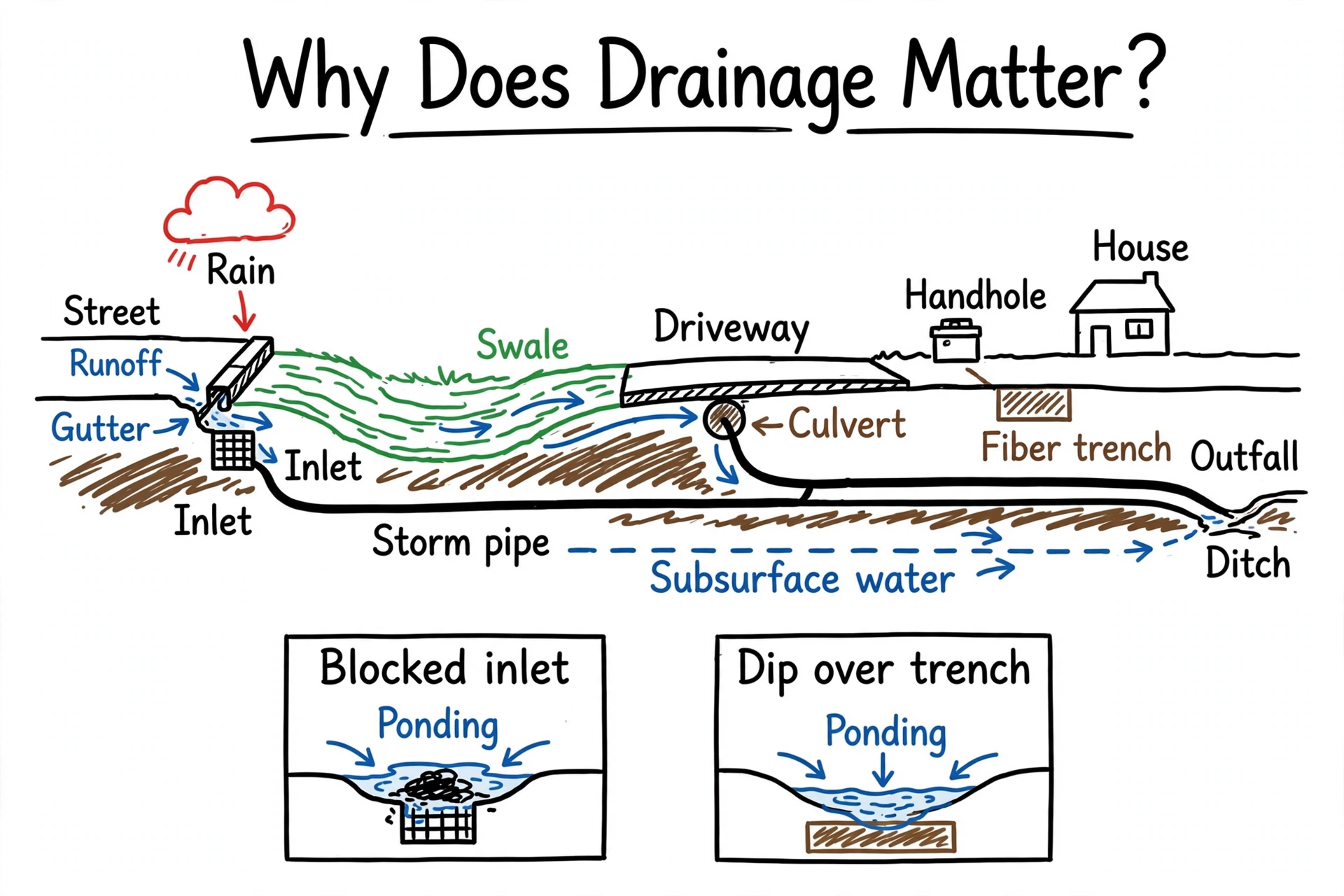
A drainage system commonly includes some or all of these parts, depending on whether the street is urban or rural and on the design for that place:
- Grading, the shaping of the ground and pavement surfaces so water flows in the intended direction.
- Gutters, the shallow channels along a curb that collect pavement runoff and carry it along the street edge, covered in Lesson 24.
- Ditches and swales. A ditch is an open channel along a road or property that intercepts runoff and carries it away. A swale is a broad, shallow open channel, often grassed, that does the same job more gently.
- Inlets, the openings, often grated or in the curb face, where surface water collected in a gutter or ditch enters a buried pipe system.
- Pipes and storm drains, the buried conduits that carry collected water through the right-of-way to an outlet.
- Culverts, pipes or box structures that carry water under a road, driveway, or embankment from one side to the other, covered in Lesson 27.
- Outfalls, the places where the system discharges to a receiving place such as a larger ditch, a channel, a stream, or another approved system. An outfall is also called an outlet in general use.
- Subsurface drains, buried perforated pipes or drain layers that collect water in the soil or under a pavement and carry it to an outlet.
Not every street has every part. A rural road may rely mainly on grading, ditches, and culverts, with no curb, gutter, or storm pipe at all. A built urban street may rely mainly on curb and gutter, inlets, and storm pipes, with no open ditch. Learn the function, collect, convey, discharge, rather than expecting one fixed list of parts everywhere.
Drainage in this lesson is also different from sewer service. A sanitary sewer carries wastewater from buildings. A storm system carries rain and runoff. In most modern built areas they are separate systems, and confusing them in the field leads to wrong reports. If you are not sure which system a structure belongs to, report what you see and ask, rather than naming it from a guess.
Who sets the requirements varies. Federal Highway Administration publications such as the Urban Drainage Design Manual, known as HEC-22, and Drainage of Highway Pavements, known as HEC-12, provide design guidance used by highway agencies. They are guidance for designers, not a field rule that a crew applies by eye. State departments of transportation publish their own drainage manuals and standard plans. Local agencies set requirements for local streets and for stormwater permits. A project contract and its plans and specifications set the requirement for that job. Those layers are different sources of authority, and this lesson does not merge them into one rule.
What Does It Look Like?
You recognize drainage first by following water, or by following the shapes built to guide water when the ground is dry.
- Start with the high and low pattern. Look at how the road surface is crowned or sloped, how yards and driveways fall, and where the low point of the street or lot sits. Water will move toward that low point unless a channel intercepts it first. In dry weather, staining, sediment lines, and worn paths in grass often show where water normally runs.
- Next, the collection shapes. Along a curbed street, the gutter is the shallow channel at the curb face. Along an uncurbed road, look for a ditch or swale parallel to the road, between the shoulder and the property or embankment. On a lawn or lot, look for a shallow swale that is easy to miss because it looks like a gentle dip rather than a structure.
- Next, the entry points. An inlet is usually a metal grate set flat in the gutter or pavement, or an opening in the curb face, sometimes both together. Debris, leaves, and sediment often collect on or near a grate, which makes it easier to spot and is also a sign it may be partly blocked. In a ditch, a culvert entrance is a pipe opening, often with a headwall or with the pipe end visible, where water leaves the ditch to pass under a driveway or road.
- Next, the buried parts you can only infer. Storm pipes themselves are underground. You see their presence in inlets, in access structures with round or rectangular covers in the street or ground, and at the outfall where a pipe discharges.
- Know what a handhole is, and what it is not. A handhole is a small buried access box for fiber and other utilities, with a lid at or near ground level. A handhole is not a drainage structure, even though poor drainage can fill it with water. Naming each correctly matters in a report.
- Next, the outlet. Follow the ditch or imagine the pipe direction downhill to where water leaves the system. At an outfall you may see a pipe end discharging into a ditch or channel, sometimes with stone or other protection placed where the water lands to slow it and limit erosion. A discharge point with bare, cut soil below it tells a different story, covered later in this lesson.
- Finally, subsurface drainage is mostly hidden. You may see only its outlet, a small pipe discharging at a ditch or curb, or a cleanout or edge drain marker where the project documents show one. Do not assume a pavement or trench has subsurface drainage because it looks dry, and do not assume it has none because you cannot see it. Records and plans describe what is buried. Your field job is to notice outlets, wet ground that stays wet, and water emerging from soil or pavement joints, and to report them exactly as found.
What Does It Do?
A drainage system does four jobs at the same time.
First, it collects water. Grading directs runoff across pavement and ground toward gutters, ditches, and swales instead of letting it spread, pond, or soak in where it lands. Collection is the reason a road is shaped rather than left flat, and the reason a ditch sits where runoff needs to be intercepted before it reaches a slope, a trench, or a property.
Second, it conveys water. Convey means to carry from one place to another. Gutters carry water along the street edge. Ditches and swales carry it along the corridor. Inlets move it from the surface into pipes. Pipes and culverts carry it through or under the corridor. Each handoff matters. A good gutter that leads to a blocked inlet does not drain the street. A good pipe with no workable outlet does not drain either.
Third, it discharges water at a planned place. Federal Highway Administration drainage guidance describes storm drainage system components by these same functions: components that collect runoff from the roadway surface and right-of-way, convey it along and through the right-of-way, and discharge it to a receiving body without causing adverse impacts on or off the site. That last phrase is the standard in plain form. The outlet is part of the job, not an afterthought.
Fourth, below the surface, it removes water that would otherwise weaken the ground that supports the work. Subsurface drainage collects water that has entered the soil or the layers under a pavement and carries it to an outlet, instead of leaving it trapped where it softens soil and reduces support. A pavement, a sidewalk panel, and a trench backfill all depend on the soil below them staying reasonably firm and stable. Trapped water works against that.
A drainage system does not make water disappear. It changes where water goes, how fast it moves, and where it lands. The pipe and ditch system described here moves water rather than treating it, although some vegetated swales and other designed treatment features can filter sediment and pollutants. It also gives no crew authority to redirect water onto another property or into a different system because that path is convenient during construction.
Where Does It Fit?
Level 2 teaches you to read the physical environment. Lesson 24 covered curb and gutter, the street edge channel. Lesson 25 covered sidewalks, Lesson 26 covered ditches, and Lesson 27 covered culverts. This lesson pulls those pieces together into the system they belong to and explains why the system matters, before later lessons return to related features such as intersections, driveways, and terrain.
In the street cross section, drainage touches almost every band. Rain falls on the travel lanes and runs to the gutter or shoulder. The gutter or ditch carries it to an inlet or culvert. Pipes cross under the street and under the utility corridor. The outfall may sit well beyond the work area. A fiber route that follows the street is working inside that whole water path, not beside it.
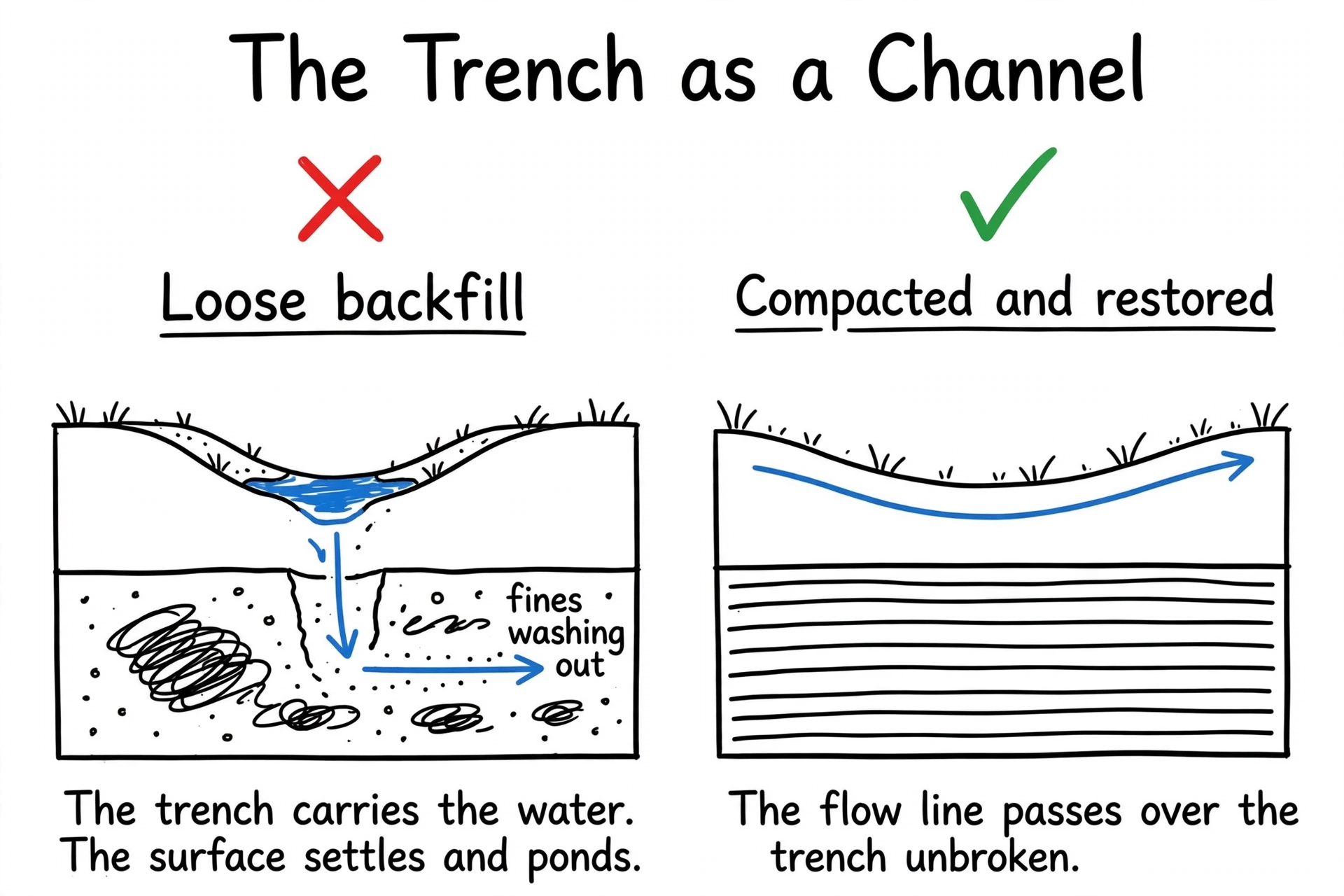
In the utility picture, buried fiber often shares the low, wet part of the corridor. Handholes sit at ground level, so a low handhole in a ponding area collects water. Trenches and bore pits interrupt the surface and can intercept both surface flow and shallow subsurface flow. Backfill that is looser than the soil around it can act as a channel. Water prefers the easier path, and a freshly dug and loosely filled trench is often that easier path. That is why a trench can be dry on the day it is dug and carry water after the next rain.
In the project picture, drainage appears in the plans, the permit, erosion and sediment control requirements, and restoration requirements. Which standard applies to a ditch grade, an inlet, a culvert, or an outfall on a given job comes from the project documents and the agency that owns or controls the drainage system, not from crew habit. Federal guidance informs agency manuals. State and local manuals and standards govern most street work a fiber crew meets. The contract for the project applies those requirements to the specific site. When those sources differ, the project documents and the controlling agency answer the question for that job.
What Is at Stake
Road safety. Federal Highway Administration material on drainage of highway pavements states in summary that effective drainage is essential to maintaining the service level of highways and to traffic safety. Water left standing or flowing across pavement slows traffic and reduces visibility from splash and spray, and standing water contributes to loss of tire grip, including hydroplaning, where a tire rides on water rather than on the pavement surface. This lesson states that risk in general terms only. How much water, at what speed, creates a given risk depends on the road, the vehicle, and the conditions, and no figure from this lesson should be used to judge a road safe or unsafe.
The life of the pavement and the ground under it. Water that enters cracks and joints and stays in the layers under a pavement, or in the subgrade, the soil layer directly under the pavement structure, weakens support. Weakened support contributes to cracking, rutting, pumping of fine soil up through joints under traffic, faulting and settlement at joints and edges, and early failure. Highway drainage references return to the same point: many pavement problems are directly related to excess moisture in the subgrade and granular layers when water is not removed. The pavement you see failing on top often started as a water problem below.
Slopes, ditches, and property. Moving water carries energy. Water concentrated into a fast, narrow flow can erode soil. Erosion is the wearing away and carrying away of soil by water. Erosion cuts ditch banks, undermines the edge of pavement and the support beside a culvert or inlet, washes out shoulder material, and deposits sediment where the flow slows. Undermining means water removes supporting soil from under or beside a structure, leaving it unsupported even though the structure itself looks intact from above. Uncontrolled discharge can also flood a yard, a driveway, a building, or a low area on another property. Drainage that protects the road but floods the neighbor is not a completed job.
Buried fiber and its structures. A flooded handhole submerges splice closures and connectors and puts their seals to the test, invites sediment and debris into the box, and makes later access work harder and less safe to assess. Many closures used underground are sealed and rated for wet or submerged conditions, so standing water by itself does not prove a closure has failed, but a damaged or poorly sealed closure can let water in, and no closure should be assumed protected beyond its rating and its actual condition. Water following a trench or a bore path can reach places it never reached before the ground was disturbed. Settlement over a trench, covered below, often begins as a water problem, because water moving through loose backfill carries fine soil with it and leaves voids. Fiber cable placed for buried service is made for that use when it carries the rating for the installation, but the system around it, closures, handholes, markers, and the restored surface above it, depends on drainage continuing to work after the crew leaves.
Construction itself. A site with poor drainage can stop work after rain. Trenches fill, bore pits fill, spoil turns to mud and runs, and access routes rut and erode. Sediment carried off a disturbed site is also an environmental and permit problem. United States Environmental Protection Agency material identifies sediment as a primary pollutant of concern in construction site stormwater runoff, because disturbed, bare soil is easily carried by runoff. Keeping the existing drainage path open during work, and restoring it at the end of work, is therefore part of the work, not cleanup after the work.
In short, drainage matters because water is patient and construction is temporary. The road, the trench, and the handhole must still perform in the next storm and the next season, long after the crew has left. A system that moved water well before the job and ponds, erodes, or floods after the job has been damaged by the job, whether or not any pipe was touched.
What Does Good Look Like?
Good drainage is usually quiet. Nothing dramatic happens in a storm, and that is the point:
- Water leaves the pavement. After rain, the travel lanes and the pedestrian route clear rather than holding broad, lasting ponds, and the gutter or ditch carries flow in its intended direction.
- Every part connects. Gutters lead to inlets that are open, ditches lead to culverts or outlets that are open, pipes discharge at an outfall that is open and protected, and no part ends in a blockage or a dead low point with no outlet.
- Inlets and grates are clear enough to accept water. They are not buried under sediment, leaves, spoil, or stored material, and the area around them has not been raised so water bypasses them.
- Ditches and swales hold their shape. Banks are stable and vegetated or otherwise protected where the design provides for it, with no fresh cutting, slumping, or washed out sections, and no sediment filling the channel bottom.
- Outfalls discharge without cutting the ground below them. Water lands where the design intends, on protection provided for that purpose or into a stable channel, rather than falling onto bare soil.
- The ground over trenches and around handholes is graded so water runs away or past, rather than collecting over the backfill or ponding against a lid. Handhole lids sit at the intended level in ground that does not act as a basin.
- Below the surface, pavement and restored ground stay supported. There is no new settlement, dip, or pumping at joints in the area the work touched, and no persistent wet strip showing that water is traveling along a trench.
- Where a project has touched the corridor, the original drainage pattern works again. Grades that were changed are restored, paths that were blocked are reopened, and photographs and notes show the inlets, ditches, culverts, and outfalls in the work area before, during, and after.
Good drainage can still be wet during a storm. A ditch is supposed to carry water during a storm. A swale may hold water briefly while it moves or soaks in as designed. Good means water goes where the system intends, at a pace the system can handle, and leaves without damaging the road, the corridor, or the property around it.
From the Field
Picture a fiber crew about to trench along the grass strip of a residential street to reach two handholes. The route crosses a shallow grass swale and passes a driveway that sits on a culvert. Before any equipment arrives, the crew leader walks the drainage path the street already uses.
The walk shows the whole path. Rain from the street runs to the gutter and down to an inlet at the low corner. Rain from the front yards runs to the swale, the swale carries it to the driveway culvert, and the culvert carries it under the driveway into a ditch that continues to the end of the block. The leader photographs what the walk finds: the inlet grate is clear, the swale holds its shape, and both culvert ends are open.
One spot gets a closer look. The second handhole sits in a shallow low spot at the edge of the swale path, and its lid carries a sediment line, a sign that water has ponded over it before the crew ever arrived. The leader records that condition as preexisting, with photographs tied to the address, instead of leaving it for someone to blame on the trench later.
During the work, the trench crosses the swale. The crew keeps spoil out of the swale channel and out of the gutter, so neither path is blocked while the trench is open, and the temporary handling of water at the crossing follows the project plan and permit rather than a field improvisation. The driveway culvert is protected and is not used for storage or equipment crossing beyond what the plan allows. The backfill in the short trench section that crosses the swale gets particular attention under the project requirements, because the leader has already marked that section as the place where loose backfill could become a water channel.
At restoration, the crew reestablishes the swale shape where the trench crossed it and grades the ground over the trench so water follows the swale rather than collecting over the backfill. The handhole area is left at its intended level, with no new basin formed around the lid. The inlet and the culvert ends are checked again and photographed clear.
After the next rain, the leader walks the route again. The gutter clears to the inlet and the swale carries water through the culvert, with no pond standing over the trench line. One small dip does appear over a short trench section, and the leader reports it rather than ignoring it, because a dip over backfill can be the first sign of settlement that water will worsen. The preexisting ponding at the second handhole is unchanged, and it stays documented as a condition of the site drainage. Correcting it belongs to whoever controls that drainage system, not quietly to the fiber project.
The crew designed nothing. It read the path water already used, kept that path open during the work, restored the shapes that carry water, and left records separating project work from conditions the project did not create. Carry that as the rule: read the water’s path before you dig, keep it open while you work, restore the shapes that carry it when you finish, and document what was already there before you touched it.
What Can Go Wrong?
Drainage fails by blockage, by damage, by changed grades, and by neglect, and construction can cause the first three in a single day.
- Ponding. Water stands on pavement, on a sidewalk, in a yard, or over a trench instead of moving to an inlet or outlet. Ponding means water collecting and standing in a place rather than draining away. Causes include a blocked inlet, a filled ditch, a low point created by settlement or by changed grading, and an outlet that is blocked or submerged. Standing water is a safety problem on the road, an access problem on the pedestrian route, and a warning that the system path is broken somewhere.
- Erosion. Moving water cuts soil from ditch banks, shoulders, slopes, trench lines, and below outfalls. Once a small channel forms, later flows follow it and cut it deeper. Erosion beside pavement, a culvert, or a handhole removes support even when the visible structure has not yet moved.
- Undermining and washout. Water flowing along or under a structure, a pipe, or a pavement edge carries supporting soil away and leaves a void. A washout is a place where flowing water has removed soil and left a hole or gap. The surface may bridge the void for a time and then collapse under a vehicle, a wheel, or a foot.
- Settlement over a trench. The ground or pavement above a trench sinks after restoration. Settlement is downward movement after soil compresses, washes away, or was not compacted well. Loose backfill that channels water speeds this failure, because moving water carries fine particles out of the backfill and the remaining soil consolidates into the empty space. The result is a dip that itself ponds water, which makes the next failure faster.
- Pavement failure from trapped water. Water that enters a pavement and cannot drain weakens the layers and subgrade below it, contributing to cracking, rutting, and pumping under traffic. The surface distress is the late sign. The cause began earlier and below.
- A flooded handhole or vault. Water ponds over a low lid, enters through a damaged lid or wall, or follows a conduit or trench path into the box. Sediment enters with it. Closures and hardware sit in water and debris that later crews must work around, and the record of what is in the box becomes harder to trust.
- A blocked or damaged culvert. Sediment, debris, a crushed end, or spoil pushed into a ditch blocks the passage under a driveway or road. Water then ponds on the upstream side, overtops the driveway or road, or cuts a new path around the end of the culvert, eroding the embankment it was meant to protect.
- Property flooding from a changed path. A crew raises a work area, berms a trench, stockpiles spoil in a swale, or regrades a lot edge, and the next rain sends water toward a building or across a yard that never flooded before. The volume of water did not change. Its path did.
- Sediment leaving the site. Bare, disturbed soil with no working drainage control produces runoff carrying sediment into ditches, inlets, and waterways. Sediment fills the very channels and structures the system needs, and creates permit and environmental exposure for the project.
- A hidden subsurface failure. An edge drain outlet is crushed or blocked, a subsurface pipe is cut by excavation and not restored, or a trench intercepts subsurface flow and redirects it toward a foundation or into a handhole. Nothing dramatic shows on the surface until wet ground, settlement, or a flooded structure reports it later.
These failures share one trait. They get worse with each storm if the cause is left in place, because water reuses the path of least resistance and enlarges it. Early recognition is therefore worth more than late repair.
What Should Someone Notice in the Field?
Notice drainage as a path, from where water lands to where it leaves, from a safe and authorized position. You are observing and reporting, not designing, resizing, or regrading a system.
- Trace the path out loud. Where does rain on this street or lot go first? Which gutter, ditch, or swale collects it? Which inlet or culvert takes it next? Where is the outfall? If you cannot name the next step in the path, name that gap in your report.
- Fix the low points. Identify the lowest ground in the work area, the low point in the gutter or ditch, and any place where the grade has clearly been changed by the work, by settlement, or by stockpiled material.
- Check every inlet and grate in the work area. Is it open, partly blocked, or buried? Is spoil, sediment, or material stored where runoff must pass to reach it? Photograph its condition before work disturbs it.
- Check every ditch, swale, and culvert the work crosses or parallels. Note the shape, any sediment filling the bottom, any bank cutting or slumping, any blocked or crushed culvert end, and any water standing long after rain in a channel that should carry it away.
- Look at the outfall. Where will the water in this system land? Is the ground below the discharge stable and protected, or bare and cutting? Is the outlet blocked, buried, or discharging onto a trench line or a property it did not serve before?
- Read the ground over and beside planned trenches and bore paths. Ask where surface water will cross the line of the work, where a ditch or swale will be interrupted, and whether loose backfill in that line could become a channel after restoration. Name those crossings before digging starts.
- Notice handholes in relation to water. Which handholes sit in low ground, in a swale path, or below a slope that drains toward them? Note ponding over lids, sediment at lid edges, and any sign that water has entered before.
- Notice wet ground that does not match the weather. A persistently wet strip along a restored trench, water emerging at a pavement joint or at the toe of a slope, or a green strip in dry weather can indicate subsurface water moving along a path the work created or uncovered. Report the location and the pattern. Leave the diagnosed cause to whoever investigates it.
- Photograph before you disturb. Take overview photographs showing the drainage path through the work area and detail photographs of inlets, culvert ends, ditch condition, outfalls, and any existing ponding, erosion, or settlement. Undocumented preexisting drainage damage tends to become project damage afterward.
- Treat blockage as a decision. If work will block a gutter, ditch, inlet, culvert, or outfall, ask how water will be handled during the work, what the permit and the erosion and sediment control plan require, and who approved the temporary arrangement. If nobody can answer, the blockage is not ready.
Safety and limits, plainly. Observing drainage does not qualify you to design or resize a drainage system, set grades for a ditch or pipe, enter a drainage structure or any confined space, work in a flooded excavation, or judge whether a system complies with a drainage standard or a stormwater permit. Those tasks belong to qualified engineers, qualified crews, inspectors, and the controlling agency under the project documents. Stay clear of moving water, unstable banks, and traffic, never enter a structure to inspect it from inside unless you are trained, authorized, and equipped under a specific plan that covers that entry, and report through your project process.
Key Terms
- Drainage. The movement and control of surface water and subsurface water so water is collected, carried along a planned path, and discharged at a planned outlet without ponding, eroding, or soaking into places it will damage.
- Runoff. The portion of rain or melting snow that flows over the ground surface instead of soaking in or evaporating.
- Surface water. Water on the ground surface, including rain, melting snow, and runoff.
- Subsurface water. Water in the soil below the surface, including water that seeps down from the surface and groundwater naturally present in the ground.
- Grade. The slope or level of the ground or of a constructed surface. Grading is the shaping of ground or surfaces to direct water and to form the intended shape.
- Gutter. The shallow channel along a curb that collects pavement runoff and carries it along the street edge to an inlet.
- Ditch. An open channel along a road or property that intercepts runoff and carries it to an outlet, a culvert, or another part of the drainage system.
- Swale. A broad, shallow open channel, often grassed, that collects and carries runoff gently.
- Inlet. An opening, often grated or in a curb face, where surface water collected in a gutter or ditch enters a buried pipe system.
- Culvert. A pipe or box structure that carries water under a road, driveway, or embankment from one side to the other.
- Outfall. The place where a drainage system discharges to a receiving place such as a ditch, channel, stream, or another approved system. Also called an outlet in general use.
- Subgrade. The soil layer directly under a pavement structure, whose strength and stability support the pavement above it.
- Erosion. The wearing away and carrying away of soil by moving water.
- Undermining. Removal of supporting soil from under or beside a structure or pavement edge by water, leaving it unsupported.
- Ponding. Water collecting and standing in a place rather than draining away.
- Settlement. Downward movement of ground or a structure after soil below or beside it compresses, washes away, or was not compacted well.
- Handhole. A small buried access box for fiber and other utilities, with a lid at or near ground level. It is an access structure, not a drainage structure.
Check Your Understanding
- In your own words, what is drainage, and why is it described as a system rather than as a single ditch or pipe?
- Name the three main functions of a drainage system in order, and give one field feature that performs each function on a typical curbed street.
- A restored trench develops a shallow dip two months after the crew leaves, and the dip ponds water after every rain. Give the most likely construction related explanation connecting loose backfill, moving water, and settlement.
- What is the difference between erosion and undermining, and why can a pavement edge or a culvert look intact from above while it is already in trouble?
- In the From the Field story, the crew leader photographs the sediment line on the second handhole’s lid before work begins, and later reports the small dip that appears over the trench instead of ignoring it. Why were both decisions right?
Answer key
- Drainage is the movement and control of surface and subsurface water so it is collected, carried along a planned path, and discharged at a planned outlet without ponding, eroding, or soaking into places it will damage. It is a system because each part depends on the parts before and after it. A gutter without an open inlet, a pipe without a workable outlet, or a ditch cut off by a blocked culvert does not drain, however good the single part looks alone.
- Collect, convey, and discharge. On a curbed street, grading and the gutter collect pavement runoff, the gutter and then the storm pipe convey it along and through the right-of-way, and the outfall discharges it to a ditch, channel, stream, or another approved receiving system. Subsurface drains perform the same three functions for water in the soil.
- The likely explanation is that backfill in the trench was left looser than the surrounding soil, so it acted as an easier path for water. Moving water carried fine particles out of the backfill and the remaining soil compressed into the lost volume, so the surface sank. The resulting dip ponds water, and that standing and moving water speeds the same process in later storms. Careful backfill and compaction to project requirements, and grading the restored surface so water does not collect over the trench, reduce the risk.
- Erosion is the wearing and carrying away of soil by moving water, visible where soil is being cut or removed, such as a ditch bank. Undermining is the removal of supporting soil from under or beside a structure or pavement edge, leaving it unsupported. The top can look intact because the structure itself has not yet moved or broken. It is bridging a void that water created below or beside it, and it can collapse when a load crosses it.
- The photographs taken before work separated a preexisting condition from project work: the sediment line proved water had ponded over that handhole before the crew arrived, so the condition stayed documented as site drainage belonging to whoever controls that system. Reporting the dip applied the same discipline in the other direction. A dip over backfill can be the first sign of settlement, and settlement driven by moving water gets worse with each storm if the cause is left in place, so an early report costs little and a late repair costs much more. Both actions follow the story’s rule: read the path first, keep it open, restore it, and document what was already there.
Lesson Takeaway
Drainage is the planned movement and control of surface and subsurface water: grading, gutters, ditches, and swales collect it, inlets, pipes, and culverts convey it, and outfalls discharge it to a receiving place. It matters because water left standing or trapped weakens pavement and soil, water moving without control erodes and undermines, and water redirected by changed grades floods structures and property, including the handholes and restored trenches of a fiber project. Read drainage as a whole path before work starts, keep that path open during work, pay special attention where trenches cross swales, ditches, and low ground, and restore the shapes and grades that carry water when the work is done.
Sources and Technical References
- Federal Highway Administration, Urban Drainage Design Manual, Hydraulic Engineering Circular No. 22, HEC-22, 4th edition. Describes storm drainage system components by function as collecting runoff from the roadway surface and right-of-way, conveying it along and through the right-of-way, and discharging it to a receiving body, and describes gutters, roadside and median ditches, and drainage inlets as the collection components. https://www.fhwa.dot.gov/engineering/hydraulics/pubs/hif24006.pdf
- Federal Highway Administration, Drainage of Highway Pavements, Hydraulic Engineering Circular No. 12, HEC-12. States that effective drainage of highway pavements is essential to maintaining the service level of highways and to traffic safety, and discusses water on the pavement, ponding locations, and pavement drainage design. https://www.fhwa.dot.gov/engineering/hydraulics/pubs/hec/hec12.pdf
- Federal Highway Administration, Urban Drainage Design Manual, Hydraulic Engineering Circular No. 22, HEC-22, 3rd edition. Earlier edition of the same manual, describing minor storm drainage system components, stormwater collection through roadside and median ditches, gutters, and drainage inlets, and inlets as the mechanism by which surface water enters storm drains. https://www.fhwa.dot.gov/engineering/hydraulics/Pubs/10009/10009.Pdf
- Federal Highway Administration sponsored research, Development of Guidelines for the Design of Subsurface Drainage Systems for Highway Structural Sections, available through the National Transportation Library ROSAP repository. Summarizes research finding that excess water in the structural sections of highways is responsible for much damage and many premature failures, and that pavements with subsurface drainage capable of removing excess water generally had lower annual costs than undrained pavements. https://rosap.ntl.bts.gov/view/dot/16445/dot_16445_DS1.pdf
- Ohio Department of Transportation and Ohio related research, Evaluation of Roadway Subsurface Drainage on Rural Routes, available through ROSAP. Discusses quality of drainage, the importance of a positive outlet for water in the base, and blocked or damaged outlets found in field evaluations. https://rosap.ntl.bts.gov/view/dot/34245/dot_34245_DS1.pdf
- United States Environmental Protection Agency construction stormwater material, summarized at the University of Minnesota Duluth Facilities Management construction site runoff control page, quoting EPA fact sheet material that sediment runoff from construction sites is a major concern and that sediment and other pollutants from construction sites can cause physical, chemical, and biological harm to waters. https://fm.d.umn.edu/stormwater/construction-site-runoff-control
Previous lesson: Lesson 27: What Is a Culvert? |
Back to Level 2 hub |
Next lesson: Lesson 29: What Is a Waterway Crossing?