
Introduction
Point-to-point fiber is a network arrangement in which one fiber path connects exactly two endpoints on a dedicated fiber assignment, with no passive splitting along the way to share that path among many subscribers. Two ends, one assigned path, nothing in the middle dividing it.
This lesson is taught because point-to-point is one of the two basic shapes an access connection can take, and misreading the shape leads to wrong claims in the field. It sits between the segment lessons that built the network map, Lessons 12 through 17, and Lesson 19, which covers the contrasting shared design. Knowing the shape is what lets a reader name the service serving a customer from endpoints and records, and say plainly what the shape does and does not promise.
What This Lesson Gives You
- Name the two features that must both be true before a connection counts as point-to-point.
- Explain why a cable jacket, a pole line, or a handhole can never prove which architecture a fiber serves.
- Tell a dedicated assignment apart from a shared split when both ride inside the same cable on the same route.
- Read labels and records for the evidence that settles the question: endpoints, assignments, and the documented path between them.
- Correct the common assumption that the word dedicated promises speed or protection the order never included.
Start With the Basics
Imagine two offices that need to share files and computer systems as if they were in the same building, even though they sit across town.
One way to connect them is to give them a private road that goes only between those two buildings and nowhere else. No other office uses that road. No side street branches off it to serve a whole row of other tenants. The road starts at one address and ends at the other address, and that is the whole job.
Another way is to build one main road and branch it so one road serves many buildings. That uses less pavement, but the buildings share the road.
Point-to-point fiber works like the private road. It is a dedicated fiber path between two endpoints. The word dedicated means reserved for that connection, not shared among a group of subscribers along the way. The word endpoint means one end of the connection, a place where the fiber path begins or ends and where equipment connects to it.
Hold that picture. Two endpoints. One dedicated path. No branching in the middle. The rest of the lesson adds the real names, uses, and limits, so you do not overclaim what you see in the field.
What Is It?
Point-to-point fiber, often shortened to P2P, is a network arrangement in which a fiber path connects two endpoints directly, with a dedicated fiber or dedicated fiber strand for that connection and no passive splitting along the way to share that path among many subscribers.
That definition needs each part explained plainly, because every word in it is doing work.
A fiber path is the full route light travels from one end to the other. It may include several segments joined by splices and patch connections. A splice, from Lesson 8, is a permanent join between two fibers. A patch connection is a removable connector connection at a panel. Both can appear inside a point-to-point path without changing what it is, as long as the path serves only its two endpoints.
Dedicated means the fiber is assigned to this connection. Industry sources describe the home version the same way: each subscriber has an individual fiber running back to an aggregation point, rather than sharing one fiber through a splitter. For facilities, a fiber or pair of fibers is assigned to link two specific sites and does not also serve unrelated customers along the route.
An endpoint is where the path terminates and connects to equipment, on a panel connector or a device port. Typical endpoints include:
- A switch port in a provider facility.
- A data center panel.
- A cell site radio unit.
- Equipment inside a business or municipal building.
One point-to-point connection has exactly two endpoints. A building with three such connections has three separate connections, not one connection with three ends.
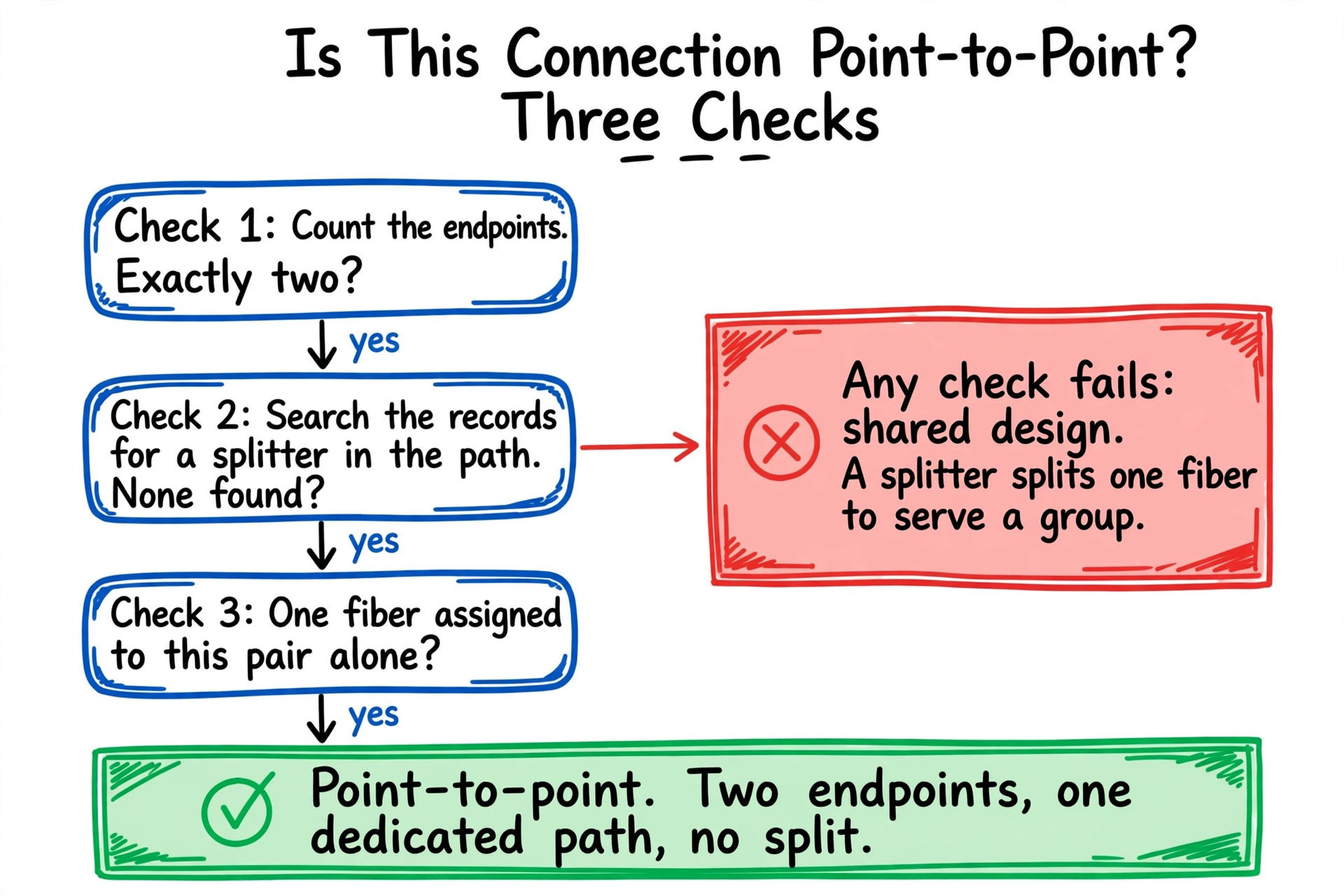
No passive splitting along the way is the clearest test. A splitter is a passive optical device that divides the light from one fiber into two or more fibers so one fiber can serve multiple endpoints. Passive means the device needs no electric power to do its job. Point-to-point fiber does not use that step. Nothing in the middle of the path divides one fiber into branches to serve many subscribers. That absence is what separates this lesson from Lesson 19, which covers point-to-multipoint design, where one fiber is split to serve many premises and the outputs of the split are shared by the group beyond the splitter. Point-to-point has no splitter, so it has no split outputs at all.
Two common forms appear in outside plant work, and beginners should keep them separate.
The first form is the site to site link. Two facilities are connected to each other: two office buildings, a school and a district office, a water plant and a city hall, a cell site and a provider facility, or two data centers. The fiber path is built or leased for that pair of places. Verizon business material describes this kind of service in plain business terms as links that connect locations, remote sites, data centers, and corporate networks with dedicated capacity between designated endpoints. The details of any one service, including speed, protection, and price, come from the contract for that service, not from this lesson.
The second form is the access design called Active Ethernet, sometimes grouped under active optical network, or AON. Each premises gets its own dedicated fiber back to an aggregation point, where individual fibers connect to powered switching equipment. A switch directs traffic to and from the correct port. Because each premises has its own fiber and its own port, the structure stays point-to-point even when hundreds of homes share one facility: each connection runs from the premises to its switch port. The FOA describes this home run form as one fiber dedicated to each premises, connecting to a central office or a local active switch.
A related term you will hear is dark fiber. Dark fiber is fiber that has been installed but is not currently lit, meaning it is not carrying a light signal from equipment at either end. A customer can lease dark fiber strands from point A to point B and then provide its own equipment to light the fiber and set the capacity. Dark fiber is often arranged point-to-point, but the word names the lighting condition, not the network shape. Lit fiber, by contrast, is fiber where the provider supplies both the path and the active service. Point-to-point answers what shape the connection has. Dark answers who lights it.
Point-to-point also describes a shape, not a promise. It does not by itself promise a speed, a price, or a reliability level. Speed depends on the equipment at both ends and the service bought. Reliability depends on the route, whether a backup route exists, and build quality. Cost depends on distance, conditions, and contract terms.
Finally, point-to-point describes the logical connection, not a single straight cable on a map. The route may share a cable sheath, a conduit, or a pole line with many other fibers. Sharing a cable is not the same as sharing the fiber path itself. One cable can contain many separate fibers, each dedicated to its own two endpoints. That distinction, between the shared container and the dedicated strand inside it, is essential for field recognition.
What Does It Look Like?
You may expect point-to-point fiber to have a distinctive look you can learn once and spot forever. It does not. The cable, poles, conduit, handholes, and closures look like the plant you have already studied. What differs is the assignment of the fibers inside and the equipment at the two ends, and most of that lives in records and closed enclosures, not on a cable jacket.
Start with what you can actually see, from a safe and authorized position, without opening anything.
- On an aerial route, you may see fiber cable on poles running between two facilities, or from a group of homes toward a provider building. The jacket and hardware do not declare how the fibers inside are assigned.
- A fiber count printed on the jacket tells you how many fibers the cable was made with. It does not tell you how they are assigned today.
- On an underground route, you will see even less: conduit entries, handholes at intervals, and building entries. Lessons 4 and 5 cover conduit and handholes.
- Whether a fiber inside runs dedicated or runs to a splitter cabinet is not visible from a handhole lid, and you do not open a handhole to satisfy curiosity. Opening plant is assigned, authorized work.
At the ends, the picture becomes a little more informative, but only inside facilities where you would need authorization to be. Point-to-point fibers typically end on a fiber panel, a frame where connectors are organized in rows with labels. Each connection uses its own port or pair of ports, labeled with the far end, the circuit, or the customer. In an Active Ethernet design, many individual premises fibers arrive in one place, each on its own switch port, because each dedicated line must terminate on powered electronics that handle that one connection.
Inside the customer building or at the customer premises, the fiber typically ends at a small enclosure, a panel, or a piece of equipment with a fiber port. In a home served by an active design, the end device is often called an optical network terminal, or ONT, the device that converts the fiber signal for use inside the premises. The name ONT is also used in shared designs, so the presence of an ONT alone does not prove which architecture serves the home. You need the upstream picture: does this premises have its own fiber back to a switch port, or does its fiber run to a splitter that it shares with neighbors? That answer is rarely visible from the wall enclosure.
At a cell site, you may see a cabinet at the base of a tower and a fiber entry. The serving fiber is often a point-to-point link back to a provider facility. Field crews call that connection backhaul, meaning the link that carries traffic from a local site back toward the core network. Backhaul names the job. Point-to-point names the shape. They are not synonyms.
So what does point-to-point fiber look like, stated accurately? Ordinary, well built fiber plant with two defined ends, labeled terminations, and no splitter enclosure in the serving path for that connection. The clearest visible sign is a negative one: no splitter serving a group from one fiber. Handle even that carefully. A splitter may sit inside a facility where you cannot see it. Absence of a visible splitter on one street is useful evidence. It is not proof by itself.
Learn to describe what you see without claiming more than you saw. A good field description sounds like this: a labeled fiber route between the two named facilities, with terminations at both ends and no splitter identified in the records for this circuit. A poor field description sounds like this: that cable looks point-to-point. The first sentence can be checked. The second sentence cannot.
Illustration coming soon.
What Does It Do?
Point-to-point fiber does one job, and it does that job for exactly two endpoints: it carries light signals between them on a dedicated path so the equipment at those two ends can communicate as a connected pair.
First, it provides a private path. Private here has a narrow meaning: the strands assigned to this connection are not also assigned to other subscribers, and traffic does not pass through a splitter that broadcasts it to a group of premises. Privacy of assignment is not a guarantee about encryption or security practices, which depend on equipment and operator practices. The claim is only this: one path, two endpoints, no shared split in the middle.
Second, it gives the two endpoints a direct equipment relationship. The device at one end transmits to the device at the other end, and capacity is set by those two devices and the service provisioned between them. Provisioned means configured and activated for a specific customer and service. That is why industry sources describe Active Ethernet as providing dedicated bandwidth per subscriber: the port is not dividing one fiber signal among a split group. Dedicated assignment does not guarantee end to end performance, because traffic still joins larger networks beyond the access link. Service guarantees belong to the contract, not this lesson.
Third, it lets two places function as one working system. Two data centers can synchronize data, two municipal buildings can share one network, and a cell site can send its traffic back to the provider network. The two endpoints stop behaving like isolated islands, at the speed and under the terms the end equipment and service actually provide.
Fourth, it simplifies fault isolation at the assignment level, within limits. If a dedicated path fails, the affected connection is its pair of endpoints, and testing points along one route between two known places. In a shared design, a failure before the splitter can affect the whole group, while a failure after it affects one branch, so the troubleshooter must first find which side of the split the fault sits on. That does not make point-to-point faults always easy. A cut in a shared conduit can damage many dedicated connections at once. Recognizing the architecture frames the problem. It does not replace testing, which this lesson does not teach.
What it does not do matters too. It does not serve a whole neighborhood from one fiber; that is the strength of the next lesson. It does not create capacity from nothing: old end equipment still limits a dedicated fiber. It does not protect itself: one cut can take a single path down. Protection is a separate design choice that must be documented, never assumed.
Where Does It Fit?
Place point-to-point fiber in the map you have built across Lessons 12 through 17, and a pattern appears. Those lessons named segments of a shared access network. This lesson names a connection shape that can appear in several places in a network, including inside and outside the access network.
Start with the access network you already know. A central office or hub, from Lesson 12, houses provider equipment. Feeder, from Lesson 13, carries signals toward a service area. Distribution, from Lesson 14, spreads them through a neighborhood. Terminals, from Lesson 9, provide connection points, and drops, from Lesson 10, reach premises. The last mile, from Lesson 15, names that final segment. The backbone, from Lesson 16, and middle mile, from Lesson 17, connect larger parts of the network.
Point-to-point fiber can sit at the very end of that map, as the access method itself. In a home run or Active Ethernet design, there is no split distribution stage. A dedicated fiber runs from the premises back through distribution and feeder territory to a switch in a local cabinet or central facility. Same streets and poles, different architecture: one fiber per premises on active equipment, instead of one feeder fiber split among a group.
Point-to-point fiber can also sit above the access network. A link between a hub and a central office, or a backhaul link from a cell site to a provider facility, is point-to-point in shape even though no home is involved: dedicated transport for a specific pair of sites.
It can also sit entirely inside a customer world. A hospital system, a school district, or a city may lease or own dedicated fiber between its own buildings and never offer retail service at all. That fiber still runs through the same poles, conduit, handholes, and closures this course teaches.
Lesson 19 completes the picture. In point-to-multipoint design, most commonly a passive optical network, or PON, one fiber is split by passive splitters to serve many premises, and the outputs of that split are shared by the group beyond it. The FOA describes that sharing as the cost saving idea at the center of PON. Real networks commonly mix both shapes: PON for large numbers of homes, point-to-point for businesses, facilities, and cell sites. Learning to name which shape serves which customer is a core skill for reading any fiber project.
One more point prevents common confusion. Point-to-point is not a cable type or a construction method. The same cables and splice methods from Lesson 8 can build either architecture. Architecture is the plan for how fibers are assigned. Construction is how that plan is built. Keep those layers separate.
What Is at Stake
Point-to-point fiber carries practical stakes in four areas. None of them requires claiming it is always better than a shared design. It fits some jobs and is the wrong choice for others. People who understand that trade read plans more accurately and talk to customers more honestly.
- Fault scope and repair. Some connections genuinely need to be treated as a pair. When a city needs its emergency operations building and its data room to behave as one system, or a cell site must deliver all its traffic back to one facility, the natural unit of work is two endpoints. A dedicated path matches that unit. Design, records, testing, and repair all organize around the pair, and everyone can answer who is affected if it fails: its two endpoints.
- Capacity claims. The capacity conversation is different when the fiber is dedicated. On a split PON fiber, capacity arriving at the splitter is shared by design among the group beyond it, because the split outputs are shared. On a dedicated fiber, access capacity is set by the port and end equipment assigned to that one endpoint. Industry comparisons call this dedicated bandwidth per subscriber, as distinct from bandwidth shared on a PON. That difference is real, but it is not a universal speed ranking. Actual speeds depend on the product sold, the optics installed, and the wider network. A dedicated design with modest electronics delivers modest service, and a newer PON generation can deliver very fast service. Architecture shapes how capacity is assigned. It does not freeze the outcome.
- Cost and scale. A dedicated design uses more fiber and more ports to reach the same number of endpoints, and that shapes cost and scale. Follow the counting. With a split design, one feeder fiber can be split to serve a whole street. With dedicated fibers, every premises needs its own strand back to the aggregation point and its own port on active equipment, which needs power and maintenance. The FOA makes the same point about the home run design: high flexibility, but higher cost in electronics and dedicated fiber than a PON. That does not make dedicated fiber wasteful. For one link between two facilities, it may be the simplest answer of all. For thousands of homes, the counting changes the economics sharply. The right question is which architecture fits this density, this requirement, and this budget.
- Records and identification. Records carry more weight here than looks do. On a point-to-point build, two identical looking cables in the same conduit may serve completely different endpoint pairs, and only labeling and records tell them apart: fiber assignments, panel ports, splice records, and circuit identifiers. A mislabeled dedicated fiber can send a repair crew to the wrong facility or cause a crew to handle the wrong fiber. Good point-to-point work lives or dies on identification discipline at both ends.
A final stake concerns expectations. The public hears dedicated as premium and faster, even when a contract promises neither. The accurate sentence is short: this connection is a dedicated fiber path between these two endpoints, and the service on it is what the order and the installed equipment provide. Refer speed, price, and guarantee questions to those documents.
What Does Good Look Like?
Good point-to-point work looks undramatic, and that is a compliment. The connection is clear at both ends, the route is documented, and nothing about the path requires guesswork by the next person who touches it.
- Both endpoints are identified the same way in the field and in the records. Each label names the far end, the circuit, or the customer, so a technician at either end can state the pair without calling to ask.
- Terminations are neat and protected. Connectors land on the correct panel ports, slack is stored without sharp bends or strain, and enclosures and panels close fully. Specific bend, tension, and installation requirements are not stated here because they come from manufacturer instructions, owner requirements, and project specifications for the actual materials in use, not from this concept lesson.
- The path contains what the design says it contains. No undocumented splitter or shared branch appears in the serving path, and any patch or splice points are the documented ones in the documented locations.
- Splice and route records match the built plant, including any protection route that was ordered, so restoration starts from facts.
- End equipment matches the order at both ends, so the link comes up as designed at turn up, the final activation steps that put a circuit into service.
- Where the connection serves a critical facility, any protection arrangement is explicit. If a second path exists, its route is genuinely separate where the design requires separation, and its existence is documented at both ends. If no protection path exists, that fact is also clear, so nobody assumes a backup that was never built.
Good, for this architecture, means a stranger to the project can pick up the records, walk to either endpoint, and confirm that the labeled physical path and the documented logical connection are the same thing.
From the Field
Picture a county project connecting three buildings in one summer: a new emergency operations center, the county administration building, and a water treatment plant outside town. The design calls for two point-to-point links, each joining one building to the administration building, where the county data systems live. Separately, homes along the road to the water plant are served by a provider PON build, using one feeder fiber and a splitter cabinet.
From the road, the two projects look similar. Both use aerial fiber on the same pole line and pass through handholes near the administration building. A new crew member tells a resident that the new cable passing her house is her dedicated fiber. The foreman corrects that the same day. The cable carries several assignments inside it. Her service is the PON design, with a drop from a terminal fed by the splitter cabinet, and the outputs of that split are shared by the homes it serves. The county fibers on the same route are dedicated between county buildings, not to her house.
Later that month, the water plant link tests as a good fiber path at turn up, but the circuit does not come up. The crew faces a choice: start digging and re-splicing along a path that just tested sound, or check the ends first. They check the end equipment and find an optic that does not match the specified pair. The authorized team installs the correct optic, the circuit comes up, and the record is updated. The records and the equipment schedule solved it. Nobody guessed from the cable.
The foreman closes the job with a labeling pass. At each building, the panel position is labeled with the far building name and circuit identifier, in the same words the office record uses. The plant on the poles never changed its appearance. The discipline at the endpoints is what makes the network legible.
Carry the decision rule out of this scenario: when a dedicated link tests sound and still will not come up, check the ends before you touch the path, and never name an architecture from a cable. Name it from endpoints, assignments, and records.
What Can Go Wrong?
Point-to-point problems tend to fall into two groups: physical failures that can affect any fiber plant, and assignment failures that are specific to a design whose identity lives in records. Both groups matter.
- A single path cut with no alternate route. A dedicated link is still one path unless protection was separately built. Excavation damage, a storm, or work by others can take it down completely for its two endpoints. Dedicated does not mean protected. Protection is a separate feature with its own route and cost.
- Wrong fiber handled because of weak identification. Two dedicated fibers in the same cable or panel can look identical. If labeling is missing, faded, or inconsistent between ends, a crew can disconnect, cut, or test the wrong fiber and create an outage for a customer who was not part of the job. This is the signature risk of an architecture you cannot identify by sight.
- Records that describe the plan instead of the plant that was built. A reroute or port change that never reached the records leaves the next crew working from a fiction, even while the physical link works perfectly.
- Splitter confusion on mixed plant. Where PON and point-to-point services share cabinets and cables, a fiber assumed dedicated may run to a splitter for another service. The container is shared even when the assignment is not, and assumptions there cause misconnections.
- Equipment mismatch at the ends. Optics or ports that do not match across the pair can leave a physically sound path carrying no service, and time is lost if the crew treats an equipment problem as a cable problem.
- Capacity expectations set by the word dedicated instead of by the order. A customer expects a speed or a guarantee the installed electronics and the purchased service never included, because someone described the architecture instead of the product. The build may be correct and the relationship still damaged.
- Shared pathway events misread as single customer events. A cable cut or conduit failure in a common route can damage many dedicated connections at once, and treating each alarm as isolated can miss the common cause.
Notice what is missing: a failure caused by sharing a split fiber with neighbors. That mode belongs to the next lesson. Knowing the architecture tells you which group of causes to consider first.
What Should Someone Notice in the Field?
You notice point-to-point fiber the way you notice a contract: by checking the named parties and the terms, not by admiring the paper. Use these observations from a safe and authorized position, without opening enclosures, entering facilities without permission, or handling fibers that are not part of your assignment.
- Start with the endpoints, not the cable. Which two places does this connection join? Exactly two endpoints, such as a school and the district office, points toward point-to-point. One facility and a group of premises beyond a splitter does not.
- Look for one to one language in labels and records. Dedicated links tie one port or fiber assignment to one far end or customer. Group language and split counts point toward shared design. Treat labels as evidence to verify.
- Check the serving path for a splitter step, using records rather than opening plant. For the connection in question, does the documented path pass through a splitter in a cabinet, closure, or facility before reaching the endpoint? If yes, that connection is not point-to-point as this lesson defines it, because a splitter’s outputs are shared by design. If no splitter appears in the documented path and the fiber is assigned end to end to this pair, the evidence supports point-to-point.
- Notice the aggregation pattern in the plan set. Many individual fibers on powered switch ports is the active point-to-point pattern. Many premises behind a passive splitter on one feeder fiber is the shared pattern. You learn this from plans and equipment schedules, not from the sidewalk.
- Notice what a cable cannot tell you. Jacket color, cable size, pole hardware, conduit, and handholes are shared across architectures. Do not announce an architecture from any of them. Say what you observed physically, then say what the records show, and keep the two statements separate.
- Notice critical site links as likely candidates, then verify. Fiber entering a single facility such as a cell site, a public safety building, a hospital, a school, or a business park building is often a dedicated link, because the serving requirement is site specific. Often is not always. Some such sites are served over shared access plant with a dedicated service overlay. Verify with the circuit record before repeating the assumption.
Safety and limits, stated plainly. Recognizing a point-to-point connection does not qualify you to open panels or closures, handle or test fibers, climb poles, enter facilities, or work on live equipment. Observe from authorized areas, read only the records your assignment allows, and leave hands on work to qualified and authorized crews. Any digging follows the 811 locate process and state law. Reading this lesson teaches recognition only.
Key Terms
- Point-to-point fiber (P2P). A network arrangement in which a fiber path connects two endpoints directly on a dedicated fiber assignment, with no passive splitting along the way to share that path among many subscribers.
- Endpoint. One end of a connection, where the fiber path terminates and connects to equipment, such as a switch port, a panel, or a premises device. One point-to-point connection has two endpoints.
- Dedicated fiber. A fiber or fiber strand assigned to one connection or one premises, rather than shared among a group through a splitter.
- Splitter. A passive optical device that divides the light from one fiber into two or more fibers so one fiber can serve multiple endpoints. Its outputs are shared by the endpoints beyond it. Its absence from the serving path is a defining feature of point-to-point design.
- Passive. Requiring no electric power to perform its function. A splitter is passive. A switch is not.
- Point-to-multipoint (P2MP). The contrasting arrangement, covered in Lesson 19, in which one point connects to many points, most commonly when one fiber is split to serve many premises in a PON.
- PON (passive optical network). A point-to-multipoint access design that uses unpowered splitters to enable one fiber to serve multiple premises. Lesson 19 covers it in detail.
- Active Ethernet. A point-to-point access design in which each premises has a dedicated fiber back to powered switching equipment at an aggregation point. Also grouped under active optical network terminology in some sources.
- AON (active optical network). An access design that uses powered equipment, such as switches, to manage connections to subscribers. In its common FTTH form it uses a point-to-point structure with a dedicated line per subscriber.
- Aggregation point. A location where many individual fibers are gathered and connected to facility equipment, such as a central office or switch cabinet. Gathering fibers in one place does not make each connection shared if each keeps its own port.
- Home run. An access layout in which a dedicated fiber runs from each premises directly back to a facility or local switch without a split in between.
- Backhaul. A link carrying traffic from a local site, such as a cell site, back toward the core network. Many backhaul links are point-to-point in shape.
- Dark fiber. Installed fiber not currently lit with a signal, which a customer may lease and light with its own equipment. Dark names the lighting condition, not the shape.
- Lit fiber / lit service. Fiber service where the provider supplies both the path and the active signal on it, using provider equipment.
- ONT (optical network terminal). A premises device that terminates the fiber signal for use inside the building. Its name alone does not prove the architecture.
- Circuit. A specific provisioned connection between endpoints, with its own identifier and record.
Check Your Understanding
- In your own words, what makes a fiber connection point-to-point? Name the two features that must both be true.
- A cable on a pole line contains many fibers. One fiber is assigned to a link between a school and a district office. Another fiber in the same cable runs to a splitter cabinet serving a street of homes. Is the cable itself point-to-point or point-to-multipoint? Explain your answer.
- On the county project in From the Field, the water plant link tested as a good fiber path at turn up, but the circuit did not come up. What did the crew check first, and why was that the right first move?
- A business buys a dedicated link between its two buildings and assumes it can never go down because it is dedicated. Correct that assumption in two sentences.
- You are handed records for two circuits. Circuit A runs facility to splitter to eight homes. Circuit B runs facility switch port to one factory with no splitter in the path. Classify each circuit and state the evidence you used.
Answer key
- A point-to-point connection joins exactly two endpoints on a dedicated fiber assignment, and its serving path contains no passive splitting that shares the path among many subscribers. Both features must hold: two endpoints with a dedicated assignment, and no shared split in the middle.
- Neither label applies to the cable as a container. Architecture applies to each fiber assignment inside it. The school fiber is point-to-point: dedicated between two endpoints, no split. The cabinet fiber is point-to-multipoint: it feeds a splitter whose outputs are shared by many homes. Sharing a sheath does not mean sharing an assignment.
- The crew checked the end equipment before touching the path. The path had already tested sound, so the fault was more likely at an end than in the middle, and they found an optic that did not match the specified pair. Checking the ends first avoided digging or re-splicing a good path.
- Dedicated describes assignment, not protection. A single dedicated path with no separately built alternate route still fails completely if that path is cut or its end equipment fails, and it stays down until repair or restoration. Protection exists only where a second path was designed, built, and documented.
- Circuit A is point-to-multipoint: one fiber split to eight homes, the defining PON pattern, with the split outputs shared by the group. Circuit B is point-to-point: a dedicated path between a switch port and one factory, with no splitter in the path. Both classifications rest on the documented path, not on cable appearance.
Lesson Takeaway
Point-to-point fiber is a dedicated fiber path between two endpoints, with no passive splitting shared among many subscribers along the way. It connects pairs of facilities, cell sites, businesses, data centers, and municipal buildings, and in its Active Ethernet home run form it gives each premises its own fiber back to powered switching equipment. Its contrast is the point-to-multipoint PON of Lesson 19, where one fiber is split and the split outputs are shared to serve many premises. The cable itself looks like any other fiber plant, so you identify point-to-point service by endpoints, assignments, and records, and by the documented absence of a splitter in the serving path for that connection. Dedicated names the assignment. It does not promise a speed, a price, or protection that the order never included.
Sources and Technical References
- The FOA Reference for Fiber Optics, Fiber To The Home Architectures. Describes the home run form as one fiber dedicated to each premises, notes its higher cost in electronics and fiber compared with PON, and describes PON sharing through passive splitters. https://FOA.org/tech/ref/appln/FTTHarch.html
- FS, P2P vs P2MP (PON): What are the differences in FTTH network? Defines P2P as each user connected through an independent fiber in an active network, describes its dedicated bandwidth and its use for data center and enterprise links, and defines P2MP through PON splitters. https://www.fs.com/blog/p2p-vs-p2mppon-what-are-the-differences-in-ftth-network-8996.html
- APSense, FTTH Access Networks, AON vs. PON. Describes AON as a point-to-point structure with a dedicated fiber per user terminated on a concentrator, and PON as point-to-multipoint sharing through passive splitters. https://www.apsense.com/article/ftth-access-networks-aon-vs-pon.html
- Light Reading, Optical Options for FTTH/B: Broadband Special Report Part 2. Describes Active Ethernet as a dedicated fiber to each premises meeting at an Ethernet switch, and discusses operating cost from field equipment and power. Used for trade framing only, not for any speed figure. https://www.lightreading.com/fttx/optical-options-for-ftth-b-broadband-special-report-part-2
- Wikipedia, Fiber to the x. Summarizes PON as point-to-multipoint with unpowered splitters serving many customers from one fiber, using less fiber than point-to-point. Used for the general contrast only, checked against the FOA source. http://en.wikipedia.org/wiki/Fiber_to_the_x
- Nokia, P2P vs PON comparison material. Contrasts point-to-multipoint fan out at a splitter with point-to-point dedicated fiber to each endpoint. http://onestore.nokia.com/asset/f/212563
- Verizon Business, What Is P2P Ethernet. Describes business point-to-point Ethernet as linking locations, data centers, and corporate networks with dedicated capacity between endpoints. Used for site to site framing only; its commercial speed and availability statements were not adopted. https://www.verizon.com/business/answers/what-is-p2p-ethernet/
- Data Canopy, Your Dark Fiber Primer. Defines dark fiber as fiber from point A to point B where the client provides the light and termination equipment. Used for the dark fiber definition only. https://datacanopy.com/your-dark-fiber-primer/
Previous lesson: Lesson 17: What Is Middle Mile? | Back to Level 1 hub | Next lesson: Lesson 19: What Is PON?