
Introduction
The last mile is the final segment of a telecommunications network: the part that delivers service to the homes and businesses that use it. The name describes position, closest to the customer. It measures nothing, and the segment it names can run a few hundred feet on a city block or several miles on a rural road.
This lesson sits where several earlier lessons come together. Feeder, distribution, terminals, and drops each got their own lesson; the last mile is the name for the ground those parts cover at the customer end of the network. It is also the segment where a project stops being a construction route and becomes service at an address, which is why the term shows up in funding documents as well as on job sites.
What This Lesson Gives You
- Explain in plain words what the last mile is, and why the word mile misleads anyone who takes it literally.
- Tell broad usage from narrow usage, and check which definition a plan or funding document is using before you rely on it.
- Recognize last mile plant on a street: neighborhood distribution, terminals near premises, one-to-one drops, and wall enclosures.
- Spot a gap at the end: an address that distribution passes but that still cannot get service.
- Explain why one short street of drops can take longer to build than the long route that fed it.
Start With the Basics
Imagine a long delivery route. A truck carries packages across the state on a highway, then onto smaller roads into a town, then down a neighborhood street, and finally up one driveway to one front door.
A fiber network works in a similar layered way. Large routes carry signals over long distances. Smaller routes branch into neighborhoods. Then a final segment reaches each home or business that wants service.
That final segment, the part that actually reaches the end user, is what people call the last mile.
The delivery route teaches the shape of it. The highway leg is one long run with no stops. The doorstep leg is short on the map and slow in practice, because it stops at every address and every address is different. The last mile of a fiber network has the same character: one shared route feeding many small, individual finishes.
Two ideas matter right away. First, the last mile is a name for a segment and a role in the network. It names a set of parts working together, and no single cable or box carries the name by itself. Second, the word mile is a figure of speech. The segment can be far shorter than a mile in a dense city block, and it can be far longer than a mile on a rural road where homes are spread out.
Hold those two ideas and the rest of the lesson will make sense.
What Is It?
The last mile is the final leg of a telecommunications network that delivers service to retail end users, meaning the homes and businesses that buy and use the service.
That definition needs a few terms explained plainly.
An end user is the person or organization at the end of the line who uses the connection, such as a household, a store, a school office, or a clinic. Premises is the property or building where that end user is located. You will hear people say one premises, meaning one address or building served. A network segment is one part of the whole network that does a distinct job.
So, restated simply: the last mile is the part of the network that finishes the job by connecting end users at their premises to the rest of the network.
In fiber to the home work, FTTH for short, usage varies by source, and this lesson teaches that variation honestly instead of pretending there is one tidy boundary everywhere.
- In broad common usage, the last mile includes distribution plus the drop. Distribution, covered in Lesson 14, is the cable and equipment that carry the signal through a neighborhood to points near groups of homes. The drop, covered in Lesson 10, is the individual connection from a terminal to one premises. Together, that neighborhood distribution and those individual drops are the broad usage taught in this lesson when people talk about building the last mile.
- In narrow usage, some writers use last mile to mean only the drop itself, the very final connection into one building.
Both usages point to the same core idea: the end of the network where it reaches the user. Where the exact boundary is drawn depends on the speaker, the document, and the program doing the funding or reporting. When you read a plan or a grant document, look for how that document defines the term instead of assuming it matches the last person you heard use it.
The name itself carries no measurement. Sources that define the term note that the word mile is used metaphorically and that the length may be more or less than a mile. A drop down a short city driveway and a long rural run along a county road can both be part of the last mile. The name describes position in the network, closest to the customer, and says nothing about distance on a map.
The last mile is also a concept for a segment, and you meet it through its parts. You see distribution cable, terminals, drops, and building enclosures. The term names the role those parts play together at the customer end of the network.
What Does It Look Like?
Because the last mile is a segment rather than one object, you recognize it by the pattern of its parts. If you stand on a residential street where fiber service is available, most of what you see in that neighborhood is last mile plant.
Look for these signs:
- Distribution cable running along poles or underground through the neighborhood, branching toward groups of homes rather than passing straight through town.
- Terminals at intervals, on poles, in pedestals, or in handholes. A terminal, from Lesson 9, is the enclosure where individual drop connections are made to the distribution cable.
- Individual drops leaving those terminals, one per premises. Aerial drops run through the air to a wall. Buried drops run underground, so you mostly see their end points.
- Small enclosures on the outside walls of homes and businesses where each drop ends, and powered equipment inside that turns the fiber signal into service the customer uses.
In a dense apartment area, that whole pattern may be compressed into a short distance, with a terminal serving many units in one building area. In a rural area, the same pattern stretches out. Distribution may run a long way between homes, and each drop may cross a large yard or a long driveway. The parts look similar. The spacing changes.
No marker in the field announces where the last mile starts. The boundary between feeder and distribution, or between distribution and drop, is a design and records boundary. In the field you recognize the last mile by the work it is doing: serving streets, neighborhoods, and individual premises, rather than carrying signals between towns or between major network sites.
Illustration coming soon.
What Does It Do?
The last mile does the final delivery job for the network, in three parts.
First, it takes a signal that has arrived in the general area and fans it out to individual addresses. The larger parts of the network are efficient because they carry many customers together. The last mile is where that shared signal is divided, routed down streets, and delivered one premises at a time.
Second, it provides the physical connection a customer actually uses. A backbone route passing near a town, or a feeder route passing through a neighborhood, gives no home service by itself. Service exists for that home when distribution reaches near it, a terminal provides a connection point, and a drop completes the path to the building.
Third, it shapes the service the customer experiences. If the last mile segment is damaged, poorly built, or not yet built, the customer feels that directly as no service, weak service, or repeated trouble, even if the long distance parts of the network are working well. That is why the last mile is often described as a bottleneck risk in older network discussions: the final links are numerous, they meet many different kinds of buildings and customer equipment, and a problem in that final link limits what reaches that customer.
Creating the signal and carrying it across the country belong to the rest of the network, and the last mile depends on everything upstream of it. Its job is the final, local delivery that makes the upstream work useful to a person at an address.
Where Does It Fit?
Place the lessons you have learned in order, from the network core outward to the customer.
A backbone is a major high capacity route that connects large parts of a network over long distances. You will study it next, in Lesson 16. Think of it as the highway system for signals.
Middle mile is the segment that connects backbone type routes to local networks. It brings capacity into or near a community but does not usually connect directly to individual homes. You will study it in Lesson 17. NTIA program material describes middle mile as the midsection that carries large amounts of data over longer distances and connects the backbone to the last mile, which connects to end users.
Feeder cable, from Lesson 13, carries the signal from a central facility out toward a service area. Distribution cable, from Lesson 14, spreads that signal through the neighborhood to terminals near groups of premises. The terminal, from Lesson 9, is where a drop can connect. The drop, from Lesson 10, completes the path to one premises.
Where, then, does the last mile sit? In broad usage, it covers that final local part of the journey: distribution through the neighborhood plus the drops into buildings, fed by feeder and middle mile routes upstream. In narrow usage, it is just the drop at the very end.
A simple way to keep it straight is this. Backbone and middle mile move signals between places. Feeder moves signals into an area. Distribution and drops, the last mile in broad usage, move signals to people at addresses in that area.
Funding language follows the same split, which is one reason the terms matter outside the field. The federal BEAD program, Broadband Equity, Access, and Deployment, administered by NTIA, the National Telecommunications and Information Administration, was designed to fund deployment to unserved and underserved locations, with the last mile as its focus for connecting homes and businesses. A separate NTIA middle mile program funds infrastructure that does not connect directly to an end user location. The same project conversation can therefore involve both terms, with different rules depending on which segment is being funded.
What Is at Stake
Whether service is real. The last mile decides whether service exists for the customer and whether public goals are met. Programs aimed at closing gaps in broadband access succeed or fail here, because a network that stops short of premises has not connected the end user. A street can look finished from a passing truck and still have homes that cannot get service because distribution, a terminal, or their individual drop is incomplete.
Cost concentrates at the end. There is one drop for every customer who takes service, and distribution must pass close enough to serve every premises a project promises to reach. Sources explaining the term point out that final links are the most numerous part of the system and therefore an expensive part to build and to upgrade. The pressure comes from the shape of the work: many separate connections, much local labor, and low sharing at the very end. A rural route that serves few homes per mile spreads its cost across fewer customers than a dense street, which raises cost per premises in that setting. Cost per premises swings widely with density, terrain, construction method, and program, so any single figure quoted without those conditions behind it deserves suspicion.
Schedule behaves differently here. A long distance route can be built as one continuous job along one corridor. The last mile cannot. It has to reach each yard, each pole, each driveway, and each building entry, and the conditions change at almost every address. Production rates earned on the route into town do not predict production on the drops that follow it.
Records decide repair speed. Terminal ports, addresses, and drop routes are documented address by address in this segment. When those records are wrong, the physical build can look fine while troubleshooting becomes guesswork, and every repair starts with hunting instead of fixing.
Definitions carry money. Because funding programs draw the last mile boundary in their own documents, two people using the term differently can misstate what is built, what is funded, and what remains. Asking which definition a document uses is a small question that protects a large amount of work.
What Does Good Look Like?
A good last mile, in general terms, looks complete, orderly, and ready for individual customers to connect.
- Distribution reaches through the planned service area and terminals are placed where drops can reach the intended premises without forced or awkward routes.
- Drops are installed as designed for each premises that is being connected, with supported aerial routes or properly placed buried routes, neat slack storage, and protected building entries. Specific depths, heights, clearances, and separations are not stated here because they come from codes, owner requirements, manufacturer instructions, and project specifications, not from this concept lesson.
- Records match the field. Terminal ports, addresses, and drop routes are documented so a later crew can find the right connection for the right premises.
- The pattern repeats cleanly from address to address, even though each route is adjusted to its own yard or building. Good last mile work looks consistent without pretending every premises is identical.
- Enclosures are closed and intact, slack is secured, and finished buried routes are restored so the yard or street looks finished, not torn up.
Good, in this segment, means a customer can be connected without rebuilding the neighborhood plant, and a repair crew can trace a problem to the right terminal and the right drop.
From the Field
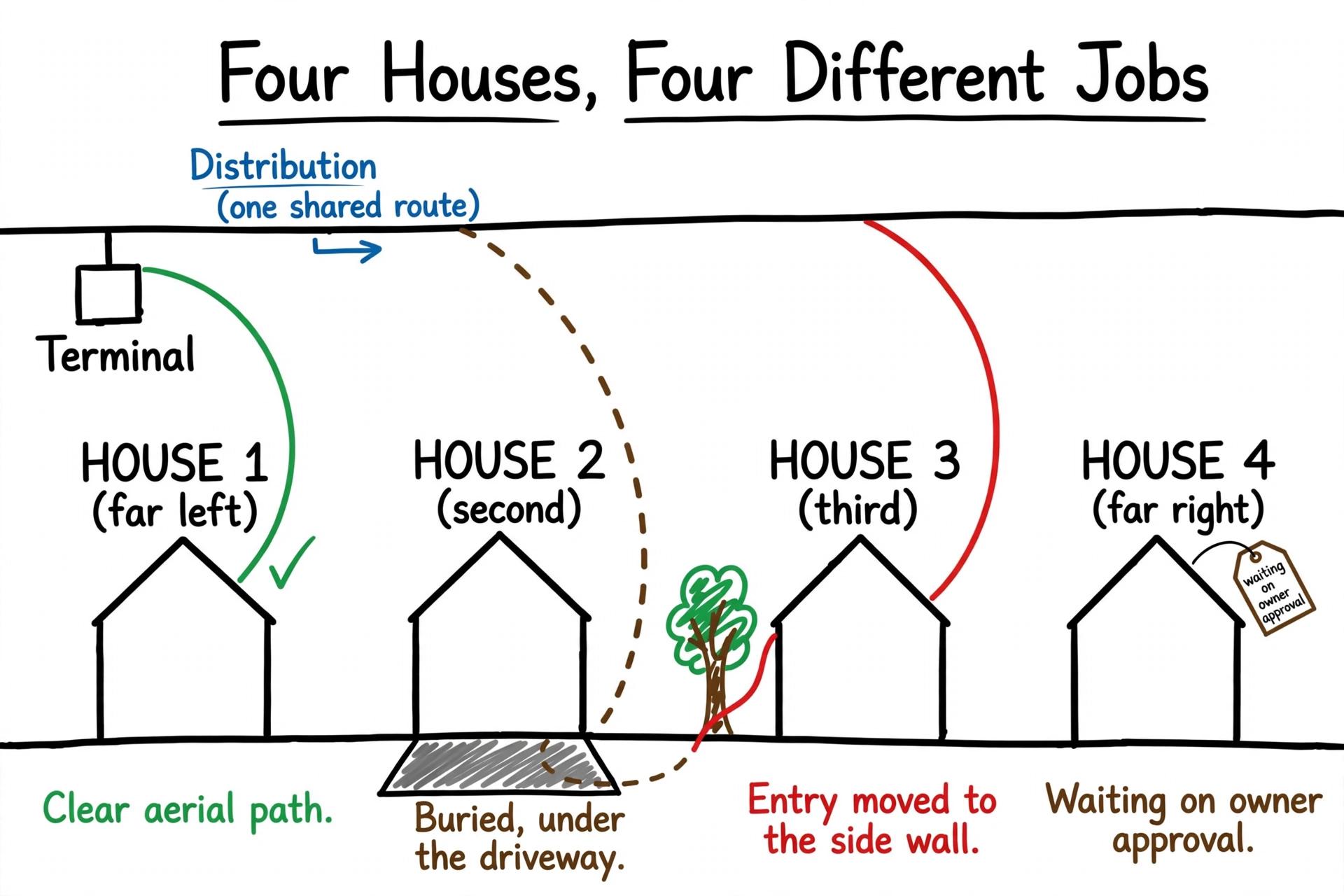
Picture a small town project built in three stages. First, a middle mile route reaches the edge of town and connects to the provider facility, and the local paper reports that fiber has arrived. Second, feeder and distribution construction runs through town over several weeks, with terminals placed on poles and in pedestals. Third, drop crews begin working street by street as residents sign up.
On one street, the first two homes connect in a single morning. Both take aerial drops on clear paths to front wall entries, and the street plan is drawn from those two houses: same aerial route, same front wall entry, four times over.
The third house breaks the pattern. Its aerial path crosses mature trees. The yard carries a sprinkler system. The homeowner wants the drop buried and the entry point on the side wall.
Here is the decision the crew lead faces. He can build the drop as drawn, hold the day’s pace, and leave this address with a route its own property fights. Or he can stop the pattern, walk the yard with the homeowner, agree on the side wall entry, bury the drop around the sprinkler system, and record the route he actually built. He chooses the second one, and the third house takes most of the day.
The fourth home, a rental, waits. The property owner has not approved an entry location, so the crew records the address as waiting on owner approval and moves on, rather than guessing an entry the owner never agreed to.
A new crew member asks why the last part is taking longer than the long route into town did. The answer is the shape of the segment. The route into town was one route built once. This one street is four separate connections, each with its own property, owner, route, and obstacles. Multiply that street by a whole town and the final segment holds most of the premises specific work on the project, on a street only a few hundred feet long.
Carry this rule: build the drop the property in front of you requires, and record the route you actually built. A plan copied from the house next door is a defect that has not been found yet.
What Can Go Wrong?
Common last mile problems are local and specific, which is why they are easy to miss on a map and obvious at an address.
- A gap at the end. Distribution passes a home, but no usable terminal port or no drop exists for that premises, so the home is counted as near fiber yet cannot get service.
- Damage to individual drops. Buried drops get cut by digging in yards. Aerial drops get damaged by trees, storms, ladders, and vehicles. One damaged drop usually affects one customer, but across a neighborhood those single customer failures add up.
- Variation handled badly. A route forced across a tree, a driveway, a septic area, or another utility because the plan was copied from the neighboring house without looking at this yard. The last mile punishes copy and paste thinking.
- Poor records at the handoff points. A drop connected to the wrong port, an address recorded against the wrong terminal, or a buried route with no useful record. The physical build may look fine while troubleshooting becomes guesswork.
- Confusion about the term itself. One person uses last mile to mean only the drop, another uses it for distribution plus drops, and a funding document uses its own definition. Crews and offices can talk past each other and misstate what is built, what is funded, and what remains. The fix is to ask which definition a document is using.
- Upstream work mistaken for completion. Middle mile or feeder construction arriving in a community is progress, and it is not last mile service. Homes are connected when the local distribution and their drops are complete and activated.
None of these require dramatic causes. Last mile trouble is usually ordinary: a missed address, a cut drop, a wrong record, or a route that fit the plan but not the property.
What Should Someone Notice in the Field?
You are looking at the last mile when you see the network change from moving through an area to serving addresses in that area. Use these observations, from a safe and authorized position, without touching plant or entering private property without permission:
- Neighborhood distribution. Cable branching down residential streets, business side streets, or rural roads toward groups of premises, rather than a single route passing straight through.
- Terminals near premises. Terminal enclosures on poles, in pedestals, or in handholes placed so individual buildings can be reached from them.
- One to one drops. Individual cables from a terminal toward single buildings. Count the pattern, not the hardware: shared cable along the street, individual connections leaving it.
- Building end points. Small wall enclosures where drops end, with the route into the building visible for aerial service or the end points only visible for buried service.
- Address by address differences. One drop aerial and the next buried, one entry at the front wall and one at the side, slack and attachments adjusted to each property. That variation is itself a sign you are in the last mile.
- Work staging that is premises focused. Crews working house by house, lot by lot, or unit by unit after the main neighborhood cable is already in place.
- Safety boundary. Recognizing the last mile does not qualify you to climb poles, open terminals or enclosures, splice fiber, dig to expose buried drops, or work on customer property. Aerial plant sits near electric services that can kill, and buried plant sits near other utilities that can be dangerous to strike. Observe from the ground, from a public or authorized position. Any digging follows the 811 locate process and state law. Reading this lesson teaches recognition only.
Key Terms
- Last mile. The final segment of a network that delivers service to end users at their premises. In broad FTTH usage it includes neighborhood distribution plus individual drops. In narrow usage it means only the drop. The word mile is metaphorical, not a measured distance.
- End user. The person or organization who uses the connection at the end of the network, such as a household or a business.
- Premises. A property or building served, such as one home, store, or office address.
- Distribution. The part of the local network that carries the signal through a neighborhood to terminals near groups of premises. Lesson 14 covers it in detail.
- Drop. The individual connection from a terminal to one premises. Lesson 10 covers it in detail.
- Terminal. An enclosure on a pole, in a pedestal, or in a handhole where drop connections are made to distribution cable. Lesson 9 covers it in detail.
- Feeder. Cable that carries the signal from a central facility toward a service area, before distribution spreads it through the neighborhood. Lesson 13 covers it in detail.
- Middle mile. The segment that connects backbone routes to local networks and brings capacity near a community, without usually connecting directly to individual end users. Lesson 17 covers it in detail.
- Backbone. A major high capacity route connecting large parts of a network over long distances. Lesson 16 covers it in brief preview here only.
- FTTH (fiber to the home). A network design in which fiber runs all the way to the customer premises. The last mile is the customer end of that design.
Check Your Understanding
- In your own words, what is the last mile, and why is the word mile misleading if you take it literally?
- Two coworkers use the term differently. One says the last mile is only the drop. The other says it is distribution plus drops. Who is right, and what should you do when a document uses the term?
- You see a long fiber route arrive at the edge of a town and connect to a provider facility, but no homes can order service yet. Which segment has likely been built, and which segment is still missing?
- On the street in From the Field, the plan showed the third house getting the same aerial drop as the first two. What did the crew lead do instead, and what rule does his decision teach?
- Why does the last mile tend to take so much build effort even when it covers a short distance on a street?
Answer key
- The last mile is the final segment that delivers service to end users at their premises. Mile is a figure of speech. The segment can be much shorter in a dense area and much longer in a rural area, because the name describes position near the customer, not a measured distance.
- Both usages exist. Narrow usage means only the drop. Broad common usage in FTTH includes distribution plus the drop. When a document matters, use that document’s definition and state which definition you are using instead of assuming.
- A backbone or middle mile type segment has likely arrived, bringing capacity to the area. The last mile is still missing: distribution through neighborhoods, terminals, and individual drops to premises are what turn area capacity into service at an address.
- He stopped the pattern. He walked the yard with the homeowner, agreed on a side wall entry, buried the drop around the sprinkler system, and recorded the route he actually built, even though it took most of the day. The rule: build the drop the property in front of you requires, and record what you built. A copied plan becomes a defect.
- Because the work repeats at every premises with different conditions. Each address can have a different route, entry, property owner, obstacles, and record. It is many small individual jobs, not one continuous route, and the drops are the most numerous connections in the system.
Lesson Takeaway
The last mile is the final segment that connects end users to the network. It is a role played by parts working together, and its name describes position near the customer, not distance. In broad usage it is the neighborhood distribution plus the individual drops. In narrow usage it is the drop alone. Either way, it is where shared network capacity becomes service at a specific address, where a large share of premises specific work and variation lives, and where a project succeeds or fails for the customer. In the field, you recognize it by distribution through neighborhoods, terminals near premises, and one to one drops into buildings.
Sources and Technical References
- Pennsylvania Broadband Development Authority, Broadband Glossary. Defines last mile as the final leg of a telecommunications network that delivers service to retail end users, and notes that last mile connections come from middle mile networks. Also defines middle mile as bringing broadband close enough to a residence or business for a provider to offer access. https://broadband.pa.gov/resources/broadband-glossary/
- Wikipedia, Last mile (telecommunications). Summarizes the term as the final stage and the access portion that physically reaches end user premises, notes that mile is used metaphorically and length may be more or less than a mile, and explains that final links are the most numerous part of the system. Used here for the general definition and the metaphor point. https://en.wikipedia.org/wiki/Last_mile_(telecommunications)
- NTIA, Enabling Middle Mile Broadband Infrastructure Program webinar presentation. Describes middle mile infrastructure as the midsection that carries large amounts of data at high speeds over long distances and connects the backbone to the last mile, which connects to end users, and lists the BEAD program amount presented in that material. https://broadbandusa.ntia.gov/sites/default/files/2022-06/May-26-Webinar-Presentation.pdf
- Telecompetitor, NTIA Seeks Comment on Implementing BEAD, Other Broadband Funding Programs. Reports the BEAD budget as focused on deployment to unserved areas and describes the middle mile program as funding infrastructure that does not connect directly to an end user location. https://www.telecompetitor.com/ntia-seeks-comment-on-implementing-bead-other-broadband-funding-programs/
- FS, FTTH Cabling System. Describes drop cables as used in the last mile to connect a subscriber optical network terminal to the FTTH network, illustrating the narrow usage where last mile language is applied at the drop. https://www.fs.com/blog/ftth-cabling-system-a-futureproof-solution-for-access-network-10306.html
Previous lesson: Lesson 14: What Is Distribution Fiber? |
Back to Level 1 hub
| Next lesson: Lesson 16: What Is a Backbone?