
Lesson Number and Title
Lesson 158, Level 8: Understand the Underground Pathway
Title: What Is Conduit Continuity?
Introduction
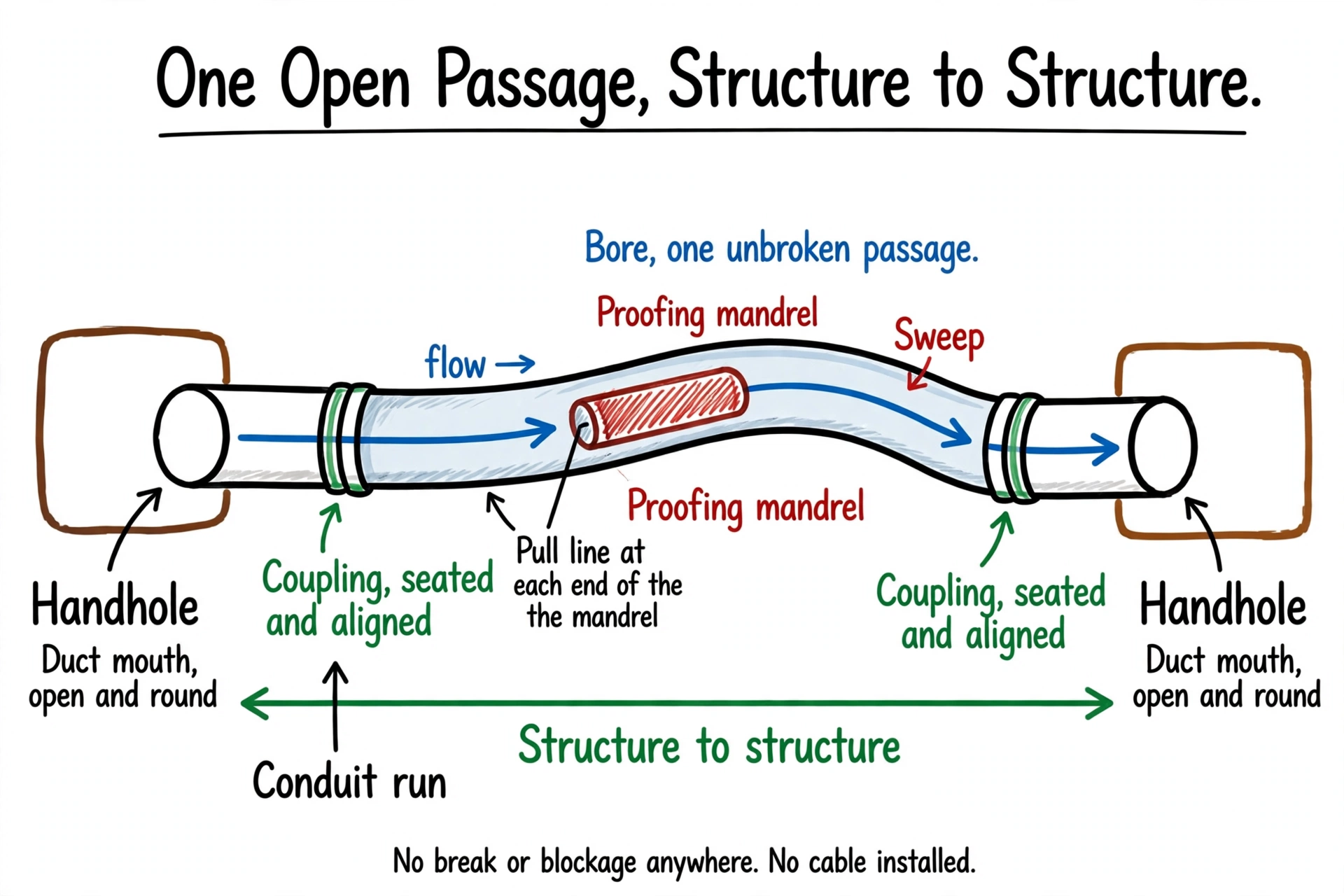
In this lesson, conduit continuity means the condition in which the bore, the open inside passage of a conduit or duct, runs as one unbroken, open, and aligned passage from one structure to the next, with every joint seated and no offset, crush, separation, or blockage breaking the path. A run has continuity when something sized for the pathway can travel the full length of the run and come out the far end.
Level 8 studies the underground pathway piece by piece. Lessons 149 and 150 taught the sweep that turns a run and the coupling that joins two sections. This lesson teaches the condition those pieces have to produce together: a whole run that a cable can actually travel, proven by a check and separate from a line on a drawing that only shows where a run was planned.
What This Lesson Gives You
- State what conduit continuity means in plain words, and tell it apart from a clean duct and from a duct that only holds a pull line.
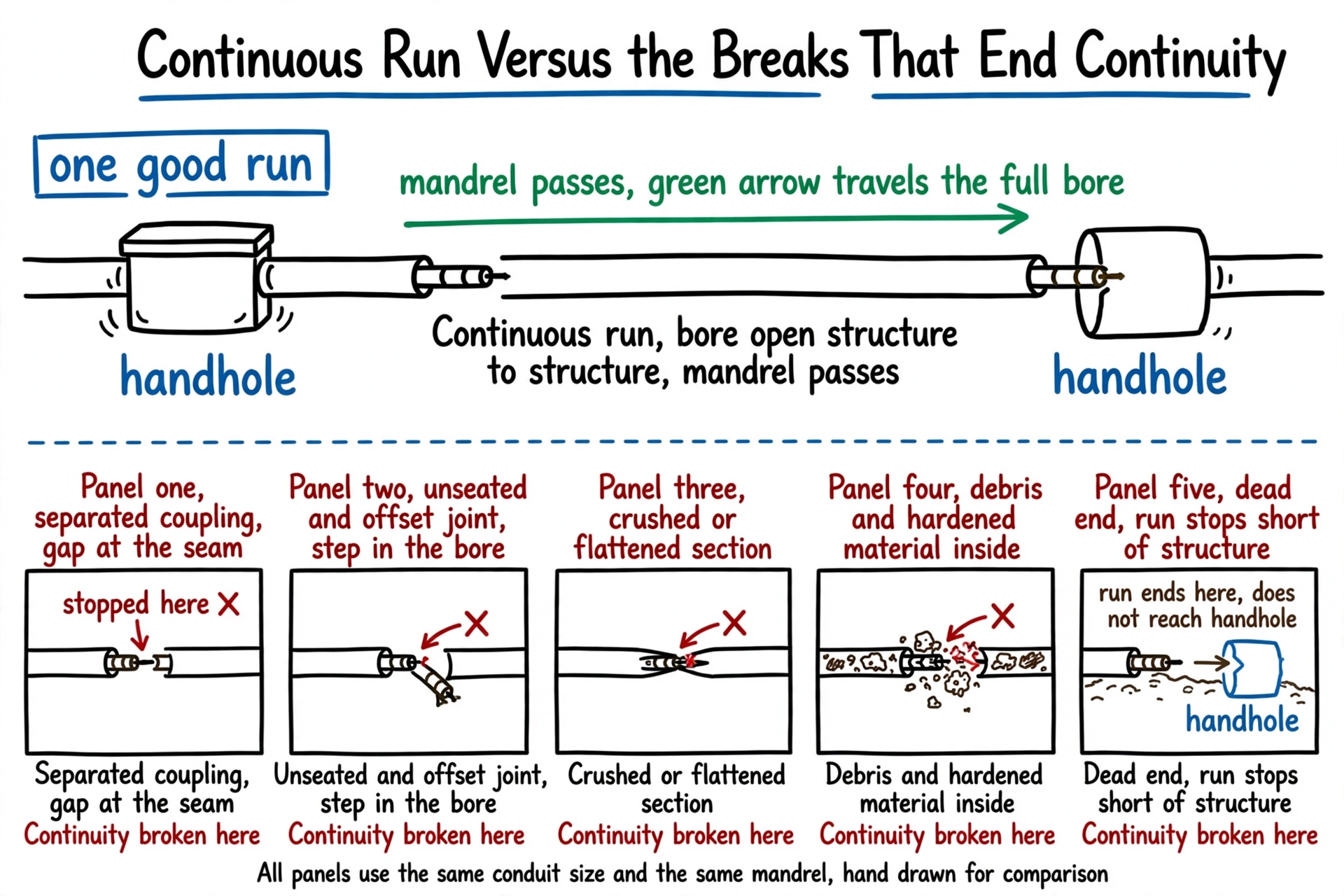
- Name the breaks that end continuity in a run: a separated or unseated coupling, an offset joint, a crushed or flattened section, debris or hardened material inside the bore, and a run that stops short of its structure.
- Explain how a run is proven, by passing a proofing mandrel, by rodding, or by an equivalent check the project documents name, and why the drawing alone proves nothing.
- Read the field signs available before cover and at proofing that point to a break, including a mandrel that stops, a rod that will not pass, and joints that sit visibly out of line.
- State the hold decision when a proof fails or a break is found, and name who owns locating and repairing the run.
Start With the Basics
Picture a drinking straw held up to the light. An open straw shows a clear circle of light from end to end, and air and liquid move through it freely. Pinch the middle flat, and the passage closes at the pinch even though the straw still runs from the glass to your mouth. Drop a grain of rice into the straw, and the passage closes at the grain instead. The straw exists in both cases. The open passage exists in only one case.
A conduit run works the same way. The run is one length of pathway between two structures, such as two handholes. The tubes, sweeps, and couplings can all be present in the ground, in the right places, and the passage inside them can still be closed at one point by a flattened section, a shifted joint, or material lodged inside. Continuity names the passage itself. A reader who holds that picture can already ask the right field question: whether the inside path runs through. The outside of the run looking complete is a separate matter, and it settles nothing about the passage.
What Is It?
Continuity is a condition of a whole run. The definitions below build the picture in order, from the passage itself to the checks that prove it and the neighboring ideas it must stay separate from.
Bore, recalled. The bore is the open inside passage of a conduit, duct, or innerduct, the space a cable, a pulling member, or a proving device travels through. Lesson 150 used the same word for the passage inside a coupling. Continuity is a statement about that passage across an entire run.
Structure to structure. A run is measured between its structures, the handholes, vaults, cabinets, and riser bases where a pathway begins and ends and where a person can reach the duct mouth. Continuity is claimed for one run at a time, from one structure to the next structure. A pathway made of several runs has continuity only when each run in the chain has it.
Continuity defined. Continuity means the bore of a run is one unbroken passage from structure to structure. Four conditions hold at the same time along the full length:
- Every section of conduit or duct is present and connected to the next section, with no gap where the pathway stops and starts again.
- Every joint is seated and aligned, so the bore runs straight through each coupling and fitting with no step and no offset edge inside the passage.
- The bore stays open at its usable size, with no crushed, flattened, or kinked section narrowing the passage below what must travel through it.
- The bore is free of anything that blocks travel, including loose debris, soil, and hardened material that entered or set inside the run.
A run that fails any one of the four conditions has lost continuity at that point, even when the rest of the run is sound.
Proofing. Proofing is the act of passing a test device through a run to show that the passage is open at the size the device represents. Mandreling is proofing with a proofing mandrel, a rigid test body sized for the conduit and pulled through the run. Seattle City Light U2-11.40 and Eugene Water and Electric Board GC5-2.3600 both call for that pull to be made by hand. Seattle City Light Construction Standard U2-11.40, titled Mandreling and Cleaning of Ducts and Conduits, gives one owner example of the pattern: after concrete has been poured or the trench backfilled over conduit, each duct run and conduit is tested for obstructions or flattening by hand pulling a proofing mandrel through it, and a section where an obstruction is found is replaced. Seattle City Light Material Standard 7645.40 covers the proofing mandrels themselves and states their application in the same terms: rigid proofing mandrels are used to test for obstructions in an underground conduit run after trench backfill and conduit pour is complete, and the mandrel size should be at least as large as the largest cable pulling head or grip that could be used within that conduit. Both documents are Seattle City Light standards for Seattle City Light work. They show how one owner writes the check. They set no sizing, timing, or acceptance rule for any other project.
Rodding. Rodding is pushing a flexible rod through a run to clear the passage and to install a pulling line: the rod is pushed to the far structure, the line is attached there, and rod and line are pulled back through the run. The Fiber Optic Association, called FOA, covers rodding in its outside plant civil works guidance as a method used to clear the duct passage and install the pulling rope, using fiberglass push rods. A rod that travels the full run and arrives at the far structure is evidence the passage is open to that rod. A rod is thinner and more flexible than a mandrel, so a rod pass and a mandrel pass prove different things, and the project documents name which check a given run must pass.
Equivalent checks named by the documents. Owner standards and contract specifications name their own versions of the same idea. Eugene Water and Electric Board Standard GC5-2.3600, Mandreling and Cleaning of Conduit, directs the installer to select the appropriately sized mandrel for the conduit to be proven, pull it slowly through the conduit by hand, and treat a full pass with no blockage or obstruction as the condition for inspector approval. A run that cannot be pulled through completely is not approved under that standard, and the customer locates and repairs the conduit and then retests it. A Texas Department of Transportation special specification for preparation of existing conduit gives a contract example from highway work: the contractor checks conduit to verify it is clear and continuous and usable for its intended purpose, tests it by pulling a mandrel through it, and cleans or repairs any conduit that will not allow passage of the mandrel. A Texas multi-duct specification uses the same pattern for new innerduct, directing that innerducts be proofed with an approved mandrel or a spherical template drawn through to show the innerduct is free from obstruction before pull tape is installed. The method, the device size, and the pass rule change from document to document. The shared idea holds across all of them: continuity is shown by a device traveling the run, under the rule the governing documents state.
Continuity, separated from cleanliness. Cleanliness means the inside of the run is free of loose material, water, and residue that raise friction or foul a cable during placement. Seattle City Light U2-11.40 treats the two ideas as separate steps in one standard: cleaning is performed by drawing a brush with stiff bristles and a swab through each duct and conduit to make certain no foreign materials are left in the duct, with a water jet flush added for conduit runs of 5 inches or larger under that standard, and mandreling is the separate test for obstructions or flattening. A run can be clean along the parts a brush reached and still fail continuity at a crushed section the brush never passed. A run can also pass a mandrel and still carry grit and water that a cleaning pass must remove before cable placement. Level 13 teaches proofing and cleaning in depth. This lesson keeps the two ideas separate at the recognition level: continuity asks whether the passage runs through, and cleanliness asks what condition the passage walls and floor are in.
Continuity, separated from a pull line being present. A pull line is the light line taught in Lesson 154, and mule tape is the flat pulling and measuring tape taught in Lesson 155. Either member can be present in a duct that has lost continuity for cable. A thin, flexible line can slip past an offset edge, ride over loose debris, and thread through a partly flattened section that will stop a mandrel and stop a cable. A line in a duct proves a line got through. The line alone never proves the bore is open at the size the cable and its pulling head need. Seattle City Light U2-11.40 orders the work in that direction for its projects: cleaning and mandreling come first, and the pull tape is left in the conduit after those steps are complete.
Continuity, separated from the drawing. A drawing shows the pathway as designed: the route, the structures, and the ducts between them. The drawing records intent. Continuity records fact, and fact is established only in the ground, by joints checked before cover and by a device traveling the run after construction. A run that appears on an as-built drawing can still dead-end short of its structure, sit crushed under backfill, or hold a separated joint. The proof is the evidence. The paper is a claim the proof confirms or denies.
What Does It Look Like?
Continuity itself hides underground, so a beginner reads it through evidence: what the open run shows before cover, what the duct mouths show at each structure, and what a proving device reports when it travels.
In the open trench or bore path, before cover:
- Sections running in one line from structure to structure, with each joint seated and the conduit entering each coupling straight, in the pattern Lesson 150 teaches.
- Sweeps turning the run through smooth arcs, with no kink or flattened section along the curve, in the pattern Lesson 149 teaches.
- The far end of the run visible at the next structure, entering the structure wall or stub at the place the plan shows, with no run ending in open ground short of the structure.
- Bedding and support holding the run at grade, with no rock or lump pressing a section out of round and no sag that drops a section below the line of the run.
At the duct mouths, from the structures at each end:
- An open, round duct mouth at each end of the run, with the bore visible as a clear opening and no soil, hardened material, or crushed lip closing it.
- An unobstructed view through a short, straight run when sighted from the far end, as a rough first sign only, since bends and length hide the middle of longer runs, and a sized proof is still required.
- A pull line or tape present in the run and able to be moved from either end, recorded as a preliminary sign only. Movement of a line shows a line can travel the run. It shows nothing about the size of the passage, and a sized proof is still required before anyone trusts the run.
- Water, silt, or grit arriving at the mouth on a line or rod, showing material inside the run that a cleaning pass or a closer look must account for.
During and after proofing:
- A proofing mandrel that enters at one structure, travels the full run, and arrives at the far structure, pulled by hand at a steady pace where the governing standard calls for a hand pull.
- A rod that travels the full run and arrives at the far structure, where rodding is the check the documents name.
- A mandrel or rod that stops partway, refuses to advance, or has to be forced, with the distance it traveled marking the place where the passage fails.
- A record entry for the run naming the check used, the result, and the date, so the proof belongs to that run and no other.
What Does It Do?
Continuity is the property that lets every later step in the work happen. Each part of that statement works by a plain mechanism.
Continuity lets a proving device certify the run before cable is risked. A mandrel sized for the conduit under the governing standard stands in for the largest thing that must later travel the run. Seattle City Light Material Standard 7645.40 states the logic directly: the mandrel size should be at least as large as the largest cable pulling head or grip that could be used within that conduit, to show cable can be pulled in successfully. When the stand-in travels the full run, the run has demonstrated that a body of that size can travel it. Cable readiness still depends on cleaning, bend, tension, and surface checks the mandrel pass does not make. When the stand-in stops, the run has located its failure while the only thing at risk is a test device that can be pulled back out.
Continuity lets pulling force become travel instead of damage. A cable pull applies tension along a path. In an open, aligned bore, that tension moves the cable forward. At a break in continuity, the same tension drives the cable head into an offset edge, wedges it against a flattened wall, or packs it into debris. The pull stalls, and added force goes into the cable jacket and the obstruction rather than into progress. An unbroken passage is what converts force into movement along the whole run.
Continuity keeps each run usable as its own segment. Cable placement, blowing, and later replacement work proceed structure to structure, one run at a time. A run with continuity can receive cable, hold a spare duct in reserve, or wait empty and still be counted as usable pathway in the record. A run without continuity is a gap in the route that planning cannot use, no matter how sound the runs on either side of it are.
Continuity protects the record. A route record built from proven runs tells the next crew which ducts can be assigned, which hold cable, and which stand ready. A record built from drawings alone carries every unproven run as if it were usable. The first assignment that trusts a false record discovers the break at pulling time, under schedule pressure, with cable on the ground.
Where Does It Fit?
Continuity is created during construction, proven after construction, and relied on for the life of the pathway.
- Design and drawings. The designer routes each run from structure to structure and names the proofing the completed run must pass. The drawing states the intent that construction and proofing later confirm or deny.
- Duct and conduit construction. Crews build continuity joint by joint and section by section: couplings seated and aligned per Lesson 150, sweeps formed and supported per Lesson 149, sections kept round and clear as the run advances. Continuity is made here, while every point of the run is still visible.
- Backfill and encasement. Cover loads the run for the first time. Seattle City Light U2-11.40 places its mandrel test after concrete has been poured or the trench backfilled over conduit for that reason: the proof examines the run in the condition the ground leaves it in after cover, which can differ from the condition the crew built it in.
- Cleaning and proofing. After the run is complete, crews clean it and prove it by the method the project documents name. Eugene Water and Electric Board GC5-2.3600 requires retesting after a repair, so a repaired run earns its approval only from a fresh full pass completed after the repair. Level 13 teaches this work in depth, including mandrel selection, cleaning tools, and acceptance records. This lesson teaches the concept and the field recognition a Level 8 reader needs.
- Pull line and tape placement. With the run proven, a pulling member is placed and left for cable placement. The member inherits a passage that has already demonstrated it can be traveled.
- Cable placement. The pulling or blowing crew works a run whose bore has been shown open at size. A hang-up during placement then points to the pull itself, to lubrication, tension, or bend load, rather than to an unknown break in the ground.
- Later use and records. Spare ducts are assigned years later on the strength of their proof records. A duct with no proof record is an unknown, and a crew opening it treats its continuity as unproven until a device travels it again.
What Is at Stake
A cable pull that stalls mid-run. The classic cost of a hidden break arrives with cable under tension in the ground. The cable head meets the offset, the crush, or the blockage, the pull stops, and the crew must decide under pressure whether to pull back, dig, or risk the cable by forcing the pull. Every part of that decision is worse than finding the break with a mandrel.
Cable damage at the break point. A cable driven against an offset edge or dragged through a flattened section can take jacket and fiber damage at exactly the point where the passage failed. A cable driven against an offset edge or dragged through a flattened section can take jacket and fiber damage at exactly the point where the passage failed. FOA pulling guidance treats excess tension and pulling by anything other than the cable strength members as fiber-damaging, which is why the break must be found with a test device before cable is in the ground.
Excavation priced against a hand check. A break found at proofing, while structures are open and the route is still a work site, is located from the distance the device traveled and repaired as construction. The same break found after restoration, or months later on a new assignment, is priced as locating, excavation, repair, re-proofing, and surface restoration.
A route that exists on paper only. A network plan that counts an unproven or failed run as usable pathway overstates the route. Splices, assignments, and customer commitments built on that count inherit the error, and the correction lands on whichever crew opens the duct next.
Schedule built on an unproven segment. Proofing sits between construction and cable placement for a reason. A segment accepted without proof pushes its failure into the placement window, where cable, splicing crews, and turn-up dates are all waiting on the same run.
Safety around structures and proving work. Proofing and rodding happen at open structures, at trench edges, and around pulling lines under hand tension. Recognition of a failed proof is the subject of this lesson. Entering structures, working in excavations, and directing repair work belong to qualified people under the project safety program, covered in the field checklist at the end of this lesson.
What Does Good Look Like?
- Every joint in the run is seated and aligned before cover, with the bore running straight through each coupling and no step visible inside any open end.
- Every section holds its round, open shape, with bedding and support in place and no kink, flattening, or point load along the run.
- The run reaches its far structure and enters it where the plan shows, with an open duct mouth at each end and no run ending short in open ground.
- The bore is clear of loose debris, soil, and hardened material, and cleaning has been completed as a step separate from proofing where the documents require both.
- A proofing device named by the project documents has traveled the full run from structure to structure and arrived at the far end, with the result recorded for that run.
- A repaired run has been re-proven with a fresh full pass after the repair, and the record shows both the failure and the passing retest.
- A pulling member left in the proven run is secured at both ends where the documents direct it, and the record names the run as proven and ready, or as failed and held.
From the Field
Picture a two person crew proofing a finished duct segment between two handholes before cable placement day. The segment was built the week before, backfilled, and recorded as complete. The crew works the check the project documents name: a proofing mandrel pulled through by hand, with a line on each end of the mandrel so it can be drawn back if it stops.
The mandrel enters cleanly and travels well for the first part of the run. Partway through, it slows, then stops and will not advance under steady hand pressure. The crew member at the far handhole reports that the pull line alone had gone through that morning without trouble, and the drawing shows the duct in place for the full segment.
The crew has a decision to make. The cable is scheduled, the line is already in the duct, and the mandrel that just stopped is the sized proof the project documents named for this run. Accepting the run would treat the line pass and the drawing as proof. Holding the run means reporting a failed segment, locating the stop point from the length of line the mandrel traveled, and opening the route again before placement day.
The crew holds the run. Working the mandrel back out and measuring the line places the stop at a coupling location from the construction record. Excavation at that point shows the coupling with one end partly unseated and shifted, leaving an offset edge inside the bore. The thin line had slipped past the edge. The mandrel, sized for the pathway, could not.
The crew remakes the joint with both ends seated and in line, backfills, and pulls the mandrel through the full segment on a fresh pass. The record is corrected to show the failed proof, the repair, and the passing retest, and cable placement keeps its date on a run that has now demonstrated continuity.
The rule to carry is simple: continuity is proven by a device sized for the pathway traveling the full run, and when that device stops, the run is held and located and repaired, no matter what the line or the drawing says.
What Can Go Wrong?
A coupling separates or sits unseated. Ground movement, handling loads, or a joint made short of its seat can open a gap at a seam. The bore ends at the gap, soil enters, and anything traveling the run meets an exposed edge. Lesson 150 teaches the joint checks that prevent this failure.
A joint sits offset. Ends joined out of line leave a step inside the bore at the seam. A flexible line can pass the step while a mandrel and a cable head catch on it, so the run reads as open to weak checks and closed to the load that matters.
A section is crushed or flattened. Backfill loads, point loads from rocks, vehicle loads over shallow cover, and poor bedding can press a section out of round. Seattle City Light U2-11.40 names flattening alongside obstructions as the condition its mandrel test exists to catch, because a flattened section narrows the passage while the outside of the run can still look complete on a drawing.
Debris and hardened material block the bore. Soil, gravel, broken conduit pieces, and water carried silt enter through open ends and unsealed joints and collect at low points and bends. Hardened material, including grout or concrete that entered a duct during encasement work, sets into a fixed blockage that cleaning alone may not move. A blockage breaks continuity at its location even when every joint and section is sound.
A run dead-ends short of its structure. A section cut short, a stub misaligned with the structure wall, or a run terminated in open ground leaves the passage ending before it arrives anywhere a crew can use it. The run exists. The route through it does not, and only a structure to structure check exposes the gap.
A weak check is accepted as proof. A pull line threaded through, air blown through, or a light sighted through a short section can each pass a run that a sized mandrel would stop in. Accepting the weak check moves the discovery to cable placement, where the failure costs the most.
A failed proof is covered by the record instead of the repair. A run written up as proven without a pass, or a repair recorded without a retest, hands the next crew a false fact. Eugene Water and Electric Board GC5-2.3600 closes that gap in its own work by withholding approval until the mandrel passes and by requiring retesting after any repair.
What Should Someone Notice in the Field?
- Trace each run on the plan from structure to structure, then confirm in the field that the run actually arrives at both structures, with an open duct mouth at each end.
- Check open joints before cover for full seating and straight alignment, and look inside open ends for a step, a gap, or an offset edge at the seam.
- Look along open sections for flattening, kinks, cracks, and point loads from bedding or rocks pressing the run out of round.
- Look inside open ends for soil, gravel, water, and hardened material, and report any run where material has entered and settled.
- Treat a pull line or tape moving through a run as a preliminary sign only, and ask what sized proof the project documents require for that run.
- During proofing, note where a mandrel or rod slows, stops, or needs force, and record the distance traveled so the stop point can be located.
- Confirm each completed run carries a proof record naming the method, the result, and any repair and retest, and flag any run recorded as complete with no proof behind it.
- Hold any run that fails its proof, shows a break before cover, or ends short of its structure, and report the condition for locating and repair instead of accepting the run on the drawing or the line.
- Know the boundary: recognizing the signs of a break, reading a proof result, measuring where a device stopped, and reporting a failed run are tasks covered by this lesson. Performing mandreling and rodding under a project standard, entering structures or excavations, operating pulling equipment, and directing excavation and repair belong to qualified people under the project documents, the owner standards, and the project safety program. Reading this lesson qualifies no one for that work, and recognizing a failed run is a different thing from being qualified to repair it.
Key Terms
Continuity: The condition of a run in which the bore is one unbroken, open, and aligned passage from structure to structure, with joints seated and no offset, crush, separation, or blockage breaking the path.
Bore: The open inside passage of a conduit, duct, or innerduct, the space a cable, pulling member, or proving device travels through.
Run: One length of pathway between two structures, such as two handholes, treated as a single unit for building, proofing, and records.
Proofing: The act of passing a test device through a run to show the passage is open and usable at the size the device represents.
Proofing mandrel: A rigid test body sized for the conduit under the governing standard or project documents, pulled through a run to test for obstructions and flattening. Also called a mandrel.
Rodding: Pushing a flexible rod through a run to clear the passage and install a pulling line, by pushing the rod to the far structure, attaching the line there, and pulling rod and line back through the run.
Offset: A misalignment at a joint or section in which one part of the bore sits shifted from the part beside it, leaving a step or edge inside the passage.
Dead-end: A run that stops short of the structure it was built to reach, so the passage ends where no crew can use it.
Check Your Understanding
- A duct holds a pull line from end to end, and the drawing shows the run complete. Why do those two facts together still fall short of proving continuity?
Answer: A thin, flexible pull line can slip past an offset edge, ride over debris, and thread through a partly flattened section that will stop a sized device and a cable. The drawing records the pathway as designed and built on paper. Continuity is a condition of the bore in the ground, and it is proven by a device sized for the pathway traveling the full run under the check the project documents name, such as the mandrel pass in Seattle City Light U2-11.40 or Eugene Water and Electric Board GC5-2.3600.
- Name four breaks that end continuity, and state the shared effect each one has on the run.
Answer: Any four of the following: a separated or unseated coupling opening a gap at a seam, an offset joint leaving a step inside the bore, a crushed or flattened section narrowing the passage, debris or hardened material blocking the bore, and a run dead-ending short of its structure. The shared effect is that the bore stops being one unbroken passage from structure to structure, so a sized device and later a cable cannot travel the full run.
- How does continuity differ from cleanliness, using the Seattle City Light standard as the example?
Answer: Seattle City Light U2-11.40 treats them as separate steps. Cleaning draws a brush with stiff bristles and a swab through each duct and conduit to make certain no foreign materials are left in the duct. Mandreling is the separate test for obstructions or flattening. A clean run can still fail continuity at a crushed section, and a run that passes a mandrel can still need cleaning before cable placement.
- In the From the Field scenario, the pull line had passed and the drawing showed the duct complete. What decision did the crew make when the mandrel stopped, and what did locating the stop reveal?
Answer: The crew held the run instead of accepting it on the line and the drawing. The crew measured the line the mandrel had traveled to locate the stop, and excavation at that point revealed a coupling with one end partly unseated and shifted, leaving an offset edge the thin line had slipped past and the sized mandrel could not pass. The joint was remade, and the run passed on a fresh full proof.
- A repaired run is backfilled and the foreman proposes recording it as proven because the repair crew saw the defect and fixed it. What does the governing pattern require instead?
Answer: A fresh full pass after the repair. Eugene Water and Electric Board GC5-2.3600 withholds approval when a conduit cannot be pulled through completely, assigns locating and repair to the customer, and requires retesting to prove the conduit after repair. The repair alone is work performed. The retest is the evidence, and the record shows the failure, the repair, and the passing retest together.
Lesson Takeaway
A pathway earns trust one proven run at a time. After this lesson, a duct on a drawing reads as a claim, a pull line inside a duct reads as a hint, and a sized device arriving at the far structure reads as evidence. A reader who checks joints and shape before cover, who asks what proof a run carries, and who holds a run when the device stops keeps a hidden break from becoming a stalled pull, a damaged cable, and an excavation on placement day.
Sources and Technical References
Seattle City Light, Construction Standard U2-11.40, Mandreling and Cleaning of Ducts and Conduits. Covers testing each duct run and conduit for obstructions or flattening by hand pulling a proofing mandrel sized and constructed per Material Standard 7645.40 after concrete pour or trench backfill, replacing a section where an obstruction is found, cleaning by drawing a brush with stiff bristles and a swab through each duct to make certain no foreign materials are left, and leaving pull tape in each conduit after cleaning and mandreling. Cited in this lesson as one owner standard example for Seattle City Light work: https://web8.seattle.gov/city-light-engineering-standards/Home/GetPDF?libId=ConstructionStandards&searchForfileName=U2-11.40-NDK-40F2023.11.14.pdf
Seattle City Light, Material Standard 7645.40, Mandrels, Proofing. Covers rigid proofing mandrels used to test for obstructions in an underground conduit run after trench backfill and conduit pour is complete, and the guidance that the mandrel size should be at least as large as the largest cable pulling head or grip that could be used within that conduit to ensure cable can be pulled in successfully: https://web8.seattle.gov/city-light-engineering-standards/Home/GetPDF?libId=BrowseAll&searchForfileName=7645.40F2024.02.23.pdf
Eugene Water and Electric Board, Distribution Construction Standard GC5-2.3600, Mandreling and Cleaning of Conduit. Covers selecting the appropriately sized mandrel for the conduit to be proven, pulling the mandrel slowly through the conduit by hand with pulling strings attached at both ends, inspector approval when the mandrel passes without blockage or obstruction, withholding approval when the conduit cannot be pulled through completely, and locating, repairing, and retesting the conduit after a failed pass: https://www.eweb.org/documents/Policies%20and%20Procedures/electric-standards/GC523600.pdf
Texas Department of Transportation, Special Specification 8483, Preparation of Existing Conduit. Covers a contract example for existing conduit: checking conduit to verify it is clear and continuous and usable for its intended purpose, testing by pulling a mandrel through the conduit, cleaning or repairing conduit that will not allow passage of the mandrel to the satisfaction of the Engineer, cleaning after the mandrel test with a rubber swab, and installing a pull line left for use in installing wire and cables: https://ftp.txdot.gov/pub/txdot-info/cmd/cserve/specs/1993/spec/es8483.pdf
Texas Department of Transportation, Special Specification 8079, NTTA Multi-Duct Conduit System. Covers proofing all innerducts with an approved mandrel or by drawing a spherical template through the innerduct to show the innerduct is free from obstruction prior to installing pull tape, as a contract example of proofing named in project documents: https://ftp.txdot.gov/pub/txdot-info/cmd/cserve/specs/2004/spec/ss8079.pdf
Fiber Optic Association, The FOA Reference for Fiber Optics, Outside Plant Fiber Optic Cable Plant Installation. Covers conduit and innerduct installation practice for outside plant fiber cable placement, as general industry guidance for the pathway work this lesson sits inside: https://www.thefoa.org/tech/ref/OSP/install.html
Fiber Optic Association, FOA OSP Fiber Optics Civil Works Guide, Duct Rodding and Duct Testing and Cleaning. Covers rodding used to clear the duct passage and install the pulling rope using fiberglass push rods, and duct testing and cleaning as pre-installation checks before cable hauling, as industry guide material: https://www.thefoa.org/tech/ref/OSP_Construction/Underground_Installation.html
Previous lesson: Lesson 157: What Are Route Markers? |
Back to Level 8 hub |
Next lesson: Lesson 159: Why Do Conduit Bends Matter?