
Introduction
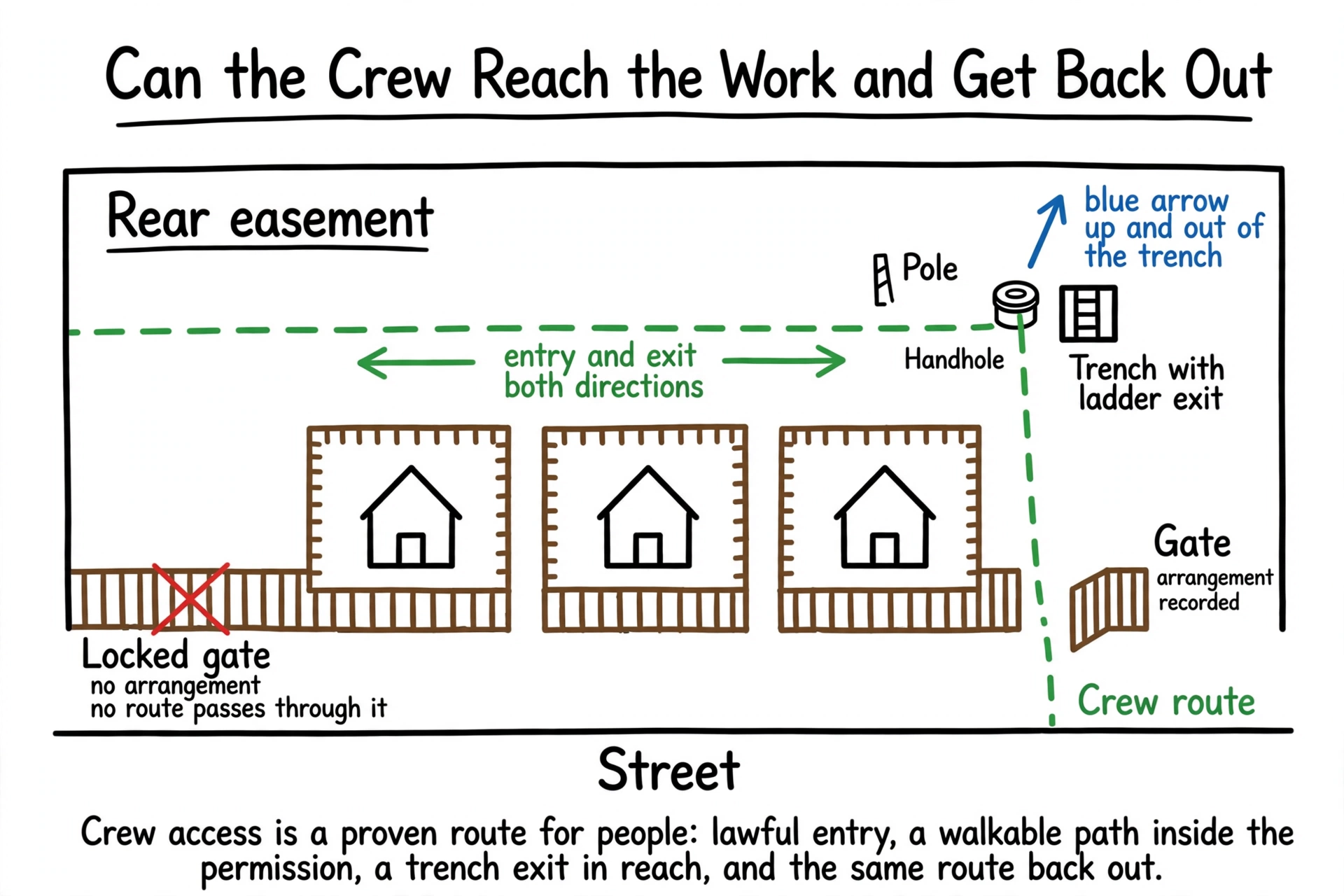
Crew access is whether people on foot can lawfully and safely reach the work area, move around it, and leave it again, including in an emergency. It covers the path from the road or gate to the pole, handhole, trench, or bore pit, the permission to be on that ground, and the way out if conditions change.
This lesson teaches crew access as a constructability check in its own right. Lesson 100 covered whether equipment and vehicles can get there. This lesson covers the separate question for people, because a route that works for a truck can still fail a worker on foot, and a path a worker can walk does not prove permission, safe footing, or a safe exit.
What This Lesson Gives You
- Walk a crew route and test it for permission, footing, entry, and exit before work starts.
- Tell crew access apart from equipment access, and explain why each needs its own check.
- Recognize a locked gate, a missing entry arrangement, and a rear easement problem as access failures that stop the job.
- Apply the federal trench egress rule correctly, with its depth trigger and its lateral travel limit.
- Report an access problem with facts and escalate it, without trespassing, forcing a gate, or improvising an unsafe path.
Start With the Basics
Think about reaching a backyard shed. You need a gate you are allowed to open, a path you can walk without tripping or sinking, and a way back out carrying what you brought in. If the gate is locked and you have no key, you have not reached the shed, even though you can see it through the fence. If the path crosses a muddy slope with no footing, you may reach the shed once and still have no safe route for repeated trips or for leaving quickly.
Crew access works the same way at work scale. A worker may need to walk the route many times in a day, carry tools and material by hand, work beside an excavation, and leave fast if weather, a cave in warning, or an injury changes the situation. A single careful walk in dry weather does not prove the route works for that use.
That is why crew access is a constructability question. Constructability means whether a design can actually be built as drawn, with the people, equipment, ground, and permissions that are really there.
What Is It?
Crew access is the verified ability of workers on foot to reach a work area lawfully and safely, move within it as the task requires, and leave it again, including by a safe exit route when conditions change.
Crew access has three parts, and all three must hold at the same time:
- Permission to be there. A legal right or an arranged permission covers the ground the crew will cross and occupy on foot.
- A physical path people can use. The route has footing, openings, and clearance that fit a person walking and carrying the hand tools and material the task requires.
- Egress. Egress means the way out. The crew can leave the work area and any excavation safely and promptly, without climbing an unsafe face, crossing a blocked gate, or passing through a hazard.
Key terms inside that definition need plain words before they are used further:
- An easement is a legal right to use another person’s land for a specific purpose, without owning the land. The document that creates it states who holds the right, what strip of land it covers, and what uses it allows.
- Right of entry means permission to enter land for a stated purpose. It can come from an easement, a permit, a contract, or a direct arrangement with the owner or occupant, and it is limited to what that source actually grants.
- A rear easement is an easement that runs along the back of lots, behind houses and fences, where poles, handholes, and underground plant often sit. Rear easements are common in fiber work, and much of the work in them is done on foot, at handholes, poles, and short underground segments set behind fences.
- A competent person, in OSHA construction language at 29 CFR 1926.32(f), is a person capable of identifying existing and predictable hazards in the surroundings or working conditions that are unsanitary, hazardous, or dangerous to employees, and who has authorization to take prompt corrective measures to eliminate them. Excavation inspections and several access decisions in this lesson belong to that person.
- A walking-working surface is any horizontal or vertical surface on or through which an employee walks, works, or gains access to a work area. The term is defined in the general industry rules at 29 CFR 1910.21, and its surface requirements sit at 29 CFR 1910.22. Construction work is governed by the construction rules in 29 CFR 1926, and this lesson cites the general industry wording only for its general principle that access surfaces are inspected and kept in a safe condition.
Crew access is different from equipment access, and the difference is the point of having two lessons. Lesson 100 asked whether a drill, a trencher, a bucket truck, and their trailers can travel, turn, set up, and leave. Crew access asks a narrower and separate set of questions:
- Can a person open and pass each gate on the route, lawfully?
- Can a person walk the full route with safe footing, in the weather and light expected for the work?
- Can a person reach the exact work point, such as the back side of a pole or the far side of a handhole, and work with room to move?
- Can every person get out quickly, including from a trench, if the competent person orders an exit or an emergency occurs?
- Does the route keep pedestrians who live or walk in the area out of conflict with the work, where the work touches a sidewalk or other pedestrian route?
A yes for equipment proves none of those points. A truck route can be wide and firm while the last stretch to the work point is a fenced rear easement with a locked gate and no arranged entry. A yes for a single walker proves very little either. A route that one person picked through in the morning can fail for a crew carrying material, for a worker leaving in a hurry, or for a person with limited mobility who uses the public sidewalk the work now blocks.
What Does It Look Like?
Crew access is judged by walking the route the way the crew will use it, from the lawful entry point to the work point and back out. Watch for these signs.
Permission and entry signs:
- A gate on the route that is locked, chained, or coded, with no key, combination, or opening arrangement recorded in the job documents.
- A fence line with no gate at the easement crossing the plan assumed, so the only entry is through a yard the documents do not cover.
- A posted sign, a locked building door, or a secured facility entrance where entry depends on an escort, a check in, or a scheduled opening that the plan never arranged.
- A rear easement that runs behind a row of fences, where each lot is fenced separately and the crew route would require passing through several private yards.
Physical path signs:
- Footing that is muddy, steep, loose, icy, or covered with debris, spoil, or stored material, so a person carrying tools cannot walk it with control.
- A path that narrows to a squeeze between a fence and an excavation edge, a structure, or stored equipment, leaving no room to pass or to step back.
- A route that crosses an open trench or excavation with no walkway provided where crossing is required or permitted.
- Vegetation, low limbs, or stored material that forces a worker to duck, climb, or leave the permitted strip to get around.
Work area and exit signs:
- A work point a person can reach from one side only, with no room to step away from the excavation edge, the bore pit, or the work itself.
- A trench with no stairway, ladder, ramp, or other safe way out in the stretch where people will work.
- A single entry point that is also the only exit, where that point can be blocked by a delivery, a parked vehicle, spoil, or the work itself.
- A route out that leads into traffic, into another work operation, or across ground that becomes unsafe when rain arrives.
Public pedestrian signs, where the work touches a street or sidewalk:
- A sidewalk or footpath closed or blocked by the work with no alternate pedestrian route provided.
- Pedestrians being directed through the work area, past equipment and open excavations, or into a traffic lane to get around the job.
- A temporary pedestrian path that is rough, discontinuous, or blocked by parked vehicles and stored material.
A good crew access check also has a paper shape. There is a dated note that names the entry point, each gate and how it opens, the permission relied on for each parcel, the footing and pinch points seen, the trench egress provided, and the exit route. Photographs show the gates, the path, and the work point. An answer based only on a memory that someone walked it once has no paper shape and should be treated as unchecked.
What Does It Do?
Crew access does practical work for the job before any building starts.
It turns permission into a usable fact. An easement on paper helps no one at a locked gate at the start of a shift. Checking entry in advance forces the key, combination, escort, or opening time to be arranged through the proper chain while there is still time to arrange it lawfully. It also reveals where the route the crew needs on foot is wider or different from the strip the document covers, so that gap can be resolved by the designated people instead of at the fence.
It protects the schedule from a quiet failure. Equipment can be on site, material can be delivered, and the design can be correct, and the job still cannot start because two workers cannot lawfully reach the handhole behind the fences. Finding that failure during planning costs a site visit. Finding it on the work morning costs a crew day and creates pressure to climb a fence or cut a lock, which are failures in themselves.
It makes emergency exit real instead of assumed. A worker in a trench, at a bore pit, or behind a building needs a way out that works under bad conditions, with alarm, weather, or injury involved. A route that was checked for egress, with the trench exit in place and the gate openable from inside, gives that worker a route that has already been proven. A route that was never checked gives the worker a problem to solve during the emergency.
It keeps the work inside safe footing and safe distances. Walking routes that cross spoil, loose material, wet slopes, and excavation edges are where slips, trips, falls, and edge failures happen. A planned route keeps people on ground that was looked at, keeps material and spoil off that route, and keeps the route clear as the work changes the ground through the day.
It protects people who are not on the crew. Residents, children, dog walkers, and people using a sidewalk still move through the area while fiber work happens. A crew access plan that also holds a safe pedestrian route around the work keeps the public out of the excavation and equipment zone, and keeps the crew from using a blocked sidewalk as an excuse to send pedestrians into traffic.
Where Does It Fit?
Crew access fits at the front of the build, alongside the equipment access check in Lesson 100, and it connects to excavation safety, permission, and work zone planning.
It fits inside the constructability sequence of this level. Lesson 99 set the proposed alignment. Lesson 100 tested that alignment for equipment. This lesson tests the same alignment for people on foot. Lesson 101 then covers the equipment setup area, and later lessons in this level test crossings, congestion, soil, rock, and other build conditions. A route that passes the equipment test and fails the crew test is still not buildable as planned, because people do the locating, the potholing, the inspection, and much of the placement work on foot.
It fits inside federal excavation safety, where the clearest crew egress rule in construction lives. OSHA at 29 CFR 1926.651(c)(2) states the trench rule in full: a stairway, ladder, ramp, or other safe means of egress shall be located in trench excavations that are 4 feet (1.22 m) or more in depth so as to require no more than 25 feet (7.62 m) of lateral travel for employees. Read the rule carefully:
- The trigger is trench depth of 4 feet or more. The rule is written for trench excavations at that depth.
- The limit is lateral travel along the trench. No employee should have to travel more than 25 feet along the trench to reach the exit.
- The exit itself can be a stairway, a ladder, a ramp, or another safe means. Climbing the trench wall is not listed as a safe means.
- Structural ramps used solely by employees as a means of access or egress from excavations must be designed by a competent person. Structural ramps used for access or egress of equipment must be designed by a competent person qualified in structural design and built to that design, under 29 CFR 1926.651(c)(1)(i).
Two related excavation rules complete the picture and both come from the same section. Under 29 CFR 1926.651(l), walkways shall be provided where employees or equipment are required or permitted to cross over excavations, and guardrails that comply with 29 CFR 1926.502(b) shall be provided where walkways are 6 feet (1.8 m) or more above lower levels. Under 29 CFR 1926.651(k)(1), a competent person makes daily inspections of excavations, adjacent areas, and protective systems before the start of work and as needed through the shift, and also after every rainstorm or other hazard increasing occurrence. Where the competent person finds a hazardous condition, exposed employees are removed from the hazardous area until precautions have been taken, under 29 CFR 1926.651(k)(2). Those inspections cover the excavation, its adjacent areas, and its protective systems, and they are the mechanism that keeps the excavation part of crew access true through the day, because rain, spoil placement, and the work itself change that ground. The rest of the route is rechecked under the job’s own access check, not under this rule.
The general principle behind those specific rules appears in the general industry walking-working surface rule at 29 CFR 1910.22(c), which requires the employer to provide, and ensure each employee uses, a safe means of access and egress to and from walking-working surfaces, and at 29 CFR 1910.22(a) and (d), which require surfaces to be kept clean, orderly, and free of hazards such as loose boards, spills, snow, and ice, and to be inspected and maintained in a safe condition. Section 1910.22 is a general industry rule. Fiber construction work follows the construction rules in Part 1926. This lesson cites 1910.22 only for the shared principle: access is provided, inspected, and kept clear. It does not present 1910.22 as the construction standard for a fiber job.
It fits inside the permission system that Level 6 teaches in full. An easement gives the holder a right to use the described strip for the stated purpose, and general explanations of utility easements make the same limiting point from the landowner side: the workers right is confined to the easement area and its purpose, and use outside that scope can be trespass. Gates and fences inside or across an easement are a practical part of that system. A landowner may secure a property, and utility practice commonly handles a locked gate inside an easement by an arrangement such as a shared lock, a key, or a combination held by the utility, so access is preserved without leaving the property unsecured. The exact arrangement for a job belongs in that job documents and in the work of the designated people who secure permissions. The field rule is simple: a lock the crew cannot lawfully open means access has not been established, whatever the map shows. No one on the crew creates entry by climbing, cutting, or borrowing a route through a neighboring yard that no document covers.
It fits inside work zone and pedestrian planning where the route meets a public road or sidewalk. The Manual on Uniform Traffic Control Devices, Part 6, Temporary Traffic Control, provides in its pedestrian considerations that if the temporary traffic control zone affects the movement of pedestrians, adequate pedestrian access and walkways shall be provided, and that if the zone affects an accessible and detectable pedestrian facility, the accessibility and detectability shall be maintained along the alternate route. Its guidance adds that pedestrians should not be led into conflicts with vehicles, equipment, and operations, that pedestrians should be provided with a convenient and accessible path that replicates as nearly as practical the desirable characteristics of the existing sidewalk or footpath, and that provisions for continuity of accessible paths should be incorporated into the temporary traffic control plan. For a fiber crew, the practical meaning is narrow: where your work blocks the sidewalk or the footpath your own crew and the public use, the alternate route belongs in the traffic control plan, and designing or changing that plan is work for qualified people under the plan. This lesson does not teach traffic control design.
State and local rules, permit conditions, facility rules for secured sites, and the contract for the job can add notice, escort, hours, and entry requirements on top of the federal rules above. Where they differ, the job documents and the designated people resolve which controls. This lesson invents none of them, and it states no gate width, path width, or clearance number for crew routes, because the federal rules cited in this lesson set no such number for a walking route through a rear easement; any width for a specific job comes from that job’s documents. The numbers stated in this lesson are the OSHA excavation numbers quoted above, and they apply only where that rule applies.
What Is at Stake
People can be trapped by a route that only worked one way. A crew that enters through a gate that locks behind them, works in a trench with no exit in reach, or relies on a single path that the work itself then blocks has built its own trap. Egress is a safety requirement with a federal number behind it in trenches, and it is a common sense requirement everywhere else on the route.
Shortcuts create trespass and conflict. Climbing a fence, cutting a lock, or crossing a yard outside the easement can be trespass even when the fiber itself will sit correctly inside its easement. It can also end the job for the day, damage the landowner relationship the next segment depends on, and expose the company to a complaint or a claim. Goodwill with owners along a rear easement is a working asset, and one forced entry can spend it for the whole street.
Bad footing injures people on ordinary trips. Slips, trips, and falls on mud, loose spoil, steep banks, and debris covered paths injure workers carrying tools and material, often far from the hazard the safety talk focused on. A fall at an excavation edge or into an excavation turns a footing problem into a much more serious event.
A blocked public route puts strangers at risk. When a job closes a sidewalk and provides no alternate route, pedestrians step into traffic or pick their way through the work area, past open excavations and operating equipment. Children and people with vision or mobility disabilities can be put at serious risk by a rough, blocked, or undetectable detour, and the MUTCD pedestrian provisions address exactly that situation.
The schedule and the record suffer together. A crew that cannot reach the work cannot build, inspect, or document it. Access failures discovered late produce idle time, repeat trips, expired locate or permit windows under their own rules, and hurried improvisation that leaves a poor record of where people actually walked and worked.
What Does Good Look Like?
Before work starts:
- The crew route is walked in advance, from the lawful entry point to the work point and back out, by a person checking footing, gates, and exit along the whole route.
- The permission for each parcel on the foot route is named, including rear easement lots, and any gap between the route needed and the document held is listed as an open item.
- Every gate on the route has a recorded opening arrangement, such as a key, combination, shared lock, escort, or scheduled opening, confirmed before the crew travels.
- Trench egress is planned before the trench is dug, so a stairway, ladder, ramp, or other safe means will be in place within the federal lateral travel limit wherever the trench will be 4 feet or more deep.
- Where the work affects a sidewalk or footpath, an alternate pedestrian route is in the traffic control plan.
During work:
- The entry gate can be opened by the crew on arrival and can be opened from inside for exit, or an attendant arrangement keeps exit available at all times.
- The walking route stays clear of spoil, stored material, and parked vehicles, and footing problems from rain or the work itself are reported and corrected through the competent person.
- The trench exit is actually in place, in the stretch where people work, and moves or multiplies as the work advances so lateral travel stays within the rule.
- Walkways are provided where people must cross an excavation, and no one crosses by jumping the trench or climbing its wall.
- The public pedestrian route stays open, continuous, and separated from the work and from traffic, or pedestrians are assisted through under the traffic control plan.
The record is clean:
- The access note names the entry point, gates and opening arrangements, permission relied on, footing and pinch points, trench egress locations, and the exit route, with dated photographs.
- Any access failure is reported the same day with facts, including which gate, which parcel, and what arrangement is missing, so the designated people can solve it lawfully.
From the Field
Picture a two person crew assigned to place a handhole and a short underground segment in a rear easement behind a row of houses. The equipment plan passed its check the week before. The drill will work from the street at the end of the row, and the reel will stay on the pavement.
The crew walks to the handhole location on foot, which is the part of the job nobody checked separately. The easement runs behind the houses, and every backyard along it is fenced. The gate at the end lot, where the street meets the easement, is chained and locked.
The job folder shows the easement for the fiber route. It records no key, no combination, and no contact arrangement for that gate. The crew can see the handhole stakes through the fence. The work point is close, visible, and unreachable by any route the documents cover.
That is the decision point. One worker suggests climbing the fence at the corner, doing the work, and sorting the paperwork later, since the fiber itself sits inside the easement. The lead stops that idea. Entry by climbing would put the crew on the lot by a route no permission covers, and it would leave the crew with no proper exit if someone was hurt behind the fences or weather moved in.
The lead photographs the locked gate and the fence line, records the lot and the time, and calls the project lead. The crew uses the rest of the morning on a street side segment they can lawfully reach, while the designated person contacts the owner through the proper channel and arranges a shared lock for the gate.
The crew returns with the gate opening under that arrangement, walks the easement route, checks footing behind each fence line, and confirms the gate can be opened from inside before any digging starts. The handhole work proceeds, and the access note for the segment now records the gate arrangement alongside the easement.
The rule to carry is this: visible is not reachable, and an easement on paper is not entry in fact. Confirm the opening arrangement and the exit before the crew travels, and solve a locked gate through the designated people, never over the fence.
What Can Go Wrong?
The locked gate with no arrangement. The crew arrives, the gate is locked, and no key, combination, escort, or owner contact was arranged. The day is lost, or pressure builds to force entry. Both outcomes were preventable at the planning stage by confirming the opening arrangement in writing.
Entry without permission. A worker climbs a fence, props a gate that was closed for a reason, or cuts through a neighboring yard to save a long walk. The presence can be trespass, it can release a dog or livestock the fence was holding, it can trigger a confrontation with an owner, and it can stop the whole job when the owner complains.
A trench with no exit in reach. The trench deepens past 4 feet, the work advances, and the ladder stays at the far end or never arrives. Lateral travel to the only exit grows well past the federal limit, and a worker who needs to leave quickly must travel the length of the trench or climb a wall that may not hold.
The single blocked exit. The only gate or path out is blocked by a delivery, spoil, or a parked truck, or a gate locks behind the crew. In an emergency, seconds are spent solving a blockage that a second look during setup would have caught.
Footing that fails under repeated use. A grass or dirt path carries the first walker and then turns to mud under repeated trips, rain, and material carries. Workers slip at the excavation edge, carry loads through a pinch point with no room to recover balance, or start cutting a new path outside the permitted strip to avoid the mud.
The public sent the wrong way. A sidewalk is closed with material and equipment, no alternate route is provided, and pedestrians walk in the traffic lane or through the excavation area. A person with a vision or mobility disability meets a rough, blocked, or undetectable detour and has no safe way through.
A secured facility entered the informal way. A crew tailgates through a secured door, borrows a badge, or enters a fenced utility or industrial site outside its check in and escort rules. The site owner treats the entry as a security breach, removes the crew, and the job loses both the day and the site relationship.
What Should Someone Notice in the Field?
- The entry point first: can the crew lawfully open every gate and door on the route, and is that arrangement recorded in the job documents before travel?
- Whether the gate can be opened from inside, so exit does not depend on someone outside the fence.
- The permission for each parcel the foot route crosses, especially rear easement lots and any yard used as a shortcut.
- Footing along the full route, including mud, slope, loose spoil, debris, and ice, judged for repeated trips with loads in hand.
- Pinch points where the path passes between a fence, a structure, stored material, and an excavation edge, with no room to step back.
- In any trench that is 4 feet or more deep, whether a stairway, ladder, ramp, or other safe means of egress is in place so no worker must travel more than 25 feet laterally to reach it.
- Whether walkways are provided where people must cross an excavation, and whether anyone is jumping the trench or climbing its wall instead.
- Whether the exit route is clear and separate from deliveries, spoil, and parked vehicles, and whether it stays clear as the work moves.
- Where a sidewalk or footpath is affected, whether an alternate pedestrian route is provided, continuous, and separated from both the work and traffic.
- Dogs, livestock, children, and residents along a rear easement route, noticed from outside the fence and reported, so entry can be arranged safely with the owner.
- Know the boundary: recognizing and reporting an access problem is the field skill this lesson teaches. Forcing a gate, cutting a lock, climbing a fence, deciding that a trench exit is close enough when it exceeds the federal limit, designing a ramp or a traffic control detour, or declaring that a permission covers ground it does not name are not reader tasks. Those decisions belong to the competent person, qualified designers, and the designated people who secure permissions and plans. Reading this lesson does not qualify anyone to enter land without permission or to work in an excavation.
Key Terms
Crew access: The verified ability of workers on foot to reach a work area lawfully and safely, move within it as the task requires, and leave it again, including by a safe exit route.
Egress: The way out of a work area or an excavation. In a trench 4 feet or more deep, federal OSHA rules require a safe means of egress within 25 feet of lateral travel.
Easement: A legal right to use another person’s land for a specific purpose without owning it, limited by the holder, the land described, and the uses allowed in its document.
Right of entry: Permission to enter land for a stated purpose, granted by an easement, permit, contract, or direct arrangement, and limited to what that source actually grants.
Rear easement: An easement along the back of lots, behind houses and fences, where poles, handholes, and underground plant often sit and where much of the work is done on foot.
Constructability: Whether a design can actually be built as drawn with available people, methods, ground, access, and permissions.
Competent person: In OSHA construction language, a person capable of identifying existing and predictable hazards in the surroundings or working conditions that are unsanitary, hazardous, or dangerous to employees, and authorized to take prompt corrective measures to eliminate them.
Lateral travel: Distance traveled along a trench to reach a means of egress. The federal trench rule sets that distance at no more than 25 feet in trenches 4 feet or more deep.
Walking-working surface: Any surface on or through which an employee walks, works, or gains access to a work area, and which must be kept in a safe condition with a safe means of access and egress.
Check Your Understanding
- How is crew access different from equipment access, and why does a job need both checks?
Answer: Equipment access tests whether vehicles and machines can travel, turn, set up, and leave. Crew access tests whether people on foot can lawfully enter, walk with safe footing to the exact work point, and exit safely, including from an excavation. A truck route can pass while the last stretch to a rear easement work point is locked and unarranged, and a walking route can pass while a trailer cannot, so one check never substitutes for the other.
- State the federal trench egress rule, with its trigger and its limit.
Answer: Under 29 CFR 1926.651(c)(2), a stairway, ladder, ramp, or other safe means of egress shall be located in trench excavations that are 4 feet (1.22 m) or more in depth so as to require no more than 25 feet (7.62 m) of lateral travel for employees.
- In the From the Field scenario, the lead refused to climb the fence even though the fiber itself sat inside the easement. What did that refusal protect?
Answer: It protected the crew legal position and its safety. Climbing would have entered the lot by a route no permission covered, which can be trespass, and it would have left the crew behind fences with no proper exit in an emergency. Waiting for a shared lock arrangement through the designated person made the entry lawful, recorded, and repeatable, and it let the crew verify the gate opened from inside before digging.
- A sidewalk is blocked by the work and pedestrians are waving through the excavation area between equipment passes. What does the MUTCD pedestrian guidance require instead?
Answer: If the temporary traffic control zone affects pedestrian movement, adequate pedestrian access and walkways shall be provided, accessibility and detectability shall be maintained on the alternate route, and pedestrians should not be led into conflicts with vehicles, equipment, and operations. The alternate route belongs in the temporary traffic control plan, which qualified people prepare.
- A gate on the route is locked, the easement document is in the truck, and the schedule is tight. What is the correct field action?
Answer: Stop at the gate, document it with photographs, location, and time, and report it to the project lead so the designated people can arrange lawful entry, such as a key, combination, shared lock, or owner opening. Do not climb, cut, force, or route the crew through a neighboring yard that no document covers.
Lesson Takeaway
Crew access is a separate test from equipment access, and a job fails it quietly: a locked gate with no arrangement, a rear easement behind fences nobody confirmed, a trench whose exit fell behind the work, a single path the job itself then blocks. After this lesson, you check people the way Lesson 100 checks machines. You walk the route for permission, entry, footing, and exit, you hold the trench egress rule to its 4 foot trigger and 25 foot limit, and you solve entry problems through the designated people on paper, before the crew is standing at the fence.
Sources and Technical References
OSHA construction standard, 29 CFR 1926.651, Specific excavation requirements, paragraphs (c)(1)(i) on structural ramps designed by a competent person, (c)(2) on means of egress from trench excavations 4 feet or more deep within 25 feet of lateral travel, (k) on daily inspections by a competent person, and (l) on walkways over excavations with guardrails where walkways are 6 feet or more above lower levels (federal requirements): https://www.osha.gov/laws-regs/regulations/standardnumber/1926/1926.651
OSHA construction definitions, 29 CFR 1926.32(f), definition of competent person as capable of identifying existing and predictable hazards in the surroundings or working conditions that are unsanitary, hazardous, or dangerous to employees, and authorized to take prompt corrective measures, via OSHA clarification of competent and qualified person as it relates to Subpart P: https://www.osha.gov/laws-regs/standardinterpretations/1986-02-21
OSHA eTool, Construction, Trenching and Excavations, Competent Person, listing competent person duties including designing structural ramps used by employees for access or egress and authorizing removal of employees from a hazardous area: https://www.osha.gov/etools/construction/trenching/competent-person
OSHA general industry standard, 29 CFR 1910.22, General requirements for walking-working surfaces, paragraphs (a) on surface conditions, (c) on providing a safe means of access and egress, and (d) on inspection and maintenance. Cited for its general principle only. Construction work follows Part 1926: http://www.osha.gov/laws-regs/regulations/standardnumber/1910/1910.22
Manual on Uniform Traffic Control Devices, Part 6, Temporary Traffic Control, Chapter 6C in the FHWA edition, on traffic control planning before occupying the zone and on provisions for continuity of accessible circulation paths for pedestrians: https://mutcd.fhwa.dot.gov/htm/2003r1/part6/part6c.htm
Missouri Department of Transportation, Engineering Policy Guide 616.3, Pedestrian and Worker Safety (MUTCD Chapter 6C), restating the MUTCD standard that if the temporary traffic control zone affects pedestrian movement, adequate pedestrian access and walkways shall be provided, accessibility and detectability shall be maintained on the alternate route, and pedestrians should not be led into conflicts with vehicles, equipment, and operations: https://epg.modot.org/index.php?title=616.3_Pedestrian_and_Worker_Safety_(MUTCD_Chapter_6C)&oldid=28114
LegalClarity, Can Utility Workers Enter My Yard Without Permission, a general explanation that a utility easement is a legal right attached to the property for a defined strip and purpose, that workers are restricted to the easement area, and that use beyond the easement scope can amount to trespass. General information only. State law and the easement document for the job control: https://legalclarity.org/can-utility-workers-enter-my-yard-without-permission/
EngineerFix, Can a Utility Company Come on My Property Without Permission, a general explanation that an easement grants access for a specific purpose, that the right is limited by the defined boundaries of the easement, and that a fence or locked gate across an easement is commonly handled by providing a key, combination, or master lock arrangement so access is preserved. General information only: https://engineerfix.com/can-a-utility-company-come-on-my-property-without-permission/
Graphic Brief 1: Main Illustration
Graphic title: Can the Crew Reach the Work and Get Back Out
Main objects: A top down plan view of a street at the bottom, a row of houses with fenced backyards across the middle, and a rear easement strip behind the fences shown as a clear band. A handhole and a pole inside the rear easement band. A dashed walking route for the crew from the street, through a gate at the end lot, along the rear easement to the handhole. A second gate on the route drawn open. A small trench segment near the handhole with a ladder in it. A red blocked path showing a locked gate on a neighboring lot with no route through.
Placement: Street across the bottom of the board. Houses and fences in a horizontal row above the street. Rear easement band as a clear horizontal strip behind the fences, near the top third. Crew route as one dashed line running from the street, through the end gate, then along the easement band to the handhole. Trench and ladder beside the handhole. White space at the top for the title and at the bottom for the key teaching point.
Labels: Minimal labels only. Street. Gate, arrangement recorded. Rear easement. Handhole. Pole. Crew route. Trench with ladder exit. Locked gate, no arrangement, with a red X.
Arrows and relationships: Green arrows along the crew route in both directions, in to the work and back out to the street, to show entry and exit use the same proven route. Blue arrow from the trench ladder up and out of the trench. Red X at the locked neighboring gate, with no arrow passing through it. Brown fence lines separating every yard from the easement band, so the band reads as the lawful corridor.
Important technical details: The crew route stays inside the street and the easement band for its whole length and never crosses a fenced yard. The ladder sits in the trench in the stretch where work happens. Any egress distance shown in the drawing is relative only, with no numeric distance labeled on the board except where a label repeats the verified federal rule from the lesson text in words. The gate on the crew route is openable and shown open.
What not to show: No worker climbing a fence. No cut lock or bolt cutters. No crew member walking through a house yard outside the easement. No vehicle route or equipment access drawing, because that is Lesson 100. No worker in a trench with no ladder. No decoration, buildings beyond the simple house row, or extra labels.
Key teaching point: Crew access is a proven route for people: lawful entry at a gate that opens, a walkable path inside the permission, a trench exit in reach, and the same route back out.
Graphic Brief 2: Added Visual, Trench Egress and Exit Check
Graphic title: The 25 Foot Egress Check
Main objects: A side view of a trench in cross section, with a worker figure standing in the trench and a ladder fixed in the trench wall. A horizontal double headed arrow along the trench floor from the worker to the ladder, labeled with the verified federal limit from the lesson. A second smaller panel to the right showing the same trench after the work has advanced, with the ladder left far behind and a red X, and a second ladder added in the new work stretch with a green check.
Placement: Main trench cross section across the left two thirds of the board at middle height. Smaller after panel on the right third, aligned at the same ground level so the comparison reads at a glance. Ground line across both panels near the top third. White space at the top for the title and at the bottom for the key teaching point.
Labels: Minimal labels only. Trench 4 feet or more deep. Ladder, safe means of egress. No more than 25 feet of lateral travel, 29 CFR 1926.651(c)(2). Work advanced, exit too far, with a red X. Exit moved with the work, with a green check.
Arrows and relationships: Blue double headed arrow along the trench floor measuring lateral travel from the worker position to the ladder. Green arrow up the ladder and out of the trench. Red arrow in the after panel running from the new worker position back toward the distant ladder, ending in a red X. Green arrow in the after panel from the new worker position to the added ladder.
Important technical details: Lateral travel is measured along the trench, so the arrow runs along the floor and never as a straight line through the trench wall. The depth trigger and the travel limit on the labels match the verified OSHA text in the lesson exactly: 4 feet (1.22 m) or more in depth, no more than 25 feet (7.62 m) of lateral travel. No other distances, depths, or ladder dimensions appear on the board. The worker climbs the ladder and never the trench wall.
What not to show: No worker climbing a trench wall. No ladder floating outside the trench. No shoring, shielding, or sloping design details, because protective systems are a separate subject and a separate qualification. No vehicles, houses, or decoration. No invented dimensions.
Key teaching point: Egress is measured where the worker stands. As the work advances, the exit advances with it, so no person in a trench 4 feet or more deep is ever more than 25 feet of lateral travel from a safe way out.
Previous lesson: Lesson 108: Why Does Traffic Affect the Construction Method? |
Back to Level 5 hub |
Next lesson: Lesson 110: Why Does Future Maintenance Access Matter?