
What You Are Learning
By the end of this lesson you will be able to explain, in plain words, why the soil on a route is not background scenery but a condition that shapes whether and how a fiber job can be built. You will be able to define soil, sand, silt, clay, loam, topsoil, and fill before anyone uses those words to make a decision. You will be able to describe how soil affects the choice between an open trench, a bore, and a plow, how it affects whether a trench wall holds or sloughs, how a directional bore steers and how its fluid returns behave, and how bedding, backfill, and compaction succeed or fail in different ground. You will be able to explain spoil handling, restoration, and settlement in soil terms, and why production moves faster in some ground and slower in other ground without putting a number on that rate. You will be able to separate four kinds of authority that are often confused: federal excavation safety rules, geotechnical investigation, manufacturer guidance for a specific machine, and common field practice or contract specifications. Finally, you will be able to state the safety boundary of this lesson clearly. Soil classification for excavation safety and the choice of a trench protective system are work for a designated competent person, and reading this lesson does not qualify you to do that work, to enter an excavation that needs protection, or to decide that any ground is safe to dig, bore, or stand in.
Prior Lesson 35 taught reading soil and rock as part of reading the environment. This lesson is different. It asks what soil does to constructability, which is whether a design that works on paper can actually be built in this place, with this ground, by a chosen method, and then restored so it stays built.
Start With the Basics
Soil is the loose and partly loose material at and below the surface of the ground that sits above solid rock. It is made of mineral particles of different sizes, plus water, air, and in the upper layers, decayed plant and animal material. When people on a job say the ground, the dirt, or the earth, they usually mean soil in this sense, plus whatever rock, roots, old fill, and buried objects are mixed into it.
The mineral part of soil is described by the size of its particles. The United States Department of Agriculture system used in soil surveys sorts those particles into three size groups.
Sand is the largest of the three groups. Individual sand grains can usually be seen with the naked eye and feel gritty between fingers. Water moves through sand relatively easily, and dry sand does not hold together in a lump. A handful of clean sand pours and runs.
Silt is the middle group. Silt particles are much smaller than sand and feel smooth or floury when dry. Silt holds more water than sand, can be firmer when moist, and can also be unstable when wet or when it is loose and dry.
Clay is the smallest group. Clay particles are so small they cannot be seen one by one without magnification, and clay feels sticky when wet and hard when dry. Clay holds water, changes volume as it wets and dries in some types, and sticks together. Soil scientists call that sticking together cohesion. A cohesive soil holds together as a mass, while a granular or cohesionless soil, such as clean sand or gravel, falls apart into separate grains more readily.
Most real soil is a mix. Loam is a mix of sand, silt, and clay in roughly balanced proportions, with no one group dominating so strongly that the soil behaves like pure sand or pure clay. Names such as sandy loam, silt loam, and clay loam describe which way a mix leans. The United States Department of Agriculture texture system names twelve texture classes from the proportions of sand, silt, and clay. Texture matters because the mix, not just a single name, drives how soil drains, holds together, compacts, and reacts to water and to a cutting tool.
Topsoil is the upper layer of soil, usually darker because it contains more organic material from plants. It supports plant growth, which is why restoration often saves and replaces it separately. Topsoil is usually not strong structural material for supporting a duct or a structure, and it behaves differently from the soil below it.
Subsoil is the soil below the topsoil. It usually contains less organic material and is the layer a trench or bore most often works in. A route can cross topsoil that looks uniform while the subsoil below changes from clay to sand to rock within a short distance.
Fill is soil or other material that people placed to raise ground, fill a low area, or backfill an earlier excavation. Previously disturbed soil is a related idea in excavation safety: ground that has been dug and put back before. Fill and previously disturbed soil are less predictable than undisturbed ground that has never been moved, because their composition, layering, and compaction can vary from load to load and because buried objects or voids can be inside them. A trench wall in fill and a bore path through fill both deserve extra caution and reporting, not assumptions.
Bearing and stability are two plain ideas used throughout this lesson. Bearing, used loosely here, means the ability of soil to support a load without sinking or shifting so much that the thing it supports is harmed. Stability means the ability of soil to hold its shape and position, for example a trench wall staying in place, a bore hole staying open, or a restored surface staying level. This lesson uses both words in their plain sense. It does not teach bearing capacity calculations or stability analysis, which are engineering work.
Water inside soil changes almost everything, and it is taught in its own lessons on groundwater that follow. In this lesson water is mentioned only where it cannot be separated from soil behavior: wet clay sticks and swells in some types, wet sand can flow or slough, saturated soil weighs more and holds together less, and a job may need dewatering, which means controlling or removing water so work can proceed. How dewatering is judged and done is not taught here.
Hold one sentence for the whole lesson. Soil is not one material with one behavior. It is a changing mix along the route and down through the layers, and every construction method pushes on that mix in a different way.
What Is It?
Soil conditions, as the term is used in this lesson, means the actual properties of the soil along and below a proposed fiber route at the depth where work will happen: its texture and mix, its layers, its moisture, whether it is undisturbed or fill, whether rock, cobbles, or boulders are mixed in, how firmly it is packed, and how it is expected to behave when it is cut, bored, plowed, loaded, wetted, dried, or put back.
A soil condition is therefore not a single label for a whole job. A mile of route can pass through firm clay on a hill, loose sand near a creek, fill around an older utility crossing, and shallow rock on a rise. Each segment has its own condition, and a plan that treats the whole route as one kind of ground will be wrong in at least some of those segments. Layers matter as much as segments. A bore or trench works below the surface, so a friendly topsoil layer can hide a difficult layer at working depth, and a hard surface crust can hide soft soil below it.
Builders learn about soil conditions from several sources, and each source has a limit that must be stated.
A soil survey, such as the Web Soil Survey operated by the Natural Resources Conservation Service of the United States Department of Agriculture, gives mapped information about soil types and properties for planning. It is built from regional survey mapping at a survey scale. It is useful for early planning and for deciding where to investigate on site. It does not contain detailed site specific information for a single trench or bore, it can include small areas of different soil inside a mapped unit, and it does not replace on site investigation. Treating a survey map as a promise about the exact soil at working depth on one lot is a misuse of the tool.
A geotechnical investigation is a site specific study, usually directed by qualified geotechnical professionals, that can include borings, test pits, sampling, and laboratory testing to describe soil and rock layers, strength, moisture, and groundwater for design and construction decisions. The Federal Highway Administration geotechnical guidance treats subsurface exploration as the way problematic conditions such as collapsible, compressible, expansive, or saturated soils are anticipated before construction, rather than discovered during it with claims and overruns. Not every small fiber job receives a full geotechnical investigation, and this lesson does not set a threshold for when one is required. That decision belongs to the owner, the designer, and the contract. The field point is narrower: when a geotechnical report exists for a job, it is a governing source for that job, and a field observation that does not match it is reported, not quietly substituted.
Field observation and job records add what maps and reports can miss: test pits or potholes dug for the job, spoil from nearby work, exposures in ditches or cuts, records of earlier projects on the same street, and the knowledge of local crews. Observation is valuable for recognition and reporting. It is not the same as laboratory testing, engineering analysis, or the formal soil classification for excavation safety described below.
That formal classification needs its own paragraph because lives depend on keeping it separate. Federal rules in the Occupational Safety and Health Administration standard for excavations, 29 CFR Part 1926 Subpart P, require that each soil and rock deposit be classified by a competent person as Stable Rock, Type A, Type B, or Type C, in decreasing order of stability, using at least one visual analysis and at least one manual analysis under Appendix A to Subpart P. In general terms, Type A is the most stable category for cohesive soils, Type B is in the middle and includes some granular and previously disturbed soils, and Type C is the least stable and includes granular soils such as sand and loamy sand and soil from which water is freely seeping or that is submerged. Soil can be disqualified from Type A when it is fissured, subject to vibration, or previously disturbed, among other factors in the appendix. Those are general concepts only in this lesson. This lesson does not teach the tests, the strength thresholds as a field procedure, or how to select, slope, bench, shore, or shield an excavation, and it gives no slope or bench configuration for a reader to use. Classification, inspection of excavations, and selection of a protective system are the work of the employer designated competent person, who under the federal definition is capable of identifying existing and predictable hazards and has authority to take prompt corrective action. If you are not that designated person for that excavation, your job is to recognize conditions, stay out of danger, and report.
What Does It Look Like?
You recognize soil conditions by looking at the surface, at exposures, and at what comes out of the ground, while remembering that what you see is evidence to report, not a classification.
Clay ground often looks smooth and tight at the surface. When dry it can be hard and cracked, with clods that break with effort rather than crumbling to powder. When wet it can be slick, sticky on boots and tools, and shiny where a blade smears it. A trench or bore in clay may at first appear to stand well because clay holds together, and that appearance is exactly why only the competent person classifies it. Cracks, fissures, and layers dipping toward an excavation change the picture, and none of that is judged by a glance from the surface.
Sand ground looks granular. Grains are visible, spoil piles slump and flow rather than standing in steep heaps, and the sides of a shallow exposure tend to ravel, which means grains keep falling away. Sand can look easy because a shovel enters it easily. Its difficulty is the opposite of hardness: it does not hold a shape well, a bore hole in loose sand can close or slough, and a trench wall in sand needs the protective decision of the competent person, not optimism.
Silt ground can look deceptively firm when dry or slightly moist, with a smooth, floury feel. It can lose strength when saturated, erode where water runs across it, and behave poorly when it is loose. Because silt can look like weak clay or fine sand at a glance, field notes should describe what was seen, where, and at what depth, rather than forcing a confident name.
Mixed ground is the most common look of all. Spoil that changes color, texture, or stone content along a trench or from one bore entry pit to the next is telling you the route crosses different soils or layers. A sudden change in the spoil, in the ease of digging, in the sound or feel reported by the operator, or in bore returns is a transition signal. Transitions are high value observations because method, tooling, and fluid choices made for the first soil may be wrong for the second.
Fill has its own look. It may contain brick, concrete chunks, wood, old asphalt, mixed colors in no natural layer pattern, or material that changes abruptly over a short distance. Ground over an old trench line may be slightly sunken, patched, or vegetated differently. None of that proves what is at depth, but all of it says the ground has been disturbed before and should not be assumed to behave like undisturbed soil.
Rock mixed into soil looks like cobbles, which are stones larger than gravel and smaller than boulders, scattered or concentrated in layers, or like a rising ledge of solid material in a cut or pit. A few surface stones do not prove rock at depth, and no surface stones do not prove there is none. Shallow rock is usually confirmed only when the work, a test pit, or an investigation reaches it.
Wet soil conditions show as darkened soil, water standing in low places or in a pit, seepage from a trench wall or bore pit, mud that sticks and pumps underfoot, and spoil that slumps as a slurry rather than stacking. Water is covered in depth in the groundwater lessons that follow. Here the recognition point is simple: soil plus water behaves differently from the same soil dry, and a condition recorded on a dry day is not a promise for a wet day.
Finally, good soil information has a paper look similar to other good field records in this level. A useful note names the segment and location, the depth or layer observed if known, the texture in plain descriptive words, moisture, signs of fill or disturbance, stones or rock, water, the date and recent weather, and the source: a survey map, a geotechnical report, a test pit, or a surface observation. A note that says only good dirt or bad dirt for a whole route has not captured a soil condition anyone can build from.
What Does It Do?
Soil conditions do work on every part of a build. This section follows that work in the order a job feels it.
Soil helps choose the method. An open trench cuts soil directly and needs soil that can be excavated and whose walls can be lawfully and safely managed under a protective system chosen by the competent person. Trenching through hard rock, through very loose sand below water, or through ground full of cobbles changes cost, tooling, and feasibility. A vibratory plow, which pulls a blade through the ground and feeds cable or duct into the slit behind it, needs soil the blade can move through continuously: deep rock, dense cobbles, heavily rooted or debris filled fill, and very hard dry clay can stop or damage a plow or force a method change, while loose uniform soil is generally more plowable. A horizontal directional bore avoids opening the whole route but pushes a steerable head through the soil, so it needs soil the head can cut and steer in and a bore path that stays open long enough for reaming and pullback. No method is soil proof. Soil is one of the facts that decides which method belongs on which segment, alongside access, crossings, congestion, permits, and restoration duties covered in other lessons in this level.
Soil decides trench stability. When a trench is cut, the walls are soil that was held in place by the soil around it and is now exposed. Cohesive soil may stand for a time and then fail, granular soil may ravel or flow promptly, layered soil may fail along the layer boundary, and vibration, added load near the edge, drying, or water can change a wall after it is cut. That is why federal excavation rules tie protective systems to classification by a competent person and to inspections before work and as conditions change. This lesson does not describe how to make a wall safe. It teaches that wall behavior is a soil property plus water plus load plus time, that appearances at the moment of cutting are not a guarantee, and that any sign of sloughing, cracking, raveling, or seepage is a stop and report signal to the competent person, not a detail to work around.
Soil steers, and resists, a bore. In horizontal directional drilling, the operator steers a drill head by its orientation and by pushing and rotating under the machine and locating system for that job. Soil changes the response. Firm uniform soil tends to give the head a predictable surface to push against. Very soft soil can let the head wander or sink without building the force needed for a steering correction. Loose sand or gravel can slough into the bore, increase drag, and make the head deflect off cobbles or a harder layer. A transition from soft to hard soil, or from soil into rock, can push the head toward the softer material. Manufacturer and dealer guidance from companies such as Vermeer and Ditch Witch consistently treats formation type as a driver of tooling choice, torque and pullback demand, penetration behavior, and the need to watch torque, thrust, and returns for a change in formation. The operator and the job plan, using the manufacturer instructions for the actual drill and tooling, decide how to respond. The field recognition taught here is to log transitions, return changes, and operator reports as soil information, not just as delays.
Soil decides whether drilling fluid can do its jobs. Drilling fluid in a bore is pumped to carry cuttings out of the hole, help keep the bore open, and cool and lubricate tooling, with the exact mix set by the job plan and manufacturer and fluid supplier guidance. Soil changes what the fluid meets. In clay, especially sticky or reactive clay, cuttings can ball on tooling, swell, thicken returns, and narrow the bore if fluid chemistry and flow are not matched to the clay. In sand, fluid can be lost into the formation, returns can drop, and the fluid must help stabilize a wall that wants to slough, while heavy sand cuttings can settle in the hole if they are not carried out. In gravel and cobble, returns can be lost and cuttings transport is harder. Inadvertent returns, where fluid escapes to the surface somewhere other than the entry or exit pit, are a soil and pressure event that the job plan addresses: they are reported promptly under that plan, not hidden. This lesson names no fluid recipe, ratio, or pressure. Those are manufacturer, supplier, and job plan facts for a specific bore.
Soil decides bedding, support, and backfill behavior. Bedding is the material placed under and around a duct or conduit to support it evenly and protect it from sharp or uneven contact. The Fiber Optic Association outside plant guidance stresses a trench bottom and padding that support the duct, and backfill placed so the duct is not damaged by rocks or poor support. Clean sand or screened soil can make forgiving bedding. Native soil full of sharp rock, frozen clumps, debris, or large stones may be unsuitable as bedding or as the first backfill around the duct even if it is acceptable higher in the trench, depending on the contract specifications and manufacturer instructions for the product. Clay that clumps can leave voids beside a duct if it is dumped rather than placed. Loose sand can migrate or need containment in some settings. The specifications for the job control what material is allowed where. The soil point is that excavated material is not automatically bedding material just because it came out of the same trench.
Soil decides compaction and settlement. Compaction is the process of packing soil or backfill, usually in layers often called lifts, to reduce air voids so the filled ground supports loads and stays at grade. Different soils compact differently. Well graded granular material typically compacts in a more predictable way than wet clay, organic topsoil, or loose silt, and soil that is too wet or too dry for its type may not reach the density the specifications require no matter how many passes are made. Testing and acceptance follow the contract and applicable standards, not this lesson. Poorly compacted backfill, backfill placed over voids, or backfill containing material that later decays or washes out settles: the surface sinks over the trench or bore pit, pavement patches dip, lawns hold water, and ducts can be stressed by uneven support. Settlement is often a soil and compaction failure that appears weeks or months after the crew has left, which is why restoration quality in Lesson 107 begins in the trench, not at the surface.
Soil decides spoil handling. Spoil is the material excavated from a trench or pit, plus bore cuttings carried out by fluid. Wet clay spoil is heavy, sticks to trucks and tracks, and stacks differently from dry sand spoil that flows and blows. Contaminated soil, where it is suspected or identified under the job environmental process, is not ordinary spoil and is not handled by field improvisation. Soil type affects where spoil can be placed without sliding, washing into water, or loading the edge of an excavation, how it is hauled, and whether any of it is suitable for reuse as backfill under the specifications. Edge loading of an excavation is a competent person and job plan question. The recognition point is to keep spoil placement inside the job plan and to report changes in spoil character as changes in soil condition.
Soil affects restoration. Restoration returns the surface to the condition the permit, contract, or owner requires: pavement, concrete, lawn, planting, or natural ground. Soil below restoration decides whether the surface lasts. A pavement patch over poorly compacted trench backfill in clay or loose fill will tend to dip or crack. A lawn restored over buried topsoil mixed deep with subsoil, or over compacted clay with no topsoil replaced, will grow poorly. Erosion prone silt or sand on a slope can wash before vegetation establishes. Rock brought to the surface during digging and left in topsoil changes mowing and use. Restoration failures blamed on the surface crew often began as soil decisions during excavation and backfill.
Soil affects production in general terms. Crews generally move faster through uniform, moderately firm, stone free soil that cuts cleanly, stays stable under the chosen protective and boring plan, and compacts as specified. They generally move slower through rock, cobble, sticky wet clay, running sand, fill with debris, and frequent transitions, because each of those demands slower cutting, more tooling changes, more fluid attention, more support or protection work, more spoil handling, or a method change. This lesson states no footage per hour, no rate, and no schedule factor. Any rate in a bid or plan is an estimator and contract fact for that job and that ground, and a field report helps it only by describing the ground truthfully.
Soil can also create a dewatering need. When an excavation or bore pit reaches soil that is saturated or below the water level for that place and season, water can enter the work and change stability, spoil, and compaction at once. Naming that need early, so the job plan and qualified people address control of water, is part of constructability. The methods and decisions belong to the following groundwater lessons and to the job plan, not to this lesson.
Where Does It Fit?
Soil sits underneath every other test in this level, literally and in the sequence of decisions.
It fits inside the constructability sequence. Lesson 96 defined constructability, Lesson 97 covered route selection, Lesson 98 the underground or aerial choice, Lesson 99 the proposed alignment, Lessons 100 and 101 equipment access and setup, and the lessons just before this one covered crossings and congestion. This lesson tests the alignment against the ground itself. Lessons that follow test groundwater in more depth, rock, restoration, and the final build decision. A route that passes every test above ground can still fail, move, or change method because of the soil below it, and a soil problem found here sends work back to route, method, and design rather than being solved only in the field.
It fits inside the federal excavation safety system, which is a safety system and not a general soil science system. The controlling federal text is 29 CFR Part 1926 Subpart P, including Section 1926.650 on scope and definitions, Section 1926.651 on specific excavation requirements, Section 1926.652 on requirements for protective systems, Appendix A on soil classification, and Appendix B on sloping and benching systems. This lesson cites that system for three facts only: classification is by a competent person using visual and manual analysis, protective systems are required under the conditions the standard states, and excavations are inspected by the competent person before work and as needed, including after rain or other events that increase hazard. State plans and state or local rules can add or vary requirements, and the job must follow the rules that apply where it is built. This lesson teaches none of the standard procedures for performing classification tests or configuring protection.
It fits inside geotechnical and design practice. Federal Highway Administration geotechnical manuals describe subsurface investigation as the process that identifies soil and rock stratigraphy, engineering properties, and groundwater before design is finalized, and they warn that unrecognized problematic soils are often discovered during construction at higher cost. For fiber work, the practical translation is that soil borings, test pits, potholing for utilities, prior project records, and a soil survey are different levels of evidence, in roughly increasing order of site specificity from survey to direct investigation, and a plan should name which level it rests on for each segment. Engineering judgments about foundations for structures such as handholes, vaults, cabinets, and poles, about settlement, and about whether ground can support a load belong to the designer and geotechnical professionals for the job.
It fits inside manufacturer guidance. Drill, trencher, plow, and fluid system manufacturers publish guidance for their equipment by ground type: tooling selection, fluid functions, monitoring of torque, thrust, and returns, and limits for the machine. That guidance is authoritative for that machine and tooling, and it does not override federal safety rules, the contract, or a geotechnical report. Ditch Witch and Vermeer guidance cited for this lesson agrees on the central point that formation should drive the bore plan, tooling, and fluid design, and that transitions between sand, clay, cobble, and rock are where plans are tested. Where a manufacturer instruction and a job specification appear to conflict, the designated people for the job resolve the conflict. The field does not resolve it by choosing the easier instruction.
It fits inside contract specifications and common practice, which must not be confused with the three authorities above. A contract can specify bedding material, backfill reuse limits, compaction method or testing, spoil disposal, and restoration in ways that are stricter than general practice for that owner or that jurisdiction. Common practice, what local crews usually do in familiar ground, is useful experience and a weak authority: it can be wrong when the segment changes, when the contract says otherwise, or when safety rules apply. A useful field habit is to label every soil claim in a note or a report by its source: federal rule, geotechnical report, manufacturer instruction, contract specification, soil survey, or observation and common practice. Labeled claims can be checked. Unlabeled claims become arguments.
Why Does It Matter?
It matters for safety first. Trench wall failure is a fatal hazard in construction, and soil behavior is at the center of it. Loose, wet, layered, fissured, previously disturbed, or vibration affected soil can fail with little warning, and the federal system exists because appearance and experience alone did not prevent cave ins. A reader who understands why soil affects stability is more likely to respect the competent person role, to notice cracking, sloughing, raveling, and seepage as urgent reports, and to stay out of an excavation they are not cleared to enter. No schedule or production argument changes that order.
It matters for method honesty. A bid or plan that assumes trenching through rock, plowing through cobble filled fill, or boring through running sand with a plan written for firm clay is not an optimistic plan. It is a wrong plan that will consume its correction in the field, where corrections cost the most, damage the most, and pressure crews the most. Naming soil early lets the designer choose a different method, a different segment alignment, different tooling, or a different price while those choices are still on paper.
It matters for the installed plant. Duct that is poorly bedded in rocky native soil, backfilled with clumps that leave voids, or left in ground that settles unevenly can be damaged, stressed, or made hard to maintain long after the surface looks finished. Fiber itself is placed after the pathway is built, and pathway quality in underground work is largely soil quality managed well or badly. The customer buys decades of service from a pathway the builder saw for a few days in an open trench or as bore returns.
It matters for neighbors, owners, and restoration. Settlement over a trench in a driveway, a yard that stays muddy because topsoil was buried and clay brought to the surface, a slope that erodes because silt was left exposed, and spoil that washes off a site are soil outcomes experienced by people who live with the work. They also become claims, callbacks, and reputation. Soil handled correctly is mostly invisible after restoration, which is the point.
It matters for money and time without inventing a number. Soil surprises are a classic source of differing site condition disputes in construction: the ground is not what the documents described, the method must change, and time and cost are argued after the fact. Contemporaneous, located, descriptive soil notes, tied to the survey, report, and contract language for the job, are how a field crew protects both the builder and the owner from memory based arguments. Photograph the exposure and the spoil, name the segment, and file the note the same day.
What Does Good Look Like?
Good soil work on a fiber job is early, segmented, labeled by source, and humble about its limits.
Before construction, the plan names what is known about soil for each segment and how it is known. A soil survey check is recorded as a planning source with its limits. Any geotechnical report, boring log, or test pit record for the job is attached to the segment it actually covers, not stretched over the whole route. Segments with no site specific information are marked as unknown, not as assumed good, and the method, tooling, fluid plan, bedding source, spoil plan, and restoration plan for each segment can be traced to the soil assumed for that segment.
The competent person system is in place before any excavation that needs it. The designated competent person is named, classification and inspections happen under Subpart P as the standard requires, protective decisions are that person system, and field reports about cracking, sloughing, water, vibration, or changed soil go to that person promptly. No lesson, cheat sheet, or field habit in this academy substitutes for that system.
For boring work, the plan matches tooling and fluid functions to the expected formations and to the transitions between them, using manufacturer guidance for the actual equipment. The crew knows what returns should generally look like for the expected soil, watches return volume and character, torque, and thrust as formation signals, and has a job plan answer ready for loss of returns, inadvertent returns, balling in clay, or sloughing in sand, rather than inventing an answer at the pit.
For trenching and plowing work, the plan has already decided, from the specifications, what counts as acceptable bedding, what excavated soil can be reused and where, what must be imported or hauled off, and how compaction and any required testing will be shown. Topsoil is stripped and saved separately where the restoration plan calls for it. Rock, debris, and organic material are kept out of the zones the specifications exclude them from.
During construction, soil notes are written segment by segment the day the ground is opened or bored. Transitions are located. Photographs show the wall layers, the spoil, and the bedding where those records matter. When the ground does not match the plan, the note says what was expected, what was found, who was notified, and what decision was made by the people authorized to make it. Changed method, tooling, or material is recorded as a decision, not absorbed as a silent field adjustment.
At closeout, backfill and compaction records, spoil disposal records, and restoration notes match the segments they claim to cover. Settlement prone segments, such as deep fill crossings or wet clay trenches, are noted for the owner and for follow up under the contract, rather than being pronounced perfect on the day the surface is first leveled.
What Can Go Wrong?
The survey as promise failure treats a Web Soil Survey map unit as a guarantee for a single bore. The crew mobilizes for the mapped soil, meets a small unmapped pocket of sand, fill, or rock at working depth, and has no tooling, fluid, or bedding answer ready. The survey did what it is designed to do at its scale. The plan asked it to do a site investigation job it cannot do.
The uniform route failure assumes the soil at the first pit is the soil for the whole job. The method works for the first segment, then fails at a transition nobody logged or planned for: the plow hits cobble, the bore deflects into a soft layer, or the trench reaches running sand. Transitions are normal in real ground. A plan with no transition answer is unfinished.
The clay failures come in two opposite forms. Dry hard clay is underestimated as a cutting and plowing problem, slowing excavation and wearing tooling. Wet sticky clay is underestimated as a handling problem: it balls on bore tooling, thickens returns, clumps in backfill leaving voids, sticks to equipment and haul vehicles, and can shrink or swell with moisture change in some types after restoration. The same word, clay, named two different build problems in two moisture states.
The sand failures are stability and loss failures. A trench wall ravels, a bore hole sloughs or loses fluid into the formation, returns fall, cuttings settle in the bore, and backfill flows or migrates where the plan expected it to stand. Sand that dug easily is misread as sand that will behave easily for the rest of the job.
The fill failure is surprise by history. The bore or trench enters previously disturbed ground containing debris, old construction material, voids, or soil compacted to no consistent standard. Steering changes, walls behave worse than the same texture in undisturbed ground would suggest, spoil contains material that cannot be reused or disposed of as clean soil under the job process, and the federal classification system treats previously disturbed soil with explicit caution for good reason.
The bedding and compaction failure is buried on purpose by haste. Rocky native soil is dumped against the duct, clay clumps bridge over voids, backfill is placed too wet or too dry to compact as specified, topsoil and organic material are buried in the structural zone, and no record is made. The trench looks finished at the surface and settles, or the duct is found damaged or stressed later. This failure is expensive precisely because fixing it means digging the job a second time.
The spoil failure places excavated material where it can slide back, wash away, load an excavation edge outside the job plan, block drainage, or mix topsoil, subsoil, and suspect material that the job process needed kept separate. Wet spoil placed on a slope or beside water creates an environmental and cleanup problem out of a digging problem.
The classification failure is the most serious. Someone who is not the designated competent person informally decides the soil is good, a wall is safe, or a protective system is unnecessary, based on a lesson, a survey map, or years of similar looking ground. Similar looking ground is not a classification, and no production pressure makes it one. When in doubt, the work stops in the affected area and the competent person and the job chain decide.
What Should Someone Notice in the Field?
Notice changes, and locate them. A change in spoil color, texture, stone content, or moisture, a change in digging or boring effort reported by the operator, a change in bore returns in volume or character, and a change in how a spoil pile stands are all soil transition signals. Record the segment, the approximate location along the route, the depth or layer if known, and the time, and report it the same day.
Notice the walls without entering to inspect them. From a safe position outside the excavation, cracking along the surface behind a wall, sloughing or raveling material, bulging, water seeping from a face, and layers that dip toward the opening are urgent observations for the competent person. Do not enter an excavation to get a closer look, do not lean over an unprotected edge beyond what the job safety plan allows, and do not treat a wall that has stood for an hour as proven.
Notice water wherever it appears, even though groundwater is taught next. Seepage, standing water in a pit, pumping underfoot, and spoil that arrives as slurry change the soil condition you are recording. Write wet as a condition with a source if you can see it, note recent rain and weather, and pass the observation to both the competent person and the bore or trench plan owner.
Notice fill and disturbance clues. Mixed debris, unnatural layering, patched surfaces, sunken lines over old trenches, and abrupt texture changes suggest previously disturbed ground. Say disturbed or fill suspected, with the evidence, rather than naming a texture confidently. That wording triggers the right caution in the classification and boring systems.
Notice whether bedding and backfill match the specifications you were given. Sharp rock against a duct, large clumps or frozen material in the first backfill, organic material buried around the pathway, and voids visible beside a duct before covering are record and report items. Photograph before covering when the job record calls for it, because after covering, the evidence is the note.
Notice compaction behavior in plain terms. Backfill that pumps, ruts deeply under light traffic, bridges over soft spots, or is placed in very thick loose layers rather than the lifts the job plan specifies is telling you settlement is being built in. Testing decisions and pass or fail judgments belong to the specifications and the people designated to test. Your contribution is an accurate observation, located and dated.
Notice your boundary in real time. You can describe soil, photograph it, locate a transition, compare it with the plan, and report a mismatch. You cannot classify soil for excavation safety unless you are the designated competent person doing it under the standard, you cannot select or approve a protective system, you cannot set a fluid recipe or a machine limit beyond manufacturer and job plan instructions given to qualified operators, and you cannot decide that suspect or contaminated soil is ordinary spoil. Knowing which side of that line an action sits on is a core skill of this lesson.
Practical Example
The following example is hypothetical. It is invented to teach how soil changes a build decision, and it does not describe a real job, a real company, a real landowner, or a real route.
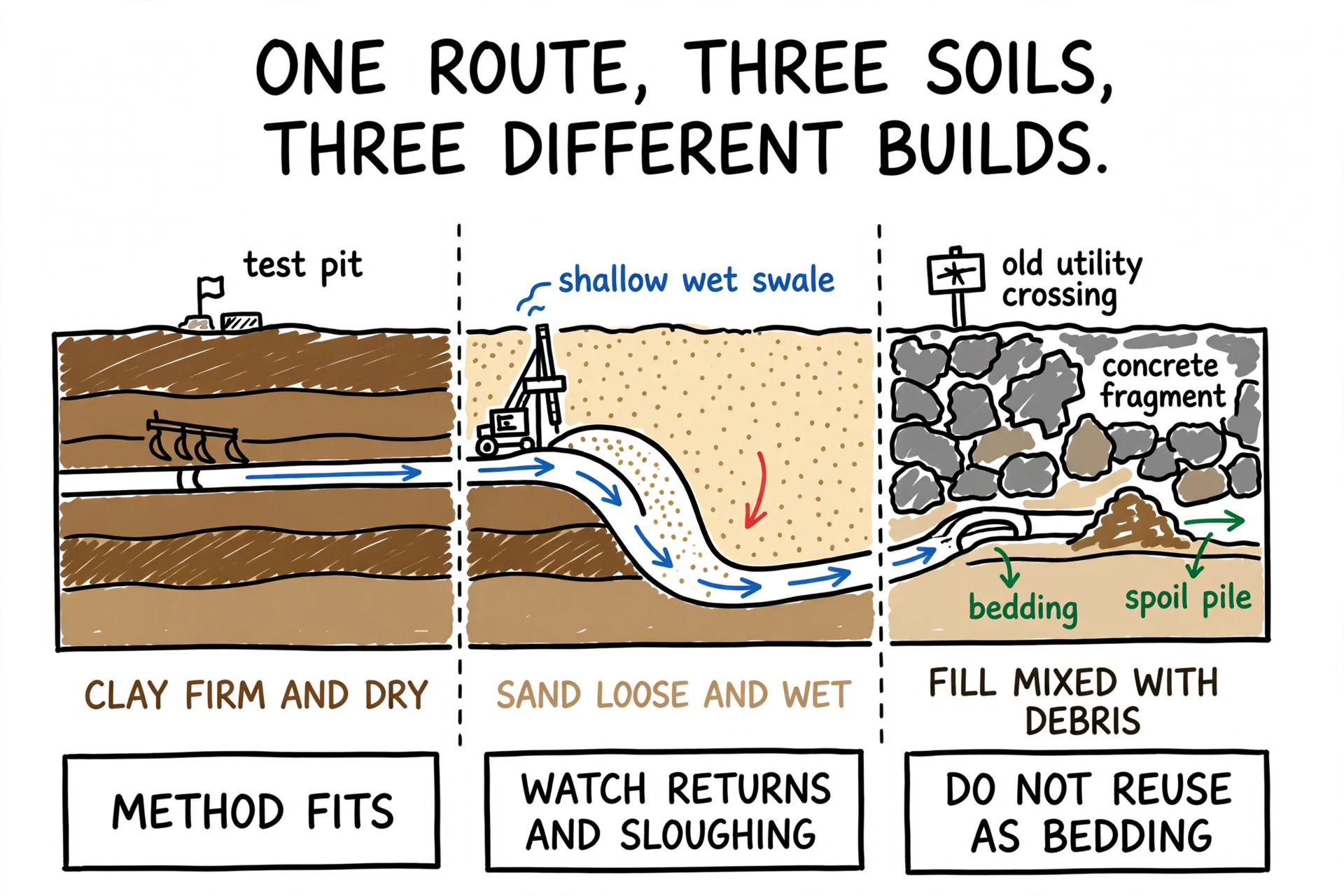
Hypothetical example: a short underground segment planned as a plow job. A hypothetical design calls for direct buried duct to be plowed along the back edge of a hypothetical subdivision, in ground a soil survey map describes in planning terms as a loam. The estimator, Dana, treats the survey as a starting point only, because Dana knows a survey map is not site specific. The preconstruction walk and two test pits dug under the job plan find three segments instead of one.
Segment one, along the higher lots, is a firm clay loam at working depth, dry on the day it was checked. A plow can work in it in general terms, though hard dry clay will be slower going than loam and tool wear will be watched. Segment two, crossing a shallow swale that drains the lots, is loose sand with wet soil at the bottom of the test pit. The plow slit in that sand is expected to close and slough, bedding and support for the duct will be harder to control, and the trench alternative there would need a competent person classification and a protective decision before anyone entered any excavation. Segment three, near an older utility crossing, is fill containing gravel, concrete fragments, and mixed soil with no natural layering. A plow blade meeting concrete fragments risks damage and a broken, uneven path, and a bore through that fill risks deflecting off hard fragments into softer soil.
Dana writes the soil note segment by segment, labeling each claim by source: survey for the planning expectation, test pit observation for what was found, and no claim at all about excavation classification, which is left blank for the designated competent person if any trench is opened. The note goes to the designer and the construction lead before mobilization.
The decision, made by the designated people in this hypothetical, keeps the plow for segment one, changes segment two to a bore with tooling and a fluid plan matched to sand under manufacturer guidance for the drill being used, with returns watched for loss, and changes segment three to a carefully planned open cut only if the competent person system and the job utility potholing plan support it, otherwise to a bore that shifts the alignment inside the permitted corridor to avoid the worst of the fill. Bedding material for any open cut is specified from the contract rather than assumed to be the excavated fill, spoil from segment three is planned for haul off under the job process rather than reuse, and topsoil in segment one is saved and replaced for restoration.
No production rate is promised in the revised plan. The schedule note says only that segment one is expected to be the steadiest work, segment two will be governed by bore and fluid behavior, and segment three is the highest uncertainty and is sequenced last so a further decision there does not strand the other segments. When construction reaches segment two and returns drop in the sand, the crew recognizes the signal from the plan briefing, stops making improvised fluid changes, and reports to the operator lead and the job plan owner, who adjust the bore under manufacturer guidance.
The teaching points are the labeling and the segmentation. The survey was used for what it can do and not blamed for what it cannot. The route was divided where the soil divided, not where the drawing was convenient. Classification was left to the competent person, fluid and tooling to manufacturer guidance and the job plan, and bedding and reuse to the contract. Soil did not make the decision alone, but no honest decision could be made without it.
Key Terms
Soil: the loose and partly loose material at and below the surface above solid rock, made of mineral particles of different sizes plus water, air, and, in upper layers, organic material.
Sand: the largest of the three soil particle size groups in the United States Department of Agriculture system. Sand feels gritty, its grains can usually be seen, water moves through it relatively easily, and clean dry sand does not hold together.
Silt: the middle particle size group. Silt feels smooth or floury, holds more water than sand, and can lose strength when saturated or loose.
Clay: the smallest particle size group. Clay feels sticky when wet and hard when dry, holds water, and gives a soil cohesion, which is the tendency to stick together as a mass.
Loam: a soil mix of sand, silt, and clay in roughly balanced proportions, with no one group dominating. Names such as sandy loam or clay loam show which way a mix leans.
Topsoil: the upper, usually darker soil layer richer in organic material, which supports plant growth and is often saved and replaced separately in restoration.
Fill: soil or other material placed by people to raise ground or backfill an earlier excavation. Previously disturbed soil is ground that has been dug and put back before. Both are less predictable than undisturbed soil.
Competent person: in federal excavation rules, a person capable of identifying existing and predictable hazards and authorized to take prompt corrective action. For excavations, the designated competent person classifies soil and rock deposits and inspects excavations under 29 CFR Part 1926 Subpart P.
Cohesive soil: soil, typically with significant clay content, that sticks together as a mass and does not crumble readily. Granular or cohesionless soil, such as clean sand or gravel, separates into individual grains more readily.
Bedding: material placed under and around a duct or conduit to support it evenly and protect it from sharp or uneven contact, as specified for the job.
Compaction: packing soil or backfill, usually in layers called lifts, to reduce air voids so filled ground supports loads and stays at grade. Acceptance follows the contract specifications and any required testing.
Spoil: material excavated from a trench or pit, plus bore cuttings carried out by drilling fluid, awaiting reuse under the specifications, haul off, or disposal under the job process.
Dewatering: controlling or removing water so work can proceed in wet ground. Named here as a possible soil related need; its methods and decisions are taught in the groundwater lessons and set by the job plan.
Check Your Understanding
- A planner says the soil survey map shows loam for the whole route, so the method is settled. What is wrong with that reasoning, in one or two sentences?
- Name four distinct parts of a build that soil conditions affect, and for one of them explain the effect in plain words.
- A trench wall in clay has stood since morning. A crew member says that proves the soil classification and that no protective decision is needed. What is the correct position?
- On a bore, returns suddenly drop and the spoil coming back changes from clay like to sandy. Name two things that change in soil terms could explain the signal, and state who decides the response and from what sources.
- Excavated fill full of concrete fragments came out of a trench. A crew member proposes using it as bedding around the duct because it came from the same trench. What decides whether that is allowed, and what soil facts argue for caution?
Answer key:
- A soil survey such as the Web Soil Survey is a planning tool built from regional mapping at a survey scale. It seldom contains detailed site specific information, can include small areas of different soil inside a mapped unit, and does not replace on site investigation. It can inform a method decision and tell a planner where to investigate, but it cannot settle the method for working depth on a specific segment.
- Any four of: method choice between trench, bore, and plow; trench wall stability; bore steering and bore hole behavior; drilling fluid performance and returns; bedding and duct support; backfill compaction and later settlement; spoil handling and reuse; restoration success; production pace in general terms; and whether dewatering is needed. Explanation in substance for the chosen one, for example: in loose sand a bore hole can slough and fluid can be lost into the formation, so a fluid and tooling plan written for firm clay will not clean or stabilize the hole the same way, and returns must be watched as a formation signal.
- Standing for a time is not a classification. Under 29 CFR Part 1926 Subpart P, each soil and rock deposit is classified by the designated competent person using at least one visual and at least one manual analysis, and protective system decisions and inspections follow that system. Clay can be fissured, layered, previously disturbed, or affected by water or vibration, and a wall can fail after standing. The crew member observation is reported to the competent person. It does not replace classification, inspection, or a protective decision, and this lesson qualifies no one to make them.
- Soil explanations in substance: the bore has likely crossed a transition, for example from clay into sand, so fluid is being lost into a more open formation, the bore wall is sloughing or cuttings are settling rather than being carried out, or both; a change in return character is a classic transition signal in manufacturer guidance. The response is decided by the operator lead and the job plan owner, using the manufacturer instructions for the actual drill, tooling, and fluid system and the job bore plan. Field crew report the signal promptly and do not invent a fluid recipe or a pressure change on their own.
- The contract specifications for the job, together with any manufacturer instructions for the duct product, decide what material is allowed as bedding. Origin in the same trench grants no permission. In soil terms, fill is previously disturbed and unpredictable, concrete fragments are sharp and hard and can damage or point load a duct and leave voids, and mixed fill will not support the duct evenly the way specified bedding is meant to. The observation is recorded and the specified bedding source is used or the question is raised before covering.
Lesson Takeaway
Soil conditions affect the build because every underground method is a negotiation with a specific mix of sand, silt, clay, rock, fill, and water that changes along the route and down through the layers. That mix helps choose between trench, bore, and plow, governs whether a trench wall holds, how a bore steers and whether its fluid returns, what can bed and backfill a duct, how well backfill compacts, how spoil must be handled, whether restoration stays level and grows, and how steadily production can move in general terms. Learn soil from labeled sources: a soil survey for planning with known limits, a geotechnical investigation or test pit for site specific facts where the job provides one, manufacturer guidance for a specific machine and its fluid, contract specifications for materials and acceptance, and federal excavation rules for safety. Inside that last system, classification and protective decisions belong only to the designated competent person, using visual and manual analysis under 29 CFR Part 1926 Subpart P, and this lesson qualifies you for none of that work. Your work is earlier and just as important: divide the route where the soil divides, describe what you see in plain located words, label the source of every claim, notice transitions, water, fill, cracking, and sloughing, and report mismatches between the planned ground and the real ground before the method, the crew, and the price are committed to the wrong soil.
Sources and Technical References
- Occupational Safety and Health Administration, Appendix A to Subpart P of Part 1926, Soil Classification: scope, definitions of cohesive soil, cemented soil, Stable Rock, Type A, Type B, and Type C in decreasing order of stability, requirement that each soil and rock deposit be classified by a competent person, and requirement for at least one visual and one manual analysis. Federal requirement. General concepts are summarized in this lesson; the appendix procedures and any protective system configuration are not taught here: https://www.osha.gov/laws-regs/regulations/standardnumber/1926/1926subpartpappa
- Occupational Safety and Health Administration, 29 CFR Part 1926 Subpart P, Excavations, Sections 1926.650, 1926.651, and 1926.652: scope and definitions including competent person, specific excavation requirements and inspections, and requirements for protective systems. Federal requirement, cited for the competent person system only. Classification text: https://www.osha.gov/laws-regs/regulations/standardnumber/1926/1926subpartpappa and Section 1926.651 text: https://codes.findlaw.com/cfr/title-29-labor/cfr-sect-29-1926-651/
- United States Department of Agriculture, Natural Resources Conservation Service soil survey material as summarized in Soil Survey Uses and Limitations, Wisconsin extension summary of the National Cooperative Soil Survey: soil survey data seldom contain detailed site specific information, are not intended as primary regulatory tools for site specific permitting decisions, are useful for broad planning, and cannot replace onsite investigation, which is recommended for intensive use of small areas: https://lafayette.extension.wisc.edu/files/2020/11/Soil-Survey-Wisconsin-Uses-and-Limitations.pdf
- Rutgers Cooperative Extension, Web Soil Survey, A Useful Tool to Understand the Natural Soil Properties of Your Farm Field: the Web Soil Survey is operated by the Natural Resources Conservation Service, provides mapped information on texture, drainage, depth, rocks, and slope for more than 95 percent of counties in the United States, and describes soil in map units with layered profile descriptions. Planning source with the limits stated above: https://extension.rutgers.edu/fs1346
- Federal Highway Administration, Geotechnical Aspects of Pavements Reference Manual, Chapter 7, Design Details and Construction Conditions Requiring Special Design Attention: problematic subgrade conditions including collapsible, compressible, expansive, and saturated soils can usually be anticipated through a complete exploration program, and when they are not recognized in design they are often identified during construction, usually resulting in claims and overruns. Geotechnical investigation guidance: https://www.fhwa.dot.gov/engineering/geotech/pubs/05037/07c.cfm
- The Fiber Optic Association, Reference Guide to Fiber Optics, Outside Plant Construction, Underground Construction: trenching, trench bottom and padding to support duct, compaction of padding, and backfill and warning tape practice for underground fiber plant. Industry reference; specific depths and dimensions in that guide are project and jurisdiction facts and are not stated as requirements in this lesson: https://www.thefoa.org/tech/ref/OSP_Construction/Underground_Construction.html
- Ditch Witch West, How Soil Conditions Impact Underground Construction: formation type influences tooling selection, fluid design, steering response, penetration rate, pullback strategy, spoil handling, and production; clay requires control of hydration, balling, and cuttings transport; loose sand requires bore integrity and fluid loss management; geotechnical reports, test pits, potholing, and prior work are subsurface information sources for the bore plan. Manufacturer dealer guidance: https://www.ditchwitchwest.com/blog/rock-clay-or-sand-how-soil-conditions-change-your-underground-construction-strategy/
- Vermeer guidance as reported in Trenchless Works, Insights from Vermeer UK on adapting HDD techniques: soil can vary dramatically within a single bore; rock requires rock tooling and steady control, sticky and reactive clay requires fluid management to reduce adhesion and swelling, and mixed soils require anticipation of transitions, monitoring of torque, thrust, and returns, a geotechnical survey before drilling, and fluid matched to lubrication, stability, and cuttings transport. Manufacturer guidance: https://www.trenchless-works.com/drilling-through-tough-ground-conditions/
- For Construction Pros, Putting HDD Power to the Project, with Ditch Witch and Vermeer sources: torque, pullback, horsepower, and drilling fluid must be balanced as a system matched to ground conditions; torque demand generally rises in difficult ground such as rock and clay and to some extent sand; fluid lubricates tooling and product and carries spoils out of the hole. Industry and manufacturer guidance, no rates or recipes taken from this source: https://www.forconstructionpros.com/equipment/worksite/underground/article/10117622/putting-hdd-power-to-the-project
Flagged for verification: no numerical depth, clearance, bend radius, pulling tension, slope, bench configuration, compaction percentage, fluid recipe, or production rate is stated as a requirement in this lesson, because those values are contract, manufacturer, engineering, or standard specific for a given job. Where a value would be needed to build, this lesson directs the reader to the governing source for that job instead of supplying a number.
Previous lesson: Lesson 103: Why Does Utility Congestion Matter? |
Back to Level 5 hub |
Next lesson: Lesson 105: Why Does Rock Affect the Build?