
Introduction
Permitting constraints are the limits written into an approval that control where work may happen, when it may happen, how it may be done, and what must happen before, during, and after the work. A route can look buildable on a map and still fail the buildability test once those written limits are read closely.
This lesson teaches constraints as a buildability check inside Level 5. It covers how to read the actual approval, how to sort the different kinds of limits, and how to decide whether the crew can meet every condition as written or must pause and get direction before work starts.
What This Lesson Gives You
- Read an issued permit and pull out every condition that limits location, time, method, notice, inspection, or restoration.
- Sort constraints by who issued them, and say which document controls when two approvals point in different directions.
- Test a planned work method against the permit conditions before mobilizing, and name the mismatch in plain language.
- Recognize an expired permit, a permit that has not yet been issued, and a field condition the permit does not cover.
- Stop and escalate in the right way when a condition cannot be met as written, without working outside the approval.
Start With the Basics
Think about a driver’s license. The license gives permission to drive. The conditions printed on or tied to that license still limit the driving. A corrective lenses restriction, a vehicle class limit, and an expiration date each control a different part of how the permission may be used. Holding the card does not erase the conditions on the card.
A permit works in a similar way. The permit is the written approval from an authority that allows specified work in a specified place. The constraints are the conditions inside that approval and in the documents it references. The crew follows both. Permission without reading the conditions is only half of the approval.
What Is It?
A permitting constraint is any enforceable limit stated in a permit, in its attached conditions, or in a standard, plan, or agreement the permit incorporates by reference. If the permit says the work must follow an attached traffic plan, a restoration standard, or a set of general conditions, those referenced requirements carry the same weight as text printed on the permit face.
The permitting authority is the agency, owner, or organization with the legal right to approve work in that ground or corridor and to set conditions for it. Authorities differ by location. A city or county controls many local streets. A state department of transportation controls state highway right of way. A railroad controls its own corridor as a private owner. The United States Army Corps of Engineers administers Section 404 of the Clean Water Act for discharges of dredged or fill material into waters of the United States, including wetlands.
A right of way permit, also called an encroachment or occupancy permit in some jurisdictions, is an approval to install, cross, or work within a right of way, which is land set aside for public or utility use, such as a road corridor. Federal policy for Federal-aid and direct Federal highway projects frames this clearly. Under 23 CFR Part 645, Subpart B, which applies to the right of way of Federal-aid or direct Federal highway projects, utilities may be accommodated when the use does not adversely affect highway or traffic safety, does not otherwise impair the highway or its aesthetic quality, and does not conflict with federal, state, or local laws or regulations, and state transportation department policies must address location and clearances, installation methods, preservation and restoration, and traffic protection during and after installation.
Constraints fall into common families. A single permit can carry several families at once:
- Work limits. The approved segment, side of the road, crossing point, or work area boundary, and ground outside that boundary where work is not authorized.
- Time limits. Allowed work hours, allowed days, seasonal or event restrictions, start deadlines, and the permit expiration date stated in the permit for that job.
- Method restrictions. Required or prohibited construction methods, such as a required crossing method, limits on open excavation, or a requirement to follow an approved plan for work in regulated waters.
- Traffic control conditions. A requirement to follow an approved traffic control plan, which is a plan showing how vehicles, bicycles, and pedestrians will be guided through or around the work zone. Temporary traffic control on public roads follows Part 6 of the Manual on Uniform Traffic Control Devices, called the MUTCD, published by the Federal Highway Administration.
- Notice and inspection conditions. Advance notice to the authority before starting, notice before a covered phase, inspection scheduling, and keeping a copy of the approved permit available at the job site where the permit requires it.
- Restoration standards. Requirements to restore pavement, shoulders, vegetation, drainage features, and other disturbed surfaces to the condition or standard stated in the permit or its referenced standard.
- Special conditions. Added requirements tied to the place, such as railroad flagging, erosion controls, protection of regulated waters or habitat, utility clearance steps, insurance or agreement requirements, and site specific directions from the issuing authority.
A constraint differs from the permit itself in a practical way. The permit answers whether the work is authorized at all. Each constraint answers a narrower question about how that authorization may be used. Lesson 86 covers what a permit is. Level 6 covers permit types in detail. This lesson stays on the constraints, because constraints are where a buildable design often becomes an unbuildable plan.
What Does It Look Like?
Constraints live on paper and on screens before they live in the field. A beginner can learn to find them by reading the full approval package, not only the first page.
Parts of an approval package to read every time:
- The permit face, with the permit number, the authorized work, the location, the issue date, and the expiration date.
- A conditions sheet or standard provisions attachment listing general conditions that apply to every permit from that authority.
- Special conditions written for this job, this segment, or this crossing.
- Referenced attachments, such as an approved traffic control plan, approved drawings, a restoration standard, or a signed agreement.
- Notes on drawings that repeat or add a permit condition, such as a flagging note at a railroad crossing or a notice note at a regulated water crossing.
Field signs that a constraint is active at a work location:
- Posted or staged traffic control devices that match an approved plan, with advance warning signs before the work area.
- Flagging personnel or a railroad flagger present where the approval requires one, before equipment enters the controlled area.
- Marked work limits, such as stakes, paint, fencing, or barriers, showing the boundary of the authorized area.
- Erosion and sediment controls installed at a drainage or water feature before ground disturbance begins inside the controlled area.
- A permit copy held by the foreman, with conditions highlighted or briefed at the start of shift.
A missing document is also a visible condition. A crew that cannot produce the permit, cannot name its expiration date, or cannot show the attached conditions is working from memory. Memory is not a control.
What Does It Do?
Constraints control risk by turning general permission into specific, checkable instructions.
A work limit keeps the crew inside ground where the authority has reviewed the plan, where other utilities and features have been considered, and where the crew has a legal right to be. Work outside the limit is work without that review, even when the physical task looks identical.
A time limit protects other uses of the corridor. Work hours are a common municipal permit condition. The permit for that job states the hours that apply, and the reasons for those hours, where the authority states them, are read from that permit and its instructions rather than assumed from another job. The exact hours belong to the permit for that job. One city’s allowed hours never prove another city’s hours, and a highway corridor can carry different hours from a neighborhood street in the same city.
A traffic control condition protects road users and workers at the same time. The MUTCD treats the needs and control of all road users through a temporary traffic control zone as an essential part of utility work, and it describes a traffic control plan as the document that shows how road users will be guided through or around the zone. The permit constraint makes that plan enforceable for this job at this location.
A restoration standard protects the asset the authority owns and the public uses after the crew leaves. State utility accommodation policies under 23 CFR 645.211 must address specifications for installation and requirements for preservation and restoration of highway facilities and natural features on the right of way. Municipal permits carry their own restoration language for their own streets and surfaces. The crew restores to the standard named in its permit.
A notice or inspection condition gives the authority a chance to witness a phase that will soon be covered or hard to verify. Examples include notice before starting work, notice before backfill or surface restoration, and a final inspection after restoration. The timing for each notice belongs to the permit for that job.
An expiration date keeps the approval current. Conditions, traffic patterns, nearby projects, and ground conditions change. An expired permit means the written authorization has ended under its own terms. Work needs a renewed or new approval before it proceeds, as the issuing authority directs.
A method restriction protects a feature that a different method would harm. Section 404 illustrates the pattern at the federal level. That program regulates discharge of dredged or fill material into waters of the United States, and the Corps and the Environmental Protection Agency apply an avoid, minimize, and compensate sequence for wetland impacts. General permits under that program allow categories of activities with minimal adverse effects only when the general and specific conditions are met. A constraint requiring a trenchless crossing, a matting system, or work from the bank is the field expression of that same protect the feature logic.
Where Does It Fit?
Constraints enter the buildability decision early, and they stay active through closeout.
At route review, the planner lists every corridor and feature the route touches, such as local streets, state highway right of way, railroad property, and regulated waters. Each touch point can bring its own authority and its own conditions.
At design, the designer selects locations and methods that can satisfy the expected conditions. A crossing placed where a required method can actually be performed is a buildable crossing. A crossing placed where the required method has no room for entry, exit, or equipment is a redesign problem found on paper.
At permit application, the applicant submits drawings, traffic plans, method statements, insurance documents, and agreements the authority requires. Railroad utility occupancy shows how complete that package can be. A railroad application can require stamped engineering plans that follow American Railway Engineering and Maintenance-of-Way Association guidance, a certificate of insurance, a signed agreement, and flagging arrangements, with no construction scheduled on railroad property until final approval has been issued.
At preconstruction review, the foreman and the inspector read the issued permits together and compare each condition against the crew, the equipment, the schedule, and the work method planned for each segment. Conflicts surface here, while changing a method or a date is still a planning task.
During construction, constraints govern daily choices: where the bore rig may set up, when a lane may be restricted under the approved plan, when notice must go in before the next phase, and when an inspector or flagger must be present.
At closeout, restoration, final inspection, and any required reports close the conditions. A permit is fully satisfied only when its closing conditions are met and accepted as the permit requires.
What Is at Stake
Stop work and removal. Work performed outside permit conditions can draw a stop work direction from the issuing authority. Work placed outside the authorized area or by a prohibited method can be ordered corrected or removed at the permittee expense under the permit terms and the authority rules. A day saved by ignoring a condition can become weeks spent undoing the work.
Safety. Traffic control, railroad flagging, and work hour conditions exist to separate moving traffic, trains, pedestrians, and workers. Texas Department of Transportation railroad guidance states that a flagger is required when work falls within a stated distance of the nearest rail or may foul the track, and that the railroad holds final authority on when flagging is needed. Skipping a required flagger or a required traffic setup trades a scheduling convenience for a life safety exposure.
Damage to protected features. Filling, grading, or discharging material in regulated waters without meeting Section 404 conditions risks harm to waters and wetlands that the permit was written to prevent. The Texas Department of Transportation compliance guidance warns that failure to comply with permit conditions can result in work stoppages by the Corps or the department.
Schedule. An expired permit, a missing flagger, a missing inspection, or a method the crew cannot perform stops production just as firmly as broken equipment. Constraint problems found during the preconstruction read can be resolved as a planning task before equipment moves. The same problems found by an inspector in the field can stop the affected work until the authority gives direction, so earlier discovery avoids the stop.
Cost. Re-restoration to the named standard, standby time while approval is sorted out, re-mobilization after a stop, and fees or charges the permit or agreement assigns to the permittee all land on the job. The permit and the agreement for that job state who bears each cost. Assumptions from another job do not transfer.
Trust and future permits. Authorities remember permittees who work clean and permittees who work loose. Authorities keep records of permit compliance, and a permittee should expect its compliance history to be available to the authority on later work. Whether that history affects a later application, its timing, or its conditions is set by that authority and its rules, and it should be confirmed with the authority rather than assumed.
What Does Good Look Like?
- A complete permit package sits on site, with the permit face, general conditions, special conditions, and referenced plans together in one place.
- The foreman can state, for the segment being built that day, the work limits, the allowed hours, the expiration date, and the next notice or inspection step, without guessing.
- The planned method for each crossing and each work area matches the method the permit allows, and the crew and equipment on site can perform that method.
- Traffic control staged in the field matches the approved traffic control plan for that location and phase.
- Required flaggers, inspectors, and notifications are scheduled before the phase that needs them begins.
- Restoration materials and methods on site match the restoration standard named in the permit.
- Any conflict between two approvals, or between a permit condition and field reality, is written down, raised to the project lead, and resolved with the issuing authority before the affected work starts.
From the Field
Picture a two-person review in a job trailer the morning before a short segment is scheduled to start. The segment crosses a city street, runs along a state highway shoulder, and ends with a crossing under a drainage feature that carries water after rain. Three approvals cover the segment, one from the city, one from the state, and one general authorization covering work near the drainage feature with conditions attached.
The foreman lays the three packages side by side and reads the conditions out loud while the inspector checks the work plan. The city approval limits lane restrictions to the hours printed on its conditions sheet. The state approval requires the approved traffic control plan for shoulder work and advance notice before starting. The drainage authorization requires erosion controls in place before ground disturbance and limits the crossing to a trenchless method inside the marked work area.
The planned schedule assumed lane restrictions could begin early to beat traffic, and the planned crossing assumed an open excavation because the bore equipment was committed on another segment that day. Reading the conditions exposed both mismatches before any equipment moved. The schedule conflict came from comparing the city hours against the crew start plan. The method conflict came from comparing the trenchless condition against the available equipment list.
The project lead faced a choice. One path was to start anyway and hope no inspector compared the field work against the paper. The other path was to resequence the day, complete the shoulder work that fit every condition, request direction from the city on the lane timing, and hold the crossing until the bore equipment could perform the required method.
The lead chose the second path. The crew built the compliant portion, the crossing waited one day for the right equipment, and the inspections that followed found field work matching the paper at each check. The segment finished without a stop work direction and without re-restoration.
The decision rule is direct: read every condition for the segment before the day is planned, compare each condition against the hours, the method, the equipment, and the notices for that day, and hold any part of the work that cannot meet its condition as written until the issuing authority gives direction.
What Can Go Wrong?
Working from the permit face alone. The face grants the approval. The attached and referenced conditions carry many of the limits that control the day. A crew that reads only the face can violate hours, notice, traffic, or restoration conditions while holding a valid permit.
Working on an expired permit. The authorization has ended by its own date. Continuing to build treats an expired document as if it were current, and the authority can stop the work and require renewal before any further progress.
Working before issuance. An application submitted is not an approval granted. The Canadian National occupancy packet makes the line plain for work on that railroad: in no event shall construction related activities be scheduled or conducted on railroad property until the railroad has issued final approval, a written agreement has been signed, and flaggers have been secured, and other railroads impose their own approval, agreement, insurance, and flagging terms that must be read the same way. Starting early places the crew on property without permission.
Assuming one permit covers another corridor. A city permit does not authorize state highway work, and a state permit does not authorize railroad work. Each authority controls its own ground. A segment that crosses three corridors can need three approvals, each with its own conditions.
Conflicting conditions left unresolved. Two approvals can require different hours, different traffic setups, or different restoration details where their areas overlap or adjoin. Building to one and ignoring the other creates a violation by choice. The conflict belongs to the issuing authorities and the project lead to resolve before work.
A condition discovered in the field. Ground truth can differ from the application drawings. A crew can find an unmarked drainage feature, a work area smaller than the drawing showed, or a surface that cannot be restored with the planned method. Treating the discovery as a reason to improvise outside the permit turns a manageable question into an unauthorized act.
Missing a notice or inspection step. A phase covered before the required inspection cannot be witnessed as the condition intended. The authority can require exposure, testing, rework, or added documentation, as its rules and the permit terms provide.
Restoration below the named standard. A surface that looks acceptable to the crew can still fail the permit standard for material, compaction, thickness, or finish. The standard in the permit controls acceptance. The crew opinion does not replace it.
What Should Someone Notice in the Field?
- Hold the full permit package and confirm the permit number, the location, and the expiration date match the segment about to be built.
- Mark the authorized work limits on the ground or on the plan, and check rig setup, entry and exit points, staging, and spoil placement against those limits.
- Compare the day planned hours against the hours printed in the permit conditions for that corridor.
- Compare the traffic control staged in the field against the approved traffic control plan, device by device and sign by sign.
- Confirm required notice has been given and required inspectors or flaggers are scheduled or present before the phase that needs them starts.
- Check that erosion controls and other special condition protections are installed before ground disturbance in the controlled area.
- Confirm the construction method about to be used is the method the permit allows for that crossing or work area.
- Watch for field conditions the permit does not cover, such as an unmapped water feature or a work area that cannot hold the required setup, and report the finding the same day.
- Read restoration in progress against the restoration standard named in the permit, while correction is still simple.
- Know the boundary: reading permits and reporting mismatches is an observer and planning task. Only the issuing authority can change, waive, or reinterpret its own condition, and only qualified people may perform regulated work such as railroad flagging duties or work in regulated waters under the applicable authorization. When a condition cannot be met as written, stop the affected work and escalate to the project lead and the issuing authority.
Key Terms
Permitting constraint: An enforceable limit stated in a permit, its attached conditions, or a document the permit references, controlling where, when, how, or under what conditions work may proceed.
Permit: A written approval from an authority allowing specified work in a specified place, subject to its conditions.
Permitting authority: The agency, owner, or organization with the legal right to approve work in a corridor or feature and to set conditions for it.
Right of way: Land set aside for public or utility use, such as a road corridor, where work follows the controlling authority permit and rules.
Right of way permit: An approval to install, cross, or work within a right of way, called an encroachment or occupancy permit in some jurisdictions.
Traffic control plan: A plan showing how vehicles, bicycles, and pedestrians will be guided through or around a work zone, following the MUTCD and any state supplement.
MUTCD: The Manual on Uniform Traffic Control Devices, published by the Federal Highway Administration, the national standard for traffic control devices on any street, highway, bikeway, or site roadway open to public travel.
Restoration standard: The condition, material, and finish requirements in the permit for returning disturbed surfaces and features after work.
Expiration date: The date printed in the permit after which the authorization ends under its own terms.
Flagging: Protection provided by trained personnel who control traffic or warn of trains, required by some permits and agreements for work in roadways or near railroad tracks.
Check Your Understanding
- What is the difference between a permit and a permitting constraint?
Answer: The permit is the written approval that authorizes specified work in a specified place. A constraint is one enforceable limit inside that approval, or in a document it references, controlling where, when, how, or under what conditions the authorized work may proceed. Holding the permit does not erase its constraints.
- A segment needs shoulder work on a state highway. Where does the crew find the traffic, location, installation, and restoration expectations that shape the state approval?
Answer: In the issued state permit and its conditions and referenced plans. For Federal-aid and direct Federal highway projects, 23 CFR Part 645, Subpart B requires state utility accommodation policies to address location and clearances, installation specifications, preservation and restoration, and traffic protection during and after installation, and the state permit applies the state policy adopted under state law to the specific segment.
- In the From the Field scenario, what two mismatches did the morning read find, and what decision followed?
Answer: The city hours conflicted with the planned early lane restrictions, and the drainage authorization required a trenchless crossing while the bore equipment was committed elsewhere and open excavation had been assumed. The lead resequenced the day to work that fit every condition, sought direction on lane timing, and held the crossing until equipment that could perform the required method was available.
- A foreman discovers the permit for the next segment expired the previous week. The design has not changed. What is the correct action?
Answer: Hold the work on that segment and escalate to the project lead to obtain a renewed or new approval from the issuing authority before building. An expired permit means the written authorization has ended under its own terms, even when the design is unchanged.
- During a bore, the crew finds a small drainage channel inside the work area that appears on no drawing and in no permit. What should happen?
Answer: Pause the affected work, protect the feature, document the finding with photos and location, and report it to the project lead the same day so the permitting question can be put to the issuing authority. Work in regulated waters is governed by authorizations such as Section 404 with conditions to meet, so the crew does not improvise a new method or a new disturbance area on its own.
Lesson Takeaway
A permit tells a crew it may build. Its constraints tell the crew whether the build planned for today, with this method, in these hours, inside these limits, is the build that was actually approved. Reading the full approval before the day is planned turns surprises in front of an inspector into decisions made in the trailer, where they cost the least.
Sources and Technical References
Federal Highway Administration, 23 CFR 645.205, policy that utility facilities may be accommodated on the right of way of a Federal-aid or direct Federal highway project when the use does not adversely affect highway or traffic safety, and 23 CFR 645.211, requirements for state transportation department accommodation policies on location and clearances, applicable codes, installation specifications, preservation and restoration, and traffic protection during and after installation.
Federal Highway Administration, Manual on Uniform Traffic Control Devices, 11th Edition, December 2023, Part 6, Temporary Traffic Control, Chapter 6B on fundamental principles, Chapter 6C on temporary traffic control elements and traffic control plans, and Chapter 6N on types of temporary traffic control zone activities including utility work.
United States Environmental Protection Agency, Wetlands Regulatory Authority, Section 404 of the Clean Water Act, on the permit requirement for discharge of dredged or fill material into waters of the United States, the avoid, minimize, and compensate sequence, and general permits applying when their conditions are met: https://nepis.epa.gov/Exe/ZyPURL.cgi?Dockey=100048AJ.txt
United States Army Corps of Engineers, Albuquerque District, Section 404 Jurisdiction, on Corps authorization for discharge of dredged or fill material into waters of the United States including wetlands, for permanent and temporary work: https://www.spa.usace.army.mil/Missions/Regulatory-Program-and-Permits/Jurisdiction/Section-404/
Texas Department of Transportation, Complying with US Army Corps of Engineers Requirements for Work in Waters of the United States, Section 404, on obtaining the permit before work, keeping the permit accessible, following all permit conditions and best management practices, and work stoppages for failure to comply: https://www.txdot.gov/content/txdotoms/us/en/manuals/cst/cah/environment/water_resources-cfadfcff/complying_with_us_armycorps_of_engineers_requireme.html
Canadian National Railway, Utility Crossing and Encroachment Application Packet, on railroad utility occupancy requirements including stamped plans following AREMA guidance, insurance, signed agreement, flagging, and no construction on railroad property until final approval: https://ecprod.cn.ca/corp/-/media/files/delivering-responsibly/safety/utility-installation/utility-crossing-encroachment-application-packet.pdf
Texas Department of Transportation, Railroad Operations Manual, Chapter 3, Maintenance Projects, on railroad flagging triggers, railroad final authority on flagging need, railroad protective liability insurance, and right of entry agreements: https://www.txdot.gov/manuals/rrd/rho/maintenance_projects.html
Town of Timnath, Colorado, Right of Way Permit Applicant Instructions, an example municipal permit instruction set covering work hours and schedule restrictions, advance notice and inspection scheduling, restoration to technical criteria, permit expiration, keeping the approved permit on site, and stop work for noncompliance. Values shown belong to that town permit program only: https://timnath.org/wp-content/uploads/2026/08/ROW-Application-Instructions.pdf
City of Emeryville, California, Standard Provisions to Encroachment Permit, an example municipal standard provisions set covering notice before starting work, inspection, work hour conditions, restoration, and final inspection. Values shown belong to that city permit program only: https://www.emeryville.org/files/assets/city/v/1/police/documents/permits/standard-provisions-to-encroachment-permit_11292021_202111291718330518.pdf
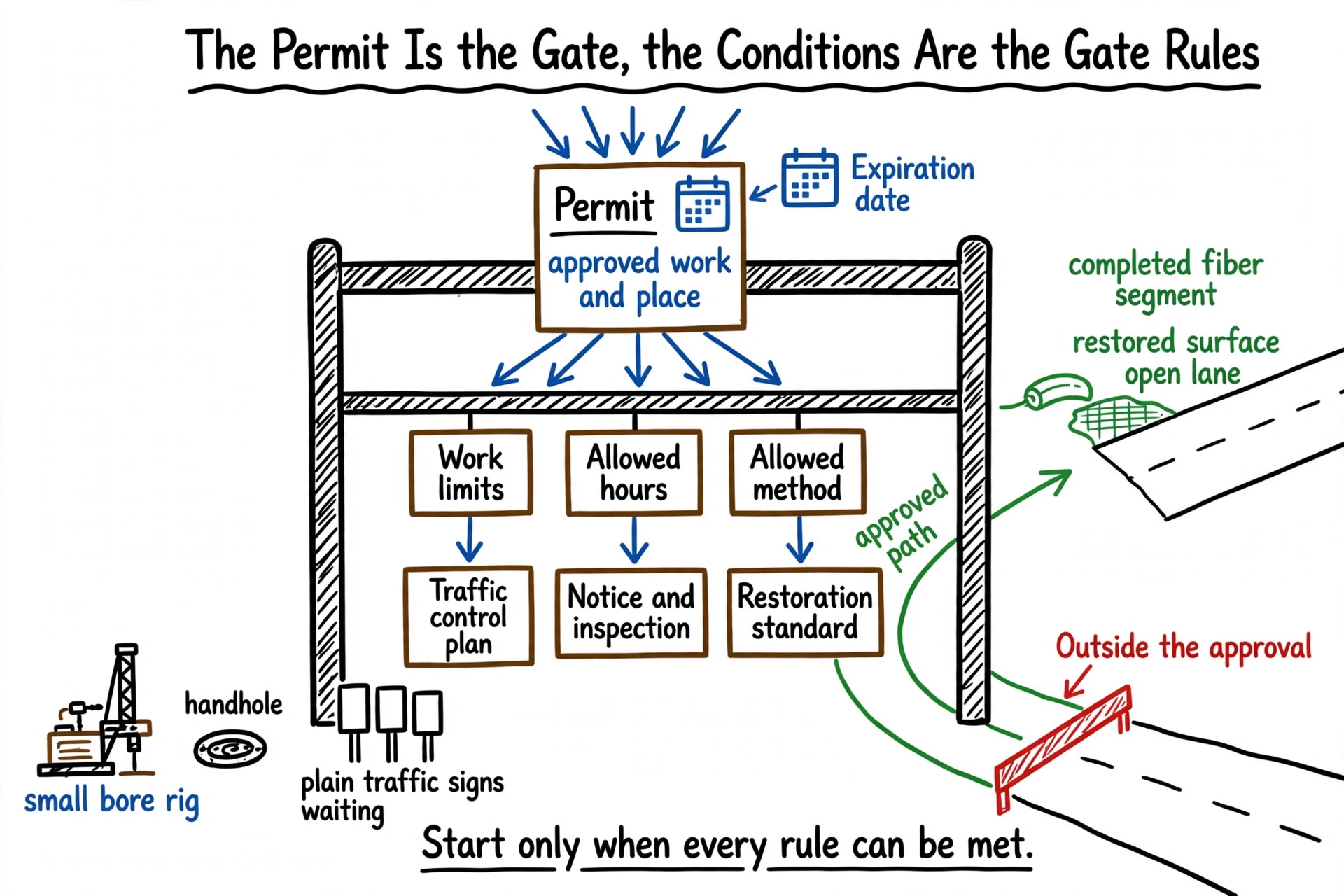
Graphic Brief 1: Main Illustration
Graphic title: The Permit Is the Gate, the Conditions Are the Gate Rules
Main objects: A whiteboard drawing of a fiber work segment passing through a large gate structure across the middle of the board. The gate frame carries a permit document panel. Six condition panels hang on the gate as labeled rule boards: work limits, hours, method, traffic control, notice and inspection, and restoration. A bore rig, a handhole, and traffic signs wait on the near side of the gate. Approved path markings lead through the gate to the completed segment on the far side.
Placement: Gate across the center, slightly above middle. Permit document panel at the top center of the gate. Condition panels in two rows of three on the gate. Crew equipment at the bottom left on the near side. Completed segment, restored surface, and open lane at the top right on the far side. White space at the top for the title and at the bottom for the key teaching point.
Labels: Permit, approved work and place. Work limits. Allowed hours. Allowed method. Traffic control plan. Notice and inspection. Restoration standard. Expiration date. Start only when every rule can be met.
Arrows and relationships: Blue arrow from the permit panel down to each condition panel, showing the conditions come from the approval. Green arrow through the gate along the approved path, showing work proceeds when every condition can be met. Red stop bar across a side path that bypasses the gate, labeled Outside the approval. Black arrows from the expiration date label to a calendar symbol on the permit panel.
Important technical details: The gate represents authorization for specified work in a specified place, following the permit definition in the lesson. No hours, dates, distances, depths, fees, or clearance numbers appear anywhere, since those values belong to the permit for that job. The traffic signs are generic shapes with no invented MUTCD device specifications. The drainage feature on the far side is crossed by a trenchless path line, showing a method condition without stating a dimension.
What not to show: No crew working outside the gate path. No expired permit shown as usable. No railroad train, flagger action scene, or excavation in water. No agency logos, permit numbers, or fee amounts. No decoration or extra labels.
Key teaching point: The permit grants the work. Its conditions govern where, when, how, and under what steps the granted work may actually proceed.
Graphic Brief 2: Added Visual
Graphic title: Read the Conditions as a Checklist Before the Day Is Planned
Main objects: A whiteboard checklist sequence drawn as five connected gates in a row, each gate representing one check from the lesson. Gate 1 shows a map boundary for work limits. Gate 2 shows a clock face with no numbers for allowed hours and expiration. Gate 3 shows a bore path under a drainage line for allowed method. Gate 4 shows traffic signs and a flagger figure for traffic, notice, and inspection. Gate 5 shows a restored road surface and grass strip for restoration. A green check box sits above each gate, and one gate in a second small row shows a red hold sign where a condition cannot be met, with an arrow looping back to a phone symbol labeled Ask the issuing authority.
Placement: Five gates in a horizontal row across the middle of the board, numbered 1 through 5. Small hold example in a row below gates 3 and 4. White space at the top for the title and at the bottom for the key teaching point.
Labels: 1. Limits match the ground. 2. Hours and dates are current. 3. Method matches the permit. 4. Traffic, notice, inspection, flagging ready. 5. Restoration standard on site. Hold. Escalate before work.
Arrows and relationships: Green arrows flow from gate to gate in sequence, showing the read happens in order before mobilizing. A green check appears only after each gate symbol. A red arrow from the hold gate loops back to the phone symbol, showing escalation returns to the authority rather than to field improvisation.
Important technical details: The sequence matches the preconstruction read taught in the lesson: limits, time, method, traffic and notice, restoration. No hours, notice periods, distances, or dimensions appear, since those values belong to the permit for that job. The clock carries no numerals. The bore path shows direction only, with no depth or clearance callouts.
What not to show: No check mark on the hold gate. No crew bypassing a gate. No invented agency names, forms, or fee figures. No decoration or extra labels.
Key teaching point: Buildability is a checklist result. A segment is ready only when every condition gate passes, and any failed gate means hold and escalate, never improvise.
Previous lesson: Lesson 111: What Are Environmental Constraints? |
Back to Level 5 hub |
Next lesson: Lesson 113: What Is a Preconstruction Walk?