
What You Are Learning
By the end of this lesson you will be able to explain the underground or aerial choice as a decision made segment by segment along a route, not as a single slogan for a whole project. You will be able to name the main factors that push a segment one way or the other: whether usable poles already exist and what condition and space they have, what make-ready work those poles would need, whether the pole owner will permit the attachment, how crowded the ground already is with other utilities, what the soil and rock allow, what crossings the segment must make, whether a local rule requires underground placement in that place, how exposed aerial plant is to storms and falling trees, how exposed underground plant is to digging damage and how much locate work it creates for its whole life, what surface restoration each method requires, and how crews will reach the plant later for repair. You will be able to recognize which method a built segment uses from field clues, and to name the transition points where a route changes from one method to the other. You will also be able to state the boundary clearly: the choice belongs to the designer and the network owner, working under permits, pole agreements, and applicable codes and standards. A field crew builds the issued design and reports conditions that do not match it. Reading this lesson does not qualify you to choose a method, to climb or work on a pole, or to excavate.
Start With the Basics
Outside plant, usually shortened to OSP, is the part of a fiber network built outdoors: cables, the structures that support or contain them, splice closures, and access points, all placed between buildings and network equipment. This lesson is about the two basic ways OSP cable is placed.
Aerial placement means the cable travels above ground, supported from pole to pole. In the most common form, a steel support wire is installed between poles first, and the fiber cable is fastened to that wire. A self-supporting cable combines the support and the fiber cable into one assembly, or carries its own strength members, so no separate support wire is needed. Those supporting parts have names you need before going further.
A pole is a vertical structure, most often wood, but also concrete, steel, or composite, set in the ground to carry utility lines above the surface. A messenger, also called strand or a support strand, is the steel wire strung between poles that carries the weight of a lashed cable. Lashing is the process of binding a fiber cable to the messenger with a thin wire wrapped around both, so the messenger carries the load and the fiber cable rides under or beside it. The communications space is the portion of a pole reserved for communications attachments, separate from the space used for electric power conductors. Where each attachment may sit on a pole, and how much clearance must be kept from other attachments, from power conductors, and from the ground, is set by applicable codes and standards, by the pole owner rules, and by the permit or agreement for that pole. This lesson names no clearance numbers, because the correct number for a given pole comes from those sources for that job, not from a general lesson.
Underground placement means the cable travels below the surface. In the most common form for new fiber work, the cable is pulled or blown through a pipe system placed in the ground first. That pipe is called conduit, or duct. A smaller duct placed inside a larger conduit is often called innerduct. A handhole is a buried access box, set with its lid at or near the surface, where conduit runs meet and where crews can pull cable, store slack, or reach a splice. A larger underground access structure is often called a vault or a maintenance hole. Some cable is placed directly in the ground without conduit. That method is called direct buried placement, and it uses cable built for contact with soil. Trenching is open digging along the route. Boring, including horizontal directional drilling, is a trenchless method that creates an underground path without opening the full surface above it. Restoration is the work of putting the surface back after construction: soil, grass, pavement, sidewalks, driveways, and landscaping returned to the condition the permit or the owner requires.
Make-ready is a term you will hear constantly around aerial work. Make-ready is all the work that must happen on an existing pole before a new attachment can be added lawfully and safely. It can include moving existing attachments to create space, replacing hardware, correcting an existing clearance or condition problem, and in some cases replacing the pole itself with a taller or stronger one. Make-ready is defined and priced through the pole owner process for the job. It is not a casual favor between crews.
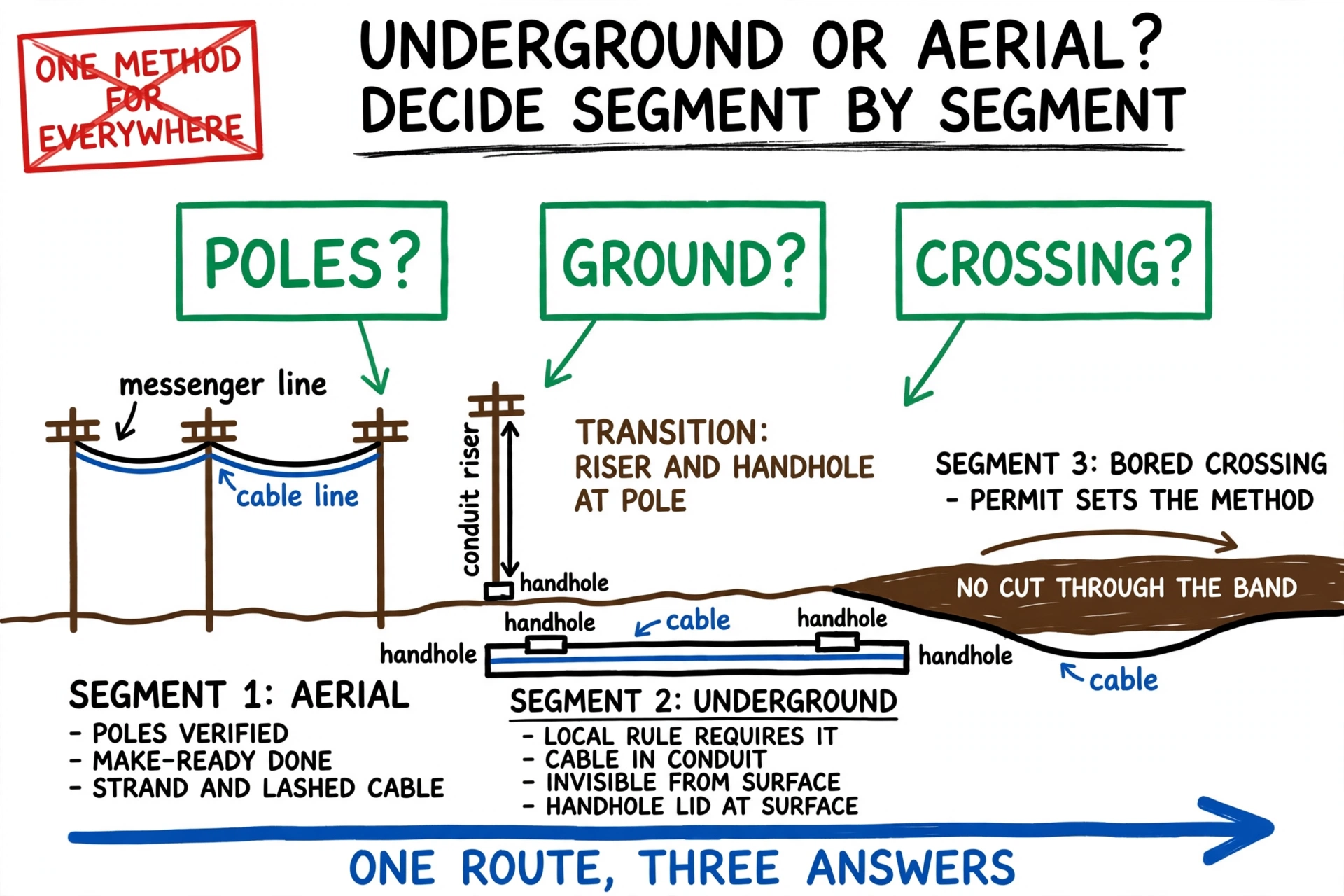
A segment is a distinct portion of a route with its own conditions: for example, the run along one street, the crossing of one road, or the stretch through one subdivision. A route is the full path from one end of the build to the other. The central fact of this lesson is that the underground or aerial question is answered for segments, and the answers are then joined at transition points. A riser is one common transition: a conduit that carries cable up a pole, so underground plant becomes aerial plant at that pole, or the reverse. A crossing is any place the route must pass over, under, or through something else: a road, a railroad, a river or stream, a driveway, or another utility corridor.
A permit is written permission from the authority that controls a place, such as a city, county, state highway agency, railroad, or private landowner, to build in that place under stated conditions. An easement is a legal right to use a defined strip of another party land for a stated purpose, such as placing and maintaining utility plant. A right of way is the land, often along a road, that is set aside for public use and for utilities. The designer works inside all three. A crew does not create them by arriving on site.
One more term controls much of the underground side. A locate is the marking, usually with paint or flags at the surface, of the approximate position of an existing underground utility, requested through the one call system before digging. In the United States, 811 is the national number to request locates before digging. State law sets the notice period, the marking duties, and the digging rules for the work location, and those details vary by state. Locating is not a one time event at construction. Every future dig near buried plant, for decades, depends on records and locates again.
What Is It?
The underground or aerial choice is the design decision, made for each segment of a route, that determines whether the fiber cable for that segment will be supported above ground on poles or placed below ground in conduit, in duct, or directly buried.
It is a comparison, not a preference. For each segment the designer weighs what already exists, what the ground and the surface allow, what rules apply to that place, what risks each method carries over the life of the plant, and what the whole life cost and maintenance burden look like, under the budget and the requirements the network owner has set. The Fiber Optic Association (FOA) design guidance makes the same starting point this lesson teaches: the choice of OSP components begins with developing the route the cable plant will follow, and cable designs themselves are optimized for the application type, with different designs for conduit, buried, and aerial use. The method and the materials are chosen together, for a specific segment.
The choice has three possible answers per segment, not two. A segment can go aerial. A segment can go underground. Or a segment can be the place where the route changes methods, with a designed transition such as a riser at a pole or a handhole beside a pole where underground conduit meets aerial plant. Real routes mix methods routinely. The FOA installation overview notes, as a general pattern, that fiber to the home in new home construction is virtually all run underground in conduit, while rebuilds in older neighborhoods may use aerial or underground. That pattern is a useful picture of the mixed answer: new ground with no poles often goes underground, and established pole lines often stay aerial, and a single network contains both.
Name what the choice is not. It is not a vote about which method is better in general. Underground is not automatically the modern answer and aerial is not automatically the cheap shortcut, and this lesson teaches neither slogan. It is not decided by the construction method a particular crew prefers or is equipped for, although crew capability and equipment are real project inputs the project team considers when it plans the work. It is not decided at the curb on the day of construction. And it is not permanent in the sense of being beyond review: owners sometimes convert aerial plant to underground later, a process often called undergrounding, under a separate project with its own funding, permits, and design.
The decision makers are specific. The network owner sets the requirements and the budget. The designer or engineer of record develops the route, evaluates the segments, and issues the design. The pole owner decides whether and on what terms its poles may be used, under federal pole attachment rules where they apply, or under state regulation in states that regulate pole attachments themselves, or under the pole owner own process where no attachment right applies. Permitting authorities decide what may be built in the places they control, and local law can remove the choice entirely for a given place, as the next sections explain. The field crew role is to build the issued segment design, and to report field conditions that conflict with it through the job process, as earlier lessons in this academy teach.
What Does It Look Like?
You can read the answer for any built segment from the surface, once you know the clues. Learn to name the method before you name anything else about a segment, because the method predicts where the cable is, how it can be damaged, and how a repair crew will reach it.
An aerial segment announces itself from a distance. A line of poles follows the road or the property line. Between the poles, a messenger wire runs in a shallow curve, low at midspan and higher at the poles. That curve is called sag, and it is a normal, engineered part of aerial plant, set by span length, cable weight, and loading conditions. The fiber cable is lashed tight against the messenger, so the pair reads as one line with a fine spiral wrap visible up close. At some poles you will see a splice closure mounted on the pole or on the messenger, and coils of stored slack cable, often held in curved supports at the pole. Self-supporting cable looks slightly different: a single cable with no separate messenger below it, or a figure eight cross section where the support and the cable share one jacket. Either way, the test is the same: the plant is visible, continuous, and above ground, and you can follow it with your eyes from pole to pole. Warning signs and pole tags on the poles, and guy wires running at an angle from a pole to an anchor in the ground where the line changes direction or ends, are supporting clues that you are looking at a pole line built to carry load.
An underground segment is quiet at the surface, and its clues sit at ground level. The cable itself is invisible. What you see is the access and marking system: handhole lids set flush in grass, soil, sidewalk, or pavement, often rectangular or round and often marked with the owner name or a communications label molded or stamped into the lid. You may see a pedestal, a low above ground cabinet or housing where underground cable comes up for distribution or splicing. You may see conduit stubs or riser conduit at a pole base where the underground run rises to meet aerial plant. Along some routes you will see marker posts or signs at intervals warning that buried cable lies below, and after a locate request you will see paint marks and flags in utility colors showing the approximate positions of what is buried. Fresh construction has its own surface signature: a restored trench line where soil or grass differs in color or age from what surrounds it, patched pavement cuts, or bore entry and exit pits that have been backfilled and restored. An underground segment between two handholes can look like nothing at all, which is exactly why records, markers, and locates matter so much for this method.
A transition point combines both sets of clues in one place. Look for the pole with a conduit riser running up its side, protected where it leaves the ground, with a handhole in the ground near the pole base. Cable leaves the handhole, rises through the riser, and joins the aerial span. The reverse transition reads the same from the other direction. Crossings have their own look: an aerial route may dip underground only to cross under a road or railroad where attachment or clearance above is not available, then rise again, so two transitions bracket one short underground segment.
In the design office, the choice looks like paper: a route map or plan set where each segment is drawn and labeled with its method, pole numbers listed where the design is aerial, handholes and conduit runs shown where the design is underground, and transitions called out at the poles or structures where the method changes. If you are handed a print, the method for the segment in front of you is stated on that print. Your field job is to confirm the ground can receive what the print states, not to substitute the other method because it looks easier from the truck.
What Does It Do?
Deciding the method segment by segment does four practical things for a project.
First, it matches the plant to what the segment can actually support. A segment with a sound, uncrowded pole line and permission to attach can carry new fiber above ground without opening the surface at all. A segment with no poles, or with poles that cannot lawfully or physically take another attachment, cannot be wished aerial. A segment of open soil with few buried conflicts can receive conduit by trenching or boring. A segment where the ground is solid rock, or already packed with other utilities, may make underground placement slow, risky, or impractical at that spot. The decision converts a map line into a buildable instruction by testing the line against the ground, segment by segment.
Second, it sets the risk profile the owner will live with. Aerial plant is exposed to weather and to things that fall or blow into it, and it is visible and reachable for inspection and repair. Underground plant is sheltered from wind, ice, and falling trees, and it is exposed instead to digging by others, to flooding and water in structures, and to the slow risk of being hard to find when records are poor. Neither profile is safe in the abstract. Each segment decision picks which set of risks that segment will carry, and a good design picks with the local hazards in view: tree density and storm history for aerial exposure, digging activity and congestion for underground exposure, and flood behavior for both.
Third, it sets the cost shape and the schedule shape of the project, in factors rather than in slogans. Aerial work on existing poles trades construction digging for pole process: application, survey, make-ready, and possible pole replacement, each with its own timeline controlled partly by the pole owner. Underground work trades pole process for ground work: locating, excavation or boring, conduit placement, handholes, backfill, and surface restoration, each sensitive to soil, rock, congestion, and weather at the surface. The FOA aerial construction guidance states, in general terms, that aerial deployment avoids underground digging, is particularly useful where the ground is uneven or rocky, and is generally faster and less costly to deploy than buried construction, while underground plant has the aesthetic advantage of being invisible once installed and is less affected by most adverse weather such as high winds or freezing rain, though it can be vulnerable to flooding. Read that as the FOA general comparison, not as a price for your segment. This lesson states no cost multiplier and no per mile figure for either method, because no honest universal figure exists: the same method is inexpensive on one segment and impractical on the next, for reasons the factor list in this lesson names. Anyone quoting a single ratio for a whole route is selling a slogan, not describing a design.
Fourth, it sets the maintenance life of the plant. The method decides how every future repair starts. Aerial damage is usually found by looking, and reached with a bucket truck or by qualified pole work. Underground damage is usually found by testing and locating, and reached by excavation, which requires new locates, permits in some places, and restoration afterwards. The method also decides what routine burden the plant carries: aerial plant needs vegetation management around it and inspection after storms, and underground plant needs accurate records and locate responses every time anyone digs near it, for as long as it exists. A designer choosing a method is choosing that future workload too, and a segment choice that ignores repair access is a choice the owner pays for later.
Where Does It Fit?
The underground or aerial decision sits early in the life of a project, inside route design, and it is constrained by four systems that meet at each segment.
It fits inside the pole attachment system, for every aerial segment on poles the network owner does not own. Under Section 224 of the Communications Act and the Federal Communications Commission (FCC) rules that implement it, utilities must generally give communications providers access to poles on rates, terms, and conditions that are just and reasonable, where the federal rules apply. Some states have certified that they regulate pole attachments themselves, and in those states the state rules govern instead. Some pole owners, such as many municipal and cooperative owners, fall outside the federal attachment right. Access to their poles is then a matter of their own process and agreement, unless state law regulates attachments to their poles, in which case the state rules govern. Verify which applies for the specific owner. In all cases the working sequence is similar: application to the pole owner, a survey of the poles, an estimate for make-ready, completion of the make-ready work, and then attachment. The FCC has repeatedly revised its pole attachment orders to set timelines and to allow forms of self help and one touch make-ready in the communications space under stated conditions. The details, timelines, and cost allocation rules for a given project come from the current rules that apply to those poles and from the pole agreement. Verify them for the job. No timeline or cost split is stated in this lesson as a universal rule, because the governing source differs by state, by pole owner, and by order size.
It fits inside the permitting and local law system, for both methods. Road and highway crossings need permission from the agency that controls the road. Railroad crossings need the railroad permission process, which designers treat as a long lead item. Work in a public right of way needs the local right of way permit and its conditions, including restoration standards and work hours. And in some places local law decides the method question directly. Many city and township subdivision and development ordinances require that new utility lines, including communications lines, be placed underground in new developments, with stated exceptions such as temporary construction facilities, certain high capacity or transmission lines, and above ground appurtenances that must sit at the surface. Wilsonville, Oregon is one documented example: its code conditions approval of new development on underground placement of new utility lines, including communication lines. Other ordinances surveyed for this lesson impose the same kind of requirement for new subdivisions, sometimes limited by development type, and sometimes with exceptions for physical constraints. The lesson is the pattern, not any one city rule: before debating a segment, check whether a local rule, a development agreement, a funding program condition, or a permit has already answered it. Where such a rule applies, aerial is not a cheaper option the designer declined. It is not an available option at all.
It fits inside the safety code system. Aerial construction and placement are governed in general by the National Electrical Safety Code (NESC), published by the Institute of Electrical and Electronics Engineers (IEEE), which addresses clearances, loading, and strength for supply and communications lines, together with pole owner specifications that apply the code to their plant. Underground construction is governed by a different set of duties: state damage prevention law built around the one call system, and federal Occupational Safety and Health Administration (OSHA) excavation rules for work that involves excavations. Earlier lessons in this academy cover the excavation duties in detail, including the duty to determine the location of underground installations before opening an excavation. This lesson only places the decision: choosing underground for a segment accepts the locate, excavation safety, and damage prevention framework for that segment, and choosing aerial accepts the clearance, loading, and work at height framework for that segment. Neither framework is optional, and neither is satisfied by reading this lesson. Work on or near energized conductors, climbing or working on poles, and excavation work are tasks for qualified, authorized people under the applicable rules and the job safety plan.
It fits inside the funding and standards system, on many rural builds. Federally funded broadband programs carry their own construction and documentation conditions. The United States Department of Agriculture Rural Utilities Service (RUS), for example, maintains separate construction specifications for direct buried plant, for underground plant, and for aerial plant, and a borrower design selects and combines the applicable specifications segment by segment. That structure is itself evidence for this lesson main point: the funding system expects a route to be a combination of methods, each built to its own specification, not a single method declared for the whole project.
Why Does It Matter?
It matters because the method is the most durable decision on the route. Electronics are replaced, cables are overlashed or swapped, and splices are reentered. The choice of poles versus ground, made at design, shapes cost, risk, and repair for the full life of the plant, and reversing it later is a construction project of its own.
It matters for buildability. A design that declares aerial where the poles are full, decayed, or unavailable does not fail on paper. It fails in sequence: the application stalls, the make-ready estimate grows, pole replacements multiply, and the segment is redesigned under schedule pressure. A design that declares underground through a corridor already packed with gas, water, sewer, electric, and older communications plant fails the same way from the other side: every crossing becomes a conflict, potholing and redesign consume the segment, and the risk of striking another utility rises. Segment by segment evaluation, with a field survey behind it, is how a designer finds these failures while they are still lines on a map.
It matters for storm and site risk, in both directions. Aerial plant in a tree dense corridor with a history of wind or ice damage will be repaired after storms, repeatedly, and each repair is urgent because customers are out of service. Underground plant in ground that floods can take water into handholes and splice closures, and a buried cut is slower to locate and slower to restore than a visible aerial failure. There is no risk free side of this choice. There is only a segment by segment judgment about which risks are present on that ground, in that climate, along that road.
It matters for other people property and safety. Underground construction works in ground other utilities already occupy, and a strike on a gas or electric facility can injure people and destroy property. Aerial construction works below and beside energized power conductors, and adds load to poles that other attachers and the public depend on. The method decision determines which of those hazard sets the project must manage on each segment, and it must be made by people with the full records: pole inspection and loading information on the aerial side, utility records and locate information on the underground side. A crew in the field has neither full record, which is one more reason the crew does not redecide the method at the curb.
It matters for restoration and for neighbors. Underground work disturbs the surface along its whole length or at its bore pits, and the project owes restoration that permits and property owners can inspect and reject. A segment through finished pavement, sidewalks, and landscaping carries a restoration burden a segment through open soil does not. Aerial work largely spares the surface but changes the view, adds or loads poles in front of homes, and can require tree trimming that property owners notice and sometimes contest. The method decision is therefore also a community decision, and owners who treat it as purely technical are surprised by permit hearings and complaints.
It matters for the record. Whichever method a segment uses, the as-built record must state it accurately, with pole numbers and attachment information for aerial segments and with measured locations for underground segments that a locator can find years later. A segment built one way and recorded the other way is a future dig risk if it is buried, and a future loading and clearance risk if it is on poles. The decision only delivers its value if the record keeps it.
What Does Good Look Like?
Good segment decisions share a recognizable shape, whichever method they select.
The decision is documented per segment, with reasons. A good design package lets a reader answer, for any stretch of the route, which method was chosen and why: poles available and surveyed, make-ready scope known, ground conditions checked, congestion reviewed, crossings listed, local rules checked. A route wide statement with no segment reasoning is a warning sign, because it usually means the losing factors on the hard segments were never examined.
Aerial segments in a good design rest on verified poles. The poles have been surveyed, their condition and existing attachments are known, the space the new attachment needs actually exists or the make-ready to create it is defined and estimated, and the pole owner process is underway or complete before construction is promised. The design accounts for loading, including wind and ice loading where the climate requires it, and for clearances as the governing code, standards, and pole owner rules set them. Vegetation exposure along the spans has been considered, and trimming or clearing needs are part of the plan rather than a surprise.
Underground segments in a good design rest on verified ground. Existing utilities along the segment have been researched from records and, where the design requires it, verified in the field before construction. Soil and rock expectations come from local knowledge, borings, or prior work in the same ground, stated as expectations rather than guarantees. Crossings are individually planned: each road, railroad, waterway, and driveway crossing has a method, whether open cut where permitted or a trenchless crossing where the surface must not open, and a permit path. Handholes are placed where pulling, splicing, and future access require them, on ground a crew can actually reach and work in later. Restoration is specified, not assumed.
Transitions in a good design are deliberate. Each change of method happens at a planned structure, a pole riser or a handhole at a pole base, with the hardware and protection the detail requires, and the print shows it. A transition that exists only because a crew ran out of one kind of material is a defect, whatever it looks like on the day it was built.
The whole route in a good design stays honest about repair. Someone with maintenance experience can look at the plan and answer how a cut cable on each segment would be found, reached, and fixed, in January, at night, under the permit conditions for that place. Segments that fail that test, such as buried plant with no access points where they are needed, or aerial plant on poles a truck cannot reach, get redesigned at the desk, where redesign is inexpensive.
What Can Go Wrong?
Treating the choice as a project slogan is the founding failure. A route declared all underground for appearance, or all aerial for speed, meets the segments that disprove it, and each disproof arrives as a redesign, a permit problem, or a stalled application in the middle of construction, when changes are most expensive and most rushed.
Assuming existing poles are free capacity is the classic aerial failure. The poles exist, so the segment is drawn aerial, and the survey then finds poles that are decayed, overloaded, too short for another attachment with required clearances, or already committed to another attacher make-ready. Pole replacement is sometimes the correct answer, but it changes the cost and the timeline of the segment completely, and a design that discovers it late has promised a schedule it cannot keep. The related failure is starting attachment before make-ready is complete and the pole owner has authorized the attachment, which can result in an unauthorized attachment, removal, and penalties under the agreement, in addition to the safety risk of loading a pole that was not ready.
Ignoring underground congestion is the matching underground failure. The corridor looks empty at the surface, so the segment is drawn underground, and the records and locates then show a corridor occupied at several depths by utilities installed over decades, some of them poorly recorded. Every crossing of those facilities needs separation the designer must verify from the governing requirements for that crossing, careful excavation to expose and protect them, and in the worst segments a reroute. Designing underground without researching what is already underground is designing blind.
Guessing at ground conditions fails in both methods. Rock that trenching equipment cannot cut, soil that will not hold a trench wall, and high water that fills every excavation are segment facts that change method economics overnight. So, from the aerial side, does a pole line in ground where new pole settings or replacements cannot be dug or bored as assumed. Ground investigation proportionate to the segment is not overhead. It is the decision evidence.
Forgetting the crossings fails predictably. A route is mostly easy ground or easy poles, and the design effort goes to the easy majority. The railroad crossing, the state highway crossing, the river, and the bridge attachment each carry their own permission process and construction method, and any one of them can set the schedule for the whole segment. Crossings are designed and permitted as individual items, early, or they become the reason a finished route has a gap in the middle.
Choosing underground and then skimping on the locate and record burden is a slow failure. Buried plant that is placed without accurate measurements, without the markers or detectable elements the design specifies, or with as-built records copied from the plan instead of measured from the build, cannot be located reliably. The first symptom is a locate that marks the wrong place. The second is a dig strike by a crew that trusted the marks. The decision to bury plant is also a decision to maintain its findability for life.
Choosing aerial and ignoring vegetation and storm exposure is the symmetrical slow failure. Spans threaded through untrimmed trees in a storm prone area will fail in weather, and the owner will pay for the same spans repeatedly in emergency repair, which costs more and arrives at the worst time. The design stage is when tree exposure can still change the answer, by trimming, by rerouting, or by selecting underground for the worst exposed segments.
Finally, letting the field redecide quietly fails even when the field instinct is right. A crew that buries a segment drawn aerial, or lashes a segment drawn underground, has built plant the permits, the pole agreement, the funding records, and the as-built record do not describe. If the buried segment is later struck because no record shows it, or the aerial segment is found to be an unauthorized attachment, the original instinct will not be the thing anyone asks about. Report the condition, as the mismatch lessons teach, and let the designer change the design in writing.
What Should Someone Notice in the Field?
Notice the method first, at every segment, and name the clues out loud until the habit is automatic. Poles, messenger, and lashed cable in a continuous line mean aerial. Flush handhole lids, pedestals, riser conduit at pole bases, and buried cable markers mean underground. A riser and a handhole together at one pole mean a transition, and transitions are worth a second look because they concentrate hardware, records, and future work at one spot.
On an aerial segment, notice the pole before the cable. Read the pole tag if one is present. Look at the base for decay or damage, at the pole for lean, and at the top for crowding: how many attachments already occupy the communications space, and whether the space for another attachment visibly exists. Notice guy wires and anchors where the line turns or ends, clearance over the road and over driveways in general terms without inventing numbers, vegetation growing into the spans, and splice closures and slack storage at the poles. A pole that is leaned, crowded, and grown into trees is telling you what the make-ready conversation for that segment would have been about.
On an underground segment, notice the access pattern. Handholes should appear at intervals a pulling and maintenance logic can explain: at direction changes, at crossings, at splice points, and at transitions. Notice lid condition and labeling, whether lids sit flush and undamaged, whether the ground around structures has settled or been paved over, and whether marker posts survive where the design uses them. Notice surface evidence of the route between structures: restored trench lines, pavement patches, and bore pits. Notice, above all, whether the surface story and the record story agree. A handhole the record does not show, or a recorded run no surface clue supports, is a mismatch to report through the job process.
At crossings, notice the method change and ask what drove it. A road crossed on poles, a road crossed by a bore with handholes on both sides, and a road crossed by open cut with fresh pavement restoration are three different answers to the same question, and each was driven by the road authority permit, the traffic, the other utilities in the crossing, or the ground. You do not need to redecide the crossing. You need to recognize that a crossing is a designed item, not a gap in the segment.
Notice restoration quality on underground work and vegetation and clearance condition on aerial work, because each is the visible half of its method life burden. Sunken trench lines, cracked patches, and dead restored grass predict water problems and owner complaints. Tree limbs resting on spans predict storm outages. Both are field observations a supervisor wants early, in plain words, with a location.
Notice your own boundary, in real time. Recognizing the method, reading its clues, and reporting a condition that conflicts with the print are field skills this lesson supports. Climbing or working on a pole, working near energized conductors, excavating, identifying an unknown buried line by handling it, and deciding that a segment should change methods are not. Route those to the qualified and authorized people through the job process, and say so plainly when asked.
Practical Example
The following example is hypothetical. It is invented to teach the segment by segment decision, not to describe a real route, a real owner, or a real pole line. No cost figure, clearance, or depth in this example is real, and none is stated, because the example teaches the reasoning, not the numbers.
Hypothetical example: a three segment route for a hypothetical network owner, connecting a hypothetical equipment site to a hypothetical new neighborhood.
Segment one leaves the equipment site along a county road. A pole line already runs the full length of the segment on the same side of the road. The designer field survey finds the poles in serviceable condition, with communications space occupied by one existing attacher and visible room the designer judges may support another attachment, subject to the pole owner survey and loading review. No local rule requires underground placement along this road. The designer selects aerial for segment one, files the pole attachment application, and carries the segment schedule risk honestly: construction on this segment cannot start until the pole owner survey, the make-ready estimate, and any make-ready work, which the survey identifies as moving one existing attachment and replacing hardware on several poles, are complete. The teaching point is that aerial here is not instant or free of process. It is chosen because verified poles exist, and its cost and delay live in make-ready rather than in digging.
Segment two leaves the county road and enters the new neighborhood. The neighborhood is being built under a development approval whose conditions, following the pattern of the local undergrounding ordinances cited in this lesson, require new utility lines in the development to be placed underground. There are no poles in the new streets, and the developer is placing conduit pathways as the streets are built. The choice for segment two is therefore not a close call: the local condition requires underground, and the open construction of the new streets makes conduit placement straightforward before pavement and landscaping are finished. The designer selects underground in conduit, places handholes at direction changes and at the planned splice point, and specifies the records and markers the locator will depend on later. The teaching point is that a legal requirement and a construction window, not a preference, decided this segment, and building it underground later, after the streets were finished, would have meant cutting new pavement and restoring finished landscaping.
Segment three is the short connection between segment one and segment two, and it must cross a state highway and a drainage channel to join them. The highway authority permit for the crossing does not allow an open cut across the pavement, and the designer judges the crossing as a single designed item: underground, by a trenchless bore, with handholes on both sides of the highway, rising at a riser pole on the county road side to join the aerial plant of segment one, and continuing in conduit on the neighborhood side. Records research for the crossing finds the corridor already carries water and gas facilities, so the bore path is designed around verified locations for those facilities, obtained through the records and locate process the job requires, and the construction plan treats exposing and protecting them as part of the crossing work. The teaching point is that the shortest segment carried the most design work per foot, because a crossing concentrates permits, other utilities, and a method transition into a few spans of ground.
Read the whole route back as one sentence: aerial where verified poles and permission made poles the workable answer, underground where the law and the open streets made ground the workable answer, and a bored underground crossing with two transitions where neither pure answer fit. That sentence, with different facts, is the answer this lesson teaches you to expect on almost every real route.
Key Terms
Segment: a distinct portion of a route with its own conditions, evaluated on its own facts for the underground or aerial decision.
Aerial placement: cable supported above ground from pole to pole, lashed to a messenger, in a self-supporting design, or in a figure eight cable that combines support and cable.
Messenger or strand: the steel support wire strung between poles that carries the weight of a lashed cable.
Lashing: binding a fiber cable to a messenger with a thin wire wrapped around both, so the messenger carries the load.
Make-ready: all work that must be completed on an existing pole before a new attachment may be added, as defined through the pole owner process, including moving attachments, replacing hardware, correcting conditions, or replacing the pole.
Underground placement: cable placed below the surface, most often pulled or blown through conduit or duct, and in some cases direct buried without conduit using cable built for soil contact.
Conduit or duct: the pipe system placed in the ground to contain and protect cable and to allow cable to be pulled, removed, or added later. Innerduct is a smaller duct inside a larger conduit.
Handhole: a buried access box with its lid at or near the surface, where conduit runs meet and crews can pull cable, store slack, or reach a splice.
Direct buried: placement of cable directly in the ground without conduit, using cable designed for that environment.
Riser: a conduit that carries cable up a pole, forming a designed transition between underground and aerial plant at that pole.
Transition point: a planned structure where a route changes methods, such as a riser at a pole or a handhole at a pole base.
Restoration: returning the surface after construction, including soil, grass, pavement, and landscaping, to the condition the permit or owner requires.
Locate: the marking of the approximate position of an existing underground utility at the surface, requested through the one call system before digging. In the United States the number is 811, and state law sets the details for the work location.
Pole attachment: the placement of communications facilities on a pole owned by another party, under the rates, terms, and conditions of the governing federal or state rules and the pole agreement.
Undergrounding: a later project that converts existing aerial plant to underground placement, with its own funding, permits, and design.
Check Your Understanding
- Why is the underground or aerial question answered segment by segment instead of once for a whole route?
- A segment has an existing pole line. Name four things the designer still has to verify before aerial is a real answer for that segment.
- Name four factors that can make underground placement the difficult answer for a segment that looks empty at the surface.
- A new neighborhood segment and an established road segment on the same route end up with different methods. Give one reason from this lesson for each choice.
- A crew believes a segment drawn underground would be faster aerial. What should the crew do, and what should it not do?
Answer key:
- Because the facts that decide the question change along the route: poles exist on one stretch and not the next, ground is open on one stretch and congested or rocky on the next, a local rule covers one place and not another, and crossings impose their own methods. A route wide answer ignores those changes and fails on the segments where the facts disagree with it. Real routes therefore mix methods, joined at designed transition points.
- Any four of: the poles exist along the whole segment on the correct side of the road; their condition can carry new load; the communications space has room or make-ready can create it; the pole owner will permit the attachment under the governing rules and agreement; make-ready scope, cost responsibility, and timeline are known; clearances and loading can be met as the governing code, standards, and pole owner rules require; vegetation and storm exposure along the spans are acceptable or manageable. A pole line standing in the field is evidence to survey, not permission to attach.
- Any four of: existing underground congestion from other utilities, with crossings that need verified separation and careful excavation; soil or rock that trenching or boring equipment cannot work efficiently; crossings of roads, railroads, or water that need their own permits and trenchless methods; high water or flooding that fills excavations and structures; finished pavement and landscaping that carry heavy restoration duties; ground where future digging by others is constant, raising the strike risk for the life of the plant; lack of reachable places for the handholes that pulling and maintenance require.
- New neighborhood: a local development condition requires new utility lines underground, and the open construction window makes conduit placement practical before streets and landscaping are finished. Established road: a surveyed pole line with available space and a pole owner attachment path makes aerial workable without opening the surface. Accept either reason in either direction where the stated facts support it, including crossings, congestion, soil, and storm or dig exposure, as long as the reason comes from the segment facts rather than a general preference.
- The crew should document the field conditions it is seeing, with locations and facts, and report them through the job process to the supervisor and designer, and then build the issued design or the written change the designer issues. The crew should not lash the segment on its own decision, attach to poles without the pole owner authorization and completed make-ready, or build a method the permits and records do not describe. Confidence about speed is not authorization, and unauthorized aerial attachment and unrecorded method changes create safety, legal, and record failures even when the cable works.
Lesson Takeaway
Underground or aerial is not a slogan. It is a segment by segment design decision, made by the designer and the network owner under permits, pole agreements, local law, and applicable codes and standards. Aerial rests on verified poles, available space, pole owner permission, and completed make-ready, and it carries storm, tree, and visibility exposure in exchange for plant you can see and reach. Underground rests on verified ground, known congestion, workable soil and crossings, and specified restoration, and it carries dig risk and a lifetime locate and records burden in exchange for plant sheltered from weather and out of sight. Most real routes mix both, joined at designed risers and handholes, and crossings are designed as items of their own. In the field, learn to read the clues: strand and lashed cable on poles for aerial, handhole lids, pedestals, markers, and risers for underground. Report any condition that conflicts with the issued method through the job process. This lesson qualifies you to recognize the two methods, explain the factors behind the choice, and notice the condition of each in the field. It does not qualify you to make the choice, climb or work on poles, work near energized conductors, or excavate.
Sources and Technical References
- The Fiber Optic Association (FOA), Outside Plant Fiber Optic Network Design: the choice of OSP components begins with developing the route; cable designs are optimized for the application type, with underground cables generally in conduit designed for pulling tension, direct buried cable armored for soil and rodent exposure and generally limited to ground that is mostly soil with few rocks, and aerial cables lashed to messengers, in figure eight form, or self-supporting: https://www.foa.org/tech/ref/OSP/design.html
- The Fiber Optic Association (FOA), Outside Plant Construction, Aerial Cable Installation: deploying fiber above ground removes the need for underground digging and is particularly useful when the ground is uneven or rocky; aerial is generally faster and less costly to deploy than buried networks in the FOA general comparison; underground plant is invisible once installed, less affected by most adverse weather such as high winds or freezing rain, and can be vulnerable to flooding: https://www.foa.org/tech/ref/OSP_Construction/Aerial%20Cable%20Installation.html
- The Fiber Optic Association (FOA), Outside Plant Construction, Underground Cable Construction: underground cables are pulled in conduit placed by trenching, directional boring can be used to avoid digging up the surface at crossings such as streets or sidewalks, marker tape above conduit assists future location, and handholes and manholes facilitate changes in direction: https://www.thefoa.org/tech/ref/OSP_Construction/Underground_Construction.html
- The Fiber Optic Association (FOA), Fiber Optic Installation overview: most outside plant is singlemode fiber that hangs from poles, is buried directly or pulled through conduit, or is submerged; in the FOA general pattern, fiber to the home in new construction is virtually all underground in conduit while rebuilds in older neighborhoods may use aerial or underground: https://www.foa.org/tech/ref/basic/install.html
- The Fiber Optic Association (FOA), Aerial Cable Plant Workmanship: strand and lash guidelines including analysis of every span for messenger size, tension, and sag, secure lashing with no loose hanging cable, splice closures attached to poles or messenger with service loops, and consideration of existing loading before overlashing: https://www.thefoa.org/tech/ref/OSP_Construction/Aerial_Workmanship.html
- Federal Communications Commission, FCC Speeds Access to Utility Poles to Promote Broadband, 5G Deployment (August 2, 2018): the federal framework for pole attachments and the one touch make-ready process, in which the new attacher performs the work required to make a pole ready for a new attachment in the communications space under the order conditions: https://docs.fcc.gov/public/attachments/DOC-353230A1.pdf?mod=article_inline
- Federal Communications Commission, Fact Sheet, Accelerating Wireline Broadband Deployment, Fifth Report and Order and Fourth Further Notice, WC Docket No. 17-84 (July 3, 2025): continued federal pole attachment reform including timelines for large attachment orders, advance notice and meet and confer duties, and contractor approval process improvements. Pole attachment timelines and duties are stated in this lesson only as a system that exists; the controlling timeline for a job comes from the current rules and agreement for those poles: https://docs.fcc.gov/public/attachments/DOC-412690A1.pdf?ref=broadbandbreakfast.com
- City of Wilsonville, Oregon, Code of Ordinances, Underground Utilities, Sections 4.300 to 4.320: approval of new development is conditioned on underground placement of all new utility lines including power, communication, street lighting, gas, and cable television, with stated exceptions, and the developer arranges and bears the rearrangement duties the code states. Cited as one documented example of the local undergrounding requirement pattern, not as a rule for any other place: https://library.municode.com/or/wilsonville/codes/code_of_ordinances?nodeId=CH4PLLADE_UNUT_S4.310EX
- United States Department of Agriculture, Rural Utilities Service, RUS Bulletin 1738-2, Rural Broadband Access Loan and Loan Guarantee Program, Advance and Construction Procedures Guide: RUS funded outside plant uses separate construction specifications for direct buried plant (RUS Form 515a), underground plant (RUS Form 515b), and aerial plant (RUS Form 515c), confirming that a funded route is specified as a combination of methods: https://www.rd.usda.gov/files/UTP_rus-bulletin-1738-web2-6-03%20_2_.pdf
- Washington Utilities and Transportation Commission, Call Before You Dig: the only way to be sure you are digging safely is to contact 811 before you dig and request a free underground utility locate; digging in Washington without a locate is against state law. Cited for the one call and locate system; notice periods and duties are set by the law of the state where the work occurs and vary by state: https://www.utc.wa.gov/tl/node/158
Flagged and unverifiable items: No universal cost relationship between aerial and underground construction is stated in this lesson, and none was verified. Published figures surveyed during research described specific electric utility undergrounding conversions in specific places, with scopes that include converting existing overhead electric plant and communications attachments. Those figures do not describe new fiber segment construction generally and were not used. Any per mile cost or cost multiplier for a segment must come from the project estimate for that segment, built from its own make-ready, ground, crossing, and restoration facts. No NESC clearance number, pole loading number, burial depth, separation distance, or make-ready timeline is stated in this lesson as a rule. Clearances and loading are governed by the current NESC edition adopted for the work, pole owner specifications, and the permit or agreement for the pole. Depths and separations for underground plant are governed by the applicable code, the utility owner requirements at each crossing, the permit, and the project specifications. Make-ready timelines are governed by the federal or state pole attachment rules that apply to the specific pole owner and order size, and by the pole agreement. Verify each of these against the governing source for the specific job before relying on it. Whether a specific pole owner is subject to federal pole attachment rules, to a state regime in a state that has certified it regulates pole attachments, or to neither, must be verified for that owner and that state. Whether a specific local ordinance requires underground placement, and what exceptions it carries, must be verified in the current code of the place where the segment will be built.
Previous lesson: Lesson 97: How Is a Route Selected? |
Back to Level 5 hub |
Next lesson: Lesson 99: What Is a Proposed Alignment?