
What You Are Learning
By the end of this lesson you will be able to define a utility strike and explain why even a small nick counts as damage. You will be able to describe what a strike can look and sound like for gas, electric, water, sewer, and communications facilities, and why each type carries a different immediate risk. You will be able to state the general response order for any strike: stop work, make the area safe within your role, and get the right notifications made, including your supervisor, the facility owner or operator, the 811 center where state law or the ticket process requires it, and 911 where there is danger to people. You will be able to explain the specific first actions for escaping gas and for electric contact, and why neither one is a repair job for the excavation crew. You will be able to explain damage reporting and documentation duties, including why damage must never be buried quietly, and describe CGA DIRT, the Common Ground Alliance Damage Information Reporting Tool, accurately as a voluntary industry reporting and analysis tool, not a substitute for required notifications. Finally, you will be able to connect prevention back to this level: 811 notice, marks, positive response, the tolerance zone, potholing, and the correct response to a mismark or an unknown utility.
This is the most safety critical lesson in this level, and its boundary is central. This lesson teaches recognition and the immediate protective actions any worker should take. It does not qualify you to repair a facility, operate a pipeline valve, re-enter an area responders have not cleared, investigate a leak, or direct an emergency response. Repair and clearance belong to the facility owner or operator and to emergency responders.
Start With the Basics
A facility is a pipe, cable, conduit, duct, or wire, above ground or underground, that delivers a service such as natural gas, electric power, water, sewer service, or communications. An existing utility is the collection of facilities already in place before new work starts. Excavation means any operation that moves or removes earth or other material, including digging, trenching, boring, and drilling. Horizontal directional drilling, usually shortened to HDD, installs a new line by steering a drill head underground along a planned path.
A strike happens when new work makes contact with an existing facility and damages it. The contact can be direct, such as a bucket cutting a cable, a drill head passing through a pipe, or an auger pulling a conduit. It can be less obvious, such as a tool scraping a coating off a steel gas pipe, a lance cracking a conduit, or equipment bending a pipe without breaking it open.
Define four working words this lesson depends on.
Damage means any impact or exposure that weakens a facility or partly or completely destroys part of it, including damage to a protective coating, a cable jacket, a conduit or housing, lateral support around a pipe, or cathodic protection. Cathodic protection is a system used to slow corrosion on buried metal pipe. That follows the Common Ground Alliance, usually shortened to CGA, glossary language for damage. Notice how wide it is. It does not require a leak, a spark, or an outage.
An operator, also called a facility owner or operator, is the company, utility, municipality, or other owner responsible for a facility and for its safe operation and repair. The operator is not the excavation crew.
An emergency, for this lesson, is damage that creates an immediate danger to life, health, property, or the environment, such as escaping gas, an energized electric facility in contact with equipment, or fast flooding that undermines the ground. State laws define emergency in their own words. The field point is simpler: if people could be hurt right now, treat the event as an emergency first and as paperwork second.
Notification means telling the people and organizations the law, the ticket, and the job process require you to tell, in the order the situation requires. For some damage it is an immediate legal duty, not optional reporting later when time allows.
Hold one idea before you read the rest. A strike is not defined by how dramatic it looks. It is defined by contact that damages a facility. A quiet scrape nobody reports today can become a failure months later, because damaged coating can let corrosion start and a damaged jacket can let water reach parts meant to stay dry. That is why this lesson treats a nick with no outage with the same reporting seriousness as a break with an obvious outage, even though the immediate protective actions differ.
What Is It?
A utility strike is contact with or damage to an existing facility during excavation, drilling, demolition, or related ground work, where the contact nicks, scrapes, dents, gouges, cuts, pulls, bends, cracks, or breaks the facility or any protective part of it. It includes an overhead strike, such as equipment contacting an overhead electric line, as well as the underground strike this level focuses on. It includes damage discovered during the work, even when the crew that found it did not cause every part of it, because discovery still triggers a duty to report and protect.
CGA Best Practice 5-24, Facility Damage Notification, states the core reporting rule in plain form: an excavator discovering or causing damage to underground facilities notifies the facility owner or operator and the 811 center, and all breaks, leaks, nicks, dents, gouges, grooves, or other damage to facility lines, conduits, coatings, or cathodic protection are reported. Read that list slowly. Breaks and leaks are on it, and so are nicks, dents, and coating damage. The practice exists because a damaged facility may not fail right away, and the owner needs the chance to inspect and make appropriate repairs before a delayed failure occurs.
Federal pipeline law adds a specific emergency duty for one class of facility. Under the Pipeline and Hazardous Materials Safety Administration, usually shortened to PHMSA, excavation damage rules in 49 CFR Part 196, an excavator that damages a pipeline and causes a release of regulated gas or hazardous liquid must promptly report the release to appropriate emergency response authorities by calling 911. That federal requirement sits alongside state damage prevention laws, which commonly require notice to the operator and the notification center when a facility is damaged, and notice to 911 or local emergency responders when damage endangers people. Exact wording, timing, and who must be notified vary by state. Verify the rule for the state where you work.
A strike is different from a near miss. A near miss is an event where damage did not occur but a clear potential for damage was present, such as finding an unmarked line inches from a bore path before contact. A near miss should still be raised through the job process. It is not the same legal event as damage. If contact damaged the facility, call it damage. Do not soften the language to near miss to make a report sound better.
A strike is also different from exposing a facility on purpose. Potholing, covered in Lesson 65, exposes a facility carefully so its position can be measured. An exposure with no damage is not a strike. If the exposure work itself nicks a coating, cuts a jacket, or bends the facility, that damage is a strike and is reported the same way. Intent does not erase contact.
What Does It Look Like?
A strike does not have one look. What you see, hear, and smell depends on the facility, and some strikes show almost nothing at all.
Gas. Signs can include a hissing or roaring sound at the damage point, dirt or debris blowing from a hole, dust in the air, bubbling in standing water over the line, a strong odor like rotten eggs where an odorant has been added to the gas, and dead or dying vegetation over a line in some leak situations. Gas operators describe smell, sound, and sight as the three families of signs. Treat any one of them near damaged gas work as escaping gas until the operator and responders say otherwise. Do not look for more proof, and never confirm a leak with a flame or a closer look. There is also a quiet form: a scrape or dent on a gas pipe with no sound and no odor in the moment. That is still damage and still must be reported, because coating damage and dents can lead to later failure.
Electric. Signs can include sparks, arcing, a loud pop or buzzing, a flash, smoke, or a cable cut with conductors exposed. A strike can also show almost nothing visible while leaving equipment energized. If a drill, bucket, or other equipment is in contact with an electric facility, the equipment itself, the ground around it, and anything touching the equipment can carry electric current. OSHA information on directional drilling warns that if a drill contacts underground electric wires, the operator may be electrocuted. The recognition rule is simple: a damaged electric facility is treated as energized until the electric operator confirms it is safe. No visible spark is required for danger to be present.
Water. Signs include water erupting from a trench or bore pit, a trench filling, muddy water running across a street or yard, loss of pressure reported nearby, and ground softening or washing out around the break. A smaller service damage may show as a steady leak that soaks soil and undermines pavement or a trench wall over time. Undermining means water removes support from soil so the ground above or beside it can collapse.
Sewer. A sanitary sewer strike can show sewage flowing into a trench or bore pit, a strong sewage odor, or a broken pipe with wastewater escaping into soil. A storm sewer strike can show a cracked drain pipe, water carrying soil out of the structure, and voids where soil washes into the broken pipe. Both carry contamination risk. Wastewater and trench water mixed with it should not be handled as if it were clean water. This lesson does not teach cleanup or entry procedures.
Communications and fiber. A strike usually looks undramatic at the cable itself: a cut or crushed orange conduit, a severed direct buried cable, a pulled duct, a damaged handhole, or fiber cut or bent sharply. Service signs appear away from the hole. Customers lose internet, phone, or cable service, and a cut can interrupt service people depend on for emergency calls and for hospital, business, and public safety communications. One personal hazard matters at the cable itself. Fiber carries light, not electric current, so the cable does not shock you. But never look directly into the end of a cut or broken fiber or into a connector to check whether it is live. Manufacturer warnings state the rule directly: do not look directly into a fiber optic transceiver or into the ends of fiber optic cables, and do not stare into a beam or view it directly with optical instruments. Much of the light used in fiber networks is invisible, so you cannot judge safety by whether you can see light. State it plainly: do not stare into a fiber end, the light is invisible, and use proper instruments and qualified procedures, not your eye, to check a fiber.
Overhead. Equipment or a load in contact with a line, a line down on equipment or on the ground, arcing at the contact point, or a damaged pole. Treat a downed line as energized and keep everyone away from the line, from equipment in contact with it, and from conductive objects it may touch.
The most dangerous look is the one crews talk themselves out of: a fresh scrape on a pipe coating, a jacket nicked but not cut through, a tracer wire severed while the main cable still works. Tracer wire is the wire buried with a nonmetallic facility so a locator can find that facility later. Cutting it does not stop service today. It makes the facility harder to locate tomorrow, which raises risk for the next excavation. Every one of those quiet signs is damage under the CGA definition, and every one belongs in a report to the owner.
What Does It Do?
A strike is not over when the tool stops moving. It sets several things in motion at once.
First, it interrupts or threatens service. A cut fiber or coaxial cable can take homes, businesses, and cell sites offline. A cut electric cable can drop power to a neighborhood, a traffic signal, a water plant, or a medical facility. A broken water main can leave customers without water or under a boil notice issued by the water system. A broken sewer can stop service and force emergency repair in the street. Even where service continues, a damaged facility may be weakened so the real interruption comes later, without warning, at a worse time.
Second, it creates immediate hazards that were not present a minute earlier. Escaping gas can ignite and cause fire or explosion if it finds an ignition source and the right conditions. An energized electric facility can shock or electrocute a worker who touches the facility, equipment in contact with it, or ground close to a fault. Escaping water can flood an excavation, undermine a roadway, collapse a trench wall, or wash soil away from other buried facilities and leave them unsupported. Sewage can contaminate soil and water. A strike converts a controlled work area into an uncontrolled hazard area, and the size of that area is set by the operator and responders, not guessed by the crew.
Third, it triggers reporting, shutdown, and investigation duties. Work at the damage point stops. Notifications go to the supervisor, the operator, and, where required, the 811 center and 911. The operator inspects and decides on repair. The job may be shut down in part or in whole while damage is assessed. Employers, excavators, and operators may each have duties to preserve information and cooperate with a review. State programs can become involved, depending on the state and the facts. None of that is handled by quietly covering the damage and continuing the bore.
Fourth, it creates costs and exposure that outlast the day: facility repair, site restoration, claims from affected customers, project delay, and rework. Regulatory penalties, legal claims, and insurance consequences can follow where laws or contracts were violated. This lesson gives no dollar figures and no percentages, because no single figure describes all strikes and invented numbers would mislead you. The honest summary is this: the cost of reporting a nick is small. The cost of a damaged facility failing later, or of a crew hiding damage that is later discovered, is far larger.
Fifth, it damages trust and future information. A facility damaged and buried without a report stays wrong on every future record. A tracer wire cut and not reported makes the next locate less reliable. A coating scrape left unrepaired can corrode in silence. A strike therefore does harm twice: once at contact, and again every day the damage stays hidden. Reporting breaks that second harm.
Where Does It Fit?
A strike fits at the failure point of the damage prevention system this level has been teaching.
The system starts before ground is broken. An excavator gives notice through 811 or the state 811 center online process. Operators respond, locators mark approximate horizontal positions in the standard colors, and positive response lets the excavator confirm each operator has responded, marked, or reported no conflict. Lessons 57 through 64 covered those steps. A strike can still happen after all of them are done correctly, because marks are approximate and records can be wrong, but skipping any step removes a layer of protection.
The system continues at the digging face. Inside the tolerance zone, the area around a marked facility where state law and best practice require extra care, crews use careful methods and expose the facility where the work requires it. Potholing verifies position at crossings. Crews maintain clearance after a facility is verified and protect exposed facilities while work is open, as federal excavation rules require underground installations to be protected and supported while an excavation is open.
The system includes responses to surprises before contact. A mismark is a mark that does not match the facility position the crew can verify. An unknown utility is a facility found that was not marked or not expected. In both cases the correct move is the one this level has repeated: stop work in the affected area, protect what was found, and use the notification and operator process to resolve the conflict before digging or drilling continues. Pushing through a mismark or past an unknown line is how a surprise becomes a strike.
Response is the layer that remains when prevention did not hold. Stop work, protect people, notify, and document are not a separate philosophy. They are the last part of the same system, and they limit how much harm the failure causes.
After the immediate response, a strike also fits into learning systems. Employers review incidents. Operators record damage. State programs may review alleged violations. At the industry level, CGA collects voluntary reports through DIRT, the Damage Information Reporting Tool, and publishes analysis of damage and near miss events so the industry can identify root causes and reduce future damage. DIRT is a learning tool fed by voluntary, confidential reporting. It is not the emergency call, it is not the notice to the operator, and it is not a substitute for any report state law requires. Keep those lanes separate: required notifications first, on the timelines the law sets, and industry learning reports in addition, through your employer process.
For fiber work, strikes fit on both sides of the shovel. A fiber crew can strike another utility while placing new plant, and the new fiber placed today becomes the existing utility another crew can strike tomorrow.
Why Does It Matter?
It matters first because people can be killed or seriously injured. Escaping gas can explode or burn. Electric contact can electrocute. A flooded or undermined excavation can collapse. Those are the reason the first actions in the next section are about people and distance, not about the schedule or the facility.
It matters because the public depends on these facilities. A communications cut can interrupt a person trying to call for help. An electric cut can stop medical equipment, traffic control, water treatment, or heating and cooling for people who cannot safely be without them. A water main break can close a street, flood a home, and leave a hospital or a school managing a loss of water. The facility in the trench is connected to people at the other end of it.
It matters because small damage grows. A nick in a coating exposes metal to soil and moisture. A gouge can concentrate stress in a pipe wall. A jacket cut can admit water that freezes, corrodes connectors, or degrades a cable over time. A dent can weaken a line that later fails under pressure or load. Owners inspect seemingly minor damage precisely because they know which small marks become future failures. An excavator is not qualified to grade that risk by eye and decide a nick is too small to report. That judgment belongs to the owner.
It matters because the law treats damage and its reporting seriously. State damage prevention laws commonly require notice to the operator for damage, immediate emergency notice where a release endangers people, and notice to the notification center in the form and timing the state sets. Federal pipeline rules require a 911 report for a regulated pipeline release caused by excavation damage. Contracts, permits, and employer rules add their own duties. A crew that stops, protects, notifies, and documents has a record of doing the right things in the right order. A crew that buries damage has created legal, regulatory, and moral exposure no saved hour can justify.
It matters because every reported strike teaches the system something. Reports identify whether the cause was no notice, a mismark, a failure to maintain clearance, a failure to pothole at a crossing, or a facility no record placed correctly. CGA publishes DIRT analysis for exactly that purpose: to turn individual events, reported voluntarily and kept confidential as to the parties, into root cause knowledge the whole industry can act on. A hidden strike teaches nothing and leaves the same trap in the ground for the next crew.
What Does Good Look Like?
Good has two parts: good prevention habits on ordinary days, and a good response on the bad day when contact happens.
Good prevention looks like the earlier lessons used together. The 811 ticket is current and covers the work area and the work being done. Positive response has been checked. Marks are present, legible, and in the correct colors. Facilities are potholed at crossings where verification is required. Careful methods are used inside tolerance zones. Exposed facilities are supported and protected. When marks and the ground disagree, or an unknown facility appears, work in that area stops and the conflict is resolved through the proper process before work resumes. None of that guarantees no strike. All of it together is what reasonable care looks like in the field.
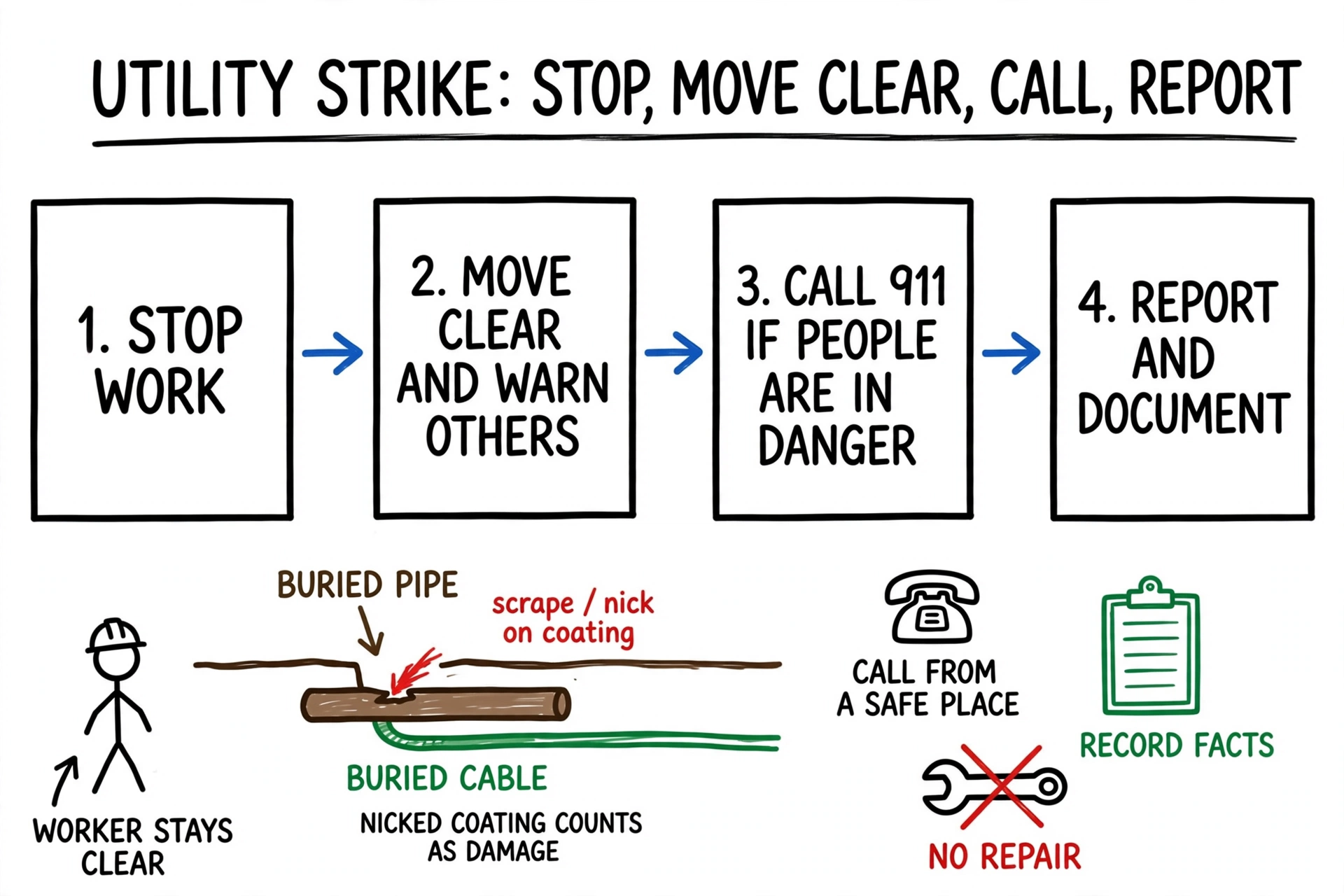
Good response starts with a full stop. The operator of the tool or drill stops the work that caused the contact. Equipment movement stops and equipment is left in place. The only exception is a movement directed by emergency responders or the facility operator to protect a person in immediate danger. A supervisor on the crew does not order equipment moved at a gas leak or an electric contact on crew authority alone. Nobody makes one more pass to finish the crossing. Nobody pulls a drill head back through a damaged line to hide the path it took, unless the operator or a responder directs a specific action for safety. The default is stop and hold position while notifications are made, and follow operator and responder direction from there.
Good response protects people within the crew role. Workers move away from the hazard, warn others nearby, and keep the public out of the area with cones, barriers, or a person posted at a safe position where that can be done without entering the hazard. For gas, good means leaving the area, staying upwind where you can judge it safely, and making calls from a safe distance. For electric, good means nobody touches the damaged facility or equipment in contact with it, and the area stays clear until the electric operator takes over. For water and sewer, good means staying clear of flooded and undermined ground and out of trench water that may be contaminated.
Good response notifies in the right order for the danger present. Where there is danger to people, 911 is called promptly, and for a regulated pipeline release that 911 call is a federal excavator duty. The supervisor is notified. The facility operator is notified directly or through the process the ticket and state law provide, including where the operator is unknown and notice to the 811 center serves as the route to the operator. The 811 center receives damage notification where state law or the ticket process requires it. Specific timing and forms vary by state and are verified for the job location. What does not vary is the principle: notify promptly, do not wait until the end of the shift, and do not let embarrassment set the timeline.
Good response documents honestly while memory is fresh. A good record captures the date and time, the exact location, the facility type and, where known, the operator, the ticket number, what equipment made contact, what the damage looks like in plain factual words, whether any product is escaping, what notifications were made and when, who took over the site, and photographs taken from a safe position where they can be taken safely. Facts only. No speculation about fault in the field record, no minimizing words such as just a scratch for coating damage, and no backfilling of the damage area before the operator inspects, unless the operator or a responder directs cover for safety.
Good response completes the follow through. The crew cooperates with the operator inspection and repair, keeps the area protected until it is released, completes employer incident reporting, and provides information for any required state report and for voluntary DIRT reporting through the employer. Work near the damaged facility does not resume until the operator and the supervisor process clear it.
What Can Go Wrong?
The failures after a strike are as teachable as the strike itself, because several of them turn a bad event into a far worse one.
The worst failure is trying to fix it yourself. Pinching a gas line, taping a cable, bending a pipe back, operating a pipeline valve, or burying a leaking facility to stop the sound are all actions outside the excavation crew role that can cause ignition, electrocution, a larger release, or a hidden failure. Facility repair belongs to the operator. Valve operation belongs to the operator. This lesson authorizes none of it.
A second failure is creating an ignition source near escaping gas. Starting or moving equipment, operating electrical switches, using a phone or radio right at the leak, smoking, or bringing a vehicle into the gas area can each provide the spark a gas cloud needs. Operator and pipeline safety guidance is consistent: leave the area and make calls from a safe distance. Do not operate equipment or switches near the leak.
A third failure is touching electric facilities or equipment in contact with them. A worker who grabs a cable to move it, climbs onto a drill that has contacted a line, or tries to pull a coworker free by hand can become the second victim. If a person is in contact with an energized source, call 911 and the electric operator and follow responder direction. Do not touch the person or the equipment while contact with the energized facility may still be present, unless you are trained and equipped for that rescue, which this lesson does not provide.
A fourth failure is burying damage quietly. Covering a nick, a scrape, or a cut tracer wire and saying nothing leaves corrosion, water entry, and locate failure in the ground, violates the notification duties in this lesson, and is commonly discovered later, when repair is harder and the questions are worse. There is no version of quiet burial that counts as good judgment.
A fifth failure is delay. Waiting to see whether service fails, finishing the bore first, or reporting at the end of the week gives a weakened facility time to fail on its own and breaks the prompt notification duties state and federal rules set for the situations they cover. When in doubt about whether a mark on a facility is reportable damage, report it and let the owner decide. CGA Practice 5-24 lists nicks and coating damage as reported damage. That settles the doubt in favor of the call.
A sixth failure is re-entering or resuming too soon. Walking back into a gas area to retrieve tools, restarting a drill before the operator releases the facility, or sending a worker into a flooded excavation to look at a sewer break all put people back into a hazard that has not been cleared. Only the operator and responders clear their hazards.
A seventh failure is a dishonest or thin record. A report that omits coating damage, guesses at a cause, changes the time, or blames the marks without facts undermines the operator repair decision, the employer review, any state review, and the industry learning DIRT exists to support. Write what you saw, what you did, and when you did it. Mark anything you do not know as unknown.
An eighth failure is treating a communications strike as a joke because nobody can be shocked by fiber. A cut can remove emergency calling, alarm monitoring, and business and medical communications for many people at once, and a fiber end handled carelessly adds an eye hazard if someone stares into it. The response is smaller in distance and drama than a gas strike. It is not smaller in honesty: stop, protect the damaged plant from further harm, notify the supervisor and the operator, document, and do not splice or repair a facility that is not yours unless you are the assigned and qualified party for that facility.
What Should Someone Notice in the Field?
You can notice the warning state before a strike, the event itself, and the quality of the response afterward.
Before a strike, notice work closing on a marked facility with no exposure at the crossing, a drill entering a tolerance zone on marks alone, marks that are faded, missing, or in conflict with visible surface evidence, and a crew working from an expired ticket or without positive response. Notice an unknown pipe or cable appearing in a trench wall and work continuing past it. Each of those is a stop and ask moment before contact, when a question still costs nothing.
At the moment of a possible strike, notice with all your senses from a safe position. Listen for hissing, roaring, arcing, or a sudden change in drill sound and torque. Look for blowing dirt, dust, bubbling water, water rising in a pit or trench, a cable or conduit appearing where soil should be, sparks, or smoke. Smell for the rotten egg odor added to natural gas and for sewage odor at a broken sewer. Notice service clues: lights flickering or failing nearby, a sudden loss of drilling fluid return in HDD that can signal the bore has broken into a pipe or structure, or alarms sounding in nearby buildings. Any one of these near excavation means stop and treat it as a strike until the responsible parties determine otherwise. Do not move closer to investigate with your hands, a probe, or your face over an open fiber end.
Notice the damage itself without touching it. From outside the immediate hazard area, can you tell what type of facility it is by material, color, size, and the marks that led to it? Is product escaping, or is the damage a scrape, dent, or cut with no release? Is equipment in contact with the facility? Is the ground flooding, softening, or washing out? Those observations, reported plainly to the supervisor and the operator, are valuable. Gathering them never justifies entering a gas cloud, touching an electric facility, or standing on undermined ground.
After the event, notice the response quality. Did work actually stop? Are people clear and is the public kept back? Were calls made promptly, and can the crew say who was called and when? Is anyone attempting a repair, a pinch, a valve turn, or a quiet backfill? That attempt is a red flag to raise to the supervisor at once. Is the damaged area left open for operator inspection, protected, and documented?
Notice also the quiet strike that presents after the fact: a locate that no longer works on a line that worked before your job, a customer outage reported along your bore path, a wet spot or a gas odor reported over a line your crew crossed earlier, or a coating scrape you remember seeing while backfilling. A late discovered strike is still a strike. Report it through the supervisor and the operator process as soon as it is recognized.
Finally, notice your own limit in every one of these moments. Recognizing a strike and starting the protective response is every worker job. Deciding the size of an evacuation, declaring a facility safe, repairing it, and releasing the site are operator and responder jobs. If you are asked to do the second list because you read this lesson, say so and route the task to the qualified party.
Practical Example
The following examples are hypothetical. They are invented to teach the response, not to describe real jobs or real companies.
Hypothetical example one: a nicked telecom duct, reported correctly. A hypothetical fiber crew is hand exposing facilities at a crossing before a small bore, inside the tolerance zone of an orange marked communications line. While carefully removing soil, a crew member sees that an earlier pass of a hand tool has scraped the orange duct and cut its outer wall at one point, and the tracer wire beside it is severed. No fiber is cut and no outage is known. The crew leader, Dana, stops the exposure work at that crossing. Dana keeps the damaged section open and protected, photographs it from the edge of the opening without touching the fiber or looking into any fiber end, and notifies the supervisor at once. The supervisor notifies the communications operator and makes the damage notification to the 811 center in the form the state process requires. Dana writes the factual record while waiting: time, location, ticket number, duct damage described as a cut in the duct wall at one point, tracer wire severed, no outage known. The operator inspector examines the duct, directs the repair the operator wants, and clears the crossing. Only then does the bore plan continue, adjusted to the verified position the exposure confirmed. The lesson is the unglamorous one: nothing dramatic happened, and the crew still stopped, reported, documented, and waited for the owner. The nick was not buried quietly, the tracer wire will be restored so the next locate works, and the record protects the next crew as much as it protects Dana’s crew.
Hypothetical example two: a gas strike handled by evacuation and calls. A hypothetical HDD crew is boring across a hypothetical street where a yellow marked gas line crosses the path. The crossing was potholed and the bore plan set clearance from the verified position. During the bore, the drill operator feels an abnormal change and the spotter at the crossing reports a hissing sound and dirt moving at a point offset from the planned crossing, followed by a rotten egg odor. The crew treats it as a gas strike. The drill stops. Nobody restarts equipment, operates switches near the area, or walks to the hiss to look into the hole. The crew moves away from the area on foot, warns a nearby resident at a safe distance to stay back, and moves upwind. From a safe distance, the crew leader calls 911 and reports a possible natural gas release from excavation damage, then calls the supervisor and the gas operator emergency number from the ticket and the job file. The crew keeps people away from a safe position and waits. Fire responders and the gas operator take control on arrival, set the area they want kept clear, and direct the crew. The crew gives responders its factual account: ticket number, marks, pothole record, time of the sound and odor, and actions taken. No crew member touches a valve, pinches a line, or covers the release with soil. The bore does not resume that day at that crossing, and the employer incident process and required notifications are completed before any discussion of schedule. The lesson is order under pressure: stop, move away, call 911 and the operator from a safe distance, keep people clear, hand over to responders, and document. The crew did not investigate the leak, did not try to save the bore, and did not decide when the area was safe. Those decisions belonged to the operator and the responders.
Key Terms
Utility strike: contact with or damage to an existing facility during excavation, drilling, or related work, including a nick, scrape, dent, gouge, cut, pull, bend, crack, or break of the facility or a protective part of it.
Damage: any impact or exposure that weakens a facility or partly or completely destroys part of it, including damage to a coating, jacket, conduit, housing, lateral support, or cathodic protection system. Damage does not require a leak or an outage.
Facility owner or operator: the company, utility, municipality, or other owner responsible for a facility and for its inspection and repair after damage.
Tolerance zone: the area around a marked facility where state law and best practice require careful methods and extra care. Its width is set by state law and varies by state.
Positive response: the system by which facility operators tell the excavator, through the 811 process, that a facility has been marked, is clear, or is affected in another stated way, so the excavator can confirm every operator has responded before digging.
Potholing: carefully exposing a buried facility at a specific point by safe excavation practices to verify its precise horizontal and vertical position. Also called daylighting or test holing.
Tracer wire: a wire buried with a nonmetallic pipe or cable so locating equipment can detect the facility later. Cutting it is damage even when service is unaffected.
Cathodic protection: a system that slows corrosion on buried metal structures, including test wires and components that can themselves be damaged by excavation.
Near miss: an event where damage did not occur but a clear potential for damage was present, such as finding an unmarked facility just before contact would have occurred.
DIRT: the Damage Information Reporting Tool, the Common Ground Alliance voluntary, confidential system for collecting reports of underground facility damage, near misses, and related events, used to analyze root causes and publish industry findings.
Notification center: the state or regional 811 center that receives locate requests and, where state law or the process requires it, damage notifications, and routes them to member operators.
Undermining: loss of soil support caused by escaping water or soil washing into a broken pipe, which can let ground, pavement, or a trench wall collapse.
Check Your Understanding
- A shovel scrapes the coating off a steel gas pipe. Nothing leaks and there is no odor. Is this a utility strike that must be reported, and if so, to whom?
- State the general response order for any strike, and name the additional first actions that escaping gas requires.
- A drill has contacted an underground electric cable and the drill rig may be energized. A worker reaches for the rig to move it away from the cable. What is wrong with that action, and what should happen instead?
- What is DIRT, and what is it not?
- Why does this lesson say a cut tracer wire with no outage still matters, and what should the crew do about it?
Answer key:
- Yes. Damage under the CGA definition includes damage to a coating, and CGA Best Practice 5-24 lists nicks, dents, gouges, and coating damage among the damage that is reported. The excavator notifies the facility owner or operator and the 811 center, following the state damage notification process. Only the operator decides whether the scrape needs repair, because coating loss can lead to corrosion and later failure.
- Stop work, make the area safe within your role by moving people away and keeping the public clear, notify the supervisor, notify the facility operator, make the damage notification to the 811 center where state law or the ticket process requires it, and call 911 promptly where there is danger to people. For escaping gas, add: move away from the leak, warn others, stay upwind where you can judge it safely, do not operate equipment or switches near the leak, do not use a phone right at the leak, and call 911 and the gas operator from a safe distance. Do not try to repair, pinch, bury, or valve off the line.
- The rig, the cable, and the ground near the contact may all be energized, so touching the rig can electrocute the worker and create a second victim. Nobody touches the damaged facility or equipment in contact with it. Keep people away, call 911 and the electric operator, and follow responder and operator direction. The facility is treated as energized until the electric operator confirms it is safe.
- DIRT is the Damage Information Reporting Tool, the Common Ground Alliance voluntary and confidential reporting system. Stakeholders submit damage, near miss, and related event information, and CGA analyzes it to identify root causes and publish industry findings that help reduce future damage. It is not the emergency call, not the required notice to the operator, not the damage notification to the 811 center, and not a regulatory filing. Required notifications come first under state and federal rules.
- A tracer wire lets locators find a nonmetallic facility. Cutting it does not stop service today, but it makes the facility harder or impossible to locate accurately tomorrow, raising the strike risk for the next excavation. It is damage to a part of the facility system. The crew stops, protects the area, notifies the supervisor and the operator, makes the required 811 center damage notification, and documents it. The operator decides the repair. It is never spliced quietly or buried without a report as if nothing happened.
Lesson Takeaway
A utility strike is any damaging contact with an existing facility, from a coating scrape with no outage to a gas release that empties a street. The facility type sets the immediate danger: gas means move away and call 911 and the operator from a safe distance, electric means treat it as energized and touch nothing, water and sewer mean respect flooding, undermining, and contamination, and communications means protect the plant, report the outage risk honestly, and never stare into a fiber end. The response order never changes: stop work, protect people within your role, notify the supervisor, the operator, the 811 center where required, and 911 where people are in danger, then document facts and hand over to the operator and responders. Even a nick is reported to the owner and never buried quietly, because small damage becomes later failure and hidden damage becomes the next crew trap. This lesson qualifies you to recognize a strike and start the right response. It does not qualify you to repair a facility, operate its valves, investigate a leak, or declare an area safe.
Sources and Technical References
- Common Ground Alliance Best Practices, Practice 5-24, Facility Damage Notification: an excavator discovering or causing damage notifies the facility owner or operator and the 811 center, and all breaks, leaks, nicks, dents, gouges, grooves, or other damage to lines, conduits, coatings, or cathodic protection are reported, because a damaged facility may not fail immediately and the owner needs the chance to inspect and repair: https://cdn.pelicancorp.com/pdfs/26-cbyd-resources-bestpractices.pdf
- Common Ground Alliance Best Practices 22.0, glossary: damage is any impact or exposure that results in the need to repair an underground facility due to weakening or partial or complete destruction of the facility, including its protective coating, lateral support, cathodic protection, or housing; damage reporting is the immediate reporting of damage caused or discovered during excavation or demolition to the 811 center and the facility owner or operator, and contacting emergency responders if necessary: https://www.pa1call.org/resourcelibrary/resource/download?id=260
- CGA Damage Information Reporting Tool, DIRT, described as a free online tool that collects underground facility event data nationally to identify root causes and reduce damage; a facility event includes damage, a near miss, and excavator downtime; reporting is voluntary, can be anonymous, is kept confidential as to individual parties, and data is not used for regulatory enforcement or to determine liability: https://www.forconstructionpros.com/equipment/article/10303267/use-dirt-to-fight-damage
- CGA DIRT system overview: DIRT is a secure web application for the collection and reporting of underground damage information, allowing users to submit damage and near miss reports, at www.cga-dirt.com: https://scga.ca/en/damage-information-reporting-tool-dirt/
- PHMSA excavation damage rules, 49 CFR Part 196, including 196.109: if damage from excavation causes a release of regulated natural or other gas or hazardous liquid from a pipeline, the excavator must promptly report the release to appropriate emergency response authorities by calling 911: https://www.customsmobile.com/regulations/expand/title49_chapterI-i1_part196_subpartB_section196.111
- Gas operator emergency guidance, CPS Energy: if a natural gas pipeline is nicked, scraped, or dented, call 911 and the gas operator; signs of a leak include the rotten egg odor of mercaptan, hissing, dead plants, dirt blowing, or bubbling water; leave the area, go to another location to call, and do not operate anything electrical, turn lights on or off, use a phone in the area, light a flame, or use appliances near a suspected leak: https://www.cpsenergy.com/content/corporate/en/about-us/energy-safety-and-preparedness/811-call-before-you-dig.html
- CenterPoint Energy pipeline safety: markers show the material transported, the operator name, and an emergency telephone number; if you nick, ding, or damage a pipeline while digging, call the operator immediately so the operator can inspect and repair damage and prevent future problems: https://www.centerpointenergy.com/en-us/residential/safety/pipeline-safety?sa=TX
- Pennsylvania One Call, pipeline safety and excavator duties: on a leaking gas or petroleum line, stop digging, evacuate the work area and adjacent structures, call 911 and the facility owner from a safe distance, eliminate ignition sources, do not operate pipeline valves, and do not attempt to stop escaping gas by covering the leak with dirt; any damage to a line must be reported to the facility owner and it is unlawful to cover up a line that may be damaged; excavators also report immediately to the facility owner any break, leak, dent, gouge, groove, or other damage to lines, coating, or cathodic protection, and immediately notify 911 and the facility owner where escaping flammable, toxic, or corrosive gas or liquid endangers life, health, or property: https://www.PA1Call.org/pocs/35d98ccc-483c-4fcc-8abc-93da945ffe61/Pipeline-Safety?viewmode=0
- Indiana 811 professional guidance: if you hit a utility line, stop digging immediately; if the damage causes flammable, toxic, or corrosive gas or liquid to escape or there is any immediate danger, move away and call 911, then notify the affected utility, then report the incident to Indiana 811: https://indiana811.org/pros/faqs-pros/
- New York 811 excavator glossary, damage: if damage occurs, stop excavation immediately and contact the appropriate utility company and New York 811 even if damage appears minor; if a substance such as natural gas starts releasing, call 911, walk away immediately, clear the area, do not try to repair or stop a leak yourself, and do not use anything that might create a spark: https://newyork-811.com/excavators/excavator-glossary/
- OSHA Safety and Health Information Bulletin, Avoiding Underground Utilities during Horizontal Directional Drilling Operations, SHIB 03-13-2018: before drilling a contractor must use the state utility location system; if the drill contacts underground electrical wires the operator may be electrocuted; striking natural gas lines may cause gas leaks at the worksite or down the line in surrounding areas, potentially causing an explosion: https://www.osha.gov/sites/default/files/publications/shib031318.pdf
- OSHA excavation standard, 29 CFR 1926.651(b): the estimated location of utility installations must be determined before opening an excavation, utility owners must be contacted, the exact location must be determined by safe and acceptable means as excavation approaches, and underground installations must be protected, supported, or removed as necessary while an excavation is open. Text via Cornell Law: https://www.law.cornell.edu/cfr/text/29/1926.651
- Juniper Networks fiber optic maintenance warnings, representative of network equipment manufacturer warnings: do not look directly into a fiber optic transceiver or into the ends of fiber optic cables; fiber optic transceivers and cables connected to them emit laser light that can damage your eyes; do not stare into the laser beam or view it directly with optical instruments even if the interface has been disabled: https://www.juniper.net/documentation/us/en/hardware/lwc-hardware-guide/lwc/topics/topic-map/lwc-maintain-fiber-optic.html
Flagged and hedged items: No evacuation distance, setback distance, gas concentration threshold, repair method, valve procedure, or resume work timeline is stated as a rule in this lesson, because those values are set by the operator, responders, and state rules for the specific facility and event, and sources that publish a distance present it as that jurisdiction or operator instruction, not as a national rule to carry to every job. Follow the distance and direction given by 911, responders, and the operator on the actual event. State damage notification timing and form vary by state; this lesson states the common pattern, notify the operator and the 811 center and call 911 where people are endangered, and requires the reader to verify the exact state rule for the work location. The fiber eye hazard is stated only as the manufacturer rule supports: do not look directly into a fiber end or transceiver and do not view it with optical instruments, because light in fiber systems can be invisible and can damage eyes. No claim is made about a specific power level, wavelength, or safe viewing distance for a cut outside plant fiber. Loss of drilling fluid return is described as a possible signal of bore contact, a recognition clue, not as proof by itself that a specific facility was struck; it requires a stop and a determination by the responsible parties.
Previous lesson: Lesson 69: What Is a Utility Conflict? |
Back to Level 3 hub |
Next lesson: Lesson 71: What Do You Do When the Field Doesn’t Match the Locate?