
Introduction
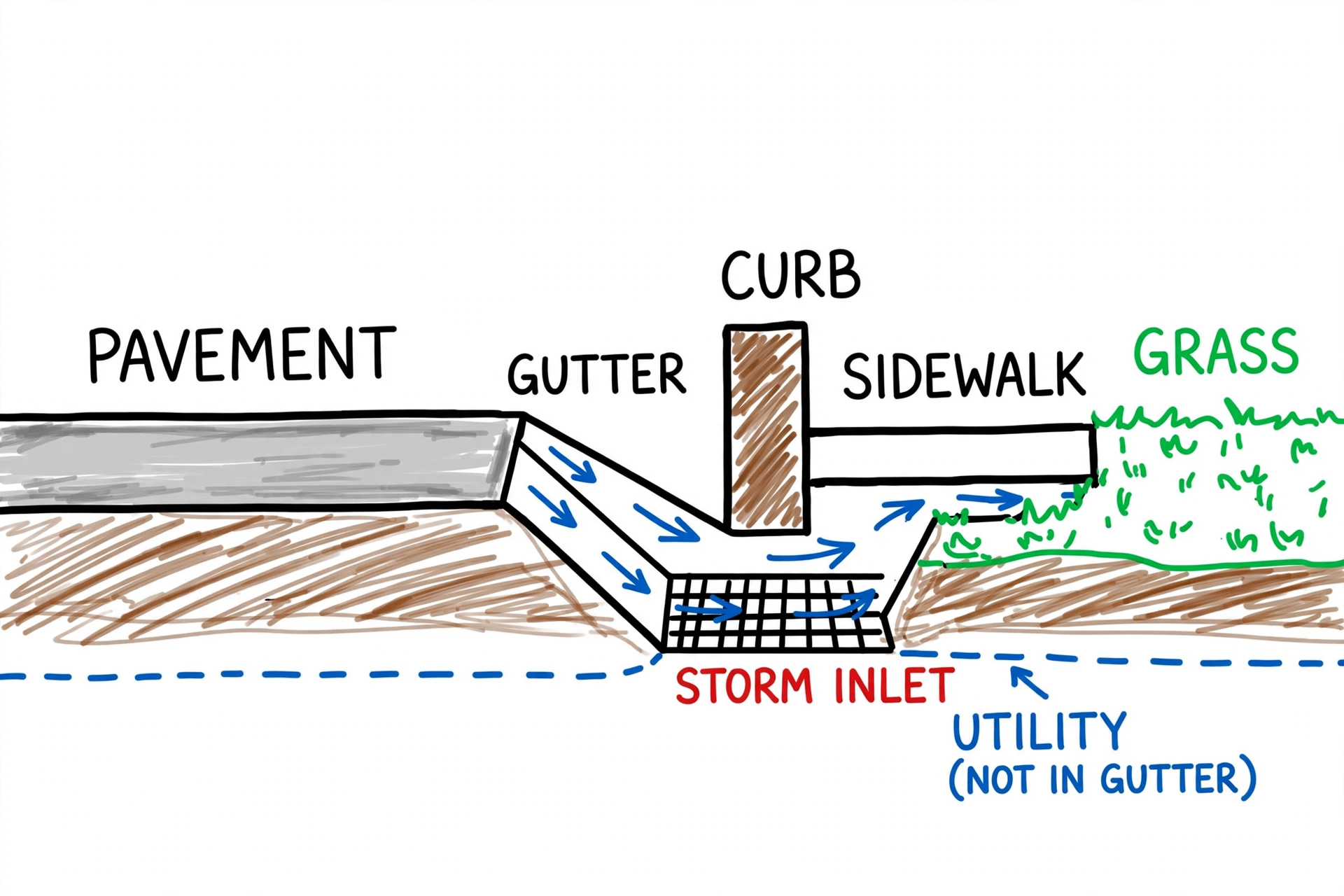
Curb and gutter is the built edge treatment along the side of a paved street. It pairs a raised curb, the boundary between the pavement and the area behind it, with a gutter, the sloped channel in front of the curb that collects stormwater and carries it along the street to an inlet. The two parts are often built as one piece, and they do different jobs. The curb defines the edge, separates traffic from the roadside, and supports the pavement. The gutter drains.
This lesson belongs to Level 2, Read the Physical Environment, because fiber routes run behind the curb, bores cross beneath it, and damage to it is repaired under the street owner’s rules. Reading the edge well, following its water, spotting where its ground has already moved, and knowing which of its features must keep working, is planning information a crew uses before any digging starts. The lesson teaches recognition. Cutting, rebuilding, or regrading curb and gutter is work for qualified crews under the owning agency’s standard detail.
What This Lesson Gives You
- Stand at any street edge and separate the curb’s job from the gutter’s job, naming the flow line and the nearest inlet.
- Follow a gutter run with your eyes and predict where its water will go, and where it will stop or spill when the run is damaged.
- Read settlement, heave, patching, and ponding evidence along a curb line and say what each one warns you about before a bore or a trench is planned.
- Explain why buried conduit belongs behind the curb and why the gutter pan is never a utility route.
- Lay out pits, spoil, and equipment so curb ramps, driveway aprons, and inlets keep working during the job.
Start With the Basics
Stand at the edge of almost any paved street in a town or subdivision and look down. The travel lanes are in the middle. As your eye moves outward, the pavement ends. At that edge there is usually a shallow channel, and behind that channel a raised edge, and behind that raised edge a sidewalk, a strip of grass, or a front yard.
That raised edge and that shallow channel have names, and they do different jobs.
The raised edge is the curb. The shallow channel is the gutter. Together, people often call the whole edge treatment curb and gutter, as if it were one thing. It is helpful to learn it as two parts with two jobs that happen to be built together.
Start with water, because water explains the shape. Rain that falls on a street cannot soak through pavement the way it soaks into soil. It runs across the pavement surface. Streets are shaped so that runoff, which is rainwater that flows over a surface instead of soaking in, moves toward the edges. Something at the edge has to collect that water and carry it away in an orderly way, or it would spill into yards, flood driveways, and pool in the travel lanes. The gutter does the collecting and carrying. The curb forms the back wall of that channel and holds the street edge in place.
A house roof works the same way at a smaller scale. The sloped roof sheds rain to an eave gutter, the eave gutter carries the water along the edge of the roof to a downspout, and the downspout drops the water clear of the house. On a street, the sloped pavement sheds water the way the roof does, the gutter at the curb carries it the way the eave gutter does, and the storm inlet takes it below ground the way the downspout does. The parts are bigger and the material is concrete. The mechanism is the same: shed, collect, carry, and drop.
Now add people and vehicles. A street needs a clear edge that drivers can see and feel, and people on foot need a place that is separated from moving traffic. The curb provides that visible, physical edge. It marks where the roadway stops and the area for pedestrians and property begins.
Keep those two ideas separate as you read. The gutter is mainly about water. The curb is mainly about edge, separation, and support. When both jobs are done well, you barely notice them. When either job fails, you see standing water, cracked edges, and patched concrete, and those visible clues matter a great deal to anyone about to work near the street.
What Is It?
Curb and gutter is the built edge treatment along the side of a paved street, made of a curb and an adjoining gutter that work together.
- Curb. The raised edge between the street pavement and the area behind it. The area behind it may be a sidewalk, a planting strip, a lawn, a shoulder, or a driveway approach. The curb has a face, which is the side that looks toward the street, and a top, which is the upper surface behind that face. In many streets the curb stands clearly above the gutter in front of it, so you can see the face as a distinct vertical or near vertical surface.
- Gutter. The sloped channel at the edge of the pavement, next to the curb, that collects stormwater and carries it along the street. Stormwater is rainwater and melting snow that runs off streets, roofs, and yards. The gutter sits lower than the travel lanes and lower than the top of the curb. Its surface slopes across its width toward the curb and also slopes along the length of the street, so water that lands in it keeps moving in one direction instead of sitting still.
- Flow line. The lowest line along the gutter, where water concentrates as it flows. You will use that term in the field. If you want to know which way water travels on a given block, find the flow line and follow it. Water follows the flow line toward lower ground and toward a storm inlet.
- Storm inlet. An opening where water leaves the gutter and enters the underground storm drain system. It is also called a drain inlet or catch basin inlet in some places. Some inlets are grates set in the gutter surface. Some are openings in the face of the curb. Some combine both. The inlet is the end point of a gutter run. The gutter carries water along the surface. The inlet takes it below ground.
Combined curb and gutter means the curb and the gutter are cast as one continuous section, most commonly in concrete, and sometimes in asphalt on certain streets. Cast means the material was placed in wet, workable form into forms or by a shaping machine and then hardened in place. When the section is combined, there is no gap between the gutter channel and the curb behind it. They were poured together and they act together. On other streets the curb and the gutter pan may be separate pieces, or there may be a curb with no formed gutter pan at all, with the pavement itself serving as the water channel next to the curb. The combined concrete section is the form most beginners will meet most often in newer subdivisions and rebuilt city streets. It is one form among several, and you should not assume every street matches it.
Two plain language families of curb are worth knowing, described here as general families and not as a code list.
- Barrier curb, sometimes called vertical curb. Its face is steep, close to upright. It is meant to discourage vehicles from mounting it, meaning climbing up and over it onto the sidewalk or yard. A driver who drifts toward a barrier curb meets a clear obstacle. Pedestrians get a clear separation from traffic.
- Mountable curb, which includes rolled curb. Its face is sloped or rounded instead of steep, so a vehicle can cross it slowly at a driveway or an intended crossing without a hard jolt or damage. Rolled curb is common in residential areas where every lot has a driveway crossing the curb line. Mountable does not make the curb meaningless. It still defines the edge and still shapes drainage. It simply trades some of the barrier effect for easier vehicle access at the places where access is intended.
Which family is used, and the exact shape, height, and width of both the curb and the gutter, are not decided by this lesson and are not the same everywhere. Those details come from the standard detail of the agency that owns or controls that street. A standard detail is the owning agency published drawing that shows how a feature must be built in that jurisdiction. A city public works department, a county, or a state transportation department may each publish its own details, and the detail for one street does not automatically apply to the next street. Whenever this lesson describes a shape, it describes the general idea. The governing detail for real work is always the local agency standard for that street, plus any project plans and permit conditions that apply.
A related feature is the curb ramp. A curb ramp is a sloped surface that cuts through or builds up to the curb so that a person using a wheelchair, a stroller, or a wheeled cart can move between the sidewalk and the street at a crossing without stepping over the full curb height. Curb ramps are part of an accessible route, which is a continuous, unobstructed path that people with disabilities can use. You will see curb ramps at intersections and at marked crossings. They matter to fiber crews because they are carefully graded features in exactly the area where crews often want to work, and damaging or blocking one creates both an access problem and a restoration problem. This lesson only introduces curb ramps so you can recognize them. Their design and requirements are treated in full elsewhere in the library.
What Does It Look Like?
Learning to see curb and gutter takes one walk around a block with your eyes at the right height. Look across the street first, then look along it, then look down at your feet. Each view shows you something different.
From across the street. The curb reads as a continuous light colored line along the edge of the darker pavement. Concrete curb and gutter is usually pale gray, noticeably lighter than asphalt pavement, so the edge stands out. Where the street is concrete, the curb and gutter may be the same color as the lanes, and the edge is defined more by shape and shadow than by color. The line is rarely perfectly continuous. It is broken at driveways, where the curb drops or rolls down so vehicles can cross. It is broken at intersections, where curb ramps slope down to the street. It may be broken at a curb opening inlet, where a rectangular opening in the curb face lets water pass into a chamber behind it.
From along the street. Looking down its length, you can see the gutter doing its shaping work. The gutter is a shallow trough. One side of the trough is the pavement sloping down toward the edge. The other side is the face of the curb rising up behind it. Between them, at the bottom, is the flow line. In a combined section, the gutter pan is a flat or gently sloped concrete strip in front of the curb face, and the joint between the pan and the street pavement is often visible as a straight line running along the block. Leaves, fine gravel, and a dark damp stain collect along the flow line after rain, which makes the line easy to find even on a dry day if you look for the debris trail.
Close up. At your feet, you can read the construction. A combined concrete section shows a smooth gutter pan, a curb face, and a rounded or squared transition where the pan meets the face. You may see joints, which are intentional lines cut or formed across the concrete at intervals to control where the concrete cracks as it shrinks and moves with temperature. You may see a joint where the back of the curb meets the sidewalk, and another where the gutter meets the pavement. Older sections may show patching, where a rectangle of newer, darker or lighter concrete replaces a damaged piece. You may see sealant, cracks, chipped corners, or a section that sits slightly higher or lower than its neighbor. That uneven step between neighboring sections is worth noticing, because it often means the ground beneath has moved or the section was reset at a different grade.
Materials vary:
- Concrete is the most common material for combined curb and gutter in permanent city streets.
- Asphalt curb appears on some lower volume streets and parking edges, formed as a rounded raised strip of asphalt instead of concrete.
- Stone curb, cut from granite or other stone, appears in older cities and historic districts, set as individual blocks.
- Brick and unit pavers appear in special streetscapes.
Do not judge function by material. An asphalt rolled edge and a concrete barrier curb are doing the same basic edge job in different forms and with different durability.
Now place the features behind and in front of the curb so you can locate the whole assembly. In front of the curb, toward the center of the street, is the gutter and then the pavement, which may include a parking lane before the travel lanes. Behind the curb, away from the street, is typically the sidewalk, or a grass strip and then the sidewalk, or in places without sidewalks, grass, a mailbox, a utility pole, or a driveway. Underground and out of sight behind the curb is often where buried utilities run, in the public right of way or in an easement near it. That relationship is central to this lesson. The visible concrete edge at the surface is often close to the invisible utility corridor behind it. The gutter itself, in front of the curb, is a surface water channel. Buried utilities do not belong in it, and later sections will explain why confusing the two causes expensive mistakes.
Three nearby features are easy to confuse with curb and gutter, and each one is a different thing:
- The sidewalk is the flat walking surface behind the curb. Curb and gutter and the sidewalk are often poured close together and may touch, and they remain separate features.
- A ditch is an open earthen channel, usually along a rural road without curb, that carries water in soil rather than on a paved pan.
- The storm drain pipe is underground. It carries water after the inlet collects it. The gutter only carries water on the surface, along the street, to the inlet.
Streets without curb and gutter exist and are normal. Many rural roads and some older residential streets drain to a shoulder and a ditch or swale instead. A swale is a broad, shallow, gently sloped channel, often grassed. If there is no raised edge and no paved channel, you are looking at a different drainage system, and the planning questions change. Recognizing the absence of curb and gutter is part of reading the environment. It is a fact to record in the walkout notes, and it belongs there beside every other drainage condition on the street.
What Does It Do?
Curb and gutter does four jobs at once, and a good field reader keeps all four in mind, because work that helps one job can quietly harm another.
- The curb defines the road edge. It gives drivers a line they can see in daylight, in rain, and at night, and a physical edge they can feel if they drift. Delineation is the word road designers use for making the path and its edges clear to the user. FHWA guidance lists pavement delineation among the core purposes of curbs. A clear edge helps keep vehicles in the roadway and helps everyone judge where the street ends.
- The curb separates vehicles from pedestrians and yards. It creates a step between the world of moving and parked cars and the world of people walking, children playing near the front yard, mailboxes, signs, and landscaping. A barrier curb separates strongly. A mountable or rolled curb separates more gently and allows crossing at driveways. In both cases the curb says, in physical form, that one side is for the street and the other side is not. That separation also protects the area behind the curb from casual vehicle encroachment and from street water.
- The curb supports and protects the pavement edge. Pavement is a layered structure, and its edge is its weakest line. Without a firm edge, asphalt or concrete pavement can ravel, crack, and break away under tires that ride near the edge and under water that works in from the side. The curb acts as a firm border that holds the edge in place and helps the pavement keep its shape. It also helps contain the street surface water within the roadway area, as FHWA drainage guidance describes, instead of letting every rain spill uncontrolled onto adjacent property.
- The combined section directs drainage. This job belongs mainly to the gutter, with the curb as its back wall. Rain runs off the crowned or sloped pavement toward the edge. The crown is the slightly raised center profile of a street that sheds water to both sides. The gutter intercepts that sheet of water, gathers it into a defined channel, and carries it along the flow line, following the longitudinal slope of the street, which is the slope in the direction of travel. At the end of the run, a storm inlet captures the water and sends it into the underground storm system. FHWA drainage material describes the curb and gutter combination as forming a channel that conveys runoff along the roadway to inlets. That sentence is the whole drainage story in miniature. Pavement sheds. Gutter collects and conveys. Inlet captures. Pipe carries away.
The gutter’s job list stops at drainage. It does not store water. A gutter that holds water in place after rain has stopped doing its job, usually because its slope was lost, debris blocks the path, or the inlet is blocked or set at the wrong elevation. It does not treat water or filter it in any meaningful way in a conventional section. It moves water from where it fell to where the underground system can take it. The gutter is a water path on the surface. It carries no conduit, marks no utility route, and gives no line for buried plant to follow. Utilities that serve the street are placed behind the curb or under other assigned areas according to the utility corridor for that street, clear of the gutter pan.
The curb ramp fits into this system as a controlled break in the curb. At a crossing, the ramp lowers the curb so the accessible route can reach the street, while the gutter flow must still pass the ramp area without ponding in the path of travel. The Access Board guidance on curb ramps stresses that ramps must be designed to prevent the accumulation of water. That detail teaches a general lesson: even where the curb is intentionally lowered, drainage still has to work. A ramp area that ponds is a defect, and no crew should treat ponding at a ramp as a normal condition.
In short, the curb defines, separates, and supports. The gutter drains. Together they make the street edge legible to drivers, safer for pedestrians, more durable for the pavement, and orderly for water.
Where Does It Fit?
Curb and gutter fits at the meeting point of several systems, which is why so many different parties care about it.
In the street cross section, which is a slice view cut across the street from one side to the other, curb and gutter sits between the traveled pavement and the roadside area. A typical urban cross section, read from the center outward, goes:
- Travel lanes
- Possibly a parking lane
- Gutter
- Curb
- The roadside, which may include a planting strip, a sidewalk, and front yards
- The right of way line and private property
The right of way is the land corridor that a public agency controls for the street and for utilities. The exact order and widths vary by street, but the curb and gutter position in the sequence is consistent. It is the hinge between the roadway and the roadside.
In the drainage system, curb and gutter is the first, surface level link in a chain. Upstream of it is the pavement surface and the roofs and yards that drain toward the street. Downstream of it are the storm inlet, the underground storm drain pipes, and ultimately an outfall, which is the place where collected stormwater is discharged to a ditch, a detention facility, a stream, or another receiving system. If the gutter is blocked, settled, or rebuilt at the wrong grade, the whole chain suffers upstream first, as water spreads wider across the pavement or ponds at driveways and crossings. Engineers describe the width of water on the pavement during a storm as spread. Keeping spread within acceptable limits is one reason inlet spacing and gutter slope matter in design. For a field observer, the practical translation is simple: the gutter and its inlets are one system, and you should always read them together. Never evaluate a length of gutter without asking where its water goes.
In the construction sequence for a new street, curb and gutter is usually built after the underground utilities and the street base are in place and the street grades have been set, and before or together with the final pavement surface and the sidewalk. That order matters for fiber work. By the time curb and gutter exists, the street already has a finished grade and a working drainage pattern. Later utility work near it is therefore restoration sensitive work. You are no longer working in raw ground. You are working next to a finished, graded, inspected feature whose elevations were set on purpose.
In the life of a fiber project, curb and gutter appears at three moments:
- At design and walkout, it helps define the likely utility corridor, the driveway and crossing constraints, and the drainage path the design must not disturb.
- During construction, it is a structure to protect: bores must pass beneath it without lifting or undermining it, trenches near it must not remove its support, and equipment must not break it.
- At restoration, it is a standard to meet: any section that was removed or damaged must be rebuilt to the owning agency standard so that the edge, the flow line, and the inlet relationships all work again.
City restoration specifications commonly require that curb and gutter that has been removed or damaged be replaced with new material conforming to the applicable technical specifications and standard details, matching the adjacent sections in dimensions, elevations, and finish unless the agency approves otherwise. That is a general pattern across agencies, stated here as practice. The governing language for a given job is that job’s permit and that agency’s specifications.
Curb and gutter also fits into the ownership picture. The street, including its curb and gutter, is usually owned or controlled by a public agency: a city, a county, or a state. The fiber network owner does not own the curb. Permission to work in the right of way, and the obligation to restore what is disturbed, come from that agency. That is why a short length of damaged curb can involve permits, inspections, and agency acceptance, and why its repair cost is out of proportion to the size of the concrete involved.
What Is at Stake
For a fiber crew, curb and gutter carries practical stakes that show up as cost, callbacks, and reputation. None of them require exaggeration.
It is near the work. Fiber routes in developed streets very often run behind the curb, in the roadside strip between the curb and the right of way line, because that strip is a common utility corridor. Handholes, conduit, and drops are set in that zone. That means the curb is frequently the closest finished structure to the excavation or the bore path. A bore that runs too shallow can heave the gutter pan or the curb, lifting it and breaking its grade. A trench dug too close without support can undermine the section, meaning remove the soil that holds it up, so it settles or tips after the trench is backfilled. A crossing that must go under the street has to pass under the curb and gutter on both sides. In short, even when the design never intends to touch the curb, the work passes within inches of it.
It is expensive to cut and restore. Concrete curb and gutter cannot be patched casually and forgotten. A proper repair usually means saw cutting to clean limits, removing the damaged section, rebuilding the base, forming or slip forming the new section to the correct line and grade, and matching the adjacent flow line so water still runs. Slip forming is a method where a machine shapes wet concrete as it moves along the line of the curb. If the new section sits even slightly high at the flow line, it acts as a small dam. If it sits low, it becomes a permanent puddle. Either error is visible to every resident on the block and to the agency inspector. Restoration to the owning agency standard is not optional decoration. It is the permit obligation, and rework after a failed inspection costs more than the original repair.
It controls water, and water finds every mistake. Drainage changed by restoration is a common long term complaint tied to curb work. A bore pit backfilled and compacted poorly near the curb can settle months later, taking a length of gutter down with it and creating ponding, which is water that stands in the gutter instead of flowing to an inlet. Ponding is more than an eyesore. Standing water accelerates pavement deterioration, creates ice in cold weather, splashes pedestrians, breeds mosquitoes in warm weather, and signals to an inspector that grades were not restored. A section rebuilt too high can divert water across a driveway or into a yard that never received street water before. The crew may be long gone when the first heavy rain reveals the problem. The callback still belongs to whoever disturbed the grade.
It is highly visible. Buried fiber work disappears when the job is done. Curb and gutter never disappears. Residents see it from their front windows. Drivers feel a settled or heaved section through the steering wheel when they park. An agency inspector can check line and grade with a string line and a level in minutes. Visible defects at the curb therefore carry an outsized effect on whether the whole job is judged as careful or sloppy, even if the fiber itself tests perfectly.
It protects access. Curb ramps, driveway aprons, and inlets cluster at the same corners and crossings where fiber work also clusters. A driveway apron is the sloped paved area between the street and a driveway that crosses the curb line and sidewalk area. Blocking a ramp with spoil or equipment, breaking a ramp corner, or leaving a settled patch in front of an inlet creates problems for people who did nothing more than try to cross the street or pull into their driveway. Field crews who read curb and gutter well plan their pits, spoils, and equipment positions to keep those features working during and after the job.
It is evidence. Before any work starts, the existing condition of curb and gutter along a route is a record of drainage direction, prior utility work, soil stability, and street age. Patched sections suggest earlier cuts. Settled sections suggest soft soil or poor compaction nearby, which is a warning for your own bore or trench. Stained flow lines and debris show where water actually goes, which may differ from where a plan assumes it goes. A crew that photographs and notes curb condition at walkout protects itself from being blamed for damage that was already there, and plans better because it saw the street as it is.
What Does Good Look Like?
Good curb and gutter is unremarkable in the best sense. It is continuous, even, and dry shortly after rain. Here is how to describe it in field language, keeping in mind that these are general characteristics of good work. Acceptance criteria for a given street come from that street’s owning agency. Acceptance is judged against the owning agency standard detail, the project plans, and the permit conditions for that street.
- The line is true. The curb follows a smooth, consistent line along the block, without sudden offsets, kinks, or sections that jut toward or away from the street. At corners it curves in a smooth radius. At driveways and ramps it transitions down and back up in a deliberate, even way.
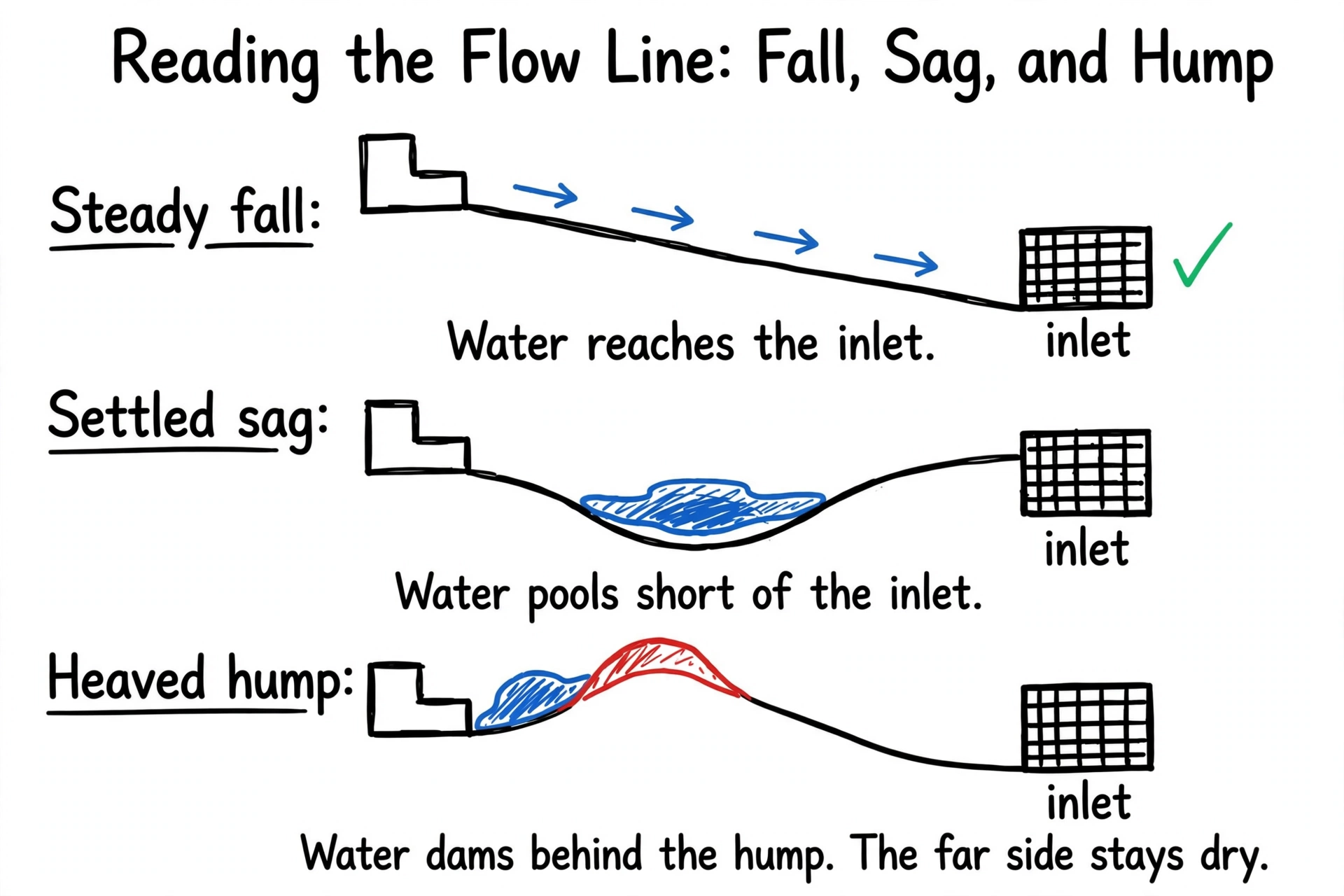
- The grade is true. The flow line falls steadily toward an inlet, without flat spots that hold water or high spots that block flow. After a rain, the gutter dries except for a damp stain. Standing water does not remain in the gutter after the rain has stopped, apart from the shallow film that any surface holds briefly. Water at an inlet enters the inlet instead of bypassing it to pond further down the block.
- The surface is sound. The concrete is intact, without major cracks, spalling, or broken corners. Spalling is a surface failure where pieces of concrete flake or pop away, often exposing aggregate or steel. Joints are present and reasonably tight. The curb face is plumb or follows its designed profile, not leaning into the street or tipping back toward the sidewalk.
- The relationships are right. The curb reveal, which is the height of the curb face exposed above the gutter, is consistent along a run, changing only where the design intends it to change, at driveways and ramps. The gutter meets the pavement cleanly, without a lip that trips tires or a gap that catches water and debris. The back of the curb meets the sidewalk or grass at a clean, even edge. Inlets sit at low points, flush with the flow, not perched above it or sunk below it in a crater.
- The drainage story is coherent. If you pour your attention, not water, along the gutter in your mind from the high end of the block to the inlet, nothing interrupts the trip. No patch dams the flow. No settled panel reverses it. No driveway apron spills street water into a garage. Coherence is the test. Good curb and gutter tells one consistent drainage story from one end of the run to the other.
A caution belongs here. A neat surface can still sit at the wrong grade, and an older surface can still drain correctly. An older street may show wear, patched joints, and honest age while still draining correctly and meeting the standard that applied when it was built. A brand new patch may look neat and still be at the wrong grade. Judge by function and by the governing standard, in that order, and leave formal acceptance to the owning agency or its authorized inspector.
From the Field
Picture a fiber crew assigned to place conduit behind the curb along one side of a residential block, with two street crossings by directional bore to reach a handhole on the far side. Before any equipment is unloaded, the lead walks the block for one purpose: to read the curb and gutter, and to let what the edge shows change the plan while changing the plan is still cheap.
First, the lead finds the inlets. There is a curb opening inlet near the low corner at the far end of the block, and its opening is half blocked by packed leaves and sediment. Water staining on the curb face above the normal flow marks shows that water has been ponding and bypassing this inlet during rains. The lead photographs it and notes it as a preexisting condition to report to the supervisor. Rebuilding it is the street owner’s work, and the crew’s job is to document it accurately and leave it alone.
Second, following the flow line back up the block, the lead sights along the curb and spots one panel, roughly in front of the third house, that sits visibly lower than its neighbors. Fine sediment has collected in the sag. Directly behind that settled panel, in the grass strip where the new conduit is planned, there is a faint older saw cut line in the sidewalk and a patched rectangle in the gutter. The picture fits together: this spot was cut and restored before, probably for an earlier utility repair, and the restoration has settled since. The lead flags the spot. The bore path is shifted slightly to avoid crossing directly beneath the settled panel, the plan adds extra attention to compaction for any excavation near it, and the preexisting settlement is documented so the crew is not later charged with causing it.
Third, at the near crossing, the planned bore pit would have sat directly in front of a curb ramp at the corner, with spoil planned for the gutter beside it. Reading the corner as a drainage and access feature, not just as open ground, the lead moves the pit a short distance along the block, keeps the ramp clear and passable, and plans spoil placement behind the curb where it cannot wash into the gutter or block the inlet path. The crossing itself is deepened in the plan, within the limits set by the project design and the located positions of existing utilities, so the bore passes well beneath the curb and gutter section instead of skimming under its base.
During the work, the bores pass without movement at the surface. The crew checks the curb line at each crossing at the end of the day by sighting along it, the same way the lead did at walkout. No lip, no sag, no new crack. At restoration, the two pits behind the curb are backfilled and compacted in lifts as the project specification requires, and the surface is restored to match the surrounding grass and sidewalk.
Two weeks later, after the first heavy rain, the supervisor drives the block. The gutter drains to the far inlet along its original flow line, apart from the preexisting ponding at the partly blocked inlet that was documented and reported. No new ponding appears at the crossings or at the pits. The settled panel looks exactly as it did in the walkout photos, no worse.
Nothing in this job required the crew to cut the curb at all. The value of reading curb and gutter showed up as three avoided problems: a mislocated pit at a ramp, a bore planned under an already settled panel, and a blame dispute over damage that predated the job. That is the normal payoff of this skill. It is quiet, and it is measured in problems that never happen.
The decision rule: walk the curb line and photograph what you find before a pit is placed, a bore path is set, or spoil is piled, and let what the edge shows you, where its water goes, where its ground has already moved, and which of its features must keep working, change the plan at walkout instead of after the first rain.
What Can Go Wrong?
Failures of curb and gutter fall into a few recognizable patterns. Learning the patterns helps you connect a visible symptom at the surface to a likely cause below it, without pretending that a glance is a diagnosis.
- Settlement. A length of curb and gutter drops below its neighbors, the flow line sags, and water ponds in the sag. Settlement usually means the soil or base beneath the section has compressed, washed out, or was never compacted well. Nearby trenching, a leaking water line, or a bore void can all contribute. For fiber work the lesson is direct: backfill and compaction beside and beneath a curb section determine whether that section stays at grade. A section can also settle as a rigid piece, tilting so the curb leans and the gutter dips, which breaks both the edge function and the drainage function at once.
- Heave. The opposite movement. A section is pushed upward, creating a lip at the joints and a hump in the flow line. Heave can come from freezing water in the soil in cold climates, from expansive soils that swell when wet, from tree roots growing beneath the section, or from a shallow bore that displaces soil upward instead of removing it. A heaved gutter dams water on its upstream side just as reliably as a settled gutter traps water within itself.
- Cracking and breakage. Shrinkage cracks are fine lines that appear as concrete cures and are often controlled by joints. Structural cracks are wider, may run across the full section, and may show vertical offset, where one side of the crack sits higher than the other. Offset is a warning that the ground beneath is moving. Corner breaks happen where tires mount the curb at driveways or where equipment strikes the section. Spalling and scaling wear the surface away. Each form has a different cause and a different repair, which is why describing a defect accurately, with its location, length, and whether it shows offset or ponding, is more valuable than simply calling it damaged.
- Drainage failures. These are functional failures, even when the concrete looks intact. Ponding water along a run means the flow line no longer falls continuously to an inlet. A blocked inlet, buried under leaves, sediment, or construction debris, will back water up the gutter even on a well graded street. A rebuilt section with a reversed slope can send water across a sidewalk or driveway instead of along the street. Ice that forms repeatedly in one gutter spot in winter is often a drainage failure announcing itself in another season. Drainage failures matter beyond the gutter itself, because water that cannot follow its designed path will find another path, often into the pavement base, a trench line, or a handhole.
- Undermining. A hidden failure. Soil is washed or removed from beneath the gutter pan or behind the curb, leaving the concrete bridging over a void. The section may look fine until a load crosses it and it cracks or drops suddenly. Scour from concentrated water flow, a broken underground pipe, or careless excavation beside the section can all create undermining. Tapping or sounding for voids and probing at edges are inspection techniques for qualified inspectors. For a beginner, the takeaway is to treat any curb section that sounds or looks unsupported, with soil visibly washed out at its edges, as a condition to report and avoid loading with equipment. Testing it by driving over it is never the right check.
- Damage from later work. This category is self inflicted, and it is the one this library most wants you to prevent. Saw cuts made in the wrong place, sections removed without clean limits, forms set to the wrong grade, flow lines not matched, joints omitted, and concrete finished before the base was properly compacted are all wounds a crew gives itself. So is the quieter damage of parking heavy equipment on a gutter pan, stockpiling spoil against a curb face so runoff is diverted for weeks, or washing out equipment so sediment fills an inlet. The concrete records all of it.
- Mismatch at restoration. A new section that does not match its neighbors in profile, finish, or elevation may function poorly and will almost certainly draw an agency correction notice. Specifications in many cities require replaced curb and gutter to match the existing adjacent sections as closely as possible in dimensions, elevations, and surface finish unless the agency engineer approves a change. Treat that matching obligation as the normal expectation, and verify the exact requirement in the permit for your street.
What Should Someone Notice in the Field?
Field observation of curb and gutter is a looking skill. Nothing in this checklist asks you to cut, dig, enter, or measure with instruments. It asks you to walk a block slowly, look in a deliberate order, and record what you see. A phone camera, a notebook, and locations recorded by address are enough for beginner level documentation.
- Start with the drainage story. Stand at the high end of the block if you can judge it, or simply pick one inlet and work backward. Identify the storm inlets first. Note whether each inlet is a grate in the gutter, an opening in the curb face, or a combination. Note whether it is clear or blocked by leaves, sediment, grass, or construction material.
- Follow the flow line. Trace it with your eyes from inlet to inlet. Look for the debris line and damp staining that reveal where water actually runs. Ask one question the whole way: if it rained hard right now, would water from every part of this gutter reach an inlet without ponding, spilling over a driveway, or crossing the sidewalk? Where the answer is no, stop and look closer. That spot deserves a photo and a note.
- Look for ponding evidence even on a dry day. Dark staining, fine sediment fans, algae or moss in a gutter in shaded areas, and a bathtub ring of dirt on the curb face all mark places where water stands regularly. Fresh ponding after rain is the clearest evidence, and the dry weather traces are nearly as reliable and are available on the day of your walkout.
- Read the curb line itself. Sight along the top and face of the curb from one end of a run. A true line looks smooth. A settled or heaved section breaks the line visibly when you sight along it, even when the defect is hard to see standing directly above it. Note any section that leans, any joint that has opened, and any place where the reveal changes suddenly without a driveway or ramp to explain it.
- Inventory the breaks in the curb. Count and note driveways, curb ramps at crossings, and any curb cuts, which are places where the curb has been lowered or removed for access. Note their condition. Is the ramp corner cracked? Is the driveway apron settled where it meets the gutter? Is there a curb cut that serves no current driveway, suggesting a prior use or prior work? Each break is a place where grades change and where restoration, if you must work there, becomes more complex.
- Look for patches and prior work. A rectangle of different colored concrete in the gutter, a saw cut line across the sidewalk behind the curb, an asphalt patch in the gutter pan, or a length of curb that is noticeably newer than its neighbors all tell you that someone has cut and restored here before. Prior restoration is useful intelligence. It suggests a utility crossing or a repair, it shows you the local expectation for finish quality, and it warns you that the ground behind that curb has been excavated before and may contain existing utilities in less than obvious positions. Existing utilities must always be located through the proper locating process before digging, regardless of what surface clues suggest. Surface reading supplements locating. It never replaces it.
- Check the relationship between the curb and the places you plan to work. Where are the handholes, pedestals, poles, and markers relative to the back of the curb? How much working room exists between the curb and the sidewalk, the fences, or the landscaping? Where would a bore pit have to sit, and would its spoil block the gutter or a ramp? Where does a bore path cross the curb line, and is that crossing at a driveway, a ramp, or an inlet, where extra care and extra restoration should be planned? Answering those questions at walkout is far cheaper than answering them with a crew standing on the street.
- Note inlet locations in relation to low points and crossings. Inlets are often placed just before a crosswalk or intersection, so that water is captured before it flows across the pedestrian crossing. If you see an inlet in the middle of a block with no obvious low point, or a low point with no inlet, note it. Either condition may reflect the original design, a later change, or a problem. Your job is to record it accurately, not to redesign it.
- Record condition before work begins. Photograph each run of curb and gutter along the planned route, including close views of existing cracks, settled sections, and ponding marks, with an address or station reference for each photo. This preconstruction record protects the public, the agency, and your own crew. It establishes what was already there, and it forces the slow look that good planning requires.
The safety boundary for all of this is plain. Observing curb and gutter happens from the sidewalk or the roadside, with awareness of traffic. Do not step into a travel lane to sight a curb line without proper traffic control in place. This lesson is not authorization to direct traffic, open an inlet grate, enter a storm structure, or cut a section for a closer look. Recognizing a blocked inlet is a reason to report it to the agency or the project supervisor. It is not a reason to lift a heavy grate by hand at the edge of traffic. Recognizing is not qualifying.
Key Terms
- Curb: The raised edge between the street pavement and the area behind it, such as a sidewalk, planting strip, lawn, or shoulder. It defines the road edge, separates vehicles from pedestrians and property, and supports the pavement edge.
- Gutter: The sloped channel at the edge of the pavement, next to the curb, that collects stormwater runoff and carries it along the street to a storm inlet.
- Curb and gutter: The combined edge treatment made of a curb and its adjoining gutter, often cast as one continuous concrete section.
- Combined curb and gutter: A section in which the curb and the gutter pan are cast together as a single piece, most commonly in concrete.
- Flow line: The lowest line along the gutter where flowing water concentrates. Following the flow line shows the direction water travels toward an inlet.
- Stormwater runoff: Rainwater and melting snow that flows over streets and other surfaces instead of soaking into the ground.
- Storm inlet: An opening, such as a grate in the gutter or an opening in the curb face, where surface water leaves the gutter and enters the underground storm drain system.
- Storm drain system: The underground pipes and structures that carry collected stormwater away from streets to an outfall. It is separate from the sanitary sewer system in most modern construction.
- Barrier curb: A curb family with a steep, near vertical face that discourages vehicles from mounting the curb. Also called vertical curb.
- Mountable curb: A curb family with a sloped face that vehicles can cross slowly at intended places such as driveways. Rolled curb, with a rounded profile, is a common mountable form.
- Curb ramp: A sloped surface through or up to the curb at a crossing that lets people using wheelchairs, strollers, or carts move between the sidewalk and the street as part of an accessible route.
- Right of way: The land corridor controlled by a public agency for a street and for utilities. Much fiber work near curb and gutter takes place in the right of way under a permit.
- Standard detail: The owning agency published drawing that shows how a feature such as curb and gutter must be built in that jurisdiction. Dimensions and profiles come from the local standard detail, not from general practice.
- Ponding: Water standing in a gutter or on a pavement instead of flowing to an inlet. Ponding usually indicates lost slope, settlement, or a blocked inlet.
- Settlement: Downward movement of a curb and gutter section below its intended grade, usually because the soil or base beneath it compressed or washed out.
- Heave: Upward movement of a section, caused by such factors as frost, expansive soil, roots, or displaced soil from a shallow bore.
- Driveway apron: The sloped paved area between the street and a driveway that crosses the curb line and the sidewalk area.
- Reveal: The height of the curb face exposed above the gutter. A consistent reveal along a run is a sign of true grade. This lesson describes reveal in general terms only. Its required dimension, where one applies, comes from the local standard detail.
Check Your Understanding
- A friend looks at a street edge and says the curb and the gutter are the same thing. In plain language, what is wrong with that statement, and what does each part do?
- You are standing on a block after a light rain. One length of gutter is holding a long puddle while the rest of the block has drained. List three different causes that could explain the puddle, and say what additional observation would help you tell them apart.
- Why is it a mistake to treat the gutter as a convenient line to follow for placing buried conduit? Where, in general terms, does the buried utility corridor usually sit in relation to the curb?
- A bore crosses under a street and, a week later, the gutter above the bore path shows a new hump and water ponds on one side of it. What likely happened below ground, what is the defect called, and what should the crew do next, within the limits of its role?
- At a walkout, like the one in From the Field, you find a patched and settled section of curb and gutter directly behind which your conduit is planned. Why does that patch matter to your plan, even though your design does not call for touching the curb, and what two actions should you take before work starts?
Answer Key
- They are two parts that are often built as one piece, but they do different jobs. The curb is the raised edge that defines the road boundary, separates vehicles from pedestrians and yards, and supports the pavement edge. The gutter is the sloped channel in front of the curb that collects stormwater and carries it along the flow line to a storm inlet. Calling them the same thing hides the drainage job, which is the job most easily damaged by nearby work.
- Possible causes include settlement of that section, which sags the flow line; a high spot or heaved section downstream that dams the flow; and a blocked or partly blocked inlet that backs water up the gutter. Debris blockage in the gutter itself is a fourth possibility. To tell them apart, sight along the curb line for a sag or a hump, follow the flow line to the inlet and check whether the inlet is clear, and look for dry weather evidence such as sediment fans and staining that show whether the ponding is a long standing pattern or a one time blockage.
- The gutter is a surface water channel. Its job is drainage only, and its pan and base occupy the street edge where traffic loads and drainage grades are critical. Buried utilities placed in or under the gutter would conflict with drainage, pavement support, and future curb reconstruction, and would be exposed every time the section is rebuilt. In general terms, the buried utility corridor in a developed street usually sits behind the curb, in the roadside strip within the right of way or an easement. The exact corridor for a given street is set by the agency and the project design, and existing utilities must be located before any digging.
- The likely cause is soil displaced upward by a bore that passed too close beneath the section, pushing the gutter up instead of removing material along the bore path. The upward movement is called heave, and the hump in the flow line acts as a dam, which explains the ponding on its upstream side. Within its role, the crew should document the condition with photos and measurements of location, notify the project supervisor and, through the proper channel, the agency that owns the street, and protect the area from further loading. Rebuilding the section to grade is restoration work to the agency standard, performed or directed by qualified parties under the permit. The crew should not attempt to grind, cut, or reset the section on its own judgment.
- The patch tells you the ground there has been excavated and restored before. Prior work means existing utilities may be present in positions that surface clues alone cannot confirm, and the settlement tells you the restored ground has already moved once, so it may be less stable or less well compacted than undisturbed ground. Before work starts, document the existing condition with dated photos and notes tied to an address, and make sure the area is covered by the normal utility locating process and the project plan, adjusting the bore or trench plan if the supervisor directs it. That is the same pair of moves the lead made in From the Field: document first, and let the plan change before the work starts. Surface reading supplements locating. It never replaces it.
Lesson Takeaway
Curb and gutter is two features built as one edge. The curb is the raised boundary that defines the street, separates traffic from people and yards, and supports the pavement edge. The gutter is the sloped channel in front of it that does one job: it collects stormwater and carries it along the flow line to a storm inlet. Once you can separate those jobs in your mind, you can read a street. You can follow water to its inlet, spot settlement, heave, patching, and ponding for what they are, recognize ramps and driveways as deliberate breaks in the curb, and understand why work behind the curb must protect the concrete in front of it. Curb and gutter is owned by the street agency, built to the owning agency’s local standard detail, and expensive to restore badly. The fiber crew that reads it carefully at walkout, protects it during construction, and restores grades faithfully afterward will leave a street that drains the way it did before the job, which is exactly what good work looks like.
Sources and Technical References
- Federal Highway Administration (FHWA), Urban Drainage Design Manual, Hydraulic Engineering Circular No. 22, Publication No. FHWA-NHI-01-021: Section on curb and gutter describes the purposes of curbs, including containing surface runoff within the roadway, preventing erosion, providing pavement delineation, and enabling orderly development adjacent to the roadway, and describes the curb and gutter combination as a channel that conveys runoff along the roadway. https://rosap.ntl.bts.gov/view/dot/58534/dot_58534_DS1.pdf
- Oregon Department of Transportation, Hydraulics Manual, Chapter 13, Appendix A, Storm Drainage: restates the FHWA curb and gutter material, including the definition of a pavement gutter as the section of pavement next to the curb which conveys water during a storm runoff event, and the triangular channel formed by a curb and gutter combination. https://www.oregon.gov/odot/hydraulics/Docs_Hydraulics_Manual/Hydraulics-13-A.pdf
- Federal Highway Administration (FHWA), Design of Bridge Deck Drainage, Hydraulic Engineering Circular No. 21: glossary definition of gutter as the portion at the edge of the deck or pavement used to convey storm runoff water next to the curb, and definitions of related drainage terms including inlet and spread. https://rosap.ntl.bts.gov/view/dot/745/dot_745_DS1.pdf
- Federal Highway Administration (FHWA), Designing Sidewalks and Trails for Access, Chapter 4, Sidewalk Design Guidelines and Existing Practices: defines the gutter as the trough or dip used for drainage purposes that runs along the edge of the street and the curb or curb ramp, and covers curb ramp components and specifications in the context of accessible sidewalks. http://www.fhwa.dot.gov/environment/bicycle_pedestrian/publications/sidewalks/chap4a.cfm
- U.S. Access Board, ADA Standards Guide, Chapter 4: Ramps and Curb Ramps: explains that requirements for curb ramps apply to ramps that cut through curbs or are built up to them, that curb ramps provide an accessible route at street crossings, and that curb ramps must be designed to prevent the accumulation of water. Full curb ramp design treatment is outside the scope of this lesson. https://www.access-board.gov/ada/guides/chapter-4-ramps-and-curb-ramps/
- Federal Highway Administration (FHWA), Guide for Maintaining Pedestrian Facilities for Enhanced Safety: covers drainage and maintenance of pedestrian facilities, including the importance of proper drainage to prevent pooling of water on sidewalks and at street edges. https://rosap.ntl.bts.gov/view/dot/27403/dot_27403_DS1.pdf
- City of Gardner, Kansas, Technical Specifications, Section 7000, Restoration of Surface Construction: an example of a city restoration specification. It requires concrete curbs and gutters that have been removed or damaged to be replaced with new concrete conforming to the technical specifications and all applicable standard details, with dimensions, elevations, and surface finish matching the existing adjacent curb and gutter as closely as possible unless otherwise approved. Cited here as an example of the general agency pattern. The governing specification for any real job is the specification of the agency that owns that street. Source document as retrieved: https://cms2.revize.com/revize/gardnerks/Documents/Services/Public Works/Technical Standards/Section 7000 Restoration of Surface Construction.pdf?t=202507170909480&t=202507170909480
Previous lesson: Lesson 23: What Is a Property Line? |
Back to Level 2 hub |
Next lesson: Lesson 25: What Is a Sidewalk?