
Lesson Number and Title
Lesson 165, Level 9: Build With Open Trench
Title: What Is Spoil?
Introduction
Spoil is the soil, rock, and other ground material that comes out of an excavation, the cut, trench, or hole dug into the earth, and is set aside beside the work or moved away from it. Spoil is the ground itself, removed and waiting. Where it sits, what it contains, and what condition it is in decide work that happens hours and weeks later, from backfilling the trench to restoring the surface above it.
Level 9 is building with open trench, step by step. Lesson 162 covered excavation, Lessons 163 and 164 covered what determines trench depth and width, and this lesson covers the material those cuts produce. Lesson 166 follows with bedding, the material placed under conduit, and the contrast matters: bedding is chosen and brought in for a job, while spoil is whatever the ground gave up, and the crew has to judge what it is good for.
What This Lesson Gives You
- Define spoil and tell it apart from topsoil, subsoil, and backfill by where each one sits in the work.
- Read a spoil pile as evidence, naming what its color, layers, rock, and moisture say about the ground the trench is passing through.
- State the federal OSHA placement rule for spoil beside an excavation, explain the falling and rolling hazard the rule addresses, and explain the separate surcharge hazard a pile creates.
- Judge whether spoil has been kept separate enough to serve restoration, and name what mixing destroys.
- Recognize the signs that spoil may be contaminated, and state the correct response at recognition level: stop, keep it separate, and report.
Start With the Basics
Picture emptying a drawer to repair the drawer. Everything that was inside has to go somewhere while the work happens, and where you put it decides how the job ends. Items tossed in one heap on the floor come back mixed, dirty, and hard to sort. Items kept in their own groups, in the order they came out, go back in minutes and the drawer closes the way it opened. Excavated ground works the same way. The material that comes out of a trench is not waste by default. It is the contents of the ground, taken out in an order the ground itself arranged, and it goes back in an order the restoration depends on.
That is the first habit this lesson builds: spoil is material in temporary storage, and storage is a decision. The second habit follows from the first. Because spoil came out of the ground in sequence, it carries a record of that ground. The pile beside the trench is the one part of the excavation a person can study in daylight, without entering anything, and it often tells the story of the trench before the trench walls do.
What Is It?
Spoil is the material an excavation produces, considered from the moment it leaves the ground until the moment it is reused, returned, or hauled away. The parts of the definition below build the judgment in order.
Spoil, defined. Spoil is soil, rock, and mixed ground material removed during excavation and set aside. Industry references define spoil as excavated material that is not immediately used in the work in progress, which covers both material waiting beside the trench for reuse and material waiting for removal. The word names the material’s condition. It says nothing about quality: spoil can be clean or contaminated, reusable or unusable, valuable or a disposal cost, and telling which is part of the work.
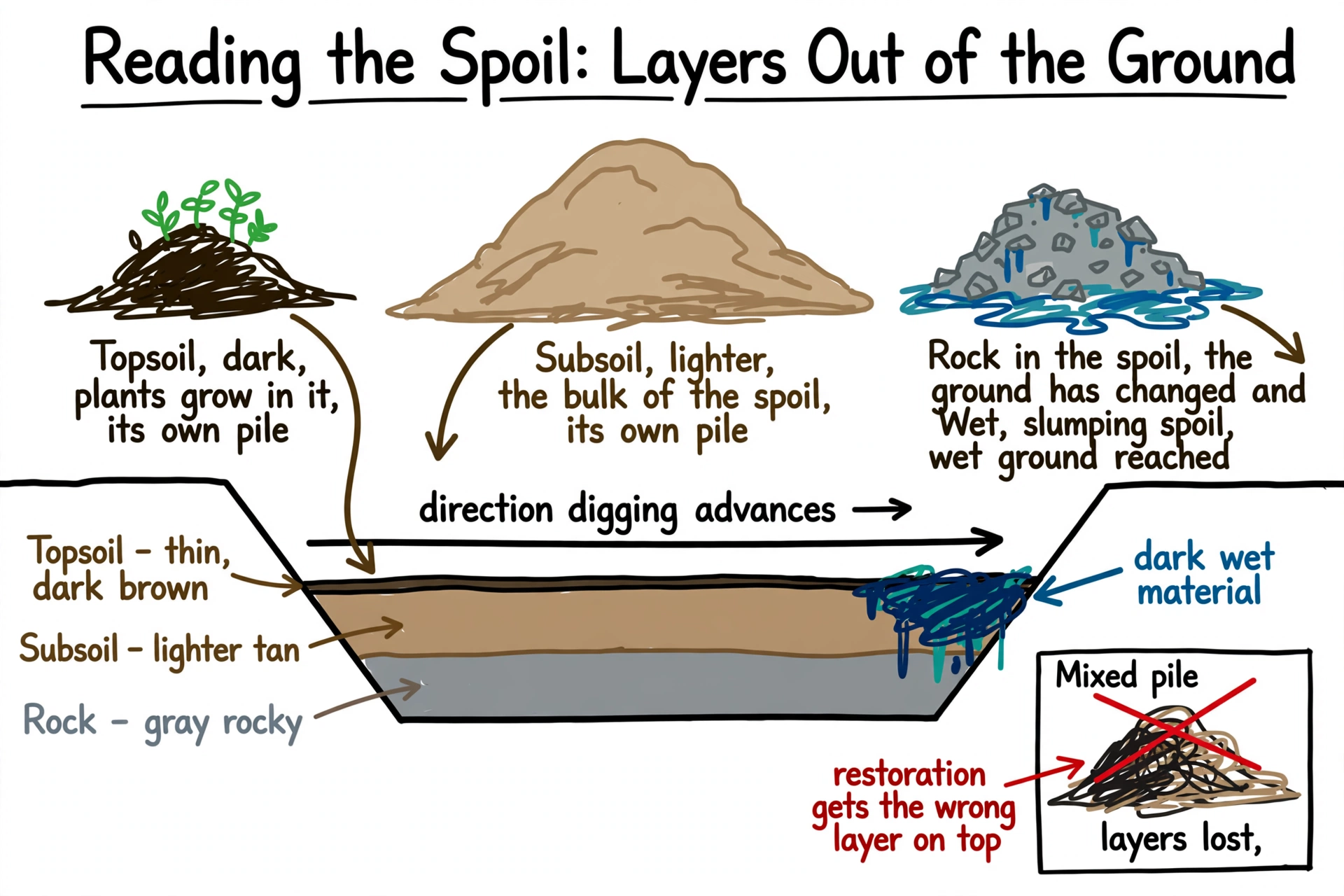
Topsoil. Topsoil is the upper layer of soil at a site, the darker layer that holds organic matter and supports plant growth. A stormwater manual definition used by Washington State describes topsoil as the material from the top several inches of the ground, including organic debris, and states plainly that topsoil does not include subsoil. Topsoil is the layer restoration needs at the surface when the work is done, because it is the layer plants grow in.
Subsoil. Subsoil is the ground material below the topsoil, down through the depth a trench reaches. Subsoil is generally lighter in color than topsoil, holds less organic matter, and makes up the bulk of what a utility trench produces. Clean subsoil is the material that can serve as fill in the ground. Topsoil spread at depth and subsoil spread at the surface each fail at the other’s job, which is why the two are kept apart.
Segregation. Segregation is keeping different materials in separate piles so each one stays available for its own use. Site soil handling guidance directs that lower soil layers be stockpiled separately from topsoil, that visibly distinct layers or soil types be stockpiled separately, and that subsoil never be mixed with topsoil or placed on top of a topsoil pile. One mixed pile cannot be unmixed by a loader. Segregation is decided at the bucket, in the first minutes of digging, or it does not happen at all.
Backfill. Backfill is material placed back into an excavation around and above the installed work, covered in depth later in this level. Spoil and backfill are related by a decision: suitable spoil, kept clean and separate, can become backfill and surface restoration material. Spoil that has been mixed with debris, contaminated, or left to wash away cannot. The pile beside the trench is therefore a supply the crew either protects or spends without noticing.
Stockpile. A stockpile is material placed in a pile in a designated spot for storage until it is used or removed. Spoil beside an open trench usually sits as a stockpile running alongside the cut. The stockpile is a working structure with its own rules for placement, covered below, and its own failure modes, covered in What Can Go Wrong.
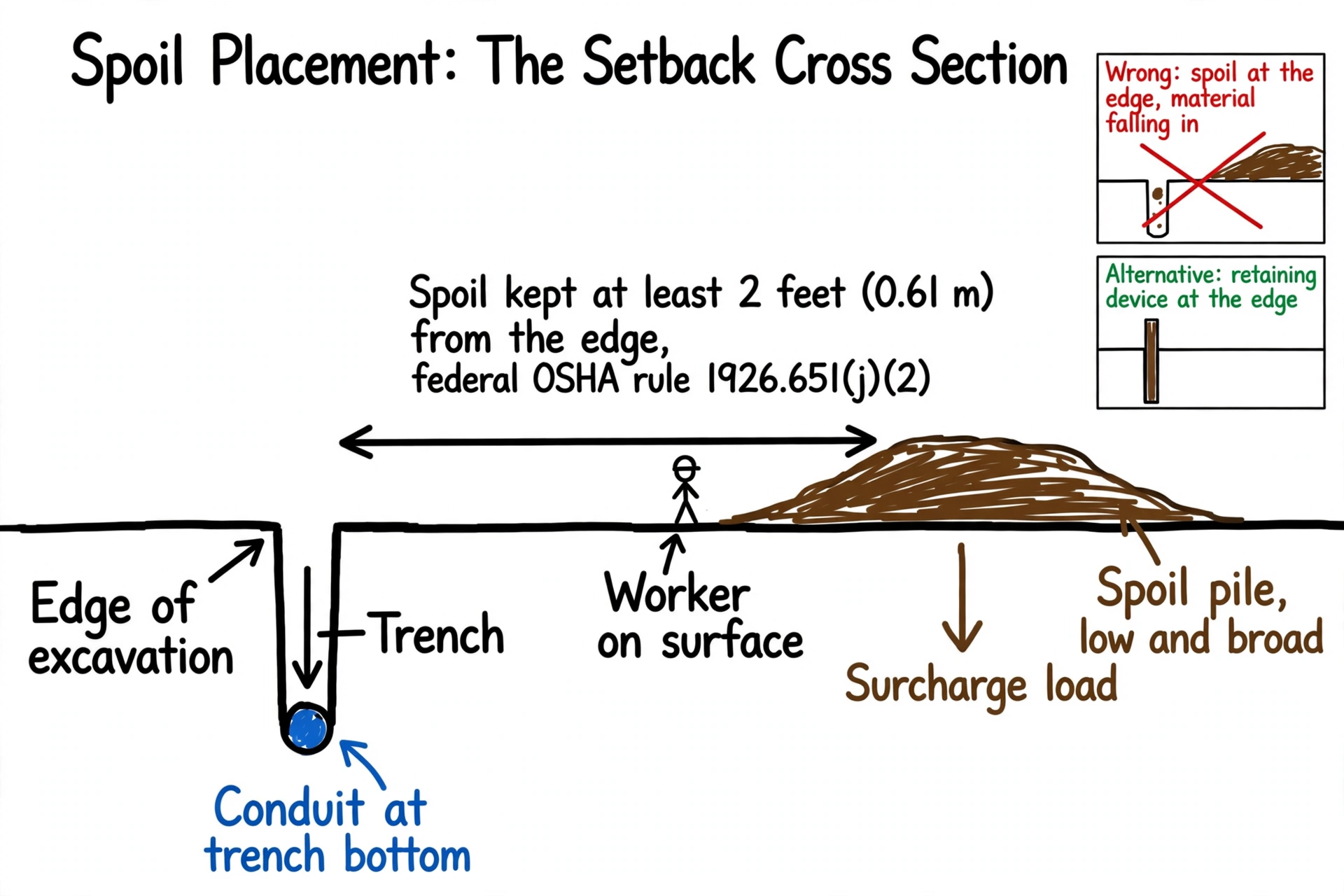
Surcharge load. A surcharge load is extra weight sitting on the ground surface near an excavation, pressing down on the ground that holds the excavation wall up. A spoil pile is a surcharge load on the trench beside it. The heavier the pile and the closer it sits to the edge, the more pressure it adds against the wall below. That pressure is one of the two hazards the federal placement rule in this lesson exists to control.
What Does It Look Like?
Spoil is the most visible material on a trench job. A beginner can read a great deal from it without touching it.
The pile itself:
- A long, low mound of loose ground material running beside the trench, placed there bucket by bucket as the excavation advanced.
- Loose texture throughout: dug material sits looser than the ground it came from, with clods, chunks, and voids, because digging broke the ground’s packed structure apart.
- Color bands or changes along the pile’s length where the trench passed from one ground type into another.
- A darker, crumbly portion near the start of the run where the surface layer came off, when topsoil was stripped and kept separate.
What the pile shows about the ground:
- Rock fragments, gravel, or solid chunks appearing in the pile, showing the trench has reached rocky ground of the kind Lesson 35, Why Do Soil and Rock Matter, teaches crews to expect.
- Wet, dark, or slumping material, or water sheen on clods, showing the cut has reached wet ground or groundwater of the kind Lesson 36, Why Does Groundwater Matter, covers.
- Clean sand or gravel running freely off the pile face, showing loose granular material that will also behave loosely in the trench wall and in the backfill.
- Stiff clay holding the shape of the bucket teeth, showing cohesive material that came out in blocks.
Signs that call for a pause and a report:
- Soil with staining that does not match the ground around it, such as gray or black discoloration in otherwise brown soil.
- Soil with an oily sheen on its surface or on water pooled against it.
- Soil giving off a chemical or fuel smell that a person notices without putting a face near the material.
- Buried debris in the pile: drums, containers, pipe fragments, ash, or construction waste that no plan mentioned.
What Does It Do?
Spoil does three jobs on a trench project, and it does a fourth job whether anyone asks it to or not.
Spoil is temporary storage for the material the trench needs back. An open trench for conduit is a temporary opening. After the conduit is placed and the bedding and cover work of the coming lessons is done, the opening is filled again, and the surface is restored. Material kept beside the trench, clean and segregated, is the nearest supply for that filling and restoring. Topsoil kept separate goes back on top, where grass and plantings can grow in it. Subsoil kept clean goes back below it. Spoil hauled away in the morning and replaced with imported material in the afternoon is the same ground bought twice, once as disposal and once as supply.
Spoil is evidence of the ground. The pile preserves, in order, what the excavation passed through. A change in the pile, from soil to rock, from dry to wet, from clean to stained, marks the place along the run where the ground changed, and that place is where trench conditions, production, and risk change with it. Lessons 35 and 36 taught why soil, rock, and groundwater matter before the digging starts. Spoil is how a crew confirms or corrects those expectations during the digging, from the surface, in daylight. Reading the pile is a recognition skill. Acting on what it shows, by changing protective systems or excavation methods, belongs to the competent person and the project plan.
Spoil is a load and a hazard that must be placed, not just dropped. The pile presses on the ground beside the trench as a surcharge load, and its loose face can shed material. Federal OSHA rule 29 CFR 1926.651(j)(2) addresses the second hazard directly: employees must be protected from excavated or other materials or equipment that could pose a hazard by falling or rolling into excavations, and protection is provided by placing and keeping such materials or equipment at least 2 feet (0.61 m) from the edge of excavations, or by using retaining devices sufficient to prevent materials or equipment from falling or rolling into excavations, or by a combination of both. That is a federal OSHA requirement. State rules, owner standards, and project documents can require more, and the project documents govern the job in hand. The rule text addresses falling and rolling material. Separately, distance from the edge also reduces the surcharge load the pile places on the ground holding the wall, because a load set farther back presses less on the ground nearest the wall.
What must stay out of spoil. Spoil keeps its value only while foreign material stays out of it. The following never belong in a spoil pile intended for reuse:
- Trash, packaging, and jobsite waste of any kind.
- Broken conduit, cable scraps, and construction debris.
- Material showing signs of contamination, which is kept separate for a different reason: so it does not spread into clean material.
- Material from a different layer than the pile holds, which destroys segregation even when every part is clean.
Where Does It Fit?
Spoil appears at the first bucket of excavation and stays in the work until restoration closes the job.
- Excavation, Lesson 162. Every pass of the bucket produces spoil. Placement and segregation are decided pass by pass, so the excavation plan names where spoil goes before digging starts.
- Trench dimensions, Lessons 163 and 164. Depth and width decide volume: a deeper or wider trench produces more spoil, and the pile needs ground room the site may or may not have. On tight sites, spoil is loaded out as it is dug because no compliant place to pile it exists.
- Conduit placement and bedding, Lessons 166 and 167. While the trench is open, the spoil pile waits beside it. Keeping spoil back from the edge keeps loose material out of the open trench and off the placed work.
- Backfill and restoration, later in this level and in Level 23. Segregated spoil returns in reverse order: subsoil below, topsoil at the surface. Mixed or contaminated spoil cannot make that return trip, and the gap is filled with imported material or left as a restoration failure.
- Environmental controls on the job. Stockpiled soil is loose soil, and loose soil moves in wind and rain. Stormwater guidance for construction sites treats stockpiles as a control point: locate piles away from runoff and flowing water, and cover them or ring them with a barrier such as a silt fence or filter berm so sediment stays on site. The project stormwater plan states the controls the job uses.
What Is at Stake
Safety at the edge. Material falling or rolling from a pile into an excavation can strike a person working below, and a pile crowding the edge adds surcharge load against the wall. Federal OSHA wrote the setback and retaining device rule in 1926.651(j)(2) for the falling and rolling hazard. The surcharge hazard is a separate effect of the same pile, addressed through protective system and sloping decisions rather than through the text of paragraph (j)(2). A pile placed carelessly is a hazard the crew built itself, bucket by bucket, beside its own work.
Restoration quality. The surface above a finished trench is what the landowner, the road authority, and the public judge. Topsoil mixed into subsoil is gone as a growing layer, and a surface restored with subsoil on top grows poorly and settles unevenly. Segregation costs nothing but attention at the bucket. Rebuilding a lost topsoil layer costs imported material, hauling, and a second mobilization.
Cost in both directions. Spoil is paid for every time it is handled: dug, piled, loaded, hauled, dumped, and replaced. Clean segregated spoil reused on site avoids the haul away and the import back. Contaminated spoil is the expensive extreme: material that must be tested, handled under a plan, and disposed of as regulated waste costs far more per load than clean soil, and clean soil mixed into it joins it at that price.
The record of the ground. A crew that never reads its spoil loses the earliest warning the ground offers. Rock appearing in the pile two hundred feet before the plan expected it, or wet material showing up in a dry reach, is information the schedule and the protective plan can still use. The same information found by the bucket striking it, or by water entering the trench, arrives as a problem instead of a warning.
Environmental compliance. A stockpile washing into a ditch, a storm inlet, or a waterway carries the site’s sediment off the site, which construction stormwater permits exist to prevent. The pile is part of the site’s erosion and sediment control system whether it was planned as one or not.
What Does Good Look Like?
- Spoil sits in the place the excavation plan named, clear of the trench edge by at least the federal OSHA setback, or behind retaining devices, and clear of drainage paths, inlets, and future work areas.
- Topsoil sits in its own pile, subsoil in its own pile, and visibly different ground types are kept separate, with no layer dumped on top of another layer’s pile.
- The pile runs low and broad rather than tall and steep, and its face is not shedding material toward the trench.
- Nothing foreign is in the piles: no trash, no debris, no broken product, no waste of any kind.
- The pile carries the erosion and sediment controls the project stormwater plan calls for, such as cover or a perimeter barrier, in working condition.
- Someone on the crew is reading the pile as digging advances, and changes in color, rock, and moisture are being reported to the crew lead and the competent person as they appear.
- Material showing signs of contamination sits separate from clean spoil, untouched, with the finding reported, while the project plan for such material is followed.
From the Field
Picture a two-person inspection stop on a residential street where a trench crew is opening ground for conduit, working lot by lot. The trench is advancing well. Beside it, the spoil runs in a single long pile, and the pile tells two stories to anyone who stops and reads it.
The first story is at the pile’s near end. The dark, crumbly topsoil from the first lots sits at the bottom of the pile, and lighter subsoil from the deeper digging has been dumped over it as the trench deepened. The two layers are already folding together where the loader has driven across the pile’s edge. Whatever goes back on the surface at restoration will come from this mixed pile.
The second story is at the pile’s far end, where the digging is active. Bucket by bucket, the operator has been placing spoil closer to the trench to save swing time, and the pile’s toe now reaches nearly to the edge. Loose clods sit on the lip itself, above the place where a worker will shortly be in the trench setting conduit.
The inspector raises both findings with the crew lead before anyone enters the trench. The decision is to stop placement, pull the near edge of the pile back so the spoil sits at least 2 feet from the edge as the federal OSHA rule requires, and restart segregation from the next lot line forward: topsoil to its own pile, subsoil to its own, accepting that the mixed length already dug will need imported topsoil at restoration. The crew lead records both corrections and the reason for the import.
The rule to carry is plain: read the pile before you trust the trench, and fix the pile while fixing is still a loader pass, because placement and segregation decided at the bucket cannot be recovered later at any reasonable cost.
What Can Go Wrong?
Spoil placed at the edge. Material at the lip can fall or roll into the excavation onto workers below, and the pile’s weight adds surcharge load against the wall. This is the condition federal OSHA rule 1926.651(j)(2) prohibits by requiring the setback or retaining devices.
Layers mixed into one pile. Topsoil buried under subsoil, or folded in by equipment traffic, loses its place in restoration. The surface gets subsoil, growth fails, and the job buys imported topsoil to repair a loss that cost nothing to prevent.
Debris and waste dumped in the pile. Trash and broken product mixed into spoil turn reusable material into waste material. The whole pile then has to be handled as the worst thing in it.
Contaminated material spread into clean spoil. One bucket of stained, sheened, or fuel-smelling soil dumped on a clean pile spreads the handling problem across the full pile. Soil management plans for contaminated ground direct that suspect material be stockpiled separately, on sheeting and covered where the plan requires, until testing decides its disposition. Recognition and separation are the field moves; testing and disposal decisions belong to the plan and to qualified people.
The pile left to weather. Rain washes an unprotected pile into ditches and inlets as sediment, and washes fines out of the pile itself, changing the material that remains. Wind carries dry fines off site. The stormwater controls on the pile are what stand between the stockpile and a permit problem.
The pile read by nobody. Ground changes announce themselves in the spoil first. A crew that treats the pile as a dumping spot misses the rock, the water, and the contamination until each one arrives in the trench as a stoppage or a hazard.
Spoil piled over other work. A pile placed on top of a buried utility, a structure, a drainage path, or the next reach of the job buries a problem under tons of loose ground. Spoil placement is part of site layout, and the plan names where piles go and where they never go.
What Should Someone Notice in the Field?
- Walk the pile before the trench: note where spoil sits relative to the edge, and whether the setback or retaining devices the federal OSHA rule requires are actually in place along the active digging.
- Check segregation with your eyes: topsoil in its own pile, subsoil in its own, distinct layers kept apart, and no fresh layer dumped across another pile.
- Read the pile in order along the run, and note every change in color, texture, rock content, and moisture, and where along the run each change starts.
- Look for wet material, slumping, or water sheen in the spoil, and connect it to the groundwater expectations for the reach being dug.
- Look for staining, unnatural discoloration, sheen, chemical or fuel odor noticed at a distance, and buried debris, and treat any of them as a stop and report finding.
- Confirm nothing foreign is entering the piles: no trash, no packaging, no broken conduit or cable, no waste.
- Check the pile’s stormwater controls: cover or perimeter barrier in place and working, and no sediment trail leaving the pile toward a ditch, inlet, or waterway.
- Confirm the pile is not sitting on a buried utility, a structure, a drainage path, or ground the job still needs.
- Know the boundary: reading spoil, checking its placement and segregation, and reporting what you see are tasks covered by this lesson. Classifying soil for protective systems, deciding how suspect material is tested and disposed of, working in the excavation, and operating the digging equipment belong to the competent person, the project plan, and qualified people. Reading this lesson qualifies no one for that work, and recognizing a condition is a different thing from being qualified to correct it.
Key Terms
Spoil: Soil, rock, and mixed ground material removed during excavation and set aside beside the work or for removal.
Excavation: A man-made cut, cavity, trench, or depression in the earth formed by removing ground material.
Topsoil: The upper, darker soil layer holding organic matter, the layer plants grow in and restoration needs at the surface.
Subsoil: The ground material below the topsoil, making up the bulk of trench spoil and serving as fill when clean.
Segregation: Keeping different materials in separate piles so each stays available for its own use.
Backfill: Material placed back into an excavation around and above the installed work.
Stockpile: Material placed in a pile in a designated spot for storage until it is used or removed.
Surcharge load: Extra weight on the ground surface near an excavation, pressing on the ground that holds the excavation wall up.
Retaining device: A barrier or structure sufficient to keep material or equipment from falling or rolling into an excavation.
Competent person: The person designated on an excavation job as capable of identifying existing and predictable hazards, with authority to take corrective action.
Check Your Understanding
- A crew member calls the pile beside the trench a waste pile and starts throwing packaging and a broken conduit length into it. What is wrong with that, in the terms of this lesson?
Answer: Spoil is material in temporary storage, and clean segregated spoil is the supply for backfill and surface restoration. Trash and debris mixed into the pile turn reusable material into waste material, and the whole pile must then be handled as the worst thing in it. Waste has its own place on a jobsite, and the spoil pile is not it.
- State the federal OSHA placement rule for spoil beside an excavation, name the hazard it addresses, and name the separate hazard a pile at the edge creates.
Answer: Federal OSHA rule 29 CFR 1926.651(j)(2) requires that excavated material and equipment be placed and kept at least 2 feet (0.61 m) from the edge of an excavation, or be held by retaining devices sufficient to keep material from falling or rolling in, or a combination of both. The rule addresses material falling or rolling into the excavation onto workers. Separately, placing the pile back from the edge also reduces the surcharge load the pile puts on the ground holding the wall.
- Midway along a run, the spoil changes from dry brown soil to wet, dark material that slumps on the pile, and rock fragments begin to appear. What is the pile telling the crew, and whose decisions does that information feed?
Answer: The pile is evidence that the ground has changed along the run: the cut has reached wet ground or groundwater, of the kind Lesson 36 covers, and rockier ground, of the kind Lesson 35 covers. That reading is reported to the crew lead and the competent person, because protective systems, excavation methods, and the production plan are their decisions to adjust. The reader’s job is to notice early and report clearly.
- In the From the Field scenario, what two findings did the inspector raise, what decision followed, and what did the mixed length of trench cost the job?
Answer: The inspector found topsoil and subsoil mixed in a single pile, with subsoil dumped over topsoil, and spoil placed with its toe nearly at the trench edge, with loose clods on the lip. The decision was to stop placement, pull the pile back to at least the federal OSHA setback, and restart segregation from the next lot line forward. The mixed length could not be unmixed, so that length will need imported topsoil at restoration.
- A bucket of spoil comes up dark-stained, with an oily sheen and a fuel smell the operator notices from the cab. What is the correct response at recognition level?
Answer: Treat the material as suspect. Keep it separate from clean spoil, do not spread it into other piles, stop and report the finding to the crew lead and the competent person, and let the project plan for suspect material govern testing and disposition. Recognizing and separating is the field response; deciding what the material is and how it is disposed of belongs to qualified people under that plan.
Lesson Takeaway
Spoil is the ground, out of the ground, still working. Placed with the setback the rule requires, kept in its separate layers, and read as it comes up, it supplies the backfill, restores the surface, and warns the crew about the ground ahead. Dropped carelessly at the edge in one mixed heap, it becomes a hazard, a waste bill, and a missed warning at the same time.
Sources and Technical References
U.S. Occupational Safety and Health Administration, 29 CFR 1926.651, Specific Excavation Requirements. Paragraph (j)(2) is the federal OSHA rule for protecting employees from excavated or other materials or equipment falling or rolling into excavations, by placing and keeping materials and equipment at least 2 feet (0.61 m) from the edge, or by retaining devices sufficient to prevent falling or rolling in, or a combination of both. Paragraph (j)(1) covers protection from loose rock or soil falling or rolling from an excavation face: https://www.law.cornell.edu/cfr/text/29/1926.651
U.S. Occupational Safety and Health Administration, Trenching and Excavation. OSHA’s overview of the excavation standard in Subpart P, covering spoil placement, surcharge loads beside excavations, and the competent person role in inspecting excavations and adjacent areas: https://www.osha.gov/trenching-excavation
CIRIA, Report R 179, Ground Engineering Spoil: Good Management Practice, publication index entry. Defines spoil for ground engineering as soil, rock, or other ground materials excavated to form a cutting or arising from a trench or foundation excavation, which may be temporarily stockpiled: https://www.thenbs.com/PublicationIndex/documents/details?Pub=CIRIA&DocId=201180
Washington State Department of Ecology, Stormwater Management Manual for Western Washington, Volume II, BMP C125: Topsoiling / Composting, carried by the City of Bellevue. Defines topsoil as material from the top several inches including organic debris, states that topsoil does not include subsoils, and directs restoring disturbed areas by returning native topsoil: https://bellevuewa.gov/UserFiles/Servers/Server_4779004/File/pdf/Development%20Services/cg-DevStds2017-BMP-C125.pdf
Colorado Oil and Gas Conservation Commission, Rule 1002, Surface Operations, soil handling. Requires soil horizons to be stored separately during construction, the segregation principle the lesson teaches for topsoil and subsoil piles: https://ecmc.state.co.us/orders/orders/1r/75.html
University of Arkansas System Division of Agriculture, Preventing Stormwater Pollution: Land Disturbances. Covers stockpile practice for construction sites: locate stockpiles out of the street and away from runoff or flowing water, and cover stockpiles or provide a barrier such as an organic filter berm or silt fence around the pile: https://www.uaex.uada.edu/environment-nature/water/stormwater/seastormwater/prevent-pollution/land-disturbances.aspx
California Stormwater Quality Association, BMP Handbook, Stockpile Management WM-3, carried by the City of Chico. Covers stockpile management procedures to reduce air and stormwater pollution from stockpiles of soil and other loose materials, including protecting stockpiles from stormwater run-on with perimeter sediment barriers and managing contaminated soil stockpiles under a separate contaminated soil procedure: https://chicoca.gov/documents/Departments/Engineering/SewerStorm-Drain-Engineering/CASQA-Fact-Sheets/wm-3_stockpile_management.pdf
New York State Department of Environmental Conservation, Soil/Fill Management Plan appendix, Krog Corporation site. Directs that excavated soil that is visibly stained or field-screened as potentially contaminated be stockpiled separately on site for further assessment, and defines stained soil as soil that is discolored, tinted, unnaturally mottled, or contains a sheen: https://extapps.dec.ny.gov/data/DecDocs/C907029/Report.BCP.C907029.2006-12-01.Appendix%20A%20-%20SoilFillMP.pdf
Oregon Administrative Rules, OAR 340-170-0020. Lists warning signs of soil contamination that a field reader can recognize, including discolored or oily soil, petroleum odors, and a sheen on water: https://oregon.public.law/rules/oar_340-170-0020
Previous lesson: Lesson 164: What Determines Trench Width? |
Back to Level 9 hub