
Lesson Number and Title
Lesson 161, Level 9: Build With Open Trench
Title: What Is Open-Trench Construction?
Introduction
Open-trench construction is a method of building underground plant by excavating an open trench along a route, placing conduit or duct in the trench, and then backfilling, compacting, and restoring the surface above it. The whole run stays visible while it is built, and that visibility is the defining feature of the method.
Level 9 teaches construction methods, and it starts here because open trench is the reference method the other methods are compared against. A reader who understands what happens inside an open trench, step by step and in order, has the framework for judging directional drilling, plowing, and every other way of putting a pathway in the ground.
What This Lesson Gives You
- Describe open-trench construction as a sequence of steps in order, and name what each step accomplishes before the next one begins.
- Recognize the equipment, materials, and trench conditions of an open-trench job at a glance, without entering the excavation.
- Explain why the run is documented before it is covered, and name the records that can only be made while the trench is open.
- Tell when open trench fits a route and when a trenchless or plowing method fits better, using surface access, run length, and what already occupies the ground.
- State the safety boundary around excavation work, including the role of the competent person under federal OSHA rules.
Start With the Basics
Picture planting a row of trees in a garden. The gardener digs the hole first, sets the root ball at the right depth on loosened soil, checks the trunk is straight while the hole is still open, and only then fills the hole back in, firming the soil around the roots as the fill rises. Filling first and checking later is impossible, because the fill hides the very thing that needed checking. Open-trench construction follows the same logic at a larger scale. The trench is the open hole, the conduit is what gets set and checked inside it, and the backfill is the fill that ends every chance to see the work directly.
That single fact organizes the whole method. Every step before backfill exists to get the buried work right while it can still be seen, measured, and corrected with a shovel rather than with a second excavation. Every step from backfill onward exists to protect what was placed, support it evenly, and return the surface to service.
What Is It?
Open-trench construction, also called open-cut construction, is the cut, place, and cover method of building an underground pathway. The Fiber Optic Association, called the FOA in this lesson, describes the basic form in its outside plant construction reference: underground cable plant is built by digging a trench and burying conduit in it, and the conduit is generally PVC pipe, sometimes holding innerduct with a pulling tape already inside to make the later cable pull easier.
The method has four defining parts:
- Excavation: the removal of soil or rock to open a trench along the planned route, at the depth and alignment the project documents state. An excavation in the federal OSHA sense is any man-made cut, cavity, trench, or depression in the earth surface formed by earth removal, and a trench is a narrow excavation in relation to its length, made below the surface, whose depth is in general greater than its width and whose width at the bottom is not greater than 15 feet.
- Placement: the conduit or duct is set in the open trench, on a prepared bed, joined section to section, and carried to the structures at each end of the run.
- Backfill and compaction: the trench is filled again in layers, called lifts, and each lift is compacted, meaning the fill material is pressed and densified so it supports the conduit and the surface above it instead of settling later.
- Restoration: the surface over the trench, whether soil, sod, gravel, sidewalk, or pavement, is returned to the condition the permit and the project documents require.
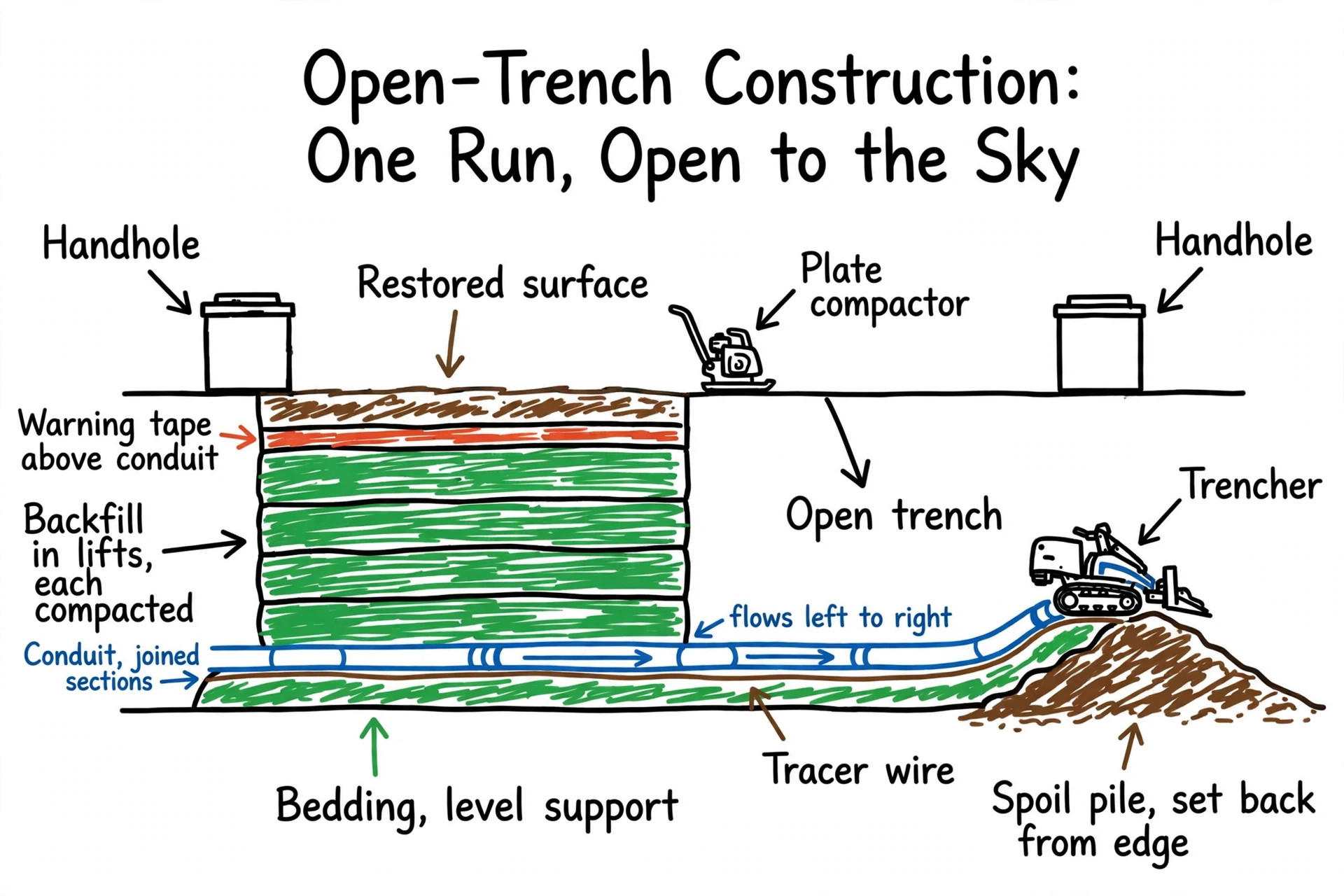
Two supporting materials appear on nearly every open-trench fiber job. Bedding is the layer of suitable material placed and leveled on the trench bottom before the conduit is set, so the conduit rests on even support along its full length rather than on stones or hard clumps. Warning tape is a printed tape buried in the fill above the conduit, and tracer wire is a conductor buried with nonmetallic conduit so the route can be located from the surface later. The FOA notes that where conduit and cable are all dielectric, a conductive marker tape buried above the conduit assists future location and warns anyone digging near the line.
Open trench is one method among several. Horizontal directional drilling, shortened to HDD, is a trenchless method that bores a guided path underground and pulls conduit through it, leaving the surface between the entry and exit points largely undisturbed. Vibratory plowing is a method in which a vibrating blade cuts a narrow slit in the ground and feeds conduit or cable into it as the machine advances. Lesson 161 defines open trench and places it beside those alternatives. Later lessons in this level take up each method in its own right.
What Does It Look Like?
An open-trench job is the easiest underground work to recognize, because the work is open to the sky along its whole length. A beginner standing outside the work area can read the job from its surface signs.
The trench and its edges:
- A continuous open cut running along the route, with the conduit visible at the bottom where placement is under way, or with an empty prepared bottom where placement has not yet reached.
- A spoil pile, the excavated soil set beside the trench for later use as backfill or for removal. Federal OSHA rules require excavated material and equipment to be kept at least 2 feet from the edge of the excavation, or held back by retaining devices, so nothing falls or rolls in on the crew.
- Trench walls that are vertical where the soil and the protective system allow, or cut back in a slope, an angled wall, where the job uses sloping as its protective method.
- A trench shield, also called a trench box, or shoring, bracing that supports the trench walls, present on deeper work where the project safety plan calls for a protective system.
The equipment at recognition level:
- A trencher, a machine built to cut a narrow trench in a continuous pass, recognizable by its digging chain or wheel.
- An excavator, a tracked or wheeled machine with a boom, stick, and bucket, used to dig wider trenches, crossings, and structure excavations, and to handle spoil and backfill.
- A compactor, in hand-guided plate or rammer form near the trench, or a roller on restored surfaces, used to densify each lift of backfill.
- Support vehicles carrying conduit lengths, bedding material, warning tape, and tracer wire, staged along the route rather than at one fixed plant.
The materials in and above the trench:
- Conduit lengths laid out along the route beside the trench before placement, with ends protected from dirt entry.
- A smooth, level band of bedding material visible on the trench bottom ahead of the placed conduit.
- Warning tape and tracer wire appearing in the fill above the conduit during backfill, before the trench reaches full depth of cover.
- Surface restoration in progress behind the backfill: graded soil, replaced sod, or patched pavement following the filled trench along the route.
What Does It Do?
Open-trench construction does one job: it creates a controlled space in the ground where a pathway can be assembled under direct observation, and then it closes that space in a way that protects the pathway for its working life.
The open cut gives the crew direct access. In an open trench, every joint, every change of direction, and every crossing of an existing utility can be seen, measured, and adjusted by hand before it is buried. A conduit section that sits crooked, a coupling that has not seated, or a stone bearing against a duct wall can be corrected in minutes while the trench is open. The same defect found after backfill costs a second excavation. Direct access is the method’s core advantage, and it is also the reason the method disrupts the surface along the entire route.
The bed and the backfill become the conduit’s support structure. A buried conduit does not carry the ground above it alone. The bedding spreads support evenly under the conduit, and compacted backfill at its sides and above it shares the loads from soil and surface traffic. A duct manufacturer installation guide for cable ducts describes the mechanism plainly: the trench bottom is formed from bedding material so the duct has continuous, level support, and backfill is placed in successive layers, with the first layer brought up to the top of the duct using the same material as the bedding and compaction worked at the sides of the duct rather than driven down on top of it. Loose, uncompacted fill settles over time, and settlement shows up later as a sunken strip along the route, cracked restoration, and uneven support under the conduit.
The sequence protects information as well as material. While the trench is open, the crew can photograph the placed work, measure cover over the conduit, confirm tracer wire and warning tape positions, and record what was actually built. Covering the trench ends all of that. Open trench therefore does two kinds of work at once: it builds the physical pathway, and it produces the only direct evidence about that pathway anyone will ever have.
Where Does It Fit?
Open trench is the first construction method in Level 9, and it sits at a fixed place in the life of a project. The work before it is design, permitting, and locating. The work after it is cable placement in the finished pathway, which Level 8 prepared the reader to judge for usability.
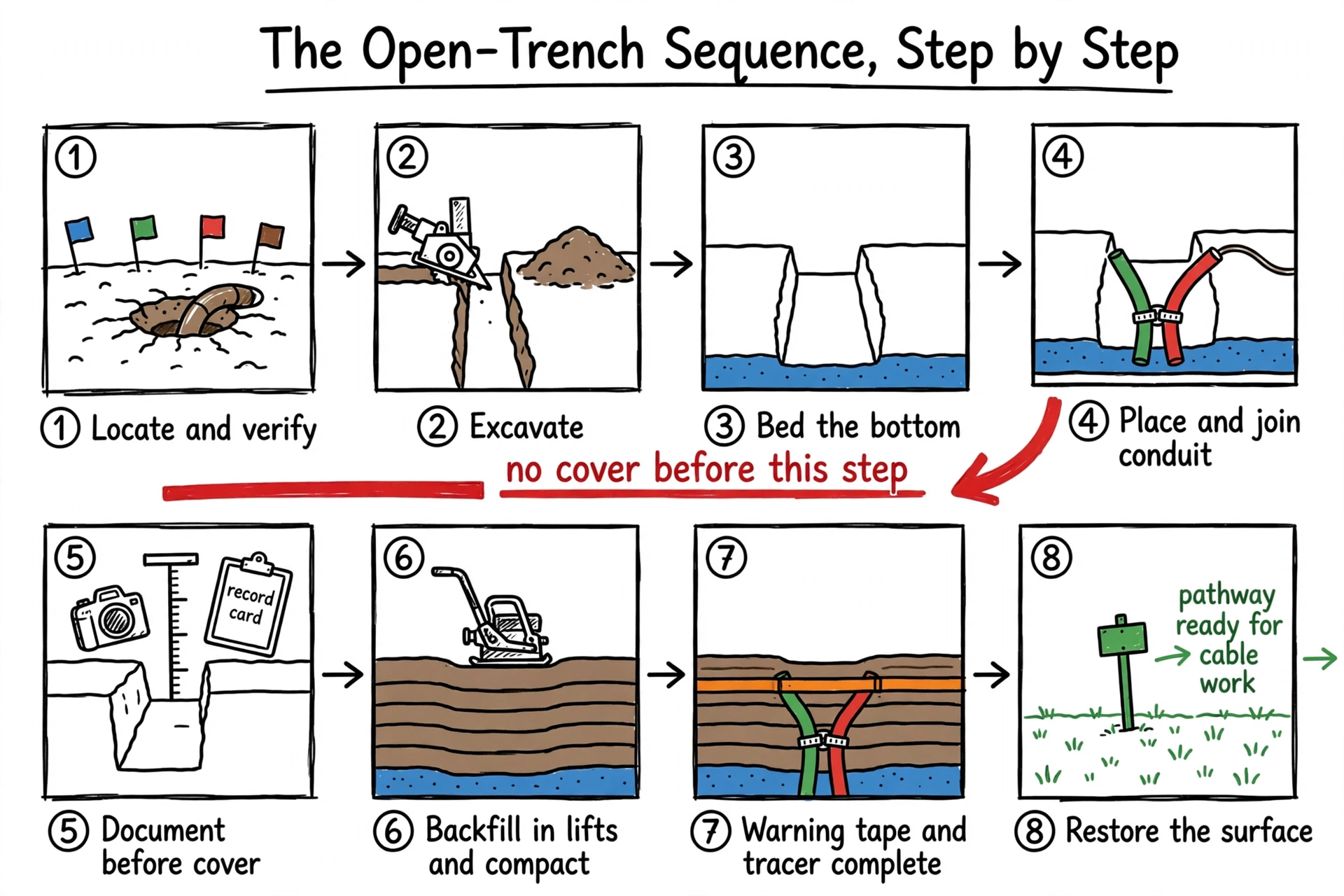
The sequence of an open-trench run, in order:
- Locate and verify. Before any excavation opens, the underground facilities along the route are located and marked. Federal OSHA rule 1926.651(b) requires the estimated location of underground installations to be determined before opening an excavation. In practice this runs through the state one-call system, reached nationally by dialing 811, under state law that sets the notice period and how long marks stay valid. Marks show approximate horizontal position, and lines near the dig are exposed by careful hand digging or vacuum excavation, a step often called potholing or daylighting, before machines work beside them.
- Excavate. The trench is opened along the marked route to the line and depth the project documents state, with spoil placed back from the edge and the protective system the safety plan requires in place where workers will enter.
- Bed. The trench bottom is trimmed level and the bedding layer is placed and leveled, so the conduit will rest on continuous support.
- Place. Conduit sections are lowered in, joined per the conduit manufacturer’s instructions, aligned through any changes of direction, and connected at the structures. Pull tape or a pulling member is placed where the documents call for it, and tracer wire is run with the conduit.
- Document before cover. The placed work is inspected, photographed, and measured while it is still visible: alignment, joints, cover depth to come, tracer wire, and any crossing of existing utilities.
- Backfill in lifts. Fill returns in layers. The first material around and over the conduit is suitable material free of stones that could damage the duct wall, placed and compacted at the sides as the manufacturer’s instructions direct, and the remaining lifts follow, each compacted before the next is placed.
- Place warning tape and tracer provisions. Warning tape goes into the fill above the conduit at the position the project documents state, where it can warn a future excavator before that excavator reaches the conduit, and tracer wire connections and access points are completed and tested.
- Restore. The surface is returned to its required condition, from graded and seeded soil to replaced pavement, and the route record is finished from the documentation made before cover.
Open trench is chosen, or set aside, at the planning stage. It fits where the surface can be opened and restored at acceptable cost: open ground, new development before paving, and routes where direct access to the ground is worth more than an undisturbed surface. It also fits short runs and shallow work where setting up trenchless equipment costs more than the dig itself, and congested ground where the crew must see and work around existing utilities by hand, since an open cut lets workers expose and support the facilities they cross. HDD fits where the surface cannot be opened, at road, river, and railroad crossings and under finished landscaping. Plowing fits long runs across open, reasonably uniform ground where a narrow slit and immediate placement serve better than an open cut. The project documents and the permit decide the method for each segment. A single route commonly uses more than one.
What Is at Stake
The surface pays for the access. Every foot of open trench is a foot of surface removed and restored. Restoration is real cost and real schedule: pavement patches, sidewalk panels, landscaping, and traffic control all ride on the method choice, and a poorly restored trench keeps announcing itself for years as a settled, cracked line across finished ground.
Buried quality is decided in a short window. The conduit is visible for hours and buried for decades. A joint left unseated, bedding left uneven, or backfill left uncompacted cannot be inspected again without digging. The method concentrates the whole quality of the run into the interval between placement and cover, which is why documentation before cover carries the weight it does.
Existing utilities share the ground. An open trench crosses whatever already occupies the route. Striking a buried electric, gas, water, or communication line can injure workers, cut service to a neighborhood, and stop the job under investigation. The locate, verify, and hand exposure steps at the front of the sequence are the controls for that risk, and skipping them converts the cheapest step of the job into the most expensive one.
Compaction decides whether the trench disappears or lingers. Fill placed without compaction in lifts settles under its own weight and traffic. The settlement trough that follows damages pavement, ponds water, and can leave the conduit unevenly supported. Compaction is invisible in the finished job and obvious in its absence.
Excavation is among the most hazardous work in construction. Federal OSHA identifies trench collapses, called cave-ins, as the greatest risk to workers in trenching and excavation work. Soil that stood in the morning can move without warning, and the weight of soil in a collapse is beyond what a buried worker can resist or what rescuers can quickly remove. The protective systems, inspections, and competent person duties in the next sections exist because the open trench that makes the work visible also opens the ground workers stand in.
What Does Good Look Like?
- Locate marks along the route are current, the locate ticket is on site, and existing lines near the dig have been exposed by hand or vacuum methods before machine digging beside them.
- Spoil sits back from the trench edge as federal OSHA rules require, and the trench is free of loose material that could fall in.
- The trench bottom is level and bedded, and the conduit rests on continuous support with no stone or hard clump bearing against its wall.
- Conduit joints are fully seated and made per the manufacturer’s instructions, the run is aligned through its changes of direction, and conduit ends are protected from dirt entry until they are joined or closed.
- Tracer wire runs with the conduit, unbroken, with its connections made and its access points in place, and warning tape is positioned in the fill above the conduit where the documents state.
- Photographs and measurements of the placed work exist before any backfill covers it, and the record states what was built, where, and with what cover.
- Backfill around the conduit is suitable material placed in lifts, compacted at the sides of the duct as it rises, with each following lift compacted before the next is placed.
- The restored surface matches the surrounding surface in material and grade, with no settled trough along the route.
From the Field
Picture a two-crew open-trench job placing a conduit run across an open field toward a new handhole, with backfill scheduled to follow placement closely so the trench does not stay open overnight. By midafternoon the conduit is in the ground along the full run, the bedding looks even, and the joints have been made section by section as the run advanced.
The backfill operator is ready to start, and the schedule favors starting. The inspector walks the run first and finds two gaps in the record. The tracer wire was laid with the conduit, and its connection at the far handhole has not been made or tested. No photographs or cover measurements have been taken along the middle third of the run, where the route passes closest to a marked existing line.
The decision point is whether backfill begins on schedule or waits. Covering the run would take the rest of the afternoon and finish the segment. It would also bury an untested tracer wire and an undocumented crossing, and neither gap could be closed afterward without opening the trench again.
The crew lead holds the backfill. The tracer connection is made at the handhole and the wire is tested end to end from its access points. The inspector photographs the placed conduit and the exposed existing line where the route passes it, and records the cover measurements along the middle third. Backfill begins after those steps, in lifts, with the warning tape placed as the fill rises above the conduit.
The segment finishes later than the day’s first plan, and it finishes complete: a tested locating system, a documented crossing, and a record a later crew can trust. The rule to carry is plain: an open trench is covered only after the work inside it has been checked and recorded, because cover ends every chance to check or record it directly.
What Can Go Wrong?
Digging before the locate is complete. Opening ground on an expired ticket, on marks that were never confirmed, or outside the marked area puts the bucket where verified information is not. Federal OSHA requires the estimated location of underground installations to be determined before opening an excavation, and state one-call law governs the notice and the ticket. A strike on a live utility is the cost of treating that step as paperwork.
Machine digging inside the tolerance zone. Locate marks show approximate position. The tolerance zone is the zone around a marked facility where extra care is required. Industry guidance from the Common Ground Alliance describes it as the width of the facility plus 18 inches on either side of its outside edge, and Texas811 describes 18 inches on either side of a marked utility as an industry accepted practice, while noting that the Texas One-Call law itself does not specify a tolerance zone. Inside that zone, hand digging or another acceptable method is used to find the exact location before more extensive excavation, until the line is exposed and its position confirmed. A bucket working blind inside that band can cut the line the marks were there to protect.
A trench bottom left rough. Stones, clumps, and high spots under a conduit concentrate load on small areas of the duct wall and leave other areas unsupported. The damage may not show until the cable pull or until ground movement works on the weak point. Bedding exists to prevent exactly this, and skipping it saves minutes against years of buried service.
Backfill that damages what it covers. Fill dropped from height, fill carrying large stones against the duct, or compaction driven directly over an unprotected conduit can crack or deform the pathway during the very step meant to protect it. Manufacturer instructions for duct placement call for the first backfill layer to use bedding-type material and for compaction to be worked at the sides of the duct, with care over the top only after cover is established.
Lifts skipped and compaction assumed. A trench filled in one pour and tamped at the surface looks finished and settles like loose soil, because it is loose soil below the top crust. Settlement then takes the restoration, the grade, and the conduit support with it.
Covering before documenting. Backfill placed over unphotographed, unmeasured work converts every later question about the run into a digging question. Depth disputes, locate failures, and damage claims all trace back to the missing record, and the record can never be remade at its original cost.
Treating the trench as safe because it looks stable. Soil faces that stand vertically can still fail, and failure gives no usable warning. A trench entered without the protective system and inspection the rules require exposes the worker to the single deadliest hazard in excavation work.
What Should Someone Notice in the Field?
- Confirm the locate ticket is current for the area being dug, the marks are visible, and any line the trench will cross or parallel closely has been exposed and its position confirmed before machine digging near it.
- Check the spoil placement: excavated material and equipment set back from the edge as federal OSHA rules require, and nothing loose poised to roll or fall into the cut.
- Read the trench bottom before conduit covers it: level, bedded, and free of stones or sharp objects where the conduit will rest.
- Watch a joint being made: sections aligned, coupling or joining method per the conduit manufacturer’s instructions, and the joint fully seated before the run advances.
- Confirm tracer wire is running with the conduit and its connections are being made, and ask whether the wire will be tested before cover.
- Ask for the documentation step out loud: photographs and cover measurements taken and recorded before backfill reaches the conduit.
- Watch the first backfill: suitable material around the duct, placed in lifts, compacted at the sides, with warning tape positioned in the fill above the conduit as the trench fills.
- Note the protective system and the inspection state of the excavation: whether a competent person has inspected the trench this shift, and whether sloping, shoring, or a shield is in place where the work requires one.
- Know the boundary: reading locate marks, watching placement and backfill from outside the excavation, checking records, and reporting a gap are tasks this lesson covers. Entering an excavation, operating trenching and compaction equipment, classifying soil, selecting or installing protective systems, and directing excavation work belong to qualified people under the project safety program, federal OSHA 29 CFR 1926 Subpart P, and state rules where they apply. Under Subpart P a competent person, someone able to identify existing and predictable hazards and authorized to take prompt corrective action, inspects the excavation daily and after any event that could increase hazards, and employees in an excavation 5 feet or deeper must be protected from cave-ins by a protective system unless the excavation is entirely in stable rock. Reading this lesson qualifies no one to do that work, and recognizing an open-trench operation is a different thing from being qualified to run one.
Key Terms
Open-trench construction: Building an underground pathway by excavating an open trench, placing conduit in it, and backfilling, compacting, and restoring the surface above it.
Excavation: Any man-made cut, cavity, trench, or depression in the earth surface formed by earth removal, in the federal OSHA definition.
Spoil: The soil and material removed from an excavation, set aside for use as backfill or for removal from the site.
Bedding: The layer of suitable material placed and leveled on the trench bottom to give the conduit continuous, even support.
Lift: One layer of backfill placed in a trench, compacted before the next layer is added above it.
Compaction: Pressing and densifying fill material so it supports the conduit and the surface and resists later settlement.
Cave-in: The sudden movement of soil or rock from the side of an excavation into it, in enough quantity to trap, bury, or injure a person.
Competent person: Under federal OSHA rules, someone capable of identifying existing and predictable hazards in the surroundings or working conditions and authorized to take prompt corrective measures to eliminate them.
Check Your Understanding
- A crew has excavated the trench, bedded the bottom, and placed and joined the conduit. The backfill operator is ready. Name the step that still stands between placement and backfill, and say why it cannot be done afterward.
Answer: Documentation before cover. The placed work must be inspected, photographed, and measured while it is visible: alignment, joints, cover, tracer wire, and crossings of existing lines. After backfill, none of that can be seen or measured directly, and recovering it requires opening the trench again.
- Why is backfill placed in lifts and compacted at the sides of the conduit first, rather than dumped in full depth and tamped at the surface?
Answer: Loose fill settles, and settlement removes support from the conduit and drops the restored surface into a trough. Placing fill in layers and compacting each layer densifies the material through the full depth of the trench. Around the conduit, bedding-type material and compaction worked at the sides support the duct without driving force down onto an unprotected duct wall, as duct manufacturer instructions direct.
- A route segment crosses a finished parking lot, and a second segment crosses an open field in new development. Which method fits each segment, and why?
Answer: The open field segment fits open trench: the surface can be opened and restored at acceptable cost, and the crew gains direct access to place and inspect the conduit. The finished parking lot crossing fits a trenchless method such as HDD: the bore passes under the surface, so the lot stays in service and no pavement is cut and patched along the route.
- In the From the Field scenario, what did the crew lead decide, what two gaps did the decision close, and what rule did the segment finish under?
Answer: The crew lead held the backfill. The hold closed two gaps: the tracer wire connection at the far handhole was made and the wire tested end to end, and the middle third of the run, including the pass near a marked existing line, was photographed and its cover measured and recorded. The rule is that an open trench is covered only after the work inside it has been checked and recorded, because cover ends every chance to check or record it directly.
- A trench is 5 feet deep and a worker will enter it to make a joint. Under federal OSHA rules, what two things must be true before that entry is proper?
Answer: The excavation must be protected against cave-ins by a protective system, as 29 CFR 1926.652 requires for excavations 5 feet or deeper unless the cut is entirely in stable rock, and the excavation must have been inspected by a competent person, as 1926.651(k) requires daily and after any hazard-increasing event. Reading this lesson qualifies no one to make either call in the field.
Lesson Takeaway
Open-trench construction earns its place as the first method in this level because it makes underground work visible. The reader who can read an open trench, its locate marks, its bed, its joints, its documentation pause, and its layered backfill, understands what every other construction method is trying to achieve without the trench. The habit to carry forward is the hold before cover: check it and record it while it can still be seen.
Sources and Technical References
Fiber Optic Association, Outside Plant Construction, Underground Construction. Covers the basic open-trench form for underground fiber plant: digging a trench to bury conduit, conduit generally PVC pipe sometimes with pre-installed innerduct and pulling tape, directional boring as the alternative where the surface should stay undisturbed, and conductive marker tape buried above dielectric conduit to assist future location and warn excavators: https://www.thefoa.org/tech/ref/OSP_Construction/Underground_Construction.html
Occupational Safety and Health Administration, 29 CFR 1926 Subpart P, Excavations, sections 1926.650 through 1926.652. The federal construction rules for excavation work: definitions including excavation and competent person, the requirement to determine the estimated location of underground installations before opening an excavation, daily competent person inspections, spoil and material setback from the edge, access and egress, and protective systems against cave-ins. Full text of the standard as republished: https://chanrobles.com/usa/uslaws/cfr/title29/29-8.1.1.1.1.16.php
Occupational Safety and Health Administration, eTool: Construction, Trenching and Excavation, Guide for Daily Inspection of Trenches and Excavations. Covers the daily competent person inspection checklist, including spoils, materials, and equipment set back a minimum of 2 feet from the edge of the excavation: https://www.osha.gov/etools/construction/trenching/excavation-check
Occupational Safety and Health Administration, Technical Manual, Section V, Chapter 2, Excavations: Hazard Recognition in Trenching and Shoring. Covers hazard recognition for trenching work, the competent person role, temporary spoil placed no closer than 2 feet from the surface edge of the excavation, and inspection frequency including daily, after rainstorms, and after other hazard-increasing events: https://www.osha.gov/otm/section-5-construction-operations/chapter-2
Polieco Group, Installation Instructions for Cable Ducts. A duct manufacturer’s installation guidance covering trench bedding from backfill material such as sand or fine gravel for continuous and level support of the duct, and backfilling in successive layers: the first layer to the top of the duct in bedding material compacted at the sides only, a second layer also compacted at the sides rather than over the duct, and subsequent layers compacted with care using excavated material cleared of large stones: https://polieco.com/en/how-to-lay-a-cable-duct/
Vermeer, Answering Utility Contractors’ Common Questions About Fiberoptic Cable Installation. An equipment manufacturer’s industry guidance covering method selection: the choice between trenchless and open-cut methods depends on above-ground obstacles and soil conditions, directional drilling is usually employed in urban areas where digging brings extensive restoration, open-cut methods serve in rural and open areas, and in congested ground with other underground infrastructure, hydro excavation trenching may be needed for short distances: https://protips.vermeer.com/underground/2022/11/10/answering-utility-contractors-common-questions-about-fiberoptic-cable-installation/
Texas811, Call Before You Dig, Frequently Asked Questions. Covers the one-call process in one state as an example of state law in practice: contacting the one-call center at least two working days before digging, locators marking lines within that window, and the industry accepted practice of an 18-inch tolerance zone on either side of a marked utility, inside which hand tools or another acceptable method should be used to find the exact location before more extensive excavation: https://texas811.org/faq/
Cabling Installation and Maintenance, Installing Underground Conduit in Customer-Owned Outside Plant. Covers conduit trench practice for campus outside plant: preparing and leveling the trench bed to form an even base for the structure, laying and joining conduit per the conduit manufacturer’s instructions, and mandreling the structure after backfill to confirm alignment: https://www.cablinginstall.com/articles/print/volume-5/issue-3/contents/installation/installing-underground-conduit-in-customer-owned-outside-plant.html
Previous lesson: Lesson 160: What Makes a Pathway Usable? |
Back to Level 9 hub |
Next lesson: Lesson 162: What Is Excavation?