
Introduction
Restoration is the work that returns a disturbed surface to the condition required after underground construction: the pavement, sidewalk, driveway, lawn, or landscape that was cut, removed, or damaged is rebuilt so the surface works and looks as it did before the work, or better where the governing documents require better. Restoration is part of the construction job. It is governed by the permit, the written authorization from the agency or owner that controls work in that place, and by the project specifications, and it is inspected and accepted like any other part of the work.
This lesson teaches why restoration reaches backward and changes the method chosen before any digging starts. A method that looks cheap to dig can become the expensive or prohibited choice once the cost, size, timing, and risk of putting the surface back are counted, and a method that costs more underground can become the right choice because it leaves the surface almost untouched.
What This Lesson Gives You
- Read a route surface by surface and name the restoration each surface will require before a method is chosen.
- Explain why the restored area is often larger than the trench that was dug.
- Compare an open trench and a trenchless crossing on total work, counting restoration, traffic control, and risk of settlement.
- Spot the permit and specification questions that must be answered before equipment is mobilized.
- Recognize a restoration failure in the field, including settlement over a trench, and report it without guessing at a repair you are not qualified to direct.
Start With the Basics
Think about fixing a pipe under a finished kitchen floor at home. You can cut the floor open, fix the pipe, and fill the hole. The job is still unfinished until the floor itself is put back so it is level, sound underfoot, and matched to the floor around it. If the floor is rare tile or newly laid hardwood, you may choose a repair route that reaches the pipe from below or from a small opening, even when that route takes longer, because opening the finished floor creates a second job as large as the first.
A street, a sidewalk, and a lawn work the same way. Each finished surface is a system. Pavement has a surface course over a base, the prepared layer of material directly under the surface that spreads load and supports it. A lawn has topsoil, the upper layer of soil that supports plant growth, over the ground below. Cutting through the finished surface breaks that system along the whole line of the cut. Putting it back takes materials, compaction, curing or growing time, and inspection. The surface is a real part of the build, with its own cost and its own rules, and the method that disturbs the least valuable surface often wins.
That is why restoration is a constructability question. Constructability means whether a design can actually be built as drawn, with available equipment, in the place that is really there, under the permits and specifications that govern that place.
What Is It?
Restoration in fiber construction covers every surface the work disturbs:
- Pavement restoration on asphalt streets, concrete streets, and alleys.
- Hardscape restoration on sidewalks, curbs, gutters, driveways, and parking areas. Hardscape means built surfaces such as concrete, asphalt, brick, and stone, as distinct from planted ground.
- Landscape restoration on lawns, planting beds, trees, shrubs, fences, and irrigation lines in yards and in the right-of-way, the strip of land set aside for a road and the utilities that share it.
- Interior trench support work that makes restoration possible, including backfill and compaction, covered below.
Three related ideas control how big the restoration job becomes.
Temporary restoration is an interim surface placed so the area can be used safely until the permanent work can be done. Examples include a cold patch, a gravel surface, or a secured steel plate over a trench in a travel lane. Permanent restoration is the final rebuilt surface that must meet the permit and specification requirements and pass inspection. Temporary work keeps traffic and pedestrians safe. Permanent work closes the job. Confusing the two is a common and expensive error, because a smooth temporary patch can hide unfinished permanent obligations.
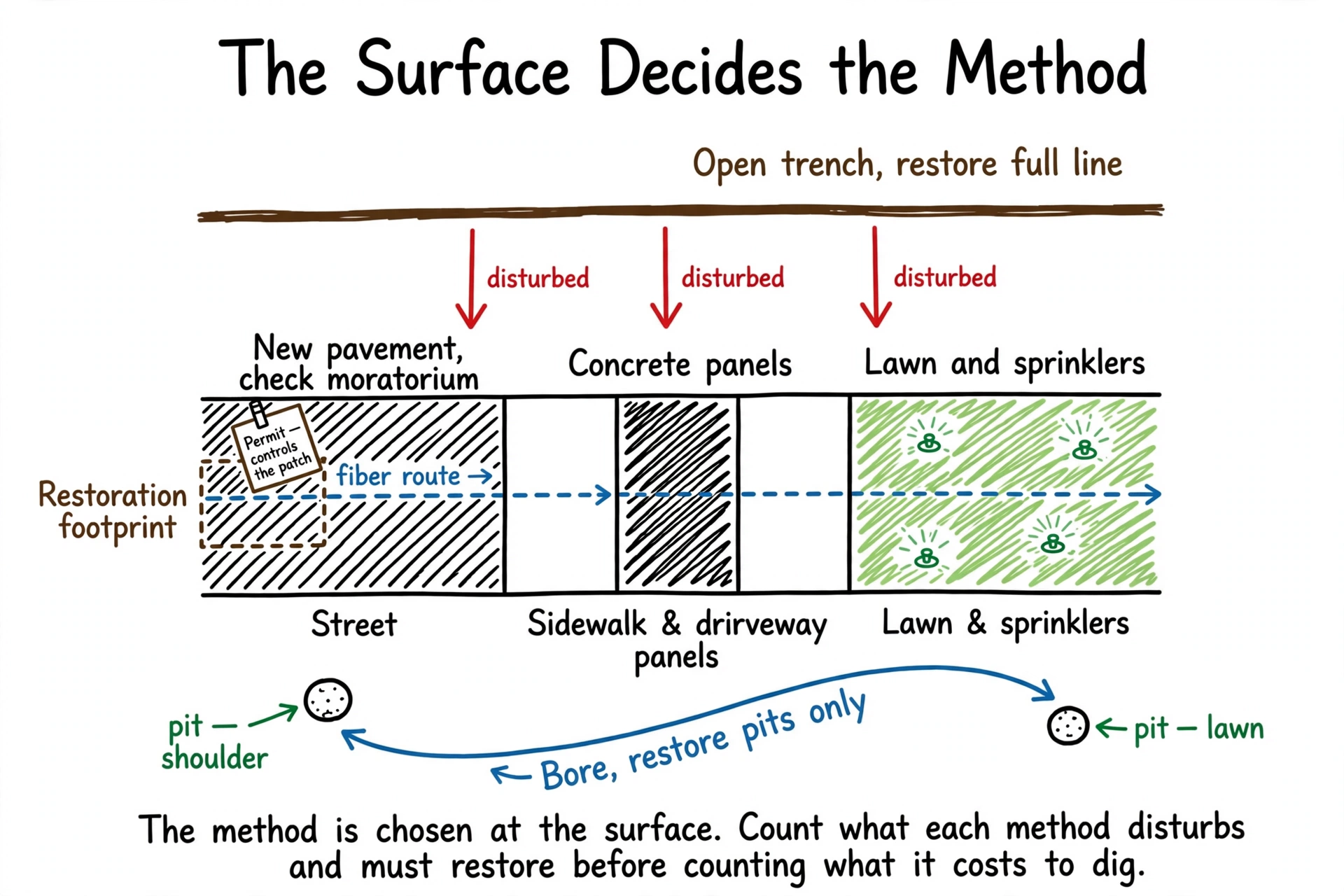
The restoration footprint is the total area that must be rebuilt, which is often larger than the trench itself. Permit standards and specifications commonly require the patch to extend beyond the trench walls onto undisturbed ground, require a full concrete panel to be replaced when a cut falls inside that panel, or require a full lane width to be resurfaced after a longitudinal cut. The exact extension, panel rule, and lane rule belong to the permit and specification for that job. No single dimension fits every jurisdiction.
A street cut moratorium, also called a street cut prohibition, is a period after a street is newly built, reconstructed, or resurfaced during which cutting that pavement is prohibited or allowed only by exception or waiver. Federal rules do not set one national moratorium length. Cities and agencies set their own periods in local code, and published examples range across several years. During a moratorium, the permit may require the applicant to show that a trenchless alternative was considered and found impractical, or to restore a much larger area if a cut is allowed. The moratorium in force on a given street, and any exception process, must be checked in that agency code and permit before a method is promised.
The governing layers are different, and they must not be mixed up:
- Federal regulation at 23 CFR 645.211 requires state transportation department accommodation policies for utilities on federal-aid highway right-of-way to include requirements for preservation and restoration of highway facilities, appurtenances, and natural features and vegetation. The federal rule requires that state policies address restoration. The federal rule does not itself set the patch size or the paving thickness for a city street.
- State and local codes, agency standard plans, and the individual permit set the enforceable restoration details for most fiber work: what may be cut, how the cut is made, how backfill is placed, how large the patch is, how quickly permanent restoration must be completed, and how long the permittee stays responsible for settlement.
- The contract and project specifications set the restoration duties between the parties on that project, including materials, testing, documentation, and acceptance.
- Manufacturer instructions govern the paving, concrete, and restoration products themselves, such as mix handling and curing directions for the product used. A product instruction never overrides the permit or the specification.
What Does It Look Like?
You can read the restoration burden of a route before anyone digs, by walking it surface by surface:
- Fresh, smooth asphalt with new markings, or a street that appears recently resurfaced, which raises the moratorium question.
- Concrete pavement, sidewalks, and driveways divided into panels, the individual slabs separated by joints. A cut inside a panel often means the whole panel is replaced under the governing standard.
- Brick, cobblestone, or stone streets and walks, which some cities protect as historic fabric and require to be rebuilt in kind with the original material returned or replaced to match.
- Decorative or stamped concrete, pavers, and special finishes at commercial frontages and residences, where matching the existing finish drives cost and lead time.
- Established lawns, mature planting, sprinkler heads and lines, fences, and retaining edges, where restoration means topsoil, grading, and either sod, grass grown as a mat with its roots and a thin layer of soil that is laid down as a finished surface, or seed placed to grow a new lawn over time.
- Gravel roads, dirt shoulders, and open ground with no finished surface, where restoration is mainly grading, compaction, and erosion control, and the burden is far lower.
- Existing patches from earlier utility cuts, visible as rectangles or long strips with different color and texture from the surrounding pavement. A line of old patches tells you the street has been cut before and that seams and settlement are already part of its condition.
During and after the work, restoration has its own visible signs:
- Neat saw cut edges along a trench line, made so the patch can bond to sound pavement and bear on undisturbed ground beyond the excavation.
- A temporary patch or plate sitting flush in a lane, with no lip that catches a tire or a foot.
- A finished patch with sealed joints, a surface level with the surrounding pavement, and markings replaced where the permit requires them.
- A restored lawn graded smooth, with sod edges tight or seed covered and protected as the specification requires.
What Does It Do?
Restoration does three jobs, and each job feeds back into method choice.
Restoration returns function. A road surface carries traffic and sheds water. A sidewalk carries pedestrians safely. A lawn controls erosion and returns the yard to use. A patch that settles, ponds water, or leaves a lip fails at function even when it looks complete on the day it was placed.
Restoration protects what is underneath. The key mechanism sits below the surface. Backfill is the material placed back into a trench around and above the duct, in managed layers called lifts, one placed layer at a time. Compaction is the process of densifying each lift with tamping or rolling equipment so the filled trench supports load the way the undisturbed ground beside it does. Settlement is the downward movement that happens later when backfill that was placed loose, in lifts that were too thick, with the wrong material, or at the wrong moisture consolidates under traffic, load, and wetting over time. Settlement shows up weeks or months later as a dip over the trench line, cracked patch edges, and ponding water. Published guidance on backfill makes the same point from experience: a thick single lift can look firm at the surface while the lower material stays loose, and the surface follows that loose material down later. The permit or specification for the job sets the lift, material, moisture, density, and testing requirements. Those values are never carried from one job to another from memory.
Restoration allocates risk and cost over time. Permits and specifications commonly make the permittee responsible for maintaining temporary restoration, completing permanent restoration within a stated period after backfill, and correcting settlement for a stated responsibility period. Those periods belong to the permit for that job. A method that creates a long trench through pavement creates a long obligation. A method that crosses under the pavement from pits in the shoulder creates a much smaller one.
Because restoration does those three jobs, it changes the method decision in predictable ways:
- Open trench, also called open cut, excavates a continuous trench from the surface, places the duct, then backfills, compacts, and restores the full line of the cut. It uses common equipment and gives direct access to the duct. It also disturbs the full length of every surface it crosses.
- Trenchless methods place duct with limited surface openings. Horizontal directional drilling, often shortened to HDD, drills a steerable pilot hole underground, enlarges it, and pulls duct through it, with surface work concentrated at entry and exit pits. Other trenchless approaches use pits at intervals. Trenchless work needs specialized equipment, guidance, and ground information, and it still requires restoration at every pit, pothole, and access point.
- Alignment itself is a restoration decision. Shifting a route from a newly resurfaced street to an older street, from pavement to a grass shoulder, or from a decorative frontage to open ground can change the restoration burden more than any change in digging equipment.
Industry comparisons of open cut and trenchless installation make the trade plainly: open cut often has lower direct digging cost on shallow work in open ground, while restoration, traffic control, and disruption on paved and developed routes can exceed the cost of the underground installation itself, which is where trenchless work gains its advantage. That comparison is a general pattern from industry sources. It is never a price rule for a specific segment. The segment estimate must count its own surfaces.
Where Does It Fit?
Restoration fits at the start of method selection, in the middle of construction, and at the end of closeout.
At planning and design, the route is inventoried surface by surface. The planner checks for moratorium streets, historic or protected surfaces, permit conditions, and specification sections on restoration, then compares methods on total installed work: excavation or boring, duct placement, backfill and compaction, temporary and permanent restoration, traffic control, and the settlement responsibility that follows. A route or method that cannot meet its restoration conditions is not constructable as drawn, however easy the digging looks.
At permitting, the agency may approve one method and deny another, require a waiver analysis for a moratorium street, set the restoration footprint and the completion period, or require full panel or full lane restoration. Those permit answers can reverse a method choice made in the office. Method selection is provisional until the permit is read.
During construction, restoration shapes daily work. Saw cutting, spoil handling, backfill in lifts with compaction and any required testing, temporary patching or plating at the end of each day, and protection of surfaces outside the cut all happen while the duct work is still underway. Equipment that tracks across finished pavement or stockpiles spoil on a lawn creates restoration that was never in the plan.
At closeout, permanent restoration is completed, inspected, and accepted. Photos taken before construction, showing the original surface condition, become the comparison record. The as-built record, the final drawing of what was actually installed, and the daily reports should show where each method was used and what was restored, so a settlement call months later can be traced to a specific segment and a specific record.
What Is at Stake
A cheap dig can become an expensive job. Full length pavement restoration, full panel concrete replacement, full lane resurfacing, specialty matching on historic or decorative surfaces, and repeated return trips for settlement repair can cost more than the duct placement they follow. A bid or a schedule that prices only the digging understates the job.
A prohibited cut can stop the job outright. Cutting a moratorium street without an exception or waiver can draw a stop, a penalty, and a much larger restoration order than a normal patch. Discovering the moratorium after mobilization wastes the mobilization and damages credibility with the agency that issues the next permit.
Settlement is a delayed failure with a clear cause. Loose or poorly compacted backfill consolidates after the surface is finished. The result is a sunken trench line, cracked pavement, a trip edge on a sidewalk, and water ponding over the duct. Repair means cutting out and rebuilding work that was already accepted as finished, under traffic, at the permittee expense where the permit so provides.
The public judges the whole job by the surface. Residents and businesses experience the project at the surface: the patch in front of a driveway, the lawn that was promised back, the lane that stays rough. Poor restoration generates complaints, claims for damaged landscaping or irrigation, and closer scrutiny of every later phase, even when the fiber itself was installed correctly.
Safety follows the surface. A settled or raised patch, a displaced plate, a loose gravel temporary surface, and an unmarked lawn excavation all create hazards for drivers, cyclists, and pedestrians. Temporary restoration and traffic control are safety work governed by the permit and the job traffic control plan. Restoration quality and public safety are the same conversation on a street job.
Records decide who pays. Before photos, permit conditions, compaction and inspection records where the specification requires them, and dated restoration photos determine whether a later dip is a settlement obligation, damage from another party cut, or normal wear. Without that record, argument replaces evidence.
What Does Good Look Like?
Before construction:
- Every surface on the route is inventoried, photographed, and matched to the permit and specification restoration requirement for that surface.
- Moratorium streets and protected historic surfaces are identified, and any exception, waiver, or in kind rebuild duty is resolved in writing before a method is promised.
- The method comparison for each segment counts restoration footprint, traffic control, temporary restoration, and settlement responsibility alongside digging or boring cost.
- Backfill material, lift and compaction method, and any density testing the specification requires are planned and staffed before the trench is opened.
- Sod, seed, concrete, asphalt, and any specialty matching materials are confirmed available in the season the work will finish.
In the field:
- Cuts are saw cut neatly, damage outside the cut limits is avoided, and any extra damage is reported the same day.
- Backfill goes in lifts with compaction as the permit and specification require, and unsuitable material such as broken pavement, organics, and rubble is kept out of the trench.
- Temporary restoration is placed before traffic or pedestrians are returned to the area, sits flush, and is maintained until permanent restoration is done.
- Disturbed lawn areas are regraded with topsoil and restored with sod or seed as the governing documents require, with edges and irrigation damage addressed.
- Brick or other protected surface material removed for the work is salvaged, protected, and returned to the surface or to the owner as the local rule requires.
At closeout:
- Permanent patches bear on undisturbed ground beyond the trench as the standard requires, joints are sealed, surfaces are level with the surrounding surface, and pavement markings disturbed by the work are replaced where required.
- Full panels and full lane widths are restored where the permit requires them, with no narrow strip left to fail between the patch and the joint or lane line.
- The segment passes the agency or owner inspection, and any punch items on restoration are closed with dated photos.
- Daily reports and the as-built record state the method used and the restoration completed for each segment.
From the Field
Picture a planner pricing a short fiber segment that crosses a city street to reach a group of homes. The street surface looks fresh, with dark asphalt and crisp markings. The first plan is a simple open trench straight across, using the trencher already on the project, with a patch to follow.
Before pricing is finished, the planner checks the permit information for that street and finds the street was recently resurfaced and sits inside the city street cut prohibition period. A cut is allowed only by exception, and the exception terms would require resurfacing a far larger area than the trench. The planner also walks the far side and finds the exit side is an established lawn with an irrigation system, while the near side has a wide grass shoulder with room for a drill and a pit outside the pavement.
That is the decision point. The trencher is cheaper by the hour and already on site. The total job tells a different story once restoration, the exception process, and the settlement responsibility on a new street are counted.
The decision is to bore under the street with HDD from the grass shoulder, place pits in the lawn and shoulder areas where restoration is grading, topsoil, and sod, and keep the new pavement intact. The bore costs more to mobilize than the trench would have cost to dig. The project avoids the prohibited cut, avoids the enlarged resurfacing order, and hands the residents a finished job with no patch across their new street.
The crew restores the two pit areas the same week, photographs the restored lawn against the before photos, and records the bore path and the pit restoration in the daily report and the as-built record. Months later there is no trench line to settle in the street, because no trench was ever opened in it.
The rule to carry is the comparison itself: choose the method on the total work to a finished, accepted surface, counting the restoration footprint, the permit conditions, and the settlement risk, and never on the digging cost alone.
What Can Go Wrong?
Pricing the dig and forgetting the surface. A segment is bid as trenching, then the permit requires full lane resurfacing or full panel replacement. The margin disappears, the schedule stretches to fit paving availability, and the dispute starts before the duct is in service.
Cutting first and reading the permit second. A crew opens a moratorium or protected street on the strength of a verbal go ahead. The agency orders a larger restoration, the historic material that should have been salvaged is already broken and hauled away, and matching material must be sourced at premium cost.
Loose backfill under a good looking patch. Backfill is dumped in thick lifts to save time, the surface is paved smooth, and the patch passes a casual look. Traffic and rain consolidate the loose fill, the patch sinks along the trench line, and the crew returns to cut out and rebuild its own finished work.
A temporary patch that becomes the permanent answer. A cold patch or plate is left in place past the permit period because the job moved on. The temporary surface ravels, settles, or shifts, complaints arrive, and the agency directs permanent restoration on its own timeline, often in worse weather and at worse prices.
Lawn restoration treated as an afterthought. Topsoil is buried under subsoil spoil, sod is laid on ungraded ground, sprinkler damage is left unreported, and seed is placed outside a viable growing window with no protection. The yard fails to recover, and a small restoration item becomes a property claim and a reputation problem on the whole street.
Damage outside the cut. Tracked equipment tears pavement beyond the trench, spoil kills grass outside the work area, and a saw cut overruns into a panel that was supposed to stay. Each item enlarges the restoration footprint at the permittee cost, because the standard duty is to restore surfaces damaged by the operation, inside the trench and outside it.
Wrong method for a sensitive surface. An open trench is chosen across brick or decorative pavement that a bore could have passed under. Even a careful in kind rebuild takes specialty labor and time, joints and patterns rarely match perfectly, and on a protected street the approval to cut may never have been available at all.
What Should Someone Notice in the Field?
- The age and condition of every pavement on the route, and any sign the street was recently built or resurfaced, which triggers the moratorium check.
- Panel joints in concrete, so a planned cut can be judged against the full panel that may have to be replaced.
- Brick, stone, stamped, or decorative surfaces, and any marker or local knowledge that the surface is protected or historic.
- Old patches and settled trench lines from earlier cuts, which show how this street and this ground have behaved after restoration before.
- Lawns, planting, fences, and irrigation heads along the line, photographed before work so the restoration target is documented before work.
- Whether the planned pits for a trenchless crossing truly sit on low burden ground, or whether a pit lands on the same expensive surface the bore was meant to avoid.
- During backfill: material going in free of broken pavement and organics, placed in lifts, with compaction equipment actually working each lift.
- At the end of each day: temporary restoration flush and secure, plates pinned or ramped as the permit and traffic control plan require, and no open trench left in a traveled or walked area without protection.
- After completion: a patch level with the surrounding surface, joints sealed, markings replaced where required, lawn graded and covered, and no dip developing over the trench line on return visits.
- Know the boundary: recognizing restoration requirements and spotting settlement is field observation. Directing paving, concrete placement, traffic control, and trench entry belongs to qualified people working under the permit, the specification, and the excavation safety rules, including the competent person duties in the federal OSHA excavation standard at 29 CFR 1926 Subpart P. Reading this lesson qualifies no one to perform or direct that work.
Key Terms
Restoration: The work that returns a surface disturbed by construction to the condition the permit and specification require, including pavement, hardscape, and landscape surfaces.
Permit: The written authorization from the agency or owner controlling a place, setting conditions for cutting, backfill, restoration size, timing, and responsibility.
Right-of-way: The strip of land set aside for a road and for the utilities that are allowed to share it.
Open trench (open cut): A method that excavates a continuous trench from the surface, places the duct, then backfills, compacts, and restores the full line of the cut.
Trenchless: A family of methods that place duct with limited surface openings, concentrating surface work at pits and access points.
Horizontal directional drilling (HDD): A trenchless method that drills a steerable pilot hole underground, enlarges it, and pulls duct through it.
Backfill: Material placed back into a trench around and above the duct, in placed layers called lifts.
Compaction: Densifying each backfill lift with tamping or rolling equipment so the filled trench supports load like the undisturbed ground beside it.
Settlement: Downward movement of a restored surface when loose or poorly compacted backfill consolidates later under load, traffic, and wetting.
Temporary restoration: An interim surface, such as a cold patch, gravel, or a secured steel plate, that keeps an area safe until permanent restoration can be completed.
Permanent restoration: The final rebuilt surface that must meet the permit and specification and pass inspection.
Restoration footprint: The total area that must be rebuilt, often larger than the trench because standards require bearing on undisturbed ground, full panels, or full lane widths.
Street cut moratorium (street cut prohibition): A period after a street is newly built, reconstructed, or resurfaced during which cutting is prohibited or allowed only by exception or waiver, as set by the local agency.
Sod: Grass grown as a mat with roots and a thin soil layer, laid down as a finished lawn surface.
As-built record: The final drawing of what was actually installed, including method and restoration by segment.
Check Your Understanding
- Why can the restoration footprint be larger than the trench that was dug?
Answer: Permit standards and specifications commonly require the patch to extend beyond the trench walls onto undisturbed ground so the new pavement is supported and bonded to sound material. Concrete work may require a full panel to be replaced when a cut falls inside it, and a longitudinal cut may require a full lane width to be resurfaced. The exact rule belongs to the permit and specification for that job.
- A street on the route was resurfaced recently. What must be checked before an open trench across it is promised, and what alternatives does that check open up?
Answer: The local street cut moratorium or prohibition and its exception or waiver process must be checked in the agency code and permit. If a cut is prohibited or carries an enlarged restoration duty, the alternatives are to bore or otherwise cross trenchlessly, shift the alignment to a surface that may be cut, or delay the crossing until the period ends, each judged on total work to a finished surface.
- In the From the Field scenario, the trencher was already on site and cheaper by the hour. Why did the planner still choose the bore?
Answer: The street sat inside a street cut prohibition period, so a trench would have needed an exception and a far larger resurfacing than the trench itself, plus settlement responsibility in a new street. The bore from the grass shoulder kept the new pavement intact and limited restoration to grading, topsoil, and sod at the pits. On total work to a finished, accepted surface, the bore was the sound choice even though its hourly digging cost was higher.
- A patch looks smooth on the day it is placed. What hidden condition can still make it fail months later, and what field practice prevents it?
Answer: Loose backfill placed in thick lifts without proper compaction can consolidate under traffic and wetting, so the surface settles along the trench line and the patch cracks or ponds water. Placing approved backfill in lifts, compacting each lift, keeping unsuitable material out of the trench, and completing any testing the specification requires are the practices that prevent it.
- Which layer of rules sets the patch size and completion period for a typical city street fiber job, and what does the federal rule at 23 CFR 645.211 actually require?
Answer: State and local codes, agency standard plans, and the individual permit set the patch size, timing, and responsibility details, with the contract specifications setting duties between the parties. The federal rule requires state transportation department accommodation policies to include requirements for preservation and restoration of highway facilities and vegetation. The federal rule does not itself set a universal patch size or paving thickness.
Lesson Takeaway
Restoration is half the method decision, hiding in plain sight at the surface. The trench or bore is temporary. The patch, the panel, the lane, and the lawn are what the agency inspects, what the resident lives with, and what settles or holds for years. After this lesson, a finished surface stops looking like empty ground to cross and starts looking like a priced, permitted, and inspectable part of the build, and the winning method is the one that delivers a finished, accepted surface for the least total work and risk.
Sources and Technical References
23 CFR 645.211, State transportation department accommodation policies, requiring state utility accommodation standards to include specifications for methods of installation and requirements for preservation and restoration of highway facilities, appurtenances, and natural features and vegetation on the right-of-way. Federal rule. It sets the policy requirement and does not set a universal patch size or thickness: https://www.govinfo.gov/content/pkg/CFR-2024-title23-vol1/pdf/CFR-2024-title23-vol1-sec645-211.pdf
Federal Highway Administration, Construction Program Guide, Utilities, summarizing joint use of highway right-of-way by utilities and the federal framework in 23 U.S.C. and 23 CFR Part 645 for utility accommodation and relocation: https://www.fhwa.dot.gov/construction/cqit/utilities.cfm
City of Vancouver, Washington, Municipal Code 11.80.100, Street restoration standards. One city example only. It shows a street cut prohibition period after construction or resurfacing, restoration conditions based on pavement type, street classification, cut orientation, and pavement age, and full panel replacement rules for concrete pavement. Periods and rules vary by city: https://vancouver.municipal.codes/VMC/11.80.100
City of Arvada, Colorado, Street Cut Moratorium page. One city example only. It shows an approval requirement for excavation in recently resurfaced pavement and approval criteria that include whether boring or jacking without disturbing the pavement is practical and whether an alternative alignment avoids the street: https://www.arvadaco.gov/1007/Street-Cut-Moratorium
West Haven, Utah, Code Section 152.030, Restoration of public property and patching and restoration policies. One city example only. It shows a permittee duty to restore a public way to its original condition with the same type and depth of pavement, temporary surfacing duties, time limits in the permit, and trench restoration details including extension beyond the excavation for certain restoration types: https://codelibrary.amlegal.com/codes/westhavenut/latest/westhaven_ut/0-0-0-4061
City of Renton, Washington, Trench Restoration and Street Overlay standards. One city example only, built on the Washington APWA and WSDOT standard specifications as adopted and supplemented by the city. It shows saw cuts and grinding beyond the trench width, minimum patch widths for transverse and longitudinal trenches, potholing restored to trench standards beyond a stated size, and temporary restoration for overnight use: https://edocs.rentonwa.gov/Documents/DocView.aspx?id=8880504&dbid=0&repo=CityofRenton
Village of Mount Prospect, Illinois, Code Section 9.820, Cleanup and Restoration. One village example only. It shows a utility duty to restore turf, terrain, and other disturbed property, restoration by backfilling, regrading, and resodding to a condition substantially equivalent to the condition before the project, sod duties, and a stated responsibility period for backfilled areas that settle: https://codelibrary.amlegal.com/codes/mtprospectl/latest/mtprospect_il/0-0-0-4387
City of Galena, Illinois, Code Section 97.45, Brick and Cobblestone Streets. One city example only. It shows protected historic brick and cobblestone streets that must be replaced in a manner consistent with original construction after any disturbance, with removed bricks or cobblestones remaining city property, and historic preservation review before removal or resurfacing: https://codelibrary.amlegal.com/codes/galena/latest/galena_il/0-0-0-32640
Sandale Ontario, A Technical Deep Dive Comparison of Trenchless vs. Open-Cut Pipe Installation in Ontario, industry comparison noting that open cut surface restoration can include asphalt, concrete, and landscape reinstatement, that asphalt and concrete reinstatement, lane closures, and traffic control can exceed the cost of the installation itself on developed routes, and that trenchless methods concentrate value where surface restoration is complex or high cost. General industry pattern only, never a price for a specific segment: https://www.sandaleontario.ca/post/a-technical-deep-dive-comparison-of-trenchless-vs-open-cut-pipe-installation-in-ontario
BuildCalc, Backfill Compaction Guide, general educational guidance explaining that backfill placed in one thick lift can appear compacted at the surface while lower material remains loose, leading to delayed settlement, sunken trench lines, and cracked pavement, and explaining lift thickness, moisture, and density testing concepts in general terms. Project lift, density, and testing values always come from the permit and specification for that job: https://trybuildcalc.com/knowledge/earthwork/backfill-compaction-guide
OSHA, Clarification of Excavation Standards, January 9, 1991, confirming the competent person inspection duties in 29 CFR 1926.651(k) under the federal OSHA excavation standard, 29 CFR 1926 Subpart P. Cited for the safety boundary only. This lesson does not teach excavation entry or protective systems: https://www.osha.gov/laws-regs/standardinterpretations/1991-01-09
Graphic Brief 1: Main Illustration
Graphic title: The Surface Decides the Method
Main objects: A top down street plan view across the middle of the board. A fiber route drawn as a blue line crossing three surface zones in a row: a newly resurfaced asphalt street with crisp markings, a concrete sidewalk and driveway made of separate panels, and an established green lawn with small sprinkler heads. Under the street zone, a faded cross section strip showing pavement over base over a trench outline. Two method sketches: an open trench drawn as a long brown cut through all three zones, and a bore path drawn as a curved blue line passing under the street with two small pits on the lawn and shoulder. A permit tag clipped to the street zone.
Placement: Street plan across the center, surface zones left to right in one row so the comparison reads in order. Open trench sketch in the upper half. Bore path sketch in the lower half, aligned to the same three zones. White space at the top for the title and at the bottom for the key teaching point.
Labels: Minimal labels only. New pavement, check moratorium. Concrete panels. Lawn and sprinklers. Open trench, restore full line. Bore, restore pits only. Restoration footprint as a wider outline around the trench in the street zone. Permit controls the patch.
Arrows and relationships: Red arrows from the open trench to each disturbed surface, showing restoration following the full cut. Green arrows from the bore pits only, showing the street surface left intact. A brown double headed arrow showing the restoration footprint wider than the trench itself. A blue arrow along the bore path under the street.
Important technical details: The restoration footprint outline sits wider than the trench on undisturbed ground. The concrete zone shows full panel outlines, with one full panel highlighted as the replacement unit. The bore passes under the pavement with no cut in the street surface. Pits sit on lawn and shoulder ground. No numeric patch widths, depths, thicknesses, or time periods anywhere on the board, because those values belong to the permit and specification.
What not to show: No worker inside an open trench. No machine cutting a moratorium street as an approved action. No loose backfill shown as acceptable. No prices or dollar figures. No buildings, vehicles, decoration, or extra labels.
Key teaching point: The method is chosen at the surface. Count what each method disturbs and must restore, under the permit that governs that surface, before counting what it costs to dig.
Graphic Brief 2: Added Visual, Open Trench Versus Trenchless Restoration
Graphic title: Same Crossing, Two Restoration Bills of Work
Main objects: A side by side comparison in two columns with a shared street cross section at the top of each column. Left column: an open trench crossing under the street from side to side, with backfill lifts shown as stacked layers in the trench, a temporary patch, then a permanent patch wider than the trench, and a faded settled patch below with a dip. Right column: a bore path passing under the street with entry and exit pits outside the pavement, pit backfill layers, and a small lawn restoration patch with sod at each pit, with the street surface drawn unbroken.
Placement: Two equal columns divided by a thin vertical line in the middle of the board. Shared street surface line runs level across the top of both columns at the same height so the contrast is direct. The settled patch sketch sits small at the bottom of the left column as the failure outcome. White space at the top for the title and at the bottom for the key teaching point.
Labels: Minimal labels only. Left column header: Open trench. Right column header: Trenchless bore. Backfill in lifts, compact each lift. Temporary patch. Permanent patch, wider than trench. Settlement if backfill is loose, with a red X. Pits outside pavement. Sod at pits. Street left intact.
Arrows and relationships: Brown arrows in the left trench pointing to each lift layer in order from bottom to top. A red downward arrow over the settled patch showing the surface dropping over loose fill. Green arrows in the right column pointing only to the two pit restorations. A blue arrow along the bore path under the unbroken street.
Important technical details: The permanent patch is visibly wider than the trench and rests on undisturbed ground at both edges. Backfill lifts are thin even layers, never one deep loose fill. The right column street has no cut, no patch, and no seam. Pit restoration is small and sits on grass ground. No numeric lift thicknesses, densities, patch widths, or time periods anywhere on the board.
What not to show: No worker inside a trench or pit. No dollar figures or cost numbers. No soil bore shown cutting through the street surface. No explosives. No decoration or extra labels.
Key teaching point: Open trench restores a line. Trenchless restores points. On a valuable or protected surface, that difference in footprint is often the whole method decision.
Previous lesson: Lesson 106: Why Does Groundwater Affect the Build? |
Back to Level 5 hub |
Next lesson: Lesson 108: Why Does Traffic Affect the Construction Method?