
What You Are Learning
By the end of this lesson you will be able to explain what equipment access means in outside plant fiber construction, and why it is tested on paper and on the ground before any equipment is sent to a job. You will be able to name the separate questions hidden inside the one short question in the title: can the equipment legally reach the work, can it physically travel the ground without getting stuck or causing damage, can it turn, can it set up, and can it leave again when the work is done, in the weather and the season when the work is planned. You will be able to list the equipment that has to make the trip on a typical underground or aerial fiber job, including a directional drill, a trencher, a bucket truck, a reel trailer, and the support vehicles that carry crew, fuel, water, and material. You will be able to describe the common blockers a field check looks for: gates and fences, narrow lanes, soft or wet ground, slopes described in general terms, overhead lines above the access path, weight carried over driveways, bridges, and culverts, and land the crew has no permission to cross. You will be able to state the central distinction of this lesson in plain words: a route a person can walk is not automatically a route a loaded truck can use. Finally, you will be able to state your boundary clearly. Recognizing an access problem and reporting it with facts is the reader job. Operating the equipment, directing traffic, deciding that ground or a structure can carry a load, or crossing private land without permission is not taught or authorized by this lesson.
Start With the Basics
Outside plant, usually shortened to OSP, is the part of a fiber network built outdoors: cables on poles or underground, conduit, handholes, splice closures, and the structures that hold them. Building that plant takes machines that are far larger and heavier than a pickup truck, and those machines have to arrive before any building can happen.
Access, in this lesson, means the route and the permission that let a vehicle or a machine travel from a public road or another lawful starting point to the place where work will happen, and back out again. Access has two halves that must both be true. The physical half asks whether the route fits the equipment and whether the ground will carry it. The legal half asks whether the crew has the right to be on that ground with that equipment at all. A wide, firm farm lane the crew has no permission to use fails the test. A fully permitted easement that turns to deep mud after rain also fails the test. Either failure stops the equipment, and stopping the equipment stops the job.
Mobilization is the moving of equipment, material, and crew to a job site so work can begin. Demobilization is the same move in reverse at the end of the work. Demobilization matters to this lesson because a route that works one way in dry weather may not work the other way after the job has torn up the ground or after rain has arrived. An access plan that only gets equipment in is half a plan.
Setup means positioning a machine at the work location and making it ready to work: leveling or stabilizing it as its manufacturer requires, setting supports such as outriggers where the machine uses them, and leaving room around it for the crew, the material, and the work itself. Setup is covered in its own right in the next lesson, Lesson 101, What Is Equipment Setup Area? This lesson ends where that one begins. Lesson 100 asks whether the equipment can get there. Lesson 101 asks whether, once there, it has the room and the ground it needs to set up and work.
Staging is the organized holding of equipment, vehicles, and material at or near the work area, in a place they are allowed to be, so the work can flow without repeated trips. A staging area is the place set aside for that holding. Staging is part of the access question because staged trucks and trailers occupy ground and weight for hours or days, not for the minutes a single pass takes.
Constructability is the larger idea this level is built on, introduced in Lesson 96: whether a design that works on paper can actually be built in the real place, with real equipment, real ground, and real limits. Equipment access is one of the first constructability tests, because it is checked before money is spent moving iron. A route can be correct, a design can be sound, and a permit can be in hand, and the job can still be unbuildable on the planned day because the drill cannot get to the bore pit.
Hold one sentence for the whole lesson. The question is never just can we get there. The question is can this specific loaded equipment, on this specific route, on this specific ground, in this specific season, with this specific permission, get in, turn, set up, work, and get out again. Every word in that sentence is a place the answer can fail.
What Is It?
Equipment access is the verified ability of the specific equipment a job needs to travel lawfully and safely from where it starts to where it will work, and back, over the actual ground and through the actual openings on the route, under the conditions expected when the work will happen.
Name the equipment plainly, because each piece fails the test in its own way. A directional drill, also called a horizontal directional drill or HDD, is a tracked or wheeled machine that bores a hole underground from an entry point so conduit or cable can be pulled back through it without digging an open trench the whole way. It typically arrives on a trailer behind a truck, travels slowly, and needs firm ground at the entry point. A trencher is a machine that digs a narrow open trench with a digging chain, bar, or wheel. A bucket truck is a truck with an insulated or non-insulated boom and a bucket that lifts a worker to reach poles and aerial cable. A reel trailer is a trailer built to carry and pay out large reels of cable or conduit, and it is long, because the reel and the tongue and the towing truck all count when it turns. Support vehicles are everything else the job sends down the same route: water trucks or trailers for drilling fluid, vacuum excavation units used to expose utilities, fuel and service trucks, material trucks delivering handholes and conduit, and crew pickups. An access answer that covers only the drill and forgets the water truck and the reel trailer is not an answer. The longest, widest, heaviest, or least maneuverable vehicle on the list sets the real test.
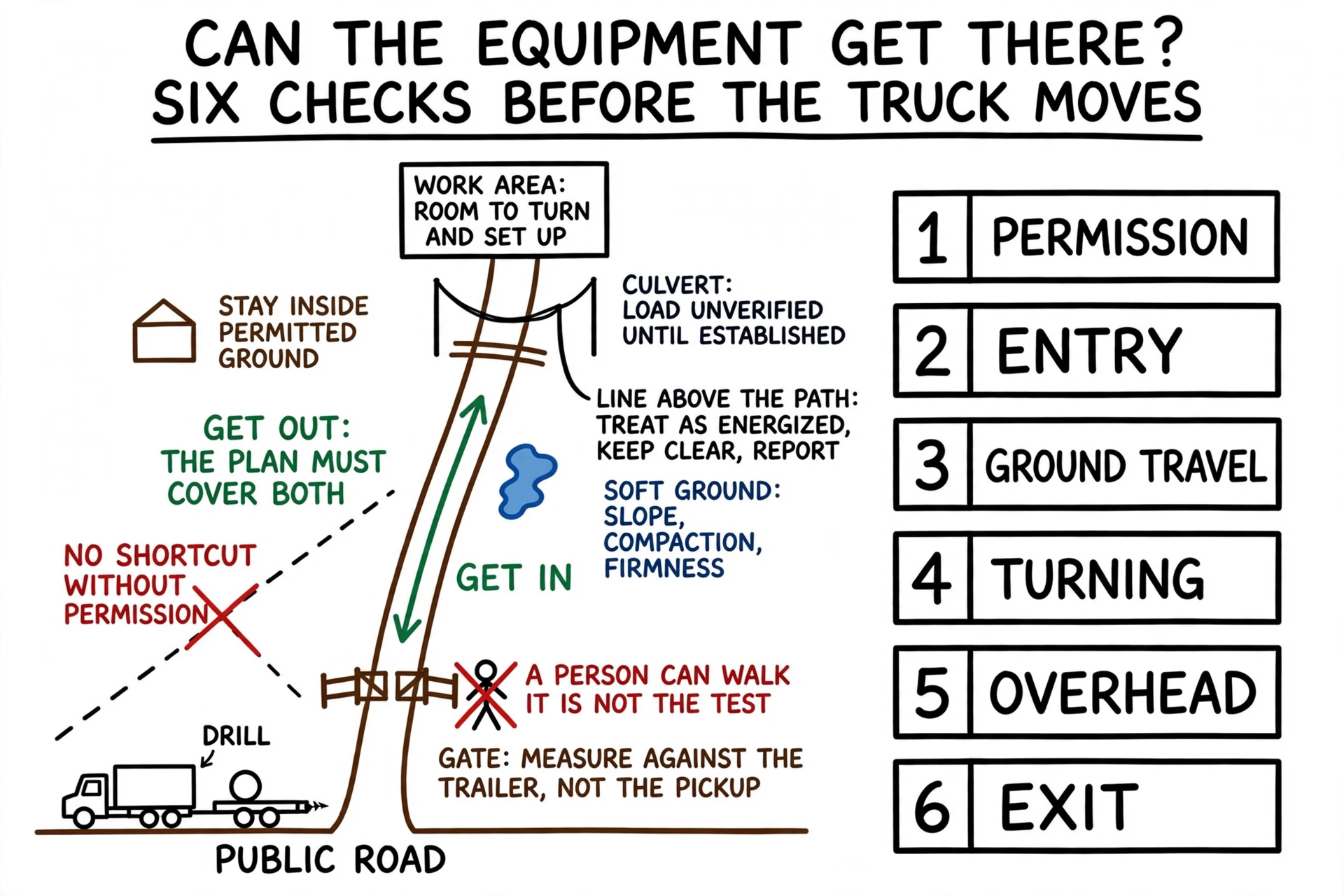
An access check, as taught in this lesson, is a deliberate review of the whole route for each piece of equipment, done before mobilization, using the print, the permit and easement documents for the job, and a visit to the ground itself. It answers six sub-questions in order.
First, permission: does a legal right exist to cross every parcel and use every road, lane, and opening on the route, for vehicles of this kind? Second, entry: can the equipment physically pass the openings on the route, including gates, fence gaps, bridge rails, tree lines, and turns off the road? Third, travel: will the ground along the route carry the loaded equipment without it sinking, sliding, or getting stuck, and without damaging the surface, what lies under it, or neighboring property? Fourth, turning: is there room at each turn, and at the work area, for the longest combination on the job to change direction without leaving the permitted ground or striking something? Fifth, overhead: is the space above the route and the work area clear of lines, limbs, and structures for the height of the traveling and working equipment? Sixth, exit: can everything leave, loaded as it will be at the end of the job, over ground the job itself may have disturbed, in weather that may have changed?
Equipment access is not the same as crew access, which Lesson 109 covers. A person on foot can step over a ditch, duck under a limb, open a light gate, and pick a dry line across a wet field. None of those facts says anything about a loaded truck and trailer. Equipment access is also not the same as future maintenance access, which Lesson 110 covers, although a route that fails today will usually fail the repair crew years later too. And access is not a one-time yes. It is a yes for a named set of equipment, in a named season, under expected conditions. A route verified in a dry month is a fact about that dry month. It is a starting assumption, not a guarantee, for a wet one.
What Does It Look Like?
You recognize an access problem by looking at the route the way the equipment will experience it: low, wide, long, heavy, and unable to step sideways when the ground goes bad.
It can look like a gate that fits the pickup and nothing else. The crew truck slips through a farm gate or a fence gap with room to spare, everyone walks the field beyond it, and the walk feels like proof. The trailer carrying the drill is wider than the truck, longer than the gap allows it to swing through, and it approaches the gate at an angle the fence line forces on it. The gate was measured, if it was measured at all, against the wrong vehicle.
It can look like a lane that narrows after the entrance. A gravel lane starts wide at the road, then pinches between a barn and a fence, or between trees, or at a culvert crossing, a buried pipe or box that carries water under the lane. The pinch point, not the entrance, is the true width of the route. The same logic applies to height: a route can be open for most of its length and fail at one low limb, one low line crossing, or one barn doorway the equipment was expected to pass.
It can look like ground that lies. A field that carries a person and a pickup in the morning can rut, soften, and swallow a loaded truck by afternoon, especially after rain, after a thaw, or after the first heavy passes have broken the surface. Tire tracks from earlier light vehicles are not evidence about loaded equipment. In the crane rules discussed later in this lesson, federal regulators define ground conditions as the ability of the ground to support the equipment, including slope, compaction, and firmness. That definition names the three things a field check is really looking at, whatever the machine: how steep, how packed, how solid.
It can look like a slope problem stated without any number. A loaded truck that travels comfortably along a flat lane may slide, tip toward the low side, or fail to climb when the same lane runs across or up a hillside, and a tracked machine that crosses a slope safely in one direction of travel may behave differently crossing it the other way. This lesson states no grade limit, because no single limit exists across equipment. The limit for a specific machine lives in that machine manufacturer instructions and in the judgment of the qualified people running the job. The field recognition skill taught here is simpler: a slope on the route is a question to raise, never a detail to wave past.
It can look like a weight problem over something built for less. A residential driveway, a small private bridge, or a farm culvert may have been built for cars and light trucks. Driving a loaded equipment truck, a water truck, or a concrete or material truck over it can crack the driveway, crush the culvert, or damage the bridge, and the damage can be sudden where a buried structure gives way. No one reads the safe load of an unmarked private driveway by looking at it. Where the job documents, the property owner, or an engineer have not established that a structure can carry the load, the honest field answer is that the load is unverified, and unverified means reported, not tested with the truck.
It can look like wires where the work needs air. Overhead lines cross many rural lanes and field entrances at the height a bucket truck travels or works, and lines also cross the setup area where a boom will rise. A line over the access path is not only a work area problem. A tall load on a trailer, a raised bed or boom not fully lowered for travel, or a reel standing high on its trailer can reach toward lines on the route itself. Field practice taught in the sources for this lesson is to treat all overhead lines as energized until the utility owner establishes otherwise.
Finally, a good access check has a recognizable paper shape, like the good mismatch record in Lesson 95. There is a dated note naming the route segment by segment: where the equipment leaves the public road, each gate or pinch point, each slope, each low line, each driveway, bridge, or culvert the route crosses, the ground condition seen and the weather when it was seen, and the permission document relied on for each parcel. Photographs show the pinch points and the ground, with a tape at the narrow openings. The note names the equipment list it was checked against. An access answer with no paper shape is usually a memory of a walk, and a walk, as this lesson repeats, is not the test.
What Does It Do?
Understanding what the access test does for a job explains why it happens before mobilization day, not during it.
First, it protects the schedule from the most wasteful failure in construction: expensive equipment and a full crew standing idle at a gate, a mud hole, or a locked fence while the office solves a problem that a site visit would have found the week before. Mobilization costs money whether or not any work happens, and a failed mobilization often costs it twice, once to go and once to come back and try again.
Second, it protects property the job has no right to damage. Rutted fields, cracked driveways, crushed culverts, broken fences, and torn up lanes are not minor side effects. They are damage to a landowner or a neighbor, they can breach the conditions the job permission was granted under, and they can cost the owner and the contractor money, time, and the goodwill the next easement negotiation depends on. Choosing a route the ground can carry is damage prevention, not caution for its own sake.
Third, it protects buried and overhead plant. Heavy equipment crossing soft ground above shallow buried utilities can damage those utilities without ever opening the ground, because load travels downward as well as the wheels traveling forward. Overhead, a boom, a tall load, or a raised trailer that contacts a line is an electrocution and outage hazard, not a clearance embarrassment. An access review that looks down for soft ground and buried structures, and up for lines, is a safety review.
Fourth, it protects people. A truck stuck on a slope, a trailer that slides off a slick unloading spot, a machine that tips because the ground under one side gave way, and a crew improvising a recovery with chains and a second truck are all situations where people get hurt around equipment. Federal access roadway language discussed in the next section states the principle in one sentence: equipment and vehicles are not to be moved on an access roadway or grade unless that roadway or grade is built and maintained to carry them safely. The access test is how a fiber job honors that principle on ground nobody built as a road at all.
Fifth, it forces the permission question early, while there is still time to solve it lawfully. An easement or a right of way is a legal right to use another person land for a specific purpose, within the limits the grant itself states. A grant that covers the fiber route does not automatically cover a wider construction crossing, a staging yard on the same parcel, or a shortcut across the neighbor parcel that was never in any document. Finding that gap before mobilization lets the designated people obtain permission, choose a different route, or change the method. Finding it with the drill already on the trailer produces pressure to trespass, and pressure is not permission.
Notice what the access test does not do. It does not qualify the reader to judge that a bridge, culvert, or driveway can carry a stated load, to set a safe slope for a machine, to direct traffic where the route meets a public road, or to operate any of the equipment named in this lesson. Those judgments belong to engineers, equipment operators, the property owner, and the job designated competent people, working from the manufacturer instructions, the job documents, and applicable law. The test taught here qualifies the reader to ask the six questions, gather facts about them, and report the answers accurately.
Where Does It Fit?
Equipment access sits at the front of the build sequence, between route selection and setup, and it touches four systems already introduced in this academy.
It fits inside the constructability sequence of this level. Lesson 96 asked what constructability is. Lesson 97 covered how a route is selected, Lesson 98 the underground or aerial choice, and Lesson 99 the proposed alignment, the intended path of the plant on the ground and on the print. This lesson tests that alignment against the equipment list. A proposed alignment the equipment cannot reach is a proposal, not a plan. When this test passes, Lesson 101 takes over at the work area itself and asks what an equipment setup area needs. Later lessons in this level test the same alignment against crossings, utility congestion, soil, rock, groundwater, restoration, and traffic. Access is the first of those tests because it is the first one that can stop the job outright.
It fits inside the safety system, at a general level this lesson states carefully and without inventing numbers. Federal OSHA construction rules for material handling equipment, at 29 CFR 1926.602(a)(3)(i), state that no employer shall move or cause to be moved construction equipment or vehicles on any access roadway or grade unless the access roadway or grade is constructed and maintained to accommodate safely the movement of the equipment and vehicles involved. That is a federal requirement written for access roadways and grades in construction, and it is the closest federal statement of this lesson core rule: the way in must be fit for the equipment before the equipment travels it. Federal OSHA crane rules, at 29 CFR 1926.1402, define ground conditions as the ability of the ground to support the equipment, including slope, compaction, and firmness, and require that crane equipment not be assembled or used unless ground conditions are firm, drained, and graded enough, with supporting materials such as mats or cribbing where needed, to meet the equipment manufacturer specifications for support and level. Section 1926.1402 is written for cranes and derricks in construction, and a directional drill or a trencher is not a crane. This lesson cites it for its definition and its logic: know whether the ground supports the machine, use supporting materials where the job plan calls for them, and let the manufacturer specifications for the actual machine govern support and level. It does not present the crane rule as a fiber equipment rule. OSHA aerial lift guidance, in the OSHA fact sheet on aerial lifts, directs that work areas be inspected for hazards before and during operation, listing drop offs, holes, unstable surfaces such as loose dirt, slopes, ditches, bumps, debris and obstructions, and overhead electric power lines and communication cables, and, for aerial lift work such as bucket truck work, it states the guidance to treat all overhead power lines and communication cables as energized and to stay at least 10 feet away. That 10 foot figure comes from that fact sheet and applies to aerial lift work near overhead lines. It is not a travel clearance for other equipment or for tall loads moving under a line, and it is not a safe distance to apply to a line whose voltage is unknown. Work by qualified electrical workers near energized lines is governed by different, voltage specific minimum approach distance rules, including 29 CFR 1910.269 for electric power work, and the voltage of a line in the field is not something a reader of this lesson can judge by looking. The field behavior taught here is to notice the line, keep clear, and report it. Manufacturer instructions for the specific drill, trencher, lift, or trailer are the authority for that machine transport, slope, setup, and support limits. State and local rules, permit conditions, and the contract specifications for the job can add requirements on top of federal rules, and where they differ, the job documents and the designated people on the job resolve which controls. This lesson invents none of them.
It fits inside the traffic and work zone system where the route meets a public road. The federal Manual on Uniform Traffic Control Devices, in Part 6 on temporary traffic control, provides that traffic control planning should be completed for highway construction and utility work before the work zone is occupied, and it describes the work space as the portion of the highway closed to road users and set aside for workers, equipment, and material, and a shadow vehicle if one is used upstream. Federal Highway Administration guidance on work zone access and egress adds that establishing and maintaining safe access and egress points is a key determinant of project safety, and that access and egress locations should be planned and integrated into the temporary traffic control plan rather than improvised at the roadside. For a fiber job, the practical meaning is narrow and important: where equipment will enter and leave traffic, cross a shoulder, or unload at the roadside, that movement belongs in the job traffic control plan, and setting or changing traffic control is work for qualified people under that plan. This lesson does not teach traffic control design or flagging.
It fits inside the permission system that Level 6 teaches in full. An easement is a legal right to use another person property for a specific purpose without owning it. A right of way, in the passage sense, is a right to travel across land to get from one place to another. Utility easements and rights of way are limited by their own terms: the holder named, the strip of land described, and the uses allowed. A crew right to install fiber inside an easement strip is not automatically a right to drive a loaded water truck across the lawn outside the strip, to stage trailers on a parcel the grant does not name, or to cut through a locked gate the documents never mentioned. Verifying the exact scope belongs to the owner, the designer, and the people who secured the permission for the job, using the recorded documents. The field contribution is to stay inside the permission that exists and to report any place where the physical route the job needs and the documented permission do not match. That mismatch, like the print mismatches of Lesson 95, is documented and reported, not solved at the fence line.
Why Does It Matter?
It matters for safety first. The failures this lesson prevents are heavy failures: a truck sliding on a wet slope, a trailer tipping during unloading on ground that is not level, a machine sinking until it leans, a boom or tall load reaching a line, a culvert collapsing under a load it was never built for. Each begins as an access assumption. Checking access while the equipment is still in the yard is the cheapest safety intervention on the whole job.
It matters for the landowner relationship, which is a real business asset in OSP work. Fiber routes cross farms, yards, church lots, school grounds, and business property, often under easements the owner granted for a specific described use. A crew that arrives by an unpermitted shortcut, or that leaves ruts, a cracked drive, and a broken gate, has spent trust the company will need again on the next segment and the maintenance visit after that. An access plan that respects the documented permission and the carrying ability of the ground is how a contractor behaves like a guest who was actually invited.
It matters for money and time on every side. A failed mobilization burns trucking, crew hours, equipment rental or ownership cost, and often a locate ticket window and a permit window with it, because locates and permits are time limited under state law and job conditions in ways this lesson does not state numerically. A second attempt usually needs the problem solved anyway, plus a recovery for any equipment that got stuck and any ground that got damaged on the first attempt. The site visit that finds the problem costs a fraction of any of that.
It matters for legal exposure. Crossing private land without a right to do so can be trespass, whether or not anything is damaged, and damaging a driveway, bridge, culvert, fence, crop, or buried utility adds property damage on top of it. Permit conditions and easement terms can also limit vehicle weight, route, season, or restoration duties. Those limits live in the specific documents for the job and the law of the state where the work is. This lesson states the principle only: no document, no crossing, and any doubt about the scope of a permission goes up the chain before the truck moves, not after it is parked in the field.
It matters for the work itself. Equipment that barely reaches a site often reaches it wrong: the drill set at a poor angle because the good setup ground was unreachable, the reel parked where the pull has to bend around an obstacle, the bucket truck working from a spot that forces the boom over a lane of traffic or toward a line. Access quality quietly decides setup quality, and setup quality decides bore accuracy, pull quality, and how safely the aerial work goes. Asking can the equipment get there is also asking can it get there well.
What Does Good Look Like?
Good access work is specific, early, and written down, and it treats getting out as seriously as getting in.
The equipment list is settled before the route is judged. The planner or foreman names every vehicle and machine that must reach the work, including the delivery and support trucks people tend to forget, and names the largest and longest combination among them. The route is then checked against that list, not against the supervisor pickup. Where a manufacturer dimension, weight, or limit matters, it is taken from that machine operator manual or specification sheet and cited as a manufacturer figure for that model, never recalled from memory of a different machine.
The route is driven or walked with the equipment in mind, ideally in conditions that resemble the work window, and every segment is judged on its own: the turn off the public road, each gate and gap with a tape on it, each pinch point between structures or trees, each slope, each stretch of unpaved ground with its drainage pattern, each driveway, bridge, and culvert with its permission and load status, and the air above the route for limbs and lines. Bad segments are photographed with a reference for scale and location. Ground is judged by evidence: existing ruts, standing water, soft shoulders, ditch lines, and how the ground behaved under recent weather, not by hope.
The permission is checked parcel by parcel against the route actually needed, including the staging ground and the turning ground, which are the two places routes quietly grow beyond the original easement. Any place where the needed route is wider, heavier, or different from the documented permission is listed as an open item for the designated people, with the work held to the documented route until the item is answered in writing.
The plan names the failure answers before they are needed. If rain closes the field route, what is the alternate: a different entrance, mats or other supporting materials placed under the job plan by qualified people, a smaller equipment package that the route can carry, a reschedule inside the permit and locate windows, or a method change the designer approves? A good access plan also protects the exit: equipment does not commit into ground it cannot leave after the bore has made mud, the trench has crossed the lane, or the weather has turned. Keeping a firm exit lane, and keeping staged material off it, is a visible habit of well run jobs.
Finally, the access note travels with the job. The crew that mobilizes works from the same segment by segment note, the same photographs, and the same open item answers that the check produced. When conditions on arrival differ from the note, that difference is treated as new information, reported the same way a changed condition was reported in Lesson 95, not forced past because the schedule is pressing.
What Can Go Wrong?
The failures in this area repeat across the industry, and most of them are versions of assuming the walk was the test.
The gate failure is the pure form. The route is approved because a person and a pickup passed it, and the drill trailer, the reel trailer, or the bucket truck physically cannot pass the gate, the turn, or the pinch point. The job now starts with fence work nobody planned, or with equipment parked on the road while the office negotiates, or with a crew tempted to cut a fence first and explain later. Cutting or crossing a fence without permission is not a solution this lesson offers. It is one of the failures.
The ground failure arrives with weather. The route was fine when it was checked, or it was never checked at all, and rain, thaw, or the job own water and drilling fluid turn the travel lane into mud. A loaded truck sinks, spins, and digs itself in. The recovery then damages more ground than the original pass would have, needs a second machine that also has to reach the spot, and sometimes needs a tow or a winch anchor on land the job has no right to use. Ground that was marginal dry is not a plan for a wet week, and the season named in the schedule is part of the access answer.
The weight failure is quiet until it is sudden. A loaded truck crosses a driveway, a small bridge, or a culvert that was built for light vehicles. The surface cracks, the culvert crushes, or the structure shifts, sometimes under the truck itself. The job now owns a repair, a landowner claim, and possibly an injury, in exchange for saving the time a longer permitted route would have taken. The fact that a structure carried a pickup yesterday is not evidence about a loaded truck today.
The overhead failure happens on the move, not only at the work area. A boom or bed not fully lowered and secured for travel, a tall reel load, or a machine loaded high on a trailer travels a lane that passes under lines or limbs. Contact with an energized line can kill people on the ground as well as in the vehicle, and can drop service to the area. The guidance in the sources is blunt for a reason: treat lines as energized, keep clear, and let qualified people and the utility owner handle any line question.
The permission failure is discovered by the landowner. The crew stages on a convenient flat parcel, cuts across a corner to save a long loop, or opens a gate the documents never granted, and the first notice the office gets is an angry owner, a locked gate the next morning, or a stop direction from the authority that issued the permit. Even where the fiber itself sits correctly inside its easement, the construction crossing outside it can be unauthorized, and unauthorized presence can halt the whole job, not just the crossing.
The one way failure strands the job at the end. Equipment gets in over dry ground, the work tears up the lane, rain arrives, and demobilization becomes a recovery operation. Material trucks cannot reach the last structures, the drill cannot leave, and restoration, which Lesson 107 covers, cannot start because nothing can travel. Experienced planners grade the exit before they praise the entrance.
The improvisation failure ties the others together. A blocked route creates schedule pressure, schedule pressure creates a shortcut, and the shortcut is where the damage, the trespass, the stuck truck, or the line contact happens. The access test exists to make the decision in the office and at the site visit, calmly, instead of at the gate, urgently, with the engine running.
What Should Someone Notice in the Field?
Notice whether an equipment list exists before anyone talks about the route. A conversation about access that never names the longest trailer, the heaviest truck, and the support vehicles is a conversation about a pickup route wearing an equipment costume.
Notice the tape measure at the openings. Gates, gaps, and pinch points get measured and written down, against named equipment, on jobs that take access seriously. A route described only with words like wide enough and plenty of room has not been tested. It has been described.
Notice where the checker looks. A good access walk looks down for ruts, standing water, ditch lines, soft shoulders, culvert ends, and driveway surfaces. It looks level for slopes, pinch points, and turning ground at the work area. And it looks up for lines and limbs over both the route and the setup area. A walk that only looks at the destination pole or the bore pit missed the lesson: the route is the subject.
Notice the season and weather honesty in the note. A check done in dry weather that says nothing about what rain does to the low segment is half a check. Healthy notes say what was seen, when it was seen, and what condition would change the answer.
Notice the permission paper at the gate, not after it. The crew can name which document allows the crossing, which parcels it covers, and where the allowed route runs, including where trailers may stage and where the turn may swing. Hesitation at that question, or an answer based on someone having always driven through there, is a red flag to raise before wheels move.
Notice staged equipment and material sitting in the exit path or outside the permitted ground. Staging that blocks the only firm way out, or that has quietly spread onto a neighbor parcel or a road shoulder outside the traffic plan, converts a good entrance into a bad job.
Notice your own role boundary in real time. Anyone on the crew can notice a narrow gate, a soft lane, a low line, an unverified culvert, or a missing permission, and anyone can and should report it with measurements and photographs before mobilization. Noticing does not make you the operator who should try the gap anyway, the person who decides the culvert will hold, the flagger who stops traffic for the turn, or the negotiator who talks a landowner into an on the spot permission. Those roles belong to operators, engineers, qualified traffic control personnel, and the designated people who secure permissions. Your report is what lets them do their jobs before the truck is stuck, the structure is cracked, or the owner is calling.
Practical Example
The following example is hypothetical. It is invented to teach the access check, not to describe a real job, a real company, a real landowner, or a real route. Any dimensions in it are hypothetical and illustrative only. They are not standards, requirements, or recommendations for any equipment or any site.
Hypothetical example: a rear easement across a farm field. A hypothetical fiber crew will bore a short underground segment to reach a hypothetical handhole location in a rear easement behind a row of houses, crossing the edge of a hypothetical farm field to get there. The design is simple. The fiber route is permitted inside its easement. The open question is the construction route for the equipment.
The foreman, Alex, lists the equipment first: a directional drill delivered on a trailer behind a truck, a water trailer, a vacuum excavation unit for potholing the utilities at the bore path, a reel trailer with conduit, and crew pickups. The longest and least maneuverable item is the truck and reel trailer combination. The heaviest single concern is the loaded water trailer crossing unpaved ground.
Alex and a crew member then check the route before mobilization day. At the field entrance they find a gate. For illustration only, imagine the tape shows the clear opening between the gate posts as narrower than the width the drill trailer needs once its approach angle is counted, because a fence line and a ditch force the truck to enter at an angle instead of straight on. The numbers are invented for this story. The teaching fact is the method: the opening was measured against the actual trailer and its actual approach, not against the pickup that had been driving through it for years.
Walking the lane, they find three more facts. The lane crosses a low segment near a creek where the ground is soft, with old ruts showing that even light vehicles struggled there after rain, and the job is scheduled in a season when rain is common. The lane crosses the farm driveway culvert near the barn, a culvert the landowner, in this hypothetical, says was put in for farm pickups and the family cars, with no record of it being built or rated for loaded construction trucks. And an overhead line crosses the lane at the barn corner, low enough in appearance that Alex treats it as a clearance question to report, without judging its voltage or its exact height, which are not field judgments for this crew.
The permission check adds a fifth fact. The job easement documents cover the fiber route and a construction crossing at the main field entrance. They do not mention the shorter cut across the corner of the neighboring parcel that the crew had informally expected to use for turning the reel trailer. That corner is therefore not available, however convenient it looks, until the designated people obtain permission or change the plan.
Alex writes the access note the same day: the equipment list, the gate measurement with a photograph and the tape visible, the soft segment located by its distance from the entrance and tied to the creek, the culvert status recorded as unverified for the planned loads with the landowner comment noted as a comment rather than a rating, the overhead line crossing located and flagged as a clearance question for the designated people, and the turning corner listed as an open permission item. Nothing in the note proposes trespassing, testing the culvert with the truck, or trying the gate at speed.
The answers come through the job process, in this hypothetical, before mobilization. The owner side widens the planned entrance work at the main gate inside the permitted area as part of the job arrangements, the soft segment is handled under the job plan with supporting materials and a weather hold agreed in advance, the loaded water trailer is routed to stay on the farm main drive and off the unverified culvert, with its final leg handled by hose from firm ground, and the reel trailer turn is replanned inside the permitted parcel. The line crossing is reviewed by the designated people with the utility owner process the job uses, and the travel configuration for that segment is set in the plan. Mobilization then happens on a morning when the ground is as the plan assumed, and the equipment gets in, sets up, and, just as important for the teaching point, gets out again the same way.
The teaching points are the order and the restraint. The equipment list came before the route judgment. The route was measured, not remembered. Weight, ground, overhead, and permission were treated as four separate questions, and a yes on one never counted as a yes on another. Unverified was written down as unverified. And every fix was decided by the people with the authority and the documents, before the trailer ever reached the gate.
Key Terms
Access: the route and the permission that together let a vehicle or machine travel lawfully from a public road or another lawful starting point to the work location, and back out again. Both the physical fit and the legal right must be true.
Mobilization: moving equipment, material, and crew to a job site so work can begin. Demobilization is the return move at the end of the work, and an access answer must cover both.
Equipment access check: a deliberate review of the whole route for each piece of equipment on the job, done before mobilization, covering permission, entry openings, ground travel, turning room, overhead clearance, and exit.
Setup: positioning a machine at the work location and making it ready to work, including stabilizing it as its manufacturer requires. The setup area itself is the subject of Lesson 101.
Staging: the organized holding of equipment, vehicles, and material at or near the work area, in a place they are allowed to be. A staging area is the place set aside for that holding.
Ground conditions: in the federal crane rule at 29 CFR 1926.1402, the ability of the ground to support the equipment, including slope, compaction, and firmness. The definition is a useful field lens for any heavy equipment, even though that section is written for cranes and derricks.
Supporting materials: materials or devices placed to help ground support equipment, such as blocking, mats, or cribbing, as named in the federal ground conditions rule. Whether and how they are used on a job is set by the job plan and the manufacturer instructions, and placing them is work for qualified people.
Easement: a legal right to use another person property for a specific purpose, without owning the property. A utility easement is limited by the terms of its own grant: the holder, the land described, and the uses allowed.
Right of way: in the passage sense used in this lesson, a legal right to travel across land to get from one place to another. In OSP documents the same words can also name the corridor where plant is placed, and the job documents control which meaning and which limits apply.
Culvert: a pipe or box structure that carries water under a road, lane, or driveway. A culvert built for light vehicles is a weight question for loaded construction equipment until its capacity is established by someone qualified to establish it.
Constructability: whether a design can actually be built in the real place, with real equipment, ground, permissions, and limits. Equipment access is one of its first tests.
Competent person: in OSHA construction language, a person capable of identifying existing and predictable hazards in the work and authorized to take prompt corrective measures. Access hazards are reported to the job designated people, including the competent person where the job names one.
Check Your Understanding
- A crew member walks a field route, drives a pickup through the gate, and reports that access is fine. Name three things that report has not tested.
- List the six sub-questions of an access check, in order.
- The job easement covers the fiber route. The crew also wants to stage trailers on the flat parcel next to the route and cut across its corner to turn the reel trailer. What is the status of that staging and that turn, and what must happen before either is used?
- A private culvert on the route has carried farm pickups for years. A loaded water trailer now needs to cross it. What is the correct field position, and who can change it?
- Why does this lesson insist that an access answer names the equipment list, the season, and the expected conditions, instead of recording a simple yes?
Answer key:
- Any three of these, in substance: the width and swing of the actual trailers and machines at the gate and pinch points, which a pickup pass does not test; whether the ground will carry loaded equipment without sinking, sliding, or damaging the surface or buried structures, which a person weight and a light truck do not test; turning room for the longest combination at the work area and at each turn; overhead clearance for tall loads and booms, which a walking person passes under without noticing; the weight of loaded trucks over driveways, bridges, or culverts on the route; and whether permission covers construction vehicles and staging at all, which a casual drive through does not establish.
- Permission: a legal right exists to cross every parcel and use every road, lane, and opening, for vehicles of this kind. Entry: the equipment can physically pass the openings, including gates, gaps, and turns off the road. Travel: the ground will carry the loaded equipment without it getting stuck or causing damage. Turning: there is room for the longest combination to change direction inside the permitted ground. Overhead: the space above the route and the work area is clear for the height of the traveling and working equipment. Exit: everything can leave, over ground the job may have disturbed, in weather that may have changed.
- Unverified and not available. An easement is limited by its own grant: the holder, the land described, and the uses allowed. A right covering the fiber route does not by itself grant staging on a different parcel or a turning cut across its corner. Before either is used, the designated people for the job must establish that an existing document actually covers that use of that parcel, or obtain permission for it, or change the plan so staging and turning happen inside ground already covered. The crew does not create the right by needing it.
- The culvert capacity for the planned load is unverified, and unverified means reported and not tested with the truck. Past light vehicle use is not evidence about a loaded trailer. The position can be changed only by someone qualified to establish the capacity, such as an engineer, or by the property owner and the designated job people establishing the facts through the job process, or by a plan change that routes the load elsewhere. The field crew reports the question. It does not answer it by driving over.
- Because access is not a property of the route alone. It is a relationship between a specific set of equipment, a specific route and ground, a specific permission, and the conditions at the time of the work. The same lane is a yes for pickups in a dry month and a no for a loaded water trailer in a wet one. Recording the equipment, the season, and the conditions preserves what the yes actually meant, so a later crew does not inherit a dry weather, pickup sized answer as if it were a promise for their load in their weather.
Lesson Takeaway
Can the equipment get there is a six part question disguised as a simple one. Before mobilization, name every machine and vehicle the job will send, then test the route for permission, entry, ground travel, turning, overhead clearance, and exit, for that equipment, in the season and weather planned. Measure the gates and pinch points against the trailers, not the pickup. Judge the ground by slope, compaction, and firmness, and treat soft or wet segments as open questions, not as challenges. Treat every driveway, bridge, and culvert as unverified for loaded trucks until someone qualified establishes otherwise. Treat every overhead line as energized, keep clear, and report clearance questions instead of judging them. Stay inside the permission the documents actually grant, including for staging and turning ground, and report any gap between the route the job needs and the route the job has on paper. Above all, remember that a person can walk it proves almost nothing about a loaded truck. This lesson qualifies you to run the access check, gather the facts, and report problems early and precisely. It does not qualify you to operate the equipment, decide that ground or a structure can carry a load, direct traffic, set supporting materials, or cross private land without permission.
Sources and Technical References
- OSHA construction standard, 29 CFR 1926.602, Material handling equipment, including paragraph (a)(3)(i) on access roadways and grades: no employer shall move or cause to be moved construction equipment or vehicles on any access roadway or grade unless the access roadway or grade is constructed and maintained to accommodate safely the movement of the equipment and vehicles involved (federal requirement): https://www.osha.gov/laws-regs/regulations/standardnumber/1926/1926.602
- OSHA construction standard, 29 CFR 1926.1402, Ground conditions, for cranes and derricks in construction: defines ground conditions as the ability of the ground to support the equipment, including slope, compaction, and firmness, names supporting materials such as blocking, mats, and cribbing, and requires ground conditions firm, drained, and graded enough, with supporting materials where necessary, to meet the equipment manufacturer specifications for adequate support and degree of level. Cited in this lesson for its definition and planning logic. It is a crane rule, not a fiber equipment rule: https://www.osha.gov/laws-regs/regulations/standardnumber/1926/1926.1402
- OSHA Fact Sheet, Aerial Lifts: employers must assure work areas are inspected for hazards before and during operation, including drop offs, holes, unstable surfaces, slopes, ditches, bumps, debris and obstructions, and overhead electric power lines and communication cables, and, for aerial lift work, workers should treat all overhead power lines and communication cables as energized and stay at least 10 feet (3 meters) away. That 10 foot figure is aerial lift guidance in this fact sheet. It is not a travel clearance for other equipment or loads, and it does not replace the voltage specific rules for qualified electrical work. Qualified electrical work near energized lines follows voltage specific minimum approach distance rules instead: https://www.osha.gov/sites/default/files/publications/aerial-lifts-factsheet.pdf
- OSHA eTool, Scaffolding, Aerial Lifts: summarizes the OSHA standards that apply to aerial lifts, including 29 CFR 1910.67, 29 CFR 1910.333(c)(3) on work near overhead lines, and 29 CFR 1926.453, and repeats the inspection and overhead clearance guidance above: https://www.osha.gov/etools/scaffolding/aerial-lifts
- Manual on Uniform Traffic Control Devices, Part 6, Temporary Traffic Control, Chapter 6C (2009 edition text): traffic control planning should be completed for all highway construction, utility work, maintenance operations, and incident management before occupying the temporary traffic control zone, and the work space is the portion of the highway closed to road users and set aside for workers, equipment, and material, and a shadow vehicle if one is used upstream: http://mutcd.fhwa.dot.gov/htm/2009/part6/part6c.htm
- Federal Highway Administration, Guidelines on Work Zone Access and Egress: the establishment and maintenance of safe access and egress points are key determinants of project safety, procedures should allow safe and efficient passage of work vehicles into and out of the work space, and access and egress locations should be planned and integrated into the temporary traffic control plan, with reference to the federal work zone safety rule at 23 CFR 630 Subpart K: https://fofcom.com/508/access-egress/
- Vermeer Pro Tips, Establishing a Safe HDD Jobsite (manufacturer guidance): read and understand the operator manual for the equipment in use, load and unload the directional drill with the trailer on level ground, never unload if the trailer surface is slick from mud, ice, or snow, place traffic warning cones around the truck and trailer, and position and stake the drill as the manual directs. Manufacturer guidance for Vermeer equipment, used in this lesson as an example of why the manual for the actual machine governs: https://protips.vermeer.com/underground/2017/07/05/establishing-a-safe-hdd-jobsite/
- Vermeer UK, 7 HDD Project Planning Tips (manufacturer guidance): a successful HDD plan includes a thorough site survey and utility mapping, the right rig and tooling for the soil conditions, a bore plan with entry and exit points, and site access and logistics sorted before work begins: https://vermeeruk.co.uk/blog/7-hdd-project-planning-tips
- Easements vs. Right-of-Way explainer, NC Land Lawyer: an easement is a legal right that allows someone to use another person property for a specific purpose without transferring ownership, utility easements let companies install, maintain, and repair infrastructure on private land, and right of way in this context primarily refers to travel or passage across land. General legal education only. The recorded documents for the specific parcel and the law of the state where the work is control any real question: https://www.nclandlawyer.com/easements-vs-right-of-way/
Flagged and unverifiable items: No universal equipment width, turning radius, ground pressure limit, slope or grade limit, driveway, bridge, or culvert load rating, or overhead clearance number for OSP construction equipment is stated in this lesson as a requirement, because none exists across machines, structures, and jobs. Every such figure is specific: to the machine model in its manufacturer manual, to the structure as established by its owner or an engineer, to the voltage and the worker qualification under the applicable electrical rules, or to the permit, easement, and contract documents for the job. Verify each against its own source before relying on it. Whether a specific parcel can be crossed, staged on, or turned across cannot be verified from this lesson or from general sources. It can only be verified from the recorded easement, right of way, license, or permission documents for that parcel and the job. Whether a specific private driveway, bridge, or culvert can carry a specific loaded vehicle cannot be verified by appearance or by past light vehicle use, and no source cited here rates any private structure. State and local rules on vehicle weight, road use, oversize loads, and damage prevention vary by jurisdiction and are not stated numerically in this lesson for that reason. The OSHA aerial lift fact sheet 10 foot figure is guidance for aerial lift work near overhead lines, not a clearance for traveling equipment or tall loads and not a substitute for the voltage specific minimum approach distances that govern qualified electrical work, and field personnel should never estimate a line voltage by looking at the line.
Previous lesson: Lesson 99: What Is a Proposed Alignment? |
Back to Level 5 hub |
Next lesson: Lesson 101: What Is Equipment Setup Area?