
What You Are Learning
By the end of this lesson you will be able to define constructability in plain words, and explain it as both a property of a design and a review process that tests that property before crews mobilize. You will be able to name the questions a constructability review actually asks in outside plant fiber work: can the crew get to the work, can the work be built in the order the design assumes, are the materials and structures available and placeable, does the design leave room to work safely, and can the finished plant be maintained later. You will be able to tell constructability apart from three things it is often confused with: a design error, a crew preference, and value engineering. You will be able to describe what good constructability looks like on a fiber route, what poor constructability looks like in the field, and how a concern raised early moves through the project process instead of becoming a surprise during construction. Finally, you will be able to state your boundary clearly: anyone can learn to spot and report a constructability concern. This lesson does not qualify you to redesign a route, approve a change, direct traffic control, or perform any regulated or hazardous construction work.
Start With the Basics
Outside plant, usually shortened to OSP, is the part of a fiber network built outdoors: cables on poles or underground, conduit, handholes, splice closures, poles, and the structures that support them. A design, in this lesson, is the set of drawings, specifications, and related documents that describe what is to be built and where. A construction print is the drawing set the crew builds from. Earlier levels covered how to read those documents.
Define the working words this lesson depends on before going further.
Constructability is the extent to which a design can actually be built as drawn, safely and in a workable sequence, using construction methods, equipment, materials, labor, and access that are realistically available for that job. The Construction Industry Institute, usually shortened to CII, defines constructability more broadly as the optimum use of construction knowledge and experience in planning, design, procurement, and field operations to achieve overall project objectives. Both statements point at the same idea. The first describes the property of a single design. The second describes the habit of bringing builders knowledge into the project early, so designs carry that property.
A constructability review is the structured check that tests the property. People with construction experience read the design before construction starts and walk through how each part would actually be built, in order, on the real ground. The American Association of State Highway and Transportation Officials, usually shortened to AASHTO, describes a constructability review as a process that uses construction personnel with extensive construction knowledge early in the design stages to ensure projects are buildable, while also being cost effective, biddable, and maintainable. That definition comes from highway work, but the test it names applies directly to a fiber route.
Access means the practical and legal ability to reach the work and work there: whether equipment can physically get in, whether there is room to stage and operate, and whether the project has the right to be there through an easement, a permit, or a right of way agreement. An easement is a legal right to use a defined part of someone else property for a stated purpose, such as placing and maintaining a cable route. The Fiber Optic Association, usually shortened to FOA, treats easements and a pre-build survey as preparation steps that come before installation for this reason.
Sequence means the order in which work must happen. In OSP work, later steps depend on earlier ones. Conduit and structures are placed before cable is pulled or blown through them. Cable is placed before it can be spliced. Splicing is done before final testing of a segment makes sense. A design that assumes a step can happen before the step it depends on has a sequence problem.
Staging means where people, equipment, reels, and materials wait and are handled during the work: where a drill or trencher sits while it works, where spoil goes, where a reel is set up to feed cable. A print can show a correct route and still leave no workable staging at a crossing, a pit location, or a pole.
Biddable, a word the AASHTO definition uses, means the documents are clear and complete enough that contractors can price the same work with confidence. Maintainable means the finished plant can be reached, opened, repaired, and restored later by the people who will own that work.
Hold one distinction for the whole lesson. Constructability asks a narrow question: can this design, as drawn, be built in the real place, in a workable order, with what is actually available? It does not ask whether the design is the cheapest possible design, whether the crew likes it, or whether a different network would be better. Those are different questions, handled by different processes, and Section “What Is It?” separates them.
What Is It?
Constructability is a property of a design, tested by a review, that answers whether the design can be built as drawn under real field conditions.
As a property, it lives in the details. A handhole is constructable at its shown location if a crew can reach that spot, excavate or set it there lawfully, connect the conduit the print shows entering it, and leave it accessible for splicing and later maintenance. A bore crossing is constructable if there is a workable place for entry and exit work areas, a path that can be drilled with available methods given the ground and the other utilities present, and room to handle the product being installed. A pole placement is constructable if the pole can be delivered, set, and worked on at that location under the job documents and the pole owner requirements. In each case the test is the same: as drawn, in that place, with real methods.
As a process, constructability is the deliberate step of asking builders to test the design before the design is final, and again at defined stages as it develops. The Federal Highway Administration, usually shortened to FHWA, describes formal constructability review processes used by state transportation agencies as iterative and multidisciplinary reviews of the plans, specifications, and estimates at defined stages of project development, involving areas such as traffic, design, construction, and maintenance. Fiber projects are smaller than highway projects, but the pattern scales down: a designer, a field experienced reviewer, and, where relevant, the people responsible for permits, locates, and later maintenance read the same documents and walk the same route, on paper and where possible on the ground.
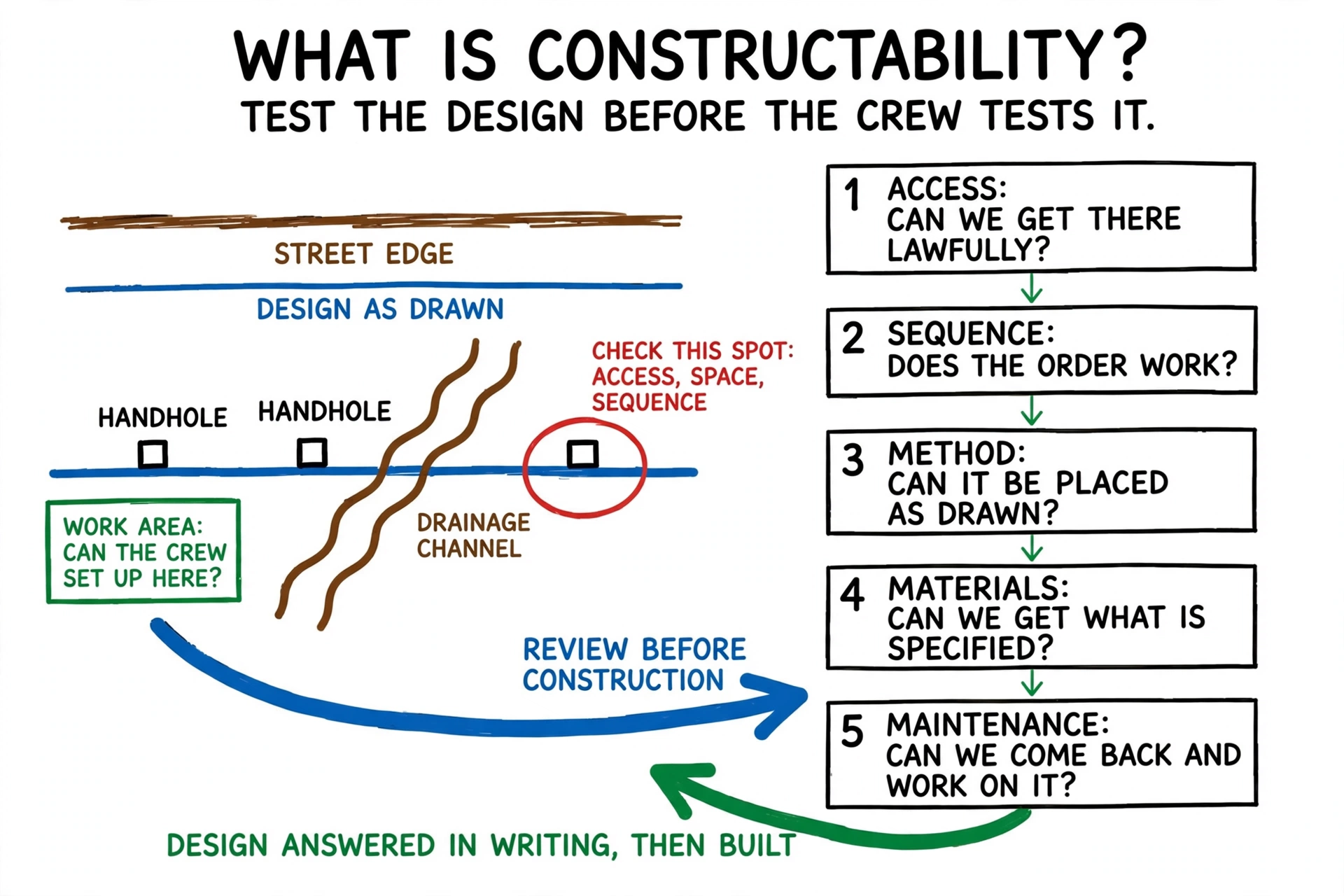
In OSP work, a constructability review normally works through a short list of questions.
Can the crew get there? Is there legal access through easement, permit, or right of way, and physical access for the equipment the method needs? Is there room to stage, to set up, and to work without leaving the permitted area?
Can the work be built in the order the design assumes? Does any step require a finished condition that a later step creates? Are crossings, structures, and cable placement ordered so each step leaves the next step possible?
Can each item be placed with available methods? Does a structure fit the space the print gives it? Can conduit be installed by the method the documents assume, given the ground, the bends in the route, and the other plant in the way? Can cable then be installed into that conduit by the methods and equipment the job will actually use?
Are the specified materials and structures obtainable and usable in time? A design built around an item that cannot be procured for the job schedule, or that cannot be handled at the site, has a constructability problem even if the drawing is neat.
Does the design leave a safe way to do the work? Work near traffic, near energized facilities, and in excavations carries duties set by law, by the job safety plan, and by the owners of nearby facilities. A design that can only be built by ignoring those duties is not constructable as drawn. This lesson teaches recognition of that conflict. It does not teach or authorize the hazardous work itself, and it does not qualify any reader to plan traffic control, direct an excavation, or work on another utility facilities.
Can the finished plant be maintained? Can a future crew reach the handhole, open the closure, and restore the site? A design that builds well once and then strands its own plant has failed the last part of the test.
Now separate constructability from its three common lookalikes.
A design error is a mistake in the documents themselves: two sheets disagree, a dimension is wrong, a required item is missing, or a detail conflicts with a governing requirement in the job documents. An error is wrong on paper, before anyone reaches the field. A constructability problem can exist in documents that contain no error at all. Every sheet can agree, every dimension can be internally correct, and the design can still fail in the field because no equipment can reach the spot, the assumed order cannot work, or the staging the method needs does not exist. Errors are corrected because they are errors. Constructability concerns are raised because the real place and the real method do not fit the drawing, and the fix is a design decision made through the project process.
A preference is a method or layout a crew likes better, is faster at, or uses on other jobs, where the design as drawn can still be built safely and lawfully with available methods. A preference is not a constructability failure, and calling it one weakens real reports. If the shown design can be built as drawn, the crew builds it as drawn, or raises the preference as a suggestion through the job process for the designer to weigh. Only the designer and owner side can change the design.
Value engineering is a separate, formal method. In general terms, value engineering analyzes the functions a project must deliver and looks for a different way to deliver the same functions at better overall value, often measured across cost, performance, quality, and life cycle. Its question is whether a different solution delivers the required function better. The constructability question is narrower and earlier in spirit: can the chosen solution be built at all, as drawn, in that place? A constructability review can feed ideas into value engineering, and a value engineering change must itself be checked for constructability before it is adopted, because a cheaper alternative that cannot be built or maintained is not value. But the two processes are not the same, they are run by different methods, and a field crew does not perform value engineering by renaming a preference.
What Does It Look Like?
Constructability itself is invisible when it is good. What you can see is its evidence, before construction in the review record, and during construction in how the work flows.
Before construction, it looks like a design that has been walked, not just drawn. The route on the print matches a route someone has physically reviewed. Structure locations sit where a crew can reach them. Crossings show work areas on both sides, not just a line across a road or a waterway. The documents name a buildable sequence: structures and conduit first, cable next, splicing and testing after. Notes account for the permits, easements, and other utilities the route touches, instead of assuming them away.
In a review meeting, it looks like specific comments tied to specific places. A reviewer does not say the design feels hard. The reviewer says the shown handhole sits where the only equipment access crosses private ground the project has no right to use, or that a crossing shows no room for the entry work area the drilling method needs, or that a segment requires cable to be spliced at a location no vehicle can reach in wet conditions. Each comment names the sheet, the location, the constraint, and the step that fails. That specificity is what lets a designer act on it.
During construction, good constructability looks uneventful, and that is the point. Crews move from structure to structure in the printed order without inventing workarounds. Materials on site match what the next step needs. Pits, trenches, and pole work open and close in the sequence the documents assumed. Questions still arise, because records are imperfect and ground changes, but they are exceptions handled through the job process, the subject of Lesson 95, not the daily method of building.
Poor constructability has a field look too. It looks like a crew standing at a location with the print open, discovering that the work as drawn cannot start: the structure location is inside an area the crew cannot enter, the crossing has no place to set up on one side, or the shown route passes through an existing facility the design did not account for. It looks like work stopping mid segment while a question travels, equipment idle or moved twice, a trench or bore path rethought on the spot, and a foreman making phone calls instead of progress. Repeated across a route, it looks like rework: plant placed, then moved; a crossing rebuilt by a second method; a splice point relocated after cable was already placed toward the first one.
In the office, poor constructability looks like a bid or a build full of qualifications and questions, requests for information about basic buildability, and change discussions about conditions that a site walk during design would have shown plainly. None of that proves fault by itself. Ground genuinely hides things. The recognizable pattern is different: the obstacle was visible, knowable, or testable during design, and nobody with construction knowledge was asked to look.
What Does It Do?
Understanding what constructability does explains why owners and designers pay for the review before they pay for the build.
First, it moves discovery earlier. The cost and disruption of a design problem grow the later it is found. The same blocked access that is a comment in a review meeting becomes, during construction, a stopped crew, a redesign under schedule pressure, and possibly work already built toward a point that now moves. CII teaching on constructability makes this timing point centrally: construction knowledge has the most effect when it enters during planning and design, and its ability to influence the project falls as the project advances. This lesson states that principle without attaching a savings percentage to it, because published benefit figures vary by study, project type, and method, and a number quoted without its study does not belong in a field lesson.
Second, it makes the design biddable in the AASHTO sense. When contractors can see a workable method, a workable sequence, and workable access in the documents, they price the work that is shown. When they cannot, they price the risk instead, qualify their bids, or ask questions that delay the job. Clear, buildable documents are a cost control, even before anyone discusses price directly.
Third, it protects the sequence of the whole route. OSP construction is a chain. A single unbuildable crossing or structure can strand finished work on both sides of it: conduit that ends at a point that cannot be crossed, cable that cannot be spliced where the design needs a splice. A constructability review tests the chain, not just the links, by walking the build order from one end of the segment to the other.
Fourth, it surfaces safety and permission conflicts while they are still paper conflicts. If the only way to build a step is to work outside the permitted area, crowd another utility facility, or set up in live traffic without the traffic control the job documents require, that is a design stage finding. Raised in review, it can be redesigned, repermitted, or replanned. Found in the field, the correct response is the Lesson 95 response: stop the affected work, protect people and the condition, document, and report. Constructability review exists so that response is needed less often, not so crews improvise around it.
Fifth, it protects the maintenance future of the plant. The review asks who comes back in five or fifteen years, at night, in bad weather, to repair this segment, and whether that person can reach the structure, open it, and work. A design that strands its own closures and handholes fails its owner slowly, long after the construction crew is gone.
Notice what constructability does not do. It does not guarantee a problem free job. Records can be wrong, ground can differ from borings, and other work can change the site after design. It does not transfer design responsibility to the reviewers or the crew: a reviewer comment is input, and the designer of record still designs. And it does not authorize anyone in the field to fix a constructability problem by quietly building something else. The review is where redesign belongs. In the field, the process from Lesson 95 governs.
Where Does It Fit?
Constructability fits at the front of the project and at every design stage after that, and it connects four systems you have already met.
It fits inside the design process itself. The CII definition places construction knowledge in planning, design, procurement, and field operations, in that order, and the FHWA descriptions of formal review processes place reviews at defined stages of project development rather than once at the end. In practical fiber terms, that means a constructability look when the route is first chosen, another as structures and crossings are detailed, and another before the documents are issued for construction. Early reviews test big choices while they are still cheap to change: which side of the road, aerial or underground at a given stretch, where crossings happen. Late reviews test details: whether this handhole fits, whether that bore has work areas, whether the splice locations can be reached by the vehicle that does splicing.
It fits inside procurement. A design that assumes a structure, a closure, or a cable that the project cannot obtain on its schedule is not constructable on that schedule, however correct the drawing is. Reviewing specified items against realistic availability is part of the review, and substituting a different item is a design and owner decision through the job process, not a field swap. Manufacturer instructions also belong in this check: an item installed against its manufacturer instructions can be rejected or fail early, so a design detail that conflicts with the manufacturer instructions for the specified product is a constructability flag to raise, not a detail to overrule in the field.
It fits inside the permitting and access system. Easements, right of way use, and permits define where the project may lawfully be, and FOA OSP preparation guidance treats obtaining easements and doing a pre-build survey as steps before installation begins. A constructability review checks the design against those boundaries: every structure, pit, staging area, and access path the build needs should sit inside ground the project actually controls or is permitted to use. Where it does not, the answer is a design move or a rights move, made by the people who own those decisions, before construction.
It fits inside the field feedback loop. The problems Lesson 95 teaches a crew to document and report are the raw material that makes the next design more constructable. Owners and design firms that keep constructability lessons learned, a practice the CII Constructability Implementation Guide recommends as part of a formal program, turn one job surprises into the next job checklist. A crew contributes to that loop the same way it contributes to as-builts: accurate, located, written field records, made the same day.
Why Does It Matter?
It matters because the field cannot absorb every paper problem. Construction crews are resourceful, and that resourcefulness hides weak design for a while: a structure shifted a little, a crossing built by a harder method, a splice done from an awkward setup. Each workaround carries a cost the design never counted, in time, in risk, in plant that is harder to maintain, or in work built outside the area the permits and easements actually cover. Constructability review is how a project stops billing those costs to the crew standing in front of the problem.
It matters for safety. A design that leaves no lawful, workable place to stand, set up, or excavate pushes risk downhill to the people least able to redesign it. Asking the access and setup questions during design is a safety act, not a paperwork preference. The field boundary stays firm regardless: recognizing that a setup cannot be made safely is a reason to stop and report, never a reason to attempt the work by an improvised method. This lesson qualifies no reader to judge excavation safety, traffic control, or work near energized facilities. Those judgments belong to qualified and authorized people under the job safety plan and applicable law.
It matters for money and schedule on every side. Unbuildable details do not become cheap because they were found late. They become change discussions, delay claims, remobilization, and rework, priced under pressure. Buildable documents let owners compare real bids, let contractors plan real sequences, and let crews spend their hours placing plant instead of solving the design at field wages.
It matters for quality. Work built in a hurry around a constructability problem tends to be the work that fails inspection or fails early in service: conduit installed by a forced method, a closure placed where it cannot be worked on properly, plant crowded into space that was never checked. A design that can be built calmly, in order, with the specified materials, is a design that can be built well.
It matters for trust between designer and builder. Designers who invite construction knowledge early get field reports that help them. Crews who raise located, specific, buildability facts, and who separate those facts from preferences, get answers they can build. Constructability, practiced on both sides, is that working relationship given a name and a place in the schedule.
What Does Good Look Like?
Good constructability is designed in, then verified. You can recognize it by a short list of habits and results.
The design was reviewed by people who have built this kind of work, early enough for their comments to change it, and the comments and answers are written down. A reviewer can point to the comment log. A designer can point to what changed, or to a written reason the design stands as drawn.
Every structure and crossing passes the access test on paper before it is tested by a crew. The reviewer has asked, for each handhole, pole, pit, and splice location: how does the crew get there, where does the equipment sit, where does the material come from, and is all of that inside the easement, the right of way, or the permit area the project holds?
The build order works end to end. Structures before cable, cable before splicing, splicing before testing, with crossings and tie ins placed in the order the route actually requires. No step depends on a later step. No segment is stranded by an unfinished one.
The specified materials and structures are real for this job: obtainable on the schedule, handleable at the site, and installable by the methods the documents assume, following their manufacturer instructions. Where an item is unusual, the documents say why and how it will be supplied.
The design leaves a maintainable plant. Splice locations can be reached by the people and vehicles that will service them. Handholes can be opened and worked in. The record the crew will leave, the as-built, describes plant that actually sits where the record says, because it was built where the design said.
And in the field, good constructability looks like the absence of drama at the design level. Crews still solve weather, ground, and record surprises, because that is construction. But they are not solving the drawing. Their questions are about conditions. Their days are spent in sequence. That calm is the visible product of the review work nobody saw.
What Can Go Wrong?
The failures in this area are predictable, and most of them start with a skipped step rather than a bad intention.
Skipping the builder in design is the root failure. A route drawn entirely from records, aerial imagery, and survey, without a construction experienced walk of the ground and the method, will contain locations that only fail when a crew arrives. The design can be neat, consistent, and wrong about buildability on every third structure.
Reviewing too late is the same failure with better paperwork. A constructability review held after the documents are issued can only generate changes, delays, and arguments. The FHWA and AASHTO descriptions both stress early and repeated review for this reason: the value of a comment depends on when it arrives, and a correct comment that arrives after mobilization is an expensive comment.
Confusing a preference report with a constructability report is a quieter failure. When every crew preference is labeled unbuildable, designers stop trusting the label, and the real access failure three structures later gets discounted with the rest. Discipline in naming, this cannot be built as drawn, with the reason, versus we would rather build it differently, is what keeps the channel credible.
Treating value engineering as a substitute is another failure. A project that skips constructability review and later cuts cost through value engineering can end up with a cheaper design that is harder to build than the original, because nobody tested the alternative against access, sequence, and staging. Value decisions need constructability checks. They are not constructability checks.
Ignoring procurement is a practical failure. The specified structure is unavailable for months, the closure is back ordered, or the item that arrives cannot be installed as detailed. The crew then waits, or pressure builds to substitute in the field, which is a design change made at the worst time by the wrong process.
Designing plant that cannot be maintained is the slowest failure. A splice closure placed where no service vehicle can reach, or a handhole buried under later work with no access preserved, builds successfully and fails its owner for decades. Construction finished is not the test. The review asks about the second visit, and the fiftieth.
Finally, fixing it quietly in the field remains a failure, exactly as Lesson 95 teaches. When a crew meets a genuine constructability problem during construction, the answer is document, report, and build the written direction. A crew that silently redesigns has solved today problem by creating an unrecorded, unchecked design, outside the permit and easement checks the original design went through. The review process exists to make that choice unnecessary. Where it still happens, the field process exists to make it visible.
What Should Someone Notice in the Field?
Notice whether the design arrives with evidence of a walk. Prints whose structure locations match real access, whose crossings show work areas, and whose notes name the actual permits and constraints of the route are prints somebody tested against the ground. Prints that place structures by spacing alone, evenly and blindly, usually were not.
Notice how the crew talks about difficulty. Specific language is a healthy sign: naming the sheet, the location, the step that fails, and the constraint, such as access, sequence, staging, or availability. Vague language, such as calling a whole design junk or calling every hard task unbuildable, is a warning sign that preferences and real problems are being mixed, and real problems will travel poorly.
Notice the first structure and the first crossing on a new segment. They are the field test of the design assumptions. If the first handhole cannot be reached as drawn or the first bore has no workable setup on one side, the same assumption likely repeats down the route, and raising it once, early, with measurements and photographs, protects the whole segment.
Notice staging in real time. Where are the reels, the drill, the spoil, and the crew vehicles actually sitting, compared with where the documents assumed they would sit? A recurring gap between assumed and actual staging is constructability information, and it belongs in the field record, not just in daily improvisation.
Notice sequence friction. A crew waiting on a step that the design ordered too early, cable placed toward a splice point that does not exist yet, or structures skipped and revisited out of order, is showing you a sequence finding. Name it as such when you report it.
Notice your own role boundary in real time. Any field worker can notice a constructability problem, describe it precisely, document it, and report it through the job process. Noticing does not make you the designer of the fix, the approver of a substitute material, the planner of traffic control, or a person qualified to perform excavation, drilling, pole work, or electrical work. Those roles belong to designated, qualified, and authorized people. The field skill this lesson builds is recognition and reporting. It is a real skill, and it is enough.
Practical Example
The following example is hypothetical. It is invented to teach how a constructability review works, not to describe a real job, a real company, or a real contract.
Hypothetical example: a crossing with no room to work. A hypothetical designer prepares a fiber route for a hypothetical network owner. One segment runs along the back property lines of a row of houses, inside an easement the owner holds, and crosses a paved drainage channel on the way to a handhole and splice point that serve the street beyond. On paper the segment is consistent. The easement is shown, the structures are spaced evenly, the channel crossing is drawn as a bore, and the splice handhole sits at the midpoint the design standard prefers.
A constructability review is held before the documents are issued. The reviewer, an experienced OSP foreman borrowed for the review, walks the segment with the print. Three findings come out of that walk, each stated as a location and a failed step.
First, access. The easement strip along the back lines is fenced by the homeowners, as easements in back yards often are in practice, and the only equipment entry the design assumed crosses a yard the project has no right to enter. Hand digging everything from the street end is not the method the documents priced or described. The step that fails is getting standard equipment to most of the segment at all.
Second, the crossing setup. The bore under the drainage channel is drawn correctly as a line, but the exit side has no workable space for the receiving setup inside the easement: the channel bank, a fence, and an existing structure crowd the exact area where the work area would need to be. The step that fails is receiving and handling the bore on the far side.
Third, maintenance. The splice handhole at the design midpoint sits at the lowest point of the segment, where the reviewer notes standing water after rain during the walk. Even if built exactly as drawn, every future splice visit would work in the wettest spot on the route, and the service vehicle cannot reach it without crossing the same yard the project has no right to use.
None of the three findings is a drawing error. The sheets agree with each other. None is a preference: the foreman is not asking for an easier job, he is naming steps that cannot happen as drawn. And none is value engineering: no one has proposed a cheaper way to deliver the same function. The findings say the chosen design, in this place, cannot be built and maintained as drawn.
The designer answers in writing. The route for that segment moves to the street side within the right of way the project can use, the crossing work areas are shown explicitly on both banks, and the splice point moves to a reachable location near the street, with the design standard spacing adjusted by the designer and recorded as a design decision. The revised documents are what the crew later builds, in order, without improvisation. The review comments, the walk notes, and the answers are filed with the project record, so the next segment designer sees why back line easement segments on this system now get an access walk before they are drawn in detail.
The teaching points are the timing and the specificity. Every finding was cheap in the review month and would have been expensive in the construction month. Every finding named a place, a step, and a constraint, which is what made it answerable. And the fix was designed and issued by the designer, then built by the crew, which is the same division of labor Lesson 95 teaches for problems found during construction. A constructability review simply moves that division of labor earlier, to where it costs the least.
Key Terms
Constructability: the extent to which a design can be built as drawn, safely and in a workable sequence, using methods, equipment, materials, labor, and access realistically available for the job. CII defines the broader practice as the optimum use of construction knowledge and experience in planning, design, procurement, and field operations to achieve overall project objectives.
Constructability review: the structured process in which people with construction experience examine a design at defined stages before construction and test whether each part can be built, in order, in the real place, and maintained afterward.
Design error: a mistake inside the documents themselves, such as conflicting sheets, a wrong dimension, a missing required item, or a detail that conflicts with a governing requirement in the job documents. An error is wrong on paper. A constructability problem can exist with no error present.
Preference: a method or layout a builder would rather use where the design as drawn can still be built safely and lawfully. A preference is a suggestion through the job process. It is not a constructability failure.
Value engineering: a formal method that analyzes the functions a project must deliver and seeks a different way to deliver the same functions at better overall value. Its question is which solution delivers the function best. The constructability question is whether the chosen solution can be built as drawn.
Access: the practical and legal ability to reach the work and work there, including physical room for equipment and staging, and legal rights through easement, permit, or right of way.
Easement: a legal right to use a defined part of another party property for a stated purpose, such as placing and maintaining a cable route.
Sequence: the order in which construction steps must happen, where later steps depend on earlier ones being complete.
Staging: where people, equipment, reels, and materials are positioned and handled while work is performed, including work areas at crossings and structure locations.
Biddable: clear and complete enough in the documents that contractors can price the same work with confidence.
Maintainable: able to be reached, opened, repaired, and restored in the future by the people responsible for the finished plant.
Procurement: obtaining the specified materials and structures, on the schedule the job requires. Availability of specified items is part of a constructability check.
Check Your Understanding
- State the constructability question in one sentence, and name the five checks a review applies to an OSP design.
- A set of prints is fully consistent, with no conflicting sheets and no wrong dimensions, yet the crew cannot get equipment to a third of the structures. Is this a design error, a constructability problem, a preference, or value engineering? Explain.
- A foreman reports that a segment is unbuildable because his crew prefers to trench where the print shows a bore, although the bore as drawn is workable and permitted. How should that report be treated, and why does the distinction matter?
- Why does the timing of a constructability comment change its cost, even when the comment itself is identical?
- What is the correct field response when a genuine constructability problem is first discovered during construction, rather than in review?
Answer key:
- The question is: can this design, as drawn, be built in the real place, in a workable order, safely and lawfully, with the methods, materials, and access actually available, and be maintained afterward? The five checks are access, sequence, placeability with available methods, availability of specified materials and structures, and maintainability, with safety and permission limits applied across all five.
- It is a constructability problem. A design error is a mistake inside the documents, and these documents contain none: they agree with each other and with themselves. The failure is between the documents and the real place, because the method the design assumes cannot reach the work. That is exactly the gap a constructability review exists to catch, and the fix is a design decision made through the project process.
- It should be treated as a preference, not a constructability failure. The bore as drawn can be built, so the design passes the constructability test. The foreman suggestion can still be raised through the job process for the designer to weigh on its merits, including cost and permits. The distinction matters because labeling preferences as unbuildable trains designers to discount the label, and the next report, which may describe a real access failure, loses credibility.
- Because the later a problem is found, the more finished work, mobilization, and schedule commitment sits behind the design as drawn. In review, the same finding costs a revised drawing. During construction it can cost a stopped crew, a redesign under pressure, remobilization, and rework of plant already placed toward the old design. The information is the same. The amount of project built on top of the problem is what changes.
- The Lesson 95 response. Stop the affected work, protect people and any condition involved, document the problem the same day with the sheet and location, the step that fails, and photographs or measurements that show the constraint, notify through the job chain so the question reaches the designer and owner side in writing, hold the affected area, and build only the written direction or revised documents that answer it. The crew does not silently redesign the segment, however obvious the fix appears.
Lesson Takeaway
Constructability is the test of whether a design can actually be built: as drawn, in that place, in a workable order, with real access, real methods, and real materials, and maintained after it is built. The review that applies the test belongs early, while answers are still drawings, and it belongs to people with construction experience reading the same documents the crew will receive. Keep the naming discipline sharp. An error is wrong on paper. A preference is a buildable design a builder would rather change. Value engineering asks which solution delivers the function at better value. Constructability asks the prior question: can the chosen design be built at all, as drawn? Raise concerns the way the hypothetical review did, with a location, a failed step, and a constraint, and route them through the project process. In the field, meet a constructability failure the Lesson 95 way: stop, protect, document, report, and build the written answer. This lesson qualifies you to recognize and report constructability concerns. It does not qualify you to redesign a route, approve a change, substitute materials, plan traffic control, or perform regulated or hazardous construction work.
Sources and Technical References
- Construction Industry Institute (CII), Constructability Implementation Guide, Second Edition, Publication SP34-1: front end constructability efforts as an investment with substantial return when methodically implemented, barriers to implementation, and the recommendation that a lessons learned database be developed and maintained as part of a constructability program: https://www.construction-institute.org/constructability-implementation-guide-second-edition
- Babcock and Wilcox Learning Center, Design for Constructability: states the CII definition of constructability as the optimum integration, also quoted as optimum use, of construction knowledge and experience in project planning, design, procurement, and field operations to achieve overall project objectives, and that the ability to influence project cost is greatest at the beginning of a project and diminishes as time progresses: https://www.babcock.com/home/about/resources/learning-center/design-for-constructability
- AASHTO Subcommittee on Construction, Constructibility Review Best Practices Guide, August 2000, summarized in VDOT design guidance: a constructability review is a process that utilizes construction personnel with extensive construction knowledge early in the design stages of projects to ensure that the projects are buildable, while also being cost effective, biddable, and maintainable, and the review should assure the project as detailed can be constructed using standard construction methods, materials, and techniques: https://www.readkong.com/page/constructibility-review-best-practices-guide-august-2000-4948399
- Virginia Department of Transportation, Location and Design guidance, Section 2E-8, Constructability Quality Review: restates the AASHTO definition above and defines a constructability review as the review of plans, specifications, and contract documents from a construction perspective to assure the documents propose an operation that is efficient, cost effective, and buildable, with emphasis on how the work is built: http://www.extranet.vdot.state.va.us/locdes/flipbook/resources/_pdfs_/chap2e_80.pdf
- FHWA Work Zone Best Practices Guidebook, Best Practice E1-3, Formal Constructability Review Process: a constructability review process is an iterative, multidisciplinary review of the plans, specifications, and estimates at various defined stages of the project development process, including traffic, design, construction, and maintenance, used to reduce contract time extensions and delay claims and the overall cost and duration of construction: https://ops.fhwa.dot.gov/wz/practices/best/view_document.asp?ID=23&from=topindex&Category_ID=90
- FHWA, Work Zone Impacts Assessment During Design, Section 6: design is the stage where constructability and staging approaches are chosen, assumptions are re-examined, and constructability issues are identified and addressed as design progresses: https://ops.fhwa.dot.gov/wz/resources/final_rule/wzi_guide/sec6.htm
- ASCE Library, Constructability: Outline of Past, Present, and Future Research, Journal of Construction Engineering and Management, Vol 143, No 8: a systematic review of constructability definitions, concepts, assessment, and implementation methods across five decades of research, including the ASCE Construction Management Committee white paper on constructability and constructability programs: https://ascelibrary.org/doi/10.1061/%28ASCE%29CO.1943-7862.0001331?cookieSet=1
- The Fiber Optic Association (FOA), Reference for Fiber Optics, Outside Plant Construction, Project Preparation: OSP installations include aerial, direct buried, and underground cable in conduit; project preparation covers easements (wayleaves), which are permission to use someone else property to deploy infrastructure, also known as a right of way or easement, and a wayleave agreement must be obtained prior to installing telecommunications equipment: https://www.thefoa.org/tech/ref/OSP_Construction/Preparation.html
- FOA Newsletter, What Is the Procedure for Construction of an OSP Fiber Network: the OSP construction procedure begins with a pre-build survey and obtaining wayleave (easement) agreements, followed by project, environmental, safety, and quality plans, before trenching, duct, and structure work begins: https://www.thefoa.org/foanl-1-16.html
Flagged and unverifiable items: No savings percentage is stated in this lesson as a fact. Published figures for constructability program benefits differ by study and year, and the studies behind them cover general capital projects rather than OSP fiber work, while the full benchmarking reports are not freely available in full text. Those numbers are therefore flagged here as unverifiable for the purpose of this lesson and are deliberately omitted from the lesson body. Before quoting any percentage benefit for constructability in a proposal or a client document, verify the exact figure, the study, the year, and the project population against the original CII publication. The AASHTO and FHWA sources cited describe highway and transportation agency practice. Their review definitions and staging are used here as general education on what a constructability review is. They are not requirements for any specific fiber project. Whether a given OSP job requires a formal constructability review, who must attend, and at what stages, is set by the owner requirements and the contract for that job, and must be verified in those documents. No depth, clearance, spacing, bend, tension, or dimension requirement is stated in this lesson, because constructability requirements of that kind come from the job design, the governing standards the job adopts, manufacturer instructions for the specified products, and the permits and easements for the route, all of which vary by job.
Previous lesson: Lesson 95: What Happens When the Print Doesn’t Match the Field? |
Back to Level 5 hub |
Next lesson: Lesson 97: How Is a Route Selected?