
What You Are Learning
By the end of this lesson you will be able to explain what a print and field mismatch is, and name the common kinds a fiber crew meets: a structure shown where something else already sits, an existing utility that is missing from the print or shown in the wrong place, a distance or station that does not fit the ground, and a detail that cannot be built as drawn. You will be able to state the core rule in plain words: the field condition is a fact to document and report through the job process, the print is not quietly edited by the crew, and work does not proceed on a guess where safety or compliance is at stake. You will be able to walk through the field response in order: stop the affected work, protect people and the condition, document what you found, notify through the chain the job uses, and wait for direction in the affected area while unaffected work continues only as directed. You will be able to describe the tools that carry the question and the answer: the verbal notice followed by written notice, the request for information, the redline markup, and the as-built correction. You will be able to explain, in general terms, how standard contract language treats differing site conditions, and why prompt written notice before a condition is disturbed matters. Finally, you will be able to state your boundary clearly: recognizing and reporting a mismatch is every field worker job. Redesigning the work, approving a changed route, or deciding a contract claim is not, and this lesson does not qualify you to do it.
Start With the Basics
Outside plant, usually shortened to OSP, is the part of a fiber network built outdoors: cables on poles or underground, conduit, handholes, splice closures, and the structures that hold them. A construction print is the set of scaled drawings, prepared by a designer or engineer for the owner, that shows what to build and where to build it. Lesson 72 defined the print and its parts. This lesson is about the moment the print and the ground disagree.
That moment is normal. A print is made from survey, records, and site visits done before construction starts. Records of older underground plant are often incomplete. A utility installed years ago may never have been recorded, or may have been recorded in the wrong place. Ground also changes after the survey: another utility crew trenches in a new line, a driveway is widened, a pole is replaced and reset in a slightly different spot. By the time your crew opens the ground, the field can honestly differ from the best print the designer could issue.
Define the working words this lesson depends on before going further.
A mismatch, also called a discrepancy or a conflict in job language, is any point where what the print shows and what the field actually contains cannot both be followed. The words overlap in field use. This lesson uses mismatch as the plain general word.
Stationing is the system of distance references along a route, covered earlier in this level, that lets a reader name a location on the print and find the same location on the ground. An offset is a measured distance sideways from a reference line or point, such as a centerline, a right of way line, or an existing structure. Station and offset together are how a mismatch gets a precise address: not “near the big oak,” but a station along the route and an offset from a named reference.
A redline is a field markup on a copy of the print, traditionally in red, that records what was actually found or actually built, with measurements and notes. A redline is a record and a question carrier. It is not a new design.
An as-built is the record, made during and after construction, of what was actually placed, where it was placed, and how it differs from the issued print. Approved corrections and the final as-built set are covered as a records process. The crew contribution is accurate field notes and redlines, made the same day, while the condition is still visible.
A request for information, usually shortened to RFI, is the formal written question a contractor sends through the job process when the documents are unclear, incomplete, or in conflict, or when a site condition differs from what the documents show. The RFI states the problem, cites the sheet and location, often proposes a solution for the designer to consider, and asks for a written answer. The answer, not the question, is the direction.
Hold one distinction for the whole lesson. A field condition is a fact. A print is an instruction. When the two disagree, the fact does not erase the instruction, and the instruction does not erase the fact. The job process exists to reconcile them, and that reconciliation is written, not improvised.
What Is It?
A print and field mismatch is a discovered difference between the construction documents and the physical conditions at the site that is large enough to affect what would be built, where it would be built, how it could be built, or whether it can be built safely and lawfully as shown.
Construction documents, defined in Lesson 72, are the collective documents that define the work for a job: commonly the agreement, the conditions of the contract, the drawings, the written specifications, addenda, and issued modifications. A mismatch can live between the field and any of them, but the field cases in this lesson fall into four practical groups.
First, something is in the way that the print does not show. Examples in OSP work include an unmarked or unrecorded utility line in the bore path, an old conduit or direct buried cable where a handhole is shown, buried debris or an abandoned structure in the trench line, or rock or water where the print and its notes gave the crew no reason to expect it at that spot.
Second, something the print shows is not there, or is somewhere else. A pole the route ties to has been removed. An existing handhole shown as the tie-in point sits several feet from its printed location. A utility the print shows clear of the crossing is in fact inside the crossing. Dimensions and stations that were measured from the printed location now point at the wrong ground.
Third, the ground itself differs from what the documents indicated. Soil or subsurface conditions differ materially from borings or records the design relied on. A ditch, slope, or pavement section differs from the survey the print was drawn from. The print is internally consistent. It is the site that tells a different story.
Fourth, the print cannot be built as drawn at that spot even though nothing hidden was found. A detail requires a clearance or a geometry the actual pole, structure, or crossing cannot provide. Two sheets disagree at the same location. A note requires a condition the field does not have. Some of these are document discrepancies rather than hidden conditions, and the contract process for them can differ, but the field response taught here is the same first response: document it, report it, and do not resolve it by guessing.
Name what a mismatch is not. It is not a preference. Ground that is harder to dig than the crew hoped, a location that would be more convenient a few feet over, or a detail the crew builds differently on other jobs is not a mismatch. It is not a minor measurement wobble inside the tolerance the job documents allow, where the job documents state one. And it is not, by itself, permission to stop the whole job, redesign the segment, or declare the contract changed. It is a specific, located, documented difference that the designated people must answer.
Contract language has a formal name for the hidden-condition part of this problem. A differing site condition, also called a changed condition in older language, is a subsurface, latent, or otherwise concealed physical condition at the site that differs materially from what the contract documents indicated (often called Type I), or an unknown physical condition of an unusual nature that differs materially from what is ordinarily encountered in work of that kind (often called Type II). The contract for the job defines the term and the process. That formal definition, and the notice duties attached to it, come from the contract for the job. Section “Where Does It Fit?” and the Sources section explain the standard federal and AIA versions as general education. Your job contract controls your job.
What Does It Look Like?
You recognize a mismatch by comparing, not by glancing. The print says one thing in a checkable way, and the field says another in a checkable way, at the same located spot.
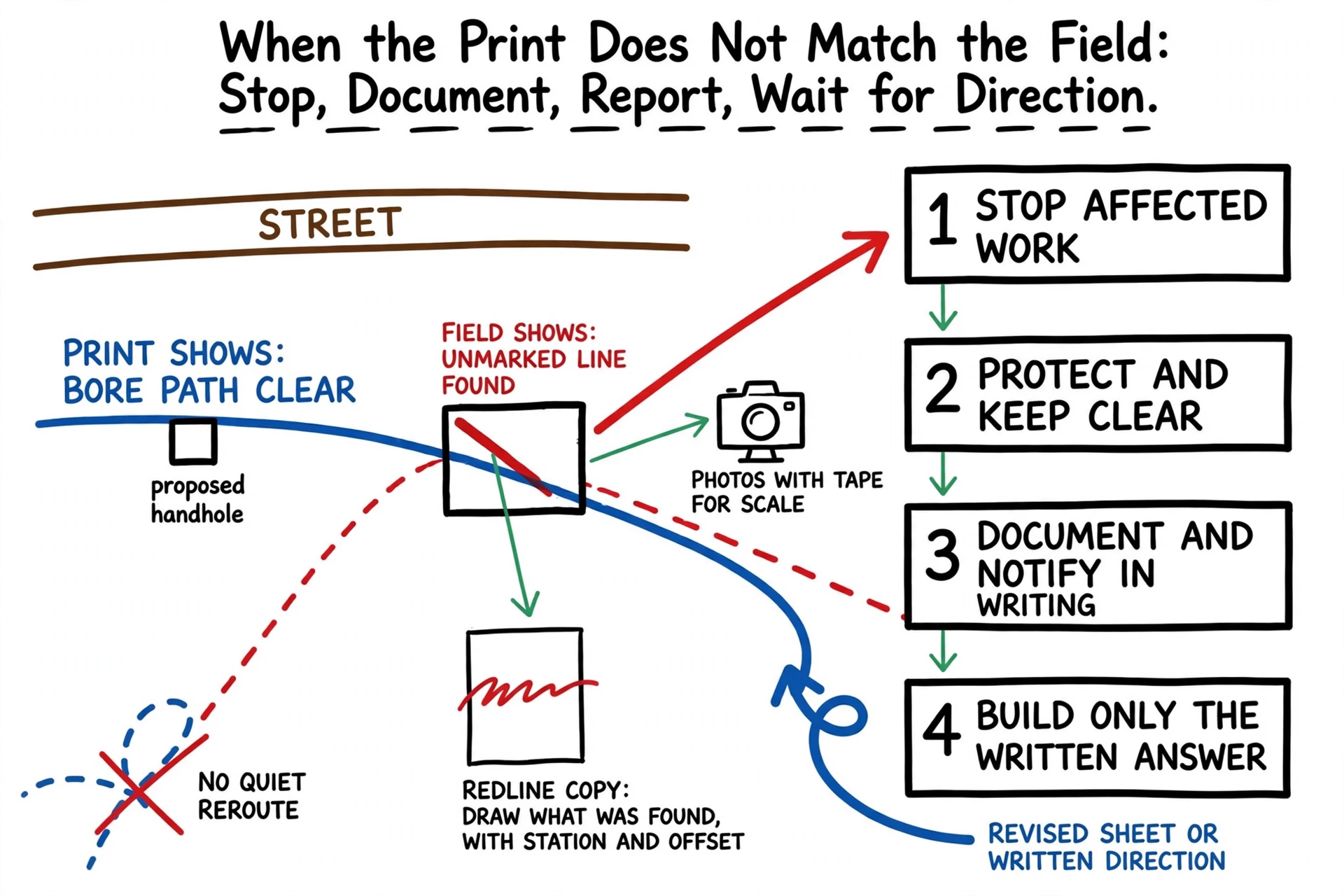
On the ground it can look like this. The locate marks and the print agree that the bore path is clear, and the pothole, the careful excavation done to expose and verify a utility, uncovers a line nobody marked and the print never showed, crossing the path at an angle. Or the opposite: the print shows an existing line crossing the path, the crew potholes the printed location with care, and finds nothing there, which means the line is somewhere untested and the clear path is unproven.
It can look like a tape measure argument. The print dimensions a handhole from a property corner or a station marker. The crew measures the dimension and lands in the middle of a driveway apron, a tree, or an existing structure. Measuring again from a second reference gives the same wrong landing. The dimension, the reference, or the survey behind the print is in conflict with the ground, and repeating the measurement will not fix it.
It can look like a structure that does not fit. The detail shows a standard entry into an existing handhole, and the handhole in the ground is a different size, a different orientation, or already full in a way the print records did not show. The crew can see that building the detail as drawn would require forcing, cutting, or crowding that the detail never intended.
It can look like paper disagreeing with paper at a field location. The plan sheet places a crossing at one station, the profile for the same segment shows it at another, or a general note prohibits what a detail directs. Standing at the station with both sheets open is often how this kind is discovered.
In the trailer, a handled mismatch has a recognizable paper shape. There is a dated note in the daily record naming the sheet, the station or address, and the difference in measured words. There are photographs with a tape or a station marker visible for scale and location. There is a redline markup on a copy of the sheet, not on the only clean field set, showing what was found and where. And there is a written question in the job system, an RFI or the notice form the contract requires, with a number or a log entry the crew can point to. A mismatch with no paper shape is a mismatch that will be argued from memory later, and memory loses.
What Does It Do?
Understanding what a mismatch does to a job explains why the response is formal.
First, it pauses the authority to build that spot as drawn. The print instructs the crew to build a specific thing in a specific place. Once the crew knows the place or the thing differs materially from the print basis, building exactly as drawn may be impossible, unsafe, or noncompliant, and building something else instead is a design decision the crew is not authorized to make. The mismatch therefore converts a building task into a reporting task for that affected area, until direction arrives.
Second, it starts a contract clock and a paper duty, on many jobs. Standard differing site conditions language requires the contractor to give written notice promptly, and before the condition is disturbed, so the owner side can investigate the condition as found. Disturbing, covering, or building over the condition before notice can destroy the evidence the investigation needs and can damage the contractor position under the contract, even when the crew meant well and built good work. The exact notice form, recipient, and timing are set by the contract for the job. No universal deadline is stated in this lesson, because none exists across all contracts. Any deadline example in training material must be read as contract-specific.
Third, it protects people and other plant. An unexpected utility can be electric, gas, fuel, water, sewer, or communications. Some of those can kill, burn, flood, or cut service to a neighborhood if struck. Stopping and protecting the condition is therefore not paperwork delay. It is the safety response, and it comes before the contract response.
Fourth, it preserves the record that the final network will be maintained from. If the crew quietly works around a condition and nobody records it, the as-built record will repeat the print error, and the next crew years later will trust a record that was known to be wrong on the day it was made. Reporting the mismatch is how the record gets corrected through redlines and the as-built process instead of inherited as a trap.
Notice what a mismatch does not do. It does not transfer design responsibility to the crew. It does not entitle anyone in the field to extra time or money by itself; contract adjustments, where they exist, are decided through the contract process on the written record. And it does not excuse building the unaffected work carelessly or stopping work the direction has not stopped. Scope discipline runs both ways: do not build the questioned spot on a guess, and do not treat one located mismatch as a general shutdown unless a supervisor or a safety condition requires it.
Where Does It Fit?
The mismatch process sits between field discovery and design authority, and it touches four systems you have already met in this level.
It fits inside the contract documents system. Two standard examples, taught here as general education and never as a substitute for reading your own contract, show the common shape. In federal construction contracting, the Differing Site Conditions clause, FAR 52.236-2, covers two types. Type I is a subsurface or latent physical condition that differs materially from what the contract indicated. Type II is an unknown physical condition of an unusual nature that differs materially from what is ordinarily encountered in that kind of work. The clause requires the contractor to give written notice promptly, and before the conditions are disturbed, and it provides that the contracting officer investigates and, where the conditions do materially differ and affect cost or time, an equitable adjustment is made and the contract is modified in writing. A companion federal clause, FAR 52.236-21, Specifications and Drawings for Construction, requires discrepancies in the figures, drawings, or specifications to be promptly submitted for a written determination, and states that a contractor adjustment made without that determination is at the contractor own risk and expense. In private work using AIA documents, AIA A201 Section 3.7.4, Concealed or Unknown Conditions, follows the same broad pattern: the contractor gives prompt notice to the owner and the architect before conditions are disturbed, the architect investigates, and an equitable adjustment is recommended where the conditions differ materially and affect cost or time. The AIA text also states an outer time limit measured from first observance; that limit is a term of that contract form, it has changed between editions, and it must never be quoted as a universal field rule. State, municipal, utility owner, and company contracts for OSP work use their own versions, with their own notice methods and recipients. The lesson is the pattern, not the clause number: prompt written notice, before disturbance, to the named decision maker, who investigates and answers in writing.
It fits inside the RFI system. Where the contract notice is the formal alert, the RFI is the working question: what exactly differs, where, by how much, what work is affected, and what direction is requested. Many jobs use the same submission to serve both purposes, and many keep them separate. Follow the job procedure. An RFI answer that directs a change may still need a formal modification or field order under the contract before the changed work is built, depending on the job documents. The RFI log, with dates, is part of how delay and cost questions are later sorted out, which is one more reason the field note must be accurate on the day it is written.
It fits inside the safety system. Federal OSHA excavation rules, at 29 CFR 1926.651(b), require that the estimated location of underground installations that may reasonably be expected to be encountered be determined before an excavation is opened, that utility companies or owners be contacted and asked to establish locations before excavation starts, that the exact location be determined by safe and acceptable means as the work approaches, and that installations be protected, supported, or removed as necessary while the excavation is open. Meeting an unexpected line is handled with those duties in view, and with the wider job safety plan: stop the mechanical work in the immediate area, keep people clear until the line is identified and the competent person for the excavation directs the next step, protect the exposed installation as paragraph (b)(4) requires, and notify the supervisor and the utility owner through the job process. Paragraph (b) itself states the location, contact, exact location, and protection duties listed above. This lesson teaches recognition and reporting. It does not qualify any reader to identify an unknown line by handling it, to work on or repair a utility, or to direct excavation safety. Those tasks belong to the utility owner and to qualified, authorized people under the job safety plan and applicable law.
It fits inside the records system. The redline made in the field, the photographs and measurements behind it, the RFI and its answer, and any issued revision together become the source material for the as-built record. When direction approves a changed location or method, the built work is recorded as built, and the issued revision or written direction is the authority cited in the record. When direction says build as printed because the field reading was wrong, that answer is recorded too, and the redline is corrected. Either way, the record ends up more truthful than the original print, which is the point.
Why Does It Matter?
It matters for safety first. The most dangerous mismatch is the one a crew works through quickly: an unmarked line assumed to be abandoned, a trench wall in soil that behaves differently from the records, a structure found where the print promised clear ground. OSP work happens around energized, pressurized, and traffic systems owned by others. A mismatch is the field telling you the map of those hazards is wrong at this spot. Believing the map over the ground, at that spot, is how utility strikes happen.
It matters for compliance and permission. The printed route was checked against easements, permits, environmental limits, and other utility records. A quiet field reroute can place plant outside the permitted area, inside a clearance the design protected, or against a permit condition nobody in the field has read. The resulting work can be ordered removed even if it functions, because function was never the only requirement.
It matters for money and time, on every side. Building over an unreported condition, then uncovering and rebuilding when the owner investigates, costs more than the pause to report it. On the contract side, standard differing site conditions language conditions any adjustment on the written notice the clause requires. A crew that disturbs first and reports later may have built the right physical answer and still damaged the company claim, the schedule relief, and the owner trust, all with one helpful shortcut.
It matters for the network record. Fiber plant lives underground and on poles for decades. Locators, repair crews, and future designers work from the owner records. A mismatch handled on paper corrects those records at the only moment the truth is exposed and measurable. A mismatch handled silently files the error as fact.
It matters for professional trust. Owners and designers expect mismatches on real routes. What distinguishes a reliable crew is not a job with no surprises. It is a crew whose surprises arrive early, located precisely, photographed, measured, and written in plain language, with the affected work held and the unaffected work moving. That reputation is built one honest field report at a time.
What Does Good Look Like?
Good mismatch handling is calm, specific, and fast at the reporting step, even when the building step has to wait.
The crew stops the affected work without drama and without creeping forward. Equipment stops short of the condition. The exposed condition is left as found, protected from damage, weather, and traffic as the job safety plan directs, and people are kept clear where an unidentified line or an unstable condition is involved. Work elsewhere on the segment continues only where a supervisor confirms it is unaffected and safe.
Documentation happens before discussion about solutions. The finder and the foreman record the date and time, the sheet number and revision, the station and offset or the address and nearest cross street, what the print shows, what the field shows, and the measured difference. Photographs show the condition close up with a tape or rule for scale, and wider shots that tie the spot to a pole number, a street sign, a property corner, or another permanent reference visible on the print. Nothing in the note speculates about whose fault the difference is. Facts first, in plain words.
Notification follows the job chain the same day, and the written notice follows the contract method. The foreman notifies the supervisor or project manager, who gives the notice and the RFI to the owner representative, designer, or contracting officer the contract names. The crew can name, afterwards, the RFI number or log entry, the person notified, and the time. If direction is given verbally in an urgent safety situation, the note records who said what and when, and the written confirmation is requested through the process. The crew builds changed work from written direction, a field order, or a revision, as the job documents require.
While waiting, the crew protects its own position honestly. The questioned area is marked or flagged in the field so no other crew builds into it. The daily report states plainly that work at that station is held for direction and what work was done instead. No extra work inside the questioned area is performed to be helpful, because extra work inside an uninvestigated differing condition can be work the contract will not recognize.
When the answer arrives, it is read back against the problem. Does it name the same station and condition? Does it change the print, confirm the print, or direct a specific alternate? The field set is updated, the redline is completed to show what was finally built and under what direction, and the as-built notes are made the same day. The crew that reported the problem closes the loop, so the record shows a question and an answer, not a gap.
What Can Go Wrong?
The failures in this area are predictable, and most of them begin as someone trying to be helpful or fast.
Quietly fixing it in the field is the central failure. The crew shifts the handhole, bends the bore around the unknown line, or deepens the trench to pass under an obstruction, and tells nobody. The plant works. The record lies. The design checks for clearance, easement, permit, and future maintenance were never run on the new location, the differing condition was never investigated, and any later damage, strike, or claim starts with the fact that the condition was concealed by the people who found it.
Disturbing the condition before documenting it is the second failure. A line is cut out, debris is hauled off, or the trench is backfilled before photographs and measurements exist. Even where no claim is ever made, the investigation the owner or designer needs is now impossible, and a second crew returning to the spot has no reliable description of what is there.
Proceeding on a guess where the guess touches safety is the most serious failure. An unidentified line is treated as abandoned because it looks old. A cable is handled to read its markings. Mechanical digging continues slowly through a marked tolerance area or past an unexpected find, on the theory that care equals safety. It does not. Identification of unknown utilities belongs to their owners and to qualified people using safe and acceptable means. Treat an unidentified line as live and in service until its owner identifies it. That is the prudent field practice taught in this lesson. It is not a quotation from OSHA or from a contract clause, and state damage prevention law for the work location may add its own duties.
Verbal-only reporting fails quietly. The foreman mentions the problem at the trailer, the supervisor means to pass it on, and three days later the crew has built up to the held spot with no written question in the system and no answer coming. When the schedule slips, nobody can prove when the condition was found or when notice was given. Standard contract language asks for written notice for exactly this reason.
Exaggerating or softening the report both fail. A note that calls every hard dig a differing site condition trains the owner side to discount the crew reports. A note that shrinks a real conflict into “field adjustment made” hides a condition the designer needed to see. Report the measured difference and let the designated people classify it.
Finally, building the answer before it is given fails in a specific way worth naming. A crew that is confident the designer will approve its proposed fix, and builds it early to save a day, has made an unauthorized change. Under standard specifications and drawings language, an adjustment made without the required written determination can be at the contractor own risk and expense, meaning the work may be unpaid, ordered removed, or both, even if the designer later agrees it was a good idea. Confidence is not authorization.
What Should Someone Notice in the Field?
Notice the comparison habit. A crew reading the print against the ground at each structure and crossing, tape in hand, is a crew that finds mismatches while they are still cheap. A crew that digs first and consults the print when something feels wrong finds them late.
Notice the stop. When something unexpected is exposed, does mechanical work in that spot actually stop, do people step back, and does the foreman get called before anything is moved, cut, or covered? The first two minutes after a find tell you most of what you need to know about a job safety and reporting culture.
Notice the documentation being made in the open, at the spot, the same hour: photographs with scale and reference, a station and offset or an address written down, the sheet number and revision named. Documentation reconstructed in the truck at the end of the week is a warning sign, because details will already have been lost or covered.
Notice whether the print copy being marked is a redline copy, and whether the clean field set stays clean. Redlines belong on the markup set. A field set covered in unapproved pencil redesigns is a red flag: it means questions are being answered locally and silently, and the next reader cannot tell issued instruction from field invention.
Notice the language in the daily record. Healthy entries name the difference factually: what the print shows, what was found, where, and what was held. Unhealthy entries say “handled,” “adjusted in field,” or “made it work” with no location, no measurement, and no reference to a notice or an RFI. Those phrases should prompt a supervisor question every time.
Notice the held area. Is it visibly marked so a second crew, a subcontractor, or the same crew tomorrow does not build into it while direction is pending? An unmarked held spot gets built by routine.
Notice your own role boundary in real time. Any field worker can and should notice a mismatch, stop the affected task, protect the condition, and report it with facts. Noticing does not make you the designer of the fix, the approver of the change, the classifier of the contract claim, or the person qualified to identify or handle an unknown utility. If you are asked to do any of those, the correct field answer is to route it to the supervisor and the job process, and say so plainly.
Practical Example
The following example is hypothetical. It is invented to teach the reporting process, not to describe a real job, a real company, or a real contract.
Hypothetical example: an unshown line in the bore path. A hypothetical fiber crew is boring a road crossing for a hypothetical network owner. The print shows the crossing at a stated station, shows one existing communications line crossing the path at a marked location, and shows no other utility in the bore window. Locates are marked, and the crew potholes the marked line and confirms it where the print said it would be.
While potholing a second verification point along the path, as the job plan requires, the crew exposes a second line that is not marked and not shown on the print, crossing the bore path at an angle. The line is unidentified. The operator stops. No one handles the line, scrapes it for markings, or test digs along it. The foreman, Sam, keeps the crew clear of the exposed section, has the pothole protected and flagged, and treats the line as in service, following the prudent field practice taught in this lesson.
Sam documents before proposing anything. The note records the date and time, the plan sheet number and revision, the crossing station from the print, and the offset of the exposed line measured from the curb line reference the print uses. Photographs show the line in the pothole with a tape for scale, the marked line in its own pothole for contrast, and a wide shot tying both potholes to the intersection and a pole number that appears on the print. Sam redlines a markup copy: the found line is drawn in, labeled as found in the field with its measured station, offset, and approximate depth as exposed, and marked unidentified.
Sam notifies the project supervisor within the hour, and the written notice and an RFI go to the owner representative the same day through the job system. The RFI states the facts, states that boring at that crossing is held, asks who owns the line and how the crossing is to proceed, and offers no self-approved reroute. The utility owner for the found line is contacted through the locate and owner process so the line can be identified by its owner.
Direction comes back in writing: the line is an active service belonging to another utility, and the designer revises the crossing, shifting the bore path within the permitted area and issuing a revised sheet. Only then does the crew bore, on the revised alignment, with the found line protected and watched as the direction and the safety plan require. Sam completes the redline to show the as-built path and cites the revised sheet as the authority. The daily reports for the held days state the hold and the alternate work performed, in the same plain language.
The teaching points are the order and the restraint. Stop and protect came before paperwork. Paperwork came before proposals. The crew described and located the condition precisely enough for people who were not standing there to act on it. And the fix was designed and issued by the people with the authority and the full records, then built and recorded by the crew.
A shorter second case, also hypothetical: the print dimensions a handhole from a street intersection, the crew measures and lands on an existing driveway apron, and a second measurement from the station marker agrees. Nothing hidden was found and nothing is unsafe. The crew still does not pick a new spot. The foreman documents the dimension conflict with both measurements, submits the question through the job process, and works another segment that day. The answer confirms a survey reference error and reissues the dimension. Small mismatch, same process, no drama. That sameness is the habit this lesson is teaching.
Key Terms
Mismatch or discrepancy: any point where what the print or another contract document shows and what the field actually contains cannot both be followed, at a specific located spot.
Differing site condition: the contract term for a subsurface, latent, or otherwise concealed physical condition at the site that differs materially from what the contract documents indicated (often called Type I), or an unknown physical condition of an unusual nature that differs materially from what is ordinarily encountered in work of that kind (often called Type II). The contract for the job defines the term and the process.
Latent condition: a condition that exists but is hidden or not reasonably observable during a normal site visit, such as a buried line with no surface evidence. Latent is the opposite of patent, which means open and observable.
Station: a distance reference measured along the route from a defined starting point, used on the print and in the field to name the same location in both places.
Offset: a measured distance sideways from a reference line or point, used with a station or an address to locate a found condition precisely.
Potholing: careful excavation, often by hand or vacuum methods, at a specific point to expose an underground utility so its exact location can be verified. Potholing is performed by qualified crews under the job safety plan, not by any reader of this lesson by virtue of reading it.
Redline: a field markup on a copy of the print that records what was actually found or actually built, with measurements and notes. A redline records facts and carries questions. It does not authorize or design a change.
As-built: the record of what was actually placed, where, and how it differs from the issued print, built from field redlines, measurements, and the written directions that authorized any change.
Request for information (RFI): the formal written question sent through the job process when documents are unclear, incomplete, or in conflict, or when a site condition differs from the documents. It cites the sheet and location, states the facts and the impact, and asks for a written answer.
Equitable adjustment: a contract change to price, time, or both, made under a contract clause when a qualifying condition or change affects the cost or time of the work. It is granted through the contract process, in writing. It is never declared by the crew in the field.
Competent person: in OSHA excavation language, a person capable of identifying existing and predictable hazards in the excavation work and authorized to take prompt corrective measures. The role is defined by the regulation and the employer designation, not by job seniority alone.
Check Your Understanding
- A bore crew exposes a line that is not marked and not shown on the print. List, in order, the first four things that should happen.
- What is the difference between a Type I and a Type II differing site condition, in plain words?
- Why does standard contract language require written notice before the condition is disturbed, instead of allowing the crew to fix the problem and report it at the end of the week?
- A foreman is certain the designer will approve moving a handhole to clear an obstruction, so the crew moves it and reports the move as complete. What is wrong, even if the designer later agrees the new spot is better?
- What belongs in a good field documentation note for a mismatch, and what does not belong in it?
Answer key:
- Stop the affected mechanical work in the immediate area and keep people clear of the unidentified line. Protect the exposed condition as the safety plan directs and, as the prudent field practice taught in this lesson, treat the line as live and in service until its owner identifies it. Document the find with sheet number and revision, station and offset or address, measurements, and photographs with scale and a permanent reference. Notify the supervisor promptly so written notice and, where the job uses one, an RFI go to the owner representative or designer the same day, and hold the affected work for written direction.
- A Type I condition differs materially from what the contract documents themselves indicated: the documents pointed one way and the site is another. A Type II condition is not about what the documents said. It is an unknown physical condition of an unusual nature that differs materially from what is ordinarily encountered in that kind of work. Type II is generally harder to establish because there is no document indication to compare against.
- Because the owner side has the right and the duty to investigate the condition as found, and investigation is only possible while the condition is undisturbed and measurable. Notice after disturbance destroys evidence, prevents verification of the measured difference, and under standard differing site conditions language can defeat a request for an equitable adjustment even where the condition was real. The written form also fixes the date, the location, and the facts, so the question is decided on a record instead of on memory.
- Authorization and risk. Moving a structure is a design change, and design changes are made and approved through the designer, owner, and contract process. Standard specifications and drawings language treats an adjustment made without the required written determination as made at the contractor own risk and expense, so later agreement that the spot is better does not retroactively authorize the move or guarantee payment, acceptance, or permit compliance for it. The correct move was to document the obstruction, submit the question, and build the written answer.
- Belongs: date and time; sheet number and revision; station and offset or address and cross street; what the print shows; what the field shows; the measured difference; photographs with scale and a permanent reference; who was notified and when; what work is held. Does not belong: speculation about fault, a self-approved redesign presented as the answer, exaggerated or minimized descriptions, or a claim about cost or time entitlement. Facts and location go in the note. Classification and decisions belong to the designated process.
Lesson Takeaway
When the print does not match the field, the ground is a fact and the print is still the instruction, and the job process is how the two are reconciled in writing. Stop the affected work, protect people and the condition, and, as prudent field practice, treat any unidentified utility as in service until its owner identifies it. Document the difference the same day with the sheet and revision, a station and offset or address, real measurements, and photographs tied to a permanent reference. Notify through the chain promptly, give the written notice the contract requires before the condition is disturbed, and carry the question on an RFI where the job uses one. Hold the affected area, keep unaffected work moving only as directed, and build the changed work only from written direction or a revised sheet. Record what was finally built on the redline and the as-built notes, citing the direction that authorized it. This lesson qualifies you to recognize a mismatch, document it well, and report it correctly. It does not qualify you to redesign the work, approve a change, classify a contract claim, identify or handle an unknown utility, or perform excavation work.
Sources and Technical References
- Federal Acquisition Regulation (FAR) 52.236-2, Differing Site Conditions, full clause text: contractor gives written notice promptly, and before conditions are disturbed, for (1) subsurface or latent conditions differing materially from those indicated in the contract, or (2) unknown physical conditions of an unusual nature differing materially from those ordinarily encountered; contracting officer investigates and an equitable adjustment is made where the conditions materially differ and affect cost or time: https://www.acquisition.gov/far/52.236-2
- FAR 52.236-21, Specifications and Drawings for Construction: discrepancies in figures, drawings, or specifications are promptly submitted to the contracting officer for a written determination, and any contractor adjustment without that determination is at the contractor own risk and expense; specifications govern over drawings in case of difference under this federal clause (a federal contract rule, not a universal rule for all contracts): https://farclause.com/FARregulation/Clause/FAR52.236-21_Alt_I-specifications-and-drawings-for-construction
- Smith Currie, What to Know About FAR 52.236-2 Differing Site Conditions: explains Type I and Type II, the elements a contractor must prove for each, and that weather and acts of God are not differing site conditions: https://www.smithcurrie.com/procurement-playbook/its-what-you-dont-know-what-to-know-about-far-52-236-2-differing-site-conditions/
- Fullerton and Knowles, Site Conditions newsletter summarizing AIA A201-2017 Section 3.7.4, Concealed or Unknown Conditions: contractor gives prompt notice to owner and architect before conditions are disturbed, architect investigates promptly, and an equitable adjustment is recommended where conditions differ materially and affect cost or time: https://fullertonlaw.com/newsletters-published/tag/Site+Conditions
- Jesson and Rains, Expect the Unexpected, Differing Site Conditions: quotes the AIA A201-2017 Section 3.7.4 two-category language and explains that differing site conditions clauses assign the risk of qualifying unknown conditions before work begins: http://www.jessonrainslaw.com/news–blog/expect-the-unexpected-differing-site-conditions
- OSHA construction excavation standard, 29 CFR 1926.651(b), Underground installations, text via FindLaw Code of Federal Regulations: estimated location of utility installations determined before opening an excavation; utility companies or owners contacted and asked to establish locations before excavation starts; exact location determined by safe and acceptable means as work approaches; installations protected, supported, or removed as necessary while the excavation is open: https://codes.findlaw.com/cfr/title-29-labor/cfr-sect-29-1926-651/
- OSHA standard interpretation, January 10, 2006, on 29 CFR 1926.651(b)(3) and (i)(1) excavation operations and underground installations: https://www.osha.gov/laws-regs/standardinterpretations/2006-01-10
- Catenda glossary, RFI construction: an RFI is a formal query raised for a discrepancy, omission, or ambiguity in project documents or an unforeseen site condition; standard process is issue identification, RFI creation with references and impact, submission, review and response, distribution, and implementation with the RFI and response archived as project records: http://catenda.com/glossary/rfi-construction
- ConWize glossary, As-Built Drawings: as-builts capture what was actually built; the site team maintains redline drawings and marks up changes as they happen, including routing and depth of underground utilities, dimensional changes, relocations, and concealed elements; the marked set is later compiled into the official record: https://conwize.io/glossary/as-built-drawings-updated-plans-showing-the-exact-final-state-of-a-completed-project/
- Legal Clarity, As-Built Drawings vs Construction Drawings: construction drawings show the design intent, as-builts show what was actually installed; deviations are documented as they happen through redline markups noting actual location, dimension, material, or routing, and markups should happen in real time rather than from memory at the end of the job: https://legalclarity.org/as-built-drawings-vs-construction-drawings-key-differences/
Flagged and unverifiable items: No universal notice deadline exists, and none is stated in this lesson as a rule. The AIA A201 Section 3.7.4 outer time limit is described only as a term of that contract form. Secondary sources conflict because the limit changed between editions: AIA A201-2007 Section 3.7.4 allowed notice in no event later than 21 days after first observance, and AIA A201-2017 Section 3.7.4 requires prompt notice and in any event notice not later than 14 days after first observance. Some summaries labelled 2017 still quote the older 21 day wording in error. No number is taught in this lesson as a field rule, because the executed contract for the job and its edition control the notice period, recipient, and form: verify the exact notice period, recipient, and form against the executed contract documents for the specific job before relying on any deadline. FAR clause numbers and text apply to federal construction contracts that include those clauses; whether a given OSP job, including a federally funded job let by a state, a municipality, or a utility owner, includes FAR 52.236-2 or 52.236-21 must be verified in that job contract documents. State one-call (811) notification periods, tolerance zone widths, and damage reporting duties vary by state law and are not stated numerically in this lesson for that reason; verify the current state requirements for the work location. Whether a specific field condition qualifies as a differing site condition, and what adjustment follows, is a contract determination for the designated decision maker on the written record, and cannot be verified from this lesson or from the sources above.
Previous lesson: Lesson 94: What Controls When Documents Disagree? |
Back to Level 4 hub |
Next lesson: Lesson 96: What Is Constructability?