
What You Are Learning
By the end of this lesson you will be able to define a legend, also called a key, on a construction drawing set. You will be able to describe what a legend defines: the symbols, line types, and abbreviations used on that set. You will be able to explain why a legend is specific to its project and its drawing set, why symbols and line styles vary between owners and designers, and why you must never assume that a symbol you learned on another job means the same thing on this job. You will be able to state where legends usually live in a set, on the cover sheet and on early general sheets and sometimes repeated on later sheets, and you will be able to use a legend step by step: find a symbol on a plan sheet, match it exactly to the legend entry, and note whether the line style shown is for existing work or for proposed work. Finally, you will be able to state what a legend does not do. A legend defines the graphic language of the drawings. It does not define work requirements. Requirements come from the notes and the specifications.
This lesson is about the legend as a tool. The individual symbols themselves, what a construction symbol is and how common symbol families are built, are the subject of Lesson 76. This lesson stays on how to find the legend, trust the legend for this set only, and use it correctly every time you open the prints.
Start With the Basics
A construction print, covered in Lesson 72, is a drawing that shows where work goes and how the parts fit together on the ground. A drawing set is the full collection of sheets for a project, issued together. A plan sheet, covered in Lesson 74, is one sheet in that set that shows a top down view of part of the work.
Drawings cannot label everything with full sentences. There is not enough room on the sheet, and a full sentence repeated hundreds of times would hide the work itself. So drawings use a graphic shorthand. Define the three parts of that shorthand before going further.
A symbol is a small graphic mark that stands for a real object or condition, such as a handhole, a pole, a splice point, or a bore pit. The symbol is not a picture of the object at scale. It is a code mark whose meaning has to be looked up.
A line type, also called a line style or line pattern, is the pattern a line is drawn in, such as a solid line, a dashed line, or a line with a repeating break and a letter or mark inside it. In outside plant work, the line itself often is the facility: a line on the plan can represent a conduit run, a cable route, or an existing utility. The pattern of that line carries meaning.
An abbreviation is a shortened form of a word or phrase, such as a short letter group that stands for a longer term. Abbreviations save space on a crowded sheet, but only if the reader knows what the short form means on this set.
A legend is the table on the drawing set that defines all three: it pairs each symbol with its name, each line type with its meaning, and each abbreviation with its full wording, for that set. The word key means the same thing. Some owners and designers title the table Legend, some title it Key, and some title it Symbols and Abbreviations. The name on the table changes. The job of the table does not.
Hold one idea before you read the rest. The legend is the dictionary for one drawing set, not a dictionary for all drawing sets. A dictionary for one set can be wrong for the next set, even when the marks look identical.
What Is It?
A legend is a defined list, usually drawn as a table with a sample of each mark on the left and its meaning written on the right, that appears on a construction drawing set and states what the symbols, line types, and abbreviations on that set mean.
That definition has three parts worth reading slowly.
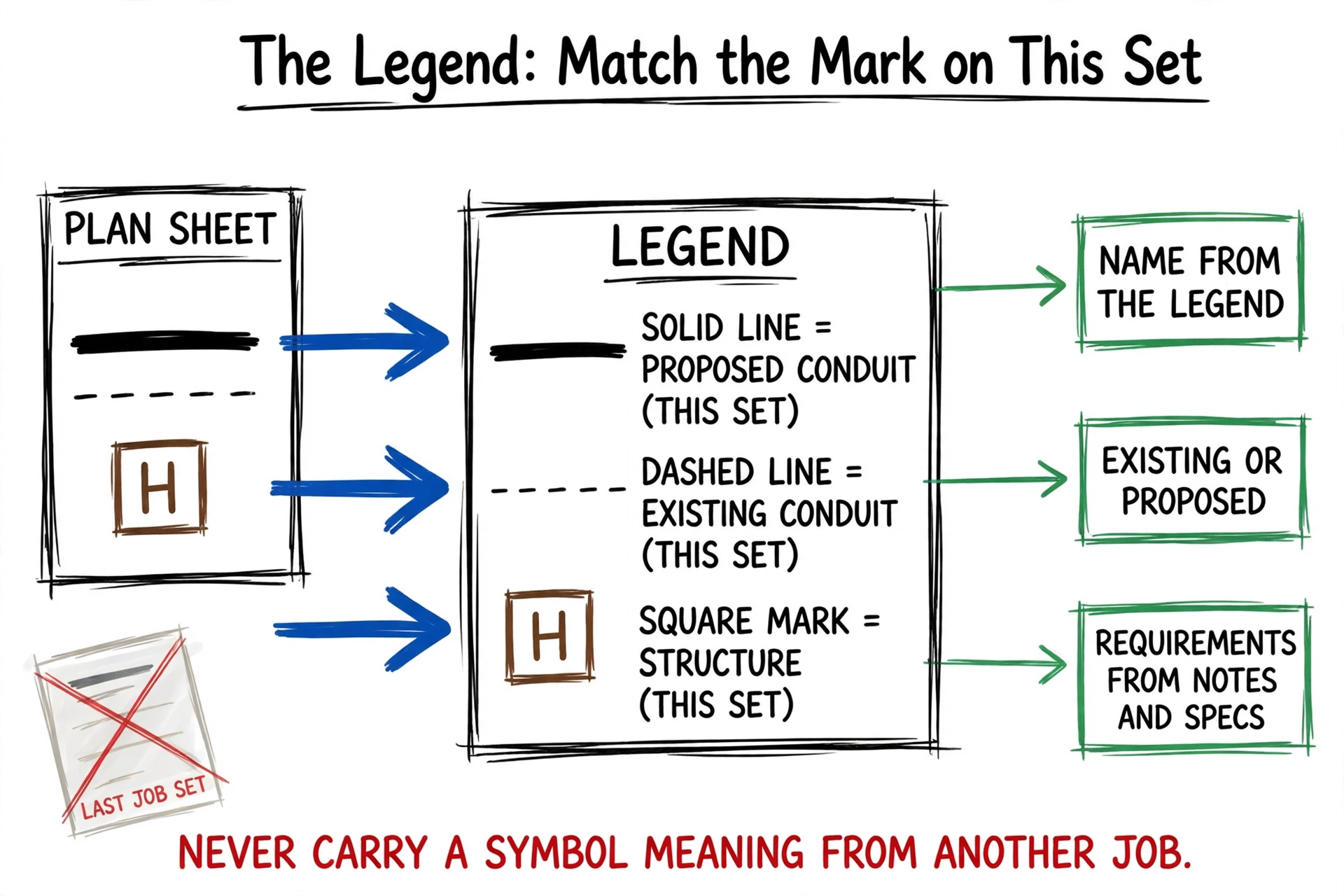
First, a legend defines symbols. Each row shows the exact graphic mark as it appears on the plan sheets, next to the name of the object or condition it stands for on this project. If the set uses a square with a letter inside it for one kind of structure and a circle for another, the legend is where that pairing is written down. Without the legend row, the mark is only a shape.
Second, a legend defines line types. Plan sheets carry many lines that cross, run together, and overlap: proposed conduit, existing conduit, existing utilities owned by others, right of way lines, easements, property lines, and limits of work. The pattern of each line is how the reader tells them apart. A legend shows a short sample of each pattern used in the set and states what that pattern means, including the critical split between existing and proposed, covered in detail later in this lesson.
Third, a legend defines abbreviations. Most sets include an abbreviations list, sometimes inside the legend table and sometimes as its own table next to it. It spells out the short forms used in labels and notes on that set, so a reader does not have to guess what a letter group means in context.
A legend is project specific and set specific. The designer who prepared the set built the legend for that set, using the standard practice of the owner whose work it is, the design firm template, and the needs of that project. Another owner, another design firm, or even the same firm on a different program can use a different symbol for the same object, the same symbol for a different object, or a different dash pattern for existing work. National guidance exists, and it matters, but it does not erase that variation. The United States National CAD Standard, usually shortened to NCS, publishes a Uniform Drawing System that includes modules on symbols, drafting conventions, and terms and abbreviations, and its sheet identification system reserves the general sheet type, type 0, for sheets that carry the symbols legend and notes. That is useful background: it shows that putting a legend on an early general sheet is standard practice, and that standard symbol libraries exist for designers to draw from. It does not mean every owner adopted the same library, adopted it without changes, or used it on the set in your hands. Treat national standards as the reason symbols often look familiar. Treat the legend on your set as the only authority for what the symbols on your set mean.
A legend is also not a complete reading of the set by itself. It tells you what a mark means. It does not tell you the size, material, depth, quantity, or installation requirement for the thing the mark stands for. Those facts live in labels next to the mark, in notes, in detail drawings, and in the specifications. The legend gets you from a shape to a name. The rest of the set gets you from a name to the work.
What Does It Look Like?
A legend looks like an organized table, and once you have seen two or three you will recognize the form even though the contents change from set to set.
The most common home is an early sheet. Many sets place the main legend on the cover sheet or on one of the first general sheets, alongside the general notes, the abbreviations list, the sheet index, and the project location information. The NCS sheet system described in the previous section reflects that same habit: general sheets carry the symbols legend and the notes for the set. Highway and public works sets follow a similar pattern. Federal Lands Highway sample plans, for example, place abbreviations and symbols information in the early A sheets of the plan set and note that additional symbols may be shown in a legend on the appropriate plan sheet itself. That second habit matters too. Some sets repeat a smaller legend, or add sheet specific symbols, on individual plan sheets, on utility sheets, or on detail sheets. A symbol that appears on only one sheet may be defined only on that sheet.
Inside the table, expect grouped rows. A legend may group its entries under headings, for example by existing and proposed features, by utilities, or by structures. The exact headings are set by the designer for that set. Each symbol row shows the mark drawn exactly as it appears on the plans, at a size you can compare, with a text label beside it. Each line type row shows a short length of the line in its true pattern, solid, dashed, dash dot, or a pattern with a repeated letter or symbol worked into it, with a label stating what that line represents and whether it is existing or proposed. The abbreviations list is usually two columns: the short form on the left, the full words on the right, in alphabetical order.
Expect the existing and proposed split to be visible in the drawing of the rows themselves, not only in the words. On many sets, existing features are drawn lighter, thinner, screened back, or in a plainer pattern, and proposed work is drawn heavier or bolder so the new work stands out from what is already in the ground. Other sets use the opposite weight or use pattern alone to separate them. Do not learn a weight rule from this paragraph and carry it to the next job. Learn the habit of checking: find the existing row and the proposed row for the same kind of facility in this legend, compare how they are drawn, and only then read the plan sheets.
A legend can also include items beyond symbols and lines. Depending on the owner and the set, it may define hatching or fill patterns for materials or surfaces, north arrow and scale references, color use on utility information, or reference marks that point to details and other sheets. If a pattern or mark appears anywhere in the set, its definition should appear in the legend or in a note on the sheet where it appears. If it appears in neither place, that is a gap to raise, not a gap to fill by guessing.
In the field, the legend usually reaches you as one sheet inside a printed set at the trailer or in the truck, as a page near the front of a PDF set on a tablet or phone, or as a posted sheet with the job prints. Its physical form changes. Its position near the front of the set and its table form stay recognizable.
What Does It Do?
The legend does four jobs for everyone who reads the set.
First, it makes the drawings readable at all. A plan sheet covered in squares, circles, dashed lines, and letter groups communicates nothing to a reader who does not have the definitions. With the legend, the same sheet becomes a map of named objects and routes that a crew can locate, count, and build. The legend is the step between seeing marks and understanding a design.
Second, it makes the drawings consistent inside one set. Every sheet in the set is supposed to use the same symbol for the same object and the same pattern for the same kind of line. The legend is the written record of that agreement. When a plan sheet, a profile, and a detail in the same set all show the same mark, the legend lets you confirm they mean the same thing, instead of hoping they do.
Third, it separates what is already there from what this project will build. The existing versus proposed distinction is the most consequential split a legend carries for outside plant work. Existing facilities are facts in the ground that the new work must avoid, cross carefully, or connect to. Proposed facilities are the work to be installed. A line pattern read backwards can put a bore path through a live utility the crew thought was new work on paper, or send a crew looking for a structure that does not exist yet. The legend is where that split is defined for this set.
Fourth, it gives the whole project one shared reference for questions. When a foreman, an inspector, and a designer disagree about what a mark means, the answer is not seniority and it is not what the mark meant on the last job. The answer is the row in this set legend. If the legend itself is unclear or a mark is missing from it, that becomes a question to the designer through the project process, with the legend as the document everyone is pointing at.
Notice what is missing from that list. The legend does not set quantities, even though symbols can be counted. It does not set materials, sizes, or depths, even though its labels name objects. It does not grant permission, show a permit condition, or replace a locate. It defines language only.
Where Does It Fit?
The legend fits at the front of the reading process for the whole set, and it stays in use for the life of the job.
It fits in sequence with the lessons before it in this level. Lesson 72 introduced the construction print as a document. Lesson 73 covered finding yourself on a print using titles, indexes, and location information. Lesson 74 covered the plan sheet as the top down view of the work. The legend is the companion to every plan sheet: the plan sheet shows the marks in place, and the legend states what the marks mean. Reading a plan sheet without its legend is reading only half the document.
It fits alongside the other front of set information. The cover sheet, the sheet index, the general notes, and the abbreviations list sit with the legend on the early sheets because together they set up everything that follows. The usual reading order for a new set is: confirm the project and the sheet index, read the general notes, read the legend and abbreviations, and only then start reading plan sheets in earnest. A reader who starts on a plan sheet in the middle of the set and never reads the front sheets has skipped the definitions the designer expected every reader to start with.
It fits next to, but separate from, the notes and the specifications. Notes, covered later in this level, state requirements for the work: what to do, what to avoid, and what conditions apply. Specifications state the fuller requirements for materials and methods. The legend states none of that. If a legend label and a note appear to point in different directions, the legend has not overruled the note. The legend told you what the object is called. The note tells you what is required for it. A conflict that cannot be resolved that way is raised through the project process, not settled in the field by preference.
It also fits across revisions. When a set is revised and reissued, symbols can be added and a legend can change. The legend that governs your work is the legend in the current issued set you are building from, not a photocopy of an earlier legend kept in the truck. Checking that your set is the current set is part of using the legend correctly.
Why Does It Matter?
It matters because the most expensive reading errors on a print are confident errors. A reader who does not know a symbol and stops to check the legend loses a minute. A reader who recognizes a symbol from another job, assumes the meaning carried over, and builds on that assumption can place work in the wrong location, order or stage the wrong structure, cross an existing utility the plan showed clearly, or miss work the plan required. The plan was not wrong. The reading was, and it was wrong in a way the legend would have prevented.
It matters because outside plant work is crowded underground. A single plan sheet can show the proposed fiber route layered over existing electric, gas, water, sewer, and communications facilities owned by several different parties, plus right of way and easement lines that carry legal limits. Line patterns are the only thing separating those layers on paper. The legend is the only place those patterns are defined. Misreading one pattern does not produce a small error. It can produce a utility strike, the subject of Lesson 70, or work built outside the easement where the owner has no right to place it.
It matters because symbols vary in the real world, whatever the standards say. Owners maintain their own drafting standards. Design firms maintain their own templates. A set prepared for one broadband owner, a set prepared for a city public works department, and a set prepared for a state highway department can each be internally consistent, professionally prepared, and different from each other in symbols, line weights, and abbreviations. A reader who works for more than one owner in a season, which is normal for contract crews and inspectors, meets that variation constantly. The legend is the adjustment step that makes moving between owners safe.
It matters because abbreviations carry the same risk in miniature. A short letter group can stand for different full terms in different disciplines or on different sets. Reference material on engineering abbreviations gives a blunt example: the same letters can be listed with more than one meaning, with a note to check the drawing legend to settle which meaning applies on that drawing. That is the general rule in one line. When an abbreviation matters to the work, the legend and abbreviations list for this set settle it. Memory does not.
Finally, it matters because using the legend is a mark of a careful reader that others can rely on. An inspector who can point to the legend row behind an observation, a foreman who checks the legend before the preconstruction walk, and a crew member who says that a mark is not in the legend and asks, all protect the job in ways that show up as problems that never happened.
What Does Good Look Like?
Good legend use is a habit with a short sequence, repeated every time a new set arrives and every time an unfamiliar mark appears.
Good looks like reading the legend before reading the plans. When a new set or a new revision arrives, the reader goes to the cover and general sheets first, reads the legend and the abbreviations list through once, and notes the existing and proposed line styles for the facility types this job will cross or install. That first read does not memorize the table. It teaches the reader how this designer draws, so surprises on the plan sheets are rarer.
Good looks like an exact match, not a close match. The reader finds the symbol on the plan sheet, then finds the legend row whose mark matches it in shape, fill, letter, and line pattern together, not in shape alone. Two symbols that share an outline can differ by a letter inside, a filled versus open center, or a short added tick, and mean different structures. Close enough is not a match.
Good looks like checking the line style every time, even for familiar facilities. Before acting on any line on a plan sheet, the reader states, from this legend, whether that pattern means existing to remain, existing to be removed, proposed, or future, whatever categories this set uses. The reader does not import the dash pattern meaning from the previous job.
Good looks like keeping the legend within reach. The general sheet stays with the working sheets in the field set, or the PDF stays one page away on the tablet, so checking takes seconds. A legend left at the office cannot correct a reading at the bore pit.
Good looks like knowing the boundary of the legend. After the legend gives the name of the object, the reader goes to the label, the note, the detail, or the specification for size, material, and requirement. Good readers can say which document each fact came from: the name from the legend, the requirement from the note or the spec.
Good also looks like raising gaps properly. A mark that appears on a plan sheet but not in the legend, a legend row that contradicts the way the mark is used on the sheets, or an abbreviation used in a note but missing from the list, is written down and sent to the designer or the project lead as a question. It is not resolved by a field vote or by borrowing a meaning from another set.
What Can Go Wrong?
The first failure is the assumed symbol: carrying a meaning from a previous job, a previous owner, or a training example onto this set without checking this legend. It is the central failure this lesson exists to prevent, because it feels like experience. The more sets a reader has worked, the stronger the pull to skip the check, and the more costly the one time the symbols differ.
A second failure is reading shape without pattern, or pattern without shape. A reader identifies a structure symbol correctly but ignores that the line attached to it is drawn in the existing pattern, and plans work as if the route were new construction. Or a reader follows the proposed line pattern correctly but misreads the structure symbols along it. The legend defines both, and both have to be read together.
A third failure is the existing and proposed reversal. This deserves its own name because of its consequences. If the set draws existing work in the pattern a reader expects for proposed work, every layer of the plan reads backwards: live utilities look like the new route, and the new route looks like something already in the ground to be avoided. Locates, potholing, and crossing plans built on that reading are built on an error the legend check would have caught in the first five minutes with the set.
A fourth failure is guessing an abbreviation. A reader expands a letter group from memory, reads a note through that expansion, and follows a requirement the note never stated, or misses the requirement it did state. Abbreviations lists exist because the same letters legitimately mean different things in different contexts. Guessing chooses one meaning silently.
A fifth failure is treating the legend as the requirement. A reader sees a symbol labeled with a structure name and assumes a standard size, a standard material, or a standard installation for that structure, because that is what the last job used. The legend made no such promise. Sizes and requirements come from labels, details, notes, and specifications for this project, and they can differ from the last job as freely as the symbols can.
A sixth failure is working from a stale legend. A revised set changes a symbol or adds a facility type, the field keeps an old print set, and the crew reads new sheets with old definitions or old sheets as if they were current. Revision control is part of legend use.
A seventh failure is the missing legend entry, handled badly. Every large set can contain a mark the designer forgot to define. The failure is not the gap itself. The failure is filling the gap quietly with an assumption and building on it, instead of stopping that item and asking. An undefined mark is a question, not a judgment call.
What Should Someone Notice in the Field?
Notice the set before the sheets. When prints arrive on a job, can you find the legend within the first sheets, and do you know whether this set also repeats legend information on individual plan or utility sheets? Notice whether the field set is complete. A working set missing its general sheets is missing its dictionary, and that is worth saying out loud before work starts, not after a misread.
Notice your own first move on an unfamiliar mark. The trained response is a pause and a trip to the legend sheet. Notice when the response in the field is instead a confident statement from memory about what the mark means. That statement, from anyone including yourself, is the cue to check the legend together.
Notice the existing and proposed patterns where the work will actually happen. At a crossing or a tie in point, compare the line patterns on the plan sheet against the legend rows for those facilities, and say out loud which lines are existing and which are proposed before anyone marks a bore path or a trench line on the ground. Print reading errors are cheapest at that moment.
Notice agreement between paper and ground through the legend, not around it. A structure shown with the symbol the legend defines as an existing structure should correspond to something the crew can find or account for in the field. A proposed symbol sits where nothing exists yet. When the ground and the paper disagree, the legend at least confirms the crew is disagreeing about the right object, and the mismatch itself is reported through the supervisor and the project process, in the same spirit as the mismark and unknown utility responses taught in Level 3.
Notice labels that use abbreviations you have not verified. A callout beside a facility, a note at the edge of a sheet, or a tag inside a detail that uses a short form you cannot expand from this set abbreviations list is a stop and check item, because the requirement you act on will be the expansion you chose.
Notice, finally, the boundary of your own role. Reading a legend correctly helps you recognize what the drawings show and report what you see accurately. It does not qualify you to redesign the work, to substitute a structure the legend names differently, or to perform regulated or hazardous work. When the drawings and the field conflict, recognition and reporting are your job. Resolution belongs to the designer, the owner, and the qualified parties for the work itself.
Practical Example
The following example is hypothetical. It is invented to teach legend use, not to describe a real job, a real owner, or a real drawing set.
Hypothetical example: a dashed line that was not the new route. A hypothetical crew receives a drawing set for a short fiber extension for a new owner the crew has not built for before. On the plan sheet, the route the crew expects to build is shown with two different line patterns in different segments: a bold solid line in one segment and a dashed line in another. The crew leader, Priya, has worked for years for a different owner whose sets drew proposed conduit as a dashed line, and her first instinct is to treat both segments as proposed work drawn two ways.
Before the walkout, Priya does the legend check this lesson teaches. She turns to the general sheet near the front of this set and finds the line type rows. On this set, the legend states that the bold solid line is proposed conduit, and the dashed line pattern shown on the plan is existing conduit to remain, placed by an earlier project. The two segments that looked like one route drawn two ways are in fact two different things: new conduit to install in the solid segment, and an existing conduit the new cable is planned to tie into in the dashed segment, with the tie in detail and its requirements given in a note and a detail drawing, not in the legend.
Priya changes the walkout plan on the spot. The dashed segment is now treated as an existing facility: it will be located, its position verified under the job process before work near it, and the tie in planned from the detail and the note rather than assumed. The material staging changes too, because conduit is needed only for the solid segment. In the debrief, Priya names the save plainly. Her memory of the other owner sets was accurate for those sets and wrong for this one, and the only thing that caught it before it became a crossing plan built on a reversed reading was a five minute match of line patterns against this legend. The lesson is not that experience misleads. The lesson is that experience is set specific, and the legend is how a reader converts experience on other sets into a correct reading of this one.
Key Terms
Legend: the table on a construction drawing set that defines the symbols, line types, and abbreviations used on that set. Also called a key.
Key: another name for a legend. A set may title its legend table Legend, Key, or Symbols and Abbreviations. The function is the same.
Symbol: a small graphic mark that stands for a real object or condition on a drawing, such as a structure or a splice point. Its meaning comes from the legend for the set, not from the shape alone.
Line type: the pattern a line is drawn in, such as solid, dashed, or a repeating pattern with a letter or mark in it. Also called a line style. On a plan, the pattern states what the line represents, including whether a facility is existing or proposed, as defined in the legend for the set.
Abbreviation: a shortened form of a word or phrase used in labels and notes on a drawing. Its full meaning on a set is given in the abbreviations list for that set.
Drawing set: the full collection of sheets issued together for a project, including cover and general sheets, plan sheets, profiles, details, and notes.
Existing: a facility or feature already in place before this project begins. On drawings, existing work is shown in the line styles and symbol forms the legend assigns to existing work on that set.
Proposed: the work this project will install. Also called new work on some sets. On drawings, proposed work is shown in the line styles and symbol forms the legend assigns to proposed work on that set, which can differ from the styles another set uses for the same split.
General sheet: an early sheet in a set that carries set wide information such as the legend, general notes, abbreviations, and the sheet index, rather than a view of one segment of the work.
Specification: the written requirements document for a project that states materials, methods, and standards for the work. A legend does not replace a specification. The legend defines graphic language; the specification defines requirements.
Check Your Understanding
- In your own words, what does a legend define, and what does it not define?
- A symbol on this set looks identical to a symbol you used for a different structure on your last job for a different owner. What do you do, and why?
- Where in a drawing set do you look first for the main legend, and where else might symbol definitions appear?
- State the step by step method for identifying an unfamiliar line on a plan sheet, including the existing versus proposed check.
- A mark appears on a plan sheet but has no row in the legend and no defining note on the sheet. What is the correct response?
Answer key:
- A legend defines the graphic language of its drawing set: what each symbol stands for, what each line type or pattern means, and what each abbreviation expands to, for that set. It does not define work requirements. Sizes, materials, depths, methods, and conditions come from labels, notes, detail drawings, and the specifications.
- You match the symbol exactly against the legend for this set and use the meaning this set assigns, even if it differs from the last job. Legends are project and set specific, symbols vary between owners and designers, and a meaning carried from another set is an assumption. The legend for the set in your hands is the only authority for that set.
- Look first on the cover sheet and the early general sheets, where the main legend usually sits with the general notes, the abbreviations list, and the sheet index. Also check individual plan, utility, and detail sheets, because some sets repeat a smaller legend or define sheet specific symbols on the sheet where they appear.
- Find the line on the plan sheet and note its exact pattern. Find the line type sample in this set legend that matches that pattern exactly. Read its label for what the line represents. Then confirm the status the label assigns: existing to remain, existing to be removed, proposed, or future, using the categories this set uses. Only then act on the line, and take any size or requirement from the label, note, detail, or specification, not from the legend.
- Stop on that item and raise it as a question through the supervisor and the project process to the designer or project lead. An undefined mark is a gap in the set, not an invitation to borrow a meaning from another set or guess from the shape. Work that does not depend on the undefined mark can be assessed by the supervisor, but the undefined item itself is not built on an assumption.
Lesson Takeaway
A legend is the dictionary for one drawing set: it defines the symbols, line types, and abbreviations on that set, including the split between existing and proposed work, and nothing beyond that set. Symbols and patterns vary between owners and designers, so a meaning learned on another job is a lead to check, never an answer to trust. Use the legend the same way every time: find the mark on the sheet, match it exactly in this legend, confirm existing or proposed, and then go to the labels, notes, details, and specifications for the actual requirements, because the legend names things and the notes and specs govern the work. When a mark is missing from the legend, ask. That short habit, repeated on every set, is what keeps a confident reader from building a confident error.
Sources and Technical References
- United States National CAD Standard, NCS content overview: the Uniform Drawing System includes modules on Drawing Set Organization, Sheet Organization, Schedules, Drafting Conventions covering symbols, line types, and notation, Terms and Abbreviations, and Symbols categorized using MasterFormat numbers. This supports the lesson statements that standardized symbol and abbreviation systems exist for designers, that drafting conventions address line types and symbols together, and that the legend habit is part of a recognized national drawing system. It does not make any one symbol universal across owners, and this lesson claims no universal symbol meanings from it: https://www.nationalcadstandard.org/ncs7/content.php
- United States National CAD Standard, Uniform Drawing System Module 1, Drawing Set Organization: sheet type designator 0 is General, described as symbols legend, notes, etc. This supports the lesson statement that general sheets at the front of a set are the standard home for the symbols legend and notes: https://www.nationalcadstandard.org/ncs6/pdfs/ncs6_uds1.pdf
- FHWA Federal Lands Highway, Sample Plans, A Sheets: early sheets of a federal highway plan set carrying abbreviations and symbols information, with the note that all special symbols and abbreviations should be placed elsewhere in the plans, typically the plan and profile sheets, and that additional symbols may be shown in a legend on the appropriate plan sheet. This supports the lesson statements that legends and abbreviations live on early sheets and that sheet specific legends also occur: https://highways.fhwa.dot.gov/sites/fhwa.dot.gov/files/A%20Sheets_0.pdf
- FHWA Federal Lands Highway, plan and profile sheet guidance, Supplement 9.6.5-1: project specific legends and utility information are placed in blank space on the first plan and profile sheet. This supports the lesson statement that a legend can also appear on a plan sheet itself, not only on the cover or general sheets: https://highways.fhwa.dot.gov/sites/fhwa.dot.gov/files/docs/federal-lands/pddm/wfl/27451/9_6_5-1.pdf
- Highway plan reading training material for utility owners and designers, summarizing state highway plan practice: readers are directed repeatedly to an early sheet, Sheet D.1 in that example set, for the complete legend of abbreviations and symbols, and drainage and stationing information is read against that legend. This supports the lesson statements that working plan readers are trained to return to one complete legend sheet for a set and that color meaning varies by subject and must be read from Sheet D.1: most existing utility features are shown in pink, existing features picked up by survey are shown in green, existing pipe information and drainage arrows use green while proposed drainage uses black, and the proposed baseline is shown in blue: https://slidetodoc.com/highway-plan-reading-for-utility-owners-designers-and-2/
- Engineering drawing abbreviations reference: a large A to Z abbreviation list in which individual letter groups carry more than one listed meaning, with discipline notes, including an entry noting that one abbreviation is read differently on different drawing types and directing the reader to check the drawing legend. This supports the lesson statement that the same abbreviation can mean different things in different contexts and that the set legend is the settling authority: https://blog.draftsperson.net/acronyms-and-abbreviations-in-engineering/
Flagged and hedged items: No specific symbol shape is stated in this lesson as the universal or standard symbol for any outside plant structure or facility, because no source verified a single symbol set adopted unchanged by all owners and designers, and the credible sources instead show standard libraries, such as the NCS Symbols module, existing alongside owner and agency practice. Any symbol example in this lesson is described as an example of a kind of mark, not as a required shape. Line weight practice, which weight means existing and which means proposed, is described only as varying between sets, because sources and practice differ and no national rule settling that split for all sets was verified. Color use for existing versus proposed information is mentioned only through one training example and is not stated as a general rule. The exact sheet a legend appears on is stated as a usual pattern, cover and early general sheets with possible repetition on later sheets, because set organization varies by owner and agency even where national guidance recommends the general sheet home. The content of the NCS itself is paywalled beyond its public overviews and module documents, so statements about the NCS in this lesson are limited to what its public pages state about its modules and sheet types, and no claim is made about a specific symbol definition inside the full standard.
Previous lesson: Lesson 74: What Is a Plan Sheet? |
Back to Level 4 hub |
Next lesson: Lesson 76: What Is a Construction Symbol?