
What You Are Learning
By the end of this lesson you will be able to run the response protocol for an unknown utility find, in order, without skipping a step. You will be able to state what stop work in the immediate area means in practice, what you must not do to the facility you found, and why every unknown facility is treated as live until its owner confirms otherwise. You will be able to explain how to protect and support an exposed facility while the question is open, who gets notified and through which channels, and what information a useful notification and a useful field record contain. You will be able to describe how identification actually happens, through records, surface clues, owner response, and careful exposure by qualified crews, and why none of those steps is a test you perform on the facility itself. You will also be able to name the common traps that turn a discovery into a strike, and state the resume rule this curriculum teaches as project protocol: work near the facility resumes only on a revised plan from the responsible decision maker. That rule is a project practice. It is stricter than the CGA minimum, which allows work to continue after notification where it can be performed without damaging the facility, unless state or provincial law says otherwise.
Lesson 56 defined an unknown utility. Lesson 55 defined an abandoned utility. This lesson does not re-teach those definitions at length. It assumes you can recognize the situation and teaches what you do next, minute by minute and step by step.
This lesson teaches recognition, stopping, protecting, reporting, and documenting. Reading it does not qualify you to locate, test, cut, move, repair, disconnect, or remove any utility facility, or to decide that work near one is safe to restart. Identification work on a facility and restart decisions belong to the facility owner and to qualified, assigned people working under state law and the project plan.
Start With the Basics
Picture a normal workday. The locate ticket is in hand. Marks are on the ground. The plan shows the lines the crew expects. Then the excavation, the bore pit, or the test hole shows something else: a pipe, a cable, a conduit, or a duct that is not on the locate, not on the ticket responses, not in the records the crew was given, and not on the print. Or the object is roughly where a line was expected, but it is the wrong size, the wrong material, or running in the wrong direction, so the record and the ground do not honestly match.
That moment is the subject of this lesson. Everything before it was preparation. Everything after it is a protocol, and the protocol exists because the first few decisions are the ones that prevent harm.
Three short definitions will carry the lesson, stated briefly because Lessons 55 and 56 covered them in full. An unknown utility is a facility whose identity, owner, and status cannot be established from reliable information available to the project. Live, also called active or in service, means connected to a working system and carrying, or ready to carry, its service. A facility owner or operator is the company, agency, or person who owns or runs a facility and holds its records. The project utility coordinator is the person the project designates to own utility questions, notifications, and answers. Your project may use a different title for that role. Learn the actual name and phone number on your project before you need it.
One more term matters here. The notification path is the ordered set of contacts your project uses when a facility question arises: your supervisor first, then the project utility coordinator, then the 811 center and the possible owners through the channels state law and the project plan provide. State law and project rules vary, including which ticket type or notice a state uses for a discovered or unmarked facility, how notice is given, and what timelines apply. When this lesson describes the shape of the path, it is describing the common shape. Your state rule and your project plan control the details on your job.
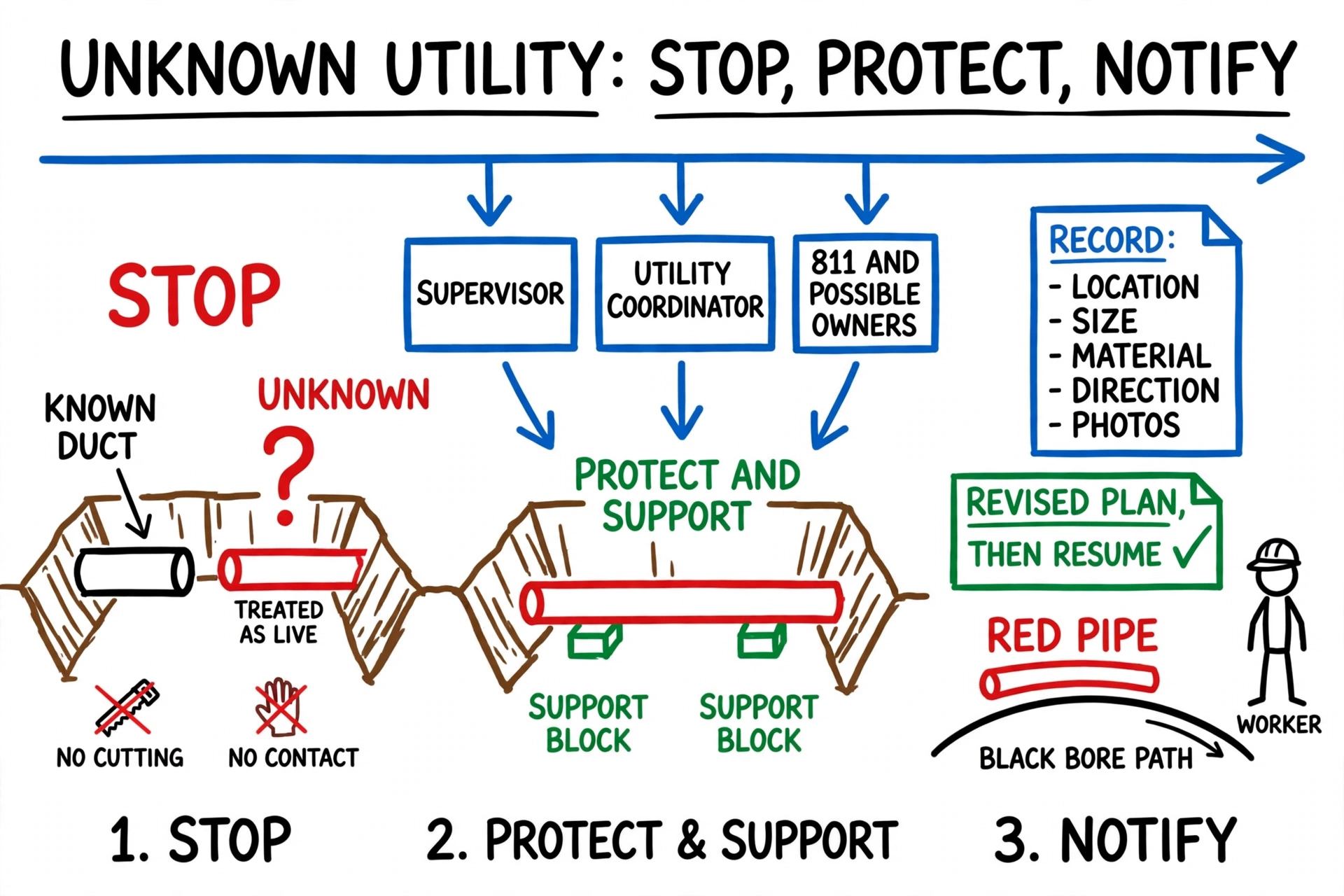
Hold the core rule in one sentence: when you find something that is not accounted for, stop work in the immediate area, treat it as live, protect it, report it, document it, and resume only on a revised plan. That resume rule is this curriculum’s project protocol, stricter than the CGA minimum, not a quotation of OSHA or CGA practice. The rest of this lesson explains each verb.
What Is It?
In this lesson, the subject is not the object in the ground. The subject is the situation and the response the situation requires.
The situation is a discovery event. A crew has uncovered, exposed, or otherwise encountered a facility, or what appears to be a facility, and the project cannot match it to reliable information. The trigger can be an extra facility where the records show none. It can be a facility that does not match its supposed record in position, size, material, or direction. It can be a fragment, a stub, or a duct whose contents and connections are not known. It can also be a marked facility that cannot be found where it was marked, because that mismatch breaks the link between the paperwork and the ground in the other direction.
The Common Ground Alliance, usually shortened to CGA, covers this situation in its Best Practices. Practice 5-21, titled Mismarked Facilities, addresses both a marked facility that is not found where it was marked and an unmarked facility found during work. A related practice on unidentified facilities states the same pattern: the excavator notifies the owner directly or through the notification service, and excavation stops in the vicinity of the facility while notification takes place. The wording differs slightly between editions and between the United States and Canadian practice manuals. The operating shape is consistent, and it is the shape this lesson teaches.
So what is the finding, in field language? Say it plainly and without a guess attached: an unidentified facility was found at a stated location, during stated work, with stated observed features, and its owner and status are unconfirmed. That sentence is complete. It does not need a service name added to sound competent. In fact, adding a guessed service name makes the report worse, because the notification may then go to the wrong owner while the right owner is never asked.
What the finding is not also matters. It is not a finding that the facility is abandoned. Abandoned, as Lesson 55 taught, rests on an owner statement that a specific facility is permanently out of service. No owner has made that statement about a facility nobody has identified yet. It is not a finding that the facility is empty, dead, quiet, spare, or harmless. None of those words can be established by looking at the outside of a pipe, a cable, or a duct. It is not permission to investigate the facility by handling it. And it is not a delay to be worked around quietly. It is a defined event with a defined response, treated by the damage prevention system as a normal and expected part of excavation work.
What Does It Look Like?
The protocol begins with recognition, so you need to know the forms a discovery takes. Lesson 56 catalogued presentations in detail. This section keeps the catalogue short and ties each form to the same response.
The clearest form is the extra facility. The plan and the marks account for a set of lines, and the ground shows one more. It may run parallel to the known lines, cross them, or run alone. It may be a pipe, a cable, a conduit, a duct bank, or a direct buried line with no conduit around it.
The second form is the facility that almost matches. The size is different from the plan. The material is different from the record. The direction does not fit the drawing. The depth, where it was already safely known from the exposure, does not fit the profile. Almost is not a match. Until the owner or the project engineer resolves the mismatch, handle the facility as unknown.
The third form is the ending or fragment. A pipe or cable stops inside the excavation, capped, plugged, cut, broken, or simply ending at the trench wall. A conduit enters one wall and leaves through the other with no structure in view. An ending shows where the visible part stops. It shows nothing reliable about the far end, about connections beyond the dig, or about whether the facility carries anything.
The fourth form is the duct or conduit that looks empty or unused. A duct can look empty at the opening you can see and still hold a cable deeper in the run, serve as a path that will carry a live cable, or belong to a system whose other end is energized or in service. Looking into the near end, from a safe position and without inserting anything, is observation. Concluding that the whole run is empty and safe is a guess.
The fifth form is the object whose type is genuinely unclear. Corrosion, damage, age, or an unusual material can hide whether a round object is a pipe, a conduit, or a cable. Plastic pipe can belong to more than one service. When the type is unclear, write that it is unclear. An honest description helps an owner match records. A confident guess misdirects the search.
In every form, what you are looking at could be any major service. It could be energized electric. It could be pressurized gas. It could be water under pressure, a sewer line, or a communications cable or duct. You cannot rule any of those out from appearance alone, and the protocol does not ask you to. Recognition is your job. Identification belongs to the owner and to the investigation the project directs.
What Does It Do?
This section covers what the stop and report response accomplishes, because a crew that understands what the protocol does is a crew that runs it under pressure.
First, the response prevents the discovery from becoming a strike. A strike is contact that damages a facility, and the most dangerous contact often comes after the first contact, when someone tries to move, cut, or test the object that was just found. Stopping work in the immediate area removes the bucket, the bore head, and the hand tools from the one object the project knows least about. Distance and stillness are protective while information is missing.
Second, the response preserves the facility in the condition the owner needs to see. An owner identifies its plant from records matched against observed size, material, direction, position, markings on the facility itself where they can be read without disturbing it, and connections to known structures. Cutting a facility open, pulling it aside, or stripping its surface destroys that evidence and can create the very release, energization, or outage the stop was meant to prevent.
Third, the response protects people in and around the excavation while it is open. Federal OSHA rule 29 CFR 1926.651(b)(4) states the duty in plain terms: while the excavation is open, underground installations shall be protected, supported, or removed as necessary to safeguard employees. Notice that the rule lists protection and support as the working options for an open excavation. Removal sits in the same sentence, but removal of an unknown facility is an owner directed act under a plan, never a field improvisation. Support matters because an exposed pipe or cable that spans open ground can sag, shift, or be struck by falling material, and a facility damaged by neglect while exposed is still a damaged facility.
Fourth, the response starts the only process that can turn unknown into known. Owners hold the records. The 811 center holds the notification system that reaches member owners. The project utility coordinator holds the project side of the question, including possible owners who may not be 811 members, private facility questions for the property owner, and the revised plan that follows an answer. A discovery that is never notified cannot be identified by the parties who hold the answers.
Fifth, the response creates the record that protects the next crew. A documented find, with location, depth where safely known, material, size, direction, condition, and photographs, becomes part of the project information. The next phase, the next contractor, and the maintenance crew years later all inherit that record instead of inheriting a surprise. An undocumented find teaches the project nothing, and the ground will teach the lesson again at a worse moment.
Finally, the response keeps legal and project responsibility clean. OSHA 1926.651(b) places duties on the employer to determine estimated locations before opening an excavation, to contact utility companies or owners and ask them to establish locations, and to determine exact locations by safe and acceptable means as excavation approaches. State damage prevention laws place notice duties on the excavator when an unmarked facility is found or when damage occurs or is discovered, with details set by the state. Following the protocol is doing what those frameworks ask. Working through an unknown facility on a guess is outside every one of them.
Where Does It Fit?
The protocol fits at a specific point in the larger process, between discovery and the revised plan. Placing it correctly shows why earlier lessons feed into it and why later work depends on it.
Before discovery, the locate process has already run. The excavator notified the 811 center, member owners responded, marks were placed, and positive response, where a state uses it, let the excavator check which owners had answered. Lessons 57 through 64 covered that system. The protocol assumes that system ran and still produced a gap, because no locate system accounts for every private facility, every unrecorded facility, and every record error. A gap after a proper locate is not proof that anyone skipped a step. It is the known limit of records and detection, and it is why the discovery protocol exists at all.
At discovery, the protocol is the bridge. Work in the immediate area stops. Work elsewhere on the site is a supervisor decision, based on whether it can proceed without affecting the found facility or the area around it. CGA practice allows that, following notification, an excavator may continue work if the excavation can be performed without damaging the facility, unless state or provincial law says otherwise. Read that allowance carefully. It is about work that can be done without damaging the facility, planned to avoid damage, with the facility protected. It is not an allowance to resume the same cut, bore, or crossing that found the facility, at the same place, on the same plan.
During identification, the protocol fits alongside subsurface utility engineering without being replaced by it. Under ASCE 38, utility information carries a quality level that states how it was obtained. Quality Level D rests on existing records. Quality Level C adds a survey of visible surface features correlated with records. Quality Level B uses surface geophysical methods to designate a horizontal position. Quality Level A comes from actually exposing a facility and measuring it at a specific point. A discovery exposure can produce Quality Level A facts about position and characteristics at that point. It still does not, by itself, establish owner or status. Exposure answers where and what it looks like. The owner answers whose it is and whether it is in service. Both answers are needed before the design question, how the new work avoids or crosses the facility, can be settled.
After identification, the protocol hands off to planning. The responsible decision maker, normally the project engineer or the designated project authority working with the facility owner, issues a revised plan. The revised plan may reroute the new work, change the crossing method, set a clearance the owner requires, require the owner to perform its own work first, or direct a specific handling of the facility under owner direction. The crew executes that plan and no more. If the plan uncovers a second unknown facility or the known facility changes character as more of it is exposed, the protocol starts again at stop.
In the project record, the protocol fits into the same documentation habit as potholing records from Lesson 65 and damage reporting duties under state law. Ohio law, used here as one state example, requires an excavator to report damage, including gouges, dents, or breaks to coatings and cable sheaths, to the utility and the protection service, and provides that if the owner is unknown, notification to the protection service satisfies the reporting requirement to the utility. Other states set their own damage reporting steps, and those steps must be checked in the law of the state where the work occurs. The lesson point is the shape, not the Ohio text: unknown owner does not mean no notification. It means notification goes through the 811 center or protection service, which is built for exactly that case.
Why Does It Matter?
It matters because the possible identities of an unknown facility include the most consequential facilities in the ground. An unidentified cable could be energized electric, where contact can cause electrocution, arc, and fire. An unidentified pipe could be gas under pressure, where a release can cause fire, explosion, and evacuation. It could be water under pressure, where a break can flood an excavation, undermine its walls, and destroy nearby work. It could be a sewer line, where a break releases contaminated water. It could be a communications cable, where a cut can remove service from homes, businesses, and emergency calling. The crew does not get to choose which of those it is by preference or by schedule. Until an owner rules possibilities out, the prudent plan holds all of them open.
It matters because the cost of a wrong guess is one sided. Treating a retired facility as live costs a pause, a notification, photographs, and a plan adjustment. Treating a live facility as retired can cost a life, an injury, a fire, an outage, a release, repair costs, regulatory reporting, and owner claims. No production gain on one crossing balances that list, and no experienced crew member needs the list exaggerated. It is long enough stated plainly.
It matters because damage data shows that failures around notification and identification are not rare edge cases. The CGA Damage Information Reporting Tool, shortened to DIRT, collects damage reports across North America. Its 2024 report analyzed 196,977 unique damage reports, and its leading root cause was failure to notify 811, at 24.54 percent of reported damages. Other leading causes included facilities not marked due to locator error and facilities marked inaccurately due to locator error. Those figures describe reported damages, not every discovery, and they should not be stretched beyond that. Their lesson point is narrow and solid: the notification and marking system is where a large share of preventable damage begins, so a discovery that bypasses notification repeats the most common failure in the data.
It matters because an unknown find is information about the whole corridor, not only about one object. If one unrecorded facility exists here, the records for the surrounding area have at least one hole, and they may have more. Demolished buildings may have had several services. Private work often came in sets. Old corridors hold old laterals and stubs together. A project that raises its care level after a find will catch the second facility by observation. A project that treats the first find as the end of surprises will meet the second one with equipment.
It matters, finally, because stopping is a skilled act that protects the reporter. A crew member who stops, protects, and reports has done exactly what federal rules, state damage prevention law, CGA best practice, and the project plan ask. That record stands up in any later review. A crew member who guesses and is wrong has no rule to point to, because no rule authorizes cutting, testing, or moving an unidentified facility to find out what it is.
What Does Good Look Like?
Good practice is visible in the first minutes and in the paperwork hours later. Look for these patterns.
In the first minutes, work in the immediate area stops. Equipment is pulled back or shut down as the supervisor directs. People, spoil, and traffic are kept clear of the facility. Nobody touches the facility to test it, nobody enlarges the exposure to follow it, and nobody offers a service name as a fact. If any damage is known or suspected, including a nick, gouge, dent, or coating break, that fact is stated at once in the first report, not discovered later. If a release, a smell of gas, sparking, or another emergency sign is present, the crew follows the project emergency plan and contacts emergency services as that plan and state law direct, from a safe position. This lesson does not replace that plan.
While the excavation is open, the facility is protected and supported as necessary to safeguard employees, as OSHA 1926.651(b)(4) requires. In practice, as directed by the supervisor and the project plan, that can mean supporting a spanning facility so it does not sag or shift, shielding it from falling material and equipment contact, and keeping loads and spoil from bearing on it. Support is placed without moving, opening, or stressing the facility. If the right support method for that kind of facility is not known on site, that question goes to the supervisor and the owner with the notification. Guessing at support for a pressurized or energized facility is still guessing.
Notification is prompt, specific, and sent through both channels. The supervisor hears about the find at once. The project utility coordinator receives the find through the project channel the same shift. The 811 center is notified directly or through the coordinator, using the ticket type or notice process the state provides for an unmarked or discovered facility, and possible owners are contacted directly where the project identifies them. A useful notification states the project and ticket number where one is used, the precise location in a form another person can return to, the work that was under way, what was observed, and whether damage is known, suspected, or not observed. Vague notice forces everyone to start over. Specific notice lets an owner recognize its facility from its records.
Identification proceeds by evidence, in a sensible order, under assigned direction. First, records are rechecked: the ticket and positive response record, the plans and their sources, prior project records, and any subsurface utility engineering data with its quality levels. Second, surface clues are compared: pedestals, valves, manholes, handholes, vents, cleanouts, markers, risers, and trench scars that might connect to the find. Third, possible owners respond, from their records and, where they choose, their own field visit or locate. Fourth, where the project directs it, qualified crews carefully expose more of the facility by safe and acceptable means, so its size, material, direction, and connections can be observed and measured. Each step adds evidence. None of them involves cutting the facility, opening it, tapping it, or applying a test the finder is not qualified and authorized to perform on that kind of plant.
Documentation is completed while the facility is visible, and it records observations rather than conclusions. A complete field record includes the location tied to a findable reference, the date and time, the work that was under way, the observed material, size, color, and direction, the depth or cover only where it was already safely known from the exposure and with the reference points named, the condition including any damage or the plain statement that no damage was observed, photographs that show the facility in place with a scale or a known object where safe to include, who was notified through which channel and when, and what protection was left in place. The status line stays honest: unknown, treated as live, owner notified, awaiting answer.
Restart is orderly. Under this protocol, work near the facility resumes only when the responsible decision maker has a revised plan, the plan is communicated to the crew, and any owner conditions in the plan are understood. The record is then closed with the owner answer, the name of the answering organization, the date, and what was done under the plan. If the facility remains unidentified after the notification process runs, the decision maker, not the finder, decides how the project proceeds, and that decision and its basis belong in the record too.
What Can Go Wrong?
The failures in this area are well known because they repeat. Each one feels reasonable in the moment. Learn the feeling as a warning.
The first trap is assuming a quiet line is abandoned. The facility makes no sound, carries nothing the crew can detect by looking, and has clearly been in the ground a long time, so someone calls it dead. Quiet proves nothing. A gas line can be silent and pressurized. An electric cable can be silent and energized. A communications cable can be silent to every sense a crew has and still carry service. Status is an owner statement, not a sound, a look, or an age.
The second trap is assuming a fiber or telecom duct is empty. The duct opening shows no cable, so the crew treats the duct as spare and plans to cut it, use it, or bore through it. The visible opening describes a few feet at one end. The run may hold a cable beyond a bend, below another duct, or entering from a structure outside the work area. An empty appearance at one point cannot clear a whole run, and a duct that truly is empty today can still be an owner facility that the project has no right to cut or occupy without direction.
The third trap is cutting an unidentified pipe to look inside. This is the most direct failure and the hardest to undo. Cutting can release gas or water under pressure, expose energized conductors in a cable mistaken for a pipe, spill the contents of a sewer or a chemical line, and destroy the facility in the act of naming it. There is no version of this step in the protocol. Identification comes from records, owners, and observation of the outside of the facility and its connections, never from opening an unknown facility in the field.
The fourth trap is moving, tapping, or testing to identify. Pulling a facility aside to see where it goes can strain a connection beyond the excavation and damage it out of sight. Striking or tapping a pipe to judge it by sound risks the facility and proves nothing reliable. Applying a meter, a tracer, or any contact test on a kind of plant you are not qualified and authorized to test risks energization, release, and a false answer. If a test belongs in the identification, it belongs to the owner of that kind of facility or to a qualified person the project assigns, working under the rules for that facility.
The fifth trap is backfilling over the find without recording it. The bore missed it, the day ended without damage, and covering it quietly feels like a clean result. It is the opposite. The facility stays unknown, now with disturbed soil around it and possibly with unnoticed damage, and the next crew inherits the surprise with less warning than the first crew had. Every exposed facility belongs in the record before the ground closes over it, identified or not.
The sixth trap is the field designed workaround. A crew shifts the bore a small distance, deepens it, or threads it past the unknown object at a clearance chosen on the spot. The crew does not know the facility size beyond the exposed point, whether it bends, or whether companions run beside it. Clearances and crossing methods belong to the revised plan and, where the owner requires them, to the owner. A guessed clearance around an unknown line is still a guess.
The seventh trap is late, narrow, or single channel notification. A find reported days later may be reported after backfill, after marks are gone, and after the evidence is covered. A find reported only to one guessed owner may never reach the actual owner. A find reported only in conversation may never reach the record or the 811 center. Use both channels, promptly, and state damage honestly, including suspected damage. Delay and vagueness do not protect anyone. They only remove the chance for the owner to answer while the evidence is visible.
The eighth trap is relief after the first find. The crew reports one unknown facility well and then works the rest of the corridor at full speed, as if the surprise budget were spent. One find is evidence that the records have gaps. Care rises in the surrounding area, nearby facilities are rematched against the marks and the plan, and the crew watches for companions in the same trench or duct bank. The second find is prevented by the attention the first find should have created.
What Should Someone Notice in the Field?
This section turns the protocol into eyes and habits. Your field job is to notice the discovery, run the first steps, and observe well. It is not to resolve the identity by handling the facility.
Notice the mismatch itself. Compare what the ground shows with what the ticket, the marks, and the print say, facility by facility. An extra facility, a missing facility, or a facility that differs in size, material, or direction is the signal. Say the mismatch out loud to the supervisor in plain words: this facility is not accounted for. That sentence starts the protocol.
Notice what to record before anything changes. Location in a form someone can return to, using the project reference system where one exists. Direction the facility runs. Observed material, size, and color, described rather than named as a service. Condition, including any nick, gouge, scrape, dent, or break, or the plain statement that no damage was observed. Depth or cover only if it is already safely known from the exposure, with the surface and the point on the facility named. Photographs in place, with a scale or known object where safe. Write observations, not conclusions. Unknown pipe, status unconfirmed, treated as live is a model entry.
Notice the surface for connections. Without opening anything or enlarging the dig, look for where the facility points: toward a pedestal, a valve, a handhole, a manhole, a riser, a building, or a trench scar. Note companions running with it in the same exposure. Those observations are often what let an owner match the find to a record, and they cost nothing but attention.
Notice the state of the exposure. Is the facility supported where it spans open ground, or is it sagging, hanging, or bearing a load of spoil? Is falling material, equipment, or foot traffic able to reach it? Is the opening protected so others do not enter or drive into it unaware? Protection while the question is open is part of the find, not an afterthought, and it is the practical form of the OSHA duty to protect and support installations while an excavation is open.
Notice your own language and the language around you. Catch the phrases dead line, old junk, just a spare, probably nothing, and the abandoned one, when no owner has said abandoned. Each phrase quietly upgrades an unknown into a harmless known thing, and crews act on the upgraded version. Replace them in speech and in notes with the honest form: unknown, treated as live, owner notified, awaiting answer.
Notice pressure and treat it as information. The bore is loaded, the closure ends at a set hour, the customer is watching, and the unknown facility is in the path. Pressure does not change what the facility is. It changes the cost of a mistake, because hurried work near an unknown facility is more likely to contact it again. When the day pushes toward a guess, that push is the signal to run the protocol exactly as written.
Carry the short routine until it is automatic. Stop work in the immediate area. Do not cut, move, tap, or test the facility, and do not assume it is dead. Treat it as live. Protect and support it while exposed, as directed. Notify the supervisor, then the project path and the 811 center. Identify through records, surface clues, owner response, and qualified exposure only. Document location, depth where safely known, material, size, direction, condition, and photographs. Resume only on a revised plan from the responsible decision maker, under this protocol.
Practical Example
The following example is hypothetical. Any resemblance to a specific project, company, or person is coincidental. Depths, sizes, and details are illustrative only and are not requirements for any job.
Hypothetical example: A fiber crew is placing conduit by directional bore along the edge of an older commercial lot. The ticket responses are complete, marks are in place for electric, gas, water, and communications, and the bore plan crosses each marked line at a planned pothole. At the second pothole, opened by the qualified exposure crew using vacuum excavation, the crew finds the marked communications duct where expected, and, running beside it in the same corridor, a plastic pipe that appears on no plan, no ticket response, and no mark.
The bore operator stops the bore before the crossing. The exposure crew stops work in the immediate area. Nobody pulls the pipe aside to see under it, nobody cuts a window in it, and nobody calls it a spare. The foreman photographs the exposure with a tape in frame, records the location against the project stationing, and writes the observed facts: plastic pipe, measured outside size recorded as observed, running in the same general direction as the duct, depth to the top of the pipe recorded from the stated surface reference, no damage observed. The pipe is supported where it spans the opening, as the foreman directs, without moving it.
The foreman notifies the project utility coordinator the same hour and states plainly that an unidentified facility was found and that no damage is observed. The coordinator notifies the 811 center through the process the state provides for a discovered facility and contacts the owners of record for the corridor, including the communications owner whose duct shares the corridor and the water and gas owners whose records might account for a plastic pipe of that size. The coordinator also raises the private facility question, because the lot once held a second building, demolished years earlier, and a private run between buildings is a real possibility that the property owner may be able to answer.
While answers are pending, the crew works on a separate segment the supervisor confirms can proceed without affecting the find. The bore crossing itself does not resume. The next day, one owner responds that the pipe is not theirs. The property owner, reached through the coordinator, produces an old site sketch showing a private water line installed for the demolished building. The water owner confirms from its records where its public main and service end, which supports the private line explanation, and the coordinator documents the answers, the answering parties, and the dates. Note what did not happen: nobody established the status of the private line by handling it. Whether it is still connected, and how it will be treated, are questions the property owner and the project engineer answer in writing.
The project engineer then issues a revised plan for the crossing that treats the pipe as a facility to be avoided by the method and clearance stated in the plan, with the exposure and support requirements the plan sets. Only then does the bore resume at that crossing, under the revised plan, with the find, the answers, and the plan all in the project record. The delay cost the project part of two days. The record the project kept means no future crew will meet that pipe as a surprise.
Key Terms
Unknown utility: A facility whose identity, owner, and status cannot be established from reliable information available to the project.
Discovery event: The moment a crew encounters a facility, or an apparent facility, that the locate, ticket, records, or print do not account for, or that does not honestly match the record offered for it.
Immediate area: The part of the work area where continued work could contact, damage, or disturb the found facility or interfere with its protection. Its exact extent is a supervisor and project plan judgment, not a fixed distance stated in this lesson.
Live: Connected to a working system and carrying, or ready to carry, its service. Unknown facilities are treated as live until the owner confirms otherwise.
Notification path: The ordered contacts for a facility question on a project: supervisor, project utility coordinator, the 811 center, and possible owners, using the channels and ticket types the state and the project provide.
Project utility coordinator: The person a project designates to own utility questions, notifications, owner answers, and the record of both. The title varies by project.
Revised plan: A plan issued by the responsible decision maker after an identification answer, stating how the new work will avoid, cross, or handle a facility, including any owner conditions.
Positive response: The system, where a state uses it, by which facility owners report the status of a locate request, so the excavator can check which owners have responded and how.
Quality Level A: The ASCE 38 grade for utility information obtained by actually exposing a facility and measuring it at a specific point. It establishes position and characteristics at that point, not owner or status by itself.
Support: Holding an exposed facility in position while an excavation is open so it does not sag, shift, or bear loads it was not carrying in the ground, done without moving or opening the facility.
Check Your Understanding
- A vacuum crew exposes a plastic pipe that is on no plan, mark, or ticket response. A crew member says it is quiet and old, so it is abandoned, and offers to cut it out of the bore path. What is wrong with each part of that statement, and what should happen instead?
- State the response protocol in order, from the moment of discovery to the moment work near the facility may resume.
- A duct looks empty at the opening a crew can see. Why does that observation not clear the duct run, and how should the duct be handled and reported?
- An owner has not yet been identified for a found facility. A crew member argues that notification is impossible until the owner is known. Explain why that argument fails, and name the channel built for this case.
- After an unknown facility is identified and the project issues its answer, a second unidentified facility appears a short distance further along the same corridor. What does the first identification clear, and what must happen for the second facility?
Answer key:
- Quiet and old describe appearance, not status. Abandoned is an owner statement that a specific facility is permanently out of service, and no owner has identified this facility, let alone retired it. Cutting it could release its contents, expose energized parts if it is not what it appears to be, and destroy the evidence the owner needs. Instead, work in the immediate area stops, the pipe is treated as live, protected and supported while exposed, the supervisor and notification path are used at once, and any handling waits for an owner answer and a revised plan.
- Stop work in the immediate area. Do not cut, move, tap, test, or assume the facility is dead or abandoned. Treat it as live. Protect and support it while exposed. Notify the supervisor, then follow the notification path through the project utility coordinator and the 811 center to possible owners. Identify it through records, surface clues, owner response, and careful exposure by qualified crews where the project directs it. Document location, depth where safely known, material, size, direction, condition, and photographs, plus who was notified and what was answered. Under this protocol, resume work near the facility only when the responsible decision maker has a revised plan and the crew has received it.
- The opening shows only the near end at one point. The run may hold a cable beyond a bend, below another duct, or entering from a structure outside the work area, and an empty duct remains an owner facility the project cannot cut or occupy without direction. Handle it as an unknown facility: stop in the immediate area if the work would affect it, protect it, notify through the project path and the 811 center, and report observed facts, including that no cable was visible at the stated opening, without upgrading that observation into a claim that the run is empty.
- Notification does not require a known owner. CGA practice directs the excavator to notify the owner directly or through the 811 notification center, and state systems provide a notice process for discovered or unmarked facilities. Where the owner is unknown, notifying the 811 center is the channel built for the case, and Ohio law states the point expressly for damage reporting: under Ohio Revised Code 3781.30(A)(6), if the owner or operator is unknown, notification to the protection service satisfies the excavator reporting requirement to the utility under that section. The project channel to the utility coordinator runs in parallel, so possible owners and the property owner, for a possible private facility, can also be reached.
- The first identification clears only the first facility, under the revised plan written for it. It clears nothing about the second facility, whose identity, owner, and status are unconfirmed. The protocol starts again for the second facility: stop in the immediate area, treat as live, protect and support, notify, document, and, under this protocol, resume near it only on a plan that addresses it. The second find also raises care for the surrounding corridor, because two record gaps in one corridor suggest more may exist.
Lesson Takeaway
An unknown utility find is not a problem to be solved by the person holding the tool. It is a signal to run a protocol. Stop work in the immediate area. Touch nothing to test it, cut nothing to name it, move nothing to clear it, and assume nothing is dead. Treat the facility as live, protect and support it while it is exposed, and get the question promptly to the supervisor, the project utility coordinator, and the 811 center, where the records and the owners who can answer actually are. Document what you observed, in facts an owner can match, and let identification come from records, surface clues, owner response, and qualified exposure. Then, and only then, under this protocol, work near the facility resumes, on a revised plan from the responsible decision maker. The crews that run this protocol without exception are the crews whose discoveries stay discoveries, instead of becoming strikes, outages, and injuries.
Sources and Technical References
Common Ground Alliance, Best Practices, Practice 5-21, Mismarked Facilities, and the related unidentified facilities practice: excavation stops in the vicinity of an unmarked, inaccurately marked, or unidentified facility, and the excavator notifies the facility owner or operator directly or through the 811 center. Following notification, work may continue only if it can be performed without damaging the facility, unless state or provincial law says otherwise. Full text via Pennsylvania 811 resource library: https://www.pa1call.org/resourcelibrary/resource/download?id=260 and Canadian CGA Best Practices Version 5.0, Chapter 4, Practice 4-20, Unidentified Facilities: https://www.info-ex.com/wp-content/uploads/2024/09/Chapter-4.CCGA-Best-Practices-Manual-Version-5.0.pdf
OSHA, 29 CFR 1926.651(b), Specific excavation requirements, Underground installations: estimated locations determined before opening an excavation, owners contacted and asked to establish locations, exact location determined by safe and acceptable means as excavation approaches, and, at (b)(4), while the excavation is open, underground installations shall be protected, supported, or removed as necessary to safeguard employees. Text via Cornell Law Institute: https://www.law.cornell.edu/cfr/text/29/1926.651
Common Ground Alliance, Damage Information Reporting Tool (DIRT) Report for 2024: 196,977 unique damage reports analyzed; top root causes included failure to notify 811 at 24.54 percent, facility not marked due to locator error, and marked inaccurately due to locator error; the top 10 root causes accounted for 85 percent of reported damages. Summary coverage: https://www.einpresswire.com/article_print/843655724/cga-dirt-report-highlights-concerning-levels-of-damages-to-buried-utilities-signals-need-for-industry-wide-changes and https://undergroundinfrastructure.com/news/2025/august/cga-report-shows-utility-damage-rates-climbing-calls-for-stronger-enforcement
ASCE 38 quality levels, as summarized in SUE guidance: Quality Level D from existing records, Quality Level C from records correlated with surveyed visible surface features, Quality Level B from surface geophysical designating of horizontal position, and Quality Level A from actual exposure and measurement at a specific point. Summaries: https://blog.emlid.com/asce-38-quality-levels/ and https://www.usanova.com/blog/what-is-subsurface-utility-engineering/
Ohio 811 guidance and Ohio Revised Code 3781.30 excerpts on damage reporting, including reporting gouges, dents, and coating damage, and the provision that if the owner or operator is unknown, notification to the protection service satisfies the reporting requirement to the utility: https://oups.org/faqs/
Flagged as variable and not stated as universal in this lesson: state ticket types, notice steps, and timelines for a discovered or unmarked facility; the extent of the immediate area around a find; support methods for a specific facility type; and any clearance or crossing requirement for an identified facility. Each is set by the state law, the facility owner, and the project plan for the job in front of you, and each must be verified there rather than taken from this lesson. No numerical clearance, depth, or timeline is stated in this lesson as a universal requirement.
Previous lesson: Lesson 67: What If a Utility Is Mismarked? |
Back to Level 3 hub |
Next lesson: Lesson 69: What Is a Utility Conflict?