
What You Are Learning
By the end of this lesson you will be able to explain, in plain language, what positive response is and who gives it. You will be able to describe the common kinds of status an operator can report, such as marked, clear or no conflict, unmarked with a reason, and not yet responded. You will be able to explain how an excavator checks those responses on a ticket before digging, and why a missing response can never be read as clear. You will be able to explain why marks on the ground and a response on the ticket are two different things and why a crew needs both. You will also be able to explain what positive response does not cover, especially private facilities, and why a saved response record matters if damage is ever investigated later.
This lesson teaches recognition and checking only. Reading it does not qualify you to locate utilities, to mark facilities, to excavate, or to decide on your own that a site is safe to dig. That work belongs to facility operators, their locators, and trained excavators working under the law and the procedures that apply in the state where the work happens.
Start With the Basics
Start with the locate request. A locate request, also called a ticket, is the notice an excavator sends through the state notification center, often called the 811 center, saying that digging is planned in a described area on a planned date. The center does not dig and it does not mark. It forwards that notice to its member facility operators whose underground facilities may be in or near the area.
A facility operator is a company or public agency that owns or operates an underground facility, such as an electric line, a gas line, a water main, a sewer line, or a communications cable. A locator is a person who, for an operator, finds and marks that operator’s facility in the field, often working for a contract locating company hired by the operator.
After receiving the ticket, each operator has to deal with its own facilities in that area. If it has a facility there, it marks the approximate location, usually with paint or flags in the standard color for that kind of utility. If it has no facility in the work area, there is nothing to mark. If it cannot finish in time, or cannot get access, or needs more information, that fact also matters to the excavator.
Positive response is how the operator reports back what it did. Without that report back, the excavator standing in the field faces a guessing problem. Quiet ground could mean the area was checked and found clear. It could also mean nobody came yet, or a locator was delayed, or a ticket was missed. Paint on the ground for one utility says nothing about the other utilities that were notified. Positive response exists to remove that guess by giving every notified operator a way to put a status on the record for that ticket.
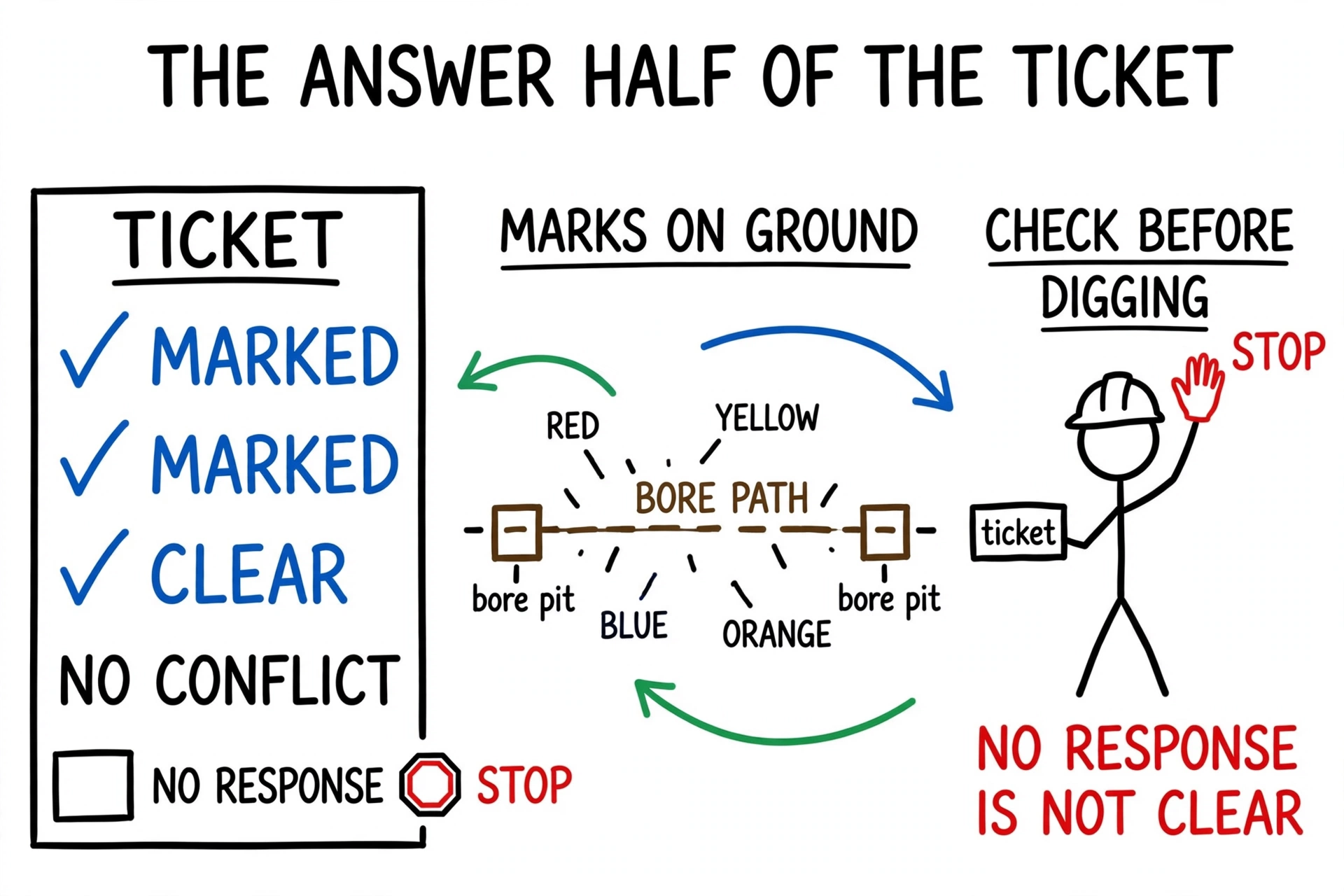
Keep one sentence in mind for the whole lesson. No response is not the same as no conflict.
What Is It?
Positive response is the system and the act by which a facility operator, or its locator acting for it, reports the status of a locate request back through the notification center so the excavator can determine whether all notified operators have responded before excavation begins.
The Common Ground Alliance, usually shortened to CGA, is the industry association that publishes the Best Practices guide for damage prevention. Its Best Practice 4-9, titled Positive Response to Locate Request, states the practice this way in summary: all facility locate requests result in a positive response from the facility owner or operator to the excavator. The CGA description adds that a positive response may include markings or documentation left at the job site, a callback, a fax, or an automated response system, and that it allows the excavator to know whether all facility owners or operators have marked the requested area prior to the beginning of excavation. That is an industry best practice. It is not, by itself, a federal law that applies the same way in every state.
In practice today, most positive response happens electronically. The operator or its locator enters a status, often called a response code, into the notification center system for that ticket. The excavator then views those statuses in the center portal, through a ticket link, by email notification where that service is offered, or by phone through the center where a phone system is provided. The exact screens, codes, and words differ by state and by center. There is no single national code list that a crew can memorize once and use everywhere.
The legal status also differs by state, and this lesson labels each example by state for that reason.
In Oklahoma, positive response is required by state law. The Oklahoma Underground Facilities Damage Prevention Act, at section 142.6.B as quoted by OKIE811, the Oklahoma notification center, says each operator shall provide a positive response to the notification center prior to the expiration of the required notice period, and that the response shall indicate the status of the required activities of the operator or its designated representative for the proposed excavation. OKIE811 states in its membership and excavator materials that responding is mandatory in Oklahoma and that excavators must check for positive responses before starting excavation.
In Florida, positive response is also built into state law. Florida Statute chapter 556, as published by Sunshine 811, the Florida notification center, defines positive response as the communications among member operators, excavators, and the system concerning the status of locating an underground facility. Sunshine 811 states that members are required to enter a response code for each locate ticket before the ticket due date and time, telling the excavator if the site is clear, marked, or unmarked.
In Virginia, state law requires the notification center to maintain a positive response system, and it requires the excavator to use it. The Virginia State Corporation Commission summary cites Va. Code section 56-265.16:1.E for the system requirement and section 56-265.24.A for the excavator duty, stating that no excavator shall begin any excavation or demolition before reviewing and heeding the positive response marking status of the excavation area. Virginia law defines positive response as a code or phrase posted by an operator or locator to the notification center detailing the marking status of a locate request.
In Missouri, the excavator duty is framed around response and a follow up step when there is none. Missouri 811 states that digging may begin if all utilities have responded, and that if all utilities have not responded, the excavator may submit a No Response ticket. Missouri law, Mo. Rev. Stat. Section 319.030 (the no-response and second-notice provision; Missouri 811 cites it as 319.030.4, and subsection numbering varies by edition), requires that second notice before excavation when an operator has failed to respond, after which the operator has a short window defined in that statute to mark or contact the excavator. The exact times in that Missouri provision are Missouri law only. Do not carry them to another state.
In Texas, Texas811 describes positive response as the system by which member companies communicate ticket status, letting the excavator know if an underground utility is marked, unmarked, not in conflict, clear, or high priority, and excavators can view responses by logging into the portal, by using the interactive ticket link on their copy of the locate ticket, or by calling the Damage Prevention Center. Texas law does impose positive response duties in at least one defined area: the Railroad Commission pipeline rules in 16 Texas Administrative Code Chapter 18 require a pipeline operator to respond by marking or by giving an all clear or no conflict notice, and require the excavator to record the response and to give a second notice when no positive response is received. Whether a comparable general duty applies to a non-pipeline facility in a specific case must still be checked against current Texas law for that case.
In Utah, Blue Stakes of Utah 811 describes its Electronic Positive Response as voluntary for facility operators at the time of the source used here. Blue Stakes says it highly encourages participation, that an email is automatically sent to the excavator on the legal date shown on the locate request with any posted responses, and that the excavator can check responses by entering the ticket number. Utah is a useful reminder that the same words can describe a required system in one state and a voluntary system in another.
Do not treat any one state example above as the national rule. The national pattern is the CGA best practice and the shared purpose. The duty, the deadline, the codes, and the follow up process are set state by state, by state law and by the notification center system that operates under it.
What Does It Look Like?
Positive response does not look like paint. It looks like a record attached to a ticket. Learning to picture that record will help you separate it from the marks in the field, which the next part of this section covers.
On a screen, in a portal or on a ticket link, a positive response record usually shows, for each notified member operator, the operator name or member code, the status that operator posted, sometimes a short code next to the words, and sometimes a note or an attachment. Texas811, for example, describes excavators viewing member responses in the portal or through the interactive ticket link on the ticket. Sunshine 811 in Florida describes excavators checking responses through its Exactix system and its Check Responses route, and notes that some codes carry instructions that require a response from the excavator. Virginia provides a phone based Positive Response System as well, which the State Corporation Commission lists at 811 within Virginia or a toll free number, in addition to its web ticket systems. Ohio811, in Ohio, describes the same basic shape: member utilities post responses, and the excavator enters the ticket or notification number to check them.
The statuses themselves fall into plain groups, even though the exact code and wording is set by each center. Use these groups to understand any state list, then read the actual list for the state you are in.
Marked. The operator located its facilities in the work area and marked them. Florida Sunshine 811 uses response wording in this family, and Virginia code 10, from the Virginia list effective June 26, 2025 as published by the State Corporation Commission, means Marked, used when all utility lines within the area of proposed excavation have been marked. Virginia also has more specific marked codes, including code 11 for marked with abandoned lines possibly in the area, and codes 12 and 13 for marked up to a privately owned utility, with a direction to contact the private utility owner for a locate.
Clear, or no facilities. The operator has no facilities at the specified excavation site. Sunshine 811 code 4 in Florida is worded Clear, no facilities, with that meaning. An operator can be clear because it simply has nothing there.
No conflict. The operator has a facility near the area, but not inside the work area described on the ticket or white lined by the excavator. Sunshine 811 code 5 in Florida is worded No conflict, and explains that the utility is outside the requested work site. Virginia code 30 is worded in the same family, no conflict, utility is outside of stated work area. Clear and no conflict sound similar, and both usually mean no marks from that operator, but they are not the same statement. Clear says nothing is there. No conflict says something exists nearby but outside the described work area. If the work area grows or moves, a no conflict answer may no longer fit, and the ticket may need to be updated or a new request made under that state process.
Unmarked, with a reason. The site was not marked, and the operator posts why. Florida Sunshine 811 lists several unmarked codes, including a code for extraordinary circumstances declared through Sunshine 811 under Florida law, a code for not the service provider for this location, and a code for work being performed by the utility with the excavator marking by agreement. An unmarked status is still a response, but it is not permission to treat the area as clear. It is an instruction to read the reason and follow it, which may mean calling the operator or waiting for a new agreed time.
Ongoing or in progress, and similar working statuses. Some systems use a status for a job where the locator and the excavator have an agreed schedule for marking. Sunshine 811 code 8 in Florida is worded Ongoing job, defined as the locate technician and excavator having established an agreement on scheduled marking. Other centers use different words for a locate that is not complete. Whatever the local words are, a not complete status means what it says. The locate is not finished.
No response. This is the absence of a posted status for a notified operator after the time when a response was due. It is not a code the operator chose. It is an empty space where a status should be. Michigan MISS DIG 811, in its positive response codes document, defines positive response under Michigan Public Act 174 as the procedure administered by the notification system to allow excavators to determine whether all facility owners or operators contacted under a ticket have responded, and notes that the posted status can be retrieved by the excavator. That definition points at the whole purpose of checking: to find the operators who have not responded, not just to read the ones who have.
In the field, at the site itself, positive response can also leave paper or physical traces, depending on the state and the operator. The CGA description allows for markings or documentation left at the job site as part of a positive response. A door hanger, a marked up site sheet, or a flag note may support the electronic record on some jobs. Do not rely on a paper trace alone when the center system holds the official ticket record for that state. Check the system record.
Finally, compare the record to the ground. Sunshine 811 guidance to excavators in Florida says to pull up the member positive responses again at the dig site before putting a shovel in the ground, compare the positive response codes to what is seen at the dig site, and contact the member utility for clarification if they do not match. That comparison habit is good practice in any state, even where the exact wording of the guidance differs.
What Does It Do?
Positive response closes the communication loop on a locate request. The excavator sent a notice out. Positive response is the answer coming back, operator by operator, on the record.
It tells the excavator which notified operators have finished. A ticket may notify several operators at once. OKIE811 notes in its Oklahoma excavator guide that on average six member companies are notified per locate request. Positive response lets the excavator account for each one of them, instead of judging the whole ticket by the paint that happens to be visible.
It separates three situations that look identical from the truck. The first is a checked and clear area, where every operator has either marked or reported clear or no conflict. The second is a partly finished locate, where some operators have responded and others have not. The third is a problem locate, where an operator has reported it cannot mark, cannot get access, or needs information or a meeting. On the ground, all three can show the same patch of unpainted dirt for a given utility. Only the response record tells them apart.
It carries instructions the paint cannot carry. Paint can show where a line is thought to be. It cannot say that a high priority facility is present, that a representative must be on site to watch and protect, that abandoned lines may also be in the area, that marking stopped at a private line, or that the excavator must call before a stated time. Oklahoma law, for example, provides that if a positive response to watch and protect is indicated, the operator shall provide the name and phone number of the contact who shall be present for observation. That kind of instruction lives in the response, not in the paint.
It creates a dated record. The ticket, the list of notified operators, and each posted status together show who was told, who answered, what they said, and when. That record has value during the job for planning, and after the job if a facility is damaged and the facts are reviewed. A memory of a phone call is weak next to a saved ticket response history.
It does not do several things, and the limits matter as much as the functions. It does not locate anything by itself. It does not prove a marked line is in the exact place the paint shows, since marks show an approximate location, not a precise one. It does not cover facilities that were never part of the ticket, including most private facilities, which are covered later in this lesson. And it does not transfer the excavator duty to dig with care. Missouri 811, summarizing Missouri law on no response, makes the point that even after the no response process, nothing excuses the excavator from exercising the degree of care required by law.
Where Does It Fit?
Positive response sits in the middle of the safe digging sequence, between the locate work and the digging.
First, the excavator plans the work, outlines the dig area, often with white paint or flags called white lining, and submits the locate request to the state notification center with the required advance notice for that state. Advance notice periods are set by state law and differ by state, so this lesson does not state a single national waiting period.
Second, the center sends the ticket to the member operators whose facilities may be affected. Those operators, through their own staff or contract locators, review the ticket, go to the field if needed, and mark their facilities or determine that they have none in the work area or none in conflict with it.
Third, each operator posts its positive response to the center system before the deadline that applies in that state. Oklahoma and Florida materials both describe that posting duty as tied to the expiration of the required notice period or the ticket due date. Virginia ties the excavator start to reviewing the response status, rather than to a simple clock alone.
Fourth, the excavator checks the responses, accounts for every notified operator, follows any instructions in the responses, and compares the responses to the marks and conditions actually seen at the site. If a response is missing, mismatched, or says not complete, the excavator follows the follow up process for that state, such as a renotification, a second request, or, in Missouri, a No Response ticket, and contacts the operator or the center as that process directs.
Fifth, only after that accounting is complete and the ticket is valid for the planned start, the excavation begins, still with the care duties that apply around marked facilities, including hand digging or other required methods in the tolerance zone for that state and facility. Positive response is a gate in that sequence, not a substitute for any of the other steps.
For a fiber crew, this gate most often appears at bore pits, trench starts, handholes, pedestal placements, road crossings, and service drops, where the crew is the excavator or is working for the excavator on the ticket. Even when another company placed the ticket, a fiber crew member who can read the response record can spot the common failure early: work about to start on a ticket that still shows an operator with no response.
Why Does It Matter?
It matters because the most dangerous reading of a quiet site is the wrong one. If a crew treats no paint as proof of no facility, a single missed, delayed, or unfinished locate becomes a strike. Strikes on electric and gas facilities can injure or kill. Strikes on water, sewer, and communications facilities can flood excavations, cut service to hospitals and homes, and stop a project for days. Positive response is the check that was built specifically to stop that wrong reading.
It matters because fiber work is usually done in crowded corridors. A new fiber path often crosses or runs beside existing electric, gas, water, sewer, cable television, and older communications plant in the same right of way or easement. The crew needs an answer from every one of those operators, not just the ones whose paint is easiest to see. A response record organized operator by operator matches that need.
It matters because instructions change the plan. A watch and protect response, a high priority notice, a marked up to private line response, or an ongoing job agreement can change the start time, the method, or the people who must be present. A crew that only looks at paint will miss all of those.
It matters because the record protects honest work. If a facility is damaged after every operator responded clear in an area and the excavator dug with care, the saved responses are part of the facts. If a facility is damaged after a crew dug with an operator still showing no response, the saved responses are also part of the facts, in the other direction. Either way, the record is more reliable than recollection.
It also matters for scheduling. Checking responses during the notice period, not only at the start time, gives the crew time to act on instructions, request clarification, or move work to another location that is fully responded to, instead of losing a morning at a pit that was never cleared to start.
What Does Good Look Like?
Good positive response practice is quiet, complete, and documented. It looks like this.
Every notified operator on the ticket has a posted status before the planned start, and the excavator or crew lead has actually viewed that list, not assumed it. Ohio811 describes the same standard in substance: check positive response before commencing excavation and confirm all notified utilities have responded.
Every marked response matches paint or flags of the right color in the field, in the area described on the ticket. Every clear or no conflict response matches a field picture that makes sense for that operator. If the site shows an obvious facility of a type an operator reported clear, such as a pedestal, a valve, a meter, or a visible trench line leading into the work area, the mismatch is raised before digging, not explained after.
Every instruction inside a response has been read and acted on. That includes call back instructions, meet requests, watch and protect contacts, private line directions, and agreed marking schedules. Florida Sunshine 811 warns members and excavators that some codes have special instructions for the excavator, and that a voicemail or email alone does not constitute a mutual agreement where an agreement is required. Good practice treats an instruction in a response as part of the response, not as fine print.
Missing responses are handled through the state process, in writing where the system allows it, and the follow up is saved with the ticket. The crew does not fill the gap with a verbal assurance from someone who is not that operator.
The ticket, the response list, and field photos of the marks are saved together in the project record for that location, so a later reviewer can rebuild what was known at the start time without hunting across phones and inboxes.
The crew still digs as if marks are approximate, because they are. Good positive response practice never turns into careless digging. It is the start gate, not the whole safety system.
What Can Go Wrong?
The central failure is digging on a missing response. An operator was notified, posted nothing, and the crew read the empty space as clear. If that operator had a facility in the bore path, the first notice the crew gets may be the strike itself.
A second failure is reading only the paint. A crew sees orange and blue paint, assumes every utility is marked, and never opens the ticket. In fact a gas operator may still be pending, or an electric operator may have posted unmarked because it could not get access through a locked gate. Paint from the operators who did come cannot answer for the operators who did not.
A third failure is confusing clear with no conflict. A no conflict response depends on the work area as described. If the crew widens a pit, moves a bore, or adds a crossing outside the described area, the old no conflict answer may no longer describe the new work. Digging the new area on the old answer is digging without a valid response for that area.
A fourth failure is ignoring an unmarked or ongoing status because the deadline passed. Time passing does not finish a locate. An unmarked status with a reason, such as extraordinary circumstances, not the service provider, or an agreed schedule still in progress, tells the excavator to follow that reason. In Florida, Sunshine 811 states that the system automatically notifies excavators when all members have provided a response or when the legal period has expired, whichever comes first. Expiration of the period and completion of responses are two different events, and the notice wording reflects that difference.
A fifth failure is assuming private facilities are covered. They usually are not. A member operator marks and responds for its own facilities. Private lines owned by the property owner, such as a line from a house to a detached building, an irrigation line, a private sewer lateral, or power to a gate or pool equipment, are generally outside the 811 member locate. Virginia marked codes 12 and 13 exist precisely to warn that marking stopped at a privately owned utility and the private owner must be contacted for that part. A complete set of member responses can still leave private facilities unlocated.
A sixth failure is a mismatch that nobody raises. The response says marked, but there is no paint in the described area. Or the response says clear, but there is a fresh trench, a riser, or a handhole in plain sight. Mismatches happen because of wrong addresses, faded paint, marks destroyed by traffic or weather, or a locate done for a different area. Digging through a known mismatch throws away the warning the check was meant to give.
A seventh failure is losing the record. The crew checked the portal on a phone, saw all responses in, dug, and saved nothing. Weeks later, after a damage claim or a dispute about who responded, there is no saved list to show. The check helped in the moment and then vanished as evidence.
What Should Someone Notice in the Field?
You do not need to be the excavator of record to notice the signs that a positive response check is complete, incomplete, or mismatched. Notice these things.
Notice whether anyone can produce the ticket. A crew that is ready to dig should be able to show the ticket number, the work area it describes, its valid start and its expiration under that state rules, and the list of notified operators. If nobody can produce the ticket, the response check cannot have been done properly.
Notice the count. Compare the number of notified operators on the ticket to the number of posted responses. Equal counts, with each status read, is the goal. A short count is a stop sign until the state follow up process has been used and documented.
Notice the words, not just the presence of a response. Marked, clear, no conflict, unmarked, and ongoing mean different things and call for different actions. A quick glance that treats every filled row as equal misses the rows that contain instructions or warnings.
Notice paint that has no matching response, and responses that have no matching paint. Marked with no visible marks may mean faded or destroyed marks that need refreshing through the center process. Paint with no response may mean the response was posted under a different ticket, or not posted yet.
Notice evidence of facilities that no response accounts for. Pedestals, transformers, meters, valves, manholes, handholes, cleanouts, risers, warning tape in an open cut, and a visible facility line entering the work area are all field evidence. If that evidence points to an operator who reported clear, or to a kind of facility no notified operator covers, raise it before digging.
Notice private facility clues near buildings. Lines leaving a building toward a garage, a barn, a pool, a gate, a yard light, or an outbuilding are often private. So are irrigation heads and private sewer cleanouts between a building and the street. A complete member response list does not clear those lines.
Notice dates and changes. A response was good for the area and time on its ticket. New work area, expired ticket, destroyed marks, or a long delay since the responses were posted can each require a new request or a renewal under the state process. Do not stretch an old response record over new ground.
If you notice any of these problems, the correct action is to pause the dig in the affected area and raise it through the crew lead and the excavator on the ticket. Do not resolve it by guessing, and do not mark, move, or remove another operator facilities or marks.
Practical Example
Hypothetical example. This example is made up to show the check in action. It is not a real ticket, a real operator, or a real job.
A fiber crew is scheduled to bore across the front of a small commercial lot to reach a new handhole. The excavator on the job placed a locate request through the state center for the bore path and the two bore pits. Five operators were notified: electric, gas, water, cable television, and an existing communications operator.
On the morning of the planned start, the crew lead opens the ticket responses before any equipment is unloaded. Electric shows marked, and red paint is visible along the side of the lot. Gas shows marked, and yellow paint crosses the bore path, so the crew plans to expose that line by an approved careful method in the tolerance zone before boring across it, as the project procedures require. Water shows no conflict, explained as its main being outside the described work area, and no blue paint is in the bore path, which fits. Cable television shows clear, no facilities at the site.
The fifth operator, the existing communications operator, shows no response at all. There is no orange paint in the bore path, and a newer crew member says the path must be clear of communications lines because nothing is painted.
The crew lead does not accept that reading. No response is treated as unknown, not as clear. The crew does not bore. The excavator follows the state follow up process for a missing response through the notification center and documents that follow up on the ticket. The crew moves to other work on the same project that does not require excavation in that area.
Later, the communications operator posts marked, and orange paint appears along a line that runs diagonally across the planned bore path, in a place nobody had guessed from the surface. The bore plan is adjusted to avoid that line as the project procedures require, and the saved response list, showing the original missing response, the follow up, and the later marked response, is filed with the ticket and the field photos.
The lesson in the hypothetical is simple. The paint that was missing on the first morning was not proof of a clear path. The empty response row was the warning, and reading it correctly is what prevented a strike on an existing communications line during a job whose whole purpose was to build another one.
Key Terms
Positive response: The report back by a facility operator, or its locator, through the notification center system, stating the status of a locate request for a ticket.
Notification center: The state or regional center, reached through 811 or its own systems, that takes locate requests, forwards them to member operators, and holds the ticket and response record. Also called the 811 center or one call center.
Facility operator: A company or public agency that owns or operates an underground facility and is responsible for locating and marking it or reporting that it has none in conflict. Also called an operator or facility owner or operator.
Locator: A person who finds and marks an operator underground facilities in the field, working for the operator or for a contract locating company hired by the operator.
Ticket: The locate request record created by the notification center, describing the excavator, the work area, the planned work, and the operators notified. Also called a locate request.
Response code: The status code or phrase an operator posts to a ticket in the center system, such as a marked, clear, no conflict, or unmarked status in the wording that center uses.
Clear: A response meaning the operator has no facilities at the specified excavation site, in the wording used by centers such as Sunshine 811 in Florida.
No conflict: A response meaning the operator has a facility near the area but outside the work area described on the ticket, so it is not in conflict with that described work.
No response: The absence of a posted status from a notified operator when a response was due. It is not a status the operator chose, and it must never be read as clear.
Private facility: An underground line owned by the property owner or another private party rather than by a member facility operator, such as a line to a detached building or an irrigation line. Private facilities are generally outside the member 811 locate and response system.
Check Your Understanding
- In your own words, what is positive response, and who gives it?
- A ticket notified six operators. Five posted marked or clear. One posted nothing. The ground shows no paint for that operator. What does the missing response mean, and what should the excavator do before digging in that area?
- What is the difference between a clear response and a no conflict response, and why does that difference matter if the work area moves?
- Name two things a positive response can tell an excavator that paint on the ground alone cannot tell.
- A ticket shows a complete set of member responses, all marked or clear. The bore path passes a line running from a house to a detached garage. Why might that line still be unlocated?
Answer key:
- Positive response is the operator, or its locator for it, reporting the status of a locate request back through the notification center, so the excavator can tell whether every notified operator has marked, reported clear or no conflict, reported a problem, or not responded at all.
- The missing response means unknown, not clear. The excavator should not dig in the affected area on that ticket and should use the state follow up process through the notification center, such as renotification or a no response ticket where that state provides one, and document the follow up. Do not dig on a missing response on the strength of the deadline alone. Complete that state’s follow up process first. A few states then expressly allow the excavator to proceed, with the degree of care the law requires, if the operator still does not respond within the window that state sets after the follow-up notice. That permission, its window, and its conditions are state law only and must be read from the current law for the state on the ticket.
- Clear means the operator has no facilities at the specified site. No conflict means the operator has a facility nearby but outside the work area described on the ticket. If the work area moves or grows into where that nearby facility is, the no conflict answer may no longer apply and the ticket needs to be updated or a new request made under the state process.
- Any two of these are correct: that an operator has no facility there and therefore left no paint on purpose; that a facility is high priority or needs a watch and protect representative present; that marking stopped at a private line; that abandoned lines may be in the area; that the locate is not complete or could not be completed and why; or instructions the excavator must follow before or during work.
- A line from a house to a detached building is usually a private facility owned by the property owner, not a member operator facility. Member operators respond only for their own facilities, so a complete member response list does not locate or clear most private lines. That part needs the property owner and, where the project requires it, a private locate arranged outside the 811 member system.
Lesson Takeaway
Positive response is the answer half of the locate request. The operator reports, on the ticket record, that it marked, that it is clear, that it is not in conflict, that it could not mark and why, or it has not responded yet. A crew that checks that record, accounts for every notified operator, follows the instructions inside the responses, and compares the record to the ground has closed the loop. A crew that reads missing paint or a missing response as clear has left the loop open, and an open loop is where preventable strikes happen.
Sources and Technical References
Common Ground Alliance, Best Practices, Practice 4-9 Positive Response to Locate Request. Practice statement and description summarized in this lesson: all locate requests result in a positive response, which may include markings or documentation at the site, callback, fax, or an automated system, allowing the excavator to know whether all operators have marked before excavation. https://carcga.org/BP_22.0_Web.pdf and https://nebraska811.com/wp-content/uploads/2020/06/CGA_BestPracticesV17.pdf
OKIE811, Oklahoma law page, quoting the Oklahoma Underground Facilities Damage Prevention Act section 142.6.B. Operator positive response duty to the notification center before expiration of the required notice period, status indication, watch and protect contact, and duty to communicate when the operator has no facilities in the area. State law example, Oklahoma only. https://okie811.org/law/
OKIE811, Excavator Guide, May 2025 update. Oklahoma excavators must check for positive responses before starting excavation, positive response confirms whether facilities have been marked or not, and on average six member companies are notified per locate request. Oklahoma guidance. https://okie811.org/wp-content/uploads/2025/05/2025-Excavator-Guide-May-Update.pdf
OKIE811, Membership Guide. Responding to the excavator is mandatory in Oklahoma under section 142.6.B, through the OKIE811 Portal, so excavators can confirm response prior to excavation. Oklahoma system description. https://okie811.org/wp-content/uploads/2024/10/Membership-Guide-October-2024.pdf
Texas811, Positive Response page. Positive response is how member utility companies communicate ticket status, including marked, unmarked, not in conflict, clear, or high priority, and excavators can view responses in the portal, through the interactive ticket link, or by calling the Damage Prevention Center. Texas system description. This page is the Texas811 system description. The Texas pipeline positive response duties cited in this lesson come from 16 Texas Administrative Code Chapter 18, verified during the Batch 13 fact-check: https://www.rrc.texas.gov/media/bwciof3s/excavator-brochure-english.pdf https://texas811.org/positive-response/
Sunshine 811, Response Codes page, Florida. Code 4 Clear, no facilities. Code 5 No conflict, utility outside the requested work site. Unmarked codes including extraordinary circumstances, not service provider for this location, and work performed by the utility with excavator marking by agreement. Code 8 Ongoing job. Florida codes only. https://sunshine811.com/response-codes
Sunshine 811, Member Positive Response page, Florida. Members are required to enter a response code for each locate ticket before the due date and time, system notifies excavators when all members have responded or the legal period has expired, and some codes carry special instructions. Florida system description. http://sunshine811.com/member-positive-response
Sunshine 811, Law page, Florida Statute chapter 556 definitions. Positive response defined as the communications among member operators, excavators, and the system concerning the status of locating an underground facility. Florida law definition. https://sunshine811.com/law
Virginia State Corporation Commission, Positive Response System page. Va. Code section 56-265.16:1.E system requirement, section 56-265.24.A excavator duty to review and heed positive response before excavation, phone access to the system, and positive response codes effective June 26, 2025, including code 10 Marked, code 11 Marked with abandoned lines possible, codes 12 and 13 Marked up to privately owned utility, and code 30 No conflict. Virginia law and codes only. https://www.scc.virginia.gov/regulated-industries/utility-railroad-safety/damage-prevention/positive-response-system/
Code of Virginia, Underground Utility Damage Prevention Act, chapter 10.3. Definitions of positive response as a code or phrase posted by an operator or locator detailing marking status, and positive response system. Virginia law. https://law.lis.virginia.gov/vacodefull/title56/chapter10.3/
Missouri 811, Excavator Responsibilities page. Digging may begin if all utilities have responded, and if not, the excavator may submit a No Response ticket. Missouri guidance. https://missouri-811.org/enforcement/excavator-responsibilities/
Missouri 811, Missouri Law page and Statute 319 summary. No response second notice duty and operator window to mark or contact the excavator after that notice, with the care duty preserved. Missouri law only, times not carried to other states in this lesson. https://missouri-811.org/enforcement/missouri-law/ and https://blog.missouri-811.org/the-scoop/reviewing-select-319-statutes
OHIO811, Positive Response page. Positive response closes the communication loop, member utilities report whether facilities are marked, cleared, or need further action, excavators should check before commencing excavation and confirm all notified utilities have responded. Ohio system description. https://oups.org/positive-response/
Blue Stakes of Utah 811, Professional Excavator page, Electronic Positive Response FAQ. Electronic Positive Response is voluntary for facility operators in Utah in this source, with email to the excavator on the legal date and ticket number lookup for responses. Utah system description, status needs verification if relied on for current Utah practice. https://www.bluestakes.org/excavator/
MISS DIG 811, Positive Response Codes document, Michigan. Positive response defined under Michigan Public Act 174 as the procedure to allow excavators to determine whether all facility owners or operators contacted under a ticket have responded, with status posted as a response code and retrievable by the excavator. Michigan law and system example. https://www.missdig811.org/cm/dpl/downloads/content/1091/Positive_Response_Codes_3-04-2026.pdf
Private facility scope sources. Sunshine 811 and Missouri 811 and JULIE Illinois materials summarized in research for this lesson state that 811 member locates cover member operator facilities and do not locate private utilities owned and maintained by the property owner, such as lines after the meter, irrigation, private sewer laterals, and lines to detached buildings. General pattern, with the exact demarcation point varying by utility and state. Verify the demarcation for the specific utility and property before relying on it.
Flags needing verification: No universal national code list, deadline, or mandate is stated in this lesson, because none was verified. The Texas pipeline positive response duties in 16 Texas Administrative Code Chapter 18 were verified during the Batch 13 fact-check. Whether a comparable general Texas duty applies to a non-pipeline facility in a specific case was not verified and is flagged here rather than stated. Utah voluntary status is from the Blue Stakes source used here and should be rechecked before citing it as current Utah law or practice. Response code lists change, including the Virginia list dated June 26, 2025, so always read the current code list for the state and center on the ticket you are checking.
Previous lesson: Lesson 63: What Is a Tolerance Zone? |
Back to Level 3 hub |
Next lesson: Lesson 65: What Is Potholing / Daylighting?