
What You Are Learning
By the end of this lesson you will be able to state the full APWA Uniform Color Code from memory or from a reference card. For each of the eight colors you will be able to name the facility type family it represents. You will be able to explain, in plain language, what a color does tell you and what it does not tell you. You will know the limits that apply to every mark you will ever read: a color identifies a type of facility, never the owner, never the exact position, never the depth, never whether the line is live or abandoned. You will be able to explain why orange alone cannot tell you which company a fiber line belongs to, why white paint is placed by the excavator planning the work and not by a facility owner marking its lines, and why pink, under the current code, marks survey work and not a known utility family. You will also know how to read the company identifiers that ride along with the colors, and what to do when a color on your site does not match this list.
This lesson teaches recognition only. Reading it does not qualify you to locate, mark, or verify any utility facility. Locating is performed by the facility owner or by a qualified locator working under the owner’s direction, using equipment and procedures this lesson does not teach.
Start With the Basics
Start with the problem the colors solve. Dozens of companies bury lines under the same streets and easements. A gas company, an electric company, several phone and fiber companies, the water department, the sewer department, and others all share the same dirt. Before anyone digs, the owners send locators to find their own lines and leave temporary marks on the ground, usually as paint lines, or as small plastic flags, or both. An excavator arriving the next morning sees a field of colored stripes and must know, at a glance, which color warns of gas and which one warns of electric. Guessing is not an option.
The industry answer is a shared color language. The American Public Works Association, usually shortened to APWA, published a standard called the Uniform Color Code for temporary marking of underground utilities. A standard is a written agreement that everyone in an industry promises to follow so that the same thing means the same thing everywhere. Under this standard, each color always means the same family of facilities, in Oklahoma, in California, in Florida, and anywhere else the code is used. The Common Ground Alliance, usually shortened to CGA, is the industry association that publishes the damage prevention Best Practices guide. CGA points to the same APWA color code, and state 811 centers across the country, including OKIE811 in Oklahoma, publish it on their websites. So when you learn these colors, you are learning one language that is used coast to coast.
Learn a few terms now, because the rest of the lesson depends on them.
A locate mark, also called a locate, is the temporary paint line, flag, or stake a locator leaves on the ground to show the approximate route of a buried facility. A mark is always temporary. Paint fades, flags get knocked over, stakes rot. Nothing about a mark is permanent.
A facility type is a family of similar facilities. Electric lines form one family. Gas lines form another. The color tells you the family, not the individual. Blue marks say drinking water, for example, but they do not say which water department, which pipe, or which main.
A company identifier is the owner’s name, initials, or abbreviation written on or next to the mark. Because several companies can share one color, the identifier is the part of the mark that names the owner. OKIE811 describes operator markings as including the appropriate color for the facility type, and states that when other companies use the same color, the marker will have a company identifier.
The tolerance zone is the width of the marked facility plus a distance on each side of it, set by state law, within which careful exposure methods are required before powered equipment is used. In Oklahoma that added distance is 24 inches on each side of the facility. Marks show approximate position, never exact position, and they never show depth at all. That last point is worth repeating until it feels automatic. A color tells you what family of facility is down there. It tells you nothing about how deep it is.
One more basic fact before the list. These colors are about marking on the ground, not about the actual colors of pipes, cables, or conduit in the trench. A buried fiber duct can be orange, blue, gray, or black. A gas pipe can be yellow coated steel or black plastic. The buried object keeps its own color. The mark on the surface uses the code color.
What Is It?
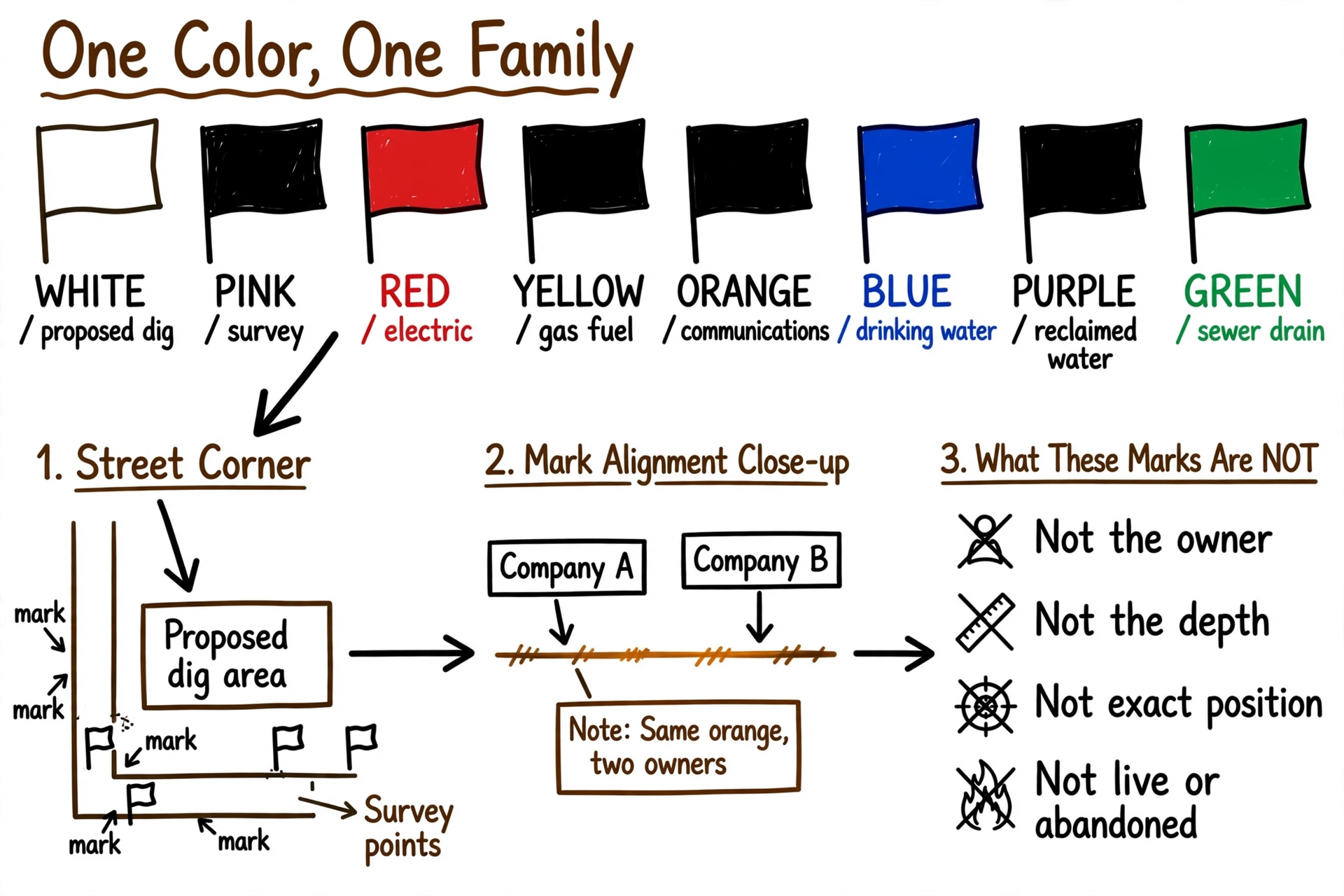
The APWA Uniform Color Code is the standard set of eight colors used across the United States and Canada for temporary ground markings that show buried utilities, proposed digging, and survey work. Six of the colors mark buried facility families. White marks proposed digging and pink marks survey work under the current code, and those two are the ones newcomers misunderstand most often.
Here is the full list, exactly as APWA and the state 811 centers publish it. Learn it as a table, not as a list of facts, because you will use it as a table in the field.
White: proposed excavation. The marks the excavator makes before the 811 call, showing where the digging is planned.
Pink: temporary survey markings. Marks left by surveyors, showing measured points, property information, or construction reference points.
Red: electric power lines, cables, conduit, and lighting cables. The electric family.
Yellow: gas, oil, steam, petroleum, or gaseous materials. The flammable and combustible family.
Orange: communication, alarm, or signal lines, cables, or conduit. The communications family, which includes telephone, cable television, alarm and signal circuits, and fiber optic cable.
Blue: potable water. Drinking water lines. Potable is the formal word for water that is safe to drink.
Purple: reclaimed water, irrigation, and slurry lines. Water that is not drinking water. Reclaimed water is wastewater that has been treated for reuse in irrigation or industry. Slurry lines carry mixtures of water and solids, such as in mining or industrial operations.
Green: sewers and drain lines. Both sanitary sewers, which carry wastewater away from buildings, and storm drains, which carry rainwater.
Notice what the list does not include. There is no color for depth. There is no color for a live line versus a retired line. There is no color for one company versus another company. Those ideas simply do not live in the color code, and every mistake this lesson warns about comes from trying to read them into it.
Two points about the two non facility colors deserve emphasis, because they cause real confusion on site.
White is the excavator’s color. When a contractor plans to dig, the contractor outlines the digging area in white paint, white flags, or white stakes before calling 811. The white marks tell the locators where to look. In the 811 process, white is placed by the excavator planning the work, not by a facility owner marking its buried lines. White is a request that shows locators where to look, not a utility warning. If you see white marks on a job you are walking, you are looking at the proposed digging limits drawn by the people who plan to dig there. One plain way to remember the distinction is this: white marks are the excavator’s, and the facility colors belong to the utilities. That single sentence is worth memorizing.
Pink is the surveyor’s color. Pink marks come from surveying and layout work, such as property corners, control points, or construction reference lines. Under the current APWA list used by 811 centers, pink marks temporary survey markings and does not mark a known buried utility family. Older APWA documents also listed pink for unknown or unidentified facilities, so a pink mark that appears to mark a facility needs a question to the locator or the 811 center, not an assumption. A newcomer who sees pink flags and assumes a known utility is present is reading a message that was never written. Treat pink marks as information from a surveyor, not as a warning about what is buried, unless the locator or the 811 center says a specific pink mark was placed under the older wording.
Now the six facility colors, one by one, with what belongs in each family.
Red is electric. The family covers power transmission lines, distribution lines, service drops to buildings, and lighting circuits such as streetlights and traffic signals. Red is the color that demands the most respect from anyone near it, because contact with energized electric plant can kill. A red mark says electric family, and nothing else.
Yellow is gas, oil, steam, petroleum, or gaseous materials. The family covers natural gas mains and services, petroleum product pipelines, oil lines, and steam lines. Yellow warns of flammable material, which is why extra care around yellow marks is standard practice. A yellow mark says fuel family, and nothing else.
Orange is communication, alarm, or signal lines, cables, or conduit. This is the family a fiber crew lives inside. It covers telephone cables, cable television lines, fiber optic cables, alarm circuits, and signal circuits such as traffic control wiring. The important fact about orange is crowding. Multiple companies often share one corridor, and every one of them paints orange. So an orange mark always needs its company identifier to be useful. An orange mark without an identifier tells you that some communications company has a line there. It does not tell you whose, and it never tells you it is yours.
Blue is potable water. The family covers drinking water mains and service lines. Blue marks a pressurized system that can flood an excavation quickly if it is struck, so blue deserves the same careful exposure as any other utility mark.
Purple is reclaimed water, irrigation, and slurry lines. The family covers non drinking water systems. Purple is seen less often on sites that have no reclaimed water, irrigation, or slurry systems, and a newcomer who has never seen purple marks should not assume they are a mistake. Where reclaimed water systems exist, purple is the correct color, and it keeps non drinking water visually separate from drinking water blue.
Green is sewers and drain lines. The family covers sanitary sewers and storm drains. Green marks lines that are usually gravity fed, meaning they flow downhill without pressure, and that often run deeper than the lines around them, but that depth tendency is a tendency only. The mark tells you sewer family. It tells you nothing about depth, direction of flow, or pipe size.
That is the whole code. Eight colors, six facility families, one excavator color, one surveyor color. Everything else on this lesson is about reading those colors correctly and, just as important, about what the colors cannot tell you.
What Does It Look Like?
On the ground, the code appears in two forms: paint and flags. Both forms use the same colors, and both are temporary.
Paint marks are sprayed directly onto the ground surface. On pavement they are usually short dashes, arrows, or letters. On soil or grass they are usually lines of paint laid along the route. OKIE811 describes the typical mark as roughly 12 to 18 inches long and about one inch wide, spaced a few feet apart along the facility. The exact size and spacing vary by locator and by ground conditions. What matters is the pattern: marks run along the route of the facility, so a line of red dashes on the pavement is a locator saying the electric line runs this way.
Letters and abbreviations ride along with the paint. A mark often carries the company identifier, the facility size or count, and a short description. Marks often carry short abbreviations, and the forms vary by owner and by state guideline. Examples you may see include TEL for telephone, CATV for cable television, and FO for fiber optic cable. Read an abbreviation you do not recognize as unknown and check the ticket or ask the locator, rather than guessing. A count or phase notation, when a locator writes one, describes the facility as that locator reported it. These letters are the part of the mark that names the owner and describes the facility. The color names only the family. Read both, and when the letters are missing or unreadable, treat the color as the whole message.
Flags are small plastic squares on wire stakes, pushed into the ground along the route. They carry the same colors and often carry the same handwritten information as paint. Flags are easier to see at a distance than paint, which is why locators use them on grass and soil, but they are also easier to disturb. A knocked over flag tells you nothing reliable. If flags on your site look scattered, trampled, or moved, the marks need to be rechecked before anyone trusts them.
Arrows and offsets are part of the language too. An arrow at the end of a line of marks shows the direction the facility continues. A change in the line of marks shows a bend or a lateral connection, a branch leaving the main line. Where several facilities run close together, a locator may mark the outer edges of the group rather than each individual line. None of these styles changes the color meaning. A dashed yellow line and a solid yellow line both mean the gas family.
What a full marking looks like in practice: picture a street corner where a fiber crew plans to bore. White paint outlines a rectangle on the grass, the excavator’s proposed work area. Inside and around it, red dashes cross the sidewalk toward a transformer, yellow dashes run along the curb toward a gas meter, orange dashes with a company name run parallel to the sidewalk, blue dashes angle toward a water meter box, and a green dashed line follows the gutter toward a storm drain inlet. Pink flags stand off to one side near a property corner, marking survey points that have nothing to do with the utilities. Each color is speaking its one word. Together they describe the families buried under that corner, and nothing more.
What the marks never show, no matter how neatly they are painted: the depth of any line, the exact side to side position within the tolerance zone, whether a line is live or abandoned, which company owns an orange line that carries no identifier, or whether every line present was actually found. Those are the five things newcomers most want the marks to say, and the marks say none of them.
What Does It Do?
The color code does one job, and it does it well. It gives every person on every job, in every state that uses it, the same instant read on what family of facility a mark belongs to. A laborer who has never read a utility plan can look at a yellow line on the ground and know to stay clear and ask questions. A foreman walking a new site can scan the colors and form a first picture of the corridor in under a minute. A locator from one state working a job in another state speaks the same color language on day one. That shared instant read is the entire purpose of the standard, and it is why the colors are worth learning cold.
To do that job, the code trades detail for speed. A yellow mark does not tell you whether the line is a two inch gas service or a high pressure transmission main. It tells you fuel family, and it expects you to get the rest from the ticket, the plan, and the locator’s notes. That trade is deliberate. The mark on the ground is the first word, not the whole report.
The code also does a quieter job: it separates the three parties on the site. White is the excavator speaking. Pink is the surveyor speaking. The six facility colors are the facility owners speaking through their locators. When you read a site, you are really reading three overlapping conversations, and the colors keep them from being confused. A white rectangle with red dashes inside it is a complete sentence: the excavator plans to dig here, and the electric owner has a line here. A pink flag next to a blue line is two different people talking: the surveyor marked a reference point, and the water owner marked a main. Reading the colors as speakers, not just as labels, is what turns a painted street into useful information.
What the code does not do matters just as much, so say it plainly. It does not identify the owner. Orange paint with no company identifier could belong to any communications company in the corridor. It does not show depth. A mark on the surface cannot measure what is below it, and buried depth changes with grading, paving, erosion, and original construction carelessness. It does not show exact position. Marks show approximate alignment, and the tolerance zone exists precisely because the true position can differ from the paint. It does not show status. A red mark on an abandoned electric cable looks exactly like a red mark on a live one. The color code has no retired color, no abandoned color, and no dead color. And it does not promise completeness. Lines can be missed, lines can be private and outside the 811 system, and marks can fade or be disturbed. The code tells you what the locator found and reported, in the family language everyone shares. It never tells you that the ground is clear.
Where Does It Fit?
The color code fits into the damage prevention sequence at the marking step, between the locate request and the digging. The sequence runs like this.
First, the excavator white lines the work area and calls 811. The white lining step has its own lesson in this level, Lesson 62. The 811 center notifies the facility owners with plant in the area. Each owner, or a locator working for the owner, finds its own facilities and marks them in the code colors. The excavator then reads the colors, checks the ticket responses, respects the tolerance zone around every mark, and exposes lines carefully before digging near them. Lessons 57 through 59 cover the 811 call, the locate request, and what marks tell us. This lesson is the color vocabulary those lessons assume.
In the life of a fiber project, the colors appear in several places. During design, plans may show existing utilities with color coded lines that follow the same code, so the designer and the reviewer are speaking the same language as the field. During preconstruction, the crew walks the marked site and reads the colors to build a mental picture of the corridor before the first shovel or bore. During construction, the colors mark the no guess zones, the tolerance areas where only careful exposure is allowed. During inspection and documentation, the colors appear in photographs and daily reports as shorthand: yellow marks in the bore path, orange marks with two company identifiers, blue marks crossing the trench line.
The code also fits into training and daily talk. Crews use the colors as plain speech. “We have yellow along the curb” is faster and clearer than “there is a gas facility along the curb,” and everyone on the crew understands it. That shorthand is useful as long as everyone remembers what the shorthand leaves out. “Yellow along the curb” means the gas family is marked along the curb. It does not mean the crew knows whose gas, how deep, or exactly where.
One more fit worth naming: the code fits into law by reference. State damage prevention laws, including Oklahoma’s, require excavators to notify the 811 center and require owners to mark their facilities. Marking is done in the APWA colors, in some states because the statute references the APWA code directly and in others because the state 811 center and industry practice adopt it. The colors themselves are an industry standard adopted into practice by law, not a federal regulation with its own enforcement section. When a state law says to respect the marks, it means these marks, in these colors. That is the sense in which the code is the law’s language, even though the code document itself comes from APWA.
Why Does It Matter?
It matters because the colors are the fastest safety information on the site, and misreading them is one of the fastest ways to get hurt.
Start with the direct safety case. Red and yellow are warning colors in the truest sense. Red marks electric plant that can kill on contact. Yellow marks fuel lines that can burn, explode, or fill a trench with gas. A crew member who cannot read red and yellow at a glance is a crew member working blind around the two most dangerous families underground. Every other color carries its own consequences too: blue water under pressure can flood an excavation and trap a worker, green sewer can expose a crew to contamination, orange fiber cuts can take down emergency communications. The colors exist so that none of that is a surprise. Learning them is not paperwork. It is the difference between seeing a warning and missing it.
It matters because the colors prevent the most expensive mistake in underground work: digging on an assumption. A crew that reads orange as “our kind of line, probably ours” and bores through it has confused a family for an owner. A crew that reads the absence of marks as “nothing here” has confused silence for information. A crew that reads a neat line of paint as an exact position has confused an approximation for a survey. Each of those misreadings has a real damage report behind it somewhere. The color code is simple on purpose, and its simplicity is exactly what tempts people to read more into it than it says. This lesson exists to draw that line clearly: the colors say family, and the rest comes from the ticket, the plan, the identifiers, and careful exposure.
It matters because fiber work lives inside orange, the most crowded color in the code. On a typical suburban street, the orange family can include the incumbent phone company’s copper, a cable company’s coaxial, one or two competitive fiber companies, a school district or municipal fiber, and the new build’s own planned route. All of them paint orange. A fiber crew that treats orange as one line will find the others the hard way. Reading orange correctly means reading the identifiers, counting the marks, and assuming there is more than one owner until the ticket says otherwise. For a fiber crew, orange is not a color. It is a crowd.
It matters because the two non facility colors protect the process itself. White lining tells the locators where to look, which means better marks and fewer missed lines. A crew that skips white lining, or white lines sloppily, gets sloppier marks in return. Pink tells everyone which marks are survey information, which prevents a crew from treating a survey point as a utility warning or, just as bad, ignoring a real utility mark because “those are just the surveyor’s flags.” Knowing which speaker each color belongs to keeps the three conversations on the site from contaminating each other.
Finally, it matters because the colors are the common ground between everyone who touches the project: the excavator, the locators, the inspector, the designer, and the owners. When all of them read the same colors the same way, the handoffs work. When any of them freelances, inventing a local meaning for a color or assuming an unlisted color means something convenient, the handoffs break. The code is a promise the whole industry makes to itself. Keeping it is part of doing the work right.
What Does Good Look Like?
Good color reading starts before anyone arrives, with the white lining. On a well run job, the excavator’s white marks clearly outline the digging area, with the work type and the company name noted, so each locator knows exactly where to focus. Good white lining is complete, visible, and honest about the work limits. It does not sprawl across half the block “just in case,” because oversized white areas produce unfocused marks.
When the locators finish, a well marked site shows each facility family in its code color, with company identifiers on the marks wherever more than one owner shares a color. Orange marks carry names. Marks include size or count information where the locator has it. Arrows show direction changes. The marks sit inside or near the white lined area, and each owner on the ticket has either marked or responded with no conflict. The crew can look at the site and read a coherent picture: white says dig here, red says electric there, yellow says gas along the curb, orange with two identifiers says two communications owners share the corridor, blue and green cross at the corner, pink flags off to the side belong to the surveyor.
Good reading is a crew habit, not a one time event. On a well run project, the foreman walks the marks with the ticket in hand before work starts, matching each color on the ground to an owner response on the ticket. The crew talks through the colors at the job briefing: what is marked, what is not marked, which orange marks belong to which company, where the tolerance zones are. Photographs of the marks go into the daily record while the paint is fresh, because paint fades and flags wander. If marks are unclear, damaged, or missing for an owner listed on the ticket, the crew requests a re mark before digging, and does not treat faded paint as permission.
Good documentation names colors precisely. A daily report that says “yellow marks along the north curb, gas company identifier ABC, approximate alignment photographed” is useful to the next crew and to anyone reviewing the job later. A report that says “utilities marked” is not. The colors are a language, and a well run project writes in it clearly.
Good practice also knows the edge cases and handles them without inventing new rules. If a mark appears in a color that is not in the code, the crew asks the 811 center or the owner what it means instead of guessing. If an orange mark carries no identifier, the crew checks the ticket to learn which owners responded, and asks for clarification rather than assuming. If pink marks sit inside the digging area, the crew confirms with the surveyor or the project what they reference, and keeps them separate from utility thinking. If white marks from a previous job are still visible, the crew confirms which white is current so nobody reads last month’s digging plan as today’s. None of these situations changes the code. They just require the same discipline the code requires everywhere: read what is written, ask about what is not, and never freelance a meaning.
What Can Go Wrong?
The failures around locate colors are failures of overreading, underreading, and misreading. Walk through each one, because every one of them feels reasonable in the moment.
Overreading is the most common failure: treating the color as more information than it is. The classic overread is depth. A crew sees a clear line of yellow paint and assumes the gas line is at a standard depth, or at the depth the last gas line was found. The mark never said any depth. Buried depth varies with original construction, grading, paving, and erosion, and industry guidance states plainly that marks show approximate horizontal position, not depth. The only way to know depth is careful exposure. A related overread is exact position. The paint is a neat line, so the brain reads it as a surveyed centerline. It is not. It is an approximation with a tolerance zone around it, and the true position can sit anywhere inside that zone. Digging to the paint instead of exposing carefully inside the tolerance zone is how strikes happen on “correctly marked” lines.
Another overread is ownership. Orange paint with no identifier gets read as “the phone company” or “probably ours” because the crew wants it to be simple. Orange is the most shared color in the code, and an unidentified orange mark is an unanswered question, not a familiar line. Cutting it to find out is the most expensive possible way to ask.
Another overread is status. A red mark gets read as “live electric,” which is the safe default, but the reverse error also happens: a mark on old, weathered plant gets read as “probably abandoned” because the ground around it looks undisturbed. The color code has no abandoned color and no dead color. A mark’s color says nothing about whether the facility is in service, idle, or retired. Status questions go to the owner, as Lesson 55 teaches. The color never answers them.
Underreading is the opposite failure: ignoring what the color plainly says. A crew in a hurry walks past yellow marks without slowing down, or treats green sewer marks as unimportant because sewers feel less dangerous than gas. Every color is a facility family with real consequences, and underreading usually comes from familiarity. The tenth marked site feels routine. The code does not get less serious on the tenth site.
Misreading comes in several forms. Confusing pink with a utility warning is a pure misread: pink is survey information, and treating it as a buried line wastes time, while ignoring a real utility mark because “the pink flags are just survey” is the same error in reverse. Confusing white with a utility mark is another: white is the excavator’s own digging outline, and a crew that reads white as “someone marked a line here” will misunderstand its own work area. Reading faded or partial marks is a quieter misread. Paint fades, flags get mowed over, and a half visible yellow dash still means the gas family. A crew that reads only the clear marks and ignores the faded ones is reading half the message.
Then there are the process failures around the colors. Marks expire. A locate ticket has a life span set by state law, commonly around two weeks, and marks placed for an expired ticket may no longer reflect current work or current plant. Digging on expired marks is digging on old information. Marks get disturbed. Construction traffic, mowing, rain, and curious passersby move flags and wash paint. A site whose marks no longer match the ticket responses needs a re mark, not a memory of where the paint used to be. And marks can be incomplete from the start: private lines beyond the owner’s service point are generally not marked through 811, some owners are not 811 members, and a locator can miss a line. The colors describe what was found and reported. They never certify that everything was found.
Finally, there is the invented color failure. Someone on site uses a non code color for a private mark, or an old mark in a discontinued local convention is still visible, or a utility uses an extra color by local agreement. The APWA code is the standard, but local practice is not always perfectly standard. The rule for any color you cannot match to the code is simple: do not guess. Ask the 811 center, ask the owner, or ask the project. A color you invent a meaning for is worse than no mark at all, because it carries false confidence.
What Should Someone Notice in the Field?
This section is about reading a marked site with trained eyes. You are not being trained to locate or verify facilities. You are being trained to notice what the marks are telling you, what they are not telling you, and when something needs a question before work proceeds.
Notice the white first. Before reading any utility color, find the excavator’s white marks and confirm they describe the work you are about to do. Is the white area the actual digging area, and is it current? Old white from a previous job, white that covers far more ground than the plan shows, or white that is missing entirely are all reasons to stop and clarify. The white is the frame around everything else. If the frame is wrong, every mark inside it is suspect.
Notice each color and name its family out loud, at least in your head. Red, electric. Yellow, gas and fuel. Orange, communications. Blue, drinking water. Purple, reclaimed or irrigation. Green, sewer and drain. Pink, survey, not a known utility family. Saying the families deliberately is how you stop your eyes from sliding over a color you see every day. Pay special attention to the colors you see least often. Purple is seen less often on sites without reclaimed, irrigation, or slurry systems, which makes it easy to misread or dismiss. Pink is common and commonly misunderstood. Give both the same deliberate read as red and yellow.
Notice the identifiers. Every orange mark should make you look for a name. When two communications owners share a corridor, the identifiers are the only thing standing between you and the wrong assumption. If an identifier is missing, smudged, or unreadable, note it and check the ticket. The ticket lists which owners were notified and how each responded. Match the marks to the responses. An owner on the ticket with no marks on the ground is an open question, not a clear corridor. Some states use positive response systems where owners report marked, no conflict, or no response, and those responses are part of the record. Use them.
Notice the condition of the marks. Fresh paint and upright flags are trustworthy as far as marks go. Faded paint, trampled flags, paint that stops halfway along an expected route, or flags lying on the ground are all signs the marking has degraded. Marks are temporary by design. When they have degraded past readability, the correct move is a re mark request, not a best guess reconstruction from memory. Photograph marks when they are fresh so the record shows what was actually there.
Notice what is not marked. An owner listed on the ticket with no marks on the ground needs a follow up. A corridor with electric and gas marks but no communications marks, in a neighborhood full of pedestals, should raise the question of whether every communications owner responded. Visible above ground clues with no matching mark, such as a gas meter with no yellow marks leading to it, or a pedestal with no orange marks, deserve the same question. The colors tell you what was found. The gaps tell you what might have been missed, and gaps get questions, not assumptions.
Notice non code colors and odd marks. If you see a color that is not one of the eight, or a mark style you do not recognize, stop and ask. Do not assign it a meaning from habit. Local conventions, private locators, and old marks can all put unfamiliar paint on the ground. The safe read of an unfamiliar mark is “unknown marking, needs identification,” and the identification comes from the 811 center, the owner, or the project, never from a guess.
Notice your own reading habits. The thought to catch is the quiet upgrade: the mark said gas family, and your brain filed it as a two inch service at three feet deep, owned by the company you always deal with. None of that was in the paint. The discipline is to read the mark at face value, family only, and to get everything else from the ticket, the identifiers, and careful exposure. Experienced field people are not people who can read more into the paint. They are people who have learned to read exactly what is there and to ask for the rest.
Carry a short routine for reading any marked site. Find the white and confirm it matches the planned work. Name each color’s family. Read every identifier, especially on orange. Match the marks to the ticket responses and flag any owner with no marks. Check the condition of the marks and photograph them. Note gaps between visible above ground clues and the marks. Ask about anything unfamiliar or missing before digging. That routine takes minutes, and it is the practical whole of this lesson.
Practical Example
The following example is hypothetical. The people, the project, and the addresses are invented to teach the reading sequence. Any resemblance to a specific real job is unintended.
Hypothetical example. A fiber crew arrives on a Tuesday morning to bore a new conduit 400 feet along the north side of a suburban street. The design shows the bore crossing one gas service and running parallel to existing communications lines. The crew’s first job is to read the site before the bore plan is finalized.
The white lining is already down: a white painted rectangle on the grass and a white dashed centerline with arrows showing the planned bore path. The paint is fresh, the work description and company name are written in white at one end, and the area matches the plan. The frame is good, so the crew reads inside it.
The colors tell a busy story. Red dashes cross the bore path near the east end, running from the street toward a transformer behind the sidewalk. Yellow dashes run along the curb for the full length, with the gas company’s identifier painted beside them. Orange dashes run parallel to the planned bore for most of its length, and the crew counts two different company identifiers on the orange marks: one reads the incumbent phone company’s initials, the other reads a competitive fiber company’s name. Blue dashes angle across the bore path near the west end toward a water meter box. Green dashes follow the gutter. Pink flags stand in a cluster near a property corner at the east end, well off the bore path.
The crew works the routine. White first: confirmed, current, matches the plan. Colors named: red electric, yellow gas, orange communications with two owners, blue water, green sewer and drain, pink survey. Identifiers read, with the two orange owners written into the morning notes. Ticket checked against the ground: every owner on the ticket has marks except one communications company, which responded no conflict, meaning it reports no facilities in the area. The pink flags are confirmed as survey control points from the project’s surveyor, unrelated to utilities. Marks photographed while fresh.
Two gaps get questions. First, the design shows the bore crossing one gas service, but the yellow marks show only the main along the curb, with no service lateral marked to the house the design names. The foreman does not assume the service is absent. The ticket shows the gas owner responded and marked, so the foreman calls the project coordinator, who confirms with the gas owner that the service to that house was retired and removed years ago when the house converted to electric heat, and the owner documents that answer for the project file. The unmarked service was a records cleanup, not a missed line, but the crew only knows that because someone asked.
Second, the blue water marks angle across the bore path, but the design shows the water main on the south side of the street. The water identifier on the marks names the city water department, and the ticket confirms the city responded. Rather than assuming the design is wrong or the marks are wrong, the inspector treats the mismatch as information: the design was drawn from records, the marks are from the owner’s locator, and the two disagree at this corner. The bore plan is adjusted to cross the marked water alignment with the required clearance, the design engineer is notified of the discrepancy for the as built record, and the crossing is added to the pothole list for careful exposure before the bore.
The bore proceeds with a plan built from reading, not from assuming. The red crossing gets a pothole and careful exposure. The yellow main gets its tolerance zone respected for the full run. The two orange owners are both treated as present, and the bore path keeps its clearance from the marked alignment of each. The blue crossing is exposed before the bore passes. The pink flags are left alone, correctly understood as survey information. Nothing in the paint told the crew any depth, any exact position, any owner beyond the identifiers, or any status. Every one of those facts came from the ticket, the identifiers, the owners’ answers, and exposure. The colors did their one job: they named the families, quickly, in a language everyone on site shared.
Key Terms
811: The national phone number and system that connects excavators to the state one call center, which notifies facility owners so they can mark their buried lines before digging. In Oklahoma the center is OKIE811.
APWA Uniform Color Code: The American Public Works Association standard assigning eight colors to temporary ground markings: white for proposed excavation, pink for temporary survey markings, red for electric, yellow for gas oil steam petroleum or gaseous materials, orange for communication alarm or signal lines, blue for potable water, purple for reclaimed water irrigation and slurry lines, and green for sewers and drain lines.
Company identifier: The facility owner’s name, initials, or abbreviation written on or beside a locate mark, used to tell owners apart when they share a color.
Facility type: A family of similar buried facilities, such as electric, gas, or communications. The color code identifies the family, never the individual facility or its owner.
Locate mark: A temporary paint line, flag, stake, or whisker left on the ground to show the approximate route of a buried facility. Temporary by design, and never a survey of exact position or depth.
Locator: A person who finds buried facilities with records and instruments and marks them on the ground, working for the facility owner or under the owner’s direction.
OKIE811: Oklahoma’s one call notification center, the 811 center for the state, which processes locate requests and publishes the uniform color code guidance for Oklahoma excavators.
Positive response: A system used in many states through which facility owners report the status of a locate request, such as marked, no conflict, or no response, so the excavator can confirm every owner has been accounted for.
Potable water: Water that is safe to drink. Marked in blue.
Reclaimed water: Wastewater treated for reuse in irrigation, industry, or other non drinking purposes. Marked in purple, kept visually separate from drinking water blue.
Tolerance zone: The width of the marked facility plus a distance on each side of it, set by state law, within which careful exposure methods are required before powered equipment is used. Marks show approximate position, never exact position, and never depth.
White lining: The excavator’s pre marking of the planned digging area in white paint, flags, or stakes before calling 811, showing locators where to focus their work.
Check Your Understanding
Answer each question in your own words before reading the answer key.
- State all eight APWA colors and the facility family or purpose each one represents.
- A crew finds orange paint with no company identifier along their planned bore path. What does the orange tell them, what does it not tell them, and what should they do next?
- Explain in your own words why a locate mark cannot tell you how deep a line is buried.
- Pink flags stand inside the planned digging area. A laborer says there must be a buried utility there. Is the laborer correct? Explain what pink means and how the crew should handle the flags.
- Name four things a color never tells you about a marked facility, and for each one, name where the crew should get that information instead.
Answer key:
- White: proposed excavation, marked by the excavator. Pink: temporary survey markings, not utilities. Red: electric power lines, cables, conduit, and lighting cables. Yellow: gas, oil, steam, petroleum, or gaseous materials. Orange: communication, alarm, or signal lines, cables, or conduit, including fiber. Blue: potable water. Purple: reclaimed water, irrigation, and slurry lines. Green: sewers and drain lines.
- The orange tells them only that a communications family facility is approximately there. It does not tell them which company owns it, how many lines are present, how deep it is, its exact position, or whether it is live or abandoned. Next they should check the locate ticket to see which communications owners were notified and how each responded, look for identifiers elsewhere along the marks, and ask the 811 center or the project for clarification before digging. They must not assume it belongs to a familiar company or to their own project.
- Model answer: A surface mark is paint on the ground, and paint cannot measure what is below it. Buried depth varies with original construction, later grading and paving, erosion, and soil movement, so even a line installed at a standard depth may not be at that depth today. Industry guidance states that marks show approximate horizontal alignment only. The only way to know depth is careful exposure by hand or vacuum methods inside the tolerance zone.
- No. Pink marks temporary survey markings, such as property or construction reference points, and pink never marks a known utility family. The crew should confirm with the project or the surveyor what the pink marks reference, keep them separate from utility thinking, and leave them undisturbed. They should not treat the flags as a utility warning and not ignore real utility marks because of them.
- Model answer, any four with sources: Owner: from the company identifier on the mark and the locate ticket responses, never from the color. Exact position: from careful exposure within the tolerance zone, never from the paint line. Depth: from careful exposure, never from the mark. Live or abandoned status: from the facility owner through the project channel, never from the color. Completeness, meaning whether every line was found: from checking ticket responses, visible above ground clues, and the knowledge that private or missed lines may exist, never from the absence of marks.
Lesson Takeaway
The APWA Uniform Color Code is a shared language of eight colors: white for your planned digging, pink for the surveyor, red for electric, yellow for gas and fuel, orange for communications, blue for drinking water, purple for reclaimed water, and green for sewers and drains. A color names the family of facility and nothing else. It never names the owner, never shows depth, never shows exact position, and never shows whether a line is live or abandoned. Read the identifiers, check the ticket, respect the tolerance zone, and expose carefully. The paint speaks one word. Everything else you need comes from asking.
Sources and Technical References
APWA Uniform Color Code for temporary marking of underground utilities, full eight color list with PMS references: white proposed excavation, pink temporary survey markings, red electric power lines cables conduit and lighting cables, yellow gas oil steam petroleum or gaseous materials, orange communication alarm or signal lines cables or conduit, blue potable water, purple reclaimed water irrigation and slurry lines, green sewers and drain lines. Published APWA chart via the City of Dover public works mirror: https://www.cityofdover.gov/media/Public%20Works/APWA%20Uniform%20Color%20Code.pdf and the APWA hosted chart PDF: https://apwa.yokoco.dev/wp-content/uploads/Uniform-Color-Code-1.pdf
OKIE811, What Do the Markings Mean? The Oklahoma 811 center’s official page: operator markings include the appropriate color for the facility type, and when other companies use the same color, the marker will have a company identifier, name, initials, or abbreviation. Marks are approximately 12 to 18 inches long and one inch wide, spaced about four to five feet apart. The page publishes the full APWA color list and notes that the code encourages all excavators, surveyors, and engineers to use these colors to prevent damage and service interruptions: https://okie811.org/what-do-the-markings-mean/
Common Ground Alliance and the 811 system: the 811 call before you dig campaign is operated by the Common Ground Alliance, the industry association for damage prevention, per utility safety guidance: https://www.entergy.com/blog/safety-quick-tip-call-before-you-dig and CGA’s role in promoting the APWA and CGA standards on locate tickets: http://nllocating.com/apwa-color-codes-for-underground-utilities-what-every-excavator-needs-to-know/
Marks show approximate position, not depth, and color alone does not identify ownership: industry locating guidance states that markings communicate presence and general alignment, not precise depth, and that color alone does not identify ownership or exact size, so the ticket information and identifiers must be read with the marks: http://nllocating.com/apwa-color-codes-for-underground-utilities-what-every-excavator-needs-to-know/ and https://www.westernlandworks.com/guide-call-811-before-digging.html
Canadian Common Ground Alliance Best Practices Version 4.0, Practice 3-12 Facility Identification: the owner is identified by markings at the time the facility is located, and where two facilities share the same color code, such as telephone and cable television, both facilities are identified: https://www.info-ex.com/wp-content/uploads/2022/07/CCGA-Best-Practice-Manual-Version-4.0-chapter-3.pdf
State law adopts the code by reference: California Government Code Sections 4216 to 4216.9 govern notification and field marking. Section 4216 defines delineation as marking the proposed excavation in white, and Section 4216.3 requires an operator who field marks to make a reasonable effort to make the field markings conform to the uniform color code of the American Public Works Association. Secondary summaries: https://legalclarity.org/california-811-color-codes-and-safe-digging-regulations/ and https://legalclarity.org/dig-safe-california-what-are-the-legal-requirements/
Tolerance zone widths vary by state: Oklahoma industry guidance describes up to 24 inches on each side of the mark, with hand digging or vacuum excavation required inside the zone; other states use 18 inches. The excavator is responsible for knowing the project state’s width: https://aepcontractorsafety.com/69143-dig-safely-electricity/ and Utah 811 tolerance and re mark rules as a second state example: https://www.bluestakes.org/faqs/
Items flagged as variable or needing verification:
State adoption details. This lesson states that state damage prevention laws require marking in the APWA colors, with California cited as the sourced example where statute references the APWA code directly. The exact statutory language, notice periods, ticket life spans, and tolerance zone widths differ by state. Verify the current statute and 811 center guidance for the project state before relying on any specific number or procedure.
Proposed APWA changes. In the references checked for this lesson, no APWA proposal to add, remove, or redefine a color was found. Verify against the current APWA chart before reusing this lesson. If a future APWA revision changes the code, the eight colors in this lesson must be updated to match the new standard. Do not teach rumored color additions.
Pink for unknown facilities. Older APWA documents list pink as temporary survey markings and unknown or unidentified facilities. Current 811 center pages, including OKIE811, list pink as temporary survey markings only. This lesson follows the current 811 center usage and notes the older wording so a crew meeting it on an old chart is not confused.
Private and non member lines. Several sources note that 811 locators generally mark only member owned facilities up to a service point, and that private lines beyond that point may not be marked. The exact boundary varies by service type, state, and owner rules. Verify on the specific project who can speak for a private line.
Previous lesson: Lesson 59: What Do Utility Marks Tell Us? |
Back to Level 3 hub |
Next lesson: Lesson 61: Paint vs. Flags