
What You Are Learning
By the end of this lesson, you will be able to explain, in plain words, what a locate request is, what information it must carry, and why the accuracy of that information decides whether the marks on the ground actually protect your work.
You will learn that a locate request is the excavator’s formal notification to underground facility operators, sent through the state 811 center, that describes where the work will happen, when it will happen, and what kind of work it is. You will learn that the ticket is the written record the center creates from that request, and that the ticket, not a phone conversation or a verbal promise, is what operators respond to.
You will learn the main parts of a complete request: who is digging, where the digging will happen, how the area is delineated, what type of work is planned, when work is proposed to start, and how large the work area is. You will learn the common ticket types, including normal tickets, design or survey tickets, emergency tickets, and renewal, remark, or update tickets. You will learn, in overview, how a center processes a ticket, how operators respond, and how positive response closes the loop.
You will also learn the limits of a ticket. A ticket covers only the work, the area, and the dates described on it. Work outside that description is not covered by that ticket. Tickets expire, and the length of time a ticket stays valid is set by state law and center rules, not by one national rule. You will learn to renew or update a ticket before it expires, and to recognize a vague or oversized request in the field.
This lesson teaches recognition and judgment. Reading it does not qualify you to submit tickets on behalf of a company if your company has not authorized you to do so, to locate buried facilities, or to authorize excavation. State damage prevention laws place legal duties on the excavator, and each project follows its own state law, its center’s rules, and its contract requirements.
Start With the Basics
Start with three words that get mixed up in the field.
An excavator, in damage prevention language, is any person or company that moves or removes earth, or that drives or bores into the ground. The term includes a directional bore crew, a trenching crew, a contractor setting poles, and a homeowner digging fence post holes. It does not mean only the machine called an excavator.
A facility operator, also called a utility owner or operator, is the company or agency that owns or operates an underground facility, such as an electric, gas, water, sewer, or communications line. Operators are responsible for locating and marking their own facilities, or for sending a locator to do it for them.
An 811 center, also called a one call center or notification center, is the state or regional clearinghouse that receives locate requests and passes them to the operators who may have facilities in the work area. Dialing 811 in the United States connects a caller to the local center. Most centers also accept requests online. The center does not dig, and in most systems the center itself does not mark lines. It moves information between the excavator and the operators.
Now picture the problem those three parties are solving. A bore crew plans to cross a street next Tuesday. Under that street there may be a gas main, a water main, two communications ducts, and a sewer lateral. None of them is visible. The crew cannot call each owner separately if it does not even know who owns what. The locate request solves that problem with one notification. The crew describes the work once, the center identifies which operators are members in that area and sends the ticket to each of them, and each operator marks its own facilities or reports that it has no facility in conflict.
That sounds simple, and the idea is simple. The quality of the result depends almost entirely on the quality of the description. A locator can only mark the area the ticket describes. If the ticket describes the wrong corner, the locator will mark the wrong corner correctly. If the ticket describes an entire subdivision when the crew will bore one short crossing, locators will spend hours marking ground the crew will never touch, and the one crossing that matters may get less attention. The request is not paperwork before the real work. The request is the instruction that creates the marks.
What Is It?
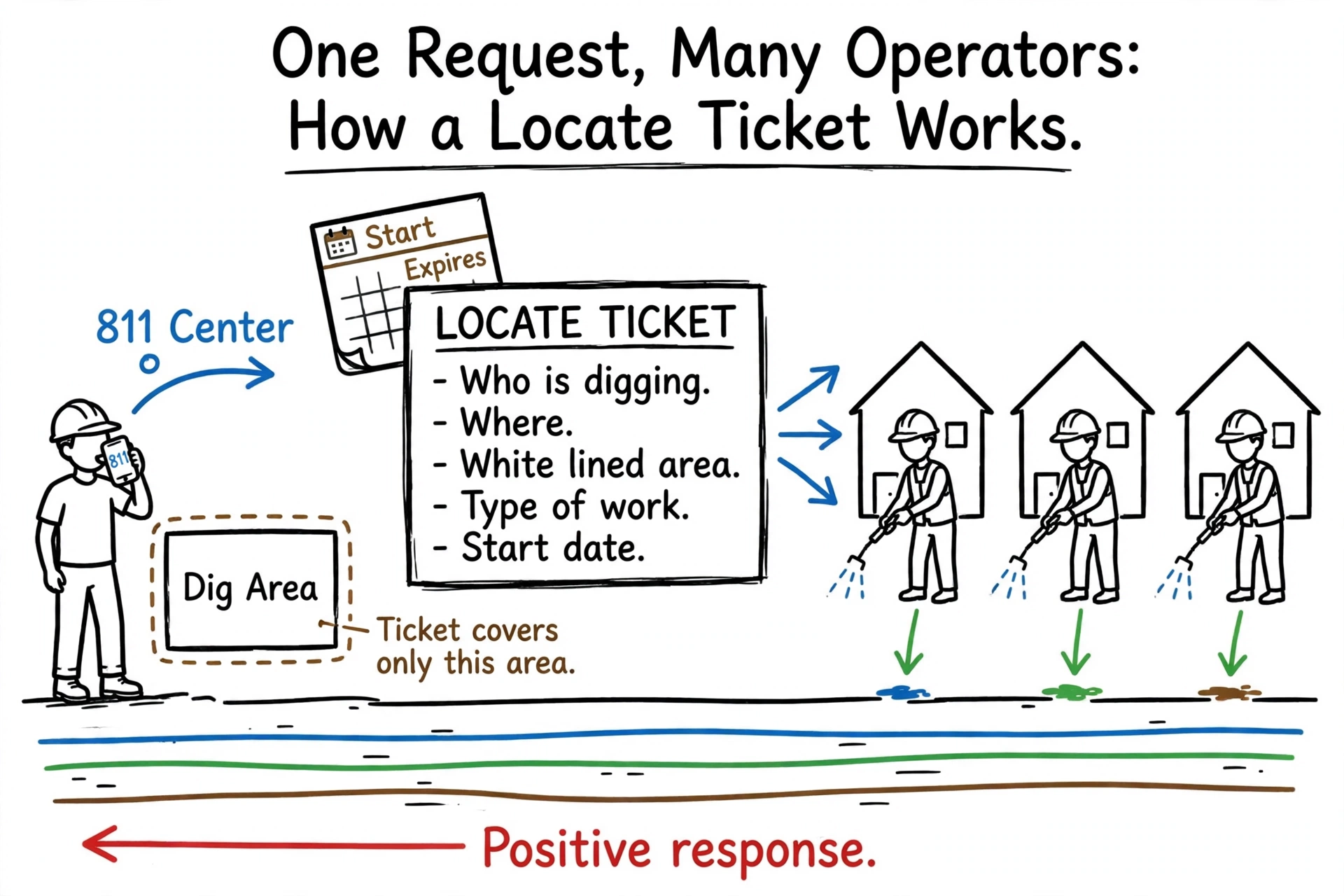
A locate request is the excavator’s formal notification, submitted through the 811 center, that excavation is planned at a described place, starting on a described date, for a described type of work, so that facility operators can locate and mark their underground facilities in that area before digging begins.
A ticket is the record the center creates from the request. When people in the field say “the ticket,” they usually mean both the request as submitted and the center’s record of it, including the ticket number, the information the excavator provided, the list of operators notified, and the dates that control the ticket. Keep the ticket number. It is the reference every later conversation uses: questions about marks, reports of no response, renewals, and any damage investigation.
Four points in the definition matter most.
First, it is formal notification, not a courtesy call. State damage prevention laws require excavators to notify the center before excavation, with advance notice periods set by state law. Submitting the request starts a legal and operational process with deadlines for operators to respond.
Second, it goes through the center. The center is the single point that reaches the member operators for the area. A direct call to one utility you happen to know about does not replace the center notification, because other operators may also have facilities there. Private facilities, such as lines owned by a property owner beyond a meter, are generally not located through the 811 system, and a ticket does not cover them. Handling private facilities is a separate project step.
Third, it describes a specific scope. Where, when, and what are not details added for neatness. They are the boundaries of the notification. Operators are notified for that place, that work, and that window of time.
Fourth, its purpose is locating before digging. The request does not approve the work, grant a permit, or guarantee that everything underground has been found. It triggers locating and marking so the excavator can plan excavation around known facilities.
A locate request is not the same as a design or survey request, although some centers offer those ticket types for planning. It is not an emergency shortcut for ordinary schedule pressure. It is not a blanket permission that follows a crew wherever it goes. Each of those misunderstandings appears later in this lesson because each one causes real field problems.
What Does It Look Like?
A ticket looks different in each center’s system, as a printed page, an email, or a screen in an online portal or mobile app. The layout varies. The information fields are consistent enough that you can learn to read any ticket by looking for the same building blocks.
Look for these parts, in roughly the order centers present them.
Ticket number and ticket type. A unique number identifies the ticket. The type tells you whether it is a normal request, an emergency request, a design request, or another type the center uses.
Excavator information. The company or person digging, a field contact name, and a phone number the locator or operator can actually reach during work hours. Some tickets also list the person who submitted the request, who may be office staff rather than the field crew.
Work location. The address or the location description: county and city or township, street address if one exists, the nearest intersecting street or cross street, and driving directions or map information where an address alone does not find the site. Rural work often needs a fuller description, such as distance and direction from an intersection, because a street address may not exist or may not pinpoint the dig area.
Extent of the work area. How much ground the ticket covers: a single lot, one intersection corner, a stated length along a named road, or a mapped polygon drawn in the center’s online system. Good tickets make the extent readable without guessing. A locator reading the ticket should be able to draw the same boundary the excavator intended.
Delineation information. Whether the dig area has been white lined, and how. Delineation, also called premarking, means marking the proposed excavation area in white before locating, using white paint, flags, stakes, or whiskers, or drawing the area electronically in the center’s system when the center offers that option. White is the color for the proposed excavation area. It is separate from the colors operators later use to mark their facilities.
Type of work. What will actually happen in the ground: boring, trenching, digging post holes, setting poles, grading, or another described activity, and often the equipment or method and the depth or purpose in general terms the center asks for. A ticket that says “installing fiber optic cable by directional bore along the north side of the road” tells a locator far more than a ticket that says “construction.”
Proposed start date and time, and the response deadline. The date the excavator proposes to begin, the date and time by which operators must respond under state law, often called the locate by or lawful start date, and the ticket expiration date. Those three dates are not the same, and confusing them is a common field error covered later in this lesson.
Operators notified. A list of the member operators the center sent the ticket to. This list matters. Before digging, the excavator checks that every operator on the list has responded. An operator not on the list was not notified by this ticket.
Remarks or locate instructions. Free text where the excavator adds the details that do not fit the standard fields: access instructions, gate codes handled through proper channels, where white lining was placed, which corner of an intersection, which side of the road, and limits such as “locate only the white lined area.”
In the field, the physical companion of the ticket is the white lined area itself. When you arrive at a site, you should be able to hold the ticket in one hand, so to speak, and match it to the ground: these white marks show the dig area the ticket describes, at the address the ticket names, for the work the ticket states. If the ground and the ticket do not match, you have found a problem before any digging starts, which is exactly when you want to find it.
What Does It Do?
A locate request does four jobs.
First, it notifies. One submission reaches every member operator the center identifies for the work area, based on the service area information operators file with the center. Without the center, an excavator would have to know every owner in every corridor and contact each one separately, and would still miss owners it did not know about.
Second, it defines the locating job. Locators work ticket by ticket. The ticket tells the locator where to go, what area to search, and by when. A clear ticket lets a locator complete the work in one trip. A vague ticket forces the locator to guess, to mark a much larger area than needed, to contact the excavator for clarification, or in some systems to pause the locate until the excavator delineates the area.
Third, it creates the shared record. The ticket number, the timestamps, the list of notified operators, and the operators’ responses together prove what was requested, who was told, and what each operator reported. That record protects the public first, because it drives the marking process. It also protects the excavator who followed the process, and it holds accountable any party who did not.
Fourth, it sets the clock. State law sets how much advance notice the excavator must give and how long operators have to respond. The ticket carries the proposed start date, the lawful start or locate by date, and the expiration date. Work must be planned inside those dates. Starting before the response deadline, or continuing after expiration without renewal, breaks the process even if paint is still visible on the ground.
What a locate request does not do is just as important. It does not find private facilities. It does not guarantee that marks are accurate; marks are an operator’s approximate indication of facility position, and excavation near marks still requires the careful exposure and tolerance zone practices taught in later lessons. It does not transfer responsibility. The excavator remains responsible for checking responses, protecting marks, and digging carefully. And it does not cover any work the ticket does not describe, a point so important that it gets its own treatment in the next sections.
Where Does It Fit?
The locate request sits near the start of the excavation sequence, after planning and before digging. A simplified sequence looks like this.
The project plans the work and knows, at least in outline, where it will dig and when. The excavator delineates the dig area in white where the location cannot be clearly described in words alone, and in many cases as a matter of good practice even when it can. The excavator submits the locate request to the 811 center, by phone, online, or through a mobile tool, observing the advance notice period state law requires. The center processes the ticket and transmits it to member operators for the area. Operators locate and mark their facilities, or clear the ticket by reporting no conflict, and record their responses through the positive response system where the state or center provides one. The excavator checks that all notified operators have responded, compares the marks in the field to the responses, and only then excavates, within the ticket’s area, scope, and valid dates. If the work changes, extends, or outlasts the ticket, the excavator updates or renews the ticket before continuing.
Notice where judgment enters. The request is written before anyone marks anything, often by office staff who have the project plans but have not stood on the site, for field crews who know the site but did not write the request. That handoff is a known weak point. Strong projects close it in both directions: field crews verify the ticket against the site before digging, and they feed corrections back so the next ticket is written from the field truth rather than from an outdated plan.
The locate request also connects backward to earlier lessons in this level. Records research and surface evidence, taught in the lessons on existing utilities and jobsite reading, tell you what should be in a corridor. The locate request is how you formally ask the owners of that corridor to show you where their facilities are for this specific dig. Later lessons in this level take up the next steps in depth: the uniform color code and what marks mean, tolerance zones, positive response, and what to do when marks and reality disagree.
Why Does It Matter?
It matters first for safety. Buried electric and gas facilities can kill. Water, sewer, and communications strikes flood excavations, undermine roads, cut service to hospitals and homes, and send crews into emergency repairs they were never meant to perform. The locate request is the trigger for the one process designed to put the position of those facilities on the ground before a bucket or a bore head reaches them. No request, no marks. A bad request, bad marks.
It matters for accuracy, because scope controls effort. Locating is skilled human work done under time pressure across many tickets a day. A complete, tight, well delineated request concentrates that effort on the ground you will actually disturb. A vague or oversized request dilutes it. The Common Ground Alliance, the damage prevention organization whose Best Practices are widely cited by centers and operators, treats delineation and clear locate instructions as core practices for exactly this reason. When the site cannot be clearly and adequately identified on the ticket, the excavator is expected to designate the route or area with white premarking, on site or electronically where the center offers it.
It matters legally and financially. State damage prevention laws tie an excavator’s duties, and in many states an excavator’s liability after a damage, to whether proper notice was given and whether the excavation stayed within the notice. Digging outside the described area, outside the described type of work, or after the ticket expired can leave the excavator treated as if it had no ticket at all for that digging. The contract and project consequences, repair costs, service outage claims, and enforcement penalties, follow from that. This lesson states the principle only. The exact rules are your state’s law, and the project must follow that law rather than any general summary, including this one.
It matters for schedule, in the direction crews least expect. A good request submitted on time protects the schedule. A bad request costs days: locators asking for clarification, operators responding to the wrong area, no response follow ups, renewals filed too late, and restarts of the waiting period when a ticket has to be corrected and reissued. Crews that treat the ticket as a skilled task start on time more often than crews that treat it as a chore.
Finally, it matters because the ticket is the crew’s own protection in the field. When a foreman holds a complete ticket, a full set of responses, and marks that match both, the crew can dig with a clear head. When any of the three is missing, the correct move is to stop and fix the gap. Recognizing that gap is a field skill, and it starts with knowing what a proper request contains.
What Does Good Look Like?
A good locate request is complete, accurate, tight in scope, and readable by a stranger. Test any ticket against this picture.
The excavator and a reachable field contact are correctly named, with a phone number that is answered during work hours.
The location finds the site without local knowledge. Address where one exists, nearest cross street, municipality and county, and added directions or map references where the address alone is not enough. The description names the side of the road, the corner of the intersection, or the portion of the lot where digging will occur, instead of naming a whole parcel when only part of it will be disturbed.
The extent matches the work. The ticket covers the ground the crew will actually disturb, plus the working room the center’s guidance allows, and no more. A bore shot is described as its route and its bore pits or entry and exit points. A series of separate small digs is described as those digs, or split into separate tickets where the center’s rules require it, rather than stretched into one continuous corridor that will not be dug.
The area is delineated. White paint, flags, stakes, or whiskers outline the dig area on site, or the area is drawn electronically in the center’s system where available. The ticket remarks say that delineation was done and where. Where state law or center policy requires white lining when the location cannot be clearly described, the requirement is met before the locator is expected to work the ticket.
The type of work is stated in real words. Boring, trenching, pole setting, potholing, grading, and similar terms, with the general purpose, such as placing fiber duct. A locator who reads it understands what disturbance is coming.
The dates are real. The proposed start date respects the advance notice period in state law, the work is genuinely planned to start in the ticket window, and someone owns the calendar task of renewing or updating the ticket before expiration if the work runs long.
The remarks carry the exceptions. Access notes, limits such as “white lined area only,” known site features, and any instruction that keeps a locator from wasting a trip or marking the wrong ground.
For large or long projects, good practice adds coordination. Rather than one enormous ticket covering miles of route or months of work, good requests break the project into workable segments that locators can mark shortly before each segment is dug, and the excavator uses the center’s large project or project ticket process where one exists, including any required pre-excavation meeting or schedule sharing with operators and locators. Marks placed months before digging fade, get paved over, and stop matching a changing site. Segmentation keeps marks fresh and tickets valid. The exact size limits and project processes are center and state specific, so verify them with your center rather than assuming a number from another state.
What Can Go Wrong?
Vague location. “Locate the property” or an address with no indication of where on the property the digging will happen leaves the locator to choose. The locator may mark the entire parcel, mark the wrong portion, or request clarification while the clock runs. The crew then either waits or digs in an area that was never the focus of the locate.
Wrong location. A transposed address, the wrong cross street, or the wrong corner of an intersection produces a perfectly executed locate of the wrong ground. Marks appear, which creates false confidence, while the actual dig area was never searched. This is among the most dangerous ticket errors because everything looks complete.
Oversized scope. Requesting a whole subdivision, an entire road corridor, or an entire parcel for a small dig overloads locators, delays responses, and can violate center policies that limit ticket size. It also increases the chance that the small area that matters is marked hastily as part of a huge area.
Undersized or mismatched scope. The ticket describes the front yard, and the crew also digs the side yard to reach a pedestal. That side yard digging is outside the ticket. If the crew damages a line there, the ticket does not cover that work. Scope creep in the field must be matched by a ticket update before the added ground is dug, not after.
Wrong ticket type. Using a design or survey ticket as if it authorized digging, when in the centers that offer them excavation cannot take place on a design ticket and a normal locate request must be placed before work begins. Or filing an emergency ticket for work that is urgent to the schedule but is not an emergency under state law. Emergency is a legal definition, generally a sudden, unexpected condition presenting clear and imminent danger to life, health, property, or essential public service that demands immediate action. Misusing emergency tickets can violate state law and pulls locators from genuine emergencies.
Expired ticket, faded marks. Work runs long, weather delays the start, or the crew is reassigned, and the ticket passes its expiration date. Validity periods vary widely by state. As examples only, some states set periods around two to four weeks, and individual state examples found in center materials include 14 calendar days, 21 calendar days, 28 calendar days, and 30 calendar days. There is no single federal validity period. Digging on an expired ticket is digging without a current notification, and faded or destroyed marks must be refreshed through the center’s renewal or remark process, with the new advance notice that process requires.
Starting too early. The crew starts before the lawful start date, or before every notified operator has responded, because paint from one operator is visible. One operator’s marks say nothing about another operator’s facilities. A missing response is a stop signal, not a detail.
No response and mismark follow up failures. An operator does not respond, or marks are clearly inconsistent with surface evidence, such as a pedestal with no marks leading to it. Continuing anyway turns a solvable notification problem into a damage risk. Centers provide specific follow up ticket types for these cases, such as no response and incorrect locate tickets, with their own response timelines under state rules.
Contact failure. The field contact on the ticket has changed, the phone number is wrong, or the mailbox is full. The locator who needed one clarification marks nothing, or marks a best guess, and the delay or error lands on the crew that supplied the bad number.
Each of these failures is preventable at the moment the request is written or checked. That is why this lesson treats the request itself, not just the marks, as a field skill.
What Should Someone Notice in the Field?
You do not have to write tickets to check them. Any crew member who can read a ticket against the ground adds a layer of protection. Notice these things.
Match the ticket to the site. Does the address, cross street, and description match where you are standing? Does the white lining on the ground match the dig area the ticket describes, and does it match the work you are actually about to do? If the crew’s plan for today reaches ground the ticket does not describe, say so before digging.
Check the dates out loud. What is the lawful start date, and has it arrived? What is the expiration date, and will today’s work finish inside it? If the ticket expires mid job, who has filed the renewal, and when? Dates read aloud in the morning briefing catch expirations that dates on a screen do not.
Check the operator list against the responses. Every operator notified should show a response: marked, cleared with no conflict, or another status the center’s positive response system defines. Learn the status words your center uses, and treat any operator still showing no response as unfinished business. Remember also that a clear or no conflict response means that operator reports no facility in conflict; it does not promise the ground contains nothing, and it never covers private facilities.
Compare marks to surface evidence. Pedestals, handholes, valve boxes, meters, risers, warning signs, and earlier lessons’ surface clues should have marks that make sense with them. A structure with no facility marked to or from it, a mark that ends abruptly for no visible reason, or paint in a color or pattern you cannot connect to an operator’s response are findings to raise, not curiosities to step over.
Notice the condition of the marks themselves. Fresh, complete marks inside a valid ticket support work. Faded, plowed away, paved over, or mowed off marks do not, even if the ticket dates still look fine. Marks that have been destroyed need the center’s remark or renewal process before digging in the affected area.
Notice white lining problems. No white lining where the ticket location is hard to describe, white lining that outlines a far larger area than the planned dig, or white lining placed for a different phase of work than today’s, all predict a locate that does not match the dig.
Notice your own scope discipline during the day. Bore pits move. Access paths get trenched. A hand dig to find a facility grows. Each time the disturbance moves outside the ticket description, the ticket question must be asked again. The habit to build is simple: new ground, new check.
If you notice any of these problems, the field action is the same pattern taught throughout this level. Stop the affected digging, keep people clear of any suspected hazard, and report through the foreman and the project’s notification process so the ticket can be corrected, renewed, or reissued. Recognizing and reporting is your job. Rewriting legal notifications or remarking another operator’s facilities is not.
Practical Example
The following example is hypothetical. Any resemblance to a specific project, company, or address is coincidental. State rules in the example are described in general terms on purpose, because the specific notice periods and ticket life in your state will differ and must be checked against your own state law and center rules.
Hypothetical example. A fiber contractor is placing underground fiber along a residential street. The work for the first week is one directional bore crossing under the street at a single intersection, with an entry pit on the northeast corner and an exit pit on the southwest corner, plus a short trench from the exit pit to a new handhole.
The office submits the locate request on Monday for the proposed start the following week, inside the advance notice period the state requires. The ticket names the intersection, identifies the two corners by compass direction, describes the type of work as directional boring for fiber placement with two pits and a short trench, and lists a field contact who will be on site. Over the weekend, the foreman white lines both pit locations and the trench route. The ticket remarks state: white lined pits and trench only.
The center transmits the ticket to five member operators. By the lawful start date, four have responded. Three marked their facilities, and one cleared the ticket with no conflict. The fifth, a communications operator, shows no response. The foreman also notices, on site, a pedestal near the exit pit with no marks connecting to it.
The crew does not start. The foreman files the center’s no response follow up for the fifth operator and asks for the pedestal area to be checked. The operator responds the next day, marks a line running near the planned exit pit, and the bore path is shifted within the white lined and ticketed area to clear it. The job starts a day later than the crew wanted and finishes without damage. Two weeks later, weather and a second bore added by the project extend the work. Before the ticket reaches its expiration date, the office submits a renewal with an updated description covering only the remaining work, rather than letting the original ticket lapse or quietly digging the added bore on the old description.
Three lessons sit inside the story. The description was tight, so locators marked two corners and a short trench instead of an entire intersection and four full approaches. The missing response and the unmarked pedestal were treated as stop signals, and the stop found a real facility. And when scope and time changed, the ticket was changed with them, before the new ground was dug and before the old ticket expired.
Key Terms
Locate request: The excavator’s formal notification to the 811 center describing planned excavation so operators can locate and mark their facilities.
Ticket: The center’s written record of a locate request, identified by a ticket number, carrying the excavator, location, scope, dates, and operators notified.
811 center: The state or regional notification center that receives locate requests and transmits them to member facility operators. Also called a one call center.
Excavator: In damage prevention law, any person or company that excavates, including boring, trenching, grading, and digging, by hand or with equipment.
Facility operator: The owner or operator of an underground facility, responsible for locating and marking that facility or clearing the ticket. Also called a utility operator.
Delineation: Marking the proposed excavation area in white, with paint, flags, stakes, or whiskers, or electronically where the center offers it, before locating. Also called white lining or premarking.
Positive response: The system by which operators report the status of a ticket back to the excavator, such as marked or no conflict, so the excavator can verify that every notified operator has responded.
Normal ticket: The standard locate request type for planned, non emergency excavation, submitted with the advance notice state law requires. Also called a routine or standard ticket in some centers.
Design or survey ticket: A planning ticket type offered by some centers to identify facilities during project design. Excavation cannot take place on a design ticket; a normal locate request is required before digging.
Emergency ticket: A ticket type reserved for excavation required by an emergency as state law defines it, generally a sudden, unexpected condition presenting clear and imminent danger that demands immediate action.
Renewal or update ticket: A follow up request that extends or refreshes a ticket before it expires, or refreshes marks, following the center’s rules and required notice.
Ticket validity: The period during which a ticket remains in effect, set by state law or center rules. It varies by state and there is no single national period.
Check Your Understanding
- In your own words, what is a locate request, and how is a ticket different from a phone call to one utility you know about?
- A ticket describes boring in the front yard of an address. During the day, the crew decides to also trench across the side yard to reach a pedestal. What is the problem, and what must happen before the side yard is dug?
- Why does white lining help a locator even when the ticket contains a street address?
- The marks of one operator are clearly visible, the lawful start date has arrived, and one other notified operator still shows no response. Can digging start? Explain your answer.
- A project will run past the ticket expiration date. What should happen, and why does it matter that this is done before the expiration date rather than after?
Answer key:
- A locate request is the excavator’s formal notification through the 811 center describing where, when, and what excavation is planned, so all member operators for the area can locate and mark their facilities. The ticket is the center’s record of that notification and reaches every notified operator, while a call to one known utility reaches only that utility and creates no center record covering the others.
- The side yard is outside the area described on the ticket, so that digging is not covered by the notification. The ticket must be updated, or a new request submitted, covering the side yard, and the locating and response process must be completed for that area before it is dug.
- An address identifies a property, not the exact ground to be disturbed. White lining shows the locator the precise dig area, so effort is concentrated there, the right facilities are marked in the right place, and areas that will not be dug are not marked unnecessarily.
- No. Each notified operator must respond for its own facilities, and one operator’s marks say nothing about another operator’s lines. A missing response is a stop signal. The excavator follows up through the center’s no response process and does not dig until the response is resolved under state rules.
- The ticket must be renewed or updated through the center before it expires, with the description revised to cover only the remaining work. Renewing before expiration keeps the notification continuously in effect; digging after expiration is digging without a current ticket, even if old marks are still visible.
Lesson Takeaway
A locate request is the instruction that creates the marks. Write it or check it like the safety document it is: the right excavator and contact, a location a stranger can find, an extent that matches the real dig, white delineation of the area, the true type of work, and dates the crew will actually meet. Then hold the line the ticket draws. Dig only the ground it describes, only after every notified operator has responded, and only while it is valid, and change the ticket before you change the work.
Sources and Technical References
Common Ground Alliance, Best Practices, Chapter 3 on one call center notification, Chapter 4 on locating and marking, and Chapter 5 on excavation, including Practice Statement 5-2 on white lining when the excavation site cannot be clearly and adequately identified on the locate ticket, and the Guidelines for Excavation Delineation in Appendix B. CGA Best Practices are industry consensus practices, not federal law. https://carcga.org/BP_22.0_Web.pdf
Missouri 811, Ticket Types. Center specific descriptions of routine, emergency, renewal, design, no response, and incorrect locate tickets, including the statements that excavation cannot take place on a design ticket and that a routine request must be placed before work begins, and a 21 consecutive calendar day ticket life for Missouri. State and center rules, shown as one state’s example. https://missouri-811.org/resources/ticket-types/
Missouri 811, Excavators page. Center processing, notification of utilities, and ticket management for excavators in Missouri. https://missouri-811.org/excavators/
Missouri 811, Confirming Ticket Responses. Positive response checking, no response follow up timing, and incorrect locate follow up in the Missouri system. https://blog.missouri-811.org/the-scoop/confirming-ticket-responses?hs_amp=true
Sunshine 811, Low Impact Marking. Florida guidance on keeping locate descriptions tight to the areas actually being dug, white lining small work areas within larger corridors, and revising locate descriptions when renewing tickets instead of repeating the original description. Florida center guidance, used as an example of center practice. https://sunshine811.com/low-impact-marking
Blue Stakes of Utah 811, How Long Is a Locate Request Ticket Valid For. Utah example of ticket life: a request expires 21 calendar days from submission in that system, with update and re-mark rules that differ from renewal. Used only to show that validity and update rules are state specific. https://www.bluestakes.org/ufaq/how-long-is-a-locate-request-ticket-valid-for/
Texas811, Frequently Asked Questions. Texas center answers on white lining when the work location cannot be accurately described, on clear or no conflict responses, and on the point that one contractor’s ticket applies only to that contractor. https://texas811.org/faq/
Diggers Hotline, Positive Response Information. Wisconsin center description of how positive response status is communicated to excavators, including automated notices when all members have responded and when they have not. https://www.diggershotline.com/positive-response-info?print=all
North Dakota One Call, Member Utilities and Positive Response. Ticket type definitions including routine and emergency, and the respot process extending a ticket for another 21 calendar days in North Dakota. Another state example showing that names and periods differ by state. https://ndonecall.com/utilities/
Flagged as not stated in this lesson: exact advance notice periods, response deadlines, ticket size limits, large project thresholds, and renewal windows for any specific state other than the labeled examples above. Those numbers are set by each state’s damage prevention law and each center’s rules, they change, and they must be verified with your own center and state law for the project you are working on. No universal federal ticket validity period exists, and none is claimed here.
Previous lesson: Lesson 57: What Is 811? |
Back to Level 3 hub |
Next lesson: Lesson 59: What Do Utility Marks Tell Us?