
What You Are Learning
By the end of this lesson you will be able to explain, in plain language, what 811 is and who runs it. You will be able to trace the path a dig request takes, from the person who plans to dig, through the state notification center, to the utility operators, and finally to the marks on the ground. You will be able to name the four roles in that chain (excavator, notification center, facility operator, and locator) and say what each one does and does not do. You will be able to list what 811 does not cover, including private lines, non-member facilities, and the center itself doing the locating. You will be able to explain why advance notice times and ticket life are set by state law and vary by state, and why no single number can be quoted as a national rule. Finally, you will understand the core responsibility rule: calling 811 does not move your digging responsibilities to someone else.
This lesson teaches recognition only. It does not qualify you to perform locates, to operate locating equipment, to mark facilities on behalf of an operator, or to perform excavation. Locating and excavation are done under state law, operator procedures, and project rules by people assigned to those jobs.
Start With the Basics
Start with a basic idea. Before anyone digs, they need to know what is already in the ground. A pipe, cable, conduit, duct, or wire that a utility company has installed to deliver service is called a utility facility. Earlier lessons in this level taught you what electric, gas, water, sewer, and communications facilities look like. All of those things share the ground under streets, easements, and yards. Digging without knowing where they are breaks them. That is called excavation damage, and it is one of the main causes of harm to underground infrastructure in this country.
Now add a second basic idea. Long ago, every region had its own system for getting utilities located before digging. A contractor who worked in one city called one number, and a contractor who worked in another city called a different one. By 1994, 71 regional one call centers had been established, each with its own different number. That was confusing, so people forgot to call, or called the wrong place.
Congress decided to fix that with a single number. The Pipeline Safety Improvement Act of 2002 directed the Federal Communications Commission, the FCC, and the U.S. Department of Transportation to establish one simple nationwide number for calling before you dig. The FCC adopted the order on March 10, 2005, and released the Sixth Report and Order, FCC 05-59, on March 14, 2005, designating 811 as the national abbreviated dialing code for state one call notification systems. The national 811 system was then launched publicly on May 1, 2007, in an event on the National Mall with the Common Ground Alliance, the U.S. Secretary of Transportation, the FCC, and industry partners. Since then, dialing 811 from anywhere in the country connects you to the right state notification center. That is the whole idea in one sentence: one free number that gets your dig notice to the right people, no matter where you are.
Before going further, nail down the words this lesson uses over and over, because the rest of the lesson builds on them.
An excavator is any person or company that plans to move earth. That includes a big construction company, a small fence contractor, a landscaper, and a homeowner planting a tree. If you plan to disturb the ground, you are an excavator in the eyes of the law.
A notification center, also called a one-call center, is the state or regional office that receives dig notices. It does not own any utilities. It takes in the information about where you plan to dig, and it sends that information out to the right utility companies.
A facility operator, sometimes called a utility operator or facility owner, is the company or agency that owns the underground pipe or cable. Operators that belong to a notification center are called member operators.
A locator is the person who goes to the site and marks the ground. Locators work for the facility operators or for companies the operators hire. The notification center itself does not send locators.
A locate ticket, also called a locate request or notification, is the record the center creates when you call. It gets a ticket number. That number is your proof that you gave notice, and it is how everyone tracks the responses.
Marks are the paint lines and flags placed on the ground to show the approximate horizontal position of facilities. Marks use the standard APWA Uniform Color Code. APWA stands for the American Public Works Association, and you will meet the full color code in the next lesson. For now, the colors to hold in mind are yellow for gas, red for electric, blue for water, green for sewer, and orange for communications.
Positive response is the reply from each notified operator saying what it found. The reply says one of a few things: the facilities were marked, there are no facilities in the area, or more action is needed. It closes the loop so the excavator knows every operator answered.
What Is It?
811 is the free national three-digit telephone number that connects anyone who plans to dig with the one-call notification center for the area where they plan to dig. It is a communication system, not a company. Think of it as a front door. You walk through the front door with your project information, and the system routes that information to every member utility operator that has underground facilities near your dig site.
The federal framework works like this. The FCC created the 811 dialing code. The Common Ground Alliance, usually shortened to CGA, is the nonprofit industry association that helped implement and continues to promote the national 811 awareness program. Call811.com is the national information website for 811, with information and links to every state center. CGA does not run the state notification service itself. PHMSA, the Pipeline and Hazardous Materials Safety Administration inside the U.S. Department of Transportation, supports the system through safety rules, grants to states, and its annual 811 Day awareness campaign. The law that matters most day to day, though, is state law. All 50 states now have one call systems, and all states have damage prevention laws that require excavators to give notice before digging. There is no single national call before you dig law, the state law for the place of the dig controls.
The key point about what 811 is: it is the way you give legal notice of your intent to dig. Calling 811 creates a record. That record shows the date, the location, the work description, and the operators that were notified. If a line gets hit later, that record is one of the first things investigators ask for. The ticket number is the confirmation number for your notice. Keep it with the job records, it is the record that you gave notice and which operators were notified.
What Does It Look Like?
You do not see 811 itself in the field. There is no building with an 811 sign on it where you work. What you see are the things 811 sets in motion.
What you see first is the number. It is three digits, free to call, reachable from anywhere in the country. Online requests go through the state center website or portal, such as okie811.org in Oklahoma. Call811.com provides national information and links to the state centers, it does not take the locate request itself. How and when you can submit a request varies by state center. Many centers offer online request entry, and OKIE811 states that its contact center operates 24 hours a day, seven days a week. Check your state center for its current phone hours, online hours, and emergency request process.
What you see next is the ticket number. In Oklahoma, for example, OKIE811 assigns a 14-digit confirmation number when a locate request is submitted and validated. That number is kept with the job paperwork for the life of the ticket.
What you see in the field are the marks and flags that result from the request. Paint lines on pavement and soil, small flags in yards, and sometimes flags with a company name or logo. The marks follow the standard color code: red for electric, yellow for gas, orange for communications, blue for water, green for sewer, purple for reclaimed water, and white for the proposed excavation area. White paint is used to mark the limits of your own dig area before you call. Many centers ask the excavator to premark the dig site in white so the locators know exactly where to mark. The pink color is used for survey marks, which are not utility marks.
What you also may see, in states that use it, is the positive response system. This is an online portal or phone system where the excavator checks the status of each notified operator. It shows whether each operator has marked, cleared, or still needs to respond. Ohio’s system, for example, lets each member utility post whether its facilities are marked, cleared, or need further action, and the excavator checks it before digging starts.
What Does It Do?
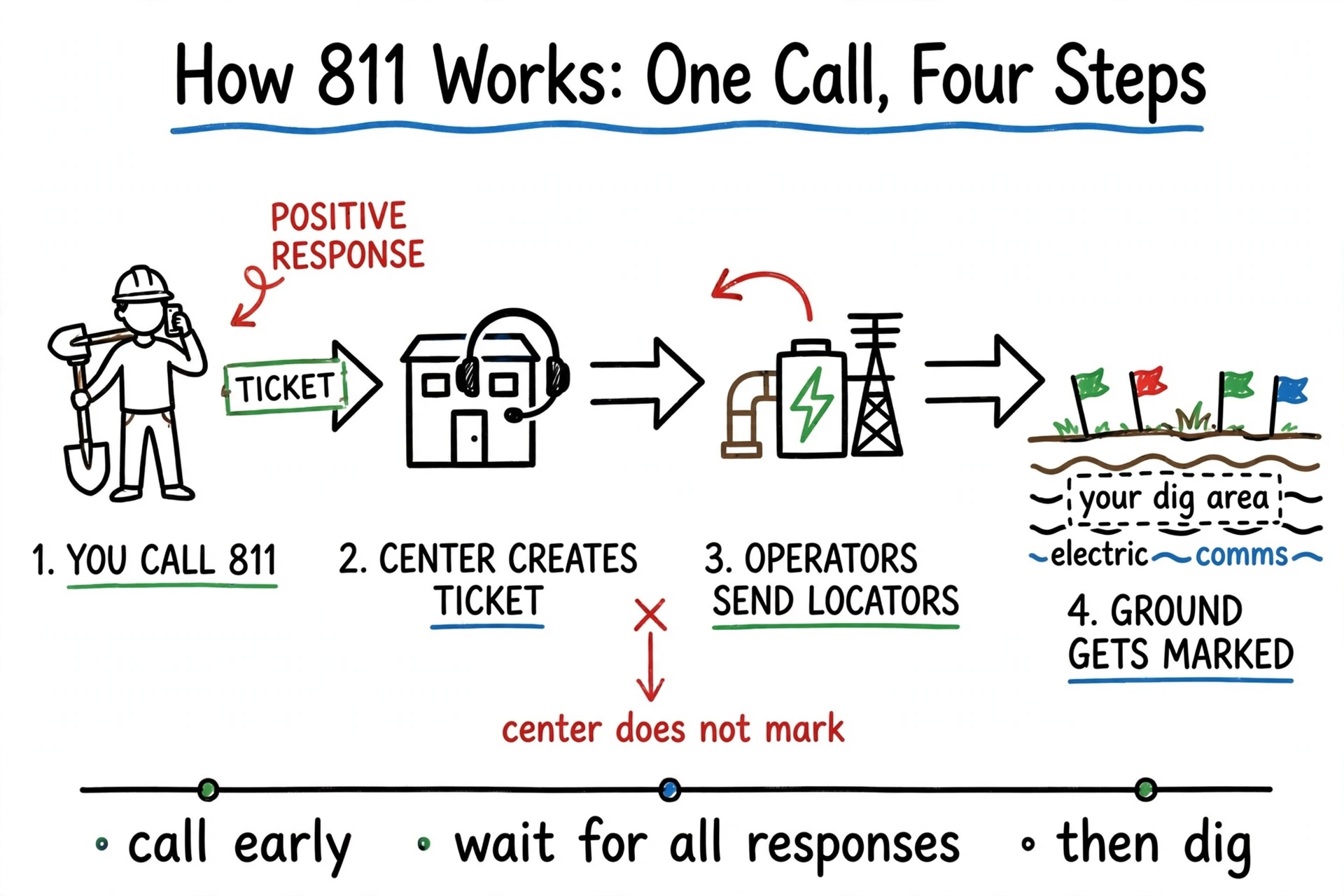
811 takes in one notice and turns it into many coordinated responses. Walk through the full flow step by step.
Step one: the excavator contacts 811. You call 811 or submit the request online. You give the location of the dig, the nearest cross street, a description of the work, the extent of the excavation, and the planned start date. In many places you also mark your dig area in white paint first, so the locators know where to focus. The center takes that information and creates the locate ticket with a ticket number.
Step two: the center notifies the member operators. The notification center looks at its member list and its maps, and sends the ticket to every member facility operator with underground facilities near your dig site. The center itself does not own facilities, does not send locators, and does not put marks on the ground. Its job in this step is routing information.
Step three: the operators respond. Each notified operator looks at its own records and sends a locator to the site. The locator may be the operator’s own employee or a worker from a locating company the operator hired. The locator uses records, maps, and detection equipment to find the approximate horizontal position of the operator’s facilities, then marks them with paint or flags in the standard colors. If the operator has no facilities in the area, it records a clear response saying so, through the positive response system or by its own method. The operator must respond within the time the state law sets.
Step four: the excavator confirms and then digs with care. The excavator waits for the required notice period to pass and confirms that every operator on the ticket has responded. Then excavation starts, with the marks guiding the work. Within the tolerance zone around each mark, digging must be done carefully by hand or with vacuum methods rather than with mechanical equipment. The tolerance zone is the strip of ground around a marked line where extra care is required. CGA best practice defines it as the width of the facility plus 18 inches on each side. Some states set a wider zone, so the local rule is the one that controls.
Two more things 811 does that are easy to miss. First, it creates the legal record. The ticket proves you gave notice. Many contractors keep ticket numbers with their daily reports and project photos for exactly this reason. Second, it handles emergencies. State laws provide a way to request emergency locates, and each state defines an emergency in its own law. In Oklahoma an emergency is an unavoidable situation that endangers life, health or property. Check your state definition, an event that does not meet it will not protect you from penalties if you skip normal notice.
Where Does It Fit?
811 sits at the very front of any job that touches the ground. It comes before the first shovel, the first fence post, the first directional bore, and the first trench for fiber. In the fiber construction world, this means 811 comes before plowing drop conduit, before hand-digging to a pedestal, before a bore crew sets up, and before a pothole is dug to verify depth.
It also sits between the excavator and every other utility. The center is the middleman. Without it, an excavator would have to find and call each utility company separately, and would probably miss some. With it, one call reaches all the member operators at once. That is the entire value of the system: one notice, all members, one record.
811 fits equally for professionals and homeowners. A professional fiber contractor calls 811. A homeowner planting a tree calls 811. A gas company crew replacing a pole calls 811 before it digs. The system does not care who you are. It cares where and when you plan to dig. And it applies to shallow work too. Utility lines are often buried at inconsistent depths, sometimes only inches below the surface, and depth changes over time with erosion, frost heave, and grading. Shallow digging is still digging.
Why Does It Matter?
It matters because the thing 811 prevents is one of the most common and most costly mistakes in construction. Striking a buried utility can cut power to a neighborhood, release gas that can explode, flood a street, or sever the fiber lines that carry 911 calls and hospital data. For the person digging, a strike can mean electrocution, burns, or a blast. For the project, it can mean repair bills, fines, and lawsuits. For the company that owns the line, it can mean an outage affecting thousands.
The numbers back this up. PHMSA reports that excavation damage remains the leading cause of pipeline incidents, and its research found that a person who calls 811 before digging has a 99 percent chance of avoiding an incident, injury, environmental harm, or death. CGA tracks damage across the industry in its annual DIRT report, and recent reports show damage rates have worsened rather than improved, with failure to notify or inaccurate locating behind a large share of strikes.
It also matters because in most states it is the law. Digging without giving notice is a violation, and if you hit a line after skipping the call, you can be held liable for the repair costs, emergency response costs, and civil penalties. Calling 811 is free. It takes a few minutes. Skipping the call remains the single largest individual root cause of excavation damage in CGA DIRT data, accounting for 24.54 percent of reported damages in the 2024 DIRT Report.
For fiber crews specifically, it matters one more time. Fiber construction is constant excavation: plowing, trenching, boring, potholing, setting pedestals and handholes. Every one of those activities needs a current ticket. A crew that treats 811 as paperwork instead of protection is the crew most likely to hit a gas line while placing conduit.
What Does Good Look Like?
Good 811 practice looks like this.
The excavator plans the dig first, including the exact area, the work type, and the start date. The dig area is premarked in white paint or white flags so locators know the boundaries.
The excavator contacts 811 early enough that the full state notice period can pass before work starts. Not the night before. Not the morning of. Early enough.
The ticket number is written down, kept with the job records, and checked. Every operator listed on the ticket is confirmed to have responded, through the positive response system where the state has one, before any digging starts.
The marks on the ground are left alone. The excavator preserves them, protects them from equipment traffic, and requests a re-mark if they fade or are destroyed by weather or work.
Excavation starts only after the notice period has passed and all responses are in. Within the tolerance zone of every mark, the work is done by hand or with vacuum excavation, not with a machine bucket.
If the ticket expires before the work is done, the excavator files a renewal and gets fresh marks. Work never continues on an expired ticket.
If conditions change, for example the dig area moves or a new area is added, the excavator files a new or updated ticket for the new area.
What Can Go Wrong?
Many things can go wrong with 811, and most of them come from misunderstanding what the system covers.
The center never locates anything. It takes your information and notifies member utilities. Each utility decides whether to mark in the field, provide maps, or clear the ticket. If you expect the center to send someone, you are waiting on a visit that will never come.
Private facilities are not marked. This is the gap that catches the most people. The operators mark only the facilities they own, usually up to the meter, the service point, or the demarcation point. Lines beyond that point are private and are the property owner’s responsibility. That includes irrigation and sprinkler systems, outdoor and landscape lighting wiring, electric or gas lines to detached garages and sheds, pool and spa equipment lines, propane lines to outdoor appliances, septic systems and leach fields, and invisible pet fence wire. Some industry estimates put private facilities at 60 to 65 percent of all underground utilities on a property. A locator who marks only the public utilities can leave most of the yard unmarked, and every one of those unmarked lines is still real.
Non-member facilities are not marked either. If a utility does not belong to the one-call center, it never gets the ticket and never sends a locator. Some private fiber networks, campus systems, and municipal systems fall into this gap.
Marks are approximate, and depth is not promised. Locate marks show the approximate horizontal position of a facility. They do not reliably show depth. Depth changes over time with erosion, soil conditions, frost heave, and changes to the landscape. Treating a mark as an exact position or assuming a line is deep enough to miss is how strikes happen.
Records can be wrong or incomplete. The locator works from the operator’s records and maps plus field detection. Old lines, lines installed before good records existed, and abandoned or unknown facilities can be missing from the records entirely. That is why even a clean ticket with fresh marks is not a guarantee that nothing else is down there.
Tickets expire. Ticket life is set by state law and varies by state. Examples in state law and center materials include 14 calendar days in Oklahoma, 21 calendar days in Utah and Missouri, and 30 calendar days in Montana, and other states set different periods. Always check the expiry date on your ticket and renew before it expires on longer jobs. Digging on an expired ticket is treated the same as digging with no ticket at all. In Oklahoma, by state law, notice expires 14 calendar days from the excavation start date stated on the notice, and no excavation may continue after that date unless a new notice is submitted. The OKIE811 excavator guide also directs excavators to keep the ticket number accessible at the job site for 14 calendar days and to update the ticket if work extends beyond that period or if marks are destroyed.
Calling does not transfer responsibility. The excavator stays responsible for digging safely, preserving the marks, staying out of the tolerance zone with machines, and stopping if something unexpected is found. The ticket proves you gave notice. It does not prove the ground is clear.
Finally, the notice rules are state rules, and they differ. Advance notice, how it is counted, ticket life, tolerance zone width, positive response requirements, and emergency definitions are all set by state law. A rule you learned in one state may not apply in the next. Never carry one state’s numbers across a state line.
What Should Someone Notice in the Field?
For this lesson, what you notice in the field is about the marks, the records, and the gaps.
Notice fresh marks and fresh flags near a planned dig area, and notice what color they are and what they say. A mark with a company name on it tells you which operator responded. Notice areas with no marks where you expected some. No marks can mean the operator cleared the ticket as having no facilities there, or it can mean the operator has not responded yet, or it can mean the marks were destroyed. Each meaning calls for a different action, and the ticket and the positive response system are how you tell them apart.
Notice white paint or white flags. That is the proposed excavation area, the excavator’s own premarking. It tells you where someone plans to dig.
Notice the difference between utility marks and survey marks. Utility marks follow the utility color code. Pink marks are survey marks, not utility locates. Do not read a pink survey stake as a utility all clear.
Notice private property features that 811 will not have marked: irrigation heads, outdoor lighting, a detached garage or shed with power, a pool or spa, a propane tank or grill line, a septic tank lid or leach field. These are clues to private lines in the ground.
Notice manholes, handholes, pedestals, valve boxes, and meter boxes near the dig area. They are above-ground clues that facilities run below, whether or not the ground is marked.
Notice faded, washed-out, or scattered marks. Marks degrade. Faded marks are not reliable marks. If the marks are gone, the ticket needs a re-mark, not a guess.
Notice the ticket itself. Is there a current ticket number for this work area, with the right dates? Is the work area on the ticket the same as the work area on the ground? A ticket for the wrong address or the wrong block is no ticket at all.
Practical Example
The following example is hypothetical. It is invented to teach the flow, not to describe a real job.
A small fiber crew is hired to place a drop from a pedestal to a house in a suburban neighborhood in Oklahoma. The crew leader, Dana, marks the planned bore path in white paint on Monday morning, then calls 811 on Monday at 9:00 a.m. The center takes the location, the work description, and the planned start date of Thursday, and gives Dana a ticket number. The center sends the ticket to the member operators in that area.
By Wednesday afternoon, three operators have marked. The gas company marked a yellow line running along the front of the lot. The electric company marked a red line to the house meter. The communications company marked an orange line to the pedestal. A fourth operator, the water department, cleared the ticket as having no facilities in the area. Dana checks the positive response and sees all four operators have answered.
On Thursday morning, Dana walks the site before the bore rig arrives. The white paint path is clear. The yellow gas mark crosses the planned bore path. Dana notes the tolerance zone around the gas line and plans to hand-dig a pothole to verify its depth and position before the bore crosses it. Dana also notices sprinkler heads in the yard. The sprinkler system is private, so 811 never marked it. Dana tells the homeowner that the sprinkler line near the bore path is the homeowner’s responsibility and asks where it runs, then plans the bore to avoid it.
The bore crosses the gas line’s tolerance zone only after the hand-dug pothole confirms the line’s position. The drop is placed without damage. The ticket number stays in the job folder. Nothing about this story required heroics. It required a call, a wait, a check, and attention to the one thing the system did not cover.
Key Terms
Excavator: any person or company that plans to disturb the ground, from a large contractor to a homeowner planting a tree. The person with the duty to give notice.
Notification center (one-call center): the state or regional office that receives dig notices from excavators and forwards them to member facility operators. It does not own utilities and does not place marks.
Facility operator (utility operator): the company or agency that owns an underground pipe, cable, or conduit. Member operators receive locate tickets and are responsible for responding.
Locator: the person who visits the site and marks the approximate position of the operator’s facilities. Works for the operator or for a locating company the operator hires.
Locate ticket (locate request): the record the notification center creates from an excavator’s notice. It carries a ticket number, the location, the work description, and the list of operators notified. It is the excavator’s proof of notice.
Marks: paint lines and flags on the ground showing the approximate horizontal position of facilities, placed in the standard color code.
Positive response: the reply from each notified operator reporting the status of the ticket, such as marked, no facilities, or more action needed. It closes the communication loop.
Tolerance zone: the strip of ground around a marked facility where mechanical excavation is not allowed and only careful hand or vacuum digging is permitted. Width is set by state law or industry best practice.
Private facility: a utility line owned by the property owner rather than a utility company, usually on the customer side of the meter or service point. Not marked through 811.
Check Your Understanding
- What is 811, and what does it connect you to?
- Name the four roles in the 811 process and say what each one does.
- What are two things 811 does not do?
- Why is it wrong to say there is one national advance notice period for 811?
- You have a current ticket, fresh marks, and the notice period has passed. Your crew hits an unmarked sprinkler line in the yard. What went wrong, and who is responsible for that line?
Answer key:
- 811 is the free national three-digit “Call Before You Dig” number designated by the FCC in 2005. Dialing it connects you to the state or regional one-call notification center for the area where you plan to dig.
- The excavator gives notice of the planned dig. The notification center takes the information, creates the ticket, and forwards it to member operators. The facility operator receives the ticket and is responsible for responding, either by marking or by clearing. The locator visits the site and places the marks on behalf of the operator. The center itself does not mark, and the locator does not decide whether notice was required.
- Any two of: 811 does not place the marks itself (the operators do). 811 does not locate private facilities beyond the meter or service point. 811 does not cover non-member facilities. 811 does not mark exact positions or depths. Calling 811 does not transfer the excavator’s responsibility for safe digging.
- Because advance notice periods are set by state law, not by one federal rule, and they vary by state. As examples from sourced material: Oklahoma requires at least 48 hours before excavation, excluding the notification date, Saturdays, Sundays, and legal holidays. Pennsylvania requires three business days. Ticket life also varies by state. Quoting one number as a national rule would be wrong.
- Nothing about the 811 process went wrong. Sprinkler systems are private facilities, and private lines are not marked through 811. They are the property owner’s responsibility. The crew should have noticed the sprinkler heads as a clue, asked the homeowner about the private lines, and planned around them.
Lesson Takeaway
811 is the free national front door to every state’s dig notification system. One call or online request creates a ticket, the center notifies every member utility operator, and the operators mark or clear the area. The system covers member utilities only, never private lines, and the marks are approximate, not exact. Notice periods and ticket life are state law and vary by state. And the most important sentence in the whole lesson: calling 811 does not move your responsibility to anyone else. You still have to confirm every response, protect the marks, respect the tolerance zone, and watch for the things the system was never designed to cover.
Sources and Technical References
- Federal Communications Commission Sixth Report and Order, CC Docket No. 92-105, released March 14, 2005, designating 811 as the national abbreviated dialing code for state one-call notification systems. Full text: https://www.federalregister.gov/documents/full_text/html/2005/04/13/05-7179.html
- GovTech, “National Three-Digit ‘Call Before You Dig’ Telephone Number Launched,” describing the May 2007 national launch with CGA, U.S. Secretary of Transportation Mary Peters, the FCC, and launch partners, and noting the 811 number was designated by the FCC in 2005 at the direction of a 2002 Act of Congress: https://www.govtech.com/dc/articles/National-Three-Digit-Call-Before-You-Dig.html
- Trenchless Technology, “Dial 811 for Damage Prevention,” June 2007, on the March 2005 FCC approval and how dialing 811 connects callers to the center for their area. A centre count given in that article was not verified in this check and is not used in the lesson: https://trenchlesstechnology.com/dial-811-for-damage-prevention/
- PHMSA, “811 Day,” on excavation damage as the leading cause of pipeline incidents and the finding that calling 811 before digging gives a 99 percent chance of avoiding an incident: https://www.phmsa.dot.gov/safety-awareness/811-day
- PHMSA pipeline safety update glossary, defining one-call center and one-call system, and noting all 50 states are covered by one-call systems with most states requiring at least 48 hours notice before excavation: https://www.phmsa.dot.gov/sites/phmsa.dot.gov/files/docs/Pipeline%20Safety%20Update%20Oct%202012.pdf
- Call811.com is referenced through the FCC order and the CGA launch materials as the national one-stop information site for 811 and state centers.
- OKIE811 Learning Hub, on Oklahoma locate request types: a normal locate request requires contact 48 hours (excluding Saturdays, Sundays, legal holidays, and the date of notification) before excavation and not more than ten days before excavation: https://okie811.org/learning-hub/
- OKIE811, “I Want To Dig,” on Oklahoma notice: excavation notice must be submitted at least 48 hours before excavation, excluding the date of notification, Saturdays, Sundays, and legal holidays: https://okie811.org/I-Want-To-Dig/
- OKIE811 2025 Excavator Guide, on keeping the 14-digit ticket number accessible for 14 calendar days and updating the ticket if work extends beyond that or marks are destroyed: https://okie811.org/wp-content/uploads/2025/05/2025-Excavator-Guide-May-Update.pdf
- Ohio811 (OUPS) Positive Response page, on how positive response closes the communication loop between member utilities and excavators: https://oups.org/positive-response/
- Pennsylvania One Call System FAQ, on the center not marking lines itself, facility owners marking only what they own, three business day notice, and service lines owned by the property owner: https://www.pa1call.org/pocs/484d2be6-7c87-4464-b190-af1ccd61fdf2/Frequently-Asked-Questions
- Underground Infrastructure magazine, “Turning awareness into action: 811 call centers,” with a state by state table of advance notice and marks validity. For Oklahoma the controlling figures are in Oklahoma law and OKIE811 materials: 48 hours advance notice as described in this lesson, and notice expiry 14 calendar days from the excavation start date: https://admin.undergroundinfrastructure.com/magazine/2025/march-2025-vol-80-no-3/features/turning-awareness-into-action-811-call-centers
- Electrical Contractor Magazine, “Ground Control to 811,” on 811 connecting to the nearest one-call center, members being utility and pipeline owners, and 811 not arranging location and marking of utilities on private property: https://www.ecmag.com/magazine/articles/article-detail/ground-control-to-811-always-call-before-you-dig
- LegalClarity, “Private Utility Locating,” on the CGA tolerance zone definition (width of the line plus 18 inches each side) and on marks being approximate rather than exact: https://legalclarity.org/private-utility-locating-finding-lines-811-wont-mark/
- Xcel Energy 811 Day article, listing state wait times (for example Texas two days, Wisconsin three days, Colorado three days) and noting customer-owned lines are the customer’s responsibility: https://stories.xcelenergy.com/stories/A-dig-mistake-can-be-a-big-mistake-
Flagged for verification or follow-up: The 99 percent avoidance figure is reported by PHMSA’s 811 Day page; it is a PHMSA research claim, not an independently measured statistic in this lesson, and it is presented as such. State notice and validity figures are labeled by state and drawn from state center materials, not presented as national rules. One OKIE811 page suggested three business days for homeowners while the Learning Hub and excavator guide state 48 hours excluding weekends, holidays, and the notification date; the lesson uses the 48-hour statutory framing from the Learning Hub and guide, and notes that excavators should confirm the current rule with their state center. The estimate that private facilities may be 60 to 65 percent of underground utilities on a property comes from industry articles citing industry estimates, and is presented as an estimate, not a measured fact. Cost and damage totals (for example 400,000 to 800,000 strikes per year, $30 billion) were reviewed but not used as lesson claims because the figures vary across sources and years.
Previous lesson: Lesson 56: What Is an Unknown Utility? |
Back to Level 3 hub |
Next lesson: Lesson 58: What Is a Locate Request?