
What You Are Learning
By the end of this lesson you will be able to explain, in plain language, what an unknown utility is. You will be able to say how an unknown utility is different from an abandoned utility, from an idle utility, and from a facility that is simply unmarked or mismarked. You will be able to describe the common ways unknown utilities are discovered, including careful exposure during construction, gaps in records, and private facilities that sit outside the public locate system. You will be able to state the field rule that governs every unknown find: stop work in the immediate area, protect the facility, report it, and notify the right parties through the 811 process and the project channel. You will be able to explain why every unknown facility is treated as live, and why nobody tests, cuts, or moves an unknown facility in order to identify it. You will also be able to explain what subsurface utility engineering quality levels can and cannot tell you, and how to document an unknown find so the next crew does not meet it as a surprise.
This lesson teaches recognition only. Reading it does not qualify you to locate, expose, test, cut, move, repair, disconnect, or remove any utility facility. Those tasks belong to facility owners, to locators and engineers working within their roles, and to crews working under a project plan and the law of the state where the work occurs. Your job in this lesson is narrower and still important: notice the unknown, protect it, and get the question to the people who can answer it.
Start With the Basics
Start with the words themselves. A utility is a service delivered through physical plant, such as electric power, gas, water, sewer, or communications, and the plant that delivers it. A facility is one physical piece of that plant, such as a pipe, a cable, a conduit, a duct, a valve, a manhole, a handhole, or a pedestal. Lesson 46 introduced existing utilities as the plant that is already in a corridor when new work arrives. Lessons 47 through 54 showed what the major types look like. Lesson 55 explained abandoned utilities. This lesson covers the case where you find plant and you cannot establish, from reliable information, what it is, who owns it, or whether it is in service.
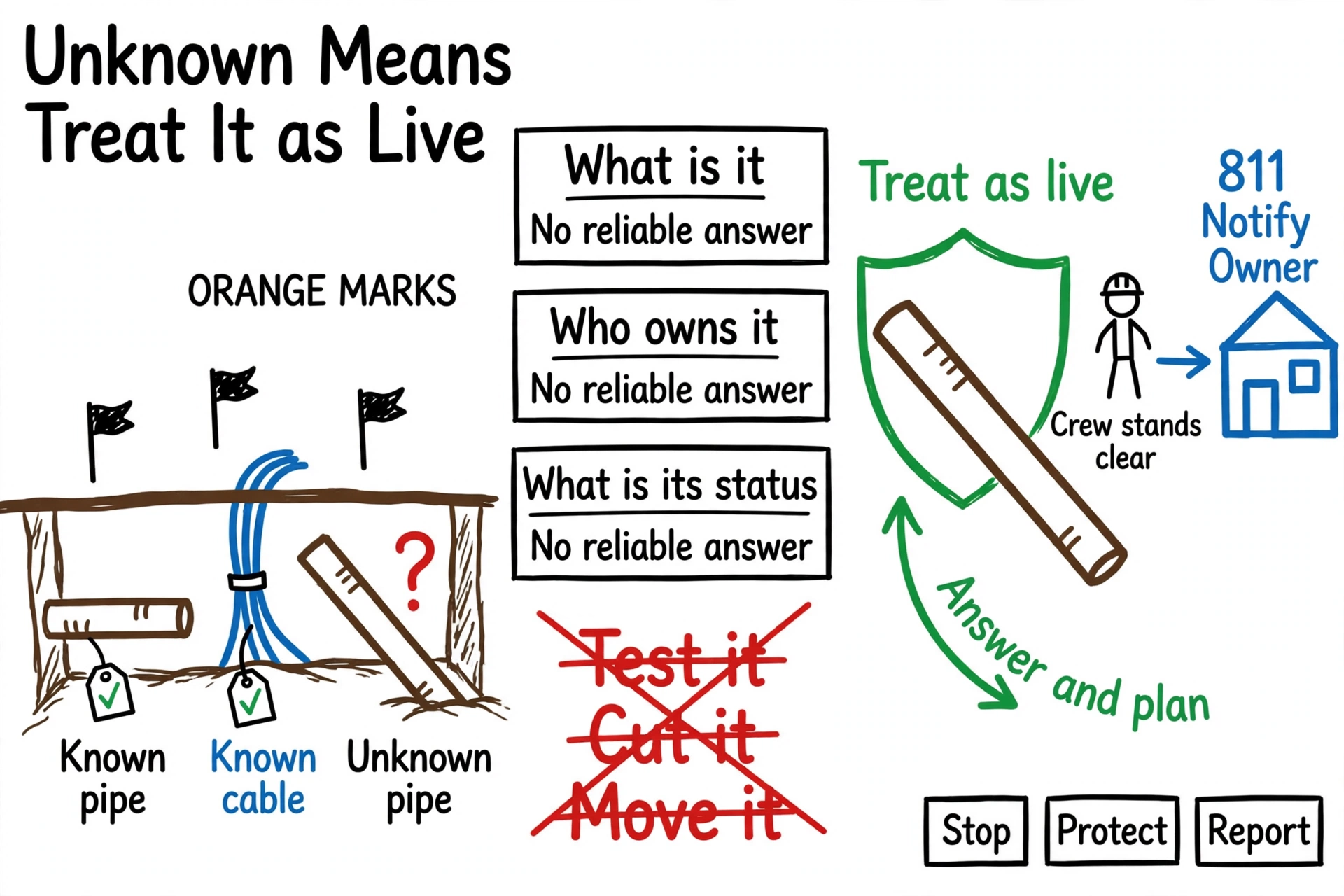
Three questions sit at the center of this lesson. First, what is it? That is the identity question. Is the object a gas pipe, an electric cable, a water line, a sewer line, a communications cable, a conduit, or something else? Second, who owns it? That is the owner question. Which company, agency, or person holds the records for it and can speak for it? Third, what is its status? That is the status question. Is it active, idle, or abandoned, using the meanings covered in Lesson 55?
Reliable information means information the project can check and file. Examples include a facility owner statement tied to the specific facility and location, a locate ticket and positive response record for the work area, project plans that name their source, and a documented subsurface utility engineering investigation that states how each location was obtained. A guess, a rumor, a memory offered at the tailgate, and a line that looks familiar are not reliable information. They may be useful as a lead for a question. They are not an answer.
An unknown utility is what you have when one or more of those three questions cannot be answered from reliable information. You do not need all three questions to fail. If you can see that an object is a pipe but you cannot establish whose pipe it is or whether it carries anything, it is unknown for field purposes. If a plan labels a line but the line you expose does not match the plan in position, size, material, or direction, the match is unproven and the exposed facility must be handled as unknown until the mismatch is resolved. Unknown is a working classification for how you behave. It is not a claim that nobody in the world knows the line. It is an honest statement that this project, at this moment, does not have a reliable answer.
Hold one rule in mind from the start, because every section returns to it. Treat an unknown facility as live. Live, also called active or in service, means connected to a working system and carrying, or ready to carry, its service. You treat the unknown as live not because you know it is live, but because you do not know that it is not. That single habit is what keeps an information problem from becoming an injury, an outage, or a damaged facility.
What Is It?
An unknown utility is a facility whose identity, owner, and status cannot be established from reliable information available to the project. The definition has three parts, and each part matters. Identity means what kind of facility it is and what service, if any, it was built to carry. Owner means the company, agency, or person who owns or operates it and holds its records. Status means whether it is active, idle, or abandoned, as those words were defined in Lesson 55. When reliable information cannot establish those points for the specific facility you found, in the specific place you found it, the facility is unknown.
Unknown is a knowledge condition, not a physical condition. Two identical pipes can sit side by side in the same trench. One may be fully documented, marked, and confirmed by its owner. The other may be unknown, because no record, mark, or owner statement accounts for it. The soil does not label them. Only the information around them differs. That is why this lesson spends so much time on records, tickets, and questions, and so little time on tricks for identifying a line by looking at it. Looking can describe a facility. Looking cannot, by itself, establish identity, owner, and status to the standard a crew should act on.
Unknown is different from abandoned, and the contrast is the most important distinction in this lesson. An abandoned facility, as Lesson 55 explained, rests on an owner statement. The owner has said, in a form the project can rely on and file, that the specific facility is permanently out of service and will not be returned to service. Common industry definitions reflect that owner decision. For example, the Michigan Damage Prevention Board defines an abandoned facility as a permanently out of service underground facility which the facility owner or operator has no intention of placing into service in the future. An unknown facility has no such statement behind it. Nobody with authority over the facility has confirmed what it is or what state it is in. If there is no owner statement, there is no confirmed abandonment, and there is also no confirmed identity to work from. The correct field classification is unknown, and the correct behavior is to treat it as live.
Unknown is also different from idle. An idle facility is a facility an owner identifies as not currently in use in one of two situations. In the Michigan definition, it is either a portion of a facility that is not in use but is still connected to a facility that is in use or still carries service, or a new facility that has not yet been connected to any existing facility. Ohio guidance adds that an idle facility is typically still connected to active facilities, is not pressurized or energized, is shut off by a switch or valve, and is planned either for reuse or for later abandonment. Idle is a status an owner confirms. For gas and hazardous liquid pipelines, federal pipeline rules do not recognize idle as a formal status, and a pipeline that is not properly abandoned is treated as active. Ohio guidance states that idle facilities shall still be located by their owners. Michigan guidance takes a different route on the same point: the owner should provide information about abandoned or idle facilities in the ticket scope, and any abandoned or idle facility that is located and marked, or exposed during excavation, is to be treated as active. An idle facility has a known owner who can speak for it, even if the facility is not carrying service today. An unknown facility may turn out to be idle once the owner is found, but until the owner is found and answers, the crew does not know that. Do not borrow the word idle to make an unknown line sound safer. Idle is a status an owner confirms. Unknown is the absence of that confirmation.
Unknown overlaps with two locate words, but it is not the same as either of them. Unmarked means no marks on the ground account for the facility. A facility can be unmarked for many reasons. It may be a private facility outside the public locate system. It may belong to an owner who was not notified. It may sit outside the area described on the ticket. It may have been missed. It may have no record at all. Unmarked describes the marks. It does not describe the facility itself, and it does not make the facility abandoned or safe. Mismarked means marks exist but they are wrong, incomplete, or do not match the facility that is found. The Common Ground Alliance, usually shortened to CGA, addresses this case in Best Practice 5-21, titled Mismarked Facilities. That practice covers both a marked facility that is not found where it was marked and an unmarked facility that is found during work. In both cases the response starts with stopping in the vicinity and notifying the owner directly or through the 811 center. An unmarked or mismarked find often becomes an unknown find, because the mismatch breaks the link between the paperwork and the ground. Treat the overlap practically: if the marks and the ground disagree, you no longer have reliable information, so you handle the facility as unknown until the owner resolves the disagreement.
Unknown also differs from a known facility with an approximate location. Many known facilities are depicted from records or from surface detection methods that give an approximate horizontal position and no confirmed depth. Approximate is not the same as unknown, provided the identity and owner are established and the project understands the limits of the location information. The subsurface utility engineering section later in this lesson explains those limits through quality levels. The line into unknown is crossed when the approximation is so poor, or the mismatch is so large, that you can no longer honestly say the record describes the facility you found. When in doubt, report the doubt. A reported doubt costs a question. An unreported doubt can cost a strike.
One more category belongs here, because it produces many unknown finds. A private facility is a facility owned by a property owner or another private party rather than by a member utility in the 811 system. Examples commonly given in state 811 and private locating guidance include a power run from a house to a detached garage, a gas line from a meter to a pool heater or grill, a water line beyond the meter, irrigation lines, yard lighting circuits, a private sewer lateral or septic line, and communications cables on a private campus beyond the service point. The 811 notification system notifies member facility owners. It generally does not locate private facilities beyond the meter, demarcation point, or service connection, although the exact boundary varies by service, owner, and state and must be verified on the specific project. A private facility is not automatically unknown. If the property owner documents it and answers for it through the project channel, it can become known. On many older properties, however, nobody documented the private lines, owners changed, and records were lost. Those undocumented private lines are unknown facilities in every practical sense, and they are a recurring source of surprises in residential and older commercial corridors.
Who can turn an unknown facility into a known one? The facility owner or operator, once identified, can confirm identity and status from its records and its own field methods. A subsurface utility engineering provider or a private locator, working within the scope the project gives them, can gather additional evidence about position and characteristics using records research, surface feature survey, geophysical designating, or careful exposure. The project engineer and the project owner can decide how the new work will avoid or cross a facility once its identity is established. Notice who is missing from that list. The excavator, the bore operator, the inspector, and the person who found the facility do not resolve an unknown by testing it, cutting it to look inside, or moving it to see where it goes. Identification methods that damage, energize, pressurize, open, or disturb a facility belong to the owner of that kind of facility, working under the rules for that kind of facility. This lesson gives no such methods, deliberately.
What Does It Look Like?
An unknown utility has no single look, because unknown describes missing information, not a material or a color. An unknown facility can look like any facility in Lessons 47 through 54, and it can also look like a fragment, a stub, or an object so altered by age and damage that its type is not obvious at all. Read this section as a catalogue of common presentations and what each presentation does and does not prove.
In an open trench, a bore pit, or a test hole, one common presentation is an extra facility. The plan and the marks account for a set of lines, and the excavation reveals one more. It may run parallel to the known lines, cross them, or run alone on an alignment nobody described. It may be a pipe, a cable, a conduit with cable inside, an empty conduit, a duct bank, or a direct buried line with no conduit around it. Extra is a signal, not an identification. Count what you found, describe it, and compare it with the ticket, the marks, and the plan before anyone assigns it a name.
A second presentation is a facility that almost matches. A cable is found near the marked position but is a different size than the plan states. A pipe is found on the right alignment but made of a different material than the record describes. A conduit is found at a depth or in a direction that does not fit the drawing. Almost matches are dangerous because they invite a crew to force the record onto the ground. Resist that invitation. A mismatch in size, material, direction, or position may mean the record belongs to a neighboring facility, that the record is wrong, that grading changed the ground above the line, or that you have found a different facility entirely. Until the owner or the project engineer resolves which explanation is true, the found facility is not reliably identified.
A third presentation is a fragment or an ending. A cable or pipe ends inside the excavation, cut, broken, capped, plugged, or simply stopping at the edge of the dig. A stub rises from the ground and connects to nothing visible. A conduit emerges from a trench wall and disappears into the other wall with no structure at either end within the work area. An ending tells you where the visible portion stops. It tells you nothing reliable about the other end, about connections beyond the excavation, or about status. Lesson 55 covered this point for abandoned plant, and it applies with even more force here: a cut gas service can remain connected at the main, a cut electric cable can remain fed from the other direction, and a cut communications cable can still carry service on another segment.
A fourth presentation is an object whose type is genuinely unclear. Corrosion can hide whether a round object is a steel pipe, a conduit, or a cable with a metal sheath. A plastic pipe can belong to water, gas, irrigation, sewer, or conduit service, and color in the ground is not a reliable guide to which service it belongs. The APWA color code governs temporary surface marks. It does not certify the identity of a pipe or cable found in the ground. A concrete or clay structure can be a sewer, a storm drain, a culvert, or an old duct structure. When the type is unclear from safe observation, say so in plain words. Writing pipe, type unknown, is honest and useful. Guessing gas or water in the report to sound decisive is neither.
Above ground, unknown facilities often announce themselves through orphan features. An orphan feature is a visible utility feature that no known facility explains. Examples include a pedestal with cables that no record accounts for, a valve box or meter base with no matching service in the plans, a manhole or handhole that does not appear on any drawing, a riser on a pole that enters the ground on an alignment nobody marked, a pipeline marker for a line that is not on the ticket responses, and a vent, cleanout, or junction box whose system cannot be traced in the records provided. An orphan feature does not prove a buried line is present at a specific spot. It proves the records for the area are incomplete, which raises the care level for all digging nearby.
In structures such as manholes, handholes, and vaults, an unknown presentation can be an unidentified cable racked on the wall, a duct entering the structure that no duct record lists, or a splice case with no tag and no record. You cannot tell from one structure where that cable goes, what it carries, or whether another segment of it is in service. Observe, photograph, and report from the structure opening in the normal safe manner for that structure. Do not open, move, or test the unidentified plant to satisfy curiosity.
Marks, or the lack of them, are part of the look but they need careful reading. The locate marks on the ground use the American Public Works Association uniform color code, under which orange is used for communications, red for electric, yellow for gas and similar materials, blue for potable water, and green for sewer and drain, with other colors for other purposes. Those colors describe what a locator marked. The absence of a color over a found facility means no locator marked that facility in that color. It does not identify the facility, and it does not clear it. In particular, never reason backward from silence. No orange marks does not mean no communications lines. No yellow marks does not mean no gas. Silence can mean no facility, a private facility, a missed facility, an unrecorded facility, or a ticket problem, and only follow up through the owner and the 811 center can sort out which.
Finally, notice what an unknown facility never looks like. It never looks proven safe. There is no jacket color, pipe material, age, depth, emptiness, or stillness that certifies that a facility carries nothing and is connected to nothing. An empty looking conduit may be a spare for future use. A dry looking pipe may be connected to a pressurized system beyond a closed valve. A cable that carries no signal a crew can notice may still be energized for power or may carry communications service the crew has no way to observe. Appearance supports a description for your report. It never supports a decision to handle the facility as harmless.
What Does It Do?
An unknown utility might do any job a utility does, or it might do nothing at all. That range is the point. Until its identity and status are established, you cannot honestly say what it does, and you must plan as if it does the most consequential job its type could do. If it might be an electric cable, plan for an energized cable. If it might be a gas pipe, plan for a pipe that could contain gas under pressure. If it might be a water or sewer line, plan for a line that could flood an excavation or carry contaminated water. If it might be a communications cable, plan for a cable whose loss could cut service, including service people rely on in emergencies. Planning for the serious case is not alarm. It is the only position the evidence supports.
That said, unknown facilities do several predictable things to a project, even before anyone learns what they are. Naming those effects helps you explain to a crew or a customer why a pause for an unknown line is productive work and not wasted time.
First, an unknown facility stops the assumption that the corridor is understood. Design, locating, and subsurface utility engineering all build a picture of what is underground. An unknown find proves the picture has a hole in it, at least in that spot. Other holes may exist nearby. Care rises across the surrounding work area and all nearby facilities are rematched against the marks and the plan. Treat one unknown find as a warning that the records for the surrounding area may have other gaps, and work on that basis until owners answer otherwise. A single unknown find should therefore raise attention across the surrounding work area, not only at the exact point of discovery.
Second, it interferes with the work physically. A facility in a bore path occupies space the bore needs. A facility crossing a trench controls how the trench can be dug, shored, and backfilled. A facility near a structure excavation controls where equipment can sit and where spoil can be placed. Even if the facility later proves to be retired plant that the owner allows the project to work around under a written plan, the project cannot design that workaround until it knows what the facility is. Unknown plant is an unpriced, undesigned conflict, and construction cannot proceed through an undesigned conflict on hope.
Third, it degrades confidence in nearby known information. If one unrecorded line exists in a test hole, the crew should ask whether the recorded lines in the same hole have been matched correctly. Crews have exposed two similar cables, assumed the first was the marked one, and measured the wrong one for the record. An unknown find is therefore also a quality check on the known finds around it. Recompare every facility in the exposure against the plan and the marks, and document which physical facility each record now refers to.
Fourth, while it remains unknown, it carries the full risk range of its possible types. That is not a figure of speech. An object that could be a gas pipe or an electric cable carries gas and electric risk until those possibilities are ruled out by the owner or by a qualified investigation the project directs. Risk does not shrink because the crew is busy, because the object looks old, or because striking it would be inconvenient. Risk shrinks when reliable information grows. That relationship is the practical reason identification work, meaning owner questions, records research, and properly scoped field investigation, is real progress even when the bore is paused.
So the honest summary is this. Nobody knows what an unknown utility does for a living. What it does to your project is clear: it reveals a gap in the record, blocks the path as an undesigned conflict, lowers confidence in nearby matches, and holds the full risk of its possible types until an owner answer or a proper investigation replaces unknown with known.
Where Does It Fit?
Unknown utilities fit into fiber construction at the points where records, locating, and the ground meet, because they are created by the gaps between those three sources. Seeing where they fit helps you prevent some of them, prepare for the rest, and respond in the right order when one appears.
In project planning, unknown utilities fit into records research. Before design is final, the project gathers utility records, prior plans, permit records, and owner maps for the corridor. In subsurface utility engineering language, information that comes only from existing records or recollections is the weakest grade of utility information. The ASCE 38 standard, maintained by the American Society of Civil Engineers, calls that grade Quality Level D. Planning that rests only on Quality Level D should expect surprises, especially in older corridors, in corridors with many owners, and on properties with a long history of private work. Good planning names that expectation in advance, budgets test holes and coordination time for it, and never presents a records based drawing as a guarantee that the ground contains nothing else.
In design, unknown utilities fit into the conflict list as an open risk. A designer can list known facilities, show their depicted positions, and assign each depicted position a quality level that states how the information was obtained. The designer cannot list a facility nobody knows about. What good design can do is reduce the unknown area: survey visible surface features and correlate them with records, which is Quality Level C under ASCE 38, and use appropriate surface geophysical methods to designate the horizontal position of detectable facilities, which is Quality Level B. Those steps find many facilities that records alone miss. They do not find everything. Geophysical methods have limits that depend on material, depth, soil, congestion, and access, and a facility that cannot be detected by the methods used remains undetected. Design documents should state the methods used and their limits, so construction does not inherit false confidence.
In the locate stage before excavation, unknown utilities fit into the 811 process as its known blind spots. The excavator notifies the 811 center, member owners respond, locators mark their facilities, and positive response systems, where a state uses them, let the excavator check which owners have responded and how. Federal law adds an employer duty underneath that state process. OSHA standard 29 CFR 1926.651(b) requires that the estimated location of utility installations that may reasonably be expected to be encountered be determined before an excavation is opened, that utility companies or owners be contacted and asked to establish the locations of their installations, that the exact location be determined by safe and acceptable means as excavation approaches, and that while the excavation is open, underground installations be protected, supported, or removed as necessary to safeguard employees. Nothing in that federal rule promises that contacting owners will reveal every facility. Private facilities, unrecorded facilities, and facilities owned by parties who were not notified can still be present. The rule tells the employer to do the contacting and the careful exposure anyway, and to protect whatever is found. Unknown finds are the case that rule anticipates when it requires protection for installations in an open excavation. The same paragraph adds a limited proviso. When utility companies or owners cannot respond to a request to locate installations within 24 hours, unless a longer period is required by state or local law, or cannot establish the exact location of the installations, the employer may proceed, provided the employer does so with caution and provided detection equipment or other acceptable means to locate utility installations are used. That proviso is part of the federal rule. The project rule in this lesson, to proceed near an unknown facility only on a revised plan or owner direction, is a stricter project practice and is not a quotation of OSHA.
In construction, unknown utilities fit at the moment of discovery, and the sequence at that moment is the operational heart of this lesson. CGA Best Practice 5-21 describes the industry pattern: when an excavator finds an unmarked or inaccurately marked facility, excavation stops in the vicinity of the facility and notification takes place. The excavator notifies the facility owner or operator directly or through the 811 center. Following notification, work may continue only if it can be performed without damaging the facility, unless state or provincial law says otherwise, and the excavator plans the work to avoid damage and protects facilities from damage. State law and state 811 guidance add their own notice steps, timelines, and ticket types for this situation, such as a second notice, a damage or discovery notice, or a request to have the facility located. Those state details vary and must be verified for the state where the work occurs. The shape of the response does not vary. Stop in the vicinity. Protect the facility. Notify through the 811 process and the project channel. Document. Proceed only on a plan that avoids damage or on direction from the owner and the project.
In subsurface utility engineering, unknown utilities fit at the top grade of investigation, with an important limit. Quality Level A under ASCE 38 is the grade obtained by actually exposing a facility, usually by careful hand digging or vacuum excavation at a specific point, and measuring its precise position and characteristics at that point. Exposure can turn an unknown object into an observed object with a measured position, a size, a material, and a direction. That is valuable, and it is often the step that lets an owner recognize its own facility. But observe the limit carefully. Exposure at a point proves what is at that point. It does not, by itself, prove who owns the facility, whether it is connected elsewhere, or whether it is in service. A test hole is often called daylighting, because the facility is brought into daylight for measurement. Daylighting improves location knowledge to the highest grade. It does not replace the owner question about identity and status. Crews who understand that limit use exposure as evidence for the owner, not as a substitute for the owner.
In your daily role, whether you are on the crew or inspecting the work, unknown utilities fit into a short routine that you will see repeated in this lesson. Notice the find and stop work in the immediate area. Keep people and equipment clear of the facility. Protect it from further contact, falling material, and traffic. Report it at once to the foreman, the inspector, or the project coordinator, whoever your project designates. Record what you observed without disturbing the facility to get more information. Ask the identification question through the 811 process and the project channel. Wait for the answer and the revised plan. Write the answer into the project record. That routine is the whole job, and doing it completely is a skilled contribution, not a delay tactic.
Why Does It Matter?
It matters, first, because an unknown facility concentrates the worst combination in excavation work: real hazard with no reliable information to manage it. A known gas main is hazardous, but the project knows its owner, its approximate position, its tolerance zone under state law, and the owner requirements that apply around it. An unknown object that might be a gas main has the same possible hazard with none of that structure around it. No owner to call on a posted number, no confirmed tolerance zone, no known material or size beyond what can be observed, and no plan written for it. The less you know about a facility, the more distance, care, and time it deserves. Unknown reverses the instinct to hurry. The correct response to missing information is more caution, not less.
It matters, second, because state 811 guidance states the live rule for exposed unmarked utilities in plain words, and crews should hear those words directly. South Carolina 811 guidance tells excavators that if they expose an unmarked utility, they should treat it like it is live and enter a further request to have the facility located. National Grid safe excavation guidance, summarizing the site check step, tells excavators to look for aboveground signs of utilities that have not been marked, and states that if unmarked facilities are found, digging stops and 811 and the facility operator are notified, and it adds two sentences worth memorizing: never assume an unmarked utility line is abandoned, and always assume lines are in use and present a potential danger. Those are not cautious suggestions from a textbook. They are the operating instructions of the damage prevention system, written for the exact moment this lesson describes.
It matters, third, because the cost of a wrong guess is asymmetric, as Lesson 55 showed for abandoned plant. If a crew treats a retired, empty facility as live, the cost is a pause, a notification, some photographs, and a plan adjustment. If a crew treats a live facility as an unknown it can test, cut, or move aside, the possible costs include injury or death from gas or electric contact, a fire or an evacuation, a flooded excavation from a water line, a sewage release, a communications outage that affects homes, businesses, and emergency calling, repair costs, regulatory reporting, owner claims, and damage to the company record that follows it into future work. No schedule gain available on a single crossing balances that list. When a foreman feels pressure to guess, that pressure is itself a warning sign that the decision is being made on the wrong basis.
It matters, fourth, because unknown facilities are common enough to be a normal part of competent work, not a rare embarrassment. Records are incomplete by history. Corridors accumulate plant from many owners over many decades. Private work was often installed with no record at all. Owners merge, rename, and retire systems, and maps do not always follow. Locating methods detect many facilities and cannot detect all of them. A project that treats every unknown find as a failure to be hidden will hide them, and hidden unknowns become strikes. A project that treats an unknown find as a normal discovery to be reported quickly will resolve most of them with a question and a plan change. Culture decides which of those projects you work on, and every report you file votes for the second one.
It matters, finally, because of responsibility. The excavator who finds an unknown facility did not create most unknowns, but the excavator and the employer own the response. OSHA 29 CFR 1926.651(b) places the duties to determine estimated locations in advance, to contact owners, to determine exact locations by safe and acceptable means as work approaches, and to protect installations while the excavation is open, on the employer. State damage prevention laws place notice duties on the excavator when an unmarked facility is found or when damage occurs or is discovered, and the exact notice, timing, and ticket procedure are set by the state. A crew that stops, protects, and notifies is doing exactly what federal and state frameworks ask. A crew that quietly cuts an unknown line out of the path has left those frameworks entirely, and no one on that crew can point to a rule that authorized the cut.
What Does Good Look Like?
Good practice with unknown utilities starts before the ground opens and continues until the project record can explain every facility that was found. Look for these patterns on a well run project.
Before construction, the project treats records as a starting point, not a finish line. Utility information on the plans states its source and, where subsurface utility engineering is used, its ASCE 38 quality level, so a reader can tell records only information at Quality Level D from designated information at Quality Level B and from exposed and measured information at Quality Level A. Corridors with old development, demolished buildings, or known private work are flagged for extra care. The plan includes a written discovery procedure that every crew member can state: stop in the vicinity, protect, notify through 811 and the project channel, document, and wait for direction. That procedure is discussed before the first excavation, not invented at the first surprise.
During the locate stage, tickets cover the actual work area, responses are checked rather than assumed, and the crew compares the marks against visible surface features before digging. A pedestal, valve, manhole, handhole, vent, cleanout, or marker that no mark or response explains is raised as a question before excavation reaches it, not after. Where the project uses a private locator or a subsurface utility engineering provider for facilities outside the 811 system, the scope of that work is written down, including what it does not cover. Nobody describes a private sweep or a designating pass as proof that no other facilities exist.
In the field, exposure near known and suspected facilities is careful and uses safe and acceptable means as the work approaches, consistent with the OSHA duties described earlier. Test holes and bore crossings are planned so facilities are seen before a bore head or a bucket reaches them. When a facility is exposed, the crew compares it with the plan and the marks one facility at a time. A facility that matches is verified and documented. A facility that does not match, or that has no match at all, is treated as unknown on the spot. Work in its vicinity stops, the facility is protected and supported as needed without moving or opening it, and notification starts the same shift, not at the end of the week.
Good notification is specific. A useful report states the project and ticket number where the project uses one, the precise location of the find in a form another person can return to, the type of work that was under way, what was exposed, its observed size, material, color, direction, and depth where that depth was already safely known from the exposure, the condition of the facility including any damage or suspected damage, photographs with a scale or a known object for size where safe to include, and what work has stopped and what protection is in place. A vague report that says an unknown line was found near the road forces everyone to start over. A specific report lets an owner recognize its facility from its records, which is often how an unknown becomes known.
Good documentation closes the loop. The project record for each unknown find can answer six questions. What was found? Where was it found? What did it look like, in measured and photographed detail? Who was notified, through which channel, and when? What did the owner or the project answer, and who gave that answer? What was done under that answer, and how was the facility left or protected at the end? Status words in the record stay honest throughout. Until an owner answers, the entry reads unknown, treated as live. After an owner answers, the entry names the owner, the date, and the status or direction the owner gave. The record never upgrades an unknown to abandoned, idle, or safe on a crew opinion.
Good practice also protects the facility after identification. Once a facility is known, the project plan states how the new work will treat it: avoid it, cross it with the clearance and method the plan and the owner require, support and protect it in an open excavation, or hold the work until the owner performs its own work on it. The crew executes that plan and no more. If the exposed facility changes character as more of it is uncovered, or if a second unknown facility appears, the discovery procedure starts again. Identification of one line never clears the next line.
What Can Go Wrong?
The failures with unknown utilities follow a small number of patterns. Learn to recognize each pattern as it starts, because each one feels helpful in the moment.
The first failure is testing to identify. A crew member wants to know what a facility is and reaches for a test that touches the facility itself: scratching or cutting the jacket to see what is inside, opening a pipe or a splice case, tapping or striking a pipe to judge by sound or feel, applying a meter or a tracer in a way the person is not qualified and authorized to do on that kind of plant, or checking whether a cable is energized by contact. Every one of those acts risks exactly the event the stop rule exists to prevent. It can release gas or water, expose energized conductors, damage a live communications cable, or destroy the evidence the owner needs to identify the facility. Identification by contact is not a shortcut. It is the hazard, performed on purpose. This lesson authorizes none of it.
The second failure is cutting or moving the unknown out of the way. A bore is ready, a trench is open, and the unknown object is physically in the path, so someone proposes to cut it, pull it, bend it aside, or bury it deeper and proceed. Moving a facility can damage it out of sight, strain a connection beyond the excavation, or shift a live line into the path of the next pass. Cutting needs no further explanation after Lessons 55 and this lesson. If the owner later directs that a section be removed or handled, that work happens under the owner direction and the project plan, with the owner answer on file. It never happens as a field improvisation.
The third failure is naming by resemblance. The object looks like the old communications cable the crew expected, so it is entered in the daily report under that name. The pipe looks like the retired water service on the plan, so the plan note is treated as a match. Resemblance is a hypothesis, and a hypothesis written as a fact corrupts the record for everyone who follows. It also misdirects the notification, because the wrong owner may be asked while the right owner is never notified. Report observations, not conclusions. Describe size, material, color, direction, and condition, and let the identification come from the owner or the investigation.
The fourth failure is assuming the unknown is the only unknown. A crew finds one extra line, reports it well, and then digs the rest of the corridor at full speed on the theory that the surprise is over. Care rises across the surrounding work area and all nearby facilities are rematched against the marks and the plan. Treat one unknown find as a warning that the records for the surrounding area may have other gaps, and work on that basis until owners answer otherwise. Demolished buildings may have had several services. Private installations may have come in sets. Old corridors can hold old laterals, old stubs, and old crossings together. After an unknown find, the correct adjustment is heightened care in the surrounding area and a fresh comparison of marks, features, and records, not relief.
The fifth failure is working around the unknown without a plan. A crew decides on its own to shift the bore a small distance, deepen it, or thread it past the unknown object at close quarters, without owner input and without a revised plan. Working near an unidentified facility at a distance chosen in the field is still working on an undesigned conflict. The crew does not know the facility size beyond the exposed point, its direction beyond the exposure, whether it bends, or whether companions run beside it. Clearances, methods, and crossing designs belong to the project plan and, where the owner requires them, to the owner. A field chosen clearance around an unknown line is a guess wearing a number.
The sixth failure is notification that is late, vague, or sent to the wrong place. A find reported days later may be reported after the excavation is backfilled, after marks are gone, and after the evidence is covered. A find reported only in conversation may never reach the owner or the record. A find reported to a neighbor, a former employee, or a single guessed owner may never reach the party who owns the line. Use the channels the damage prevention system provides: the 811 center for the state, using the ticket type that state provides for an unmarked or discovered facility, and the project channel to the coordinator, engineer, or inspector who owns utility coordination. If damage of any kind has occurred or is suspected, say so in the notification at once. Damage reporting duties and timelines are set by state law and by the owner, and concealing or delaying a damage report compounds a bad event.
The seventh failure is quiet backfill. The unknown facility is covered again with no record, no photograph, and no notification, because the bore missed it and the day ended well. Quiet backfill steals the next crew its warning. The facility remains unknown, now with disturbed soil around it and possibly with unnoticed damage. Every exposed facility, struck or untouched, identified or not, belongs in the project record before the ground closes over it.
The eighth failure is overclaiming what an investigation proved. A designating pass that detected nothing in an area is reported as proof the area is empty. A test hole that found one facility is reported as proof no other facility crosses the trench. A records search that returned no plan is reported as proof no facility was ever built. Each claim goes beyond its method. Geophysical designating detects facilities that respond to the methods used under the conditions present. A test hole proves what is inside that hole. A records search proves what the records hold. Honest reporting states the method, the scope, and the limit together, so the next decision maker inherits the real level of confidence and not an inflated one.
What Should Someone Notice in the Field?
This section turns the lesson into eyes and habits. You are being trained to notice the signals that information is missing, not to supply the missing information by handling the facility.
Notice counts that do not agree. The ticket responses and the marks describe a set of facilities. The plan shows a set of facilities. The open ground shows a different number. Any disagreement in count is a stop and compare signal. Count again, facility by facility, and identify which physical facility each mark and each plan line refers to. The facility left over after that honest matching is unknown, even if it resembles one of the known ones.
Notice surface features with no explanation. Walk the work area before digging and list what you see: pedestals, cabinets, manholes, handholes, valve boxes, meter bases, hydrants, vents, cleanouts, pipeline markers, warning signs, poles with risers, and patches or trench scars in pavement. For each feature, ask which known facility explains it. A feature with no explanation is advance warning of a possible unknown facility, delivered while you can still ask questions cheaply. State 811 and utility safety guidance makes this same check a standard step: look for aboveground signs of utilities that have not been marked before excavation begins.
Notice ground with a past. Demolished buildings, filled basements, old foundations, cleared lots that once held structures, relocated road alignments, and lots whose use changed over time all predict undocumented services. A demolished structure may have been served by some combination of power, water, sewer or septic, gas, and communications, and any service it did have had to go somewhere when the building came down. Which services existed, and how each one was retired, varies by property and must be treated as an open question until an owner answers. Some were formally retired by their owners. Some were cut at the building and left. Ground with a past should be dug as ground with unknowns in it until owners answer otherwise.
Notice private work. A detached garage, a barn, a shop, a pool, a guest house, a gate, yard lighting, an irrigation system, a propane tank, or a second building on the same property implies private runs between structures. Those runs are commonly outside the 811 locate, as the private facility discussion in this lesson explained. Ask the property owner question through the project channel before digging between buildings, and treat any line found there as unknown until the property owner or another responsible owner answers for it.
Notice marks that end, fade, or conflict. A marked line that stops before the work area ends, marks that point to a facility that cannot be found by careful exposure where the marks place it, and marks that conflict with a facility that is found are all mismarked patterns under CGA Best Practice 5-21. Each pattern means the information chain has broken at that spot. Stop in the vicinity, protect what you found or the area you searched, and notify, rather than digging a wider search with powered equipment on the strength of marks that have already proved unreliable there.
Notice direction and companions. When an unknown facility is exposed, observe and record which way it runs, because direction points toward its connections and helps an owner match it to records. Observe whether other facilities run with it in the same trench or duct bank, because facilities are sometimes installed together in a shared trench or duct bank, and one unknown line may have companions beside it. Observe structures it enters or leaves, if that can be seen without opening anything. All of this is observation from the exposure that already exists. None of it requires enlarging the dig, opening the facility, or following it with equipment to see where it goes.
Notice your language, because language drives behavior. Catch phrases like dead line, old junk, just a spare, probably nothing, and the abandoned one when no owner has said abandoned. Each phrase quietly upgrades an unknown into a known, harmless thing, and crews act on the upgraded version. Replace those phrases in your own speech and in your notes with the honest form: unknown pipe, unknown cable, status unconfirmed, treated as live, owner notified. The honest form keeps the next person careful. The casual form gives the next person permission you do not have to give.
Notice pressure, including your own. The bore is loaded, the road closure ends at a fixed hour, the inspector is waiting, and the unknown line is in the way. Pressure does not change what the facility is. It changes only what a mistake will cost, because hurried work near an unknown facility is more likely to contact it. When you feel the day pushing you toward a guess, treat that feeling as field information: this is the moment the procedure exists for. Stop, protect, report, notify. Those four verbs fit on an index card, and they are the practical whole of this lesson.
Carry a short routine for any unknown find. Stop work in the immediate area and keep equipment, spoil, and foot traffic clear of the facility. Protect the facility from damage while the question is open, and support it as needed in an open excavation without moving or opening it. Tell the foreman or inspector at once. Record the location, the observed size, material, color, direction, and condition, the depth only if it is already safely known from the exposure, and photographs that show the facility in place. Notify through 811 and the project channel, stating clearly that an unmarked or unknown facility was found and whether any damage is known or suspected. Write every answer, the answering organization, and the date into the project record. Proceed only on the plan or direction that follows, and recheck the surrounding area with fresh care, because one unknown rarely travels alone.
Practical Example
This example is hypothetical. The people, the project, the addresses, and the companies are invented to teach the decision sequence. Any resemblance to a specific real job is unintended.
Hypothetical example. A fiber crew is building a new underground route along the side street of an older mixed use block. The work is a directional bore for new conduit, with test holes at the planned utility crossings. The locate ticket for the work area has been answered by the member owners. The marks show a communications line, a water main, and an electric line in the corridor. The plan, built from owner records and a designating pass, shows the same three facilities and assigns the depicted positions Quality Level B, meaning the positions came from surface geophysical designating. No private locating was scoped for the block, because the parcels were thought to be served only from the street. That assumption is about to be tested.
At the second test hole, the crew exposes the marked water main where expected. Below and to one side of it, the careful exposure also uncovers a plastic pipe that no mark, plan line, or ticket response accounts for. The pipe runs diagonally, heading from the street side toward the rear of a parcel where a small commercial building stood years ago and was demolished. The parcel is now a gravel lot. The pipe has no tracer wire visible in the exposure, no tape above it that the crew can see, and no structure at either end inside the test hole.
The bore operator offers three quick identifications in one breath. It is probably the old water service to the demolished building. It might be a gas service, because the building likely had gas. It could be an irrigation line for the lot, although the lot has no landscaping. Each guess points to a different owner, a different hazard, and a different next step, which is itself the proof that none of them is an identification. The inspector stops work in the vicinity of the test hole. The exposed pipe is protected, the hole is kept open and guarded, and no one taps, cuts, or moves the pipe to gather more clues.
The report that goes out that morning is built from observations only. It gives the project name and ticket number, the test hole location described so another person can find it, the observed pipe described by size range in plain words, material appearance, color, direction, and depth as already known from the exposure, its position relative to the marked water main, photographs of the pipe in place, and a statement that its identity, owner, and status are unknown and that it is being treated as live. It also states that no damage is known. The notification goes through the state 811 center using the process that state provides for a discovered unmarked facility, and in parallel through the project channel to the coordinator who owns utility coordination for the job.
The coordinator widens the question instead of guessing a single owner. The gas owner and the water owner are both asked, with the photographs and measurements attached, whether the pipe is theirs. The property owner of the gravel lot is asked, through the project, what private services served the demolished building and what records exist. The design provider is asked to review the designating data for the block and to state whether the pipe could have been missed by the methods used, and why. Work on the bore is rescheduled to a later crossing where the information is complete, so the crew day is rearranged rather than lost.
The answers arrive over two days and they arrive in pieces. The gas owner states that its records show a gas service to the demolished building was retired under its own process years earlier, on an alignment along the front of the parcel, and that the exposed diagonal pipe does not match that service in position or direction. The water owner states that the diagonal pipe does not match its recorded service either, and that its service entered from a different street. The property owner then produces an old site plan from the building sale file. The plan shows a private line running diagonally from a neighboring parcel, installed to feed an outbuilding that was removed even earlier than the main building. The private line was never recorded with any utility, never marked through 811 because it was private, and nobody involved in the current project knew it existed. The property owner, as the owner of that private facility, provides a written statement through the project about what the line was built to carry and what the property records show about its disconnection, and the project engineer decides how the new bore will treat the physical pipe that remains in the ground. Only at that point does the project record change the entry. It no longer reads unknown. It reads identified as a private facility by its owner, with the owner statement, the old site plan, and the engineer direction all filed, and with the physical handling at the crossing governed by the revised bore plan.
Notice what the crew never did. They never tested the pipe to see what was inside it. They never cut it to confirm it was empty. They never moved it out of the bore path on a guess. They never accepted the first plausible story, even though the first story, an old service to a demolished building, was close to the truth in spirit and wrong in every detail that mattered, including which owner could answer for it and which alignment the real services used. Notice also what the investigation did and did not prove. The test hole proved the pipe exists at that point, at that depth, on that direction. It did not prove ownership or status. The owner statement proved identity and status to the standard the project could file. The revised plan, not field improvisation, decided the crossing. That division of work, observation by the crew, identification by the owner, decision by the project, is the correct shape of every unknown utility case.
Key Terms
811 center: The state notification center reached by dialing 811 in the United States, through which excavators notify member facility owners of planned excavation and of discovered unmarked facilities, using the ticket types and timelines the state provides.
Abandoned facility: A facility its owner has confirmed is permanently out of service, with no intention of placing it into service in the future. Ohio guidance adds that an abandoned facility is no longer on the owner active mapping system, has been physically disconnected from the active system, and, if it carried a product, has been purged and depressurized. Abandoned rests on an owner statement the project can file. An unknown facility has no such statement.
Active or live facility: A facility that is connected to a working system and is carrying, or is ready to carry, its service, such as voltage, gas, water, or signal. Unknown facilities are treated as live until an owner establishes otherwise.
Designating: In subsurface utility engineering, the use of appropriate surface geophysical methods to detect a facility and determine its approximate horizontal position. Designating produces Quality Level B information under ASCE 38.
Facility: The general term for any physical piece of utility plant, such as a pipe, cable, conduit, wire, duct, valve, manhole, handhole, or pedestal.
Facility owner or operator: The company, agency, or person that owns or operates a facility and holds its records. Only this party can confirm the identity and status of its facility.
Idle or inactive facility: An idle facility is a facility an owner identifies as not currently in use in one of two situations. In the Michigan definition, it is either a portion of a facility that is not in use but is still connected to a facility that is in use or still carries service, or a new facility that has not yet been connected to any existing facility. Ohio guidance adds that an idle facility is typically still connected to active facilities, is not pressurized or energized, is shut off by a switch or valve, and is planned either for reuse or for later abandonment. Idle is a status an owner confirms. For gas and hazardous liquid pipelines, federal pipeline rules do not recognize idle as a formal status, and a pipeline that is not properly abandoned is treated as active. It is not a word for a facility nobody has identified.
Mismarked facility: A facility whose marks are wrong or incomplete, or do not match the facility that is found. CGA Best Practice 5-21, Mismarked Facilities, covers notification for two related cases together: a marked facility that is not found where it was marked, and an unmarked facility that is found during work. Unmarked remains its own word. It describes the absence of marks only, and it is defined separately in this list.
Positive response: A system, used in many states, through which facility owners report the status of a locate request, so an excavator can confirm which owners have marked, have no facilities in the area, or have not yet responded.
Private facility: A facility owned by a property owner or another private party rather than by a member utility, such as a line beyond a meter or service point serving a detached building, a pool heater, irrigation, or yard lighting. Private facilities are generally outside the public 811 locate and must be verified project by project.
Quality Level: Under ASCE 38, a grade from D to A describing how utility information was obtained. Level D comes from existing records or recollections, Level C adds a survey of visible surface features correlated with records, Level B comes from surface geophysical designating of horizontal position, and Level A comes from actual exposure and measurement at a specific point.
Subsurface utility engineering: The engineering practice of investigating and depicting existing utilities at graded levels of reliability. Often shortened to SUE. Its quality level system is defined in ASCE 38.
Tolerance zone: The area on either side of a marked facility within which state law generally requires extra care and careful exposure methods before powered equipment is used. Its exact width and rules are set by each state and must be verified for the state where the work occurs. An unknown facility has no marked tolerance zone until it is identified and marked.
Unknown utility: A facility whose identity, owner, and status cannot be established from reliable information available to the project. Unknown is a knowledge condition, not a physical type, and every unknown facility is treated as live.
Unmarked facility: A facility for which no locate marks account. Unmarked describes the marks only. It does not establish identity, owner, status, or safety.
Check Your Understanding
Answer each question in your own words before reading the answer key.
- A test hole exposes a pipe that appears on no plan, carries no marks, and matches no ticket response. The operator says it is probably an old irrigation line and wants to move it aside. How should the pipe be classified, and what should happen next?
- What is the difference between an unknown facility and an abandoned facility, and why does that difference control field behavior?
- A crew finds a cable near a marked position, but it is a different size and material than the plan describes. Is the cable identified? Explain your answer in one or two sentences.
- State the four step field rule for an unknown find, in order, and name the two channels a notification should travel through.
- A designating pass under ASCE 38 reports no facility in part of a corridor, and a test hole in that part then exposes a pipe. Did the designating pass fail to do its job, and what does the test hole prove and not prove?
Answer key:
- The pipe is an unknown utility, because its identity, owner, and status cannot be established from reliable information. Work in the vicinity stops, the pipe is protected and left unmoved and unopened, the find is documented from observation, and notification goes through the 811 center process for a discovered unmarked facility and through the project channel. It is treated as live until an owner identifies it and the project issues a plan or direction.
- An abandoned facility rests on an owner statement that the specific facility is permanently out of service with no intention of returning it to service. An unknown facility has no owner statement and no reliable identity or status at all. Because abandoned at least has an owner behind it, while unknown has nothing behind it, an unknown facility can never be handled on crew judgment. It is treated as live, and identification must come from the owner or a properly scoped investigation, not from testing or cutting by the crew.
- No. A mismatch in size and material breaks the match between the record and the ground. The record may belong to a different facility, the record may be wrong, or the found cable may be a different facility entirely. Until the owner or the project resolves the mismatch, the found cable is handled as unknown and treated as live.
- Stop work in the immediate area, protect the facility, report it, and notify. Notification travels through the state 811 center, using the ticket or notice process that state provides for a discovered unmarked facility, and through the project channel to the person who owns utility coordination for the job. Documentation accompanies both, and work near the facility proceeds only on the plan or direction that follows.
- Not necessarily. Designating at Quality Level B uses surface geophysical methods to detect facilities that respond to those methods under the conditions present, and it depicts approximate horizontal position for what it detects. A facility that does not respond to the methods used, or that sits outside their effective scope, can remain undetected without anyone misusing the method. The test hole proves the pipe exists at that specific point with the position and characteristics observed there, which is Quality Level A location information for that point. It does not by itself prove who owns the pipe or whether it is in service. Those points still require the owner.
Lesson Takeaway
An unknown utility is a facility whose identity, owner, and status cannot be established from reliable information, and that missing information is exactly why it must be treated as live. Unknown is not abandoned, because abandoned rests on an owner statement and unknown has none. Unknown is not idle, because idle is a status an owner confirms for a connected facility. Unknown is not cleared by being unmarked, by looking old or empty, by matching a guess, or by sitting in an area where records or designating found nothing. When you find one, your job is complete and specific: stop in the vicinity, protect the facility, report what you observed in precise and honest words, notify through 811 and the project channel, document every answer, and proceed only on the plan that follows. You never test, cut, or move an unknown facility to identify it. Identification belongs to the owner. Your careful observation is what makes that identification possible.
Sources and Technical References
Common Ground Alliance, Best Practices 22.0, Practice 5-21, Mismarked Facilities. Practice statement: the excavator notifies the facility owner or operator directly or through the 811 center if an underground facility is not found where one has been marked, or if an unmarked underground facility is found. Practice description: when an excavator finds an unmarked or inaccurately marked facility, excavation stops in the vicinity of the facility and notification takes place, and if excavation continues it is planned to avoid damage and facilities are protected from damage. Full guide: https://carcga.org/BP_22.0_Web.pdf
OSHA, 29 CFR 1926.651(b), Underground installations. Federal rule: the estimated location of utility installations that may reasonably be expected to be encountered must be determined before opening an excavation, utility companies or owners must be contacted and asked to establish locations, the exact location must be determined by safe and acceptable means as excavation approaches, and while the excavation is open, underground installations must be protected, supported, or removed as necessary to safeguard employees. Text via FindLaw: https://codes.findlaw.com/cfr/title-29-labor/cfr-sect-29-1926-651/ and OSHA inspection guidance: https://www.osha.gov/enforcement/directives/cpl-02-00-087. The same paragraph adds a limited proviso. When utility companies or owners cannot respond to a request to locate installations within 24 hours, unless a longer period is required by state or local law, or cannot establish the exact location of the installations, the employer may proceed, provided the employer does so with caution and provided detection equipment or other acceptable means to locate utility installations are used. That proviso is part of the federal rule. The project rule in this lesson, to proceed near an unknown facility only on a revised plan or owner direction, is a stricter project practice and is not a quotation of OSHA.
American Society of Civil Engineers, ASCE 38, Standard Guideline for the Collection and Depiction of Existing Subsurface Utility Data, quality level system as summarized in secondary sources. Quality Level D from existing records or verbal recollections, Quality Level C from surveying visible surface features and correlating them with records, Quality Level B from surface geophysical designating of existence and horizontal position, and Quality Level A from actual exposure, usually by hand digging or vacuum excavation, giving precise position and characteristics at a specific point. Summaries: https://en.wikipedia.org/wiki/Subsurface_utility_engineering and https://www.usanova.com/blog/what-is-subsurface-utility-engineering/ and https://blog.emlid.com/asce-38-quality-levels/
Michigan Damage Prevention Board, Best Practice 2015-04, Abandoned and Idle Facilities. Defines an abandoned facility as a permanently out of service underground facility which the owner or operator has no intention of placing into service in the future, defines an idle facility as a facility not in use but still connected to a facility in use or still carrying service, or a new facility not yet connected, and states that an abandoned or idle facility that is located and marked, or exposed during excavation, is to be treated as active, and that an excavator who suspects an unmarked facility must give immediate additional notice and stop excavation in the immediate vicinity: https://www.missdig811.org/cm/dpl/downloads/content/10322/Best_Practices_-_Abandoned_Facilities_Final.pdf
Ohio definitions for active, pending, idle, and abandoned facilities, including idle as not currently in service but planned for reuse or later abandonment, typically still connected to active facilities and shut off by a switch or valve, and abandoned as no longer on the owner active mapping system, physically disconnected from the active system, and, for a line that carried product, purged and depressurized: https://oups.org/wp-content/uploads/2026/07/Abandoned-Lines-April-2026.pdf
South Carolina 811 excavator guidance. If you expose an unmarked utility, treat it like it is live and enter a secondary action to have the facility located: https://sc811.com/wp-content/uploads/2024/02/SC811-Excavator_Tri-Fold-2024-Digital-Version.pdf
National Grid safe excavation checklists. Check the site on the planned excavation date, look for aboveground signs of utilities that have not been marked such as meters, pipeline markers, and valves, and if unmarked facilities are found, stop digging and notify 811 and the facility operator. Never assume an unmarked utility line is abandoned. Always assume lines are in use and present a potential danger: https://ngridsafety.com/safe-excavation-checklists/
Northern Lights Locating summary of the American Public Works Association uniform color code for temporary markings. Red for electric, yellow for gas, oil, or steam, orange for communications including telephone, cable, and fiber, blue for potable water, green for sewer and drain, and purple for reclaimed water, irrigation, and slurry. Markings communicate presence and general alignment, not precise depth: http://nllocating.com/apwa-color-codes-for-underground-utilities-what-every-excavator-needs-to-know/
Private facility guidance. Indiana 811 states that public utilities leading up to the meter are located through the 811 system, and that a utility added beyond that point, such as a run from a home to a detached garage or another location, is a private utility and is not located through the 811 system: https://811.safedigindiana.com/?gad_source=5&gclid=EAIaIQobChMIrpr-ye72hQMVIkH_AR2eLwjTEAAYASAAEgIBs_D_BwE and a private locating comparison summarizing that 811 notifies member utilities that mark lines they own up to the meter, main service connection, or property line, while lines beyond that point are the property owner responsibility: https://safesitellc.com/private-utilities-location-vs-811-state-one-call/
Pipeline and Hazardous Materials Safety Administration advisory bulletin clarifying pipeline operational status, via Federal Register text. Pipelines that are not properly abandoned and may be used in the future are considered active for regulatory purposes, whatever informal label such as idled or inactive is applied to them: https://www.federalregister.gov/documents/full_text/html/2016/08/16/2016-19494.html
Items flagged as variable, hedged, or needing verification:
There is no single federal definition of the phrase unknown utility that this lesson could cite. The definition used here is a curriculum working definition built from the three questions a project must be able to answer, identity, owner, and status, and from the way CGA Best Practice 5-21, state 811 guidance, and the abandoned and idle definitions treat a facility with no reliable information behind it. Flagged as a curriculum definition, not a quoted regulatory definition.
State law varies. Notice duties, ticket types for a discovered unmarked facility, response timelines, positive response rules, tolerance zone width, and damage reporting steps are set by the state where the work occurs. The South Carolina and other state examples in this lesson illustrate the shared treat as live and notify pattern. Verify the current statute and 811 center guidance for the project state before relying on any specific procedure or timeline. No state timeline or tolerance width is stated as a universal number in this lesson.
Private facility boundaries vary. The point where a member utility facility ends and a private facility begins differs by service type, by owner, and by state, and is described in sources as the meter, the demarcation point, the service connection, or the property line depending on context. Verify the boundary for the specific service on the specific project. The list of private facility examples is a common examples list from 811 and private locating guidance, not an exhaustive list.
ASCE 38 details. This lesson uses the widely published four level summary of ASCE 38. The current edition of the standard, its exact definitions, and any project specific quality level requirements must be read in the standard itself and in the project specifications before quality levels are assigned contractually. No numeric accuracy value for any quality level is stated in this lesson, because published summaries differ and the standard controls.
Geophysical detection limits. Statements that designating and private locating methods cannot detect every facility are general method limits reported across subsurface utility engineering sources. Whether a specific facility is detectable depends on its material, depth, soil, congestion, and access on the specific site, and can only be assessed by the provider performing that work on that site.
Previous lesson: Lesson 55: What Is an Abandoned Utility? |
Back to Level 3 hub |
Next lesson: Lesson 57: What Is 811?