
Lesson Number and Title
Lesson 156, Level 8: Understand the Underground Pathway
Title: What Is Warning Tape?
Introduction
Warning tape is a wide, brightly colored printed film that a crew buries in a trench above a buried utility line, so a future excavator meets the tape and reads its warning before the digging tool reaches the line below. For fiber and other communications work the tape is orange, and its printed legend, the words repeated along the tape, names the kind of line buried below.
Level 8 studies the underground pathway piece by piece. Lesson 153 taught tracer wire, Lesson 154 taught pull line, and Lesson 155 taught mule tape. This lesson teaches the member that sits in the soil above the pathway itself: what warning tape is made of, how its color and legend carry information, how the detectable form adds a locating function, and how a reader can tell a correct installation from one that will fail the next crew that digs there.
What This Lesson Gives You
- Tell buried warning tape apart from surface barricade tape, from mule tape, and from tracer wire at a glance, from location, construction, and job.
- Read the color and the printed legend on a roll or on tape exposed in a trench and state what kind of utility the tape says is below.
- Explain the difference between non-detectable tape and detectable tape, and name what equipment finds the detectable form from the surface.
- Check tape in an open trench before backfill for the conditions that decide whether it will warn a future excavator, including position above the line, flat lay, continuity, and correct color and legend.
- State the stop decision when tape is exposed during digging, and name the boundary between recognizing tape and being qualified to excavate.
Start With the Basics
Picture a sealed envelope left inside a wall during a remodel, with a note on it that reads: pipes behind this wall, stop and check before cutting. The note does no work while the wall stays closed. Its whole value arrives on the one day someone opens the wall, and on that day it has to be in the right place, still readable, and clear enough to change what the person does next. Warning tape works in the ground on the same principle. It is a note buried on purpose, placed where a future dig will find it in time.
Picture a second envelope made with a thin sheet of metal foil sealed inside the paper. A person with a metal detector could find that envelope through the wall without opening anything. Detectable warning tape carries that same added idea underground. A foil core inside the film lets a locator find the tape path from the surface, while plain tape can only be found by digging down to it.
What Is It?
Warning tape is a buried warning and identification member for underground work. The definitions below build the picture in order.
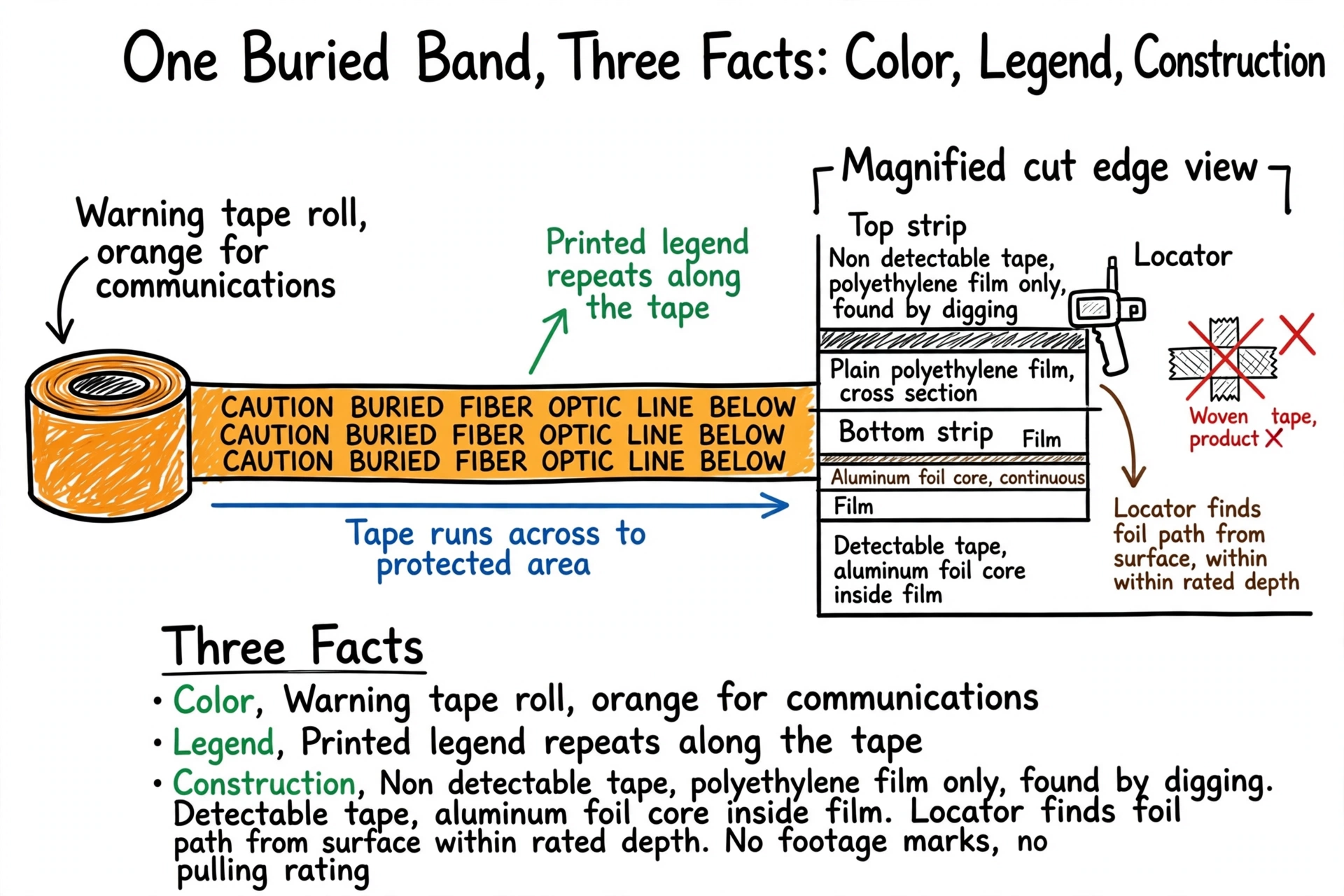
Warning tape defined. Warning tape, also called buried warning tape, underground warning tape, or buried barricade tape, is a printed film placed in the soil above a buried utility during backfill, where backfill is the soil returned to a trench after the line is placed. Presco describes its non-detectable underground warning tape as a tape buried above electrical lines, gas pipes, communication cables, and other utility installations to prevent damage during excavation. 3M sells the same class of product as Scotch buried barricade tape, in non-detectable and detectable series.
Film material. The base material is polyethylene, a plastic film material chosen for burial because it resists soil moisture and soil chemicals. Presco lists its non-detectable tape as a co-extruded polyethylene tape, heavy metal free, that serves as a highly visible proximity warning device. Harris Industries describes its underground tape as non-adhesive polyethylene tape that is impervious to alkalies, acids, and other soil components. T. Christy Enterprises describes its non-detectable marking tape as linear low density polyethylene formulated for extended use underground. The film has to survive in soil for the life of the installation, because the warning is needed years after the trench is closed.
Printed legend. The legend is the warning message printed in a repeating pattern along the tape. 3M product tables pair each tape with a legend such as CAUTION BURIED FIBER OPTIC LINE BELOW on orange tape and CAUTION BURIED ELECTRIC LINE BELOW on red tape. T. Christy states that on its non-detectable tape the legend continually repeats a minimum of every three feet. The legend does two jobs: it tells the excavator to stop, and it names the utility type below, so the stop comes with information about what is at risk.
Color and the APWA code. Tape color follows the APWA Uniform Color Code, the color system published by the American Public Works Association that assigns one color to each kind of underground facility. Under that code, orange means communication, alarm, or signal lines, cables, or conduit. The full code assigns red to electric power, yellow to gas, oil, steam, petroleum, or gaseous materials, blue to potable water, green to sewers and drain lines, purple to reclaimed water, irrigation, and slurry lines, white to proposed excavation, and pink to temporary survey markings. The APWA code began as a system for temporary surface marking with paint and flags, and tape manufacturers state that their buried tape colors meet or follow the same APWA colors, so the color a locator paints on the surface and the color of the tape buried above the line tell the same story.
Non-detectable tape. Non-detectable tape is printed polyethylene film with no metal in it. Presco lists its non-detectable product in widths of 3 inches and 6 inches, with custom widths available, in thicknesses of 4 mil and 6 mil, in APWA colors including orange, where a mil is one thousandth of an inch, the unit used for film thickness. Non-detectable tape warns only when a dig physically reaches it. No locator can find it from the surface, because there is nothing conductive in the film to find.
Detectable tape. Detectable tape is a laminate that carries a metal foil core inside the film. 3M describes its Detectable Buried Barricade Tapes 400 Series as nominal 5 mil tapes constructed of a solid aluminum foil backing with a clear film laminate, and states that the aluminum backing helps make underground assets easier to locate when using a non-ferrous locator. Presco describes its detectable tape as a laminated polyester, foil, and polyethylene blend, with aluminum foil laminated full width between polyester and polyethylene sheeting. T. Christy describes its detectable tape as a five ply composition with a solid aluminum foil core encapsulated within polyethylene backing. Because the foil is conductive along the full length of the tape, a pipe and cable locator or a metal detector can register the tape path from the surface before any digging starts, as long as the tape lies flat and sits within the detectable depth the manufacturer states for its width.
Width and thickness. Width and thickness are product properties stated by each manufacturer for each tape. Presco lists non-detectable tape at 3 inches and 6 inches wide and 4 mil or 6 mil thick. 3M lists its detectable 400 Series at 5 mil thick, in 3 inch and 6 inch widths. Reef Industries, maker of Terra Tape, publishes detectable tape placement guidance that pairs width with burial depth: 2 inch width up to 12 inches deep, 3 inch width up to 24 inches deep, and 6 inch width up to 36 inches deep. That guidance is manufacturer guidance for its detectable product. It explains why wider tape exists for deeper work, and it sets no width rule for other products or other projects.
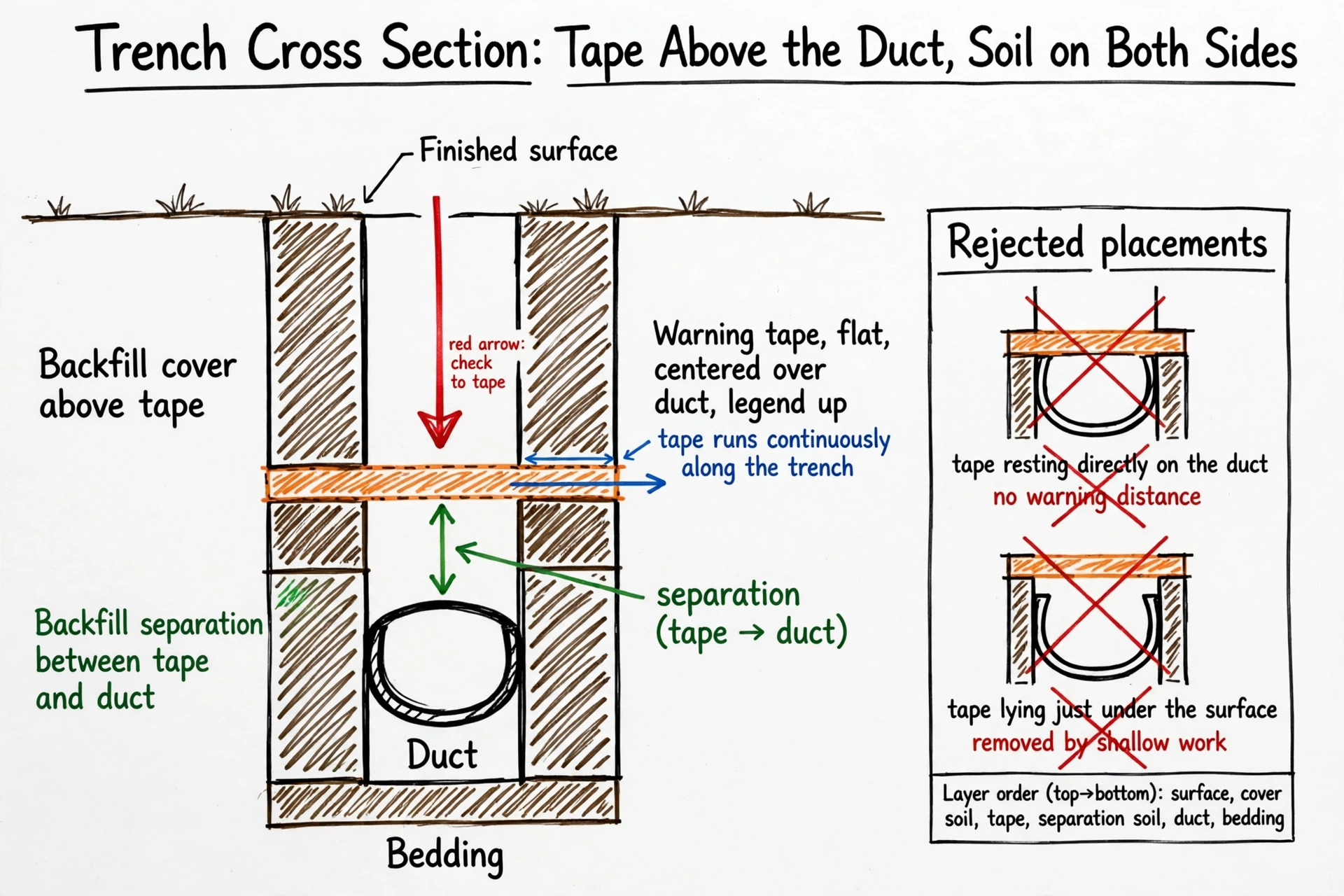
Placement above the line. Warning tape belongs in the trench above the utility it protects, with soil between the tape and the line, so an excavator coming from the surface meets the tape first. How far above the line, and how far below the surface, is set by the project documents, the utility owner requirements, and the manufacturer instructions for the tape in hand. Published examples show the pattern and its range. T. Christy states that its non-detectable tape should ideally be buried approximately 12 to 18 inches below the surface and a minimum of 12 to 18 inches above the pipeline being protected. Harris Industries states that underground tape should be installed 12 to 18 inches below ground level and 12 inches directly above buried pipes, cables, and conduits, before final backfilling. A Pacific Gas and Electric standard for gas pipelines directs 6 inch wide warning tape above the pipeline at least 12 inches below grade and no closer than 12 inches from the pipe, with a stated exception for joint trench work. Each of those figures belongs to its named source and its named work. None of them is a universal rule, and the drawings and specifications for the job in front of a crew govern that job.
Surface barricade tape, separated. Barricade tape in the surface sense is a thin printed polyethylene film strung above ground on posts, cones, or stakes to mark a work area or a hazard for people walking or driving nearby. 3M sells surface barricade tapes such as its 300 Series CAUTION tape for that above ground use. Surface barricade tape and buried warning tape share a film family and a printing style. They differ in location and in job: one stands in the air to control movement today, and the other lies in the soil to warn a dig years from now. Surface tape has no place buried as a substitute for buried tape specified for underground service.
Mule tape, separated. Mule tape is the flat woven polyester pulling tape taught in Lesson 155. It lives inside a duct and pulls cable through the pathway, and it carries a pulling strength rating from its manufacturer. Warning tape lives in the soil above a duct or a direct buried line, carries no pulling rating, and never goes inside a pull. The shared word tape is the only connection, and the two products are never interchangeable in a trench or in a record.
Tracer wire, separated. Tracer wire, also called locate wire, is the insulated conductive wire taught in Lesson 153, placed with a nonmetallic pathway so a locator signal can travel along the wire and trace the route from the surface through access points. Detectable warning tape and tracer wire both help a locator, and they do it differently. Tracer wire is a wire, connected to the locator transmitter at an access point, and its job is locating. Detectable tape is a wide foil bearing film whose first job is the physical warning in the trench, with locating as an added property of its foil core. A project can specify either one, or both, and the record should name which members were actually placed.
What Does It Look Like?
A beginner meets warning tape on a roll at the trench edge, unrolling into an open trench during backfill, and years later in the bucket of a machine or in a hand dug exposure during someone else’s dig. Recognition comes from width, color, legend, and position.
On the roll and at the trench edge:
- A wide flat film roll in a solid APWA color, in the 3 inch or 6 inch widths buried tape is sold in, which overlap the 3 inch width of surface barricade tape, so width alone never separates the two products. Orange is the color for communications and fiber work under the APWA code.
- A bold legend printed in a repeating pattern along the full length of the tape, readable from the trench edge, naming the utility below with wording such as CAUTION BURIED FIBER OPTIC LINE BELOW.
- A smooth polyethylene face with no weave, no sequential footage numbers, and no strength rating printed on it. Footage marks belong to mule tape, and a pulling rating belongs to a pulling member. Warning tape carries neither.
- Packaging or a data sheet naming the product as buried or underground warning tape, stating whether it is detectable or non-detectable, and giving its width and thickness.
In the open trench during backfill:
- A continuous flat band running the length of the trench, centered over the duct or line below, lying flat rather than twisted, folded, or bunched.
- Soil cover between the line and the tape, and soil cover still to come between the tape and the finished surface, matching the separation the project documents call for.
- Legend facing up where the product instructions call for it, so the first person to expose the tape can read it without turning it over.
- Overlaps or splices where one roll ends and the next begins, laid so the band stays continuous with no gap over the line.
Exposed during a later dig:
- A bright band appearing in the soil or in the spoil coming out of a trench or bore pit, well above the depth of the line it protects.
- On a machine dig, tape of the stretch type specified for some work, such as the Terra Tape in the Pacific Gas and Electric and Reef Industries material below, stretches and pulls up in a length rather than snapping cleanly, drawing the operator’s attention. A Pacific Gas and Electric standard describes this behavior for gas pipeline tape: when the tape is exposed and grabbed with excavating equipment, it stretches without breaking, thus alerting the excavator of the facility below. Reef Industries makes the same claim for Terra Tape, stating that when dug up the tape will stretch up and out of the ground in one continuous piece, alerting the operator to stop digging.
- Legend text still readable after burial, in whole or in part, naming the utility type below.
- On detectable tape, a metallic sheen or foil layer visible at a torn or cut edge, showing the laminate construction that plain film does not have.
Conditions that change the look and matter at a glance:
- Tape lying off to one side of the trench, so the band sits beside the line instead of above it.
- Tape twisted into a rope like strand, folded over on itself, or bunched in one spot, narrowing the warning band to a fraction of its width.
- A gap in the run where a roll ended and the next roll was never started, leaving a length of line with no tape above it.
- Wrong color for the utility below, or a legend naming a different utility than the one being installed.
- Tape lying directly on the duct or line with no soil separation, or tape so near the surface that routine grading or shallow digging will remove it long before any deep dig occurs.
What Does It Do?
Warning tape earns its place by interrupting a future dig at the right moment, and by carrying identification that survives burial. Each function works by a plain mechanism.
The tape interrupts the dig before the tool reaches the line. The mechanism is position plus visibility. The tape sits in the soil column directly above the line, at a separation the project documents set. Any excavation that approaches the line from the surface passes through the tape layer first. The bright color registers against brown and gray soil, the film catches on the bucket or the shovel instead of passing unnoticed, and the stretch behavior described by manufacturers gives the operator a visible pull of bright material before the tool travels the remaining separation to the line. The warning only works because the tape is encountered with distance still in hand. Tape placed at the same depth as the line, or below it, warns at the moment of damage or after it, which is no warning at all.
The legend turns a stop into an informed stop. A plain colored band says something is below. A printed legend says what is below and what to do about it. 3M legends state the utility in plain words, such as CAUTION BURIED FIBER OPTIC LINE BELOW, and the APWA color repeats the same identification in code form for anyone who reads colors. An excavator who can name the utility below can make the right next decision: stop machine digging, expose the line by the careful methods the job and the damage prevention rules require, and contact the facility owner or the one call system as the situation calls for. Color and legend agree on a correct installation, and that agreement is itself a check an inspector can make in an open trench.
Detectable tape adds a surface locating function. The foil core in detectable tape is conductive along the length of the run. A non-ferrous locator or metal detector can sense that foil path from the surface and follow the tape line, which follows the utility line beneath it, within the detectable depth the tape manufacturer states for the tape width in the ground. 3M states that the aluminum backing in its 400 Series helps make underground assets easier to locate with a non-ferrous locator. This locating property matters most over nonmetallic pathways, such as plastic duct, that carry no metal of their own for a locator to find. Detectable tape still performs the in trench warning job with its color and legend. The foil adds a second, earlier chance to know the line is there, before soil is disturbed at all.
The film preserves the warning across years in soil. A warning that fades, rots, or dissolves before the next dig is a warning that never arrives. Polyethylene film resists the moisture, acids, and alkalies present in soil, per the Harris and Presco product material, and manufacturers formulate buried tape for extended underground use. Presco states that its detectable tape message is treated so it will not degrade or fade when exposed to alkalis, acids, and other destructive elements underground. Durability is the quiet half of the product: the tape is read once, years later, by a stranger, and it has to be legible on that single reading.
What the tape never does. Warning tape carries no load, protects against no impact by strength, and gives no permission and no exact location. It is a warning layer, one layer among several that include one call notification, surface locating and marking, records, and careful excavation practice under the Common Ground Alliance damage prevention framework. Tape can be displaced, missed on a fast dig, or absent on older installations. Finding no tape never proves that no line is below, and finding tape never states the exact depth or exact position of the line beneath it.
Where Does It Fit?
Warning tape is placed near the end of open trench construction, during backfill, after the pathway is built and inspected. Its working life begins after the trench closes.
- Pathway placement and inspection. The duct, conduit, or direct buried line is placed, bedded, and inspected first. Any tracer wire specified for the run is placed in its specified position during this stage, per Lesson 153.
- Partial backfill to the tape level. Backfill is placed and compacted as the project documents require, up to the elevation where the tape will lie, leaving the specified separation between the line and the tape.
- Tape placement. The crew unrolls the tape continuously along the trench, centered over the line, lying flat, with the correct APWA color and legend for the utility below, and with overlaps at roll changes so no gap remains.
- Final backfill and surface restoration. The remaining backfill covers the tape to finished grade. From this moment the tape is invisible, and the only evidence it exists is the project record.
- Records. The record for the segment can name the tape type placed, detectable or non-detectable, its color and legend, the product, and the separation used, so a future locate or design can account for it. A record that says tape was placed, on a run where it was skipped, teaches the next crew to trust a warning that is not there.
- Future excavation. Years later, any dig over the line meets the system in order: one call marks on the surface first, a locator may find detectable tape or tracer wire next, and the buried tape itself is the last warning inside the soil before the tool reaches the line.
- Bored construction, separated. Tape placement requires an open trench. A bored run has no open trench during installation, so tape cannot be laid above the line in the same way, and bored work relies on the locating and record members the project specifies for that method, such as tracer wire placed with the product. A reader should never assume tape lies above a bored line.
What Is at Stake
A dig in that reaches the line. Fiber duct and cable offer a machine bucket no resistance that an operator can feel in time. A strike can cut service to customers, trigger repair splicing under pressure, and create claims for the damage. Warning tape exists because the last chance to prevent that strike sits inside the soil itself, at the moment the excavator is already committed to the dig.
A wrong color or legend misidentifies what is below. An excavator who reads electric on the tape over a fiber duct, or fiber on the tape over a power conduit, plans the next move for the wrong hazard. Color and legend errors made during a quiet backfill become misinformation delivered to a stranger at the worst moment, with the authority of print behind them.
Missing, gapped, or displaced tape leaves a silent length. A run with tape over nine tenths of its length and a gap at a roll change has a hole in its warning exactly where a future dig may land. Tape pushed to the trench wall during careless backfill leaves the line itself unmarked from above. The failure is invisible once the trench closes, which is why the check belongs to the open trench, before cover.
Tape placed with no separation wastes the warning. Tape resting on the duct is found at the same instant the duct is struck. Tape placed just under the surface is stripped away by grading, landscaping, or shallow work long before a deep excavation occurs, and its absence later can be misread as proof that the corridor is clear. Separation in both directions is what gives the warning its working distance.
Confusing the tape products defeats each product. Warning tape used as a pulling member will fail, because it has no pulling rating. Mule tape buried above a line as a marker carries footage numbers and no warning legend, and tells a future excavator nothing. Surface barricade tape buried in place of specified buried tape substitutes a film that the project never approved for underground service. Each tape in Level 8 has one job, and the stake in keeping them separate is that each job actually gets done.
Records that overstate the installation. Owners, locators, and designers make decisions from as built records. A record claiming detectable tape where plain tape was placed sends a locator hunting for a foil path that does not exist. A record claiming tape on a bored or skipped segment sends an excavator digging with confidence the ground does not support.
What Does Good Look Like?
- The tape product matches the project documents: buried warning tape rated for underground service, detectable where the documents call for detectable, non-detectable where they call for plain film.
- The color matches the utility below under the APWA Uniform Color Code, orange for communications, and the legend names the same utility the color announces.
- The tape runs continuously over the full length of the line, centered above it, with overlaps at roll changes and no gaps, twists, or bunched sections.
- The tape lies flat with the legend readable from above, at the separation above the line and below the surface that the project documents specify.
- Backfill around and above the tape is placed without dragging, displacing, or tearing the band, and the tape position is verified before final cover closes the trench.
- The segment record names the tape type, color, legend, and product placed, and states plainly any length where tape could not be placed, such as a bored section.
From the Field
Picture a two person crew backfilling a duct run across the side lot of a small commercial building. The duct is placed and inspected, tracer wire is in position, and partial backfill has brought the trench up to the level where warning tape will lie. The foreman unrolls orange tape from the reel staged at the trench edge and walks it along the run.
Halfway along the run the roll runs out. The second crew member brings the spare roll from the truck. The spare is orange and the width looks right, and the crew is behind schedule because a delivery truck needs the lot cleared within the hour.
The crew member holds the two roll ends side by side before laying the spare. The legend on the installed tape reads CAUTION BURIED FIBER OPTIC LINE BELOW. The legend on the spare roll reads CAUTION BURIED TELEPHONE LINE BELOW. Both rolls are orange, both are buried warning tape, and the difference is only in the printed words.
The decision sits in front of them before any more soil goes in. Laying the spare keeps the schedule and puts a continuous orange band over the duct, and the words would still warn a future excavator to stop. The words would also name the wrong facility, and the as built record for the segment would either repeat the wrong legend or hide it. Getting the correct roll means a trip to the supply yard and a late handover of the lot.
The crew holds backfill at the tape level, sends for the correct roll, and lays tape with one continuous legend over the full run. The foreman notes the delay and its reason in the daily record, along with the tape product and legend actually placed.
The rule to carry is simple: color gets the stop, and the legend gets the decision right. When the color matches and the words do not, the tape is the wrong tape, and backfill waits until the tape over the line tells the whole truth about what is below it.
What Can Go Wrong?
Tape omitted to save time. A trench closed without tape looks identical to a trench closed with it. The omission surfaces years later, during a dig that receives no in ground warning before the tool reaches the duct.
Tape laid twisted, folded, or bunched. A band twisted into a narrow strand presents a fraction of its printed width to a future bucket. The legend can pass through a dig as a scrap of orange film that no one reads, instead of a band that stops the work.
A gap at a roll change. Two rolls laid end to end with a space between them leave an unmarked window over the line. Continuity is a placement check, made by walking the run before cover, and it cannot be checked at all after cover.
Wrong color or wrong legend. A color that belongs to another utility under the APWA code, or a legend naming another facility, delivers a confident wrong answer to a future excavator. The From the Field scenario shows the mild version of this failure, caught at the trench edge. The severe version is buried and believed.
Tape placed against the line or at the surface. Tape with no soil separation below it warns at the instant of contact with the line. Tape with no useful cover above it is removed by shallow work and weathering long before the deep dig it was placed for. Both placements consume the product and deliver no working warning distance.
Detectable tape expected, plain tape placed. A locator working from records that promise detectable tape will sweep for a foil path, find nothing, and may conclude the corridor is empty. Substitution between detectable and non-detectable product is a record failure as well as a placement failure, and it is never a field decision to make silently.
Tape displaced during final backfill. Soil dropped from height or pushed carelessly can drag a light film band off the line, fold it, or tear it. The tape was correct at placement and wrong at cover, which is why verification happens as the first cover goes over it, and why backfill method around the tape is part of the work.
Tape treated as proof, in either direction. An excavator who treats exposed tape as an exact depth marker can dig carelessly through the remaining separation. An excavator who finds no tape on an older run and treats the absence as clearance can strike a line that was installed before tape was specified, or on a bored section where tape was never placed. Tape informs excavation. It never replaces one call notification, locating, or careful digging practice.
What Should Someone Notice in the Field?
- Name the product in hand as buried warning tape, surface barricade tape, mule tape, or tracer wire before it goes in or over a trench, using construction, printing, and the packaging or data sheet.
- Read the legend in full on the roll, and confirm the color matches the utility below under the APWA Uniform Color Code, orange for communications, with the legend naming that same utility.
- Confirm whether the project documents call for detectable or non-detectable tape, and confirm the roll in hand matches that call by its product name and data sheet.
- Walk the laid tape before cover: continuous over the full run, centered above the line, flat, untwisted, legend readable, with overlaps and no gaps at roll changes.
- Confirm the separation between the line and the tape, and between the tape and the finished surface, matches the project documents, and flag any section resting on the duct or lying near the surface.
- Watch the first cover pass over the tape and confirm the band stays in position as backfill is placed, with no dragging, folding, or tearing.
- Record the tape type, product, color, and legend placed for the segment, and record any length where tape was not placed, including bored sections, in plain language.
- During any later excavation, treat exposed warning tape as a stop signal: stop machine digging at the tape, read the legend, and follow the project and damage prevention procedure for exposing the line below.
- Know the boundary: reading a legend, naming tape products, checking tape position in an open trench, and reporting a gap, a wrong legend, or displaced tape are tasks covered by this lesson. Excavating near a buried line, operating locating equipment as the locator of record, and exposing live facilities belong to qualified people working under the one call system, the project safety program, and the facility owner requirements. Reading this lesson qualifies no one for excavation work, and recognizing warning tape is a different thing from being qualified to dig.
Key Terms
Warning tape: A wide printed polyethylene film buried in a trench above a buried utility, colored under the APWA Uniform Color Code and printed with a repeating legend, so a future excavator meets the warning before reaching the line below. Also called buried warning tape or underground warning tape.
Legend: The warning message printed in a repeating pattern along warning tape, naming the kind of utility buried below, such as CAUTION BURIED FIBER OPTIC LINE BELOW.
APWA Uniform Color Code: The American Public Works Association color system assigning one color to each kind of underground facility. Orange means communication, alarm, or signal lines, cables, or conduit.
Non-detectable tape: Warning tape made of printed polyethylene film with no metal content. It warns only when a dig physically reaches it, and no locator can find it from the surface.
Detectable tape: Warning tape built as a laminate with a solid aluminum foil core inside the film. The conductive foil lets a pipe and cable locator or metal detector register the tape path from the surface when the tape lies flat and within the manufacturer’s stated detectable depth for its width.
Polyethylene: A plastic film material used for buried warning tape because it resists soil moisture, acids, and alkalies during long burial.
Backfill: The soil returned to a trench in layers after the line and its markers are placed, closing the trench to finished grade.
Tracer wire: The insulated conductive wire placed with a nonmetallic pathway so a locator signal can trace the route from the surface through access points, taught in Lesson 153. Also called locate wire.
Check Your Understanding
- How do non-detectable warning tape and detectable warning tape differ in construction, and what does that difference let a crew do?
Answer: Non-detectable tape is printed polyethylene film with no metal in it, so it warns only when a dig physically reaches it. Detectable tape is a laminate with a solid aluminum foil core inside the film, per the 3M 400 Series and Presco detectable product descriptions. The conductive foil lets a pipe and cable locator or metal detector register the tape path from the surface, before any digging starts, when the tape lies flat and within the manufacturer’s stated detectable depth for its width.
- A roll of warning tape is orange. What does the color state under the APWA Uniform Color Code, and what second check keeps the color from being the only identification trusted?
Answer: Orange states communication, alarm, or signal lines, cables, or conduit under the APWA Uniform Color Code. The second check is reading the printed legend in full. Color and legend must agree and must both name the utility actually buried below, because a roll can carry the right color with a legend naming a different communications facility, or the wrong color for the line entirely.
- Why does warning tape belong above the line with soil separation on both sides, rather than resting on the duct or lying just under the surface?
Answer: The warning works only when an excavator meets the tape with distance still in hand. Tape resting on the duct is found at the same instant the duct is struck, so it delivers no warning. Tape just under the surface is removed by grading and shallow work long before a deep dig. The separation above the line and the cover below the surface are set by the project documents, and published manufacturer and utility examples place the tape with soil on both sides for that reason.
- In the From the Field scenario, the spare roll matched the installed tape in color and product type. Why did the crew hold backfill instead of laying it?
Answer: The legend differed. The installed tape read CAUTION BURIED FIBER OPTIC LINE BELOW and the spare read CAUTION BURIED TELEPHONE LINE BELOW, naming a different facility than the duct being buried. The crew held backfill at the tape level, sent for the correct roll, and laid one continuous legend over the full run, because the legend is the part of the warning that tells a future excavator what is below, and a wrong legend buried under a correct color is misinformation with the authority of print.
- A locator sweeps a corridor where the record promises detectable tape and finds no foil signal. Name two explanations the locator must weigh before treating the corridor as clear.
Answer: The record may be wrong, with non-detectable tape placed in substitution for the detectable product specified. The line may also have been placed by a method or in an era with no tape at all, such as a bored section where tape cannot be laid above the line. Absence of a tape signal never proves absence of a line, and the corridor is resolved through the one call and locating process, and records correction, rather than by assumption.
Lesson Takeaway
Warning tape is a message buried on purpose, addressed to a stranger who will open the ground years later with a machine in hand. After this lesson, a roll of tape reads as a set of checkable facts: its color under the APWA code, the exact words of its legend, whether its construction is plain film or foil laminate, and whether it lies flat, continuous, and centered above the line with soil on both sides. A reader who checks those facts in the open trench, and who stops a dig the moment tape appears in one, uses the tape the way it was made to be used.
Sources and Technical References
American Public Works Association, Guidelines for Uniform Temporary Marking of Underground Facilities, APWA Guide. Covers the APWA Uniform Color Code used for temporary marking of underground facilities to minimize damage during excavation, with orange for communication, alarm, or signal lines, cables, or conduit, red for electric power, yellow for gas, oil, steam, petroleum, or gaseous materials, blue for potable water, green for sewers and drain lines, purple for reclaimed water, irrigation, and slurry lines, white for proposed excavation, and pink for temporary survey markings: https://www.apwa.org/wp-content/uploads/APWA-Guide_UniformTempMarkingsNEW-V1-02-25-22.pdf
American Public Works Association, Uniform Color Code sheet. Covers the same APWA color assignments in summary form, including orange for communication, alarm, or signal lines, cables, or conduit, and the direction to use color coded marks to indicate the location or route of buried lines: https://www.apwa.org/wp-content/uploads/Uniform-Color-Code.pdf
3M, Scotch Detectable Buried Barricade Tapes 400 Series, data sheet. Covers nominal 5 mil tapes constructed of a solid aluminum foil backing with a clear film laminate, the aluminum backing helping make underground assets easier to locate with a non-ferrous locator, tensile strength per ASTM D-882, and the product table pairing legends and APWA colors, including Scotch 407 and 409 in orange with the legend CAUTION BURIED FIBER OPTIC LINE BELOW: https://media.ic-find.com/datasheets/df658c22fc9b12e3afcf9202e3446d3d.pdf
3M, Scotch Barricade Tape and Detectable Buried Barricade Tape specification summary. Covers surface barricade tapes in the 300 Series as above ground CAUTION and DANGER tapes, and detectable buried tapes in the 400 Series, including 407 in orange at 3 inches by 1000 feet by 0.005 inch with the legend CAUTION BURIED FIBER OPTIC LINE BELOW: https://pimmedia.winsupplyinc.com/pim/SPEC/092019/_407_05112857780_SPEC.pdf
Presco, Non-Detectable Underground Tape sell sheet. Covers non-detectable underground warning tape buried above electrical lines, gas pipes, communication cables, and other utility installations to prevent damage during excavation, co-extruded polyethylene construction, heavy metal free, serving as a highly visible proximity warning device, roll widths of 3 inches and 6 inches with custom widths available, roll length of 1000 feet, thicknesses of 4 mil and 6 mil, and APWA colors including orange: https://presco.com/media-library/wp-content/uploads/sites/4/2020/06/Non_Detectable_Undergound-Tape-Sells-Sheets.pdf
Presco, Product Specification Sheets, including 4 mil and 6 mil Non-Detectable Underground Warning Tape and Detectable Underground Warning Tape. Covers polyethylene film construction, widths of 3 inches, 6 inches, and 12 inches or made to specification, detectable tape as a laminated polyester, foil, and polyethylene blend with aluminum foil laminated full width between polyester and polyethylene sheeting, and the detectable message treated so it will not degrade or fade when exposed to alkalis, acids, and other destructive elements underground: https://presco.com/media-library/wp-content/uploads/sites/4/2013/10/SpecSheetBinder.pdf
T. Christy Enterprises, How to Specify Underground Marking Tapes, LIT-4022. Covers detectable marking tape located below ground with a non-ferrous metal detector when buried at proper depths, detectable construction as a 5.0 mil five ply composition with a solid aluminum foil core encapsulated within polyethylene backing, non-detectable tape ideally buried approximately 12 to 18 inches below the surface and a minimum of 12 to 18 inches above the pipeline being protected, non-detectable construction as minimum 4.0 mil linear low density polyethylene formulated for extended use underground, and the legend continually repeating a minimum of every three feet: https://tchristy.com/wp-content/uploads/sites/2/2022/10/HowtoSpecify_MarkingTapes_2014.pdf
Harris Industries, Underground Tape catalog page. Covers vivid color coded underground tapes warning excavation crews of buried pipes and cables before damage can occur, non-adhesive polyethylene construction impervious to alkalies, acids, and other soil components, stock and custom legends, APWA recommended color codes, and installation guidance to install tape 12 to 18 inches below ground level and 12 inches directly above buried pipes, cables, and conduits before final backfilling: https://www.harrisind.com/ut.htm
Pacific Gas and Electric Company, Standard L-16, Gas Pipeline Underground Warning Tape. Covers a utility owner standard example for open trench gas work: warning tape installed over gas pipelines, intended for an excavator in the tolerance zone to strike the tape before the pipeline, tape that stretches without breaking when grabbed by excavating equipment and thus alerts the excavator, 6 inch wide tape installed above the pipeline at least 12 inches below grade and no closer than 12 inches from the pipe, with a joint trench exception at a minimum of 6 inches above the pipe, and bright yellow tape marked Caution: Gas Line Buried Below: https://www.pge.com/content/dam/pge/docs/account/service-requests/l-16.pdf
Reef Industries, Terra Tape underground marking tape, ARCAT company listing. Covers Terra Tape as an extrusion laminated underground marking tape in detectable and non-detectable grades for protecting, identifying, and locating buried utilities, color pigmented plastic construction, standard APWA color codes, fiber optic warning tape available in orange, tape that stretches up and out of the ground in one continuous piece when dug up to alert the operator to stop digging, and detectable tape placement guidelines pairing width with depth: 2 inch width up to 12 inches deep, 3 inch width up to 24 inches deep, and 6 inch width up to 36 inches deep: https://www.arcat.com/company/terratape-div-of-reef-industries-inc-39672?pids=203492
Blackburn Manufacturing, Warning Tape product page. Covers the detectable and non-detectable distinction in plain terms: detectable tape has an aluminum foil core that locates with a standard cable locator, non-detectable tape is polyethylene only, polyethylene film resisting soil chemicals, moisture, and mechanical backfill, and standard APWA color codes including orange for telecom: https://blackburnflag.com/marking-tape/warning-tape/
Previous lesson: Lesson 155: What Is Mule Tape? |
Back to Level 8 hub |
Next lesson: Lesson 157: What Are Route Markers?