
Lesson Number and Title
Lesson 155, Level 8: Understand the Underground Pathway
Title: What Is Mule Tape?
Introduction
Mule tape is a flat, woven polyester pulling tape that crews place inside a conduit or duct and use to pull fiber optic, copper, and coaxial cable through underground conduit, with sequential distance marks printed along its length so the tape that pulls the cable also measures the run. Neptco describes its MULETAPE product in those plain terms: flat, woven, polyester tape used for installing fiber optic, copper, and coaxial cables in underground conduit.
Level 8 studies the underground pathway piece by piece. Lesson 154 taught pull line, the light round line placed in a duct to establish a path. This lesson teaches the heavier flat member that often follows it: what mule tape is made of, why its flat shape matters inside a duct, how its printed marks turn a pull into a measurement, and how a reader can tell sound tape from tape that should stay out of a pull.
What This Lesson Gives You
- Tell mule tape apart from pull line and from warning tape at a glance, from shape, material, markings, and job.
- Explain why a flat woven profile spreads pulling load inside a duct, and name the manufacturer sources that describe that behavior.
- Read the printed sequential marks on a tape to state how much tape has entered a run, how much run remains, and how much tape is left to pay out.
- Check a tape and its connection before a pull for the conditions that lower its strength, including knots, wear, and damage.
- State the hold decision when tape marks, tape condition, or a connection raise a question before a pull commits, and name who owns the pulling work itself.
Start With the Basics
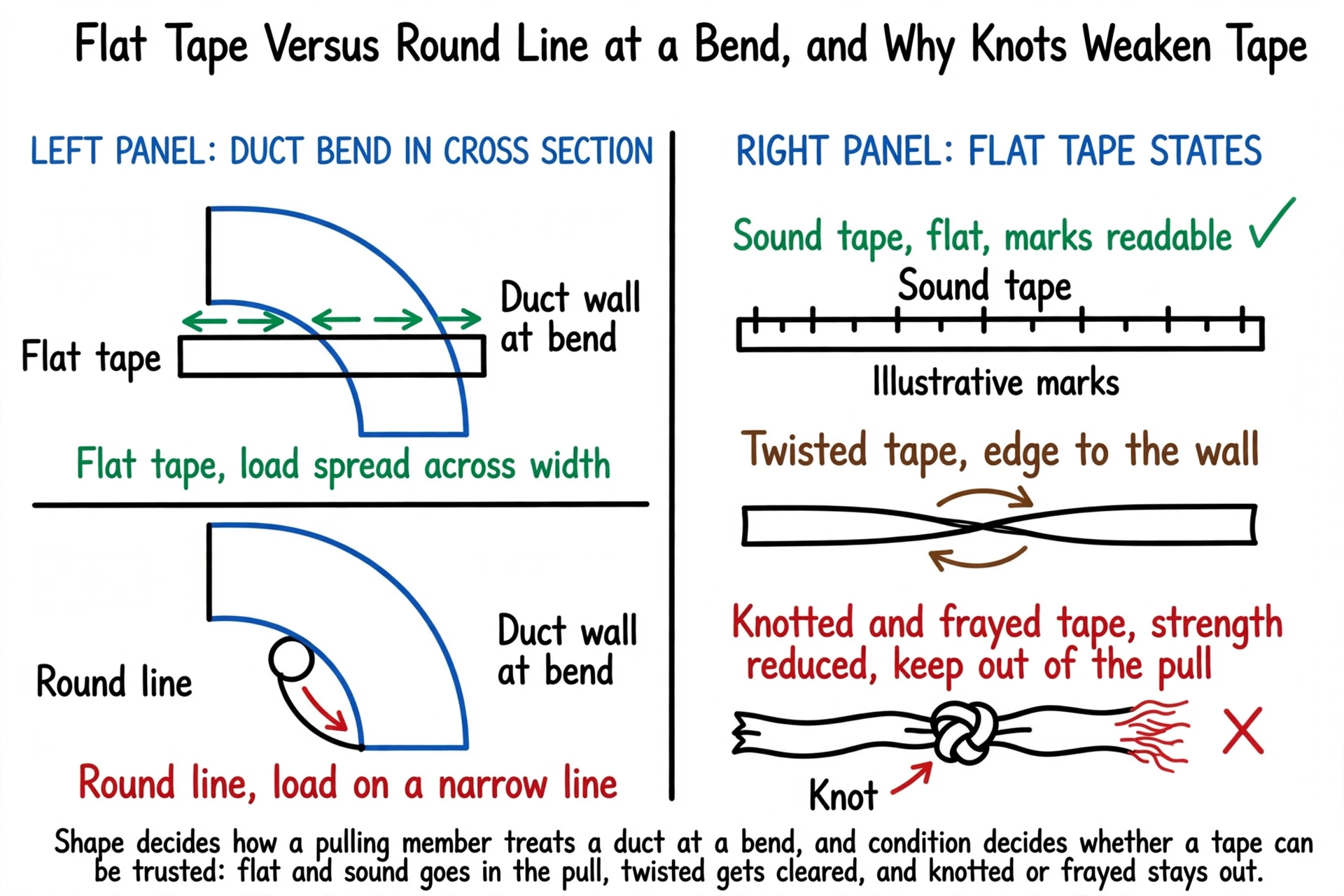
Picture a wide backpack strap resting on a shoulder beside a thin cord carrying the same load. The cord concentrates its pressure into a narrow line and digs in. The wide strap spreads the same load across a broad surface, so the shoulder feels pressure over an area instead of along a cutting edge. Mule tape works inside a duct on the same principle. Its flat woven face meets the duct wall and the bends in the run across a width, and manufacturer material from Chase Corporation and Klein Tools describes that flat profile as distributing or dispersing the pulling load.
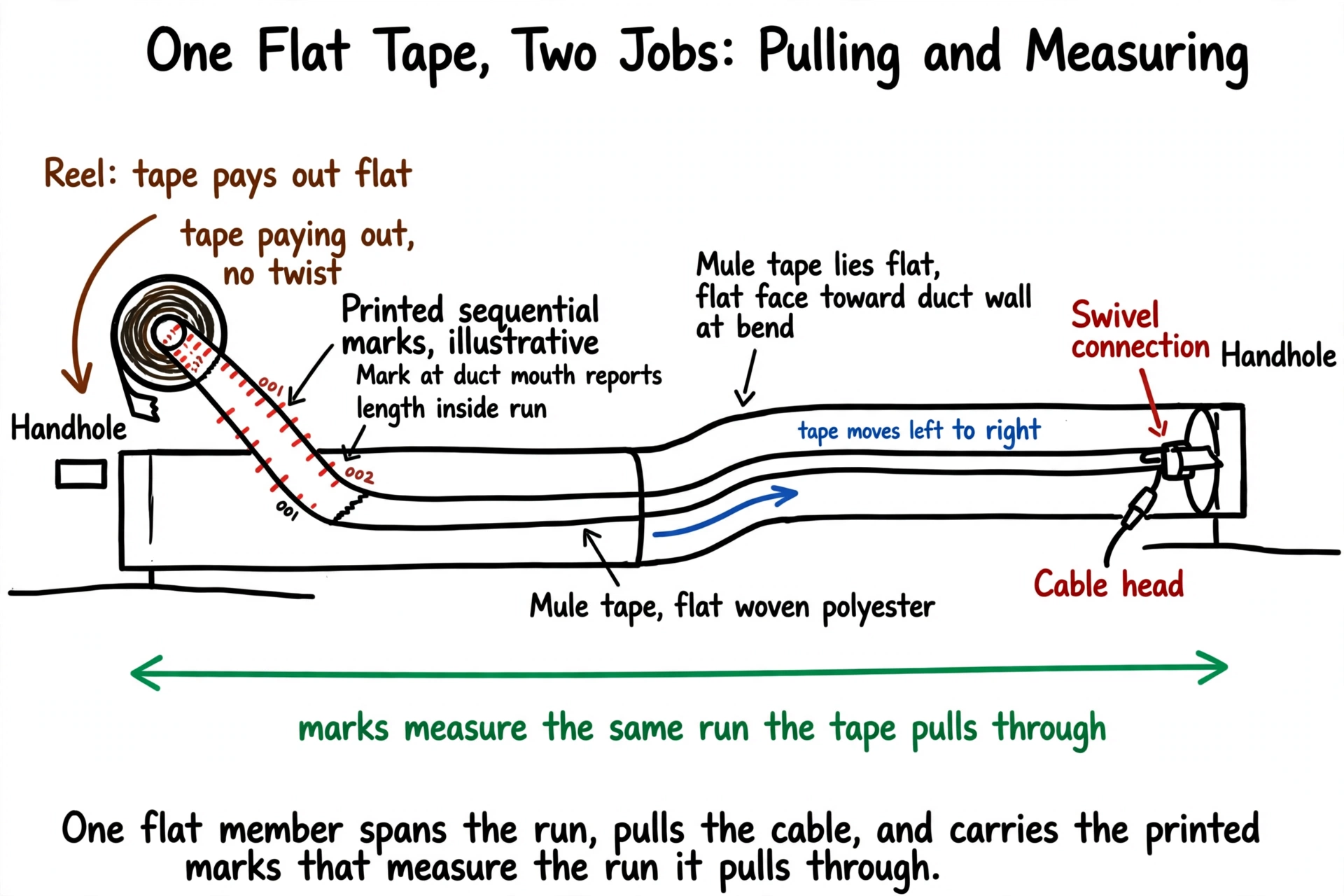
Picture a measuring tape with its numbers printed along the blade. A carpenter reads the number at the edge of the work and knows a length without bringing a second tool to the job. Printed mule tape carries that idea into a duct. Numbers run in sequence along the tape, so a crew reads the mark at the duct mouth and knows how much tape has traveled into the run while the same tape does the pulling.
What Is It?
Mule tape is a pulling and measuring member for conduit work. The definitions below build the picture in order.
Mule tape defined. Mule tape, also called pull tape, is a flat tape woven from polyester, a synthetic fiber material, and made to be placed in conduit or innerduct and used to pull cable through the pathway. Neptco lists MULETAPE for fiber optic, copper, and coaxial cable installation in underground conduit. Dura-Line sells the same class of product as Bull-Line woven pull tape in polyester fiber. Southwire sells its version as QWIKtape Pull Tape, and Greenlee and Klein Tools sell polyester measure and pull tapes in the same family.
Flat profile. The profile of a tape is the shape of its cross section. Mule tape has a flat, ribbon shaped profile. A round pulling line contacts a duct bend along a narrow line. A flat tape contacts the bend across its width. Chase Corporation states that the flat woven polyester profile distributes pulling forces more evenly within the conduit and helps reduce friction. Klein Tools describes its flat polyester pull tape as strapping that disperses pull load and minimizes stretching when pulling.
Woven construction. Woven means the polyester yarns are interlaced over and under each other to form the tape, in the same basic way cloth is woven. Dura-Line names its product woven pull tape. Neptco describes its tape as a flat, woven polyester product as well. The weave gives the tape its flat form and its pulling strength in one member.
Lubrication. Many mule tapes are pre-lubricated, which means a lubricant is applied or integrated during manufacture to lower friction during a pull. Neptco describes MULETAPE as lubricated for easy pulling and reduced friction. Chase Corporation states that MULETAPE contains integrated silicone lubrication that helps reduce friction and heat buildup during cable installation. Southwire states that QWIKtape has a low coefficient of friction, and a coefficient of friction is a measure of how much two surfaces resist sliding against each other. Southwire credits that low friction with minimizing duct melting.
Sequential markings. Sequential markings are distance numbers printed in order along the length of the tape, rising or falling by a set increment so position on the tape can be read at a glance. Neptco describes MULETAPE as durably printed with sequential footage or meter markings. Southwire describes QWIKtape as printed with accurate, sequential, easy to read footage markings that provide quick and accurate measurement of conduit runs. Greenlee describes its polyester conduit measuring tape as permanently printed with measurements every foot, and its catalog language pairs the two jobs in one sentence: fish and measure conduit runs in one operation. Dura-Line lists accurate sequential foot or meter markings on its polyester Bull-Line tape. Marking increment and direction vary by product. Klein Tools, for example, marks one tape with descending one foot increments so a crew can determine the amount of tape left to pay out.
Strength class. A strength class is the rated pulling strength group a specific tape product belongs to, stated by its manufacturer for that product. Strength is a product property. It is never a general property of all mule tape. Neptco lists MULETAPE in a variety of pulling strengths from 200 to 6,000 pounds across its polyester product line. Dura-Line lists its polyester Bull-Line tape across a tensile strength range of 500 to 6,000 pounds. Southwire lists individual QWIKtape products at stated average breaking strengths, including 400, 1,250, 1,800, and 2,500 pound products. A crew selects a tape by the rated strength on the data sheet for the exact product in hand, matched to the job through the manufacturer selection guidance and the project documents.
Low elongation. Elongation is the amount a material stretches under load. Mule tape polyester is described by its makers as a low elongation material. Neptco lists low elongation as a feature tied to worker safety. Chase Corporation explains the mechanism: low elongation construction minimizes stored energy during pulling operations, and lower stored energy reduces snap back risk if the tape or its connection fails under tension.
Pull line, separated. A pull line is the light round line taught in Lesson 154, placed in a duct to establish a path and to bring a stronger pulling member through. Mule tape is the stronger flat member that can serve as that pulling member, and it adds printed measurement that a plain pull line does not carry. The two products differ in shape, in strength class, and in whether they measure as they work.
Warning tape, separated. Warning tape is a buried marker tape covered in Lesson 156. It is placed in the ground above a buried line as a warning to future digging. It is never a pulling member, and it never belongs inside a pull. The similar name is the only connection. This lesson mentions warning tape only so the two tapes are never confused in a parts box or in a record.
Connections and knots. A tape does its work through a connection, the joint where the tape attaches to a cable pulling eye, a swivel, or another length of tape. Manufacturer material treats the connection as the weak point of the system. Klein Tools warns on its pull tape product page that knots in line can significantly reduce tensile strength. Chase Corporation, writing about its MULEKNOT connection for MULETAPE, states that traditional knots can reduce break load strength by as much as 50 percent, and that the purpose built knot was developed to reduce that loss. Dura-Line publishes a Bull-Knot joining procedure for its Bull-Line tape, for tying two lengths together or tying a length to a pulling swivel or pulling eye, and that procedure directs the installer to keep the flat surface in continuous contact between the two tape lengths.
What Does It Look Like?
A beginner meets mule tape on a reel or in a bucket, paying out at a duct mouth, and printed along its length. Recognition comes from shape, surface, and marks.
On the reel, in the bucket, and on the staging pile:
- A flat white or light colored ribbon wound on a sturdy reel, or coiled in a bucket made for dispensing tape. Neptco packages MULETAPE on wooden or plastic reels, and Klein Tools supplies one pull tape in a bucket with a hole in the lid for controlled, tangle free dispensing.
- A woven surface that reads as cloth under a close look, with the interlaced yarn pattern visible along the flat face.
- Printed numbers and tick marks running along one face of the tape in sequence, in feet or in meters depending on the product.
- A maker name, product name, and strength rating on the reel, bucket, or packaging, naming the exact product and its strength class.
- Width that changes with strength class. Neptco and Dura-Line product tables pair wider tape with higher strength products in their lines, and each table lists the width for the specific product.
Paying out at a duct mouth during placement or a pull:
- A flat ribbon entering the duct lying flat, feeding from the reel or bucket without the coiling and spiraling a round line shows.
- Numbers passing the duct mouth in order, so an observer can read the mark at the mouth and state how much tape has entered the run.
- A leading end fitted for travel through the duct, attached to a conduit mouse or projectile where the crew places the tape by blowing or vacuum.
- At the far end during a pull, the tape under tension running in a straight line from the duct mouth to the pulling equipment, with the printed face still readable where the tape is slack.
Conditions that change the look and matter at a glance:
- Frayed edges, cut strands, or a nicked face along the tape, showing as loose fibers or a break in the woven pattern.
- A hard twist or a kink that keeps the tape from lying flat as it pays out.
- A knot tied in the tape away from a proper connection, or a connection that looks bulky, uneven, or improvised.
- Marks worn, smeared, or unreadable along a section, so position can no longer be read from that section with confidence.
- Dirt, grit, or debris ground into the weave, showing as dark staining that does not brush away.
What Does It Do?
Mule tape earns its place by doing two jobs in one member, and by behaving inside a duct in ways a round line does not match. Each job works by a plain mechanism.
The tape pulls the cable. Placement comes first. The tape is lightweight and flexible, and Neptco describes MULETAPE as lightweight and easily blown into conduit or innerduct. Chase Corporation describes the working sequence: the tape is typically blown or vacuumed through conduit using a mouse or projectile, the cable is then secured to the tape using an approved pulling connection, and the cable is pulled through the conduit. Dura-Line lists excellent blowability into conduit for its polyester Bull-Line tape, and lists the tape as a product that can be pre-installed into conduit. Once the tape spans the run, pulling force travels from the pulling equipment, through the tape, through the connection, and into the cable. The cable follows the path the tape already proved.
The flat face spreads the load at bends. A pull loads a tape hardest where the run bends, because the tape presses against the inside of the bend as it travels. A narrow round line presses that load into a narrow contact line. A flat tape presses across its width. Chase Corporation states that the flat profile distributes pulling forces more evenly within the conduit. Dura-Line claims strong burn through resistance for its coated polyester tape, using the term burn through for the damage a moving pulling member can do when friction and pressure cut or melt into a duct wall at a bend. Southwire makes the related friction point for QWIKtape: a low coefficient of friction minimizes duct melting. The flat, lubricated face is the mechanism behind both claims: spread the load, lower the friction, and the tape is gentler on the duct it travels through.
The printed marks measure the run while it works. The numbers on the tape form a ruler that travels through the duct. When the tape has been placed through a run, the mark at one end compared with the mark at the other end states the length of tape inside the pathway, and that length reports the run length the cable must cover. During a pull, the mark passing the duct mouth reports how much cable has entered and how much run remains ahead of the cable head. Greenlee built its measuring tape product around this pairing, describing it as a way to fish and measure conduit runs in one operation. Southwire states the same pairing for QWIKtape: thread and measure conduit, then pull wire with one product. Klein Tools marks one tape with descending increments so the crew can also determine the amount of tape left to pay out. One member does the pulling and the measuring, so the measurement comes from the actual path the cable will travel, bends included.
Low stretch keeps the measurement honest and the pull controlled. A tape that stretched a long way under load would report false lengths from its marks and would store energy like a spring. Polyester mule tape is made for low elongation. Klein Tools credits its flat polyester strapping with minimizing stretching when pulling. Chase Corporation ties low elongation to safety directly: the construction minimizes stored energy during pulling operations, which reduces snap back risk while pulling performance stays consistent. The marks stay meaningful because the tape length stays close to its printed length under working load.
Where Does It Fit?
Mule tape appears after a pathway exists and before a cable occupies it, and it appears again whenever a later cable needs the same path.
- Pathway proofing and preparation. After a duct run is built and proved clear, a pulling member must be placed through it. Mule tape serves as that member on runs where its strength class and its measuring face fit the work ahead.
- Tape placement. Crews place the tape by blowing or vacuum with a mouse or projectile, by pulling it through behind a pull line placed earlier, or by using tape that was pre-installed in conduit at manufacture or during pathway construction. Dura-Line lists pre-installed tape as a standard use of its Bull-Line product, and conduit makers offer conduit with pull tape installed before delivery.
- Measurement and cable preparation. With the tape spanning the run, the crew reads the marks to confirm the run length, checks that length against the cable length staged for the pull, and confirms the cable on the reel covers the run with the working length the job requires at both ends.
- The cable pull. The cable is secured to the tape through an approved connection, lubricant is used where the job calls for it, and the tape draws the cable through the pathway while the crew reads the marks to track progress.
- Leaving a member behind. Project documents and owner standards often direct that a pulling member be left in a duct after a pull, secured at both ends, so a future cable can be placed without re-establishing the path. Iowa DOT telecommunications special provisions give one public example of this pattern in contract language: woven polyester pull tape with permanent sequential footage markings, provided in each HDPE conduit in each segment of a route and secured to the duct plug at each end. That example is a contract specification for that work. It states a pattern, and it sets no rule for other projects.
- Records. The record for a segment can name the tape product and strength class placed, the measured length the marks reported, and whether a tape was left in the duct for future use. A later crew reading that record knows what member waits inside the pathway and what length to expect.
What Is at Stake
A failed tape strands a cable mid-run. Tape that breaks under tension leaves the cable partway through a pathway, with no pulling member spanning the run. Recovery means re-establishing a path, extracting or re-pulling the cable, and inspecting the cable for damage from the failed pull. A break at a knot, a nick, or a worn section is a break the pre-pull check was built to prevent.
A wrong length wastes cable or stops a job. Cable cut or staged from a guessed length can arrive short at the far end, where no splice plan exists, or long, where expensive cable sits as waste. The printed marks exist to remove the guess. A crew that skips reading them gives up the measurement the tape already carried through the exact path.
Duct damage at bends. A pulling member that cuts or melts into a duct wall at a bend damages the pathway itself. A groove worn into a bend catches future cables, and a wall cut through can admit soil and water. Tape selection, lubrication, and pulling practice protect the duct as well as the cable, and the damage, once made inside a buried bend, is found only when a later pull hangs up at that spot.
Cable damage from a bad pull. Excessive tension, a connection that slips or digs into the cable, or a pull that continues against an obstruction can damage the cable the tape was hired to protect. Chase Corporation selection guidance ties tape choice to the cable itself: required tape strength depends on cable weight, conduit length, bends, and factors such as lubrication and conduit fill, and installers consult the cable manufacturer limit for pulling tension before a pull proceeds.
Stored energy and worker safety. Any tape under tension holds energy, and a tape or connection that fails can release that energy as snap back toward the crew. Low elongation polyester reduces the stored energy compared with a high stretch line, per Chase Corporation. Reduction is a smaller hazard. It is never the absence of a hazard, and pulling work stays in qualified hands under the project safety program.
A missing member for the next cable. A duct left empty after a pull, where the documents directed a tape to remain, pushes the cost of re-establishing the path onto the next crew and the next project. Leaving the pathway ready is part of finishing the pull.
What Does Good Look Like?
- The tape product and strength class match the pull, selected from the manufacturer data sheet and selection guidance for the cable weight, run length, bends, lubrication, and fill on the job.
- The tape pays out clean and flat from its reel or bucket, with no fraying, nicks, cut strands, or ground in grit visible along the working length.
- The printed marks are legible along the tape, and the crew reads and calls the marks at the duct mouth during placement and during the pull.
- The measured run length from the marks is recorded and checked against the staged cable length before the pull starts.
- The connection to the cable is made with the knot or joining method the tape manufacturer publishes for that tape, with the flat surfaces in contact where the procedure directs it.
- The tape runs untwisted into the duct, lying flat as it enters, with no stray knot tied anywhere along its length.
- After the pull, a pulling member is left in the duct and secured at both ends where the project documents direct it, and the record names the tape product and the measured length.
From the Field
Picture a two person crew placing cable in a duct segment between two handholes on a commercial site. The pathway was proved the day before. The crew blows mule tape through the segment in the morning so the run can be measured and pulled before the end of the day.
The tape travels through and arrives at the far handhole. One crew member reads the mark at the far end and calls the number back. The second crew member reads the mark still showing at the near duct mouth and does the subtraction the marks make possible. The tape inside the duct covers a run noticeably shorter than the segment length shown on the work order.
The crew has a decision to make before any cable is attached. The staged cable was cut and coiled for the longer length, so length alone is no problem. The question runs the other way. A run that measures short can mean the tape found a path the drawing does not show, or the tape doubled back, balled, or stopped against an obstruction and the far end arrived by a shorter route through a connected duct.
Pulling on a wrong path would put the cable in the wrong duct, or drive the cable head into an obstruction under full pulling load. Checking costs minutes while the tape is still the only thing in the pathway. The crew holds the pull, works the tape back and forth to confirm it runs free for its full measured length, and re-reads the marks at both ends after reseating the tape.
The second reading matches the first, and a check of the handhole shows the duct arrangement differs from the drawing: the segment runs through an intermediate handhole that the work order combined into one length, and the tape has measured the first leg only. The crew places tape through the second leg, records both measured lengths, and pulls each leg as its own run.
The rule to carry is simple: read the marks at both ends and trust the measurement enough to stop on it. When the tape measures a run that differs from the paper, the pull waits until the tape and the paper agree, because the tape traveled the path and the paper did not.
What Can Go Wrong?
Pulling with damaged tape. Frayed edges, cut strands, nicks, or a glazed and stiff section concentrate load on the remaining fibers. The tape can part at that section under a load the undamaged tape would have carried, stranding the cable mid-run.
Trusting a knotted section at full rating. Klein Tools warns that knots in line can significantly reduce tensile strength, and Chase Corporation states that traditional knots can cut MULETAPE break load strength by as much as 50 percent. A tape joined or attached with an improvised knot carries an unknown rating at exactly the point under greatest stress.
Selecting tape by habit instead of by the pull. A light strength class taken from the top of the pile can be asked to pull beyond its rating on a long, bent, or heavily filled run. A rating belongs to the product on its data sheet, and selection follows the manufacturer guidance for the conditions of the specific pull.
Skipping the measurement the tape offers. Marks unread are a ruler unused. A crew that never reads them can stage short cable, miss a wrong path or an obstruction that a short measurement would have exposed, and lose the progress record the marks give during the pull itself.
Letting the tape twist or run dirty. A twisted tape presents its edge instead of its flat face at bends, giving up the load spreading the flat profile exists to provide. Grit ground into the weave raises friction along the whole run and works against the duct wall and the cable jacket for the full length of the pull.
Reusing worn tape on a critical pull. Chase Corporation states that mule tape is generally treated as a single use installation product, because after a cable pull the tape may have wear or strength reduction that a glance cannot measure. Worn tape saved for the heaviest pull on the job reverses the logic the single use practice protects.
Confusing tape products in the record or the parts box. Pull line recorded as mule tape tells the next crew a stronger member waits in the duct than the one actually there. Warning tape pulled from the same shelf for a pulling job puts a marker product with no pulling rating into a tension role it was never made for.
Using tape outside its purpose. Neptco states that pulling tapes are intended for use only by cable installation professionals, and that the product must never be used to strap, bind, or lift items. Klein Tools adds its own limits for its pull tape: for wire and cable installation only, never for overhead lifting, and never on live circuits, because tape can wick moisture and become conductive.
What Should Someone Notice in the Field?
- Name the product in hand as mule tape, pull line, or warning tape before any of them enters a duct, using shape, weave, printed marks, and the rating on the reel or packaging.
- Read the strength class and product name on the reel, bucket, or data sheet, and confirm the class fits the pull planned, with the cable manufacturer tension limit checked for the cable.
- Run the working length through a visual check as it pays out: fraying, nicks, cut strands, stiff or glazed sections, and grit ground into the weave.
- Confirm the printed marks are legible and note whether they read in feet or meters and whether they rise or fall as the tape pays out.
- Read the marks at both ends after placement, compute the length inside the run, record it, and compare it with the segment length on the work order before attaching cable.
- Watch the tape enter the duct flat and untwisted, and stop to clear any twist, kink, or stray knot before the pull begins.
- Confirm the connection uses the joining method the tape manufacturer publishes for that tape, and treat any improvised knot as a failed connection until it is remade.
- Call the marks aloud at the duct mouth during the pull so both ends of the job share the same progress and remaining length.
- After the pull, confirm a pulling member remains in the duct and is secured at both ends where the documents direct it, and record the tape product and measured length.
- Know the boundary: reading marks, naming tape products, checking tape condition, and reporting a damaged tape, a wrong measurement, or a bad connection are tasks covered by this lesson. Placing tape under air pressure, operating pulling equipment, and pulling cable under tension belong to qualified people under the project safety program and the equipment and tape manufacturer instructions. A tensioned tape can fail and snap back toward the crew, and no one stands in line with a tape under load. Reading this lesson qualifies no one for pulling work, and recognizing a sound tape is a different thing from being qualified to run the pull.
Key Terms
Mule tape: A flat, woven polyester pulling tape placed in conduit or duct to pull cable through the pathway, commonly printed with sequential distance marks so it measures as it pulls. Also called pull tape.
Polyester: A synthetic fiber material woven to make mule tape, chosen by manufacturers for pulling strength with low elongation.
Profile: The shape of a tape cross section. Mule tape has a flat, ribbon shaped profile that spreads load across its width.
Sequential markings: Distance numbers printed in order along the tape, in feet or meters, so position and length inside a run can be read at the duct mouth.
Strength class: The rated pulling strength group of a specific tape product, stated by its manufacturer on the product data sheet.
Elongation: The amount a material stretches under load. Low elongation tape stretches little, so its marks stay accurate and stored energy stays lower.
Connection: The joint where tape attaches to a cable pulling eye, a swivel, or another length of tape. Manufacturer material treats the connection as the weak point of a pull.
Pull line: The light round line placed in a duct to establish a path and bring a stronger pulling member through, taught in Lesson 154.
Check Your Understanding
- How does mule tape differ from pull line in shape, in job, and in information carried?
Answer: Pull line is a light round line placed to establish a path and bring a stronger member through. Mule tape is a flat woven polyester tape in stated strength classes that serves as a pulling member itself. Mule tape also carries printed sequential marks, so it reports length and progress while it works, and a plain pull line carries no measurement.
- Why does the flat profile matter at a bend in the run?
Answer: A bend presses the pulling member against the inside wall of the duct. A flat tape spreads that load across its width, and manufacturer material from Chase Corporation describes the flat profile as distributing pulling forces more evenly within the conduit. A narrow round line concentrates the same load on a narrow contact line, which raises friction and the risk of the member cutting or melting into the duct wall at the bend.
- A tape data sheet lists a strength class for one named product. Why can that number never be quoted as the strength of mule tape in general?
Answer: Strength is a product property stated by each manufacturer for a specific tape. Neptco lists its polyester line across strengths from 200 to 6,000 pounds, and Dura-Line lists its polyester Bull-Line line from 500 to 6,000 pounds. A number from one product describes that product only, and selection for a pull uses the data sheet for the exact tape in hand.
- In the From the Field scenario, the tape measured a run shorter than the work order length. What decision did the crew make, and what did the check reveal?
Answer: The crew held the pull before attaching any cable, worked the tape to confirm it ran free, and re-read the marks at both ends. The check revealed an intermediate handhole the work order had combined into one length, so the tape had measured the first leg only. The crew taped and pulled each leg as its own run and recorded both measured lengths.
- A length of tape shows a tied knot in its middle and frayed edges near one end. The pull planned is the longest of the week. What is the correct field decision?
Answer: Keep that tape out of the pull. Klein Tools warns that knots can significantly reduce tensile strength, and fraying concentrates load on the remaining fibers. Chase Corporation treats mule tape as generally single use because a pull can leave wear and strength reduction. A long pull gets sound tape in the strength class the manufacturer guidance selects for the job, and the damaged length is reported and removed from pulling service.
Lesson Takeaway
Mule tape is two tools in one flat member: a pulling tape strong enough to draw cable through a buried pathway, and a printed ruler that reports the length of the very path the cable will travel. After this lesson, a flat woven tape reads as a set of checkable facts: its product and strength class, the condition of its weave, the connection at its end, and the numbers passing the duct mouth. A reader who checks those facts, and who stops a pull when the numbers disagree with the paper, uses the tape the way it was made to be used.
Sources and Technical References
Neptco (Chase Corporation), Polyester MULETAPE product sheet. Covers flat, woven, polyester tape for installing fiber optic, copper, and coaxial cables in underground conduit, lubrication for easy pulling and reduced friction, durable printing with sequential footage or meter markings, pulling strengths from 200 to 6,000 pounds across the line, low elongation for enhanced worker safety, lightweight construction easily blown into conduit or innerduct, splice free lengths, reel packaging, splicing by conventional methods or the MULEKNOT, and the limit that pulling tapes are for cable installation professionals and must never be used to strap, bind, or lift items: https://rexel-cdn.com/products/3-polyester-muletape.pdf?i=54066DBA-D3B0-4FE7-9A29-79C257293E18
Chase Corporation, Cable Pulling Made Safe with MULETAPE and MULEGLIDE. Covers MULETAPE as the original trademarked flat woven polyester pulling tape, integrated silicone lubrication, sequential footage or meter markings for tracking distance and measuring runs, flat profile distributing pulling forces more evenly and reducing friction, low elongation minimizing stored energy and snap back risk, placement by blowing or vacuuming with a mouse or projectile, securing cable with a MULEKNOT or approved connection, strength selection based on cable weight, conduit length, bends, lubrication, and fill, and treatment of the tape as generally single use because a pull may leave wear or strength reduction: https://chasecorp.com/products/cable-pulling-and-detection
Chase Corporation, The Importance of the MULEKNOT. Covers strength loss at knots, with traditional knots reducing break load strength by as much as 50 percent, the purpose built MULEKNOT developed to reduce that loss and reduce slippage under tension, and printed sequential measurements as part of the MULETAPE feature set: https://blog.chasecorp.com/pulling-and-detection/the-importance-of-the-muleknot
Southwire, QWIKtape Pull Tape product sheet. Covers threading and measuring conduit and then pulling wire with one product, accurate sequential easy to read footage markings providing quick and accurate measurement of conduit runs, low coefficient of friction minimizing duct melting, easy blowing through conduit, and individual QWIKtape products at 400, 1,250, 1,800, and 2,500 pound average breaking strengths: https://images.salsify.com/image/upload/s–Vr9rJNne–/721cc2c988339985b904befd82934113493844b6.pdf
Klein Tools, Conduit Measuring Pull Tape, 1800-Pound x 1300-Foot, product 50131. Covers woven flat polyester strapping that disperses pull load and minimizes stretching, descending one foot increments to measure conduit runs and determine tape left to pay out, pre-lubrication to reduce friction, 100 percent polyester tape, bucket dispensing, and the warnings that knots in line can significantly reduce tensile strength, the tape is for wire and cable installation only, it must never be used on live circuits or for overhead lifting: https://www.kleintools.com/catalog/pull-line/conduit-measuring-pull-tape-1800-pound-x-1300-foot
Dura-Line, Bull-Line Woven Pull Tape, Polyester Fiber. Covers woven polyester pull tape with a lubricated coating, burn through resistance, excellent blowability into conduit, accurate sequential foot or meter markings, pre-installation into conduit, a tensile strength range of 500 to 6,000 pounds across the line, approximate widths paired with strength products, reel packaging, and conformance language for Bellcore GR-356-CORE: https://drln-prd-pltn-ods-web-assets.azureedge.net/duraline/asset/1270/DL Pull Tape Polyester 12.2019.pdf?v=1652292908&rendition=original
Dura-Line, Bull-Knot Joining Procedure, in the Bull-Line Pull Tape document above. Covers joining two lengths of Bull-Line tape together or tying one length to a pulling swivel or pulling eye, a compact knot that minimizes hangup in the conduit system, and the step directing the installer to keep the flat surface in continuous contact between the two tape lengths.
Greenlee, Conduit Measuring Tape and Dispenser, catalog material. Covers fishing and measuring conduit runs in one operation, permanently printed measurements every foot, strong waterproof polyester construction, and a pay out dispenser: https://kirby-assets.roccommerce.net/files/_kirby/8/2/6/2093795.pdf
Iowa Department of Transportation, Special Provision SP-156174, Telecommunications Outside Plant Equipment and Materials. Covers a contract specification example for pull tape: woven polyester composition, a stated minimum pulling strength for that contract, permanent sequential footage markings, pull tape provided in each HDPE conduit in each segment of the route, and tape secured to the duct plug at each end: https://ia.iowadot.gov/specifications/provisions/2015/SP-156174.pdf
Previous lesson: Lesson 154: What Is Pull Line? |
Back to Level 8 hub |
Next lesson: Lesson 156: What Is Warning Tape?