
Lesson Number and Title
Lesson 154, Level 8: Understand the Underground Pathway
Title: What Is Pull Line?
Introduction
A pull line is a light line left inside a conduit run, end to end, so a later crew can attach a stronger pulling tape or rope, or in light cases the cable itself, and draw cable through the pathway without first having to get a line through an empty duct. The Fiber Optic Association describes the same job from the duct side: conduit and innerduct often arrive with a pulling tape already installed, and where a duct has no tape, a line is blown through the duct to pull a stronger pulling tape or line through.
Level 8 studies the underground pathway piece by piece. A finished pathway includes more than the tube itself. It includes a way for the next crew to use the tube. This lesson teaches the pull line: what the line is, how it gets into an empty duct, how it differs from the stronger flat tape it often brings in, and why its ends are secured and identified at structures so the line stays findable.
What This Lesson Gives You
- Open a handhole or vault, find the pull line for a duct, and tell whether the line runs end to end, is secured, and is identified for that duct.
- Name the ways a line gets into an empty duct, and match each way to the tool that carries the line through.
- Tell a light pull line apart from flat pulling tape at a glance, and state which one does the heavy pulling work on a given job.
- Explain why both ends of a line are tied off with slack left in the structure, and what a crew loses when an end slips back into the duct.
- State the hold decision when a duct has no usable line, and name the re-proofing and re-lining work that decision starts.
Start With the Basics
Picture threading a needle. The thread goes through first because the thread is thin, light, and easy to pass through a small opening. Once the thread is through, it can carry heavier material behind it. Nobody tries to push the heavy material through the eye on its own.
A pull line works the same way inside a conduit. The line is thin and light, so air, a rod, or a fishing tool can carry it through a long, bending, buried tube that no one can reach into. Once the line spans the run from structure to structure, it becomes the connection between the two ends. A crew ties a stronger tape or rope to the line and pulls the stronger member through, and the stronger member then pulls the cable. The line itself does the first, lightest job in the chain. Leaving the line in place after construction is like leaving the thread in the needle for the next person. The pathway is ready to use the moment the next crew opens the structure.
What Is It?
A pull line is a working line, placed in a duct and left there on purpose. The definitions below build the picture in order.
Pull line defined. A pull line, also called a pull string in installation procedures, is a thin cord placed through the entire length of a conduit run before cable is pulled. A horizontal cabling pulling procedure states the requirement in plain terms: a pull string is a thin cord used to pull cable through the conduit, and the pull string must extend through the entire length of the conduit before cable can be pulled. In underground work the run sits between two structures, the access points at the ends of the run, such as a handhole, a small buried access box a worker reaches into from the surface, or a vault, a larger underground room a worker can enter under the project safety program.
What the line is made of. Pull line products are light synthetic lines sold for this job. Greenlee describes its poly line as polyethylene string, a lightweight plastic twine, supplied in long lengths in a dispenser for use with power fishing systems or for hand dispensing. Southwire lists its poly line for light duty cable or rope pulling applications, in a ready to use container that dispenses a tangle free line, with the line resistant to rot and mildew. The Plastics Pipe Institute notes a wider factory range for lines placed inside innerduct at manufacture: manufacturers can install pull tape ranging from inexpensive polypropylene rope to higher cost aramid tapes that are pre-lubricated and measured and marked. Material and strength belong to the named product. A figure from one maker never transfers to another line on the truck.
Strength belongs to the product. Greenlee lists a 210 pound maximum capacity for its poly line in its poly line guidance, and Southwire lists its poly line at 210 pounds tensile strength. Those figures describe those light duty products, and they explain the place of a light line in the chain: the line is strong enough to bring in the next member, and the next member is chosen for the pull itself. Project documents can require far more. Seattle City Light Construction Standard U2-11.40 requires that after cleaning and mandreling, each conduit have left in it a flat, pre-lubricated, polyester or aramid pull tape of 2,500 pound minimum tensile strength, printed with sequential footage markings. That requirement is a municipal standard for that system. It shows why the record and the project documents, rather than habit, decide what line or tape a finished duct must contain.
Pull line and pulling tape. A pulling tape, sold under names that include mule tape, is a flat, woven tape built to pull. Southwire describes its MULETAPE pulling line as a durable, low friction polyester tape, printed with accurate sequential footage markings, that lets a crew thread, measure, and pull with a single product, and that replaces pull line, conduit measuring tape, and rope in many applications. The shape is the visible difference: a pull line is a thin round cord, and a pulling tape is a flat woven band. The flat band spreads load across a wider surface as it travels around bends. Lesson 155 teaches pulling tape in full. This lesson keeps to one relationship: a light pull line often serves as the messenger that brings the flat tape into the duct, and the tape then does the pulling work the light line was never sized to do.
The carrier that takes the line through. An empty duct gives a light line no way to travel on its own, so a carrier moves it. Common carriers named in manufacturer and industry material include:
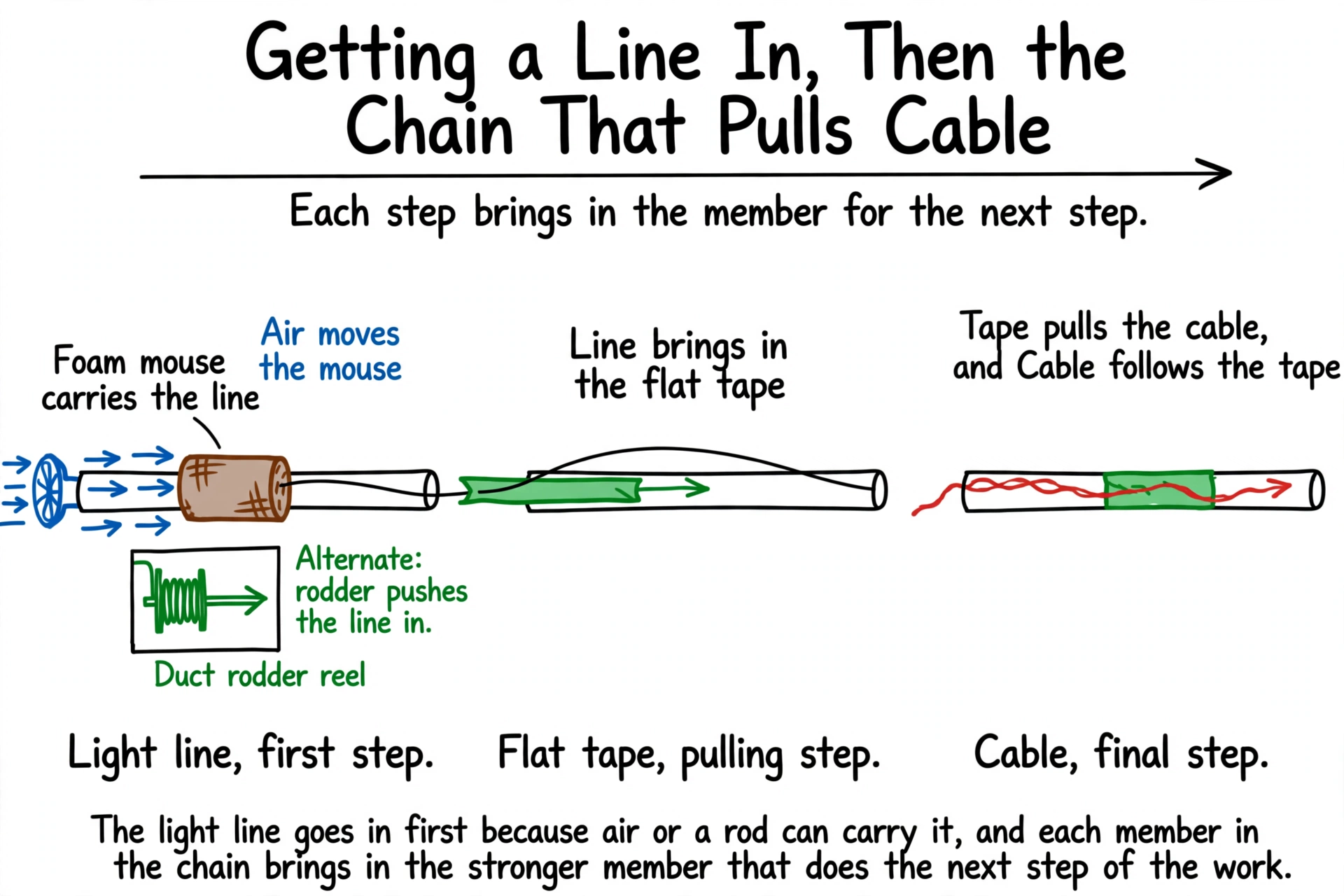
- A mouse, also called a rat in vacuum work, is a foam or rubber carrier sized to fit snugly inside the conduit, with the line attached to it, so moving air can push or draw the carrier and the line through the run.
- A fish tape is a retractable metal tape, described by Greenlee as thin spring steel capable of negotiating bends and corners, that is fed through the conduit with the line attached, so the line follows the tape to the far end.
- A duct rodder is a stiff fiberglass rod on a reel that a crew pushes through the duct. Jameson instructions for its Easy Buddy rodder direct the user to push the rod through the conduit in short thrusts, then attach the wire or cable being pulled to the pulling eye. In pull line work the rod carries the line, or pulls the line back through, in the same way.
- A line package placed inside the duct at manufacture, covered below, arrives with the line already in place and needs no carrier in the field.
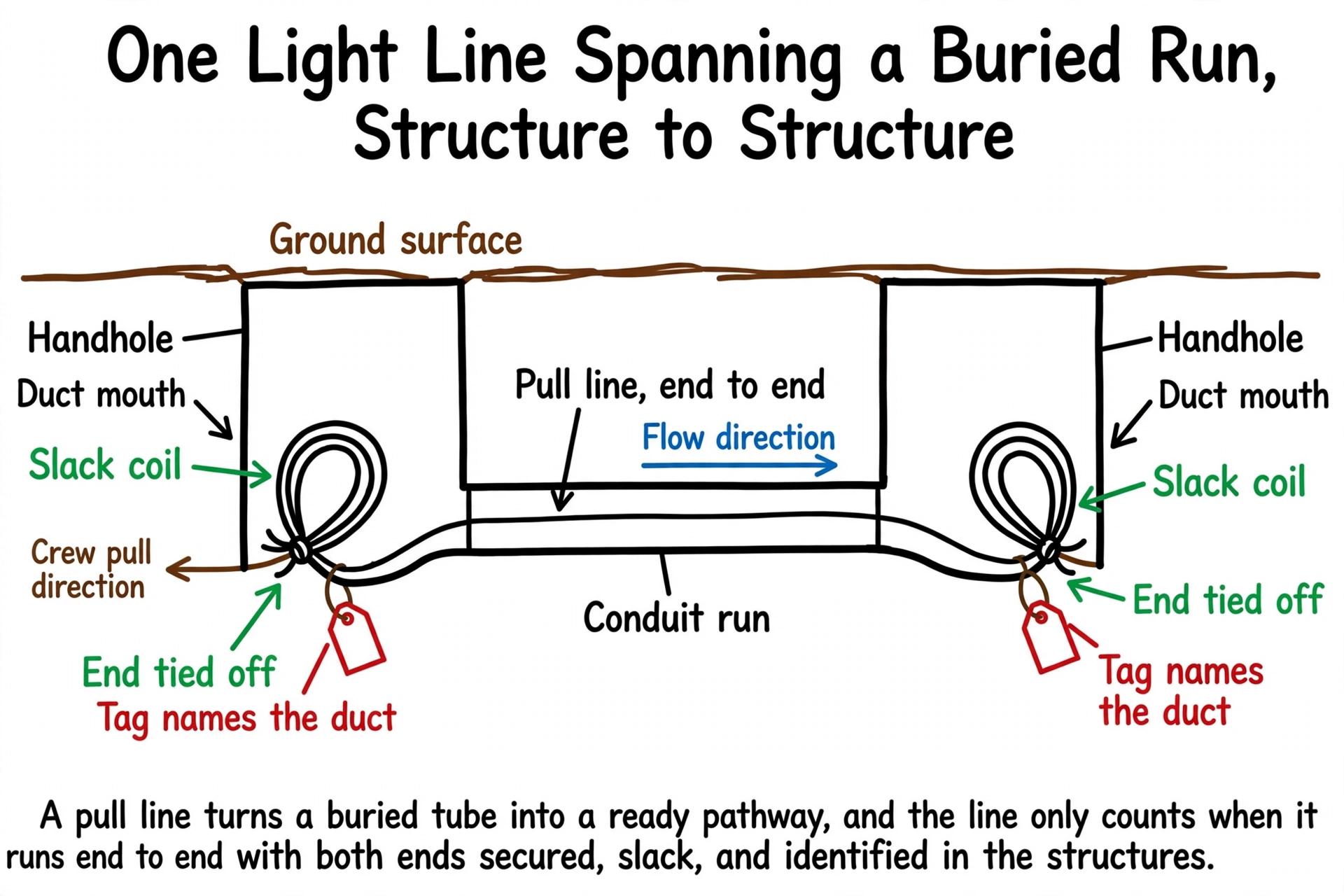
Secured ends and slack. A line only helps if a crew can find its ends. Installation practice ties the line off at both ends. The fishtape pulling procedure directs the installer, when a delay will pass before cable pulling, to tie off the pull string at both ends, and gives the reason directly: tying off prevents accidentally pulling the string back into the conduit and prevents the need to re-fish the conduit. Municipal and utility specifications set the finished condition in measurable terms. Seattle City Light U2-11.40 requires 5 feet of slack left in each handhole and 10 feet of slack left in each vault and at each pole riser conduit for the pull tape left in the duct. A New York specification for precast concrete conduit requires the rope pulled in behind the mandrel to extend 6 feet beyond the conduit ends, with the rope made fast in each manhole. The numbers differ by owner and by document. The pattern is the same in both: slack outside the duct mouth, and the end made fast so it stays there.
What Does It Look Like?
A beginner meets pull line in three places: in its container before work, traveling through a duct during placement, and finished inside a structure. Each place shows different evidence.
In the container and on the truck:
- A bucket, pail, or canister of thin line with a dispensing opening in the lid, sized so the line pays out without tangling. Greenlee and Southwire both describe ready to use containers that dispense the line directly.
- A thin, light cord that a worker can hold between two fingers, in a bright or natural plastic color depending on the product, with no footage markings on light poly line products.
- Beside it, for comparison, a spool or pail of flat woven tape, visibly wider and flatter than the cord, with printed footage numbers running along the tape on marked products.
During placement:
- A foam mouse or rat at the duct mouth with the line tied to it, ready for a blower or a vacuum to move it through the run.
- A fish tape reel or a duct rodder reel set at the structure, with the rod or tape entering the duct mouth and the line attached at the far end or paying out behind the carrier.
- Line paying out fast and loose from its container while air moves the carrier, with a worker tending the container so the line feeds without a knot or a snag at the mouth.
Finished inside a structure:
- A line emerging from a duct mouth, with several feet of slack coiled or laid in the structure rather than cut flush at the mouth.
- The end tied off to a fixed point in the structure or secured in the manner the project documents direct, so the end cannot slip back into the duct.
- The line identified for its duct, by a tag, a label, or the record for the structure, so a crew can match line to duct where several ducts enter the same structure.
- In a duct with cable already placed, a trailer string, a fresh line pulled in alongside the cable during the pull, tied off at both ends for the next pull. The fishtape procedure includes attaching a trailer string to the cables to provide a string for future pulls, and tying off both ends of the trailer string when the pull finishes.
What Does It Do?
A pull line does one mechanical job: it connects the two ends of a buried run with a continuous member that a crew can pull on. Everything else follows from that connection.
The line bridges a run no one can reach into. Once conduit is buried and structures are set, the inside of the run is closed to hands and eyes. A cable cannot be pushed through a long run with bends, because a flexible cable buckles when pushed. The run needs a member that already spans it, attached at the near end to the next member and free to be drawn from the far end. The pull line is that member. Pulling on one end moves the whole line, and whatever is tied to the line travels through the duct behind it.
The line works as the first step in a chain. Electrical Contractor magazine describes the sequence in its coverage of vacuum fishing systems: a foam mouse, sized to the conduit and attached to a light test line, is blown or sucked through, and the test line is used to pull through the heavier pull line, which serves for light pulls or pulls through, in turn, heavier rope for heavy pulls. The Fiber Optic Association gives the same chain for fiber duct: where innerduct has no pulling tape installed, a line may be blown through the duct to pull a stronger pulling tape or line through the duct. Each step brings in a member strong enough for the next step, and the light line only has to survive the lightest step.
In light cases the line pulls the cable directly. Greenlee guidance states the two uses plainly: poly line may be used to pull a larger rope, which in turn pulls the cable, or the poly line may be attached directly to lighter gauge cable. Southwire describes its poly line the same way, as a line to pull electrical and communication wire in light duty applications. The project documents and the cable manufacturer limits govern which case a given pull falls into. A light line used beyond its product rating fails inside the duct, and a failed line inside a duct is the problem this lesson exists to prevent.
A line left in place makes the pathway reusable. A duct with a secured line in it can accept cable on the day the cable crew arrives, and a duct that receives a trailer string during a pull stays ready for the next cable. A duct with no line in it is a tube that first needs a line established, and establishing a line in a finished, buried run is slower and less certain than leaving one during construction.
Where Does It Fit?
Pull line work sits at the end of pathway construction and at the start of cable placement, and the line itself can enter the duct at three different points in the life of the run.
- At manufacture. The Plastics Pipe Institute explains that a pull line can be installed in innerduct at the factory: the innerduct is extruded over the pull line, with the line fed into the extrusion die at the same rate the tube forms, giving a continuous pull line inside the finished innerduct. Duct ordered with a line or tape installed arrives on the reel with the pathway already lined.
- After proofing, with the mandrel pass. Utility specifications tie the line to acceptance of the duct. The New York precast conduit specification directs that, when the duct is found acceptable on the first pass, a line be attached to the rodding device or the approved mandrel before its final passage through the conduit, so the line pulls a polypropylene rope in behind the mandrel. Seattle City Light places its pull tape requirement after cleaning and mandreling in U2-11.40, in the same sequence: clean the duct, prove the duct, then leave the line in it.
- At cable placement. The cable crew finds the line in the structure, ties on the tape or rope the pull requires, or ties the line to the cable in a light pull, and draws the cable through. A trailer string goes in with the cable where the documents call for the duct to stay lined after the pull.
- In the record. The structure record and the as-built show which ducts hold cable, which ducts stand empty with a line in them, and which ducts have no line and will need lining before use. An empty duct with a secured, identified line reads as a finished, usable pathway in that record. An empty duct with no line reads as unfinished work.
What Is at Stake
A lost end turns a finished duct back into an empty tube. A line end that slips back into the duct leaves nothing to grab. The next crew must establish a line again in a buried run, using air, vacuum, or a rodder, with no guarantee the duct is still clear. The tie off at each end takes a minute during construction. Re-lining a run takes a crew, equipment, and a return trip.
A missing line delays the cable crew. Cable placement is scheduled around pathways that are ready. A duct with no usable line stops the pull at the structure. The crew either lines the duct on the spot, when conditions and equipment allow it, or leaves the cable unplaced and the schedule slips while the pathway problem gets solved.
A broken line strands the pull. A light line asked to do heavy work, a line damaged by a knot or a sharp duct edge, or a line that parts at a bad tie can break inside the duct during a pull. The cable stops mid-run, the broken line must be cleared, and the run must be lined again before the pull can restart. A cable left partway in a duct is exposed to damage while the crew recovers the run.
A tangled or knotted line will not travel. Line that pays out of its container in a knot, or line stored loose in a structure in a tangled coil, jams at the duct mouth or inside the run. Time at the structure goes to clearing the tangle rather than pulling cable, and a knot pulled tight inside a duct can wedge and cost the run its line entirely.
An unidentified line creates the wrong pull. Structures often hold several ducts. A line with no tag and no record match can be tied to the wrong tape or the wrong cable, and the error surfaces only when the pull starts into the wrong duct or the right duct stands with no line used. Identification at the structure is what connects the physical line to the plan.
Re-proofing is the hidden cost. A duct that lost its line also lost its proof history in practical terms. Before a new line and a cable can be trusted in that run, the duct needs proofing again to show the run is still open and clear, because silt, water, or damage may have entered while the duct stood open and unlined. The cost of a missing line is measured in a repeated acceptance process, rather than in the price of the line itself.
What Does Good Look Like?
- Every empty duct in the structure holds a line that runs the full length of the run, verified by a gentle hand pull that moves line at the far end.
- Both ends of the line are tied off or made fast in the structure, in the manner the project documents direct, so neither end can slip back into the duct.
- Slack sits in the structure outside the duct mouth, in the amount the project documents state for that structure type, coiled or laid so it pays out without tangling.
- Each line is identified for its duct by a tag, label, or record entry that a later crew can match to the duct plan without guessing.
- The line in the duct matches the product the project documents require for a finished pathway, whether that product is a light pull line or a rated pulling tape.
- The line shows no knots, no frayed or cut sections at the mouth, and no tangled mass in the structure, and it moves freely when tugged by hand.
- Ducts with cable placed hold a trailer string tied off at both ends where the documents call for one, so the pathway stays lined after the pull.
- The record for the structure names which ducts are lined and empty, which ducts hold cable, and which ducts still need a line.
From the Field
Picture a two person crew opening a handhole on a duct run that was built and backfilled several weeks earlier. The cable crew is scheduled to place fiber in one empty duct that morning. Three ducts enter the handhole. One holds cable. Two stand empty.
The crew member kneeling at the handhole looks for the pull line in the first empty duct. The duct mouth is open and bare. No line emerges, no coil sits in the handhole, and no tag names the duct. A gentle check of the second empty duct finds a line tied off with slack coiled beside the mouth and a tag wired to the line.
The foreman asks the question this lesson teaches: is there a secured, identified line in the duct the plan calls for? The record for the structure shows both empty ducts were lined during construction. The bare duct lost its line at some point after lining, when an end that was left unsecured slipped back into the duct or was pulled out during later work nearby.
The crew now faces a choice. The cable can go into the duct with the good line, if the plan allows that duct as a substitute, with the change recorded. Or the crew can spend the morning re-lining the planned duct, starting with proofing the run to confirm the duct is still open, then blowing or rodding a new line through before any cable moves.
The foreman holds the cable placement for the planned duct. The run gets proved first, a new line gets established and tied off with slack and a tag, and only then does the cable pull begin. The duct that kept its line stays ready for its own future cable, and the record is corrected to show the re-lining work and the reason for it.
The rule to carry is simple: a duct is ready for cable when a secured, identified line runs end to end in it, proven at the structure before the pull is rigged, and a duct without that line gets proved and lined again rather than trusted on the strength of an old record.
What Can Go Wrong?
Leaving the end unsecured. A line end left loose in a structure can slip back into the duct under its own movement, during later work in the structure, or when water moves in the duct. The run loses its line, and the next crew must re-fish or re-rod the duct before any pull can start.
Cutting the line flush at the duct mouth. A line cut at the mouth leaves nothing to tie to and nothing to grab. Slack in the structure is working material for the next crew. A flush cut throws that material away and can drop the end inside the duct.
Asking a light line to do a heavy pull. A light poly line has a product rating in the range the manufacturer states for that product. A pull beyond that rating parts the line inside the duct, strands the cable mid-run, and leaves broken line to clear before the run can be lined again.
Letting the line knot or tangle. Line fed carelessly from its container, or stored in a loose tangled coil in a structure, jams at the duct mouth or wedges inside the run. A knot pulled tight under load can lock in a bend and end the usefulness of the line in that duct.
Skipping identification. Several ducts in one structure can hold several lines. An untagged line invites a pull into the wrong duct, a cable placed off plan, and a record that no longer matches the ground. The error is found late, after cable is already in the wrong pathway.
Using a damaged line. A line frayed at a duct edge, cut partway through, or degraded after long exposure in an open structure can fail at the damaged point under a light load. The failure happens inside the duct, where the crew cannot reach the break.
Leaving an empty duct unlined at acceptance. A duct turned over with no line in it passes its unfinished state to the cable phase. The cable crew inherits lining work, the duct needs proofing again to be trusted, and a pathway that should have been finished at construction gets finished a second time at cable placement prices.
What Should Someone Notice in the Field?
- Count the ducts entering the structure and count the lines. Every empty duct should present a line at its mouth.
- Tug each line gently by hand and confirm the line moves freely and runs to the far structure, rather than ending a few feet inside the duct.
- Check that each line end is tied off or made fast, with slack coiled or laid in the structure outside the duct mouth.
- Read the tag or label on each line and match it to the duct and the structure record before tying anything to the line.
- Look at the line condition at the mouth: no fraying, no partial cuts, no knot pulled tight at the edge, and no tangled mass in the structure.
- Confirm the line product matches what the project documents require for a finished duct, and report any duct holding a light line where the documents require a rated tape.
- Note any duct with cable in it and check for a trailer string tied off at both ends where the documents call for one.
- Record every duct with no line, a lost end, or a damaged line, and report the condition so the run can be proved and lined before the cable crew is scheduled.
- Know the boundary: finding a line, checking that it is secured and identified, and reporting a missing or damaged line are tasks covered by this lesson. Blowing or rodding a line through a duct, rigging and running a cable pull, working around a line or tape under tension, and entering a vault under a confined space program belong to qualified people under the project documents and their training. A line under tension can snap and strike, and no one stands in line with a pull or handles tensioned line beyond their assignment and authorization. Reading this lesson qualifies no one for that work.
Key Terms
Pull line: A light line placed through the full length of a conduit run so a later crew can draw in a stronger tape or rope, or in light cases the cable itself. Also called a pull string.
Pull string: Another name for a pull line, used in installation procedures for the thin cord that must extend through the entire length of a conduit before cable can be pulled.
Pulling tape: A flat, woven tape built to pull cable through duct, often printed with sequential footage markings. A pull line often brings the tape into the duct.
Mule tape: A widely used name for flat polyester pulling tape, sold as a low friction tape that can thread, measure, and pull with a single product.
Mouse: A foam or rubber carrier sized to fit snugly inside a conduit, with the line attached, so blown or vacuum drawn air can carry the line through the run. Also called a rat in vacuum work.
Fish tape: A retractable metal tape of thin spring steel that is fed through a conduit with the line attached, so the line follows the tape to the far end.
Duct rodder: A stiff fiberglass rod on a reel that is pushed through a duct to carry a line, or to pull a line or cable back through the run.
Trailer string: A fresh line pulled into a duct alongside a cable during a pull and tied off at both ends, so the duct stays lined for a future pull.
Structure: An access point at the end of a duct run, such as a handhole or a vault, where duct ends, lines, and slack are found and worked.
Check Your Understanding
- State the job of a pull line in one sentence, and name the two loads a pull line can carry.
Answer: A pull line connects the two ends of a conduit run with a continuous light member that a crew can pull on. The line can carry a stronger pulling tape or rope into the duct, or it can be attached directly to lighter gauge cable in a light pull, within the product rating and the project documents.
- Name three ways a line gets into an empty duct, and name the carrier or tool each way uses.
Answer: Air placement uses a foam mouse or rat attached to the line, moved by a blower pushing air or a vacuum drawing air through the duct. Rod placement uses a duct rodder, a stiff fiberglass rod pushed through the duct with the line attached at its pulling eye. Fishing uses a fish tape of thin spring steel fed through the conduit with the line attached. A fourth way needs no field carrier at all: the line is installed inside innerduct at the factory, during extrusion.
- A finished duct on one project must hold a flat, pre-lubricated tape rated at 2,500 pounds minimum, with footage markings and set slack in each structure. A finished duct on another job holds a light poly line. Explain why both can be correct.
Answer: The line or tape left in a finished duct is set by the owner standard and the project documents for that job, rather than by a single rule for all work. Seattle City Light U2-11.40 states the rated tape, markings, and slack amounts for its system. Another project can specify a light pull line for its ducts. The field check is always against the documents for the job in hand, and a product figure from one maker or one owner never transfers to another.
- In the From the Field scenario, the record said the bare duct had been lined during construction. Why did the foreman still hold the cable placement and order proofing and re-lining?
Answer: The record described an earlier condition, and the structure showed the current one: no line at the duct mouth, nothing tied off, and no tag. A duct that lost its line may also have taken in silt or damage while it stood open, so the run had to be proved open and clear and lined again before cable could be trusted in it. The check at the structure outranks the old record.
- Why are both ends of a pull line tied off, and what does the tie off protect against?
Answer: Tying off keeps each end in the structure, with slack available for the next crew to work with. An unsecured end can slip back into the duct, and a line with an end inside the duct cannot be used. The crew must then re-fish, re-rod, or blow a line through the run again before any cable can be pulled, which is the rework the tie off exists to prevent.
Lesson Takeaway
A pull line is a small, cheap member that decides whether a buried duct is ready or unfinished. After this lesson, an open structure reads at a glance: a line at every empty duct mouth, secured, slack, tagged, and free to move, means the pathway is ready for the crew that comes next. A bare duct mouth means the work is still owed, and naming that condition early, at the structure, keeps a one minute tie off from turning into a morning of proofing and re-lining.
Sources and Technical References
Greenlee, Poly Line Tips. Covers poly line as polyethylene string for pulling electronic and data cables, a 210 pound maximum capacity, use with power fishing systems or hand dispensing, pulling a larger rope that in turn pulls the cable or attaching directly to lighter gauge cable, fishing with a spring steel fish tape, air propulsion with a foam or rubber mouse, and the vacuum method with a foam rat: https://www.98905.com/home-repair-maintenance/electrical-repairs/69488.html
Southwire, MULETAPE, Grips, and Lines brochure. Covers MULETAPE as a durable low friction polyester tape with sequential footage markings that replaces pull line, measuring tape, and rope in many applications, poly line for light duty cable or rope pulling in a tangle free dispensing container resistant to rot and mildew, poly line listed at 210 pounds tensile strength, and MULETAPE pull line models with their stated breaking strengths: https://assets.usesi.com/product-media/brochures/USESI_629525_brochure.pdf
The Fiber Optic Association, Outside Plant Fiber Optic Cable Plant Installation. Covers underground cable pulled in conduit with pre-installed innerduct and pulling tape, innerduct generally supplied with pulling tapes, and blowing a line through a duct to pull a stronger pulling tape or line through where the innerduct has no tape installed: https://www.thefoa.org/tech/ref/OSP/install.html
Electrical Contractor Magazine, Wire Pulling Enhancements: Refining the Original. Covers conduit cleaning and proofing before pulling, vacuum and blower fishing systems from Greenlee and other makers, a foam mouse sized to the conduit attached to a nylon test line blown or sucked through, and the test line pulling through the heavier pull line for light pulls or heavier rope for heavy pulls: https://www.ecmag.com/magazine/articles/article-detail/miscellaneous-wire-pulling-enhancements-refining-original
Seattle City Light, Construction Standard U2-11.40/NDK-40, Mandreling and Cleaning of Ducts and Conduits, effective November 14, 2023. Covers testing each duct run for obstructions by hand pulling a proofing mandrel, cleaning with brush and swab, and leaving in each conduit after cleaning and mandreling a flat, pre-lubricated, polyester or aramid pull tape of 2,500 pound minimum tensile strength with sequential footage markings, with 5 feet of slack in each handhole and 10 feet of slack in each vault and at each pole riser conduit: https://web8.seattle.gov/city-light-engineering-standards/Home/GetPDF?libId=ConstructionStandards&searchForfileName=U2-11.40-NDK-40F2023.11.14.pdf
New York State Department of Transportation, Item 662.26000008, Install 5 Inch Precast Concrete Conduits, Consolidated Edison specification. Covers rodding and mandreling for acceptance, and the pulling lines requirement: a line attached to the rodding device or mandrel before its final passage pulls in sufficient polypropylene rope so that 6 feet of rope extends beyond the conduit ends, with the rope made fast in each manhole: https://www.dot.ny.gov/spec-repository-us/662.26000008.pdf
Plastics Pipe Institute, HDPE Innerduct Frequently Asked Questions. Covers factory installed pull tape ranging from inexpensive polypropylene rope to pre-lubricated, measured and marked aramid tapes, and how the pull line gets installed in innerduct by extrusion over the line at the factory: https://conduitcalc.plasticpipe.org/power-comm/pcd-faq-innerduct.html
Jameson, Easy Buddy Duct Rodder Instruction Manual. Covers pushing the fiberglass rodder through conduit in short thrusts, attaching wire or cable to the pulling eye, swivel eye and pulling eye accessories for attaching a pull line or grip, and rod handling and safety warnings: https://manualspro.net/431975-jameson-6-14-300m-easy-buddy-duct-conduit-rodder-instruction-manual
Procedure for Pulling Horizontal Data and Voice Cables in Conduits Using Fishtape. Covers a pull string as a thin cord that must extend through the entire length of the conduit before cable can be pulled, fishing with fishtape and pressurized air methods using a foam rat or ball, tying off the pull string at both ends when a delay passes before pulling to prevent the string being pulled back into the conduit and the need to re-fish, attaching a trailer string to provide a string for future pulls, and tying off both ends of the trailer string: https://electricalengineering123.com/procedure-pulling-horizontal-data-voice-cables-conduits-using-fishtape/?noamp=mobile
Previous lesson: Lesson 153: What Is Tracer / Locate Wire? |
Back to Level 8 hub |
Next lesson: Lesson 155: What Is Mule Tape?