
Lesson Number and Title
Lesson 152, Level 8: Understand the Underground Pathway
Title: What Is a Conduit Transition?
Introduction
A conduit transition is the point in a pathway where the pathway changes from one material, size, type, or environment to another, joined by a fitting or an assembly made for that change so the bore stays continuous across it. Southwire describes its transition fittings in direct terms: one side of the fitting is a compression coupling and the other side is a glued or threaded coupling, allowing a watertight connection of dissimilar material.
Lesson 150 taught the coupling, the fitting that joins two conduit sections. This lesson teaches the change point itself. A pathway rarely stays one material and one size from end to end, and every place it changes, the two sides arrive with different joining methods, different outside diameters, or a different setting on each side of the joint. This lesson teaches how to recognize a transition, how each side keeps its own joining method, and how to check and record the change point before it is covered.
What This Lesson Gives You
- Walk a pathway and point to each place it changes material, size, type, or environment, and name what changes at that point.
- State, for a transition in front of you, which joining method belongs to each side of the fitting, and name the method that must never be carried across to the other side.
- Check a finished transition for alignment through the change, full seating or bonding on both sides, and a bore that steps down or steps up in a controlled way with no ledge or gap.
- Read a transition fitting and its packaging and confirm that the two sides of the fitting match the two sides of the pathway it is about to join.
- Write the record entry for a transition so it names the pathway on both sides and the fitting used, and state the hold decision when either side cannot be verified before cover.
Start With the Basics
Picture a travel adapter plug carried on a trip abroad. The adapter has one face shaped for the outlets in the country you left and a different face shaped for the outlets in the country you entered. Neither face tries to be the other one. The adapter works because each face matches its own system completely, and the connection between the two systems happens inside one piece made for exactly that pairing.
A conduit transition works the same way. On one side of the change point sits one kind of pathway, with its own material, its own outside diameter, and its own way of being joined. On the other side sits another kind. A fitting made for a plain joint between identical sections cannot serve both sides, because each side asks for a different grip, a different seal, or a different bond. The transition fitting answers both sides at once: one end of the fitting is built for the first pathway, the other end is built for the second pathway, and the bore passes through the middle.
Picture a second image for a size change. Two floors at slightly different heights meet at a doorway. A low ramp carries a cart from one floor to the other without a jolt. A bare step at the same doorway catches the cart wheel every time. A size transition inside a pathway faces the same choice. The inside passage has to change diameter in a controlled way inside the fitting, so a cable traveling through meets a guided change in the passage instead of an exposed edge.
What Is It?
A transition is the change point, and the fitting at that point is only one part of it. The definitions below build the picture in order, from the change itself outward.
Transition defined. A transition is the location where a pathway changes in material, in size, in type, or in environment, and the change is carried across a fitting or an assembly selected for that specific change. Lesson 150 defined a coupling as a short fitting that receives one conduit end in each side and joins the two ends into one continuous pathway. A transition uses coupling technology, and it adds a difference: the two sides differ from each other in at least one way that matters to the joint.
The two sides. Each side of a transition is a pathway side: the conduit, duct, or duct system arriving at the change point, described by its material, its size, and its setting. Naming a transition takes two descriptions, one per side. A record that names only one side has described half a joint.
Outside diameter. The outside diameter is the full width across the outside of a conduit or duct, the dimension a grip, a clamp, or a compression seal acts on. Dura-Line states the plain version of the sizing rule for its E-LOC line: transition couplers are used to join ducts with different outside diameters. Two pathways can carry the same nominal size name and still present different outside diameters, so the fitting is matched to the measured outside diameter of each side, following the manufacturer material for the product.
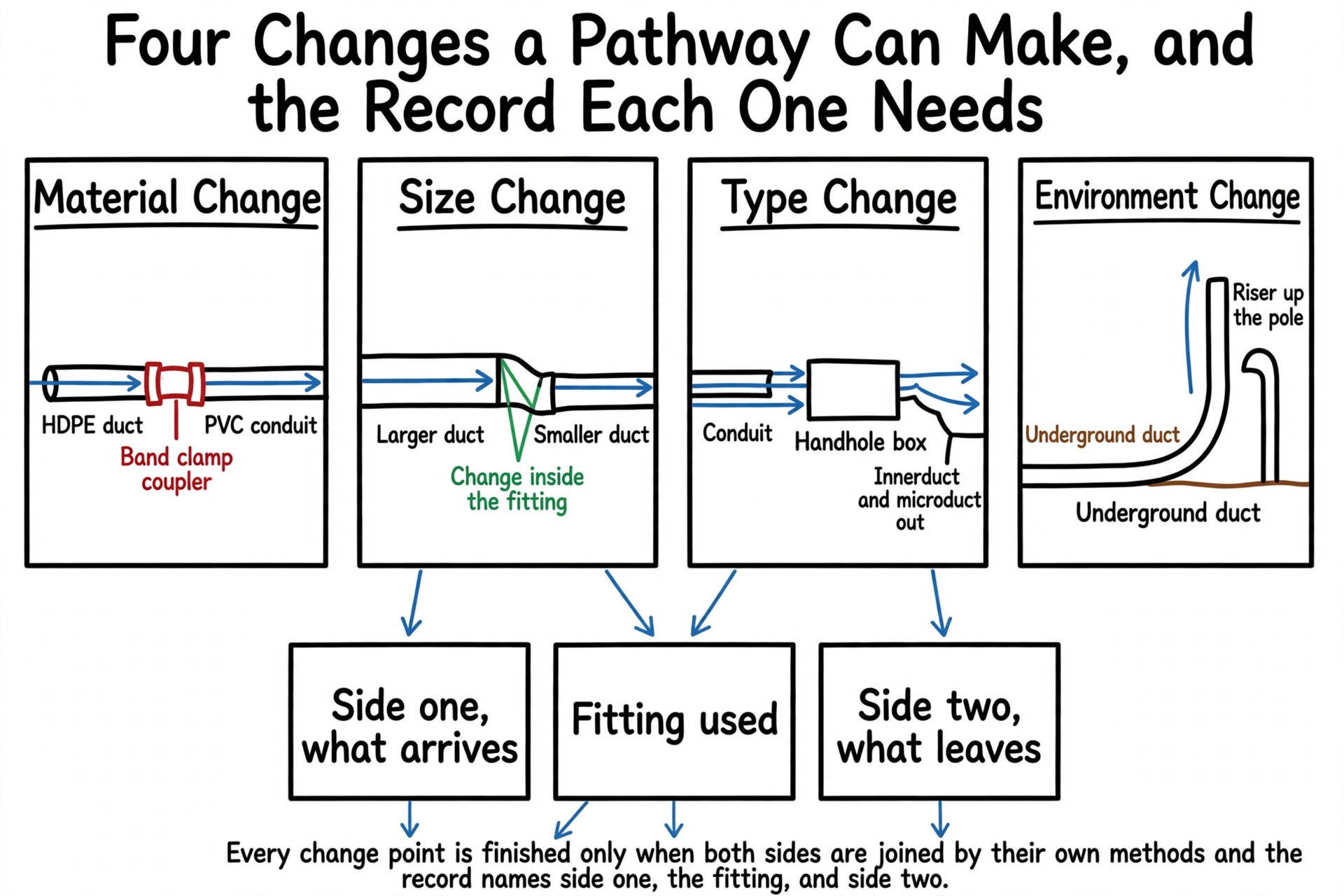
Material transition. A material transition joins two different conduit materials at one point. Dura-Line lists its Shur-Lock II coupler for coupling dissimilar conduits such as HDPE to PVC, threaded or non-threaded metal conduit, or fiberglass conduit, and its Side-Band Couplers as a transition between dissimilar conduits of the same kinds. Southwire lists E-LOC transition fittings for HDPE to threaded rigid pipe, HDPE to a solvent welded connection, and HDPE to PVC. The materials differ. The joint still has to hold, seal, and keep the bore in line, as Lesson 150 required of every coupling.
Size transition. A size transition joins two different sizes at one point, so the bore changes diameter inside the fitting. Southwire describes its E-LOC Transition Couplings as having the features of an E-LOC Coupling while providing a transition from one size conduit to another, including transitions to dissimilar materials. Dura-Line offers microduct transition couplers to provide coupling of different diameters, and describes its microduct couplers as specially designed to ensure a smooth interior transition. The size change belongs inside the fitting. The cable should never meet the size change as an open edge in the bore.
Type transition. A type transition joins two different forms of pathway, such as a duct entering an innerduct system, a conduit meeting a microduct system, or one tubing type meeting a rigid conduit type. Carlon transition adapters for electrical nonmetallic tubing join that tubing to Schedule 40 and Schedule 80 PVC conduit and to metal conduit, with each adapter made for one named pairing. The form changes. The pathway still has to read as one continuous route.
Environment transition. An environment transition carries a pathway from one setting into another, such as underground duct rising into a riser, the vertical conduit that carries the pathway up a pole or a structure, or underground conduit entering a building, a vault, or a cabinet. Champion Fiberglass describes its utility risers as pre-fabricated elbows that connect the underground conduit to the riser so a cable can be pulled through into the associated panel, cabinet, or meter box, and lists customer specific transitions for those risers, including PVC couplers, PVC stubs, and fiberglass or PVC male and female adapters. The setting changes at the surface or at the structure wall. The joint at that point carries the change.
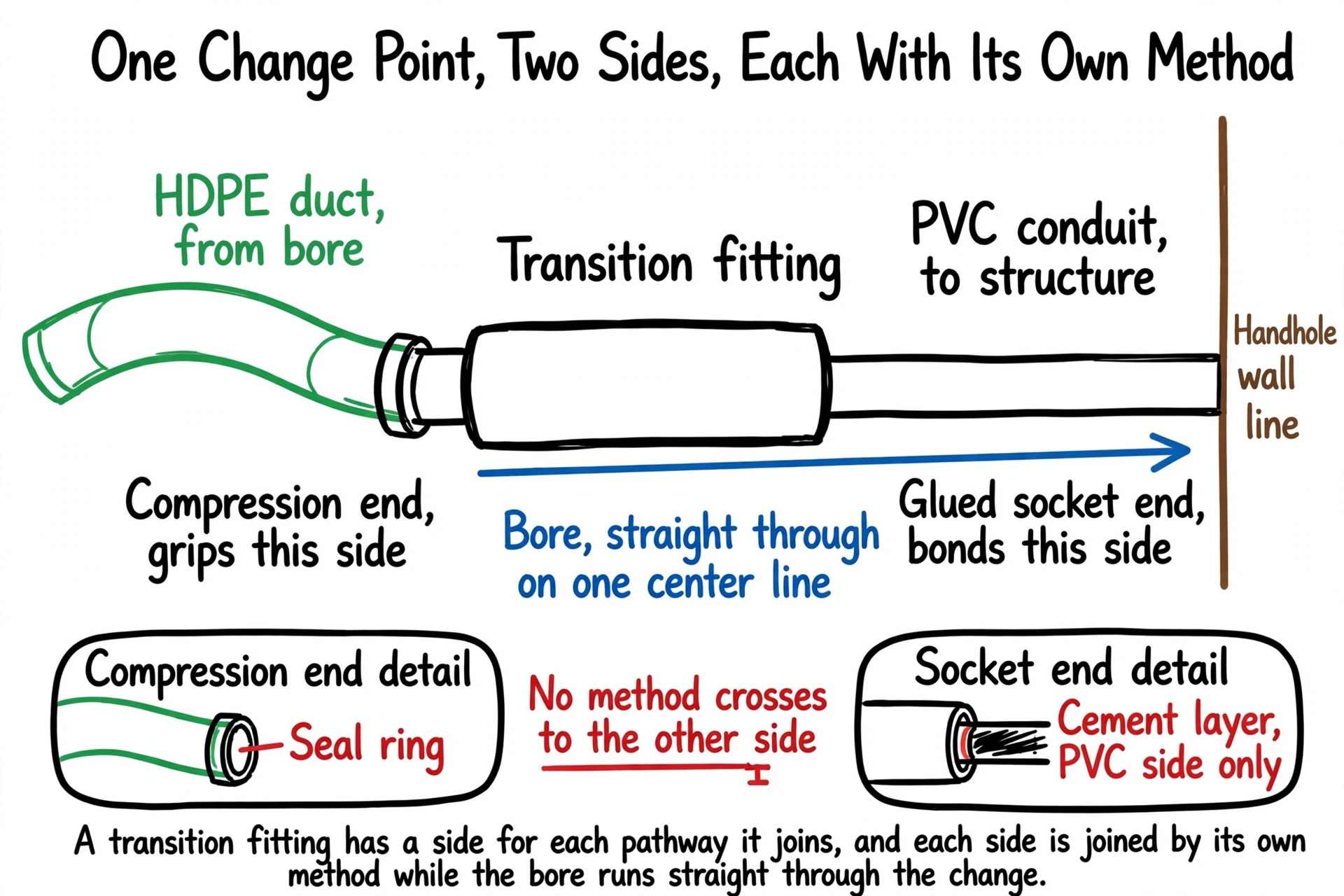
Each side keeps its own joining method. A joining method is the way a conduit end is attached and sealed: a compression grip, a clamp, a thread, a solvent cement bond, or a fusion joint, as Lesson 150 laid out by material. Southwire states the governing fact for transition fittings plainly: one side of the transition fitting is a compression coupling and the other side is either a glued or threaded coupling. The HDPE side of an HDPE to PVC transition is joined by the compression side of the fitting. The PVC side is joined by the glued side, following solvent cement practice for PVC. Solvent cement belongs to the PVC side only, and heat fusion belongs to an HDPE to HDPE joint only. Neither method crosses to a material it was never made for.
Alignment through a change. Alignment means the two pathway sides and the fitting share one center line, so the bore runs through the change without an angle. A step is a raised edge inside the bore where one surface sits higher, lower, or farther in than the surface beside it, as Lesson 150 defined it. At a size transition, the inside diameter changes by design, and the fitting shapes that change. A step at a transition means the change escaped the fitting: an end sits crooked, an end stopped short, or the wrong fitting left two bore walls facing each other across a gap.
Controlled transition. A controlled transition is a size or type change shaped inside the fitting so the passage narrows or widens gradually enough for a cable, a proofing device, and pulling line to pass without catching an edge. Industry guidance on microduct connectors treats the transition between ducts as part of the cable path, and a reducer between different duct sizes is expected to provide a controlled transition between the two sizes. Dura-Line uses the same design language for its microduct couplers: specially designed to ensure a smooth interior transition.
The transition record. The transition record is the as-built entry for the change point. A complete entry names the pathway on the first side, the pathway on the second side, and the fitting used to join them. A coupling record from Lesson 150 named one product and one conduit. A transition record carries two pathway descriptions, because the next crew needs to know what they will find on each side of the fitting before they open the ground or order a replacement.
Common transition forms. Project documents and manufacturer instructions govern which form a given change point receives.
- Dissimilar material couplers. A coupler whose grip and seal act on the outside of each end can join two materials in one body. Dura-Line lists the Shur-Lock II, with stainless steel band clamps and a locking ring, for HDPE to PVC and for transitions to threaded or non-threaded metal and fiberglass conduit, and lists its fully divisible Side-Band Couplers as a transition between dissimilar conduits with high pull-out strength.
- Two-method transition fittings. A fitting with a different joining method built into each end. Southwire E-LOC and Double E-LOC transition fittings pair a compression side for HDPE with a glued side for a PVC solvent welded connection or a threaded side for rigid pipe, for a watertight connection of dissimilar material.
- Size transition couplers. A coupler made in two sizes, one at each end. Southwire lists E-LOC Transition Couplings by paired outside diameters, and Dura-Line lists microduct transition couplers by paired diameters for joining microducts of different sizes.
- Adapters at structures and risers. A short adapter or a prefabricated riser assembly carries the pathway into a different setting. Champion Fiberglass supplies risers with PVC sleeve couplings and male adapter transitions bonded on, with alternate transitions available for other pairings, and Carlon supplies transition adapters that join its tubing systems to rigid PVC conduit and to metal conduit.
- Duct to innerduct and microduct changes. A larger conduit can carry innerduct, a smaller duct placed inside a conduit to divide its space, or microduct, a small duct made for blown or jetted microcable. Fiber Optic Association material carried in industry coverage describes innerducts placed inside a conduit, each carrying a cable, and microducts pulled into a conduit to add capacity. Where an underground duct system hands off to an innerduct or microduct system, the handoff point is a transition, and the record names the duct on one side and the innerduct or microduct system on the other.
What Does It Look Like?
A beginner meets a transition first as a fitting that refuses to look the same from both ends. Each stage of the work shows different evidence.
On the staging pile and in the parts box:
- A fitting with two visibly different ends, such as a compression end with an end cap on one side and a smooth socket or a threaded end on the other side.
- A coupler body that changes size along its length, wider at one end and narrower at the other, for a size transition.
- Band clamp couplers and side-band couplers staged for a material change, with their clamps and bolts present.
- Packaging and molding marks that name two pairings instead of one, such as HDPE to PVC or one diameter paired with another diameter.
- A prefabricated riser or a structure adapter staged near the pole base, the vault, or the building entry where the setting is about to change.
- Microduct transition couplers in small sizes, color coded by size in the Dura-Line microduct line, staged with the microduct system they belong to.
In the open trench or at the structure during joining:
- Two different pathways arriving at one point: a flexible HDPE duct meeting a rigid PVC stick, a larger duct meeting a smaller duct, or an underground duct meeting a riser sweep or a structure stub.
- One side of the fitting being worked by one method, such as an end cap tightened down or band clamps tightened, while the other side waits for its own method, such as solvent cement applied to a PVC socket.
- Both pathways cut, prepared, and marked for seating following the fitting manufacturer instructions for that product, as Lesson 150 required at every joint.
- The fitting held in line with both pathways while each side is joined, with neither pathway forced into a bend to reach it.
As a finished transition before backfill or cover:
- A fitting centered on the change point, joined fully on both sides, with clamps or end caps tightened on the mechanical side and a clean bonded appearance at a solvent cement side.
- The pathway running straight through the fitting on one center line, even where the size or the material changes across it.
- A size change that happens inside the fitting body, with no exposed edge, shim, tape wrap, or improvised filler visible at either end of the fitting.
- At a riser or a structure entry, the pathway passing through the change in setting in a sealed, supported assembly, with the fitting and the adapter named in the record.
- A record entry that names both sides and the fitting, ready to be checked against the fitting in the ground before cover.
What Does It Do?
A transition earns its place by carrying one pathway across a difference without letting the difference become a defect. Three mechanisms work at the same time, and Lesson 150 named the same three jobs for every coupling: an aligned bore, resistance to separation, and a closed seam. A transition has to do all three jobs across two sides that do not match.
The fitting gives each side the joint that side requires. Two pathways meet, and each one can only be joined correctly in its own way. HDPE takes a mechanical grip or a fusion joint. PVC takes a solvent cement bond or a mechanical fitting rated for PVC. Threaded rigid pipe takes a threaded connection. A transition fitting holds the answer in one body: Southwire describes one side as a compression coupling and the other side as a glued or threaded coupling. The compression side grips the HDPE. The glued side bonds to the PVC. The threaded side engages the rigid pipe. No side is asked to accept a joining method built for another material, and no installer has to invent a joint in the field.
The fitting carries the bore across the difference. The pathway would otherwise end twice at the change point, once for each system, with a gap between two incompatible ends. The fitting bridges the gap with its own short bore. Where the two sides share a size, that bore holds one diameter through the change. Where the sizes differ, the fitting shapes the change in diameter inside its body, so the passage a cable travels narrows or widens under control. Dura-Line microduct material calls this a smooth interior transition, and microduct connector guidance treats a controlled transition between ducts as part of the cable path itself. Alignment does the remaining work: both sides brought into the fitting on one center line present a continuous passage to anything traveling through, even though the material outside that passage changed completely.
The fitting seals and holds across two different behaviors. The two sides of a transition can differ in stiffness and in how they respond to handling and ground movement. A flexible duct arriving from a bore meets a rigid stick in a trench. A buried duct meets a riser fixed to a structure. The grip, clamp, bond, or thread on each side of the fitting has to hold that side at the strength the product data sheet states, and the seal has to close the seam against the soil and water around the joint, as the product is designed to do. Southwire describes its E-LOC coupling as a compression coupling that provides a watertight and airtight connection in buried or restrained applications, with the ability to join dissimilar materials such as PVC, HDPE, fiberglass, or metal. A transition that holds on one side and slips on the other has failed at the side that slipped, and the failure sits at the one point in the run where two systems depend on each other.
The transition marks where the record has to change. Downstream of the change point, the pathway is a different material, a different size, or a different system, and every later decision depends on knowing where that change happened. A crew pulling cable needs to know the smaller size governs the rest of the run. A repair crew needs to know which joining supplies to bring for each side. The fitting in the ground is the physical marker. The transition record is the paper marker, and the two have to agree.
Where Does It Fit?
Transitions appear wherever a design changes its mind about the pathway, and the changes follow the logic of the work.
- Design and submittals. The designer places transitions where the route changes material, size, type, or setting, and the project documents name the fitting approved for each pairing. A fitting is approved for a named pairing of sides, so a substitution changes two joint designs at once.
- Material changes along a route. A run built in one material for one installation method hands off to another material where the method or the setting changes, such as reeled HDPE duct meeting PVC stick conduit in a duct bank or at a structure.
- Size changes along a route. A pathway steps down or steps up where the cable count, the duct availability, or the structure opening calls for a different size, and the transition coupler carries the change at one recorded point.
- Structure entries and risers. Underground duct meets a handhole, a vault, a cabinet, a building entry, or a pole riser. The pathway changes setting and often changes material or fitting type at the same point, and prefabricated riser and adapter assemblies exist for these pairings.
- Duct to innerduct and microduct handoffs. A conduit system hands off to innerducts or microducts that divide its space or carry blown cable, and the handoff point is recorded as a transition between the two systems.
- Proofing and cable placement. Crews prove the run before cable placement, and Seattle City Light Construction Standard U2-11.40 requires each duct run to be tested for obstructions or flattening by hand pulling a proofing mandrel through it. A transition is a named suspect in any failed proof, because the bore changes at that point by design, and a badly made change adds a step to the designed change.
- Repair and restoration. A damaged section replaced with a different material or a different size creates a transition at each end of the repair. Each repair transition enters the record with both sides named, like any planned transition.
- Records. The as-built record carries each transition with both pathway sides and the fitting named. A transition buried with a one-sided record can still be found later, by a mandrel that stops at the size change nobody wrote down.
What Is at Stake
A cable that meets an uncontrolled change. The designed change at a transition is a change in diameter or direction of the passage. A badly made transition adds an edge to that change. The proofing device, the pulling line, or the cable catches on the edge at a fixed address in the pathway, after burial, and the fix begins with excavation at a point that was open to view on the day it was made.
A joint made with the wrong method on one side. Solvent cement carried across to an HDPE side, or a grip sized for one outside diameter forced onto another, produces a transition that looks assembled and holds on only one side. The weak side separates or leaks underground, and the pathway fails at the joint between two systems that each performed correctly everywhere else.
A run planned against the wrong size. Cable placement depends on the smallest size in the route. A size transition that never reached the record leaves planners reading the larger size for the whole run. The cable, the innerduct, or the microduct selected for that run meets the smaller section mid-route, where the correction costs a dig or a redesign.
Water and silt entering at the change point. Transitions cluster at structures, risers, and low points where water collects. A seam that leaks at a transition admits water and silt into two systems at once, and material entering there migrates into whichever side sits lower.
Air loss on blown cable jobs. A microduct or duct transition that leaks air steals the pressure that carries a blown or jetted cable. The cable slows or stalls, and the crew hunts for a leak at a change point the record may not even name.
A repair crew sent with half the supplies. A repair at a transition needs the joining method for both sides. A record naming one side sends a crew with one set of fittings to a joint that needs two, and the open excavation waits while the second set travels.
Safety around structures, risers, and open excavations. Transition work happens at trench edges, inside vault and handhole work under the project safety program, and at pole bases and building entries. Recognizing and checking a transition is the subject of this lesson. Entering excavations and structures, climbing or working at poles, and making joints beyond an assignment belong to qualified people under the project documents and their training.
What Does Good Look Like?
- The fitting product matches the named pairing at the change point: the material, size, and type on each side of the fitting match the pathway arriving on that side.
- Each side of the transition is joined by its own method, following the fitting manufacturer instructions for that side, with no joining method carried across to a material it was not made for.
- Both sides are fully seated, bonded, threaded, or clamped as their method requires, verified by the mark, the appearance, or the check the manufacturer instructions specify for that product.
- The pathway runs straight through the transition on one center line, with no angle at the fitting and no forced bend in either side leading into it.
- The size or type change happens inside the fitting body, with no exposed edge, gap, shim, or tape wrap visible at either end.
- Seals, clamps, and end caps sit in place and are fully tightened on the mechanical side, with no seal ring pinched or showing where it should sit hidden.
- At a riser or a structure entry, the assembly is supported and sealed as the project documents direct, with the pathway passing through the change in setting without a kink or a forced alignment.
- The transition record names the pathway on both sides and the fitting used, and any transition that was remade is recorded as remade, with the reason named.
From the Field
Picture a two-person crew finishing a duct run at a handhole, where the pathway changes before it leaves the structure. On one side of the handhole wall, the run arrives as HDPE duct placed by boring. On the other side, the run continues as a PVC conduit of the same size built in an open trench toward the next structure. The change point sits at the handhole, open and reachable, with backfill and restoration waiting on the trench side.
The fitting in the parts box is a two-method transition fitting. One end is a compression fitting for the HDPE side. The other end is a solvent weld socket for the PVC side. The crew joins the HDPE side first, and the compression end tightens down and holds. The PVC conduit end is then pushed into the socket end dry, to check the fit, and it slides in and feels snug.
One crew member suggests leaving the PVC side as it sits. The fit feels tight, the handhole will be closed within the hour, and the cement can is back in the truck. The joint looks finished from every angle available in the handhole.
The inspector at the structure asks the question this lesson teaches: which method belongs to that side, and where is the evidence it was used? The solvent weld side of the fitting earns its hold and its seal from a cement bond, following solvent cement practice for PVC. A dry socket has neither. The snug feel reports friction at one moment, and friction alone leaves the PVC side free to work out of the socket as the ground settles and the trench side moves.
The crew lead holds the close-out at that structure. The PVC end comes back out, the socket and the conduit end are prepared and cemented following the cement and fitting manufacturer instructions, and the end is pushed home and held while the joint sets. The record entry names the HDPE duct on the bore side, the PVC conduit on the trench side, and the transition fitting used, and only then is the handhole closed.
The rule to carry is simple: a transition is finished when each side has been joined by the method that side requires, with evidence for both sides, and a side that only feels tight holds the close-out instead of hiding inside a closed structure.
What Can Go Wrong?
Carrying one joining method across both sides. Solvent cement applied to an HDPE side, or a threaded or push connection forced onto a side built for a bond, leaves one side of the transition unjoined in every way that matters. The fitting looks complete, and the weak side separates or leaks underground.
Leaving one side dry, unseated, or partly made. A socket pushed together without cement, a compression end left short of full seating, or a clamp left loose means the transition was finished on one side only. The unfinished side carries partial grip and a partial seal at the point where two systems depend on each other.
Forcing a fitting onto the wrong outside diameter. A transition coupler exists because the two sides present different outside diameters. A fitting forced onto an oversized end, or left loose on an undersized end, cannot grip and seal as designed on that side, and the defect hides inside a fitting that appears to fit.
Letting the size change escape the fitting. A smaller duct butted against a larger duct with tape, a shim, or an open gap leaves the diameter change exposed inside the bore. Every proofing device and cable meets that edge, and the edge sits at a point the record may describe as a smooth transition.
Joining the two sides at an angle. Pathways arriving from a bore and from a trench rarely line up on their own. Ends joined at an angle load the fitting unevenly and leave a step inside the bore at the change point, where a step does the most harm.
Recording only one side. A record that names the fitting and one pathway leaves the other system undocumented. Later crews plan pulls, order repair fittings, and judge sizes from a record that describes half the joint.
Covering a transition that was never checked as a transition. A plain coupling check asks whether two identical ends seated. A transition check asks that question twice, once per side, with a different method and a different proof on each side. Covering the change point after a single-side check buries the unchecked side with it.
What Should Someone Notice in the Field?
- Name what changes at the point in front of you: material, size, type, environment, or a combination, and name the pathway on each side before naming the fitting.
- Read the fitting and its packaging or molding marks, and confirm that each side of the fitting matches the pathway arriving on that side in material and outside diameter.
- State the joining method for each side out loud, and confirm that each side shows the evidence of its own method: clamps or end caps tightened, a cement bond made while the cement was wet, threads engaged, or seating marks aligned.
- Sight along the pathway through the transition and look for any angle at the fitting or forced bend in either side leading into it.
- Check that any size change happens inside the fitting body, and look for tape, shims, exposed edges, or gaps at either end of the fitting.
- At a riser or a structure entry, check that the assembly is supported and sealed as the documents direct, and that the pathway passes through the change in setting without a kink.
- Photograph finished transitions before cover where the project record calls for it, and record both pathway sides, the fitting product, and any transition that was remade.
- Hold backfill, structure close-out, or cover over any transition with a side unjoined by its own method, a side unseated, a mismatched fitting, or an improvised size change, and report the condition for correction while the change point is still reachable.
- Know the boundary: recognizing a transition, naming its two sides, checking the evidence for each joining method, and reporting a defective change point are tasks covered by this lesson. Making fusion joints, entering excavations and structures under a safety program, working at poles, and directing backfill or close-out belong to qualified people under the project documents and their training. Reading this lesson qualifies no one for that work, and no one should remake a transition, enter a structure, or join a pull beyond their assignment, training, and authorization.
Key Terms
Transition: The location where a pathway changes in material, size, type, or environment, carried across a fitting or an assembly selected for that specific change.
Transition fitting: A fitting built with a side for each pathway it joins, so each side of a change point is joined by the method that side requires.
Outside diameter: The full width across the outside of a conduit or duct, the dimension a grip, clamp, or compression seal acts on.
Material transition: A change point joining two different conduit materials, such as HDPE duct to PVC conduit, at one fitting.
Size transition: A change point joining two different sizes, so the bore changes diameter inside the fitting in a controlled way.
Controlled transition: A size or type change shaped inside a fitting so the passage narrows or widens without an exposed edge for a cable to catch.
Riser: A vertical conduit that carries an underground pathway up a pole or a structure into the setting above ground.
Transition record: The as-built entry for a change point, naming the pathway on both sides and the fitting used to join them.
Check Your Understanding
- A pathway changes from HDPE duct to PVC conduit at one point. Which joining method belongs to each side of a two-method transition fitting at that point, and which method must never cross to the other side?
Answer: The HDPE side is joined by the mechanical side of the fitting, such as the compression side on a Southwire E-LOC transition fitting. The PVC side is joined by the glued side, a solvent cement bond following solvent cement practice for PVC, or by a threaded side where the fitting provides one. Solvent cement belongs to the PVC side only and is never the joining method for HDPE, and a mechanical grip sized for one side is never forced onto a side it was not made for.
- Two ducts carry the same nominal size name. Why can a transition coupler still be the correct fitting between them, and what dimension settles the question?
Answer: The two ducts can present different outside diameters even under the same size name, and a grip, clamp, or compression seal acts on the outside diameter. Dura-Line states that transition couplers are used to join ducts with different outside diameters. The measured outside diameter of each side, checked against the manufacturer material for the fitting, settles the selection.
- What makes a size change a controlled transition, and where does the change happen in a well made size transition?
Answer: The fitting shapes the change in diameter inside its own body, so the passage narrows or widens without an exposed edge, a gap, or a shim in the bore. Dura-Line describes its microduct couplers as specially designed to ensure a smooth interior transition, and the change happens inside the fitting, where the cable path stays continuous.
- In the From the Field scenario, why did the inspector question a PVC side that felt snug, and what did the crew do before the handhole was closed?
Answer: The solvent weld side of the fitting earns its hold and its seal from a cement bond, and a dry socket pushed together by hand has friction only, with no bond and no seal as the product is designed to deliver. The crew held the close-out, removed the PVC end, prepared and cemented the socket and the conduit end following the cement and fitting manufacturer instructions, seated the end and held it while the joint set, and recorded both pathway sides and the fitting before the handhole was closed.
- Write the record entry for a transition in words. What three pieces of information must it carry, and what goes wrong later when one piece is missing?
Answer: The entry names the pathway on the first side, the pathway on the second side, and the fitting used to join them. A missing side leaves later crews planning pulls against the wrong size or material and arriving at a repair with joining supplies for only one side of a joint that needs two.
Lesson Takeaway
A pathway changes along its route, and every change point asks two questions instead of one: what is on this side, and what is on the other side. After this lesson, a transition reads as a pair of joints sharing one fitting, each side joined by its own method, with the bore carried across the difference under control. A reader who names both sides, checks the evidence for both methods, and writes both sides into the record keeps a change point from becoming the place where two good systems fail to meet.
Sources and Technical References
Dura-Line, Couplers, Accessories. Covers Shur-Lock II for coupling HDPE and PVC conduit and dissimilar conduits including HDPE to PVC, threaded or non-threaded metal conduit, and fiberglass conduit, Side-Band Couplers as a transition between dissimilar conduits, E-LOC push-on couplers with transition couplers used to join ducts with different outside diameters, and field assembly couplers and adapters to join different material types: https://www.duraline.com/accessories/Couplers/split-lock–181/
Southwire, SIMpull Couplers, E-LOC Transition Fittings, Spec 87202. Covers transition fittings for HDPE to threaded rigid pipe, HDPE to solvent welded connection, and HDPE to PVC, with one side of the transition fitting a compression coupling and the other side a glued or threaded coupling for a watertight connection of dissimilar material: https://cabletechsupport.southwire.com/en/cablespec/download_spec/?spec=87202&country=US
Southwire, SIMpull Couplers, E-LOC Conduit Coupling, Spec 87200. Covers the E-LOC compression coupling providing a watertight and airtight connection in buried or restrained applications, joining dissimilar materials such as PVC, HDPE, fiberglass, or metal, transitions between sizes, and E-LOC Transition Couplings providing a transition from one size conduit to another including transitions to dissimilar materials: https://cabletechsupport.southwire.com/en/cablespec/download_spec/?spec=87200
Dura-Line, Micro Couplers, Microtechnology Accessories. Covers Micro Couplers used to join two segments of MicroDucts with straight and transition couplers available, transition couplers to provide coupling of different diameters, and couplers specially designed to ensure a smooth interior transition: https://www.duraline.com/-/ods/Resource/1692/2425/Original/DL_Micro%20Couplers%2011.23.pdf?version=1701115428
Dura-Line, MicroAccessories. Covers Micro Couplers used to join two segments of MicroDucts, with straight and transition couplers available in multiple sizes: https://www.duraline.com/accessories/microaccessories/microduct-split-coupler-7951/
Champion Fiberglass, Xpress Utility Risers and Expandable Utility Risers. Covers pre-fabricated riser elbows that connect underground conduit to the riser for pulling cable into a panel, cabinet, or meter box, risers supplied with PVC sleeve couplings and PVC male adapter transitions, and customer specific transitions including PVC couplers, PVC stubs, and fiberglass or PVC male and female adapters for underground to overhead transitions: https://championfiberglass.com/champion-fiberglass-now-offers-xpress-utility-risers/
Carlon, Flex-Plus Blue ENT product material, ABB Library. Covers transition adapters joining electrical nonmetallic tubing to Schedule 40 and Schedule 80 PVC conduit, with the PVC adapter solvent cemented to the conduit, and ENT to EMT transition adapters joining tubing to metal conduit: https://library.e.abb.com/public/25c3a95b68d14ff8a82fb37288be7a4e/9AKK108470A7810_Brochure_Carlon_ENT_EN.pdf?x-sign=i3u1SRYS1r0KRfgVy1emtFU3wZ%2Br7frRzVIjQ2N4s8368Mk4pl7emrsZpJ4B47dF
Fiber Optic Association underground installation guidance, carried in Electrical Contractor Magazine, Construction Without Disruption: Installing Fiber Optic Cables Underground. Covers conduit carrying multiple innerducts with one cable each, microducts pulled into conduit to add capacity for blown microcable, and adding cables to existing conduit systems: https://www.ecmag.com/magazine/articles/article-detail/systems-construction-without-disruption-installing-fiber-optic-cables-underground
Microduct connector design guidance, FCST, How Microduct Connector Design Affects Fiber Blowing Performance. Covers a connector providing a smooth internal passage, accurate duct alignment, and reliable sealing, the transition between ducts as part of the cable path, and a reducer between different duct sizes providing a controlled transition between the two sizes: https://www.fcst.com/How-Microduct-Connector-Design-Affects-Fiber-Blowing-Performance-id00170435.html
Seattle City Light, Construction Standard U2-11.40, Mandreling and Cleaning of Ducts and Conduits. Covers testing each duct run and conduit for obstructions or flattening by hand pulling a proofing mandrel through it after installation, and replacing a section where an obstruction is found: https://web8.seattle.gov/city-light-engineering-standards/Home/GetPDF?libId=ConstructionStandards&searchForfileName=U2-11.40-NDK-40F2023.11.14.pdf
Previous lesson: Lesson 151: What Is a Conduit Fitting? |
Back to Level 8 hub |
Next lesson: Lesson 153: What Is Tracer / Locate Wire?