
Lesson Number and Title
Lesson 151, Level 8: Understand the Underground Pathway
Title: What Is a Conduit Fitting?
Introduction
A conduit fitting is a manufactured piece that connects, turns, branches, ends, or adapts a conduit run, so a pathway built from straight sections can go where the design sends it and finish where the design ends it. Industry fitting guides state the job list in the same plain terms: a fitting connects, terminates, adapts, seals, or provides access to a raceway system, and the fitting has to match the system it serves.
Level 8 studies the underground pathway piece by piece. Lesson 149 taught the sweep, the fitting that turns a run gradually, and Lesson 150 taught the coupling, the fitting that joins two ends in line. This lesson teaches the family those two pieces belong to, because a real pathway needs more than straight joins and turns: it needs branches where the design branches, closures where a run ends or waits, and adapters where one size, material, or system meets another.
What This Lesson Gives You
- Walk a staged parts pile or an open trench and name the job of each fitting in front of you, from its openings and its shape: join, turn, branch, close, or adapt.
- Place the coupling and the sweep inside the fitting family, and state which larger category each one belongs to.
- Read a fitting by its ends: socket, thread, flare, different sizes on each side, or a closed face, and say what each end is made to meet.
- Match a fitting to the conduit material, size, and system in the project documents and on the product marking, and state why a fitting made for one system cannot be assumed to serve another.
- State the hold decision when an opening in a pathway is about to be buried with the wrong fitting on it, or with no fitting on it, and name the job that opening still needs done.
Start With the Basics
Picture the fittings bin in a plumbing repair kit. Straight pipe in that kit does one job well: it runs in a straight line at one size. The bin holds the pieces that do everything else. An elbow turns the line around a corner. A tee splits the line into a branch. A coupling joins two straight pieces end to end. A reducer steps the line down to a smaller pipe. An adapter lets a plastic pipe meet a threaded metal fitting. A cap closes a stub that waits for a future fixture.
Conduit fittings fill the same bin for a pathway, with one difference in what travels inside. A plumbing fitting guides water under pressure, and a bad plumbing joint announces itself with a leak a person can see. A conduit fitting guides a cable that travels through once, under pulling tension, and then sits in the pathway for years. A wrong conduit fitting hides underground and presents its bill later, to a pulling crew, a proofing device, or a cable jacket. The shapes in the bin look familiar because the jobs are the same: join, turn, branch, change size, change system, close the end. The reader who learns to name the job first, and the fitting second, has the habit this lesson builds.
What Is It?
A fitting is any piece in the pathway that is manufactured separately from the straight conduit and installed at a point where the run does something besides run straight. The definitions below build the picture in order, from the piece itself to the members of the family.
Fitting defined. A fitting is a manufactured component, made for a stated conduit material, size, and system, that performs one defined job at one point in a run. Standards for PVC conduit fittings show how specific that definition is in practice. NEMA TC 3 covers PVC fittings intended to be joined in the field by a solvent cement system to rigid PVC conduit, tubing, and other fittings, based on the outside diameters given in NEMA TC 2. UL 651 covers rigid PVC conduit and fittings, including elbows, couplings, adapters, expansion and deflection joints, and conduit hub fittings. The fitting is a designed part of a system, with dimensions and requirements of its own, and it is never a generic piece of plastic that happens to fit over an end.
Socket, bell, and thread. Fittings meet conduit through their ends, and three end forms recur across the family. A socket is a cup shaped opening that receives a plain conduit end inside it, where the joint is made by solvent cement, by a grip and seal inside the fitting, or by another method the manufacturer specifies. A bell is a flared, enlarged end, formed on a conduit section or supplied as part of a fitting, that receives the plain end of the next section. A thread is a helical ridge cut or molded on an end, so the end screws into or onto a mating threaded part. Carlon catalog material describes its adapters by these ends directly: a female adapter carries female threads on one end and a socket on the other, and a male terminal adapter carries male threads on one end and a socket on the other.
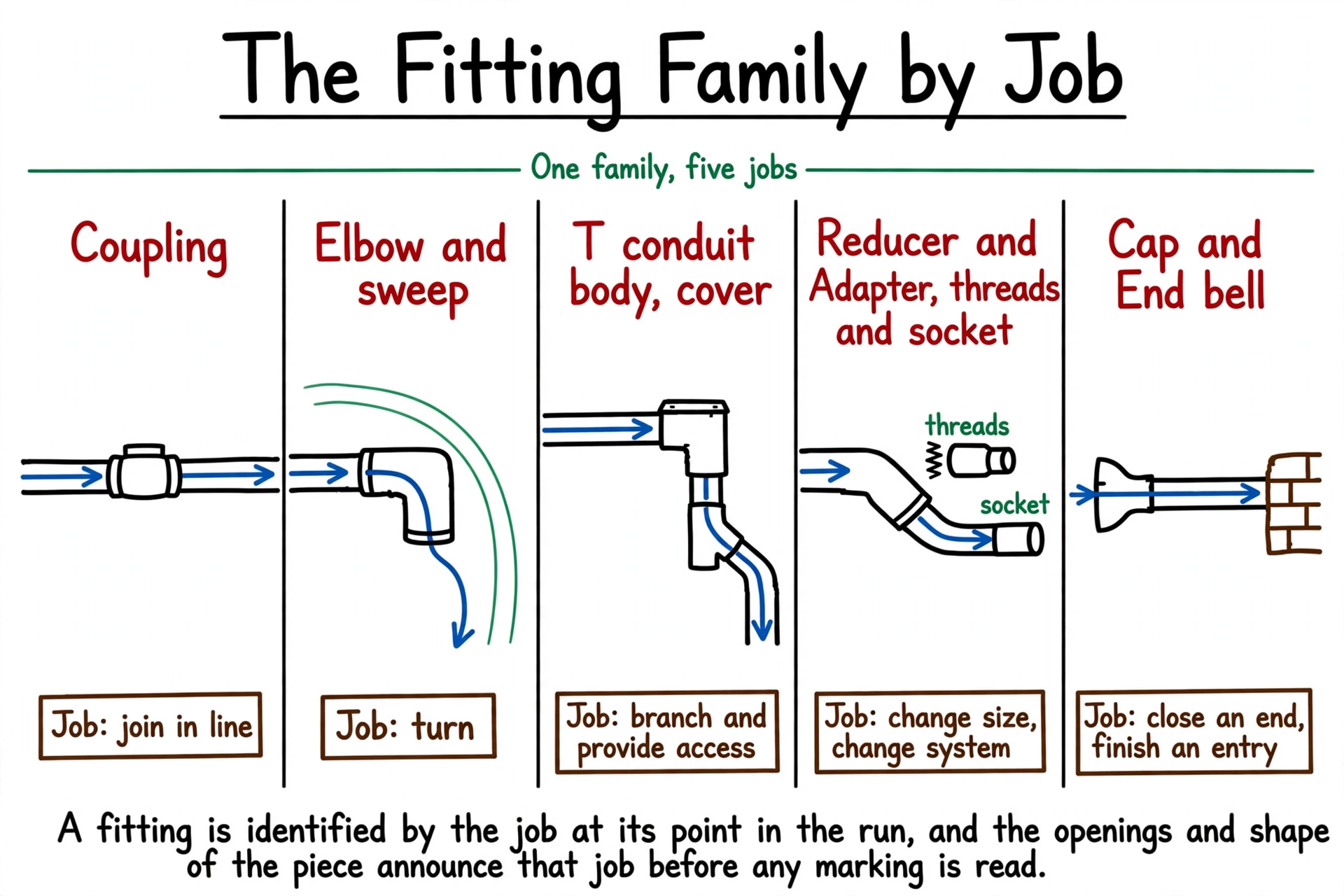
Coupling, the joining member. A coupling is the fitting that joins two conduit ends in line, covered in full in Lesson 150. UL 651 describes couplings as fittings intended for joining two lengths of rigid PVC conduit, a length of conduit to an elbow, and, with a junction box adapter, a length of conduit or an elbow to a box. A coupling is one member of the fitting family, the member whose job is the straight join, and every other member in this lesson exists because a pathway needs jobs a straight join cannot do.
Elbow and sweep, the turning members. An elbow is a factory made fitting at a fixed angle that changes the direction of a run. A sweep is the long radius form of elbow, covered in full in Lesson 149. Central Conduit states the relationship plainly: all sweeps are elbows, and only long radius elbows earn the name sweep. The turning job therefore has two radius choices inside one family member, and the project documents state which radius a given turn receives.
Conduit body and the branch. A conduit body is a fitting with a removable cover that provides access to the inside of the run for pulling cable and for changing direction. Fitting guides list common conduit body configurations by letter, including C and T forms. A tee form, in conduit work, is the T configuration of conduit body: the run passes straight through, a third opening branches off at a right angle, and the cover keeps the junction reachable for pulling and inspection. Branching in an underground duct bank follows the project documents for that build, and the fitting at a branch is selected and recorded like any other fitting on the run.
Reducer, the size change. A reducer is a fitting that joins conduit of two different sizes, with a larger opening on one side and a smaller opening on the other. UL 651 defines reducers in exactly those terms, as fittings intended for joining lengths of two different sizes of rigid PVC conduit. Carlon lists a swedge reducer for its duct line, and Dura-Line describes transition couplers as the pieces used to join ducts with different outside diameters. The bore steps down inside the reducer, and that step is a designed feature of the fitting, placed where the design changes the pathway size.
Adapters and transition fittings, the system change. An adapter is a fitting that lets conduit meet something built to a different form: a threaded fitting, a metal conduit system, a box, or an enclosure. UL 651 describes internally threaded adapters as fittings for joining rigid PVC conduit or an elbow to threaded rigid metal conduit or other externally threaded devices, and externally threaded adapters, called terminal adapters, as fittings for joining conduit or an elbow to a box knockout or a threaded hub. Carlon describes its male and female adapters the same way, as pieces for adapting nonmetallic conduit to boxes, threaded fittings, and metallic systems. A transition fitting is an adapter whose two sides join different conduit materials or different outside diameters, with each side joined by the method that material requires. Dura-Line describes its side-band couplers as usable as a transition between dissimilar conduits, including HDPE to PVC and threaded or non-threaded metal conduit, and lists transition couplers for joining ducts with different outside diameters.
Cap and plug, the closing members. A cap is a fitting that closes the end of a conduit length, fitting over or onto the end from outside. UL 651 defines caps as fittings intended for closing the ends of unused lengths of rigid PVC conduit. A plug is a closing piece that seats inside the conduit opening. Carlon lists polyethylene plugs in its duct fitting line alongside its couplings and bell ends, and Dura-Line includes end caps in its microduct accessory line, as pieces designed to perform with microducts. A closed end keeps soil, water, and debris out of a pathway that is waiting for cable, waiting for a later construction phase, or held as a spare.
End bell, the finished entry. An end bell is a fitting that provides a flared, bushed opening at the open end of a conduit length. UL 651 defines end bells as fittings intended to provide a bushed opening at the open end of a length of rigid PVC conduit. The flare replaces a square cut edge with a smooth, widened mouth where the conduit ends at a structure wall, a vault, or an enclosure, so a cable leaving or entering the conduit passes over a rounded surface. NEMA TC 3 includes end-bells in its list of covered PVC fittings, and Carlon lists molded and fabricated end bells in its duct line.
Expansion fitting, the movement member. An expansion fitting is a fitting built to allow a conduit run to lengthen and shorten with temperature change while the joint stays made. UL 651 covers expansion, expansion-deflection, and deflection joints among rigid PVC fittings, and fitting selection guides list the expansion fitting as the answer when a PVC run must be allowed to move. Expansion fittings appear where the project documents call for them, and the fitting only does its job when the run is anchored and supported as the manufacturer instructions direct.
The family as a list. Project documents and manufacturer instructions govern which member a given point in a run receives. The family, by job, is:
- Join in line: the coupling.
- Turn: the elbow, with the sweep as its long radius form.
- Branch and provide access: the conduit body, including the T form, where its cover stays accessible; underground branches are made at accessible structures.
- Change size: the reducer.
- Change form or system: the adapter and the transition fitting.
- Close an end: the cap and the plug.
- Finish an entry: the end bell.
- Allow movement: the expansion fitting.
What Does It Look Like?
A beginner meets fittings on the staging pile, in the parts box, and installed in the open trench and at structure walls. Shape and openings carry the identification, and the cues below sort the family by what a person can see.
On the staging pile and in the parts box:
- Short pieces noticeably wider than the conduit, each with molded or printed markings naming the maker, the size, and the system the piece belongs to.
- Couplings with two openings in line, one at each end, covered in Lesson 150.
- Elbows as compact corner pieces at a fixed angle, and sweeps as long open arcs in the same sizes, covered in Lesson 149.
- A T shaped piece with three openings and a removable cover, the conduit body form that branches a run and keeps the branch reachable.
- Reducers and transition pieces with a visibly larger opening on one side and a smaller opening on the other.
- Adapters with threads on one end and a smooth socket on the other, in male and female thread forms.
- Caps as closed cups with one opening, and plugs as solid or tabbed pieces sized to seat inside a conduit end.
- End bells as flared, trumpet shaped mouths, wider at the opening than the conduit they finish.
- An expansion fitting as a longer body with a sliding section, where the product design provides one, staged with its manufacturer instructions.
Installed, in the trench and at the structure:
- A fitting centered at the point where the run does its job: the join, the turn, the branch, the size change, or the end of the run.
- Conduit entering each opening straight and seated, with the joint method matching the material: solvent cement on PVC socket fittings per the fitting manufacturer instructions, mechanical or fusion joints on HDPE per Lesson 150.
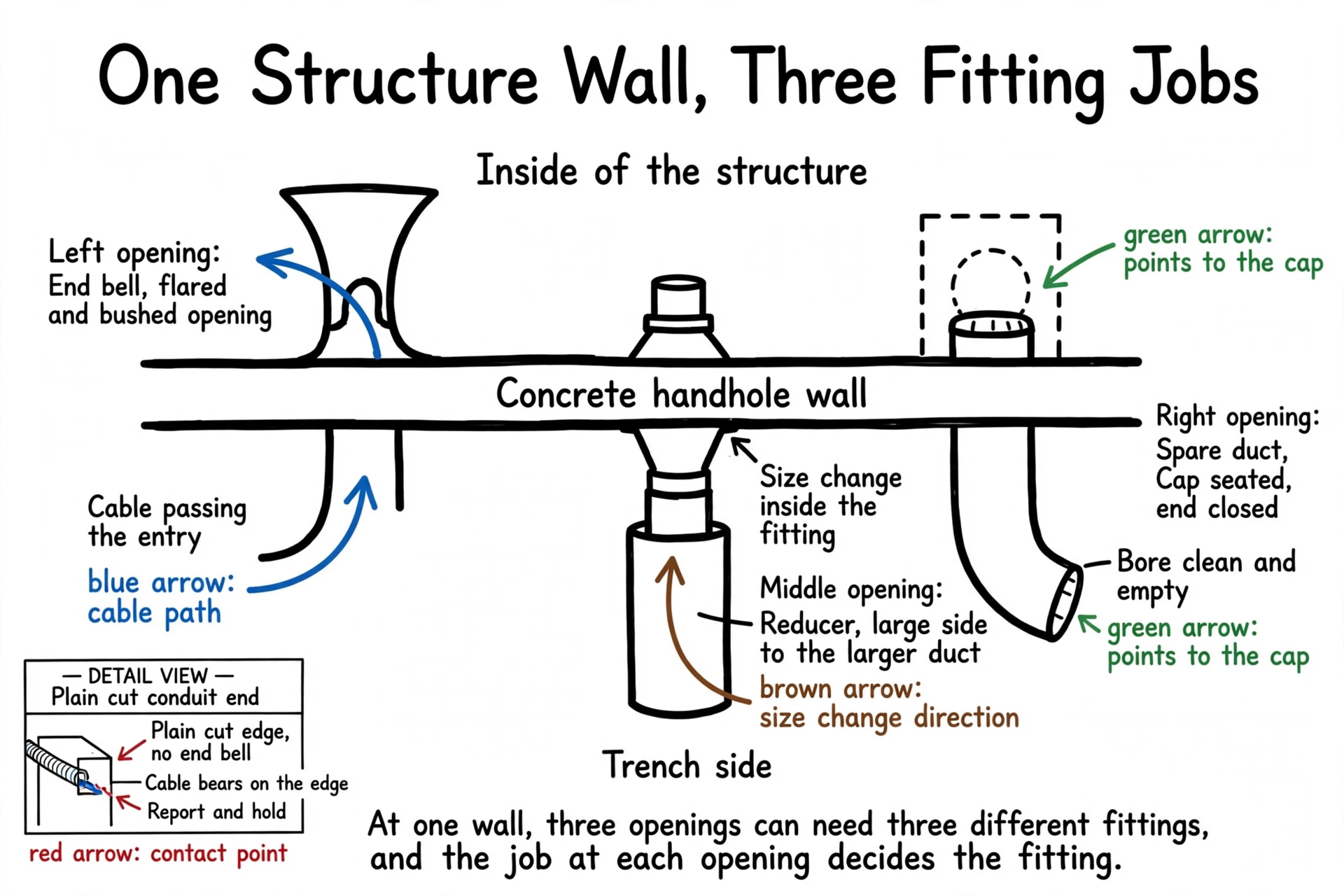
- An end bell set flush at a structure wall, with its flare facing the inside of the structure where the cable will pass.
- A cap or plug seated on every spare or unfinished duct end in the structure and at the trench, with no open duct mouth showing.
- A reducer oriented with its large side toward the larger conduit, so the bore steps down in the direction the design intends.
What Does It Do?
Each member of the family does its job through a mechanism, and the mechanisms share one requirement: the inside passage, called the bore, has to stay continuous, aligned, and smooth enough for a cable to travel, at every point where a fitting touches the run.
The joining and turning members carry the bore through a change. A coupling carries the bore across a seam in a straight line, as Lesson 150 teaches. An elbow or sweep carries the bore around a change of direction, as Lesson 149 teaches. In both cases the fitting supplies the passage where straight conduit cannot: across the gap between two ends, or around a corner no straight section can follow. The fitting wall replaces the conduit wall for that short distance, and the cable feels the fitting interior as part of the pathway.
The branching member keeps the branch reachable. A conduit body with a T form lets a run continue straight while a branch leaves at an angle, and its removable cover keeps that junction open to a pulling crew, as long as the cover stays accessible. That limit decides where the form belongs. NEC 314.29 requires boxes and conduit bodies to be installed so the wiring inside can be reached without excavating sidewalks, paving, earth, or other material placed to establish finished grade, so a conduit body buried in an underground run fails the rule that governs it. An underground fiber pathway therefore makes its branches at accessible structures, such as a handhole or a vault, where a crew can open the branch point. The mechanism matters for fiber work: cable travels through fittings under tension and around turns, and an access point at a branch gives the crew a place to feed, pull, and inspect instead of forcing a cable around a buried, unreachable junction.
The adapting members translate between forms. A reducer translates between sizes: the bore enters at one diameter and leaves at another, inside one manufactured piece with a designed internal step. An adapter translates between systems: a socket on one side accepts plain PVC conduit with a cement joint, while threads on the other side engage a metal fitting or a box hub, per the UL 651 and Carlon descriptions of those parts. A transition fitting translates between materials or outside diameters, with each side gripped or joined by the method that side requires. Translation inside one designed fitting is the point. A stack of unrelated pieces forced together in the field has no manufacturer behind the combination, and fitting guides warn against improvised combinations for exactly that reason.
The closing members protect an unfinished pathway. A cap or plug closes an open end so the ground stays out of a duct that has no cable in it yet. An open duct end in a trench or a structure admits soil, water, and debris from the moment the run is placed, and material that enters at an open end collects inside the bore the next cable must travel. The closure also marks the end as a deliberate end: a capped spare reads as a planned spare in the record, while an open end reads as an unfinished job.
The entry member protects the cable at the wall. An end bell widens and rounds the mouth of the conduit where the run ends at a structure. A cable pulled through that mouth bears against the edge of the opening as it changes direction into the structure. A square cut conduit edge concentrates that bearing on a narrow line. The flared, bushed opening spreads the contact over a smooth curve, so the cable jacket passes the entry without meeting a sharp edge at the point where pulling tension is already working on it.
The movement member absorbs length change. Conduit runs change length as temperature changes, and a run fixed rigidly at every point has nowhere to put that change. An expansion fitting gives the run a designed place to move: one section slides within the fitting while the joint stays closed, so length change is absorbed at the fitting instead of bowing the run or stressing the joints at its ends. Where the documents call for the fitting, the anchors and supports around it are part of the same design, and the fitting cannot do its job in a run that was fixed down against its instructions.
Where Does It Fit?
Fittings appear at every point where a pathway changes state, from the first design decision to the last spare duct capped in a structure.
- Design and submittals. The designer sets each point in the run where a fitting is required: joins, turns, branches, size changes, system changes, entries, and closures. The project documents name the fitting type, material, and size for each point, and manufacturer data and the standards behind the product, such as NEMA TC 3 for PVC fittings and UL 651 for rigid PVC conduit and fittings, support the selection.
- Staging and layout. Fittings are counted and staged against the drawings before the trench opens. A missing end bell or reducer found at staging is a paperwork problem. The same piece missing at the structure wall becomes pressure to improvise, which is why the count happens early.
- Trench and duct bank construction. Crews install couplings, elbows, sweeps, and reducers as the run advances, and each fitting is set, checked, and recorded while the work is still open.
- Structure entries. Where runs end at handholes, vaults, cabinets, and buildings, end bells finish the entries, adapters connect conduit to enclosures and hubs, and spare ducts receive caps or plugs. FOA outside plant guidance treats component selection and documentation as part of the installation contract itself, and structure entries are where fitting choices stay visible for later crews to inspect.
- Size and system transitions. Where the design steps a pathway down in size, changes material, or hands a run from underground conduit to a structure system, reducers and transition fittings make that change at a designed point in the run.
- Repair and restoration. A damaged fitting is replaced with the same job of fitting, and a repair that changes the fitting type changes the pathway at that point. The replacement enters the record with its product and location.
- Records. The as-built record names the fitting at each branch, transition, and entry where the documents require it, so a later crew reading the record knows what the ground and the structures contain.
What Is at Stake
A cable damaged at an unprotected entry. A run that ends at a structure wall with a plain cut edge gives every cable pulled through that entry a sharp bearing point. Jacket damage at an entry can stay hidden inside the structure wall and surface later as a failed cable on a route that tested clean at placement.
A spare pathway lost to an open end. A spare duct left uncapped fills gradually with water, silt, and debris. The spare exists to carry a future cable without new construction, and an open end spends that value quietly, season by season, until the future crew finds a blocked tube where the record promised an empty one.
A transition that separates or steps. An adapter or transition fitting mismatched to the material or outside diameter on either side can grip poorly, seal poorly, or leave an internal step where the sizes change outside the designed reducer geometry. The joint sits underground or inside a structure wall, and its failure is found by a proofing device or a cable, at excavation prices.
A branch with no access. A branch built without reachable access at a structure leaves later crews no pulling point at the junction. Cable placement at that branch becomes a longer, harder pull through a junction nobody can reach, with the tension and sidewall pressure that Lesson 149 attaches to forced geometry.
Improvised fittings with no standard behind them. A combination stacked together in the field to fake an adapter or a reducer carries no manufacturer instructions, no tested dimensions, and no listing for the job. When it fails, the record cannot even name what was installed, because no product was.
Records that name the wrong fitting. A reducer recorded as a coupling, or an entry recorded with an end bell that was never set, sends later crews planning pulls and repairs against a pathway that does not exist. Fitting records are cheap at installation and expensive to reconstruct after cover.
Safety at structures and in trenches. Fitting work happens at open trenches, at structure walls, and around pulling operations. Recognition of fitting types and defects is the subject of this lesson. Entering structures and excavations, pulling cable, and making joints belong to qualified people under the project safety program and their training.
What Does Good Look Like?
- Every point in the run where the pathway joins, turns, branches, changes size, changes system, ends, or enters a structure carries the fitting the project documents name for that job.
- Each fitting matches the conduit material, size, and system, confirmed by the product marking and the record, with no fitting borrowed from a different system on the strength of a close fit.
- Conduit enters every fitting opening straight and fully seated, with the joint made by the method the fitting and conduit manufacturers specify for that material.
- Every spare, stubbed, or unfinished duct end in the trench and in each structure is closed with a cap or plug, seated and recorded as a spare.
- Each structure entry that the documents finish with an end bell shows the flare set at the wall, smooth and unbroken, with no plain cut conduit edge left as the cable bearing surface.
- Each reducer and transition fitting sits at the location the drawings place it, oriented correctly, with both sides joined by the method that side requires.
- Any fitting substituted in the field is an approved equal for the same job, and the substitution is written into the as-built before cover.
- The record names the fitting type and product at each branch, transition, and entry, so the pathway on paper matches the pathway in the ground.
From the Field
Picture a two person crew finishing the conduit entries at a concrete handhole late in the build. Three ducts arrive at the wall. One duct continues into service and the drawings finish its entry with an end bell. One duct steps down in size inside the structure, and the drawings place a reducer at that point. One duct is a spare, and the drawings close it with a cap.
The crew opens the fittings box and finds the reducer and the cap. The end bell is missing. The shipment shows it back ordered, and the backfill and restoration schedule for the structure starts the next morning.
One crew member proposes a practical finish. The active duct can enter through its plain cut end, since the conduit edge feels smooth enough to a glove. The spare can stay open until the cable crew arrives, since the handhole has a lid. The reducer is on hand and correct, and two out of three entries would match the drawings.
The crew lead works the decision by naming the job at each opening, the check this lesson teaches. The plain cut end leaves the cable bearing on a square edge at the exact point where the cable turns into the structure, and the end bell exists to replace that edge with a flared, bushed opening. The open spare admits water and silt from the structure floor for as long as it waits, and the cap exists to close an unused end. Each missing fitting leaves its job undone, and both jobs get harder to do after restoration closes the work area.
The lead sets the reducer as drawn, caps the spare with the cap on hand, and holds the active entry open. The lead records the entry as incomplete, notes the missing end bell against the delivery record, and keeps the structure on the punch list until the end bell arrives and is set, photographed, and entered in the as-built.
Restoration lost part of a day at one structure. The active entry gained the smooth mouth every cable through that wall will bear against, the spare stayed clean and empty, and the record matched the ground at all three openings.
The rule to carry is simple: name the job at every opening before cover, and an opening whose fitting job is undone holds the work at that opening until the correct fitting is set and recorded.
What Can Go Wrong?
Leaving a structure entry unfinished. A plain cut conduit end at a structure wall gives every cable a sharp edge to bear against at the entry. The damage risk repeats on every pull through that entry for the life of the structure.
Leaving a spare or stub end open. An uncapped end admits water, silt, and debris into a pathway built to stay empty and clean. The blockage is discovered by the future crew the spare was built to serve.
Forcing a fitting across systems. An adapter or coupling made for one material or outside diameter, forced onto another, can look assembled while gripping and sealing below its design. Fitting selection guides make the matching rule explicit: the fitting must match the wiring method and the trade size, and product markings and manufacturer instructions determine the permitted uses of a particular fitting.
Stacking pieces to fake a fitting. Reducers, locknuts, and unrelated connectors combined in the field to imitate an adapter produce a joint no manufacturer designed or tested. Selection guidance warns against improvised combinations and directs the installer to one fitting identified for the complete transition.
Reversing or misplacing a reducer. A reducer set backward, or placed at a point the design did not intend, moves the internal step to the wrong location and can face the step against the direction of the pull. The pathway size change then happens where no record expects it.
Omitting the expansion fitting where the design calls for one. A run that cannot absorb its length change at a designed point puts that movement into its joints and supports. Bowing, stressed joints, and fittings pulled out of alignment follow from movement that had an assigned place to go.
Burying a branch and its access with it. A branch covered over in the ground, whether a conduit body was buried at the junction or no access fitting was installed at all, leaves no pulling and inspection point a crew can reach without digging. A cover that takes excavation to reach is no access at all, and every later cable job at the branch inherits the longer, harder pull.
What Should Someone Notice in the Field?
- Name the job at every fitting in front of you: join, turn, branch, change size, change system, close, finish an entry, or allow movement, and confirm the fitting present matches the job and the drawings.
- Read the marking on each staged fitting for maker, size, and system, and confirm the fitting matches the conduit material and size it will serve before it leaves the pile.
- Check every opening of every installed fitting for conduit entered straight and fully seated, with the joint method matching the material on each side.
- Look at each structure entry for a finished mouth: an end bell flare where the documents call for one, set flush and unbroken, with no plain cut edge serving as the cable bearing surface.
- Check every spare, stubbed, and unfinished duct end in the trench and in each structure for a seated cap or plug, and report any open end the same day it is seen.
- Confirm each reducer and transition fitting sits where the drawings place it, oriented with the large side toward the larger conduit, with both sides joined by their own methods.
- Keep fittings for different systems physically separate at staging, so a look alike piece from another system cannot be grabbed in place of the specified fitting.
- Photograph entries, branches, and transitions before cover or restoration, and record the fitting type and product at each point in the as-built.
- Hold cover or restoration at any opening where the specified fitting is missing, damaged, or replaced by an improvised stack, and report the condition for a materials decision.
- Know the boundary: recognizing a fitting, naming its job, checking seating and closures, and reporting a missing or wrong fitting are tasks covered by this lesson. Selecting fitting systems, designing transitions and entries, entering structures and excavations, and pulling cable belong to qualified people under the project documents and their training. Reading this lesson qualifies no one for that work, and no one should enter a structure or excavation, remake a joint, or join a pull beyond their assignment, training, and authorization.
Key Terms
Fitting: A manufactured piece that connects, turns, branches, ends, or adapts a conduit run at a stated material, size, and system.
Coupling: The fitting that joins two conduit ends in line into one continuous pathway. Also called a coupler.
Elbow: A factory made fitting at a fixed angle that changes the direction of a run at a standard radius.
Sweep: The long radius form of elbow, spreading a direction change over a longer arc to ease cable pulling.
Conduit body: A fitting with a removable cover that provides access to the inside of a run for pulling cable and changing direction, including the T form that branches a run.
Reducer: A fitting that joins conduit of two different sizes, with a larger opening on one side and a smaller opening on the other.
Adapter: A fitting that lets conduit meet a different form, such as a threaded fitting, a metallic system, a box, or an enclosure, with threads on one end and a socket on the other in common forms.
Transition fitting: An adapter whose two sides join different conduit materials or different outside diameters, with each side joined by the method that material requires.
Cap: A fitting that closes the end of an unused conduit length from outside the end.
Plug: A closing piece that seats inside a conduit opening to close the end.
End bell: A fitting that provides a flared, bushed opening at the open end of a conduit length, finishing an entry at a structure.
Expansion fitting: A fitting built to allow a conduit run to lengthen and shorten with temperature change while the joint stays made.
Check Your Understanding
- Name the jobs the fitting family covers, and give the member that does each job.
Answer: Joining in line belongs to the coupling. Turning belongs to the elbow, with the sweep as its long radius form. Branching with access belongs to the conduit body in its T form. Changing size belongs to the reducer. Changing form or system belongs to the adapter and the transition fitting. Closing an end belongs to the cap and the plug. Finishing an entry belongs to the end bell. Allowing movement belongs to the expansion fitting.
- A coupling and a sweep are both fittings. State the larger category each one belongs to by job, and state the relationship between a sweep and an elbow.
Answer: The coupling belongs to the joining members: it joins two ends in line. The sweep belongs to the turning members. A sweep is a form of elbow: all sweeps are elbows, and only long radius elbows earn the name sweep, so a sweep and a standard elbow do the same job at different radii.
- What do UL 651 and the Carlon catalog agree on about adapters, and why does that agreement matter in the field?
Answer: Both describe adapters as the pieces that join nonmetallic conduit to a different form: threaded fittings, metallic systems, boxes, and hubs, with threads on one end and a socket on the other in the common male and female forms. The agreement matters because the adapter is a designed translation between systems, with a manufacturer and a standard behind each side of the joint. A field stack of unrelated pieces has neither.
- In the From the Field scenario, the reducer and the cap were on hand and the end bell was missing. Why did the crew lead hold only the active entry, and what did the lead do about the other two openings?
Answer: The lead named the job at each opening. The reducer and the cap were present, so their jobs could be finished as drawn: the reducer was set at its location and the spare was capped. The active entry had no end bell, so its job, giving the cable a flared, bushed opening instead of a plain cut edge, could not be done with the material on hand. The lead held that entry open, recorded it as incomplete against the delivery record, and kept the structure on the punch list until the end bell was set and entered in the as-built.
- A spare duct in a finished structure is found with no cap, and a crew member says the lid on the structure keeps the duct clean. What is the correct field response?
Answer: Close the end and record it. A cap is the fitting intended for closing the ends of unused conduit, and the closure belongs on the duct end itself. A structure lid sheds weather from above and does nothing about water and silt at floor level inside the structure, which is where the open duct mouth sits. The spare gets its cap, and the record shows the spare as closed and ready.
Lesson Takeaway
Straight conduit runs in one direction at one size, and everything a real pathway has to do beyond that happens at a fitting. After this lesson, a reader looks at any point in a run and asks one question first: what job happens here? The fitting present either answers that job, with the right member, the right material, and the right size, or the point is unfinished. A reader who names the job at every opening, checks the fitting against it, and holds cover where the job is undone keeps small molded pieces from becoming excavation sized problems.
Sources and Technical References
NEMA TC 3-2021, Polyvinyl Chloride (PVC) Fittings for Use with Rigid PVC Conduit and Tubing. Covers PVC fittings intended to be joined in the field by a solvent cement system to PVC rigid conduit, tubing, and other fittings, based on the outside diameters given in NEMA TC 2-2013: https://www.nema.org/standards/view/polyvinyl-chloride-fittings-for-use-with-rigid-pvc-conduit-and-tubing
NEMA TC 3-2015, Polyvinyl Chloride (PVC) Fittings for Use with Rigid PVC Conduit and Tubing, scope section. Lists the fittings covered by the standard: couplings, female adapters, male terminals, junction box adapters, reducers, elbows, caps, and end-bells, with requirements for materials, workmanship, dimensions, and physical properties: https://webstore.ansi.org/preview-pages/NEMA/preview_NEMA+TC+3-2015.pdf
UL 651, Standard for Safety, Schedule 40, 80, Type EB and A Rigid PVC Conduit and Fittings, Eighth Edition, scope and fittings sections. Covers elbows, couplings, adapters, expansion, expansion-deflection, and deflection joints, and conduit hub fittings; defines couplings as joining two lengths of conduit, conduit to elbow, and conduit to a box with a junction-box adapter; defines junction-box adapters, internally threaded adapters to threaded rigid metal conduit, externally threaded terminal adapters to box knockouts and threaded hubs, reducers as joining two different sizes, caps as closing the ends of unused lengths, and end bells as providing a bushed opening at the open end of a conduit length; states that rigid PVC conduit and fittings are joined in the field by push-fit or by a cement containing a solvent for PVC: https://store.accuristech.com/standards/ul-651?product_id=3058612
Carlon, PVC Elbows, Conduit and Fittings catalog, Elbows, Sweeps and Accessories and Conduit Bodies and Fittings sections. Lists P&C duct end bells in molded, fabricated, and long-length forms, P&C duct adapters, the swedge reducer, bell ends, standard couplings, and polyethylene plugs; describes female adapters as adapting nonmetallic conduit to threaded fittings and metallic systems with female threads on one end and a socket on the other, and male terminal adapters as adapting nonmetallic conduit to boxes, threaded fittings, and metallic systems with male threads on one end and a socket on the other: https://assets.gordonelectricsupply.com/datasheets/ts/CARLONE04396_14_27_78.pdf
Dura-Line, Couplers, Accessories. Covers transition couplers used to join ducts with different outside diameters, side-band couplers usable as a transition between dissimilar conduits including HDPE to PVC and threaded or non-threaded metal conduit and fiberglass conduit, and couplers or adapters to join different material types: https://www.duraline.com/accessories/Couplers/split-lock–181/
Dura-Line coupler selection material, carried by CBM. Covers coupler selection at the joint where the cable is most vulnerable, and Dura-Line MicroAccessories including couplers and end caps designed to perform with MicroDucts and FuturePath: https://www.cbmrep.com/articles/dura-line-couplers-easily-join-conduits-and-microducts
Central Conduit, Custom Radius PVC Sweeps. Defines a standard elbow as a factory made fitting at a fixed angle with a relatively tight radius, a sweep as a long radius elbow designed to make cable pulling easier at the same angles with a much larger radius, states that all sweeps are elbows while only long radius elbows earn the name sweep, and lists the PVC conduit used for its sweeps as manufactured to meet or exceed NEMA TC-2 and UL 651: https://centralconduit.com/custom-radius-pvc-sweeps/
National Electrical Code (NFPA 70), Section 314.29, Boxes, Conduit Bodies, and Handhole Enclosures to Be Accessible. Requires boxes and conduit bodies to be installed so the wiring inside can be rendered accessible without removing any part of the building or structure, and, for underground circuits, without excavating sidewalks, paving, earth, or other substance that is to be used to establish the finished grade. Summary of the rule and its underground wording: https://electricalflux.com/wire-general/nec-electric-wiring-cover-code-requirements
REVCO Lighting and Electrical Supply, Conduit Fittings Guide: Types, Applications, and How to Choose. Defines a conduit fitting as a piece that connects, terminates, adapts, seals, or provides access to a raceway system; assigns connectors to terminating conduit at a box, couplings to joining raceway sections, conduit bodies including T forms to pulling access and changes in direction, reducers to changing conduit size, listed transition fittings to joining different wiring methods, and expansion fittings to allowing PVC movement; directs the reader to choose a fitting by the job it must do, the raceway type, the trade size, and the environment, and to confirm permitted uses from product markings and manufacturer instructions; warns against improvised combinations of reducers, locknuts, and unrelated connectors: https://www.revcoelectric.com/roller/blog/entry/conduit-fittings-guide-types-applications
Fiber Optic Association, The FOA Reference for Fiber Optics, Outside Plant Fiber Optic Cable Plant Installation. Covers outside plant installation practice, contractor responsibility for choosing components that meet industry standards, and documentation of the installed plant presented to the customer for future restoration: https://www.thefoa.org/tech/ref/OSP/install.html
Previous lesson: Lesson 150: What Is a Conduit Coupling? |
Back to Level 8 hub |
Next lesson: Lesson 152: What Is a Conduit Transition?