
Introduction
An abandoned utility is a facility whose owner has permanently removed it from service, has no intention of placing it back into service, and has left some or all of it in place in the ground, on poles, or in structures. The defining fact lives in the owner’s decision and the owner’s records. Nothing about how a facility looks can establish that status, and nothing about how it looks can rule the status out.
This lesson sits in Level 3, Recognize Existing Utilities, and it covers the category where recognition fails most dangerously, because every surface sign of abandonment also fits plant that is still in service. The lesson teaches recognition and field behavior only. Cutting, removing, disconnecting, de-energizing, purging, or repairing any facility belongs to the facility owner and to people the owner authorizes, working under the owner’s procedures and the law that applies to that kind of facility. Lesson 56 takes up the neighboring category, the unknown facility.
What This Lesson Gives You
- Explain, in plain language, what abandoned means as a records status, and name the only party who can establish it.
- List the common signs that make a line look abandoned, and say why each one of those signs also fits a line that is still live.
- Describe what abandoned plant can look like below ground, inside structures, and above ground.
- Explain why plant that carries no service still occupies corridor space, interferes with locating, and bends project records.
- Run the field routine for a questionable find: stop, protect it, ask the owner through the project channel, document the answer, and proceed only as directed.
Start With the Basics
Start with a simple picture. A utility facility is anything a utility owner has built to deliver a service. The word facility is the general term the industry uses for a pipe, a cable, a conduit, a wire, a duct, a manhole, a handhole, a pedestal, a valve, or any other piece of plant. The word plant is also used in this industry, and it means the physical equipment a company has installed, taken as a whole. When people in outside plant work say “the plant in this corridor,” they mean all of those physical pieces together.
A facility is active, also called live or in service, when it is connected to a working system and is carrying, or is ready to carry, its service. An electric cable that is energized carries voltage. A gas pipe that is in service carries gas under pressure. A water main carries water. A fiber or copper communications cable carries signals. Active is the normal state. Nearly everything you will meet on a job was built to be active and is active.
Over a long corridor, though, not everything in the ground is still being used. Networks get rebuilt:
- A copper telephone cable is replaced by fiber.
- A small gas main is replaced by a larger one on a different street.
- An old water line is retired when a new subdivision main takes over.
- A company goes out of business and its conduit is left behind.
When the owner permanently takes a facility out of service and does not intend to use it again, and leaves some or all of it in place, that facility is described as abandoned.
Notice the three parts inside that idea, because all three matter:
- The owner made the decision. Abandonment is an owner’s act, recorded in the owner’s system.
- The decision is permanent. It is a retirement, not a pause, a shutdown, or a slow season.
- Some or all of the physical plant is still there for you to find, in the ground, on poles, or in structures.
If any one of those three parts is missing, you do not have a confirmed abandoned facility. You have a question.
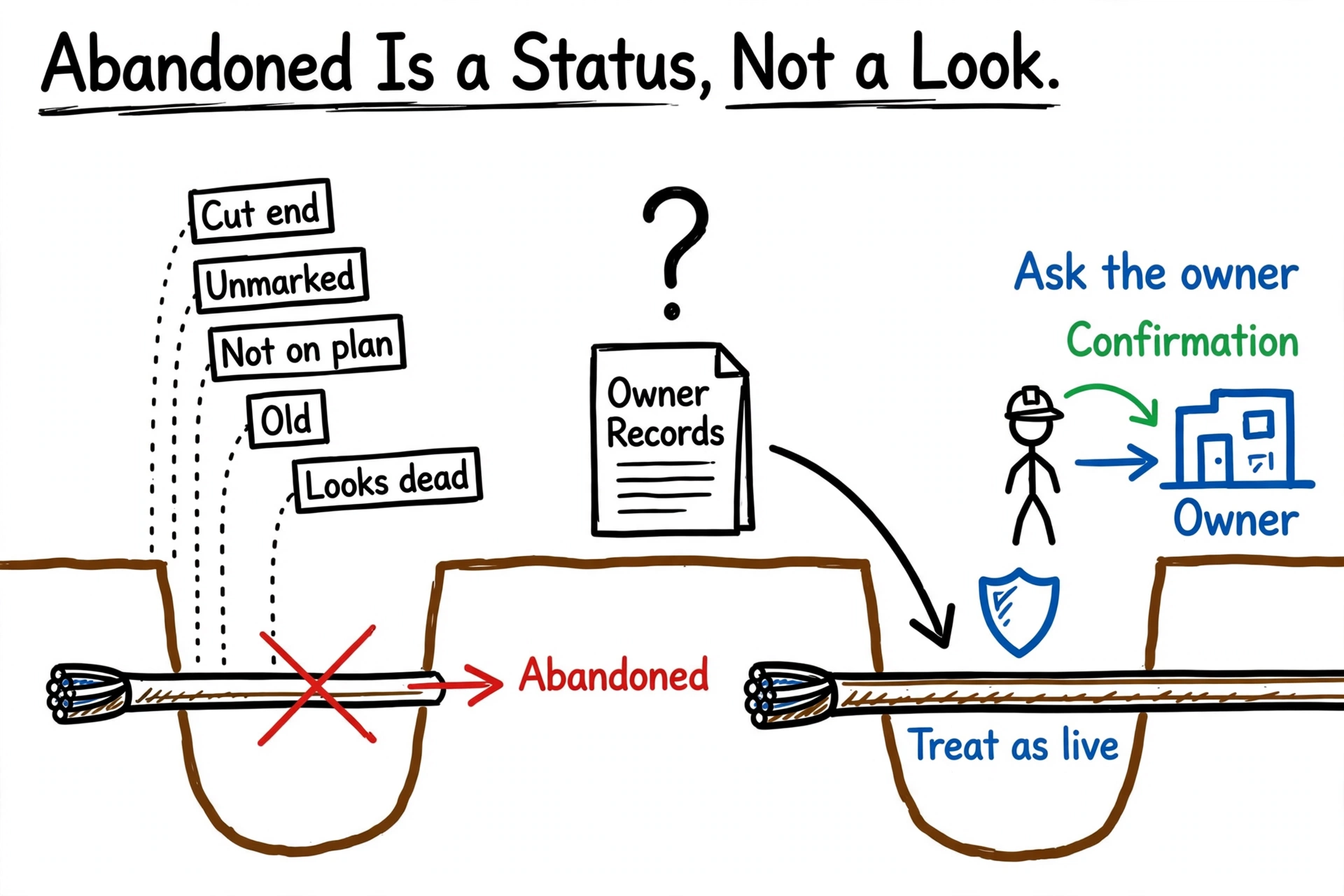
Think of a car parked at the back of a lot with weeds around the tires, a flat tire, and no license plates. Every one of those details suggests the car was left behind. None of them transfers the title. The car still belongs to somebody until its owner gives it up through the process that governs vehicles, and a stranger who hauls it off on the strength of the weeds has taken someone else’s property. A buried line works the same way. Rust, weeds, a cut end, and missing records are the weeds around the tires. The status lives with the owner, and until the owner speaks, the line is treated as somebody’s working plant.
Hold on to one more basic idea before going further. Abandoned is a status. A status is a fact about how something is classified in the owner’s records and decisions. Appearance is only what something looks like to your eyes, and appearance settles nothing here. A line cannot look its way into being abandoned. It can only look old, or cut, or unused, and every one of those looks also fits lines that are still in service. That single distinction is the heart of this whole lesson, and it is why the field rule you will see repeated here is simple: treat every facility as live until the owner confirms otherwise.
What Is It?
An abandoned utility is a facility whose owner has permanently removed it from service and has no intention of placing it back into service, but which still exists in whole or in part in the ground, on poles, or in structures such as manholes and vaults.
That definition follows the way the industry itself uses the word:
- The Michigan Damage Prevention Board defines an abandoned facility in its published best practice as a permanently out of service underground facility which the facility owner or operator has no intention of placing into service in the future.
- California law uses a similar plain idea and adds a physical test: an abandoned subsurface installation is one that is no longer in service and is physically disconnected from any active or inactive subsurface installation.
Notice that both definitions are built around the owner’s decision and the facility’s actual condition in the owner’s system. Neither definition says anything about how the facility looks to a passerby.
Abandoned is not the same as several nearby words, and mixing them up causes real trouble in the field:
- Inactive or idle means not currently in use, but still connected to a system that is in use, or kept ready for future use. Industry guidance separates idle from abandoned for exactly this reason. An idle gas line may still be pressurized. An idle electric cable may still be energized or may be re-energized without warning. Because an idle facility can become live again by the owner’s choice, it must never be treated as abandoned. Federal pipeline guidance makes the same point in strong terms: for gas and hazardous liquid pipelines, the regulator recognizes a facility as either active and fully subject to the safety rules, or abandoned after the required abandonment steps. A pipeline that is shut down but not properly abandoned is still treated as active.
- Out of service is a loose spoken phrase. It can mean temporarily shut down for repair, seasonally closed, isolated for a project, or permanently retired. Because it can mean so many things, the phrase by itself proves nothing. When you hear it, the useful question is: out of service in what sense, decided by whom, and recorded where?
- Decommissioned is another loose phrase. In some industries it means a formal process was completed. In casual talk it can mean little more than “we stopped using it.” Do not treat the word as proof of anything unless the owner connects it to a specific completed process.
- Disconnected is a physical description, not a status. A cable cut at one end is disconnected at that end. It may still be connected and energized at the other end. A gas service cut at the building may still be connected to a live main at the street. Disconnection at the point you can see tells you nothing reliable about the rest of the line.
- Unknown is different again, and it gets its own lesson next, Lesson 56. An unknown facility is one whose identity, owner, and status cannot be established from reliable information. An abandoned facility, by contrast, has an owner statement behind it. Someone who owns it has said, in a form the project can rely on, that this specific facility is permanently out of service. If nobody can say that, the facility is not confirmed abandoned, whatever it looks like. It is unconfirmed, and unconfirmed means treat it as live.
Who can establish that a facility is abandoned? Only the owner or operator of that facility. The list of people who cannot establish it is longer:
- Not the excavator.
- Not the locator.
- Not the inspector.
- Not the property owner whose land it crosses, unless that person also owns the facility itself, which is sometimes true for private lines and is covered later in this lesson.
- Not the oldest person on the crew, and not the person who hit it.
The owner is the only party who knows its own records, its own connections, and its own intentions, and the owner is the only party who can perform or verify the physical steps that true abandonment may require for that kind of facility.
For some kinds of facilities, abandonment is not just a decision. It is a regulated process with required steps that only the operator may carry out. Gas pipelines are the clearest example. Federal regulation at 49 CFR 192.727 covers abandonment or deactivation of gas pipeline facilities, and it states, in summary, that each pipeline abandoned in place must be disconnected from all sources and supplies of gas, purged of gas, and sealed at the ends. The only exception in that sentence is narrow: the pipeline need not be purged when the volume of gas is so small that there is no potential hazard. That summary is included here so you understand that real abandonment involves deliberate physical work by the operator. It is not a procedure for you to perform, and this lesson deliberately gives no instructions for doing it. The point for a fiber crew is the opposite one: if those steps were never done by the operator, then by the rule the owner itself follows, the line may not be abandoned at all.
Other facility types have their own rules, which vary:
- Electric utilities follow their own standards and state rules for retiring cable and equipment, and a retired cable can sit near energized equipment in the same trench or structure.
- Water and sewer owners follow their own practices for retiring mains and laterals, and a retired pipe may still hold water or still be connected at a point nobody remembers.
- Communications owners retire copper and fiber plant under their own records practices, and retired communications plant is abandoned plant a fiber crew is likely to meet in its own corridors.
The details differ by facility type, by owner, and by state. What does not differ is the principle: the owner’s word, through a channel the project can document, is what turns a suspicion into a status.
There is one more uncomfortable fact to absorb here. Records for abandoned facilities are often incomplete, and the industry guide warns that information about them may not be available at all. The Common Ground Alliance, usually shortened to CGA, is the industry association that publishes the Best Practices guide for damage prevention. Its Best Practice 4-11, titled Abandoned Facilities, states that information on abandoned facilities is provided when possible, and it openly notes that information about the presence or location of an abandoned facility may not be available because records were updated or deleted, and that an abandoned line may be nonlocatable because of how it was abandoned or because access points are limited or no longer exist. In plain terms, the industry itself warns you that the paperwork trail for abandoned plant is incomplete by nature. That warning cuts in one direction only: toward caution, never toward guessing.
What Does It Look Like?
There is no single look for abandoned plant, and that is the problem. Abandoned facilities are the same pipes, cables, conduits, and structures as live ones, because they used to be live ones. Age, wear, and damage change the surface, but nothing about the surface certifies the status. Read this section as a list of things you may see and what each one does and does not prove.
Below ground, in an open trench, a bore pit, or a test hole, you may find any of the following:
- A conduit or duct with nothing in it, or with an old cable still inside. An empty duct may be a spare built for future use, which is a common and deliberate practice. A spare duct is an asset waiting for a cable, and it is not abandoned. An occupied duct may hold a cable that is dark today and lit tomorrow, or a copper cable that still carries working pairs on part of its length.
- A cable that ends in the trench, cut or broken, with no splice case and no continuation in sight. This is the sight that tempts people most. Remember that a cable has two ends and a middle. Seeing one end tells you nothing about the other end. Electric and communications cables can be fed from either direction. A gas pipe cut at one point may still be connected to a pressurized main at another point. A water pipe may still be connected and full. The cut you can see may also be damage, including old damage that was never reported.
- A pipe with a cap, a plug, or a crimped or flattened end. A cap can be part of a proper abandonment by the owner. It can also be a temporary closure during construction, a repair fitting, or a closure put on last year by a different crew for reasons nobody wrote down. A cap is a clue worth reporting. It is not a certificate.
- Old materials that are rarely installed today, such as lead sheathed cable, clay pipe, cast iron pipe, steel pipe with heavy corrosion, or wood duct. Old material proves old construction. It does not prove retirement. Plenty of old facilities remain in daily service for many decades, and some of the oldest plant in a corridor is the plant the owner can least afford to replace.
- A line that sits at a shallow or unusual depth, or on an alignment that matches no current record. Depth and alignment vary on live plant too, because ground levels change, roads are rebuilt, and original construction was not always careful. Unusual placement is a reason to slow down. It is never a reason to relax.
In structures such as manholes, handholes, and vaults, abandoned plant often looks like cable racked along the wall with its tags missing, a duct plugged with an old cable stub, or a splice case that appears to have no working fibers or pairs in use. You cannot tell from inside one structure what the rest of that cable is doing. A cable that carries nothing through this manhole may carry live service between two other structures. Appearances inside a structure justify a report and a question to the owner. They never justify cutting.
Above ground, the clues are softer still:
- A pedestal with no cables apparently connected, or with grass growing undisturbed around it.
- A pole with wires that appear to go nowhere, or a pole line that ends at a cleared lot.
- A riser pipe on a pole with a cable that stops partway.
- A valve box or meter base with no meter.
- An old service drop lying on the ground or hanging low.
Each of these can describe retired plant. Each of these can also describe plant that is awaiting repair, awaiting a customer connection, seasonally inactive, or live and simply untidy. Above ground clues prove very little on their own, because so much above ground plant is worked on, damaged, and left in intermediate states by many different hands.
Markings deserve their own paragraph, because crews lean on them heavily. In some states the law describes a specific way to show known abandoned facilities. California, for example, requires an operator to indicate the presence of any abandoned subsurface installations, if known, within the delineated work area with the letter A inside a circle. That marking is helpful where it exists. The absence of marks, though, proves nothing. A facility may be unmarked because it is private and outside the public locate system, because the owner has no record of it, because the ticket area did not cover it, or because it was missed. Unmarked does not mean absent, and unmarked certainly does not mean abandoned. The marking system answers the question “where does the owner say its facilities are.” It does not answer the question “what is this thing I just found.”
Finally, learn to recognize the look of a genuine abandonment done properly, because you will occasionally meet one and it teaches the contrast. A properly documented abandonment usually arrives with paperwork before it arrives with a shovel: the owner named on the ticket or the plan, a statement that a specific facility is abandoned, a location description, and often field marks or shared digital location information. CGA Best Practice 4-11 describes information sharing by field markings or by sharing the location digitally, with digitally shared locations treated as informational and based on the best information available. The physical plant in the ground may look identical to the undocumented case. The difference is the owner’s statement wrapped around it. That is the whole lesson in one contrast: the status lives in the statement, not in the soil.
What Does It Do?
An abandoned facility does nothing. That is its definition. It carries no electricity, no gas, no water, no sewage, and no signal, and it serves no customer. If a facility is doing any of those jobs, it is not abandoned, whatever someone called it.
A facility that does nothing can still affect everything around it, though, and this section is about those effects, because they are the reason a fiber crew has to care:
- It occupies space. Underground corridors, the usable bands of soil along streets and easements where utilities are placed, are crowded and getting more crowded. A retired duct bank still takes up the exact space a new bore path wants to cross. A retired main still forces a new line to go over, under, or around it. Space occupied by dead plant is space the new design has to pay for in deeper bores, extra test holes, or reroutes.
- It interferes with locating. Locating is the process of using instruments at the surface to detect a buried facility and mark its position. Some locating methods work by putting a signal on a metallic line and following that signal. An abandoned metallic line lying near a live one can carry a stray signal, confuse the reading, or be mistaken for the live line itself. Other lines become nonlocatable after abandonment because the access points a locator needs were removed. CGA Best Practice 4-11 names this problem directly. The practical result is that abandoned plant can make the live plant around it harder to find accurately.
- It corrupts records. Records are the drawings, maps, and databases that describe what is buried where. When a crew exposes a facility, assumes it is the live one on the plan, and records measurements against the wrong line, the error enters the project record and misleads the next crew. When an owner deleted a retired line from its maps, the line vanished from the paperwork while staying in the soil, so the next project’s records show empty ground where a pipe still sits. Subsurface utility engineering, often shortened to SUE, is the engineering practice of investigating and depicting existing utilities at graded levels of reliability. Its standard, ASCE 38, grades utility information from Quality Level D, which comes from existing records or recollections, up through Quality Level A, which comes from actually exposing and measuring the facility at a specific point. Abandoned plant is a standing lesson in why Quality Level D information is the weakest grade: the records may be old, incomplete, or deliberately cleaned of the very lines you are about to find.
- It can still hold something, in a small number of cases. A retired pipe may hold standing water. A retired tank or line may hold residue. Owner accounts and regulator advisories describe rare cases in which facilities believed to be empty or disconnected were later found to contain product, or were reconnected or repressurized in error. Treat those accounts as a warning about certainty, not as a prediction about the line in front of you. You have no field test in this lesson, and no business performing one, that can prove a pipe or cable holds nothing. That proof belongs to the owner.
So the honest summary is this: an abandoned facility does no work, but it does plenty to your work. It takes space, muddies locates, bends records, warns of company underground, and demands the same careful handling as live plant until its owner has spoken.
Where Does It Fit?
Abandoned plant fits into the life of a corridor at the far end of a facility’s life cycle, and it helps to see the whole cycle once.
A facility is planned, then designed, then built, then placed in service. It is maintained, repaired, and sometimes partly rebuilt for years or decades. Then one of three endings arrives:
- The owner removes it, taking the physical plant out of the ground entirely, after which nothing remains to find.
- The owner replaces it, building new plant and retiring the old, either removing the old or abandoning it in place.
- The owner simply retires it, abandoning it in place because removal would cost more, disturb more, or risk more than leaving it.
Abandoning in place is a legitimate and common choice. Pavement, buildings, trees, and other live utilities often sit on top of retired plant, and digging it all out can do more harm than leaving it. Georgia law reflects this reality by giving facility owners a choice of duties for abandoned facilities: maintain recorded information about their location and other characteristics, or maintain them in a locatable manner, or remove them. Three different lawful strategies, all belonging to the owner. When you find retired plant, you are looking at the result of one of those choices, or at plant whose owner never got around to making one.
In the damage prevention process, abandoned plant fits into the locate stage in an awkward spot. The locate process, run through the 811 center in each state, exists so that owners can mark their facilities before excavation. Common Ground Alliance Best Practice 4-11 provides that information on abandoned facilities is provided when possible. Georgia law says the same in statute, directing owners to provide information on abandoned facilities, when possible, in response to a locate request or a design locate request, and adding that when the presence of an abandoned facility within an excavation site is known, the owner should attempt to designate it or provide information about it to the excavator. Other states state the duty differently, so verify the current statute and 811 center guidance for the state where the work occurs. The phrase “when possible” is doing heavy work in those sentences. It exists because owners often cannot locate what they retired, for the records reasons already covered. Design for that gap. Do not be surprised by it, and do not fill it with a guess.
In project planning, abandoned plant fits into utility coordination, the work of listing every facility in a corridor, deciding which ones conflict with the new construction, and agreeing with each owner on what happens to each conflict. A confirmed abandoned facility in a bore path is a coordination item, not a field surprise to be solved with a saw. The owner or the project plan decides whether it stays, whether the new line crosses it at an agreed clearance, or whether the owner removes the conflicting section. Those decisions are made in writing, ahead of the crew, by people with authority over both the old facility and the new design.
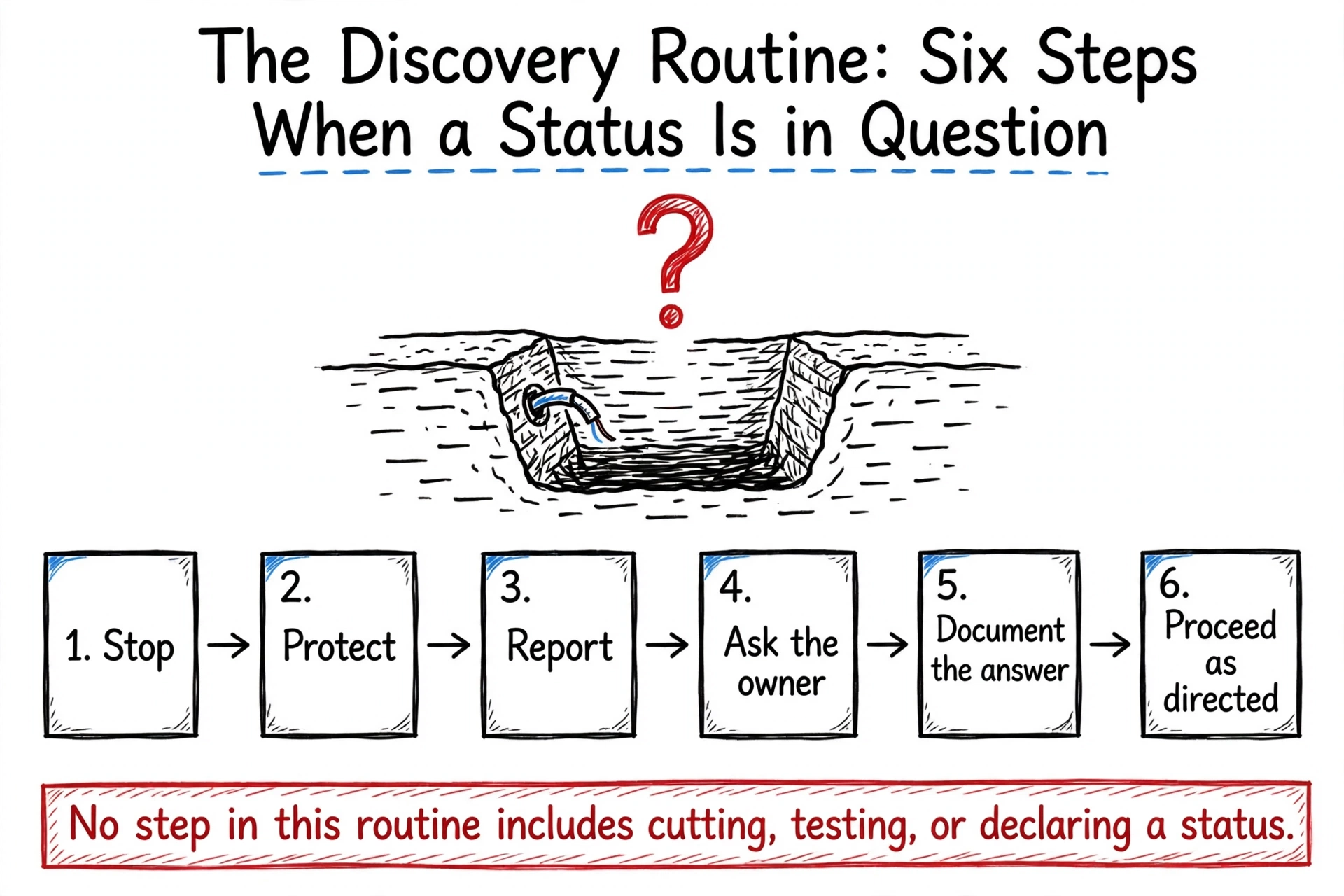
In your own daily sequence as a fiber crew member or inspector, abandoned plant fits at one specific moment: the moment of discovery. A facility appears that the marks and the plan do not fully explain, or a facility the plan calls abandoned appears in a condition that does not match the paperwork. At that moment your job narrows to a short list:
- Stop work in the immediate area.
- Protect the facility from further contact.
- Report what you found, where you found it, and what it looks like, through the project channel.
- Wait for the owner’s answer or the project direction.
- Document the answer in the project record so the next crew inherits knowledge instead of a rumor.
- Then proceed as directed.
Everything else, including any cutting, removal, or declaration about status, belongs to someone else.
What Is at Stake
People can be killed by a wrong guess about gas and electric facilities. That is the first stake, and it is the reason every source in this lesson, from state law to industry best practice, lands on the same instruction. Georgia law states it without qualification: when located or exposed, all abandoned utility facilities and sewer laterals shall be treated as live utility facilities and sewer laterals. South Carolina 811 guidance to excavators says the same thing in shorter words: if you expose an unmarked utility, treat it like it is live. California law requires the excavator to presume all subsurface installations to be active, and to use the same care around installations that may be inactive as around active ones. CGA Best Practice 4-11 says that when located or exposed, all abandoned facilities are treated as live facilities. Four different authorities, one rule. When regulators, legislatures, and the industry all repeat a rule that plainly, a crew does not improve on it with local judgment.
The error runs in one direction. If you treat a truly abandoned line as live, the cost is time: a pause, a phone call, a test hole, a short delay while the owner answers. If you treat a live line as abandoned and cut it, the costs run the other way and some of them cannot be undone:
- A cut gas line can release gas that migrates through soil into buildings.
- A cut electric cable can arc, burn, or shock.
- A cut water main can flood an excavation and undermine the soil around everyone working in it.
- A cut fiber or copper cable can take down service for a neighborhood, a business, or an emergency service, and even when nobody is hurt, the repair bill, the claim, and the investigation land on the project.
Weigh a short delay against that list and the field rule stops looking cautious. It starts looking obvious.
Responsibility sits inside a process that starts with owners. Federal excavation law puts duties on the employer before and during digging. OSHA standard 29 CFR 1926.651(b), the federal rule for underground installations during excavation, requires that the estimated location of utility installations that may reasonably be expected to be encountered be determined before an excavation is opened, that utility companies or owners be contacted and asked to establish the locations, that the exact location be determined by safe and acceptable means as the excavation approaches, and that while the excavation is open, underground installations be protected, supported, or removed as necessary to safeguard employees. Note what that federal rule does not contain: any permission for a crew to declare a facility abandoned and remove it on its own judgment. Removal under that rule is a protective measure carried out as necessary to safeguard employees, within a process that starts with contacting owners. A crew that cuts a line because it looked abandoned has stepped outside that process, and “it looked abandoned” is not a defense that appears in any of the sources for this lesson.
Money and schedule punish the gamble, not the pause. An unconfirmed line in a bore path stops a bore. That is frustrating, and the frustration is real. But a strike stops the job for far longer, adds repair and reporting duties, may bring a regulator or an owner claim, and can follow a company into its bidding record. Handled correctly, an abandoned facility is usually a small problem: a documented pause, an owner answer, and a plan adjustment. Handled by assumption, the same pipe can become the largest problem on the project. Projects that build the owner question into their routine, early and without drama, lose hours. Projects that gamble lose weeks.
What Does Good Look Like?
Good practice around possibly abandoned facilities is visible long before anyone opens the ground, and it continues after the hole is closed. On a well run project, you can observe all of the following:
- The utility list for the corridor includes retired and abandoned facilities as their own line items, separate from live facilities, before construction starts.
- Where an owner has provided abandoned facility information, it appears on the plan or in the coordination notes with its source named, so anyone reading it can tell an owner statement from a crew assumption.
- Designs treat owner provided abandoned locations as approximate, matching how CGA describes digitally shared abandoned locations: informational, based on the best information available.
- Bore plans account for known retired plant as physical obstructions even when those lines carry nothing.
- Tickets are placed and answered for the whole work area, and the crew reads the responses instead of only looking at the paint.
- Where state practice provides a specific mark for known abandoned facilities, such as the circled A used in California, the crew knows what that mark means and what it does not mean: it means the operator is aware of abandoned plant in the delineated area, and it does not mean every other unmarked line is live or that the marked line may be cut.
- Questions about marks go back to the operator through the notification center or the project channel, and the answers are written down.
- Facilities are exposed by safe and acceptable means as the work approaches them, consistent with the OSHA duties described in this lesson, and once exposed they are protected and supported as needed.
- Every found facility is compared against the plan and the marks. A facility that matches gets verified and documented. A facility that does not match, in position, size, material, direction, or condition, gets treated as unconfirmed and reported the same day, with photographs and measurements taken without disturbing it further.
- An owner’s confirmation, when it comes in writing or through a documented project channel, is filed with the project record and tied to the specific location, because a confirmation about one segment does not automatically cover a different segment of the same line.
- The project plan states what happens at the conflict point after a confirmation: the new work avoids the facility, crosses it at an agreed clearance, or the owner removes or authorizes the handling of the conflicting section under the owner’s direction. The crew executes the plan. The crew does not expand it.
- If the exposed facility differs from what the confirmation described, work pauses again, because the confirmation may belong to a different line.
- The project record can answer, for each found facility: what was found, where, at what depth where lawfully and safely measured, what it appeared to be, who was asked, what the owner answered, and what was done.
- Photographs show the facility in place before any directed action.
- Notes use honest status words: confirmed abandoned by the named owner on a stated date, or status unconfirmed, treated as live. Words like “dead line removed,” with no owner behind them, do not appear, because they describe an authority the crew never had.
From the Field
Picture a fiber crew directional boring a new conduit along the back of an older commercial strip, to reach a new cabinet. The design shows one existing communications line in the corridor, marked in orange, and one gas service shown on the plan with a note that reads: retired per owner records, 2019. The crew potholes at the two planned crossing points, digging careful test holes by a safe method to expose facilities before the bore passes.
At the first crossing, the test hole finds the marked communications cable where expected. It also finds, about a hand’s width to one side, a second cable, older, with a dull lead colored sheath, running on the same general alignment. The second cable is on no plan and carries no marks. The bore operator says it is probably the old lead cable that was replaced years ago, and he is probably right about its history. The inspector writes down what was actually observed instead: a second cable, material and size described, depth recorded, direction noted, photographs taken, status unconfirmed. The project coordinator sends the owner named for communications plant in that corridor a precise question: a second cable was exposed at this location at this depth on this alignment; is it yours, and if so, what is its status?
Work on that crossing pauses. The crew moves to layout and material staging, so the pause costs staging time rather than idle time. The owner answers the next day through the project channel: the second cable is theirs, it was retired in place when the fiber replacement was built, and their records show it disconnected at both ends. They provide the retirement reference for the project file. The answer changes the paperwork status of that cable from unconfirmed to confirmed abandoned by the owner. It does not change the bore plan by itself. The project plan then addresses the physical problem, which is that two cables now occupy the crossing: the bore is adjusted to pass with the clearance the plan requires from the live cable, and the retired cable is left in place, because nothing in the owner’s answer asked the fiber crew to remove it.
At the second crossing, the test hole finds the gas service that the plan called retired. The pipe is steel, it is capped at the exposed end with what looks like a threaded cap, and the exposed section holds standing water that weeps from a corroded joint as the hole is opened. The foreman likes the plan note and wants to treat the pipe as dead, shift the bore slightly, and keep the day. The inspector points at the difference between the two crossings: at the first crossing, the owner answered a question about the specific facility that was actually found. At this crossing, all anyone has is a plan note copied from records, written years earlier, about a facility whose exposed condition has not been checked against those records by its owner.
The gas question goes to the gas owner through the project channel the same morning, with photographs and the exposed condition described exactly, including the cap and the corrosion. Nobody cuts, moves, or tests the pipe. The bore at that crossing is held. The gas owner sends its own representative, because gas facilities are the owner’s responsibility to evaluate. The representative determines, using the owner’s records and the owner’s methods, that this service was never formally abandoned: it had been disconnected at the building during demolition years ago, but the owner’s abandonment steps at the main were never completed or recorded, and the owner still carried it as an inactive service. The owner’s crew then handles the service under the owner’s procedures and the owner’s schedule, and only after the owner confirms completion does the project replan the crossing.
Look at the contrast, because it is the lesson. Same corridor, same day, same plan style, two lines that both looked retired. One was confirmed abandoned by its owner and was left alone under a plan. The other was a records error sitting on top of an incomplete retirement, and the only thing that separated a routine day from a cut inactive gas service was the decision to ask the owner instead of trusting the note and the cap. Notice also what the fiber crew never did at either crossing: it never cut a facility on its own judgment, never declared a status, and never treated a plan note as an owner’s answer. The crew’s work was observation, protection, precise questions, and documentation.
Carry this decision rule out of the story: a line’s status is settled by its owner’s answer about the specific facility you actually found, and by nothing else. Until that answer exists, the line is live in your planning, your potholing, and your paperwork, whatever it looks like and whatever any note says about it.
What Can Go Wrong?
The central failure is misidentification: deciding a facility is abandoned when it is not. It happens in recognizable ways, and each one feels reasonable in the moment:
- The line looks dead. Paint is gone, the cable jacket is cracked, the pipe is rusted, vegetation has grown over the pedestal. None of that disconnects anything. Appearance tracks age and weather, not status.
- The line is cut at one end. A service line cut at a demolished building is the classic case. The other end can still be connected to a live main or a live source. For gas, a service that was cut without the operator completing its abandonment steps may still be connected at the main. For electric, a cable cut at one structure may still be fed from another. Cutting a second time, at your end, can be the act that opens a live system.
- The line is not marked. Unmarked lines include private facilities outside the public locate system, facilities the owner has no record of, facilities outside the ticket area, and facilities that were simply missed. Crews have struck live lines in ground that came back with no marks at all. No marks means no information. It never means no utilities, and it never means abandoned utilities.
- The line is not on the records. Records are incomplete in both directions. Owners hold records of lines that were removed decades ago, and lack records of lines that are still in the ground and still working. A line missing from the records is a line whose history is unknown. Unknown history is a reason for more care, not less.
- The line is very old. Age is not retirement. Water, sewer, gas, and electric systems all contain facilities that have served for many decades and continue to serve. Some owners replace plant aggressively and some run plant until it fails. You cannot read an owner’s replacement policy off a corroded pipe.
- Someone says it is abandoned. A neighbor, a property owner, a retired employee, or a member of another crew may speak with total confidence. Their information may even be right. It is still not an owner confirmation through the project channel, and it does not transfer responsibility. If the statement matters, route it to the owner and let the owner confirm or deny it in a form the project can file.
- The abandonment was incomplete, or is misunderstood. A line can be abandoned for one purpose and still present a hazard. A retired gas line that was properly disconnected, purged, and sealed by the operator under the federal rule is a very different object from a line that was merely valved off by persons unknown. From the surface, and even from an open trench, you cannot reliably tell which of those you are looking at. That is precisely why the status question goes to the owner, who holds the abandonment record if one exists.
- A confirmed abandoned line causes harm without being live. It can collapse under equipment, leaving a void. It can be mistaken for the new line during later work. Its removal, when directed, still involves excavation hazards, and a large retired pipe or duct bank can be heavy, unstable, or contaminated with residue depending on what it once carried. Directed handling of abandoned plant is real work with real hazards, planned by the project. It is never a casual cleanup task.
- The paperwork fails quietly. Writing “abandoned” in a daily report on the strength of a glance creates a false record that the next crew may trust with a bore head. Writing nothing at all leaves the next crew to rediscover the same line as a surprise. Both failures are avoidable with one honest sentence in the record, naming what was found and whether the owner has confirmed its status.
What Should Someone Notice in the Field?
You are not being trained here to test, trace, or certify any facility. You are being trained to notice the signals that a facility needs an owner’s answer before work proceeds around it. Watch for these:
- Mismatches. The plan shows two lines in the trench corridor and the open trench shows three. The marks show one communications line and the test hole finds two cables. The plan calls a line abandoned and the line you exposed is at a different depth or on a different alignment than the paperwork describes. A mismatch means the paperwork and the ground disagree, and when they disagree, the ground is telling you that the record is unreliable in this spot. Report the mismatch with measurements and photographs.
- Endings. A cable or pipe that ends in your excavation, cut, capped, crimped, or broken, is something to report, and the report is where its meaning gets decided, by the owner. Note which direction it runs from the ending, because direction points toward whatever it was, or is, connected to. Note the condition of the end: a clean manufactured cap looks different from a fresh cut, and both look different from a crushed or torn break. Record what you see in descriptive words. Let the owner interpret it.
- Materials and construction from earlier eras. Lead sheath, clay, cast iron, transite style cement pipe, wood duct, and armored cable types that are no longer commonly installed all suggest earlier construction. Earlier construction means earlier records, and earlier records are more likely to be missing, hand drawn, or superseded. Old plant should raise your care level and your expectation of additional undocumented plant nearby.
- Structures with no apparent living contents. A manhole or handhole where every cable looks tagged with old or missing tags, a pedestal with its connections removed, a conduit stub rising from the ground and ending in air, a meter base with no meter, a valve box that has not been opened in years. Notice them, photograph them, and report them. Then remember the limit of the observation: contents can enter and leave a structure at points you cannot see, and a structure that looks retired from one opening may be very much alive at the next.
- Ground clues of earlier construction. A straight line of settled soil crossing a lot, an old trench scar in pavement, a row of patched cuts along a street, a cleared swath in brush where a pole line once ran, foundations of demolished buildings. Demolition is a generator of questionable lines, because buildings come down faster than their services are formally retired. Ground that held a building should be assumed to hold its old services, in unknown condition, until owners answer for them.
- What the marks are not saying. Learn the difference between a marked facility, a marked known abandoned facility where your state uses such a mark, and silence. Silence from a particular owner on a ticket can mean the owner has no facilities in the area, or that the owner has not responded, or that the owner’s facilities there are private to someone else. Positive response systems, where states use them, exist so excavators can check which owners have responded and how. Use them. A ticket with an unanswered owner is an unfinished locate, not a clear corridor.
- Private facilities. The public locate system generally covers facilities owned by utilities up to a service point. Lines beyond that point often belong to the property owner: the run to a detached garage, a gas line to a pool heater, irrigation lines, yard lighting, a private fiber or power run between buildings. These lines may have no owner in the utility sense available through 811 at all, and the person who can speak for them may be the property owner. An old private line on a property may be retired, or it may be the line feeding the barn that everyone forgot to mention. The same rule holds: ask the person who owns it, through the project channel, and treat it as live until that answer arrives.
- Your own reasoning, in real time. That is where the failure starts. The thoughts to catch are these: it looks dead. Nobody would leave that live. It is not on the plan, so it must be the old one. We will lose the day if we stop for this. Each of those thoughts is a signal to stop and ask. Experienced field people are not people who never have those thoughts. They are people who have learned what those thoughts are worth.
Carry a short routine for any questionable find. It fits on an index card, and it is the practical whole of this lesson:
- Stop work in the immediate area and keep equipment clear of the facility.
- Protect the facility from damage while the question is open.
- Tell the foreman or inspector at once.
- Record the location, depth if already safely known, size, material, direction, condition, and photographs.
- Ask the owner question through the project channel, naming the facility as precisely as your observations allow.
- Write the answer, the answerer’s organization, and the date into the project record when it comes.
- Proceed only on the direction that follows.
One boundary closes this checklist. This lesson teaches recognition only. Reading it does not qualify you to cut, remove, disconnect, de-energize, purge, or repair any utility facility. Recognizing is your job. Qualifying belongs to the facility owner and the people the owner authorizes.
Key Terms
- Abandoned facility: A facility whose owner has permanently removed it from service, has no intention of placing it back into service, and has left some or all of it in place in the ground, on poles, or in structures.
- Active or live facility: A facility that is connected to a working system and is carrying, or is ready to carry, its service, such as voltage, gas, water, or signal.
- Facility: The general term for any physical piece of utility plant, such as a pipe, cable, conduit, wire, duct, valve, manhole, handhole, or pedestal.
- Facility owner or operator: The company, agency, or person that owns or operates a facility and holds its records. Only this party can confirm that its facility is abandoned.
- Idle or inactive facility: A facility that is not currently in use but is still connected to a system in use, or is kept for possible future use. An idle facility is not abandoned and may still be energized, pressurized, or returned to service by its owner.
- Locate: The process by which a facility owner, or a locator working for the owner, uses records and instruments to determine and mark the position of a facility before excavation. The request process is commonly reached by dialing 811 in the United States.
- Nonlocatable facility: A facility that cannot be detected and marked by the locating methods available, which can happen after abandonment when access points were removed or records were lost.
- Outside plant: The physical network built outdoors, including buried, aerial, and structure based facilities, as distinct from equipment inside buildings. Often shortened to OSP.
- Positive response: A system, used in many states, through which facility owners report the status of a locate request, so an excavator can confirm which owners have marked, have no facilities in the area, or have not yet responded.
- Quality Level: Under ASCE 38, a grade from D to A describing how utility information was obtained, from existing records or oral recollections at Level D to direct exposure and measurement at a specific point at Level A.
- Retired in place: A spoken description of a facility taken out of service and left where it was built. The phrase describes an outcome people believe happened. It does not by itself prove that the owner completed or recorded an abandonment.
- Tolerance zone: The area on either side of a marked facility within which state law generally requires extra care and careful exposure methods before powered equipment is used. Its exact width and rules are set by each state and must be verified for the state where the work occurs.
- Unknown facility: A facility whose identity, owner, and status cannot be established from reliable information. Unknown is covered in Lesson 56 and is a different condition from abandoned, because abandoned rests on an owner statement and unknown has none.
Check Your Understanding
Answer each question in your own words before reading the answer key.
- A crew exposes a copper cable that is cut at the exposed end, heavily weathered, and missing from the project plan. The operator says it is obviously abandoned and wants to pull it out of the bore path. What is wrong with that conclusion, and what should happen instead?
- What is the difference between an idle facility and an abandoned facility, and why does the difference matter at the trench edge?
- Name the field rule that CGA Best Practice 4-11, Georgia law, and California law all share for abandoned or possibly inactive facilities.
- At the second crossing in the From the Field story, the plan note said the gas service was retired per owner records, and the exposed pipe was capped. Why did that note and that cap, together, still fail to confirm abandonment, and what did confirm the service’s actual status?
- How is an abandoned facility different from an unknown facility, as those terms are used in this curriculum?
Answer key
- A cut end, weathered condition, and absence from the plan are all consistent with a live facility. The cable may be fed or connected from the other end, the cut may be old damage, and records are known to be incomplete. Nobody on the crew has the authority to declare the cable abandoned. Work in the immediate area should stop, the cable should be protected, the find should be documented with photographs and measurements, and the owner should be asked through the project channel. Removal, if it ever happens, follows the owner’s confirmation and the project plan, under the owner’s direction.
- An idle facility is not currently in use but is still connected to a system in use, or is kept for possible future use, so it may still be energized or pressurized and can be returned to service by its owner. An abandoned facility has been permanently removed from service by its owner with no intention of returning it. The difference matters because treating an idle line as abandoned is exactly the mistake that leads to cutting a line that is still part of a live system.
- Treat it as live. CGA Best Practice 4-11 states that when located or exposed, all abandoned facilities are treated as live facilities. Georgia law states that when located or exposed, all abandoned utility facilities shall be treated as live utility facilities. California law requires the excavator to presume all subsurface installations to be active and to use the same care around possibly inactive installations as around active ones.
- A plan note is records information, copied forward from earlier documents, and records for retired facilities are often incomplete, outdated, or wrong. A cap is a physical clue, and a cap can be a temporary closure, a repair fitting, or a closure whose reason nobody wrote down. Neither one is an owner statement about the specific facility that was found. The service’s actual status was settled only when the gas owner evaluated it with its own records and methods and reported that the service had never been formally abandoned and was still carried as an inactive service.
- An abandoned facility has an owner statement behind it: the owner has said the specific facility is permanently out of service. An unknown facility has no reliable identity, owner, or status at all. If no owner statement exists, a facility cannot be classed as confirmed abandoned, no matter how it looks. It stays unconfirmed and is treated as live.
Lesson Takeaway
Abandoned is a status only the owner can establish. A line that looks dead, is cut at one end, is unmarked, is missing from the records, or is simply very old has not been proved abandoned, because every one of those conditions also fits live facilities. The rule shared by industry best practice and by state law is to treat every located or exposed facility, including one believed abandoned, as live until the owner confirms otherwise through a channel the project can document. Your job on finding a questionable facility is short and complete: stop, protect, ask the owner, document the answer, and act only on the direction that follows. A fiber crew never cuts a facility on its own judgment that the facility is abandoned.
Sources and Technical References
- Common Ground Alliance, Best Practices, Practice 4-11, Abandoned Facilities. Practice statement: information on abandoned facilities is provided when possible. Practice description: when the presence of an abandoned facility within an excavation site is known, an attempt is made to locate and mark it, and when located or exposed, all abandoned facilities are treated as live facilities. The practice also notes that information may be unavailable because of updating or deletion of records, and that abandonment or limited access may render a line nonlocatable. Full guide: https://carcga.org/BP_22.0_Web.pdf
- Common Ground Alliance Best Practice 4-11 update discussion, including the revised language on sharing abandoned facility locations by field markings or digitally, with digital locations provided for informational purposes based on the best information available: https://actsnowinc.com/global-811-magazine/digital-locating-and-abandoned-facilities-a-culture-change-opportunity
- Georgia Utility Facility Protection Act, O.C.G.A. Section 25-9-7, subsection on abandoned utility facilities. Owners shall either maintain recorded information on abandoned facilities, maintain them in a locatable manner, or remove them; shall provide information on abandoned facilities, when possible, in response to a locate or design locate request; should attempt to designate a known abandoned facility within an excavation site or provide information to the excavator; and when located or exposed, all abandoned utility facilities and sewer laterals shall be treated as live. Text: https://law.justia.com/codes/georgia/2022/title-25/chapter-9/section-25-9-7/ and Georgia 811 dig law compilation: https://georgia811.com/wp-content/uploads/2025/03/Georgia-Dig-Law_090122.pdf
- California Government Code Section 4216.4(a)(3). An excavator shall presume all subsurface installations to be active, and shall use the same care around subsurface installations that may be inactive as the excavator would use around active subsurface installations. Text: https://law.onecle.com/california/government/4216.4.html
- California Government Code Section 4216.3(a)(1)(C) and related provisions. An operator shall indicate with an A inside a circle the presence of any abandoned subsurface installations, if known, within the delineated area, and records on abandoned subsurface installations, to the extent they exist, shall be retained. Text: https://california.public.law/codes/government_code_section_4216.3
- California Government Code Section 4216(a) and (b). Abandoned subsurface installation means a subsurface installation that is no longer in service and is physically disconnected from any active or inactive subsurface installation. Active subsurface installation means a subsurface installation currently in use or currently carrying service. Text: https://leginfo.legislature.ca.gov/faces/billTextClient.xhtml?bill_id=201520160SB119
- OSHA, 29 CFR 1926.651(b), Underground installations. Estimated locations must be determined before opening an excavation; utility companies or owners must be contacted and asked to establish locations; exact locations must be determined by safe and acceptable means as excavation approaches; and while the excavation is open, underground installations must be protected, supported, or removed as necessary to safeguard employees. Text via Cornell Legal Information Institute: https://www.law.cornell.edu/cfr/text/29/1926.651
- Michigan Damage Prevention Board, Best Practice 2015-04, Abandoned and Idle Facilities. Defines an abandoned facility as a permanently out of service underground facility which the owner or operator has no intention of placing into service in the future, defines idle facilities separately, and states that an abandoned or idle facility that is located and marked, or exposed during excavation, is to be treated as active: https://www.missdig811.org/cm/dpl/downloads/content/10322/Best_Practices_-_Abandoned_Facilities_Final.pdf
- South Carolina 811 excavator guidance: if you expose an unmarked utility, treat it like it is live, and submit a further request to have the facility located: https://sc811.com/wp-content/uploads/2024/02/SC811-Excavator_Tri-Fold-2024-Digital-Version.pdf
- Federal Highway Administration, Subsurface Utility Engineering brochure, summarizing ASCE 38 quality levels: Level D from existing records or oral recollections; Level C from surveying visible above ground features correlated with records; Level B from surface geophysical methods giving approximate horizontal position; Level A from actual exposure and measurement at a specific point: https://www.fhwa.dot.gov/design/sue/suebrochure.cfm
- Pipeline and Hazardous Materials Safety Administration regulations, 49 CFR 192.727, Abandonment or deactivation of facilities. In summary, each gas pipeline abandoned in place must be disconnected from all sources and supplies of gas, purged of gas, and sealed at the ends. The pipeline need not be purged when the volume of gas is so small that there is no potential hazard. This regulation is cited at recognition level only, to show that gas abandonment is an operator process with required steps. It is not a procedure for excavators or fiber crews: https://ecfr.io/Title-49/Section-192.727
- Pipeline and Hazardous Materials Safety Administration advisory bulletin on pipeline status, explaining that pipelines not properly abandoned are considered active, and that informal labels such as idled or inactive do not remove a pipeline from the safety regulations: https://www.federalregister.gov/documents/full_text/html/2016/08/16/2016-19494.html
Previous lesson: Lesson 54: What Are Traffic and Streetlight Systems? |
Back to Level 3 hub |
Next lesson: Lesson 56: What Is an Unknown Utility?