
Introduction
Sanitary sewer infrastructure is the buried network of pipes, access structures, and pumping sites that collects wastewater from buildings and carries it to treatment. A fiber crew works over it, beside it, and across it on almost every street, and the crew reads it entirely from the surface: closed covers, small caps, green marks, and fenced pumping sites.
This lesson sits in Level 3, where each existing utility system is taken one at a time. It pulls together the manhole boundary from Lesson 43 and the jobsite read from Lesson 45, and it adds the parts only the sewer system has: a lateral at every building, gravity flow, force mains, and lift stations. The lesson teaches recognition only. Reading it qualifies no one to open, enter, clean, or repair any part of a sewer system.
What This Lesson Gives You
- Read a street’s closed covers, caps, and green marks and name the sanitary parts they point to.
- Picture a lateral at every occupied building, whether or not a cleanout or a mark can be found for it.
- Tell a gravity main from a force main at recognition level, and name the surface facility that warns a force main is present.
- Sort sanitary features from storm features on the same street and record each under its own system.
- Report odor, grease, damage, and backups as observations, and hold the boundary of never opening or entering a sanitary structure.
Start With the Basics
Every building with indoor plumbing sends wastewater somewhere. Sinks, showers, washing machines, and toilets drain into pipes inside the building. Those pipes join into one line that leaves the building underground. From there, in a community served by a public sewer, the wastewater travels through a network of buried pipes to a treatment plant, where it is treated before it is released or reused under the rules that govern that plant. That whole buried network is sanitary sewer infrastructure.
The drains inside one house teach the system’s logic at small scale. Every fixture in a house drains downhill into branch pipes, the branch pipes join one building line, and that line leaves the house on a downward slope. The street system runs the same downhill pattern at neighborhood scale: building lines become laterals, laterals join mains, and mains run toward lower ground and toward treatment. Where the downhill pattern runs out, at a low area or a ridge, a pump takes over, the same way a house on low ground sometimes needs a pump to lift its wastewater up to its line. Read the street system as the house system written large, and the parts below fall into place.
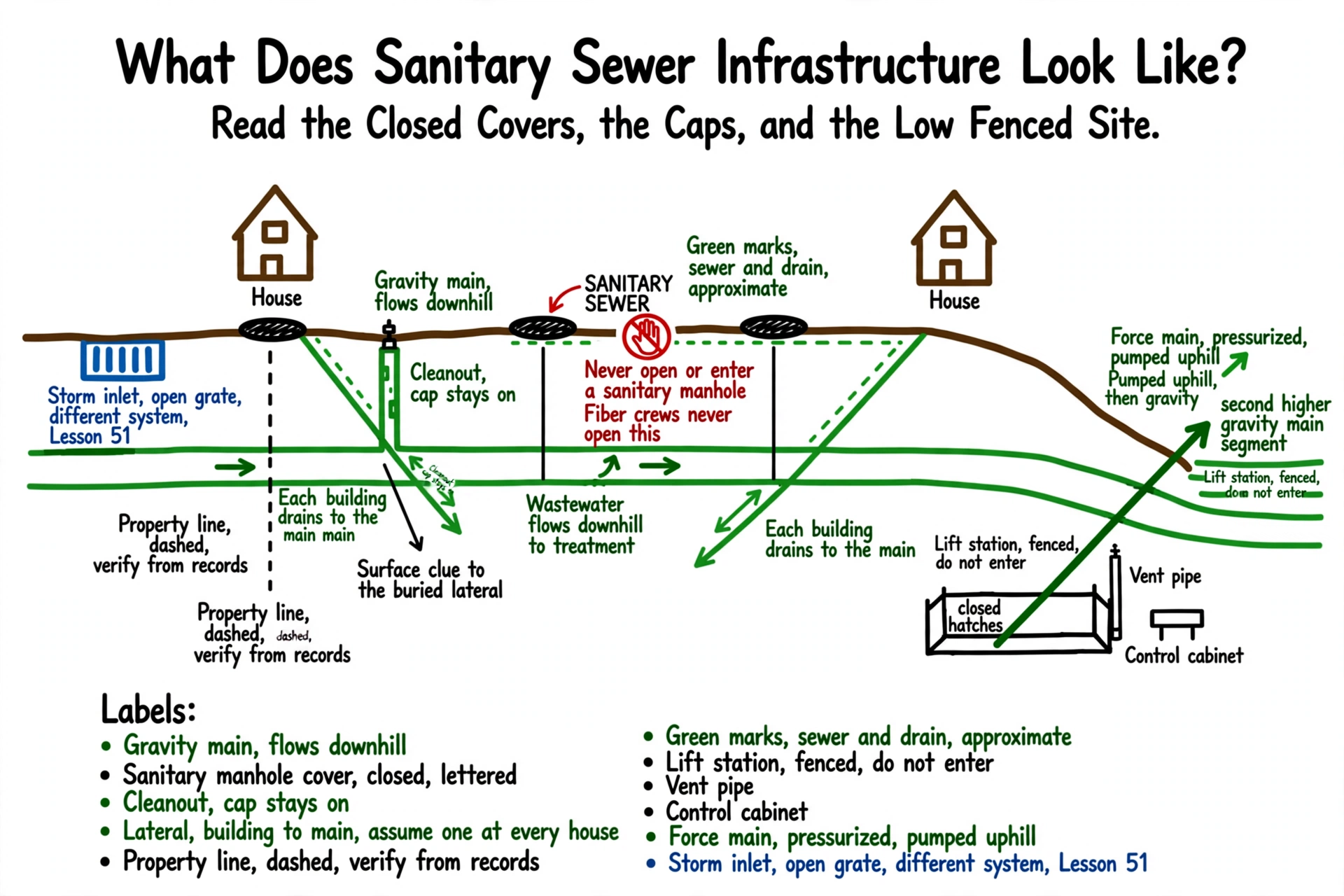
A beginner looks at a residential street and sees pavement, lawns, and a few round iron lids. A trained reader sees a system:
- A round lid in the middle of the street lettered SEWER suggests a main running down that street.
- A small capped pipe in a front yard near the property line suggests the point where one property connects toward that main.
- A green paint line on the pavement suggests where a locator believes a buried sewer or drain line runs.
- A small fenced site at a low spot in the neighborhood, with a cabinet and a vent pipe, suggests a place where wastewater has to be lifted because gravity alone will not carry it any farther.
None of that reading requires opening anything. It requires knowing what each surface feature usually means, checking that meaning against the prints and the locate marks, and treating every disagreement as a question to report. Three ideas carry the whole lesson:
- Sanitary sewer is a closed wastewater system. What goes into it comes from buildings, and its surface openings are closed covers and caps, never open grates waiting for rain.
- The larger part of the system moves by gravity. Flow runs downhill, pipe to pipe, toward lower ground and toward treatment. Where the ground will not allow that, pumps push it, and those pumped sections behave differently and are marked by different surface evidence.
- The system belongs to someone else. It belongs to a sewer owner, usually a city, a utility district, or a similar authority, and the laterals that connect buildings to it are often owned in whole or in part by the property owner. A fiber crew protects that system, plans around it, and reports problems with it. A fiber crew never opens it, enters it, cleans it, or repairs it.
What Is It?
Sanitary sewer infrastructure is the network of buried pipes, access structures, and pumping sites that collects wastewater, the used water and waste that leave a building through its drains and toilets, and carries it to treatment. The word sanitary in the name separates this system from storm drainage, which carries rain and surface runoff. The two systems are separate, they go to different places, and Lesson 51 covers storm infrastructure on its own. This lesson stays with the sanitary system, except for one short contrast where the difference matters for recognition.
The working parts and words, each used through the rest of the lesson with the meaning given here:
- Sanitary sewer. The pipe network that carries wastewater from buildings to treatment. When people on a job site say the sewer, they usually mean this sanitary system, but the word alone can be loose, so confirm which system a speaker means when it matters.
- Sewer main. The shared pipe that collects wastewater from many properties and carries it onward. Mains run under streets and easements and connect to larger mains as they go.
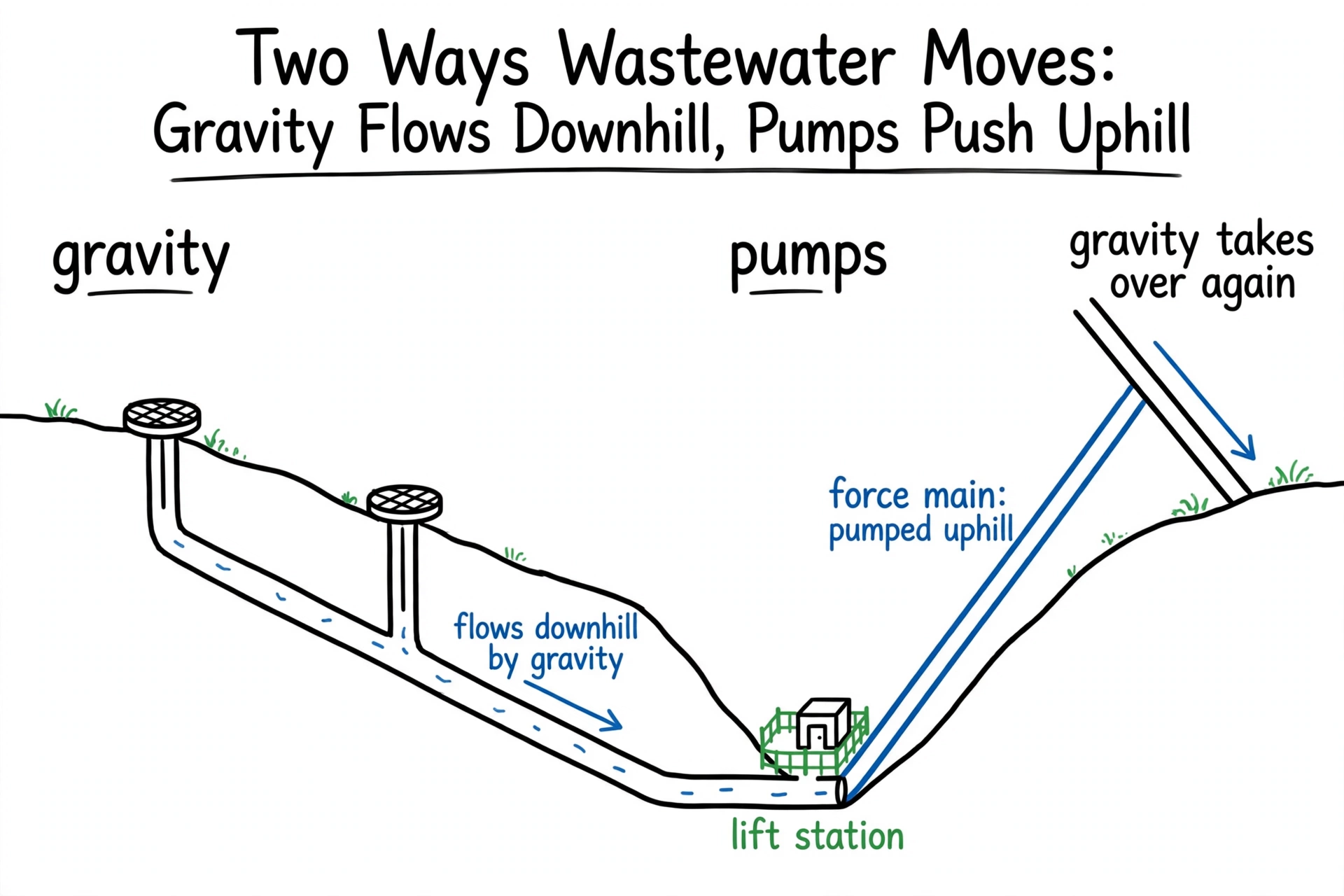
- Gravity main. A main sewer pipe in the street or in an easement that carries wastewater downhill by gravity, the flow moving because the pipe slopes downward in the direction of travel, with no pump pushing the flow inside that pipe. The exact slope, size, and depth of any gravity main are set by the sewer owner design and the records for that system. This lesson states none of those values, because none of them can be judged from the surface and none of them are the same on every system.
- Lateral. The smaller pipe, also called a sewer lateral or a service lateral, that connects one building to the main. It runs from the building, across the property, to the main in the street or easement. In many communities the property owner owns and maintains the lateral, or the part of it on private property, while the sewer owner owns the main. The exact split of ownership and maintenance duty varies by community and is set by local rules and the sewer owner policy. Verify the split from the project records or the sewer owner when ownership decides who must act.
- Force main. A main that carries wastewater under pressure. A pump pushes the wastewater through it, so a force main can carry flow uphill or across ground where a gravity pipe could not keep flowing downhill. At recognition level, the difference that matters is this: a gravity main flows downhill on its own, and a force main is pressurized because a pump is driving it. A pressurized pipe that is struck or cut can release wastewater under pressure, and its route is tied to a pumping site. Depths, pressures, and pipe details for any force main come from the sewer owner records, never from surface observation.
- Lift station. A site, also called a pump station in common use, where wastewater that has arrived by gravity is collected and then pumped to a higher pipe so it can continue toward treatment. It does this job because gravity flow cannot climb. The wastewater collects in an underground tank at the site, pumps lift it out, and it leaves through a force main. The names lift station and pump station are used somewhat loosely between owners, so confirm what a given owner calls a given site from its records. For recognition, both names point to the same kind of place: a working pumping site that a fiber crew observes from outside and never enters.
- Cleanout. A capped access point on a lateral or on a building drain line that lets the sewer owner or a plumber reach the line with cleaning or camera equipment from the surface. It is a small pipe with a removable cap, set at or near the ground surface. The cap is removed only by the people authorized to work on that line. For a fiber crew, a cleanout is evidence: it shows where a lateral runs.
- Manhole. An underground access chamber large enough for a person to enter, reached through a heavy cover at the surface, covered in full in Lesson 43. A sanitary manhole gives the sewer owner access to a sanitary main. It belongs to the sewer system, never to the fiber network. Its cover is the only part a fiber crew should ever see, because the chamber below it is a confined space.
- Confined space. In the federal safety rules of the Occupational Safety and Health Administration, called OSHA in this lesson, a space that is large enough and so configured that an employee can bodily enter it, has limited or restricted means for entry and exit, and is not designed for continuous employee occupancy.
- Permit-required confined space. A confined space, shortened to permit space in this lesson, that has one or more of these characteristics: it contains or has the potential to contain a hazardous atmosphere; it contains a material that has the potential for engulfing an entrant; it has an internal configuration such that an entrant could be trapped or asphyxiated by inwardly converging walls or by a floor which slopes downward and tapers to a smaller cross-section; or it contains any other recognized serious safety or health hazard. Lesson 43 teaches that a given manhole may be a permit space and that this cannot be determined from the surface.
- Hydrogen sulfide. A toxic gas that can form where sewage and other organic matter break down. It is one of the gases that can be present in sewer air. OSHA describes it as a colorless gas that can be smelled as a rotten egg odor at low levels, that is heavier than air so it can collect in low and enclosed places such as sewers and manholes, and that can deaden the sense of smell, so a person can stop smelling it while it is still present. That last fact is the one to remember: odor is never a test, and the absence of odor is never proof that air is safe. This lesson gives no gas concentration numbers, because judging air requires instruments and trained people.
- Cross bore. An unintended intersection where a line installed by boring passes through another buried line. In this lesson the case that matters is a gas line, a communications line, or another bored line that pierces a sewer lateral or a sewer main and stays there, partly blocking it. The bored line may not leak at first and the sewer may keep working for a time, so the damage can stay hidden until the lateral blocks and someone tries to clear it. This lesson treats the cross bore at overview level only, as a reason to locate laterals carefully before boring and to treat blocked laterals with caution, never as a condition a fiber crew investigates or clears.
- Locate mark. Temporary paint, a flag, or both, placed by a locator to show the approximate location of a buried facility. Under the Uniform Color Code of the American Public Works Association, called APWA in this lesson, green marks mean sewers and drain lines. That one color covers both sanitary sewers and drain lines, so a green mark alone cannot tell you whether the buried line below it is sanitary or storm. The surface features, the prints, and the records have to sort that out.
What Does It Look Like?
Work through the surface picture feature by feature. On a typical residential or commercial street, sanitary sewer infrastructure announces itself in six ways: paint and flags, round covers, small caps in yards, the pattern those features make together, pumping sites, and report-only clues such as odor or grease at a structure.
Green locate marks.
- When a locate ticket has been worked, expect green paint lines, green flags, or both, running along the street, along an easement, or from the street toward buildings.
- Follow a green run the way you follow any other color. Note where it starts, where it ends, where it crosses your planned bore or trench, and where it connects in a sensible way to a manhole cover or toward a building.
- Green is approximate. It shows where the locator believes the center of a buried sewer or drain line to be. It shows no depth, no pipe size, and no proof of whether the line is sanitary or storm.
- If green marks appear where no cover, cleanout, or record suggests a line, or if a cover sits in the street with no green marks near it, that mismatch is a finding to record and report. Leave the cover closed and the ground undug while the question is settled.
Round sanitary manholes.
- The most common sanitary surface feature is a round, heavy iron cover set flush in the pavement, often near the center of the street or in line with the main that runs down that street.
- Many carry raised lettering cast into the metal that reads SEWER, SANITARY, or SANITARY SEWER, or that names the city or sewer owner. Some carry a pattern of small holes or a textured pattern, and older covers may carry wording from an earlier owner or no readable wording at all.
- Covers also appear in easements behind lots, in alleys, and at low points where mains meet.
- Read the lettering word for word, photograph the cover, and note its condition: closed and seated and flush is the normal picture, while raised, sunken, cracked, rocking, buried, or paved over is a finding.
- A line of these covers down a street, spaced at junctions and at changes in direction, is the surface trace of the main below.
- Lesson 43 taught the parts of a manhole and the confined space boundary at its cover, and every word of that lesson applies here with extra force, because a sanitary manhole serves a live wastewater pipe and its air can contain sewer gases.
Cleanouts at property lines and near buildings.
- Look in front yards, side yards, planting beds, and near sidewalks for a small vertical pipe with a cap, sitting at grade or raised a short distance above it.
- The pipe and cap are commonly white or black plastic on newer work and cast iron on older work, and the cap may have a raised square or a slot for a wrench and may be stamped with a word such as SEWER or CLEANOUT.
- Some properties have one cleanout near the building, some have one near the property line or the sidewalk, some have two, and some older properties have none that can be found from the surface. A cleanout in a small buried box with a lid also occurs in common practice.
- For recognition, the exact form matters less than the pattern: a lone small capped pipe in a yard, in line between a building and the street, is strong evidence of the lateral below it.
- Record its location in line with the building and the main, photograph it, and treat the ground between the cleanout, the building, and the main as ground a lateral probably crosses.
- Leave the cap in place and leave the box closed. Treat a yard with no visible cleanout as a yard whose lateral is still unlocated: an occupied building is served somehow, and a missing cleanout stays an open question.
Laterals as a pattern.
- You will rarely see a lateral itself, because it is buried. You recognize it by the line its evidence makes: building, then cleanout where one exists, then property line, then main in the street with its manhole covers.
- On a street where fiber will be bored lot by lot, picture one such line for every occupied building, running roughly from the building front or side toward the main, even where no cleanout is visible and even where green marks stop at the main.
- Public locate tickets in many places cover the public main and may leave the private part of a lateral on a lot unmarked. That coverage question is set by state rules and the sewer owner practice for the job in hand, and it must be verified through the project process.
- The safe reading habit is the one Lesson 45 teaches for all services: treat every occupied property as crossed by a lateral until records and the project process show otherwise.
Lift stations and pump stations.
- At a low point in a neighborhood, along a road outside a subdivision, or beside a creek crossing where the ground dips, you may find a small fenced site that belongs to the sewer owner.
- From outside the fence, a typical site shows some or all of these: a flat concrete pad or a graveled area, one or more large flat hatches or lids set into the pad or the ground, a tall vent pipe, an electrical control cabinet or panel on posts or on a small structure, a small building or enclosure on larger sites, warning signs and an owner sign with a site name or number, and sometimes a standby generator or a pole with an antenna for alarms.
- The pumps and the tank are below ground or inside the structures, so the working parts are mostly out of sight. What you can see is enough to name the place: a fenced, signed, powered site at low ground, owned by the sewer system, is a lift station or pump station until the owner records say otherwise.
- Stay outside the fence. Open no hatch, lid, cabinet, or building, and never treat the site as a shortcut, a parking place, or a place to store material.
- Note it as a major facility on your walk, note the green marks and any force main route the prints show leaving it, and keep bore and excavation plans clear of the site and its pipes through the project process.
Grease, odor, and other report-only clues.
- Near a sanitary manhole, a cleanout, or a lift station, you may notice a sewage odor, grease staining around a cover edge, or wastewater pooled where it should not be.
- Treat each of these as an observation to record and report from a normal standing position in the course of your walk. Keep your distance, leave every cover and cap closed, and move on.
- Odor in particular must be handled honestly. A rotten egg smell can be one sign of hydrogen sulfide at low levels, but the gas can also deaden the sense of smell, and sewer air can hold other hazards with no smell at all. An odor means report it and move on with the walk at a normal distance. No odor means nothing at all about the air inside a structure.
- Grease or staining at a cover suggests the main may be carrying a heavy load of fats and material from kitchens, or that flow has backed up against the cover at some point. That is the sewer owner problem to evaluate, and the crew confirms it by reporting, never by opening the structure.
One short contrast with storm inlets, because the two are confused in the field.
- A storm inlet is an opening that takes rain off the street: it sits at the curb and gutter, it is open by design, and it usually shows a grate or a curb opening that you can see water enter.
- A sanitary manhole is closed by design: it sits most often in the street or an easement, it is covered by a solid round lid, and nothing is supposed to enter it from the surface.
- Open grate at the curb means storm. Solid round cover in the street lettered for sewer means sanitary.
- If a solid cover and an open inlet sit near each other, they belong to two separate systems, and each must be recorded under its own system. Lesson 51 covers storm structures in full.
What Does It Do?
The sanitary system does one job: it moves wastewater from every connected building to treatment, reliably, in a closed network, without exposing people or the ground along the way to what it carries. Each part moves that job one stage.
The laterals start the job. Each lateral collects the wastewater of one building and carries it, by gravity in the usual arrangement, from the building to the main. That is why laterals matter so much to a boring crew even though they are small and often private. There is one for nearly every building, they cross the same front yard and right-of-way ground that fiber laterals and drops also cross, and they are the part of the sewer system least likely to be fully shown on public records.
The gravity mains continue the job. A main receives the laterals along its length, receives flow from smaller mains, and carries the combined flow downhill toward larger mains, toward a lift station, or toward treatment. Manholes on the main give the sewer owner access for inspection, cleaning, and repair by its own authorized crews. The flow in a gravity main is under no pressure. It moves because the pipe runs downhill, which is also why gravity systems are laid out around the low ground of an area and why their manholes so often trace the low line of a street or a drainage path.
The lift stations and force mains solve the uphill problem. Gravity cannot carry wastewater out of a low area, over a ridge, or up to a treatment plant that sits higher than the neighborhood. So the gravity mains deliver the flow to a lift station, the station collects it in its underground tank, and its pumps push it through a force main to a higher main, where gravity can take it again. That is the whole recognition picture: low fenced site, then pressurized pipe leaving it, then gravity flow resuming at higher ground.
The cleanouts serve the maintenance of the laterals and building lines. They give the owner of the line a surface point where cleaning tools or a camera can enter the line without digging it up or entering a structure. Their value to a fiber crew is different: they are the most reliable surface marker of where a private lateral actually runs.
Put together, the system protects public health and the environment when it stays intact and closed. A broken main, a pierced lateral, or a surcharged structure puts untreated wastewater into soil, into ditches, into basements, or onto the surface, and turns a utility strike into a cleanup, a health complaint, and a regulatory problem on top of a repair. That is what the system does when it works, and what stops working the moment it is damaged.
Where Does It Fit?
Level 3 teaches you to recognize existing utilities. Lesson 46 began that work with the idea of existing utilities as a whole, and the lessons around this one take the systems one at a time. This lesson covers the sanitary sewer system. Lesson 43, in Level 2, already taught the manhole as a structure and the confined space boundary at its cover, and Lesson 45 taught the full jobsite read, in which sewer evidence is one part of the utility evidence pass. This lesson pulls the sewer parts of those earlier lessons together and adds the parts only the sewer system has: laterals at every building, cleanouts, gravity flow, force mains, and lift stations.
In the street picture, the sanitary system shares the ground with every other utility a fiber crew must cross. A typical corridor holds the sanitary main down the street, laterals crossing the right-of-way at every lot, and fiber, electric, gas, and water facilities crossing those same laterals at close to right angles. The green marks, the manhole covers, and the cleanouts are how that buried pattern can be read before a bore is planned through it.
In the project picture, sanitary recognition feeds four decisions:
- The locate decision: whether the ticket and the marks account for the mains, and whether the private laterals need separate locating or verification under the project plan and state rules.
- The bore plan: where laterals will be crossed, and at which crossings the plan requires exposure or other verification before the bore passes.
- The placement of pits and handholes: a pit dug over a lateral or beside a sanitary manhole can meet wastewater, undermine a structure, or block the sewer owner access.
- The response plan: who on the project calls the sewer owner, and how fast, if a strike, a backup, an odor complaint, or a damaged cover is reported from the field.
In the ownership picture, the sanitary system is split in a way the other systems in this level mostly are not. The mains, manholes, lift stations, and force mains belong to the sewer owner. The laterals, in many communities, belong in whole or in part to the property owners they serve. A strike on a main is the sewer owner emergency. A strike on a lateral is also a property owner problem at a specific house, with wastewater that has nowhere to go. Both must be reported through the project process at once, and neither is repaired by the fiber crew.
What Is at Stake
- Damage prevention. The sanitary system is everywhere fiber goes, and parts of it are easy to miss. The main announces itself with covers down the street. The laterals stay silent. A crew that reads only the main, plans a shallow bore down a row of front yards, and never pictures the lateral in front of each house has planned a bore through the most numerous sewer pipes on the street. Recognizing cleanouts, reading green marks to the buildings they serve, and assuming a lateral at every occupied property are what stand between that plan and a series of strikes.
- Health and the neighborhood. What a sanitary pipe carries is wastewater, never stormwater. A cut lateral or a cracked main releases untreated wastewater. Residents lose the use of their drains, wastewater can back up into a building or surface in a yard, and the cleanup is handled as a health and environmental matter, handled as far more than a simple pipe repair. A crew that damages this system has created a condition the property owner, the sewer owner, and in some cases a health or environmental authority must respond to.
- The cross bore, the hidden stake. When a gas line or another bored line pierces a sewer lateral and is left in place, the lateral is partly blocked from that day forward. The blockage may take months or years to stop the line. When it does, the natural response is to clear the lateral with mechanical cleaning equipment, and a cutting tool sent down that lateral can cut the gas line that is crossing it. Utilities and safety organizations describe the result plainly: gas can then escape, travel through the sewer piping, and collect inside a building, with fire and explosion as the possible outcomes. The fiber lesson inside that chain is direct. A bore that crosses a lateral without verifying where that lateral is can create a hazard that appears later, in front of different people, with no warning that a fiber or gas bore is the cause. Careful locating, verification at crossings where the plan requires it, and honest records of where bores actually went are how a crew avoids planting that hazard.
- Safety at structures. Sanitary manholes and lift station wet wells are structures where permit-required confined space hazards are commonly present, including sewer gases and flow that cannot be shut off the way a tank can be isolated. Whether any specific structure is a permit space cannot be determined from the surface, and that uncertainty is itself a reason the boundary does not move. Their air can contain hydrogen sulfide and other sewer gases, and water or wastewater can enter while a person is inside. Those hazards are the reason this lesson repeats the Lesson 43 boundary until it is automatic: a fiber crew never opens or enters these structures, for any field reason, including curiosity, a dropped tool, a photograph, or a wish to confirm what a cover letter says.
What Does Good Look Like?
- Every sanitary manhole on and near the route is found, photographed, and logged by location, with its cover lettering recorded word for word, its condition noted, and its system recorded as sanitary, separate from storm, telecom, electric, and water structures on the same street.
- Green locate marks are walked end to end, compared against the covers, cleanouts, prints, and records, and every mismatch, such as a cover with no marks or marks that end before a building they should serve, is written down and reported before digging or boring.
- Cleanouts are found where they exist, photographed in place, and used to draw the probable lateral line for each property. Properties with no visible cleanout are still treated as served by a lateral, and that assumption is written in the notes, never left as a gap.
- Lift stations and pump stations near the route are identified from outside the fence, logged with their owner signs and visible features, and treated as facilities to protect and to plan around, with no entry into the site and nothing opened.
- The bore and pit plan accounts for the mains, the laterals, and any force main route shown on the records, and crossings that the project process requires to be verified are verified by the methods that process directs before the bore passes them.
- Covers are left closed, seated, and undamaged, cleanout caps are left in place, spoil and material are kept off covers and away from structures, and no fiber work blocks the sewer owner access to its manholes, cleanouts, or stations.
- Any odor, grease staining, pooled wastewater, damaged cover, or backup reported by a resident is passed to the supervisor and the sewer owner through the project process the same day, described as an observation, with no attempt by the fiber crew to confirm it by opening anything.
Good stays at recognition: the crew read the sewer system accurately from the surface, planned around all of it, including the private parts, and left every part of it closed, intact, and accessible to its owner.
From the Field
Picture a fiber crew preparing to bore a new distribution line down the east side of a residential street, crossing the front yards of twelve houses to reach a new handhole near the far corner. The prints show a sanitary main down the center of the street, with manholes at both ends of the block and one at the middle. The locate ticket is current and green marks run down the street over the main.
On the preconstruction walk, a crew member works the sanitary read in order. The covers come first. All three covers on the block are round, flush, and lettered SANITARY SEWER, and they are logged separately from two curb inlets on the same block, which are open grates at the gutter and are logged as storm for Lesson 51 follow up. One sanitary cover at the middle of the block sits slightly sunken with cracked pavement at its frame. That condition is photographed and reported before any work, so it is on record as preexisting.
The green marks come next, and they change the plan. The marks over the main are clear, but only four of the twelve houses show any green marks running from the main toward the building. At those four houses, a cleanout is found in the front yard near the property line, and the marks, the cleanout, and the building line up. At the other eight houses, the walk finds three more cleanouts with no marks reaching them, and five houses with no visible cleanout at all. The walk notes record all twelve lots as crossed by an assumed lateral, show the seven found cleanouts by address, and list the difference between the main marks and the lateral evidence as a question for the project lead: the public locate appears to cover the main, and the plan for verifying the private laterals at the bore crossings must be settled before boring starts.
The lead settles it through the project process. The bore plan is revised so that each lateral crossing on the route is verified by the method the plan and the state rules direct for that work, the bore depth plan is set from the verified crossings rather than from an assumed clear yard, and a record sheet is added so the crew logs where the bore actually passes each lot. Two lots down from the far corner, the walk also finds a small fenced site at a low swale behind the houses, with a pad, flat hatches, a vent pipe, and a control cabinet, signed as a sewer owner lift station. Nobody enters the site. It is logged as a facility, the force main route shown on the prints leaving it is added to the bore plan as a pressurized line to avoid, and the handhole location is shifted through the project process so no pit is dug beside the station fence or over its pipes.
When boring starts, the crew works from the revised plan. Each lateral crossing is treated as a known facility, never as empty ground. At the end of the block, the bore record shows, lot by lot, where the bore ran in relation to the lateral evidence the walk collected. No lateral is struck, no cross bore is left behind, and no cover was opened at any point. The sunken middle cover was protected from equipment for the whole job.
Carry the rule out of this story: read the whole system before the bore, covers, marks, cleanouts, and stations together, record an assumed lateral at every occupied building, and settle every disagreement between the marks, the features, and the prints through the project process before the bore starts.
What Can Go Wrong?
- Boring through a lateral that was never pictured. The bore crosses a front yard where no cleanout was visible and no green marks reached the house, and the crew treats the lot as clear. The lateral is pierced. The damage may not be discovered until the resident drains back up, which can be days or weeks later, and by then the bore records are the only evidence of what crossed that yard.
- Creating a cross bore. A gas, fiber, or other bored line is installed through a sewer lateral or main and left in place. The crossing partly blocks the sewer line. Later, mechanical cleaning of the blocked line can cut the bored line. With a gas line, the result can be gas escaping into sewer piping and into a building, with fire or explosion possible. This is the worst long term outcome of careless boring near sewers, and it is entirely a locating and verification failure on the day of the bore.
- Striking a force main as if it were a gravity pipe. A pressurized main is cut or cracked and wastewater releases under pressure, spreading farther and faster than a gravity leak and continuing until the pumps are stopped by the sewer owner. Treating every sewer pipe as a low pressure gravity pipe is the error. The lift station on the prints is the warning that a force main leaves it.
- Opening or entering a sanitary manhole. A crew member lifts a sewer cover to look for a duct, to check a route, or to retrieve a tool. The air at the opening can hold hydrogen sulfide and other gases that cannot be judged by sight or smell, the chamber serves a live wastewater pipe that cannot be isolated, and any part of the body over or through the opening can be in that air while the feet are still on the street. In Lesson 43 terms, the structure is a confined space, it may be permit-required, and neither fact can be settled from the surface.
- Leaning on odor as a safety test. A crew decides a structure or a low area is fine because nobody smells anything, or decides a faint rotten egg smell is normal and stays working over an opening. Hydrogen sulfide can deaden the sense of smell, so a fading smell can mean a rising hazard. Odor is a clue to report and to move away from, never a measurement.
- Damaging or burying a cover or a cleanout. Equipment breaks a cover or a frame, a pit undermines a manhole, spoil buries a cleanout, or restoration paves over a lid. The sewer owner loses access, the next locate is wrong, and a cover left raised or sunken becomes a hazard to traffic and to pedestrians.
- Confusing sanitary with storm. A crew treats a sanitary manhole as a storm structure, plans drainage or discharge around it, or records it under the wrong system, so the locate, the plan, and the emergency call, if one is needed, all name the wrong owner and the wrong system. Solid closed covers and open curb inlets belong to different systems, and the notes must keep them separate.
- Clearing or snaking a blocked lateral as a favor. A resident reports a backup after nearby boring and a crew member offers to help clear the line. Mechanical clearing of a lateral that may contain a cross bore can cut a gas line, and sewer cleaning is the sewer owner and plumber work in any case. The correct help is a fast report through the project process, never a tool in the line.
What Should Someone Notice in the Field?
Notice sanitary sewer infrastructure from the surface, in this order, and record what you find with locations and photographs. You are observing and reporting. The checklist closes with the standing safety boundary.
- Marks first. Walk the green APWA marks end to end. Green means sewers and drain lines. Note every crossing of your planned route, every run that heads from a main toward a building, every faded or destroyed stretch, and every place where the marks and the surface features disagree. Remember that green covers both sanitary and storm lines, so the marks start the identification and the features finish it.
- Covers next. Find every round cover on and near the route. Read and record the lettering word for word: SEWER, SANITARY, a city or owner name, or no readable lettering. Note whether each cover is closed, seated, flush, cracked, rocking, raised, sunken, buried, or paved over. Sort each cover by system in your notes, and log any cover you cannot assign as unidentified rather than guessing. Keep every sanitary cover closed; identification never requires lifting one.
- Cleanouts and laterals next. At each property, look for the cleanout: a small capped pipe at grade or slightly above it, near the building, near the property line, or in a small ground box. Photograph what you find, note its position between the building and the street, and draw the probable lateral line from building to main in your notes. Where no cleanout is found, write lateral assumed for every occupied building.
- Pumping sites next. Look at low ground along the route for a fenced sewer owner site with a pad, flat hatches, a vent pipe, a control cabinet, and owner signs. Log it as a lift station or pump station, note the owner wording on its signs, and note any force main route the prints or marks show leaving it. Observe from outside the fence only. Enter no part of the site and open no hatch, lid, cabinet, or gate.
- Gravity and force at recognition level. From the prints, the records, and the marks, note which sewer pipes on your route are shown as gravity mains and which are shown as force mains, and flag any pipe whose type the records do not show as a question for the project process. Decide the type of a buried pipe from the records, and state no depth, size, or pressure for any pipe from observation.
- Report-only clues. If you notice sewage odor, grease staining at a cover, pooled wastewater, a resident report of a backup, or a damaged or displaced cover in the course of the walk, record it as an observation with its location and pass it to your supervisor the same day for the sewer owner. Keep your distance, open nothing, and use the presence or absence of odor to judge the air in no structure or low area.
- Cross bore awareness at crossings. At every place your planned bore will cross a known or assumed lateral or a sewer main, note the crossing on the plan, confirm that the locate and verification steps the project requires for that crossing are complete, and record where the finished bore actually ran. A crossing without verification and without a record is the exact gap that leaves cross bores behind.
- The standing boundary. Never open a sanitary manhole. Never enter one. Never lean over or into an open one, never reach into one, and never remove a cleanout cap or open a lift station hatch. Recognizing these structures is the whole of your qualification at them; opening and entering belong to the sewer owner crews working under the owner authorization and the employer confined space procedure. If you find a sanitary cover off or a hatch open with no authorized sewer crew present, keep people away from the opening as you safely can and report it at once. If a person is in trouble inside a sewer structure, summon emergency help and your supervisor and keep others out. Stay out yourself.
Key Terms
- Sanitary sewer. The buried pipe network that collects wastewater from buildings and carries it to treatment. It is a closed system with closed covers and caps at the surface, separate from storm drainage.
- Wastewater. The used water and waste that leave a building through its drains and toilets and enter the sanitary system.
- Gravity main. A main sewer pipe that carries wastewater downhill by gravity, with no pump pushing the flow inside that pipe. Its slope, size, and depth are set by the sewer owner design and records and cannot be judged from the surface.
- Sewer main. The shared pipe, usually in a street or an easement, that collects wastewater from many laterals and carries it onward to larger mains, to a lift station, or toward treatment.
- Lateral (sewer lateral). The smaller pipe that connects one building to the main, running from the building across the property to the main. Ownership and maintenance duty for a lateral, or for the part of it on private property, vary by community and must be verified locally.
- Force main. A main that carries wastewater under pressure, pushed by pumps at a lift station, so flow can travel uphill or across ground where gravity flow cannot continue. A struck force main can release wastewater under pressure.
- Lift station (pump station). A sewer owner site where wastewater collected by gravity in an underground tank is pumped to a higher pipe through a force main so gravity flow can resume. Recognized from outside by its fence, pad, flat hatches, vent pipe, control cabinet, and owner signs. Never entered or opened by a fiber crew.
- Cleanout. A capped access point on a lateral or building drain line, seen as a small capped pipe at or near the ground surface near a building or a property line. It lets the line owner reach the line with cleaning or camera equipment, and for a fiber crew it marks where a lateral runs.
- Manhole. An underground access chamber large enough for a person to enter, reached through a heavy cover at the surface. A sanitary manhole serves a sanitary main, belongs to the sewer owner, and is a confined space. See Lesson 43.
- Cross bore. An unintended intersection where a line installed by boring passes through another buried line and stays in place. A bored line through a sewer lateral can partly block it, and later mechanical clearing of that blockage can cut the bored line, which is a serious hazard when the bored line carries gas.
- Hydrogen sulfide. A toxic gas that can form where sewage and organic matter break down and can collect in sewer air and in low enclosed places. It can be smelled as a rotten egg odor at low levels, but it can deaden the sense of smell, so odor is never a test for its presence or absence.
- Confined space. A space that is large enough and so configured that an employee can bodily enter it, has limited or restricted means for entry and exit, and is not designed for continuous employee occupancy, as defined in the federal OSHA rules.
- Permit-required confined space (permit space). A confined space that has one or more of these characteristics: it contains or has the potential to contain a hazardous atmosphere; it contains a material that has the potential for engulfing an entrant; it has an internal configuration such that an entrant could be trapped or asphyxiated by inwardly converging walls or by a floor which slopes downward and tapers to a smaller cross-section; or it contains any other recognized serious safety or health hazard. Whether a given sanitary manhole is a permit space cannot be determined from the surface.
- APWA green marks. Temporary locate paint or flags in the green of the APWA Uniform Color Code, meaning sewers and drain lines. Green covers both sanitary and storm lines, so surface features and records must complete the identification.
Check Your Understanding
- On one block you find a solid round cover in the middle of the street lettered SANITARY SEWER and an open grate at the curb a short distance away. Which system does each feature belong to, and what surface difference decides it?
- Green marks run clearly over the main down a street, but at most houses on the block no green marks run toward the buildings and no cleanout can be found. A trainee says those lots have no sewer service to worry about. Identify the errors in that statement and state the correct reading.
- Explain, in plain words, the difference between a gravity main and a force main, and name the surface facility that warns you a force main is present in a corridor.
- What is a cross bore in a sewer lateral, why can it stay hidden for a long time, and why does it become dangerous when the lateral is later cleared with mechanical equipment?
- During a walk you notice a rotten egg odor near a sanitary manhole, and a coworker says the smell is fading so the air must be getting safer and a quick look under the cover would settle it. Give the correct response, point by point.
Answer key
- The solid round cover lettered SANITARY SEWER is a sanitary manhole, giving the sewer owner access to the sanitary main. The open grate at the curb is a storm inlet, built open so rain can enter the storm system. The deciding difference is that the sanitary system is closed at the surface, with solid covers and caps, while a storm inlet is open by design at the curb and gutter. The two features belong to separate systems with separate owners and must be recorded separately.
- First error: treating the absence of marks as the absence of a facility. A public locate commonly covers the public main, and the private part of a lateral on a lot may not be marked under the ticket. That coverage must be verified through the project process. Second error: treating a missing cleanout as proof of no lateral. Cleanouts can be buried, hidden, inside a ground box, or absent on older properties. Third error: ignoring the building itself. An occupied building with indoor plumbing is served somehow, and on a street with a sanitary main that service is a lateral running from the building to the main. The correct reading is to record a lateral as assumed at every occupied property, note the cleanouts actually found, write the marks gap as a question, and let the project process settle how each lateral crossing will be verified before boring. That is the reading the crew in From the Field applied to all twelve lots.
- A gravity main carries wastewater downhill by gravity, with no pump pushing the flow inside the pipe. A force main carries wastewater under pressure, pushed by pumps, so it can travel uphill or across ground where gravity flow cannot continue. The surface facility that warns you a force main is present is a lift station, also called a pump station: the fenced sewer owner site at low ground with a pad, flat hatches, a vent pipe, and a control cabinet, where the gravity flow is collected and pumped into the force main.
- A cross bore is an unintended intersection where a line installed by boring, such as a gas line or a fiber line, passes through a sewer lateral and stays in place, partly blocking it. It can stay hidden because the bored line may not leak and the lateral may keep flowing past the partial blockage for months or years, until waste builds up and the line stops. It becomes dangerous at clearing because a mechanical cutting tool sent down the blocked lateral to clear it can cut the line crossing it. If that line carries gas, the cut can release gas that travels through the sewer piping and collects in a building, with fire and explosion possible. That chain is why laterals are located and crossings are verified before boring, and why a fiber crew never clears a lateral.
- Point by point: the odor is an observation to record and report to the supervisor for the sewer owner, from a normal distance, never a condition to investigate. A fading smell means nothing about safer air, because hydrogen sulfide can deaden the sense of smell while it is still present, and sewer air can hold other hazards with no odor at all. Odor is never a test, in either direction. No cover is lifted by a fiber crew for any reason, including settling a question about air, because the manhole is a confined space that may be permit-required and its classification cannot be determined from the surface. For a permit-required confined space, OSHA defines entry as any part of a person passing through an opening into the space, and entry is considered to have occurred as soon as any part of the body breaks the plane of the opening. Because you cannot tell from the surface whether a given manhole is a permit space, the rule for this walk is simple: no part of you goes over or into the opening, and any entry into such a structure happens only under the owner authorization and the employer confined space procedure from Lesson 43, which do not apply to this walk. The crew moves on at a normal distance and lets the report do the work.
Lesson Takeaway
Sanitary sewer infrastructure is read from the surface by its closed covers, its small caps, its green marks, and its pumping sites. A round cover in the street lettered SEWER or SANITARY marks a main below and a confined space at the cover. A small capped pipe in a yard marks a lateral, and every occupied building has a lateral to picture whether or not a cleanout or a mark can be found. Gravity mains flow downhill, force mains flow under pump pressure out of lift stations, and the fenced station at low ground is your warning that a pressurized pipe shares your corridor. Odor and grease are clues to report, never tests and never invitations. A bore that pierces a lateral can leave a cross bore that turns a later sewer clearing into a gas emergency, so laterals are located, crossings are verified, and bores are recorded. Above all, the boundary from Lesson 43 stands without exception on this system: a fiber crew recognizes sanitary structures, protects them, plans around them, and reports problems with them, and it never opens or enters a sanitary manhole, a cleanout, or a lift station.
Sources and Technical References
Federal requirements (United States, OSHA):
- Occupational Safety and Health Administration, Confined Spaces in Construction, 29 CFR 1926 Subpart AA, including 1926.1201 Scope, which lists manholes for sewer, storm drain, electrical, communication, and other utilities, plus sewers and lift stations, as locations where confined spaces may occur, and 1926.1205 Permitting process. Used for the confined space framing in this lesson, consistent with Lesson 43. https://www.osha.gov/laws-regs/regulations/standardnumber/1926/1926.1205 and the scope discussion at https://www.labor.nc.gov/does-subpart-aa-confined-spaces-construction-apply-you
- Occupational Safety and Health Administration, Permit-Required Confined Spaces, 29 CFR 1910.146 (general industry), including Appendix C, Example 1, a sewer entry program that names engulfment, toxic gases including hydrogen sulfide, flammable gases, and oxygen deficiency as potential hazards of sewer entry. Used for the sewer specific permit space hazards named in this lesson. https://www.osha.gov/laws-regs/regulations/standardnumber/1910/1910.146appc
- Occupational Safety and Health Administration, Hydrogen Sulfide, Overview and Hydrogen Sulfide in Workplaces. Describes hydrogen sulfide as a colorless, highly toxic gas with a rotten egg odor at low concentrations, heavier than air, able to build up in low lying and confined areas including sewers and manholes, produced from decaying organic matter and sewage, and able to overcome workers quickly, with the warning that after a time a person can no longer smell it. Used for every hydrogen sulfide statement in this lesson. No concentration value from any source is stated as a field test or a safe level in this lesson. https://www.osha.gov/hydrogen-sulfide
Industry, utility, and owner references:
- American Public Works Association, Uniform Color Code for Marking Underground Facilities, as published by the Hawaii One Call Center. States green for sewers, drainage facilities, or other drain lines, with white for proposed excavation, pink for temporary survey markings, red for electric, yellow for gas and petroleum, orange for communication and fiber, blue for potable water, and purple for slurry, irrigation, and reclaimed water. Used for the green marks teaching in this lesson. https://digsafelyhawaii.com/ticketing-tools/apwa-color-code/
- Mt. View Sanitary District, Did You Know? States that storm drains are commonly found in gutters and have open grates to allow water in, while sewers are found in the street and are covered by steel manhole lids, that wastewater travels through sanitary sewer lines to a treatment plant, and that manhole covers should never be removed by the public. Used for the one paragraph sanitary versus storm recognition contrast. https://www.mvsd.org/did-you-know-d09ea98
- City of Dunedin, Florida, What Is Flowing Where: Stormwater vs. Sanitary Sewer Systems. States that sanitary systems have laterals connected to homes and businesses feeding main lines to treatment, that lift stations help push wastewater where gravity is not enough and carry wastewater only, and that sanitary systems have manhole covers for maintenance access and do not have open drains or grates. Used for lateral, lift station, and closed cover recognition. https://www.dunedin.gov/Your-Government/Learn-and-Engage/Dunedin-insights/City-Services-Resident-Life/Stormwater-vs.-Sanitary-Sewer-Systems
- Jackson Energy Authority, Wastewater Collection. Defines a sewer lateral as the pipeline connecting a property to the sewer main and states it is owned and maintained by the property owner in that system, a sewer main as the pipeline carrying wastewater from laterals to force or gravity mains, manholes as access for inspection, cleaning, or maintenance, a sewer force main as the pressurized main that carries wastewater against gravity where needed, a gravity main as the network of pipes transporting wastewater to lift stations and treatment plants, and a lift station as the place that pumps wastewater from low areas to higher areas so gravity flow can continue. Used for the system definitions in this lesson. The ownership statement is that owner example only. Lateral ownership varies by community. https://Jaxenergy.com/learning-center-articles/wastewater-collection
- Pioneer Plumbing, What Are Sewer Mains? Describes wastewater flowing from a home through its lateral to the public sewers, gravity systems in which wastewater travels downward toward treatment without mechanical assistance, and force mains as pressurized pipes that use a pump at a lift station to move wastewater to a higher elevation where gravity flow resumes. Used for the gravity versus force recognition teaching. https://www.pioneerplumbing.com/what-are-sewer-mains
- UNITRACC Sewer School, How Does a Sewer Force Main Work? States that wastewater travels through a lateral on an individual property and combines with neighboring wastewater in the sewer main under a nearby street, that gravity is the primary force in most of the system, and that pressurized force mains with pumps at a lift station are required where gravity cannot move wastewater from one point to another, such as from low lying areas up to higher elevations. Used for the lateral to main to force main sequence. https://www.unitracc.de/aktuelles/news/how-does-a-sewer-force-main-work-sewer-school
- Hansen Plumbing and Remodeling, Understanding Sewer Line Cleanout Essentials, and Maplewood Plumbing, What Is a Sewer Cleanout? Describe a cleanout as a capped pipe access point, often plastic or cast iron, flush with the ground or raised slightly, near a foundation, along the line toward the street, or near the property line or sidewalk in some homes, sometimes labeled or stamped, sometimes in pairs, and sometimes buried or hidden. Used for cleanout recognition only. Locations and forms vary, and no size is stated as standard in this lesson. https://hansensplumbing.com/blog/sewer-line-cleanout/ and https://maplewoodplumbing.com/blog/what-is-sewer-cleanout/
- Pacific Gas and Electric Company, Sewer Cleaning Safety. States that a cross bore is when a new pipe or cable installed by underground drilling goes through another underground pipe or cable, that a gas line through a sewer line can obstruct flow and lead to a blockage or backup, that a natural gas leak can occur if a plumber damages the gas line while cleaning a sewer line with a cross bore, and that the 811 system does not include the vast majority of residential sewer lines in that discussion. Used for the cross bore overview in this lesson. https://www.pge.com/en/outages-and-safety/safety/gas-safety/sewer-cleaning-safety.html
- GPRS, What Is a Cross Bore and How Does GPRS Help Prevent Them? Defines a cross bore as an inadvertent intersection where a new line installed by trenchless methods such as directional boring intersects and potentially breaches an existing underground utility such as a sewer line, creating a pathway for hazardous materials to leak into the sewer system, with gas and sewer cross bores raising risks of gas leaks, explosions, and fires. Used for the cross bore definition and the prevention framing. https://www.gp-radar.com/article/what-is-a-cross-bore—and-how-does-gprs-help-prevent-them
- Brown Equipment, Confined Space Entry for Sewer and Manhole Crews. Summarizes that manholes, wet wells, and lift stations are almost always permit-required confined spaces because a sewer system cannot be fully isolated and can contain a hazardous atmosphere, and that 1910.146 governs general industry maintenance while 1926 Subpart AA governs construction work. Used as a secondary summary only. The federal standards above govern. https://www.brownequipment.net/blog/confined-space-entry-sewer-manhole
Previous lesson: Lesson 49: What Does Water Infrastructure Look Like? |
Back to Level 3 hub |
Next lesson: Lesson 51: What Does Storm Sewer Infrastructure Look Like?