
Introduction
Checking that the correct prints are available means confirming, sheet by sheet, that the print set on site matches the governing document list for the job in title, sheet number, revision identifier, and issue date, and that each sheet carries a status that authorizes construction. A set can be present, complete looking, and still wrong, because an earlier revision can sit in the truck or on the wall after a newer revision has replaced it.
Level 7 prepares a jobsite before ground opens. Lesson 130 covered the job briefing at the point of work. This lesson covers the document check that belongs beside that briefing: the crew holds the current issued for construction set, superseded sheets have left active use, and any gap gets raised before work starts from a sheet nobody can confirm.
What This Lesson Gives You
- Check a print set sheet by sheet against the governing list for the job, matching title, sheet number, revision identifier, and date before work starts.
- Tell an issued for construction sheet apart from a sheet issued for review, for information, or for tender, and explain why revision alone never proves a sheet can be built from.
- Remove or clearly mark a superseded sheet so the old sheet leaves active use while the record of the change stays intact.
- Decide what to do when a sheet on site disagrees with the governing list, when a required sheet is missing, or when a field copy and an office copy carry different revisions.
- Read a title block and a revision block on a fiber construction sheet and name the fields that prove which version the crew is holding.
Start With the Basics
Think about a printed recipe card taped inside a kitchen cabinet. The cook who wrote the recipe later sends a corrected version because one ingredient amount changed. The corrected card goes into a drawer. The old card stays taped to the cabinet, where hands reach for it out of habit. Anyone cooking from the cabinet door follows careful steps and still produces the wrong dish, because the instruction in use was replaced and nobody took the old instruction out of the place where work happens.
A print set fails through the same mechanism. A construction print is a drawing sheet that shows the location, character, and details of work to be performed for a project. Prints get revised as design answers change, field conditions get clarified, and contract changes get approved. When a sheet is reissued with a status that authorizes construction, that issue replaces the earlier construction issue of that sheet. A revision issued only for review, for information, or for tender does not replace the construction issue. The replacement only protects the job when the earlier sheet leaves the places where crews actually work: the truck, the trailer wall, the foreman folder, and the shared drive folder the crew opens on a phone.
Think about a gate check at an airport as a second picture. The agent compares the name on identification, the flight number, and the date on the boarding pass against the flight list for that departure. A pass with the right name and the wrong date fails the check, even when the traveler printed it at home in good faith. The print check in this lesson works the same way. The crew compares the identity fields printed on each sheet against the governing list for the job. A sheet with the right title and the wrong revision fails the check, even when the sheet arrived on site through a normal channel.
What Is It?
Checking that the correct prints are available is a document control check performed at the jobsite before work starts and again whenever a new issue reaches the site. Document control is the set of rules and records that shows which version of each project document is current, what that version may be used for, who issued it, and who received it. The check has a reference, a comparison, and an action. Each element does work.
The reference is the governing document list for the job. Project practice uses several names for that list, including a drawing register, a document register, and a transmittal log. A drawing register is the running list of every drawing on a project, with each drawing number, title, current revision, status, and issue history in one place. A transmittal is the formal record of one issue, stating which drawings at which revisions went to whom, when, and for what purpose. The register states what is current. Transmittals prove who was told. The crew checks against that list, rather than against memory, a file name, or the newest looking PDF on a phone.
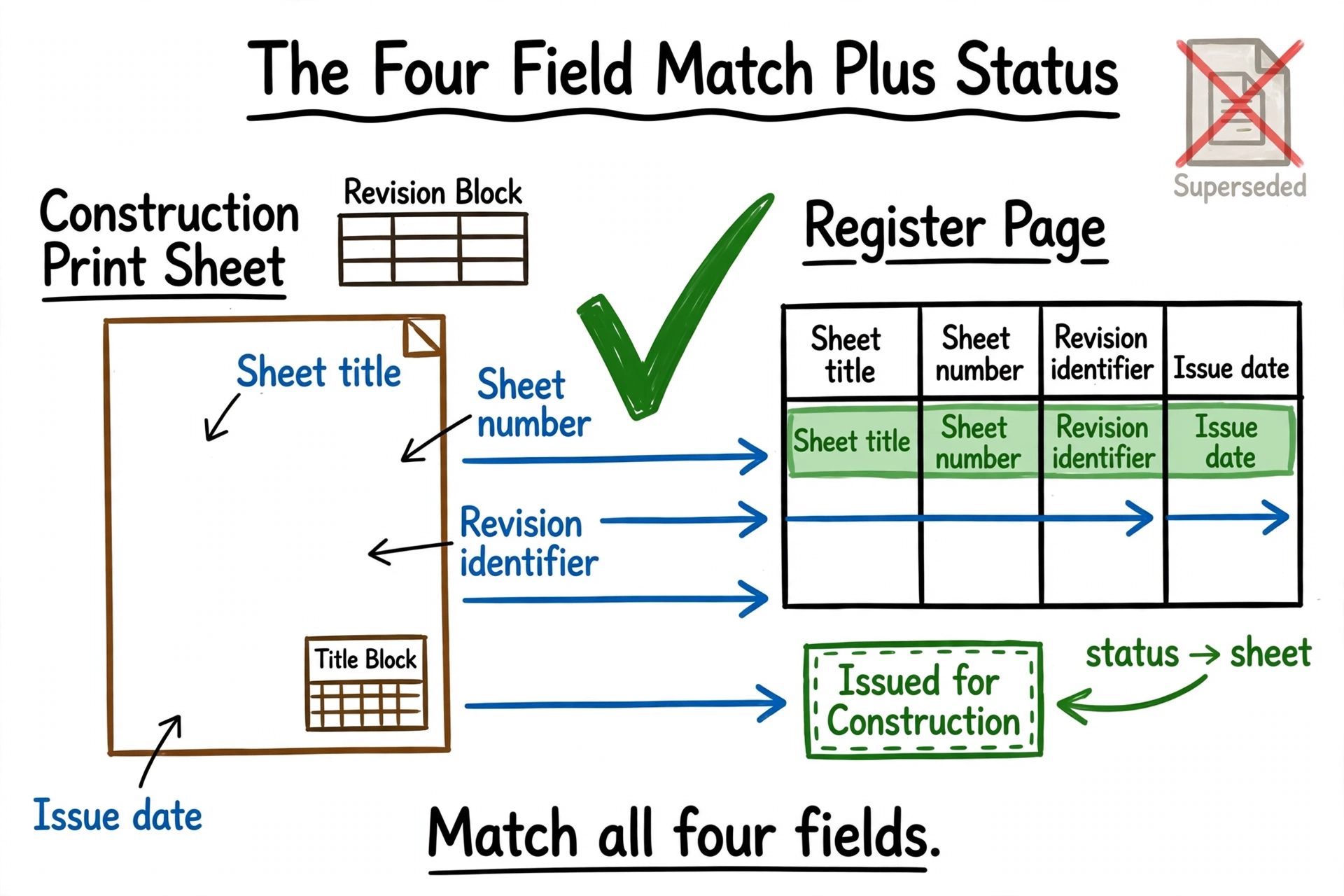
The comparison covers four fields on every sheet. The checker reads the sheet title, the sheet number, the revision identifier, and the issue date in the title block and revision block, then matches all four against the register line for that sheet:
- Sheet title. The words that name what the sheet shows. The title on the sheet matches the title in the register word for word.
- Sheet number. The short code that identifies one sheet inside the full set. Sheet numbers let a crew confirm the set holds every sheet in the expected order, and cross references on other sheets point to work by sheet number.
- Revision identifier. The letter, number, or combined code that marks which issue of that sheet the copy represents. Common schemes use letters during preliminary stages and numbers after a sheet is released for construction, and some projects use a prefix that signals the stage. The project procedure for the job defines the scheme in use, so the checker follows the scheme the register records.
- Issue date. The date of the issue the sheet represents. The revision block lists each revision with its date and a short description of what changed, so the date on the sheet can be checked against the date in the register.
Status sits beside revision, and status decides use. A status is the label that states what a drawing may be used for. Practice uses labels such as issued for review, issued for information, issued for tender, issued for construction, as-built, and superseded. Revision and status answer different questions. Revision states the sequence. Status states the permission. A sheet can carry the highest revision in the truck and still sit at a review status, which means the design authority has released the sheet for comment rather than for building. Only a sheet whose status authorizes construction under the project procedure belongs in the active construction set.
Issued for construction carries a specific meaning. Issued for construction, often shortened to IFC, describes a set the design authority has authorized for construction in accordance with the project procedures. State department of transportation practice gives the same idea a contract form: the plans, specifications, and other contract documents govern the work, and approved revisions become part of those documents. Michigan Department of Transportation construction guidance, summarizing Subsection 103.02 of its Standard Specifications for Construction, states that the department reserves the right to revise the contract, that the contractor agrees to perform the work as revised, and that the contractor must wait for direction from the engineer before proceeding with revised work while continuing with work the revision leaves unaffected. Delaware Department of Transportation construction manual guidance carries the parallel rules for addenda and plan revisions: modifications issued after advertisement of the project and before proposals are submitted are issued as addenda and become part of the contract, contractors are responsible for work in all addenda, and copies of all addenda should be available on the project, and plan revisions during the project enter the contract through the revision process the manual describes. North Carolina Department of Transportation construction manual guidance states the same governing principle in Section 104: the contractor performs work in accordance with the contract documents, and changes in plans proceed through the alteration and supplemental agreement process the section describes.
Superseded describes a sheet that has been replaced. A superseded sheet is an earlier revision replaced by a later revision. Document control practice keeps the superseded sheet in the project record for audit and contract history, marked as superseded, and removes the sheet from active use channels. Quality management practice under ISO 9001:2015 Clause 7.5 follows the same control: documented information gets identified and described, for example by title, date, author, or reference number, and reviewed and approved before use; changes get controlled, for example by version control; and obsolete documents get prevented from unintended use, by removal or by suitable identification if they are kept for any purpose. A superseded sheet kept for reference must be clearly marked as superseded and controlled so it cannot be mistaken for the current sheet, following the project procedure. ISO 9001:2015 Clause 7.5 requires prevention of unintended use, by removal or by suitable identification or controls if the document is kept. Project procedures differ: some archive the marked sheet apart from the active set, and DelDOT plan practice marks the superseded sheet ‘void’ and keeps it in the bound set behind the current sheet. A superseded fiber sheet sitting unmarked in the active set is a defect in the set, even when nobody has built from the sheet yet.
The sources of the duty need accurate labels. Three kinds of authority touch this check, and the lesson keeps the kinds separate:
- Contract documents govern a specific job. The agreement, plans, specifications, addenda, and approved revisions for a project state what that project requires, including which revision of each sheet the contractor builds from and how a revision gets authorized. A direction to proceed with revised work comes through the contract channel the project documents name, commonly the engineer or the owner representative for the job.
- Standards govern a method across jobs. ISO 9001:2015 Clause 7.5 states a general control method for documented information. The standard applies where an organization adopts the standard or a contract invokes the standard. The standard supplies the control logic: identify, approve, distribute, control changes, and prevent unintended use of obsolete documents.
- Company and project practice govern daily handling. Register keeping, transmittal acknowledgement, stamping superseded prints, and clearing old prints from trucks and walls are practice steps a company or a project adopts to satisfy the contract duty. Practice steps vary by project. The underlying test stays constant: the sheet in the crew hands matches the governing list, with a construction status, on the day the work happens.
What Does It Look Like?
A correct print set has visible signs a beginner can check without building anything:
- A governing list exists for the job and sits where the crew can reach the list: a register, an issue log, or a transmittal record naming each sheet, its current revision, its status, and its issue date.
- Every sheet in the active set carries a legible title block with the project name, sheet title, sheet number, date, and revision information.
- Every sheet carries a revision block listing revisions with dates and short descriptions, and any revision cloud and delta marks on the drawing face match rows in that block. A revision cloud is a loop drawn around a changed area. A delta is the small numbered marker placed beside a cloud to tie the change to a revision block row.
- The set carries an IFC or equivalent construction status marking where the project procedure uses one, and no sheet in the active set carries a preliminary, for review, or not for construction marking.
- A superseded sheet kept for reference must be clearly marked as superseded and controlled so it cannot be mistaken for the current sheet, following the project procedure. ISO 9001:2015 Clause 7.5 requires prevention of unintended use, by removal or by suitable identification or controls if the document is kept. Project procedures differ: some archive the marked sheet apart from the active set, and DelDOT plan practice marks the superseded sheet ‘void’ and keeps it in the bound set behind the current sheet.
- The sheet count and sheet order match the sheet index on the cover sheet or in the register, with no gaps where a required sheet should sit and no duplicate sheets at different revisions.
- Addenda and approved revision sheets named in the contract documents for the job sit with the set, so the set the crew holds includes the changes the contract already adopted.
- Field copies and office copies agree. The revision in the foreman folder matches the revision in the office set and the revision in the register for every sheet the day covers.
A wrong set also has visible signs:
- Two copies of the same sheet number sit in the set at different revisions.
- A sheet shows a revision cloud for the latest revision with no matching row in its revision block. Earlier revision block rows may have no cloud on the current sheet face, because clouds from earlier revisions are commonly removed; a missing cloud for an earlier row is not, by itself, a defect.
- A title block date stays frozen at an early issue date while the register shows a later issue for that sheet.
- A file name claims a final or new status while the title block and register show an earlier revision. File names carry no authority in this check.
What Does It Do?
It ties the work to the contract. The plans and specifications govern the work under the contract documents for the job. Building from the governing revision is how field work stays inside the agreement the owner and the contractor signed. Building from a replaced revision places work outside that agreement, even when the crew performed the physical task with care. Acceptance, payment, and closeout all get judged against the governing documents, so the revision in the crew hands decides whether well built work counts as correct work.
It makes a change reach the hands that build. Design changes travel through documents. An engineer revises an alignment, a handhole location, a crossing method, or a splice point by revising sheets and issuing the revision through a transmittal or a contract revision. The register records the change. The transmittal carries the change to named recipients. The jobsite check closes the loop: the check confirms the revised sheet actually replaced the old sheet at the point of work. A revision that reached the office and stayed in an inbox changed the record and left the field unchanged, and the gap stays invisible until someone compares the set in the truck against the list.
It gives every crew the same instruction. Fiber work runs in sequence across crews and days. A bore crew, a trench crew, a placement crew, and an inspector can each hold a copy of the same sheet. Register control gives all copies one current revision to match. When copies disagree, crews can each follow a sheet faithfully and still produce work that conflicts at the junction between tasks, because the instructions themselves conflicted before anyone touched the ground.
It preserves the history while protecting the present. Supersede and retain is the control, rather than delete and forget. The register keeps one row per revision, with earlier rows marked superseded and the replacing revision noted. The project can later show which revision governed on the day a segment was built, which matters for as-built records, deficiency reviews, and payment questions. At the same time, withdrawal from active use protects the present: the historical copy leaves the truck and the wall, so history stays available in the archive and unavailable as a working instruction.
It creates a stop point before cost attaches. Paper is cheap to correct. Buried conduit, set structures, and placed fiber carry excavation, material, restoration, and reinspection cost when a revision error surfaces after cover. The check moves discovery to the cheapest moment: a title block comparison at the truck, before setup, while the correction costs a phone call and a replacement sheet.
Where Does It Fit?
The print check sits inside jobsite preparation, after the documents arrive and before the crew builds from the documents:
- At project award and at each new issue, the office or document controller logs each sheet in the register with number, title, revision, status, and date, and issues the set under a transmittal to named recipients.
- At the preconstruction meeting in Lesson 128, the organizations confirm how prints get issued, who owns the register, and how revisions reach the field for the project.
- Before starting, under Lesson 129 and Lesson 130, the crew knowledge check and the job briefing work from the print for the segment, so the briefing picture and the print picture need to be the same picture.
- In this lesson, the field check compares the set on site against the governing list before work starts for the day and whenever a new issue, an addendum, or a contract revision reaches the site during the job.
- During the work, a field change or an approved plan revision can replace a sheet mid job. A field change is a change made during construction to address field conditions. Approval authority for a field change sits with the roles the contract documents name, covered in Lesson 93, and the revised sheet enters the active set through the same register and withdrawal steps as any other revision.
- Later lessons return to the same documents from other sides: Lesson 132 checks permits, Lesson 91 teaches what a revision is as a document, Lesson 94 teaches what controls when documents disagree, and Lesson 95 teaches the response when a print and the field disagree. This lesson covers one narrower question: whether the set in hand is the set the job currently governs.
What Is at Stake
Rework and removal. Work built from a superseded sheet commonly gets discovered after the work exists: at inspection, at a junction with a segment built from the current sheet, or at acceptance. The correction then includes removal, rebuild, restoration, and reinspection. Document control guidance across construction practice names building from a superseded drawing among the costliest routine errors on a project for exactly that reason: the error hides inside correct looking work until the work is complete.
Payment and acceptance. Contract revisions change scope, quantities, and price through the formal revision process. Michigan guidance states that the contractor and the engineer reach agreement on scope and method of payment for a revision before the revised work commences. Force account is the stated exception path, not a general fallback: where no existing unit prices cover the revision and the engineer does not receive a cost estimate within five calendar days of the request, a contract change order may be generated with an estimated budget and the work may commence under force account procedures, and force account work requires the pre-approval of the region construction engineer before the work commences. A crew that builds a revision nobody directed, or builds an old revision after a change was approved, creates a payment dispute alongside the physical problem. The work may be real. The contract basis for paying for the work may be missing.
Coordination failure between trades and segments. A revised sheet often coordinates with other sheets: a moved structure changes a conduit run, a changed crossing changes a profile, a relocated splice changes slack storage. Building one sheet at the old revision while neighboring work follows the new revision produces conflicts that neither crew caused through workmanship. The failure sits in the document set, and the field pays for the failure at the seam.
The record. After an incident, a deficiency, or a claim, the project reconstructs which revision was issued, who received the revision, and which revision the crew held. A register with one row per revision and transmittals with recipients and dates answers those questions from records. A set with no register leaves the questions to memory and to whichever print happens to survive in a truck.
Safety around changed work. A revision can move work away from a hazard, change a crossing, or change a traffic or excavation detail. Building from the earlier sheet can place a crew in a location or a configuration the revision was issued to avoid. The print check is a quality and contract control first, and the check also keeps the crew working from the latest safety relevant information the project has issued. Recognition has a limit here: checking prints qualifies nobody to redesign work, approve a change, or perform regulated or hazardous work. Those duties sit with the qualified and authorized roles the project documents name.
What Does Good Look Like?
- The governing register for the job is current, reachable from the jobsite, and owned by a named person who logs each new issue as the issue arrives.
- Every sheet in the active set matches the register in title, sheet number, revision identifier, and date, and every sheet carries a status that authorizes construction.
- The cover sheet index, the register, and the physical set agree on sheet count and order, with no missing sheet and no duplicate sheet at two revisions.
- Addenda and approved revisions named in the contract documents sit with the set, and revised work waits for the direction the contract channel requires before the revised work proceeds.
- A superseded sheet kept for reference must be clearly marked as superseded and controlled so it cannot be mistaken for the current sheet, following the project procedure. ISO 9001:2015 Clause 7.5 requires prevention of unintended use, by removal or by suitable identification or controls if the document is kept. Project procedures differ: some archive the marked sheet apart from the active set, and DelDOT plan practice marks the superseded sheet ‘void’ and keeps it in the bound set behind the current sheet.
- Each new issue arrives with a transmittal or an equivalent issue record naming recipients, revisions, date, and purpose, and receipt gets acknowledged through the project procedure.
- The foreman or inspector can state, for the segment of the day, which revision governs each sheet in use and where that fact was checked.
From the Field
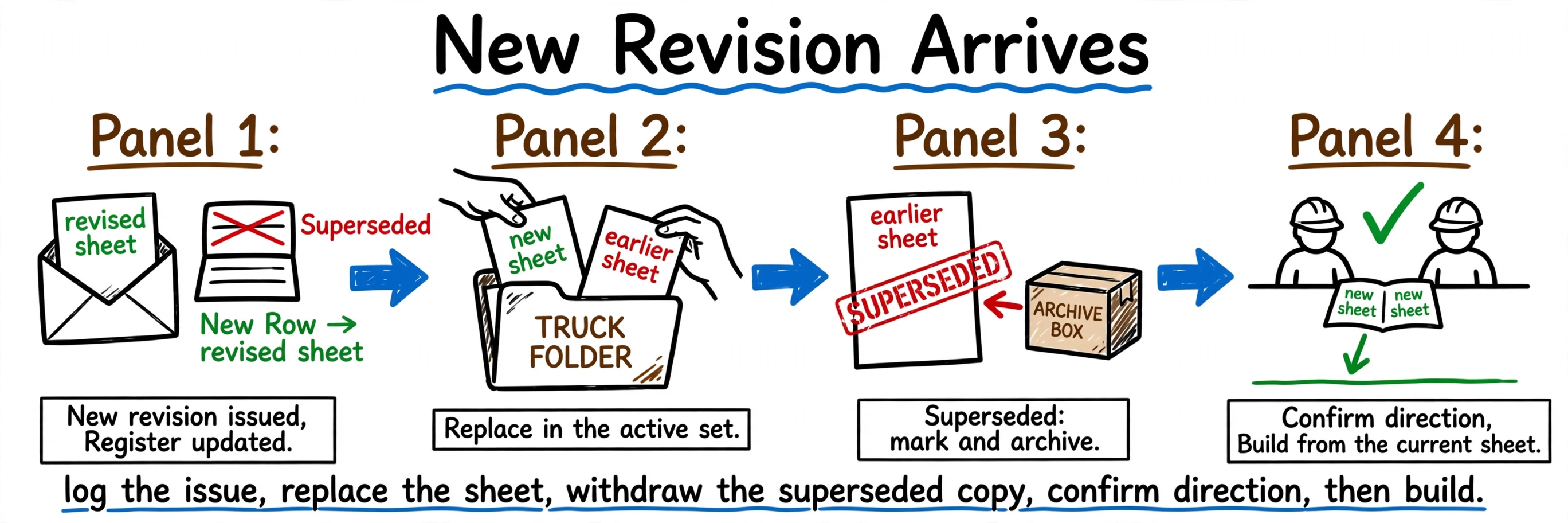
Picture a two crew fiber job placing underground conduit and handholes along a road corridor over several days. The office issues a revised plan sheet for one segment after a utility conflict review. The revision moves one handhole location and adjusts the conduit path approaching the structure. The register gets a new row for the sheet at the new revision, marked issued for construction, and the earlier row gets marked superseded. A transmittal sends the revised sheet to the project distribution list.
The trench crew works from a printed set kept in the crew truck. The printed set still holds the earlier revision of the segment sheet, because the new print went to the office printer and the digital folder, while the truck set stayed in service from the week before. The sheet title and sheet number match the job. The paper looks complete. Nobody has compared the revision identifier and date in the title block against the register since the set first went into the truck.
The inspector arrives before excavation for the segment and runs the print check as a routine preparation step. The inspector reads the title block on the truck sheet, then reads the register line for the same sheet number. The sheet number and title agree. The revision identifier and date disagree: the truck sheet carries the earlier revision, and the register shows the later issued for construction revision as current, with the earlier revision marked superseded.
The contract for this job follows the Michigan DOT rule in Subsection 103.02: revised work waits for direction from the engineer, and work the revision leaves unaffected continues. The decision point sits in that mismatch. The schedule favors starting excavation, since the crew, the equipment, and the locates for the day are ready, and the moved handhole sits a modest distance from the earlier location on paper. The governing documents point the other way: the active set fails the check, the revised work has a contract channel for direction, and excavation from the superseded sheet would place a structure and a conduit path where the current design no longer puts them.
Work on the affected segment pauses. Unaffected work continues where the governing sheets check out. The current revision gets printed and placed in the truck set, the superseded sheet gets marked and removed to the archive, and the engineer direction for the revised segment gets confirmed through the project channel before excavation starts on that segment. The crew loses part of a morning. The job avoids excavating, setting, and later removing a structure built to a replaced instruction.
The decision rule is direct: when any field on a sheet disagrees with the governing list, the sheet fails the check and the affected work waits. Replace the sheet, withdraw the superseded copy from active use, confirm direction for revised work through the contract channel, and only then build the segment. A matching title and sheet number never rescue a mismatched revision.
What Can Go Wrong?
The old print that never left. A new revision updates the register and the digital folder while a printed superseded sheet stays in the truck or on the trailer wall. Crews reach for the copy at hand. Revision control guidance names this failure directly: a procedure that updates the register and leaves obsolete prints in circulation stays incomplete.
The newest revision with the wrong status. A sheet arrives at a new revision for review or for information and enters the active set on revision alone. The crew builds from a design the authority released for comment. Status and revision answer different questions, and the check fails when either answer is wrong for construction.
The partial set. One revised sheet enters the set while coordinated sheets stay at earlier revisions, or a required sheet goes missing entirely and the crew works around the gap from an adjacent sheet. The set looks thick enough to be complete. The index and register comparison exists to catch count and coordination gaps that thickness hides.
The file name that lies. A PDF named with final or current language carries an earlier revision inside the title block. A phone copy saved weeks earlier carries the same trap. The register and the title block hold authority in the check. A file name holds none.
The revision nobody was directed to build. A revised sheet reaches the field through an informal channel, with no transmittal, no register entry, and no direction through the contract channel. Michigan contract revision guidance states the guardrail in contract terms: the contractor must wait for direction from the engineer before proceeding with revised work, while continuing work the revision leaves unaffected. Building first and regularizing later reverses the contract sequence and puts payment and acceptance at risk.
The archive copy that walks back. A superseded sheet retained for reference sits unmarked beside the active set and returns to use during a busy morning. A superseded sheet kept for reference must be clearly marked as superseded and controlled so it cannot be mistaken for the current sheet, following the project procedure. ISO 9001:2015 Clause 7.5 requires prevention of unintended use, by removal or by suitable identification or controls if the document is kept. Project procedures differ: some archive the marked sheet apart from the active set, and DelDOT plan practice marks the superseded sheet ‘void’ and keeps it in the bound set behind the current sheet.
The mismatch treated as a tie. A field copy and an office copy disagree and the crew picks the copy held by the senior person, or the copy that supports the planned setup. A disagreement between copies is a failed check with a defined response: pause the affected work, consult the governing list, and resolve the revision through the project channel. Seniority and convenience hold no authority in the comparison.
What Should Someone Notice in the Field?
- Confirm a governing register or issue list exists for the job and that the list is reachable from the jobsite on the day of work.
- Read the title block and revision block on each sheet for the segment and match title, sheet number, revision identifier, and date against the governing list.
- Confirm each sheet in use carries a status that authorizes construction, and set aside any sheet marked for review, for information, preliminary, or not for construction.
- Compare the physical set against the sheet index for count and order, and raise any missing sheet or duplicate sheet at two revisions before work starts.
- Check that addenda and approved revisions named in the contract documents sit with the set, and that revised work has direction through the contract channel.
- Confirm superseded sheets are clearly marked as superseded and controlled so they cannot be mistaken for the current sheet, following the project procedure, in the truck, in the trailer, and in the digital folder the crew uses.
- Treat any mismatch between copies, or between a copy and the register, as a stop for the affected work until the project channel resolves the governing revision.
- Know the boundary: checking prints, reporting a mismatch, and withdrawing a superseded copy under the project procedure are recognition and support tasks. Approving a revision, directing revised work, redesigning work, and performing regulated or hazardous work require the qualification and authorization the contract and the governing rules demand. Reading this lesson qualifies no one for those duties.
Key Terms
Construction print: A drawing sheet that shows the location, character, and details of work to be performed for a project.
Document control: The set of rules and records that shows which version of each project document is current, what that version may be used for, who issued it, and who received it.
Drawing register: The running list of every drawing on a project, with each drawing number, title, current revision, status, and issue history in one place.
Transmittal: The formal record of one document issue, stating which drawings at which revisions went to whom, when, and for what purpose.
Revision identifier: The letter, number, or combined code printed on a sheet that marks which issue of that sheet the copy represents.
Revision block: The table on a sheet listing each revision with its identifier, date, and a short description of what changed.
Title block: The labeled box on a sheet that identifies the project, the sheet title, the sheet number, the scale, the issue date, and the revision history.
Status: The label on a drawing that states what the drawing may be used for, such as issued for construction, issued for review, or superseded.
Issued for construction (IFC): The status of a set the design authority has authorized for construction in accordance with the project procedures.
Superseded: The status of an earlier revision replaced by a later revision, retained in the record and withdrawn from active use.
Contract documents: The agreement, plans, specifications, addenda, and approved revisions that govern a specific project.
Addendum: A modification issued after a project is advertised and before proposals are submitted, which becomes part of the contract. Plural: addenda.
Revision cloud: A loop drawn around a changed area on a sheet. A delta is the small numbered marker beside a cloud that ties the change to a row in the revision block.
Check Your Understanding
- Name the four fields the jobsite check matches between a sheet and the governing list, and name the fifth attribute that decides whether the sheet may be built from.
Answer: Title, sheet number, revision identifier, and issue date get matched against the governing list. Status decides use: the sheet needs a status that authorizes construction under the project procedure. A high revision at a review status fails the check.
- A register shows a sheet at a new revision marked issued for construction, with the earlier revision marked superseded. The truck set still holds the earlier revision, unmarked. State two defects in the set and the control that fixes each one.
Answer: The active set holds a superseded sheet as a working instruction, and the superseded copy carries no identification and sits at the point of use. Replace the truck sheet with the current revision, then mark the earlier sheet as superseded and control the earlier sheet so it cannot be mistaken for the current sheet, following the project procedure. ISO 9001:2015 Clause 7.5 requires prevention of unintended use, by removal or by suitable identification or controls if the document is kept. Project procedures differ: some archive the marked sheet apart from the active set, and DelDOT plan practice marks the superseded sheet ‘void’ and keeps it in the bound set behind the current sheet.
- In the From the Field scenario, which fields agreed between the truck sheet and the register, which fields disagreed, and what did the crew do before excavating the affected segment?
Answer: Sheet title and sheet number agreed. Revision identifier and issue date disagreed: the truck sheet carried the earlier revision and the register showed the later issued for construction revision as current. Work on the affected segment paused, unaffected work continued, the current revision replaced the truck sheet, the superseded sheet was marked and removed to the archive, and direction for the revised segment was confirmed through the project channel before excavation started.
- A revised sheet reaches a foreman through an informal message, with no register entry and no transmittal. The revision changes the work the crew planned for the morning. State the contract sequence the lesson teaches for revised work, using the Michigan guidance.
Answer: Revised work waits for direction through the contract channel before the revised work proceeds, while work the revision leaves unaffected continues. Michigan guidance summarizing Subsection 103.02 states that the contractor agrees to perform work as revised and must wait for direction from the engineer before proceeding with revised work. The sheet also needs a register entry and an issue record so the set can be checked.
- Explain why a PDF file name that includes the word final proves nothing in the print check, and name the two authorities the check trusts instead.
Answer: A file name is a label a sender chose, and a saved copy can keep an old name or gain a hopeful name while the sheet inside stays at an earlier revision. The check trusts the title block and revision block printed on the sheet itself, matched against the governing register for the job.
Lesson Takeaway
A print set earns trust through comparison, never through presence. After this lesson, a sheet on site reads as either a sheet that matches the governing list in title, number, revision, and date, with a status that authorizes construction, or a sheet that fails the check and stops the affected work until the project channel resolves the governing revision.
Sources and Technical References
Michigan Department of Transportation, Construction Manual, Section 103.02, Contract Revisions, summarizing Subsection 103.02 of the Standard Specifications for Construction: the department reserves the right to revise the contract, the contractor agrees to perform work as revised, the contractor must wait for direction from the engineer before proceeding with revised work while continuing unaffected work, and contract change orders formally authorize and incorporate revisions that alter nature, scope, cost, or schedule. MDOT Construction Wiki: https://mdotwiki.state.mi.us/construction/index.php?title=103.02_Contract_Revisions&oldid=9582
Delaware Department of Transportation, Construction Manual, Part B, Plans and Specifications, including addenda to the contract and plan revisions during the project: modifications issued after advertisement and before proposals are submitted are issued as addenda and become part of the contract, contractors are responsible for work in all addenda, and the inspector should ensure copies of all addenda are available on the project. DelDOT publications: https://DelDOT.gov/Publications/manuals/construction_manual/pdfs/04-construction_manual-part_b.pdf
Delaware Department of Transportation, Construction Manual, Part C, Contract Administration, Section C10.00, Contract Documents: the contract documents for each project include general notices, standard specifications, bid proposal, special provisions, supplemental specifications, plans, and standard construction details, with plan revisions among the project documents, and a governing ranking applies when contract documents conflict. DelDOT Construction Manual: https://stage.constructionmanual.deldot.gov/index.php?title=Part_C_-_Contract_Administration&diff=next&oldid=815
North Carolina Department of Transportation, Construction Manual, Section 104, Scope of Work, including intent of contract, supplemental agreements, and alterations of plans or details of construction: the contractor performs work in accordance with the contract documents, supplemental agreements for allowable modifications are executed before the affected work except as the section provides, and the engineer may make changes in plans or details of construction as necessary or desirable. NCDOT Construction Manual: https://connect.ncdot.gov/projects/construction/Pages/ConstMan.aspx?Method=CM-01-104
Lunr, How to Set Up a Drawing Register: Columns, Conventions, and a Worked Example, describing a drawing register as the single list of every drawing with number, title, revision, status, and issue history, the rule of one row per revision, the rule to supersede and never delete, and the rule that every issue carries a transmittal reference so the project can show which revision is current, who received the revision, and when: https://www.lunr.app/blog/how-to-set-up-a-drawing-register
Nuru, Is This the Current Drawing? Document Control Explained, describing document control as the rules and records that show which version of each document is current, what the version can be used for, who approved the version, and who received the version, with the register, revision control, status codes, and transmittals as working parts, and the direction to withdraw or clearly mark an older revision as superseded once a new revision is issued for use: https://www.joinnuru.com/post/is-this-the-current-drawing-document-control-explained
AODocs, Drawing Revision Control: Current and Superseded Sets, defining drawing revision control as the process used to identify which drawing revision is authorized for a stated purpose, control distribution to defined recipients, and remove superseded sets from current use channels so outdated drawings stay out of construction, review, and handover, with revision, status, purpose of issue, approval evidence, and distribution history kept distinct: https://www.aodocs.com/blog/drawing-revision-control-capital-projects
Helonic, Title Block Guide: Every Field and What to Check, describing the title block as the labeled box that identifies the project, the design firm, the sheet number and title, scale, issue date, revision history, and the professional seal, with the sheet number and title matching the sheet index, and the revision block as the table where each row matches a delta and a revision cloud on the sheet: https://helonic.com/knowledge-base/title-block-guide
CadTri, What Is a Title Block?, describing the title block contents including project name, sheet title, sheet number, date, and revision information, with revision history as a table listing each revision number, date, and brief description, and sheet numbers as the means to confirm a set holds every sheet in the expected order: https://www.cadtri.com/blog/what-is-a-title-block
Smithers, Mastering ISO 9001 Document Control, summarizing ISO 9001:2015 Clause 7.5 on documented information: documents are identified and approved before use, changes are controlled with version identification, and obsolete documents are prevented from unintended use, with retained obsolete documents clearly identified as obsolete or superseded: https://www.smithers.com/resources/2026/february/smithers-summarizes-mastering-iso-9001-document-control
Previous lesson: Lesson 130: What Is a Job Briefing? |
Back to Level 7 hub |
Next lesson: Lesson 132: Are the Required Permits Available?