
Introduction
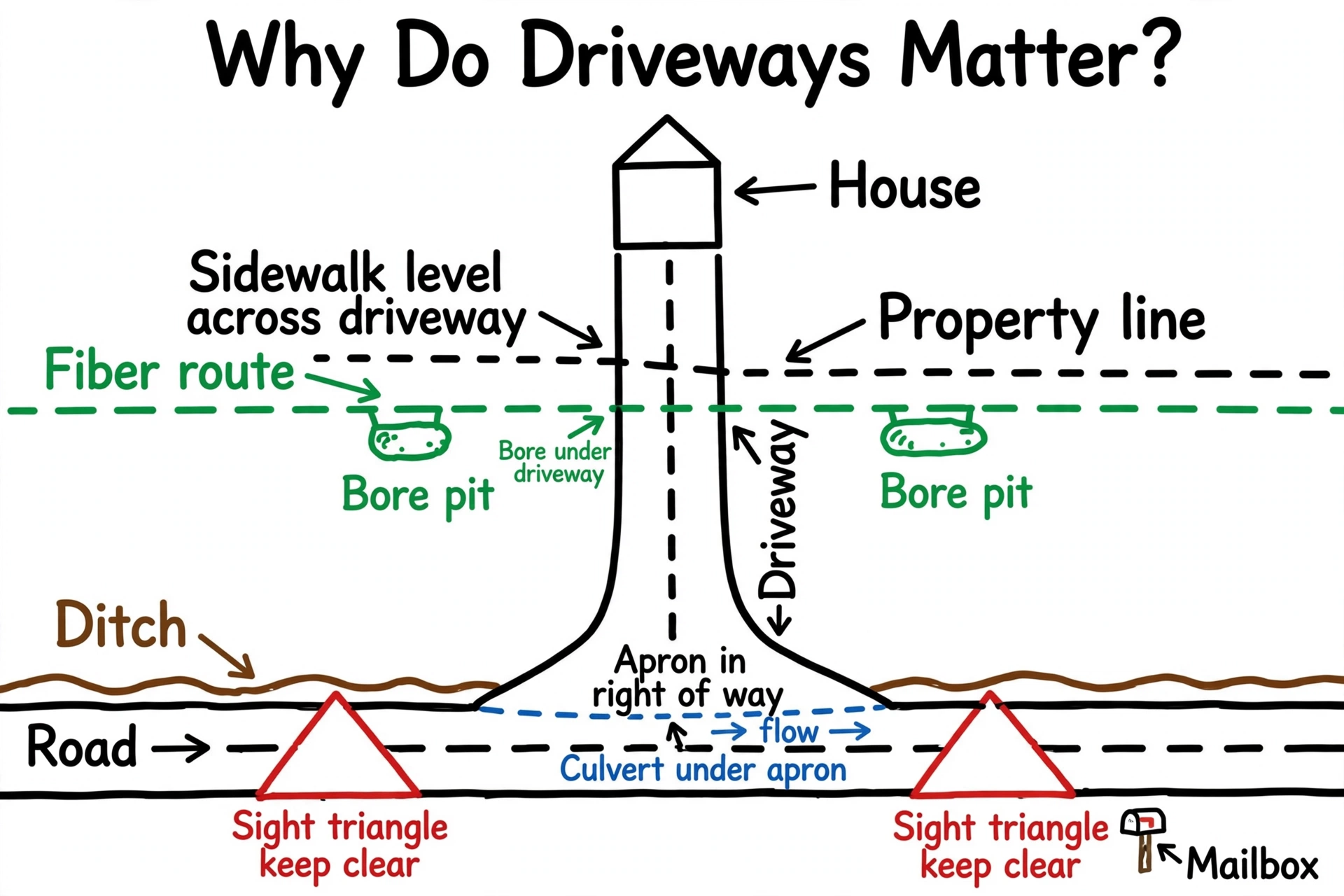
A driveway is a private way that provides vehicle access from a public or private road to a property: the prepared surface a vehicle uses to get from the road onto the lot and back again. Its parts answer to different owners and different rules. The apron at its outer end lies in the public right of way under the road authority’s permit system, the body behind the property line belongs to the property owner, and where the driveway crosses a roadside ditch, a culvert underneath it carries the ditch water through.
Driveways matter to a fiber route because the route crosses one at nearly every lot, and each crossing concentrates an owner’s daily access, a drainage path, a walking crossing, and a driver’s view in the same few feet of ground. This lesson sits in Level 2, after the lessons on the right of way, ditches, culverts, and drainage, and it combines those pieces at the one feature where they all meet at once. It teaches recognition: how to read a driveway crossing and protect it during fiber work. It does not qualify anyone to design a driveway, set its width or grade, size a culvert, cut a curb, or judge sight distance for a permit. Those tasks belong to the road authority, to the property owner for the private portion, and to qualified crews working under the project design, permit, and contract.
What This Lesson Gives You
- Read a driveway crossing from the road inward and name its parts: the curb cut, the apron, the sidewalk crossing, the culvert, and the driveway body.
- Tell which part the road authority controls and which part the property owner controls, and know where the project documents confirm the line.
- Read a surface, a culvert end, and a driver’s view before work starts, and record them so the condition a project found stays separate from damage a project caused.
- Keep a property reachable during work, and recognize the written agreement and temporary access that must be in place before an entrance is closed.
- Judge a finished crossing the way its owner will: a car in and out, water through, a clear view, and a surface restored in its own material and grade.
Start With the Basics
Picture a house on a road. Between the road and the garage or front yard there is a short piece of ground that a car crosses every day. Without it, the house is cut off from the road. A delivery driver cannot reach the door easily, a resident cannot get a car in or out, and in an emergency an ambulance or fire vehicle has a harder approach. That connecting piece is the driveway.
Now picture a fiber route following the same road. The route runs along the edge of the road, in the right of way covered in Lesson 21, past lot after lot. Every lot with a house, a business, a barn, or even just a field entrance has some kind of driveway or entrance crossing that band of ground. The fiber line has to get past each one. On a plan the line looks smooth. In the field the line crosses surface after surface, ditch after ditch, and owner after owner.
A driveway works like the doorway between a private room and a public hallway. The room belongs to the occupant, and the occupant decides what happens inside it. The doorway and the hallway belong to the building, and the building sets rules for the doorway because everyone in the hall passes it and depends on it staying open and undamaged. A guest may cross the threshold. A guest does not move the door, block it, or leave it damaged. A driveway puts the same arrangement on the ground: the property owner holds the room, the road authority holds the doorway and the hall, and a fiber crew crosses as a guest whose work is judged at that threshold every day.
Three ideas explain most of what follows:
- A driveway is two things at once. It is private access, the way a specific owner reaches a specific property. And its outer end is a public access point, a place where private traffic joins public traffic. The private end matters to one household or business. The public end matters to everyone driving, walking, or cycling past.
- A driveway sits across things a fiber crew cares about. It sits across the sidewalk where there is one, so people on foot or using a wheelchair cross the driveway on their way along the street. It sits across the roadside ditch where there is one, so ditch water has to pass under it, usually through a pipe. And it sits across the likely fiber path, which often runs in the same strip of ground between the road edge and the property line.
- A driveway is personal in a way a ditch or a curb alone is not. People notice their own driveway. They notice a crack that was not there, a blocked entrance when they come home, gravel scattered on a concrete surface, or a patch that sits higher than the rest and catches a bumper or a snowplow. A crew can do technically sound buried work and still fail at a driveway, because the surface and the access are what the owner lives with every day.
Three promises follow from those ideas, and a fiber project makes them at every driveway even when nobody says them out loud:
- Keep the property reachable, or provide a temporary way in that the owner has agreed to.
- Keep water moving the way it moved before, through the ditch and the culvert.
- Leave the surface, the grade, and the view at the road as they were found, restored under the project permit and contract.
What Is It?
A driveway is a private way that provides vehicle access from a public or private road to a property, such as a home, a business, a farm building, or a parking area. In plain terms, it is the prepared surface a vehicle uses to get from the road onto the lot and back again. That short definition needs its parts, because different parts of a driveway answer to different owners and different rules.
- Driveway apron. The apron, also called a driveway approach in many road authority documents, is the portion of the driveway between the edge of the road or the curb and the property line or the sidewalk. One county policy cited in this lesson defines it, in summary, as the paved area placed between the edge of the roadway and the property line. The exact boundaries vary by place and by whether there is a curb and a sidewalk. The teaching point does not vary. The apron is the part of the driveway that lies in the public right of way, and that is why the road authority, and not only the property owner, has rules for it.
- Curb cut. Where a road has a curb, a curb cut is the opening made in the curb so a vehicle can pass from the road onto the apron without driving over a full height curb. In many curbed streets the curb is lowered or depressed at the driveway instead of being cut as a separate notch. Both terms, curb cut and depressed curb, name the same job: giving a vehicle a passable entry while the rest of the curb still contains the road edge and directs water along the gutter. Lesson 24 covers curb and gutter in detail. This lesson adds only that every driveway on a curbed street is also a break in that curb line, and that break was built or permitted for that lot.
- Driveway body. Behind the property line or behind the sidewalk, the driveway continues across private property to a garage, a carport, a parking area, a barn, or a turnaround. That portion is the owner’s private surface. It may be concrete, asphalt, gravel, pavers, or another prepared surface, and it may be wide, narrow, long, short, flat, or sloped, depending on the lot and on the local rules that applied when it was built. A fiber easement or a right of way may still cross or run beside it in some places. Do not assume the legal line from a guess. Confirm it in the project documents and, where the project requires it, from located property markers.
- Driveway culvert. Lesson 27 covers culverts in full. Here, a driveway culvert is a pipe placed under the driveway, most often under its apron where the driveway crosses a roadside ditch or swale, that carries ditch water under the driveway so the driveway does not act as a dam. One town stormwater page cited in this lesson describes driveway culverts in that way, as pipes that convey stormwater under a driveway apron within the right of way, and notes that maintenance responsibility for a driveway culvert can rest with the property owner in that town system. Responsibility differs by place. In some systems the road authority maintains it, in others the owner does, and on a fiber project the contract can make the contractor responsible for damage the project causes, whatever the standing maintenance rule is. Check the project documents instead of assuming.
- Access management. Access management is the way a road authority controls where and how properties connect to a road. The Federal Highway Administration, shortened to FHWA, is the federal agency for highways. FHWA material on driveways explains that every driveway is a point where vehicles, people on foot, and people on bicycles can come into conflict, and that managing the number, location, and design of access points is part of keeping a road safe and working well. FHWA also notes that the right of access for owners beside a road is governed by state law, not by one federal driveway law, and that states and local governments set driveway permit requirements and standards for placement, design, and construction, with considerable variation from place to place. That variation is a core fact in this lesson. There is no single national driveway width, apron thickness, grade, or culvert size that a crew can carry from job to job.
- Driveway permit. A driveway permit, also called an access permit or an entrance permit in some systems, is the road authority permission to build, change, move, widen, or remove a driveway connection to its road. A permit is usually needed to create a new driveway or to change an existing one in the right of way. Whether a fiber crossing that cuts, bores under, or restores an apron also needs work under a right of way permit, a utility permit, or both depends on the authority and the project. The permit in the project file, not habit, answers that question.
- Sight distance. Sight distance is the length of road a driver can see from a given position. At a driveway it works in two directions. A driver leaving the property needs to see approaching traffic in time to enter the road safely. A driver on the road needs to see a vehicle at or entering from the driveway in time to slow or stop. A sight triangle is the clear area near the corner where a driveway meets the road that must stay free of obstructions so those views remain open. The required distances and the exact triangle depend on the road, its speed, and the governing standard the authority uses, often drawn from guidance of the American Association of State Highway and Transportation Officials, shortened to AASHTO. This lesson states no sight distance figure as a field rule. A crew’s job is narrower: do not block the view that is there, with spoil, equipment, parked vehicles, material, or restored ground piled too high, and report a view that was already blocked.
- Restoration. Restoration is putting back what the work disturbed, to the condition and standard the permit and contract require. For a driveway that can mean the same kind of surface that was there, concrete for concrete, asphalt for asphalt, gravel for gravel, set to a grade that drains as it did and meets the road, the sidewalk, and the rest of the driveway without a lip or a dip that was not there before. Restoration belongs to the work itself. Where the project contract includes it, as the cited project patterns do, it is a contract obligation with its own inspection.
A driveway is private access, and it is not spare ground. It is not a public road, not a parking strip for a work crew, not a place to stockpile spoil or material, and not ground for a bore pit just because it is flat. Flat is exactly why the owner uses it, often every day.
What Does It Look Like?
You recognize a driveway first by its job, a prepared break in the road edge that leads onto a lot, and then by its surface, its edges, and what it crosses. Start at the road and work inward, the way a car travels.
At the road. At a curbed street, look for the curb cut or depressed curb, a lowered section of curb that lines up with the driveway. The gutter in front of it may be shaped as part of the apron. At a road without a curb, often called an open section road, there is no cut to find. The apron meets the edge of the pavement directly, and beside it the roadside ditch continues up to the driveway and resumes on the other side.
The apron. The apron is usually the same material as the driveway body, concrete or asphalt in many built up areas, gravel or stabilized material in many rural areas, but not always. An apron may have been replaced on its own and can differ in color, age, or material from the driveway behind it. Many aprons flare wider at the road than at the property line, so a turning vehicle has more room at the point where it leaves the pavement. Those widened sides are sometimes called wings or flares. Some aprons have a radius, a curved edge, instead of a straight flare. Note the shape before work, because restoration has to match the footprint that was there, not a rectangle that is easier to form.
The sidewalk crossing. Where there is a sidewalk, the sidewalk crosses the driveway. In good design the walking surface continues across the driveway at a steady level, and the apron slopes up to meet it, rather than the sidewalk dropping and rising through the driveway slope. That matters for people using wheelchairs, strollers, or walkers, and it matters to a fiber crew because sidewalk panels at a driveway are often built thicker or differently for vehicle load, and because a cut in that crossing affects both the driveway user and the sidewalk user at the same time. Lesson 25 covers sidewalks. At a driveway, always read the sidewalk and the driveway as one crossing.
The driveway body. Behind the line, driveways take several forms:
- A short urban driveway may be only long enough for one car between the sidewalk and a garage.
- A rural driveway may run a long way back to a house, a barn, or a field gate, with grass, a ditch, or a fence along its sides.
- A commercial driveway is often wider, may have separate entry and exit points or a marked circulation pattern, and may serve trucks and customers as well as the owner.
- A shared driveway serves more than one lot from one connection to the road.
- A field entrance may be only a gravel patch and a gate, used a few times a season, and easy to miss on a drive by, yet it is still an access point its owner counts on.
The culvert. Where there is a ditch, look for the culvert. From the road you may see only its ends, a round or shaped pipe opening in the ditch line on each side of the driveway, sometimes with a headwall, a flared end section, or stone around it, sometimes partly buried, grown over, or filled with sediment. The pipe itself is under the apron and the fill over it. Note both ends if you can do so from safe ground. A driveway with a ditch on both sides and no visible pipe ends is a question to raise, and it stays a question until the project process answers it. Water may pass another way, the pipe may be hidden, or the crossing may already have a drainage problem.
Signs of daily use. Small features mark how a driveway is lived with:
- A mailbox is often near the driveway, sometimes on a post at its edge.
- Newspaper boxes, address numbers on a post or a rock, a basketball hoop, parked cars, tire tracks in gravel, and worn edges where vehicles turn tight all tell you the driveway is active.
- A gate or cattle guard marks a rural entrance in regular use.
- Grass growing through gravel and a chain across the entrance can suggest a little used access, but little used does not mean free to block or cut without notice. Ownership and access rights do not expire because grass grew.
Grade. Notice the slope of the driveway. Some driveways rise from the road, some fall from the road toward the house, and some are nearly flat. A driveway that falls toward the road sends its surface water toward the ditch or gutter. A driveway that falls away from the road has to drain somewhere on the lot. Where the apron meets the road is a sensitive point. Too steep a break can scrape a low vehicle. Too flat or reversed a slope can send road water onto the lot or pond water on the apron. Record the grade as you find it with photographs. Do not judge whether it meets a standard. That is a design and permit question.
What Does It Do?
A driveway does one main job. It connects a property to the road network, so people and vehicles can get in and out. Everything else it does supports that connection or limits the harm that connection can do to the road, to water, and to people passing by.
It provides ingress and egress. Ingress means entering the property from the road. Egress means leaving the property to join the road. A working driveway lets residents come home, guests visit, deliveries and mail arrive, refuse trucks serve the lot, farm and work vehicles reach buildings, and customers and employees reach a business. For a home, losing driveway access for a night can mean a car left on the road or a resident who cannot get in. For a business, a blocked entrance during open hours can mean lost trade and a serious contract problem. For any occupied property, blocked access can delay emergency vehicles. The seriousness does not depend on whether the blockage was intentional. An open trench, a spoil pile, a parked rig, or a removed apron blocks the same way.
It creates a controlled conflict point, and then has to control it. FHWA driveway material makes this plain in summary: turning vehicles slow or stop in or near the travel lane, following drivers must respond, and people on the road, on the sidewalk, and at the driveway itself meet at one place. Good driveway location and design reduce that risk with adequate sight distance, a sensible angle to the road, usually close to perpendicular where the authority requires it, enough room to turn without backing into the road where a turnaround is provided, and a surface that does not wash loose material onto the pavement. A fiber crew does not redesign any of that. A fiber crew protects it by keeping the crossing visible, open, and in its found condition, and by following the project traffic control plan when work is at the entrance.
It carries the sidewalk and the road edge across itself. At a driveway, the sidewalk user does not stop being a road user. The curb and gutter do not stop moving water. The driveway is a guest crossing those systems, built to their rules in the right of way, not the other way around.
It lets drainage pass. Where a ditch or swale runs along the road, the driveway crosses over that drainage path. The culvert under it, where one is provided, carries the water through. Crowning or shaping of the driveway surface, a slight high point or side slope that sheds water to the edges instead of sending it down the middle onto the road, also matters, and FHWA material notes in summary that driveway surfaces should be paved or stabilized and shaped with crowning, ditching, and culverts as needed so surface water is not diverted onto the adjoining roadway and loose material does not wash onto it. If the culvert is crushed, blocked, filled by trench spoil, or removed and not replaced, the driveway becomes a dam. Water ponds on the upstream side, overtops the driveway or the road in heavy rain, erodes the edges, and can flood the lot or the neighbors. Lesson 28 covers why drainage matters for the whole route. A driveway is one of the most common places that principle becomes concrete, because the pipe is small, hidden, and directly under the work.
For a fiber network, it marks a crossing decision that repeats all day. At each driveway the design has already decided, or should have decided, whether the line passes under the surface by a bore, crosses in a trench under the project restoration rules, runs behind the driveway in the easement, or shifts to another alignment. The driveway does not decide that for the crew. It tells the crew that a surface, an owner, a drainage pipe, and a daily access need all occupy the same few feet of ground, and that all four have to survive the crossing.
Where Does It Fit?
Level 2 teaches you to read the physical environment a route passes through. Earlier lessons placed work in the right of way and in easements, past property lines, curbs and gutters, sidewalks, ditches, and culverts, and through drainage and waterway crossings. This lesson combines those pieces at the one feature where they all meet at once, lot by lot, for the whole length of a residential or rural route.
In the corridor cross section, a driveway is the interruption. On ordinary ground the bands a crew has learned run side by side: travel lanes, shoulder or curb and gutter, ditch or sidewalk, grass or utility strip, property line, private lot. A driveway cuts across those outer bands at a right angle. The fiber line, running lengthwise, meets that cut at every lot. Read a route that way and you stop counting driveways as scenery and start counting them as crossings, each with a surface to protect or restore, a culvert to find, and an owner to notify under the project process.
In the ownership picture, a driveway is a boundary lesson you can stand on. The road authority controls the road and, through its permit system, regulates the apron and any culvert and sidewalk work inside the right of way. Regulation is not the same as ownership or maintenance. Who builds and maintains the apron and its culvert varies by place, and in some systems that duty falls on the property owner who uses the entrance, so the project documents must be checked rather than assumed. The property owner controls the private driveway behind the line, subject to any easement that crosses it. The fiber project may hold a right of way permit, a utility permit, and easement rights, all at once, and a single driveway crossing can touch all three. Which document authorizes which act at a given driveway comes from the project file for that route, not from a general statement in this lesson.
In the project picture, driveways appear in three places:
- In design, as counted crossings with a chosen method, a restoration type, and any culvert or sidewalk notes on the prints.
- In construction, as daily access and notification work, because residents and businesses plan around when their entrance will be affected.
- In closeout, as restoration inspection, because a driveway crossing is easy for an owner and an inspector to find and judge long after conduit depth is out of sight.
Driveway problems missed in design and notice work tend to surface lot by lot during construction and closeout, when each one is slower to fix than it would have been as a design decision.
In the sequence of Level 2, this lesson prepares you for the lessons that follow on the visible utility features that share the corridor. Poles, handholes, pedestals, and other plant are often set near driveways, because the same strip of ground serves both. Learning to read a driveway now teaches you to ask, before you place or dig anything near one, where the car turns, where the water goes, where the driver looks, and where the owner will stand to judge your work.
What Is at Stake
Access. Access comes first, because access is the driveway’s purpose. Illinois Department of Transportation standard language cited in this lesson states the principle in summary: access must be maintained to all existing properties during construction unless arrangements for a short closure have been made in writing with the property owner, with notice to the engineer. The wording and the form differ by authority and by contract, but the principle is a common contract pattern: a closure is arranged by agreement before it happens. A crew that blocks a driveway without that agreement has not saved time. It has taken a person’s home access and created a dispute that will cost more time than the notice would have taken. Emergency access sharpens the point. A trench or a rig that blocks the only entrance can delay help that cannot wait for a plate or a backfill.
Safety at the road. A driveway is a place where a slow or stopped turning vehicle, through traffic, and a vehicle backing or pulling out meet. Sight distance is the margin that makes that meeting work. Spoil piled in the sight triangle, a trailer parked at the entrance, restored fill left high, or vegetation and material left where a driver needs to see can remove that margin without changing the driveway itself. Work in or near the traveled way at a driveway also needs the traffic control the project plan requires. A resident pulling out around a crew has a view shaped by where the crew put its trucks and cones. Put them where the plan says, not where the shade is.
Drainage. A driveway culvert is small and easy to damage and hard to notice until it rains. A bore that passes too close, a trench that fills the ditch, equipment that crushes a shallow or weakened pipe, or spoil left in the ditch line can block the flow that the culvert exists to carry. The result is ponding, erosion, a washed apron edge, or water sent onto the road or onto a lot. Those outcomes can appear in the first heavy rain after the crew has left the street, when nobody connects them to the fiber work except the owner whose driveway flooded.
The surface and the owner’s property. Concrete can crack under equipment it was not built to carry, or at a cut that was not saw cut and restored correctly. Asphalt can rut, tear at a cold joint, or settle over a poorly compacted trench. Gravel can be mixed with soil, scattered onto the road, or left with ruts and a lost crown so it holds water and turns to mud. Pavers and decorative surfaces can be lifted and relaid wrong. None of those failures needs bad intent. Weight, cutting, and compaction decide them. Photographing the surface before work, protecting it during work where the plan requires it, and restoring it to the permit and contract standard are how a project proves the difference between existing damage and project damage.
Cost and schedule. Driveway restoration is visible, countable, and easy to reject at inspection. A crossing restored in the wrong material, at the wrong grade, with a lip at the sidewalk or the road, or with a blocked culvert will be called back. Callbacks at driveways are scattered, one lot here and one lot there, and each one needs another visit, another notice to an owner, and another traffic setup. Avoiding the crossing by an approved bore, where the design calls for it, or doing the open crossing and its compaction and restoration right the first time, is cheaper than a season of returns.
Trust along the whole route. A fiber project meets most owners at their driveway and at their front yard, not in an office. A crew that gives notice, keeps a way in, protects the surface, and cleans up loose material teaches the next street that the project can be trusted. A crew that blocks, cuts, and leaves a poor patch teaches the opposite lesson just as fast, and the next street starts with complaints before work begins. It decides how permission, cooperation, and inspection go easier or harder for the rest of the build.
What Does Good Look Like?
A good driveway crossing for a fiber project looks ordinary when it is done, which is the point:
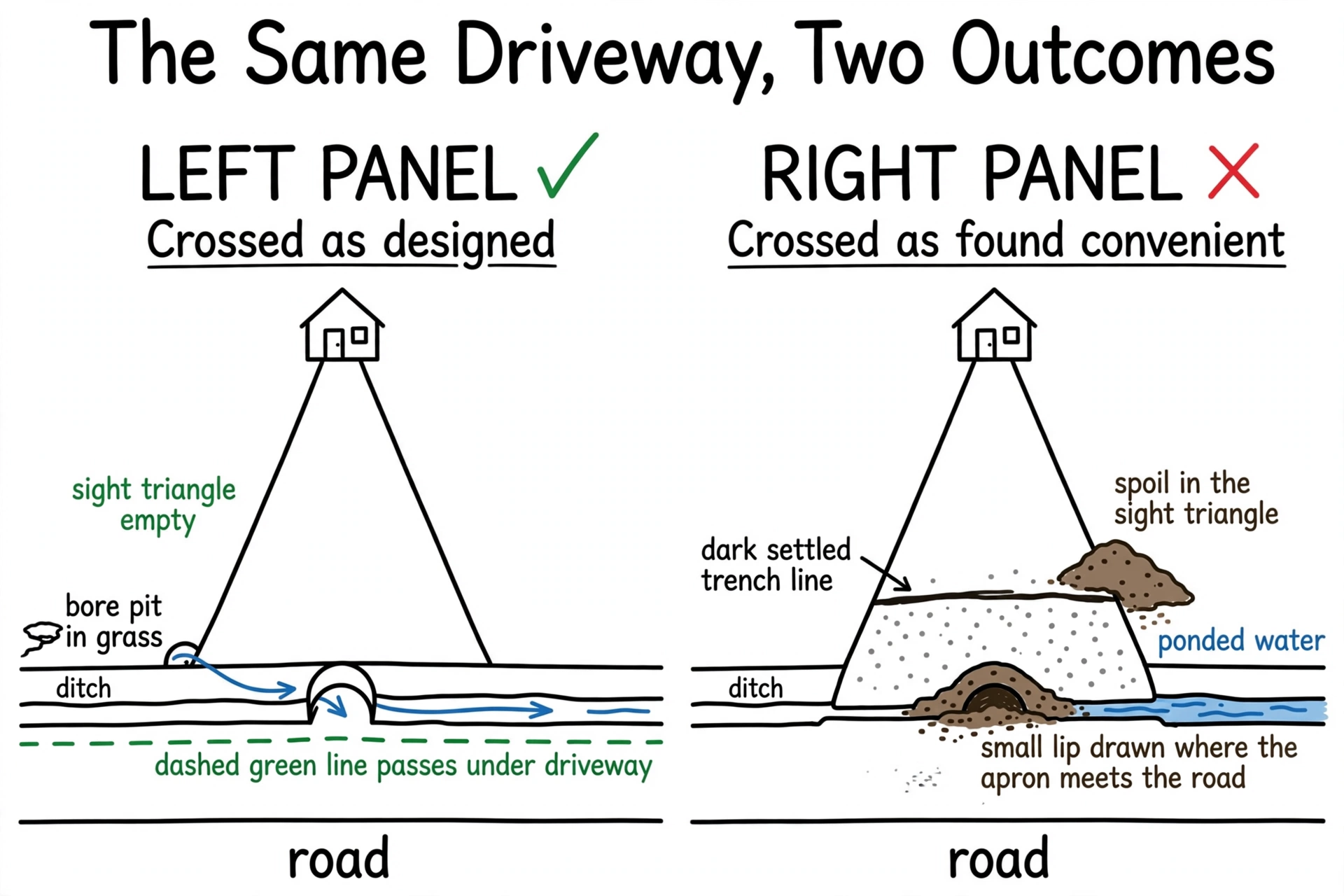
- The crossing method matches the design and permit. Where the design says bore under the driveway, the bore passes under the surface and the culvert zone as designed, with pits outside the driveway surface where the prints place them. Where the design says open cut, the cut, bedding, and backfill follow the project standards for work under a traveled surface.
- Access is maintained, or a temporary access is in place that the owner has agreed to under the project process. Any agreed closure is short, scheduled, and communicated in advance, and emergency access is considered in the plan. Steel plates, temporary gravel, or another temporary surface, where the plan uses them, are secured, passable, and removed or replaced by permanent restoration on the project schedule.
- The culvert and the ditch are protected and working. Culvert ends are located and noted before work, spoil is kept out of the ditch and away from pipe ends, equipment does not cross a vulnerable pipe without the protection the plan requires, and at the end of the day water can pass as it passed before.
- The surface is protected and then restored like for like. Photographs show cracks, patches, stains, edge damage, and grade before work. Restoration matches the existing material and footprint, meets the road and the sidewalk without a new lip or dip, holds the grade that drains as the driveway drained before, and is compacted so it does not settle into a trench line across the driveway.
- Sight distance and the sidewalk crossing are left clear and usable. No spoil, material, sign, or parked equipment blocks the sight triangle or the walking path across the driveway beyond the active work and its traffic control, and the restored sidewalk crossing is level and passable as the project accessibility requirements demand.
- The site is clean. Loose gravel and soil are off the road and the sidewalk, mud tracked by equipment is cleaned under the project rules, mailbox access and gates are as they were, and no material or marker is left in the driveway turning area.
- Records are complete. Before and after photographs, the culvert note, any owner agreement for a closure, and the as built position of the line at the crossing are in the project file, so a later crew or inspector is not guessing what happened at that lot.
A good crossing is judged by what still works when the crew leaves: the owner can get in and out, water can get through, a driver can see, a person can walk or roll across, and the surface looks and works as a driveway should.
From the Field
Picture a fiber route following a two lane road past a row of homes on large lots. Each lot has a gravel or asphalt driveway, a roadside ditch, and a culvert under the apron. The design calls for the buried line to run along the ditch side of the right of way, boring under each driveway, with pits in the grass strip between driveways.
Before construction, the crew leader drives the route slowly and counts the driveways against the prints. The leader finds one entrance the prints do not show, a gravel field entrance to a side pasture, with a culvert end almost hidden in grass. The leader photographs it, notes it on the route record, and reports the mismatch. The designer adds the crossing with the same bore method and notes the culvert position, so the bore path and pit positions can be set to avoid it.
At one asphalt driveway, the before photographs show an existing crack across the apron and a patched area near the mailbox, and the culvert end on the upstream side is partly filled with sediment, described exactly as found. The leader records both facts. Without those records, the crack could later be read as project damage, and the sediment could later be read as a project blockage.
During construction, the bore at that driveway is completed from pits outside the apron, as designed. At the next lot, a concrete driveway, the plan calls for an open crossing of a side easement behind the driveway instead of a cut through the concrete, and the crew keeps its heavier equipment off the concrete surface, using the access the plan provides.
At one lot the work does require a short period where the entrance cannot be used. Following the project process, the owner is notified in advance and agrees in writing to a short closure during work hours, with a temporary gravel passage kept passable beside the work area and full access restored at the end of the day. Emergency access is part of that conversation, not an afterthought. The closure happens as agreed, and the temporary passage is removed when permanent restoration is done.
At the final walk, each driveway on the route is photographed again from the same positions as the before photographs. Aprons and surfaces match their found condition outside the restored crossings, culvert ends are clear of spoil, ditch lines are open, no gravel from the work is on the road, and the owner at the closure lot confirms access was kept as agreed. The as built record shows the line position at each driveway crossing as actually built, including the added field entrance.
Nobody did anything dramatic at any single driveway. The crew counted every entrance, found every culvert it could see, photographed every surface before touching it, kept access by agreement, and restored what it disturbed. The decision rule to carry: never improvise a driveway crossing at the machine. Count it, record it, and cross it the way the design, the permit, and the owner agreement say, or stop and get it added to the plan.
What Can Go Wrong?
Driveway failures are usually small acts with personal consequences. The failures below are ordinary shortcuts meeting a feature an owner uses every day.
- A blocked entrance with no agreement. A trench is left open, a rig is parked across the apron, or the apron is removed and the owner comes home to no way in. The failure is the missing notice, agreement, and temporary access.
- A crushed or blocked culvert. Equipment crosses a weakened pipe, a bore or trench collapses or fills it, or spoil is left in the ditch over its end. The driveway looks fine in dry weather and fails as a dam in rain, with ponding, erosion, and flooding that can reach the road or the lot.
- A cut in the wrong place or without a locate. A saw cut or trench crosses an unlocated service to the house, a sprinkler line, an invisible fence wire, a septic component, or the culvert itself. Driveway ground is busy private ground as well as right of way. Locate and pothole under the project process, as the design requires.
- Restoration in the wrong material or at the wrong grade. Concrete replaced with loose gravel, asphalt patched without proper edges and compaction, or gravel left flat so it ponds. A restored grade that sends road water onto the lot, lot water onto the road, or leaves a bumper scraping lip at the road or a trip lip at the sidewalk is a failure even if the trench below is sound.
- Settlement across the driveway. Backfill under a traveled surface is not compacted in the manner the project standard requires, and the crossing sinks into a visible, felt line. Vehicle load makes poor compaction show itself quickly, as settlement under traffic.
- Spoil or staging in the sight triangle. A pile, a trailer, a portable toilet, or a sign placed at the entrance blocks a driver’s view of the road, or the road’s view of the driveway, for as long as it sits there. The risk ends when the obstruction ends, which is why placement matters from the first hour, not only at closeout.
- Damage outside the cut. Equipment tracks crack a concrete corner, a truck tears an asphalt edge, or a bore pit slumps at the apron edge. Work that only paid attention to its own trench line leaves damage in the turning area where tires actually travel.
- A missed driveway. A field entrance, a shared driveway behind a hedge, or a second entrance to a commercial lot is not on the crew list and gets no notice, no culvert note, and no planned crossing, so it is improvised when the line reaches it. Missed entrances are found in design review and in a slow preconstruction drive of the route, not at the bore machine.
- Loose material left on the road. Gravel from a driveway or from a temporary access washes or is tracked onto the pavement, where it is a skid hazard for bicycles and motorcycles and a complaint for every driver. FHWA guidance treats stabilizing the surface and keeping material off the adjoining roadway as part of good driveway practice, part of the work itself.
These failures share one root. The driveway was treated as empty flat ground in the way of the line, instead of as an owner access, a road access point, a drainage crossing, and a walking crossing that all happen to share the same surface.
What Should Someone Notice in the Field?
Notice a driveway as its owner, the road authority, and a driver leaving it would meet it, from a safe and authorized position. You are observing, locating, and reporting. You are not designing the driveway, judging its permit compliance, or approving its condition.
- Name the crossing first. What kind of property does it serve, a home, a business, a farm or field, or a shared group of lots, and is it the only entrance or one of several? That answer sets how serious a blockage would be and who needs notice.
- Read the surface and its condition. Name the material of the apron and of the driveway body separately, concrete, asphalt, gravel, pavers, or another surface, and note cracks, patches, settled areas, edge damage, and stains exactly as found, with photographs before any work or equipment crosses it.
- Find the road connection. Note the curb cut or depressed curb where there is a curb, or the pavement edge and ditch where there is not. Note flares, wings, or radius edges, and whether the apron is wider at the road than at the line.
- Find the sidewalk crossing. Where a sidewalk crosses, note its level across the driveway, any lip, slope, or broken panel, and whether a person walking or rolling can pass in its current condition.
- Find the water path. Follow the ditch or gutter to the driveway, look for culvert ends on both sides, and note the pipe condition you can see without entering it: open, partly filled with sediment, crushed, buried, or not visible. Note ponding marks, erosion at the edges, and where driveway surface water appears to go. Do not enter a culvert, and do not judge its required size.
- Read the grade by eye and by evidence. Does the driveway rise, fall, or run flat from the road? Are there scrape marks at the road edge, ponding stains, or tire ruts that show how vehicles and water actually use it? Record what you see, not a grade measurement you did not take with the proper tools and authority.
- Check the view. From a safe position at the entrance, off the traveled way, note what blocks a driver’s view along the road: vegetation, fences, walls, signs, parked vehicles, mailboxes, or ground shape. Note where crew spoil, trucks, or material would block that same view if placed in the obvious flat spots.
- Note the busy details. Mailbox position, gates, address markers, parked vehicles, overhead clearance from trees or lines at the entrance, and any sprinkler heads, landscape edging, or decorative work at the edges that equipment could damage.
- Match the prints to the ground. Confirm the crossing method on the prints for this driveway, the pit or trench positions, the restoration type, and any culvert or access note. Count the driveways as you go. A driveway in the field that is not on the prints, or a print driveway that is not in the field, is a mismatch to report.
- Plan the access answer before you need it. Where will the owner park and walk in during the work? How long will any closure last under the plan, and has the agreement the contract requires been made and recorded? If you cannot answer, raise it before the cut or the bore, not after.
Safety and limits, plainly. Observing a driveway does not qualify you to design or redesign it, size or replace its culvert as an engineering act, cut its curb, set its grade, certify its sight distance, or direct traffic at its entrance outside the project traffic control plan. Stay out of live lanes, work only in authorized areas, and never back equipment across a sidewalk or out of a driveway into the road without the spotter and control the project safety plan requires. Recognizing a driveway’s condition is one skill. Qualifying to change it is another. Report mismatches and damage through the project process.
Key Terms
- Driveway. A private way that provides vehicle access from a public or private road to a property, such as a home, a business, or a farm building.
- Driveway apron or approach. The portion of a driveway between the edge of the road or the curb and the property line or the sidewalk, usually lying in the public right of way and built under the road authority permit and standard.
- Curb cut. An opening or lowered section in a curb, including a depressed curb, that lets a vehicle pass from the road onto a driveway apron.
- Access point. Any place where traffic enters or leaves a road, from a large intersection to a single driveway or field entrance.
- Access management. The road authority practice of controlling the number, location, and design of access points to a road, to balance property access with road safety and operation.
- Driveway permit. Road authority permission, also called an access or entrance permit in some systems, to build, change, move, widen, or remove a driveway connection to its road.
- Driveway culvert. A pipe placed under a driveway, most often under its apron where it crosses a ditch or swale, that carries water under the driveway so the driveway does not block the drainage path.
- Sight distance. The length of road a driver can see from a given position. At a driveway it applies both to a driver leaving the property and to a driver on the road approaching the driveway.
- Sight triangle. The clear area near where a driveway meets the road that must stay free of obstructions so drivers can see each other.
- Restoration. Putting back what work disturbed, in the material, footprint, and grade the permit and contract require, so the surface works and drains as it did before.
- Temporary access. A passable way in and out of a property provided during work that affects its driveway, on terms the owner has agreed to under the project process.
Check Your Understanding
- Name the parts of a typical driveway crossing from the road inward, and say who controls the apron and who controls the driveway body behind the property line.
- A resident says the crew can block the driveway all day because the resident is at work, but there is no written agreement and no temporary access. Why is a verbal remark like that not enough on a project that follows the pattern in this lesson, and what should be in place instead?
- Why does a driveway across a roadside ditch need a culvert, and what happens in wet weather if that culvert is crushed or blocked by spoil during fiber work?
- A crew restores a concrete driveway crossing with loose gravel, leaves the restored grade sending water toward the road, and piles spoil at the entrance where it blocks the view along the road. Name the three separate failures in that one crossing.
- During a preconstruction drive, you find a gravel field entrance that is not on the prints, with a culvert end hidden in the grass. What should happen before the line is built past that entrance, and why?
Answer key
- From the road inward: the curb cut or depressed curb where there is a curb, or the pavement edge where there is not; the apron in the right of way between the road edge or curb and the property line or sidewalk, with flares or a radius at its sides where built that way; the sidewalk crossing where a sidewalk passes over the driveway path; the culvert under the apron where the driveway crosses a ditch; and the driveway body across private property to the garage, building, or parking area. The road authority permits and regulates the apron and the connection through its permit and standards, while who maintains the apron varies by place and can fall on the property owner. The property owner controls the private driveway body, subject to any easement that crosses it. Project work in either part needs the authorization the project documents provide for that part.
- Access during construction is a contract and permit matter, handled through the project documents. The pattern in this lesson, drawn from state standard language, is that access is maintained to all properties during construction unless a short closure has been arranged in writing with the owner, with notice as the contract requires, and a passable temporary way where the agreement provides one. A remark may not cover the whole household or business, may not cover deliveries, visitors, or emergency vehicles, and leaves no record when memories differ. What should be in place is the written agreement, the agreed hours and temporary access, and a record in the project file, all before the entrance is blocked.
- The ditch is a drainage path that the driveway crosses. Without an open pipe under the driveway, the driveway fill blocks that path and acts as a dam. The culvert carries ditch water under the driveway so drainage continues along the road. If the culvert is crushed or blocked, water ponds on the upstream side, can overtop the driveway or the road in heavy rain, erodes apron edges and ditch banks, and can flood the lot or neighboring ground or send water and material onto the road. The failure may not show until the first heavy rain after the crew leaves, which is why culvert ends are located, protected, and checked clear as part of the crossing, not after a complaint.
- Material failure: restoration must match the existing surface under the permit and contract, concrete for concrete, not loose gravel left as a permanent surface. Grade and drainage failure: the restored grade must drain as the driveway drained before and must not divert surface water onto the adjoining roadway. Sight failure: spoil in the sight triangle blocks the view a driver leaving the property needs and the view drivers on the road need of the driveway, removing the safety margin the driveway location depends on. Each failure has a different fix and a different inspector, owner, or road user who will find it.
- Report the mismatch through the project process before building past it. The designer or project team adds the entrance as a crossing, with its method, its culvert position as found, and its restoration and notice needs, and the prints and records are updated. A missed entrance improvised at the machine risks a bore or trench through an unnoted culvert, an owner with no notice whose access is affected, and a crossing with no planned restoration. Field entrances count as access points even when they are used only a few times a season.
Lesson Takeaway
A driveway is a private access that is also a public access point, an apron in the right of way under a road authority permit, a sidewalk crossing, and, where a ditch runs, a culvert crossing, all in the same short piece of ground a fiber route must cross lot by lot. Treat every driveway as four promises at once. Keep the property reachable, or close it only on a written agreement with an agreed temporary way in. Keep water moving through the ditch and the culvert as it moved before. Keep the view at the road and the walking path across the driveway clear and usable. And restore the surface in its own material, footprint, and grade, photographed before and after, so the owner’s daily test, a car in and out, water through, and no new lip, crack, or pond, is passed long after the crew has left the street.
Sources and Technical References
- Federal Highway Administration, Access Management (Driveways), FHWA-SA-14-080. Explains that access points range from large intersections to simple field entrances, that every driveway is a potential conflict point among vehicles, people on foot, and people on bicycles, that access permitting is governed by state law with considerable variation among states and localities using rules, codes, guidelines, and design standards, that permit review considers context, degree of access, geometry including location, grade, sight distance, and turning, and treatment of cyclists, pedestrians, drainage, and pavement type, that driveways should be located where alignment and grades are favorable and should generally meet the road close to perpendicular, that surfaces should be paved or stabilized with crowning, ditching, and culverts as needed so water and loose material are not diverted onto the adjoining roadway, and that sight distance guidance in the briefing is drawn from AASHTO policy. This lesson uses those principles only and states no width, grade, or sight distance figure as a universal rule. https://highways.dot.gov/safety/local-rural/access-management-driveways
- Federal Highway Administration, Technical Summary: Access Management in the Vicinity of Intersections. Supports the access management framing that thoughtful control of access points near intersections balances safety and operation of the road with ingress and egress to adjacent properties. http://rosap.ntl.bts.gov/view/dot/41040/dot_41040_DS1.pdf
- Montgomery County, Maryland, Driveway Construction Policy and permit guidance. States, as one local example, that a right of way permit is required for construction of a residential or commercial driveway apron and for restoration, repair, removal, or modification of an existing driveway, and defines a driveway apron as a paved area placed between the edge of the roadway and the property line. Local rules differ by place. This lesson uses the definition and the permit principle as an example, not as a national rule. https://www.montgomerycountymd.gov/DPS/Resources/Files/Land_Development/Driveway Construction Permit Policy Guidelines.pdf
- Maryland Department of Transportation State Highway Administration, Guidelines for Residential Entrances to State Highways, illustrations. Shows, as one state example, depressed curb entrances for curbed highways and open section driveway aprons for roadways without curbing, and that driveway location is selected with regard to available sight distance and neighboring entrances, with approval by the state highway administration for entrances to state highways. https://roads.maryland.gov/mdotsha/pages/index.aspx?PageId=492
- Illinois Department of Transportation, standard note 107.09 on property owner access during construction. States, as one state contract example, that access must be maintained to all existing properties during construction unless arrangements are made in writing by the contractor with the property owners, with a copy to the engineer, for short term closures, and notes the common practice for commercial entrances of building half at a time or keeping at least one entrance available. Contract language differs by project. https://apps1.dot.illinois.gov/eplan/desenv/110813/DistrictStandardsForWebsite/District%204/D4GeneralNotes/Section%20100/107_09.pdf
- Town of Carrboro, North Carolina, Driveway Culvert Maintenance page. Distinguishes roadway culverts from driveway culverts as one local example, describes driveway culverts as pipes that convey stormwater under a driveway apron within the right of way, and in that town system assigns driveway culvert responsibility to the property owner, with advice to inspect and clean them. Maintenance responsibility differs by place and is stated here as an example only. http://www.carrbororec.org/2565/13430/Driveway-Culvert-Maintenance
- National Center for Safe Routes to School, SRTS Guide: Universal Design and Access. Supports the sidewalk continuity teaching in this lesson: in summary, the sidewalk should continue across a driveway at a steady level, the driveway apron should not be carried through the sidewalk, and wing type driveways that keep the apron out of the sidewalk area provide a better pedestrian crossing, with slower turning movements. http://guide.saferoutesinfo.org/engineering/universal_design_and_access.cfm
- New York City Street Design Manual, Curb Cuts. Supports, as one city example, that curb cuts are applied at vehicular access points to abutting property, that placement should account for street trees, poles, hydrants, lights, and places where vulnerable users gather such as crosswalks, ramps, and bus stops, and that sidewalk continuity and accessible clear path requirements apply at driveway locations. https://www.nycstreetdesign.info/geometry/curb-cuts
Previous lesson: Lesson 32: Why Do Intersections Matter? |
Back to Level 2 hub |
Next lesson: Lesson 34: Why Does Terrain Matter?