
Introduction
A railroad is a system for moving trains on fixed steel rails, together with the track structure that carries the rails, the corridor of land that holds the track and its drainage, signals, and access, and the operating rules and property rights that control everything inside that corridor. For a fiber route, a railroad is the most demanding feature in Level 2, because it combines private ownership, engineering control, and a live operating hazard in one strip of ground.
This lesson teaches you to read that strip of ground the way its owner does: to name its parts, to tell controlled railroad property from the road right of way beside it, and to name the ways a fiber route may lawfully get past it. It sits after the bridge and waterway lessons because a railroad presents the same kind of forced decision point, with an owner whose permission, protection rules, and approval process decide whether the fiber crosses at all.
What This Lesson Gives You
- Name the parts of a track structure from the rail down to the subgrade, and say what each part does.
- Read a railroad corridor and tell where controlled railroad ground begins, using records rather than fences or appearance.
- Name the four broad ways a fiber route can get past a railroad, and the document that controls each one.
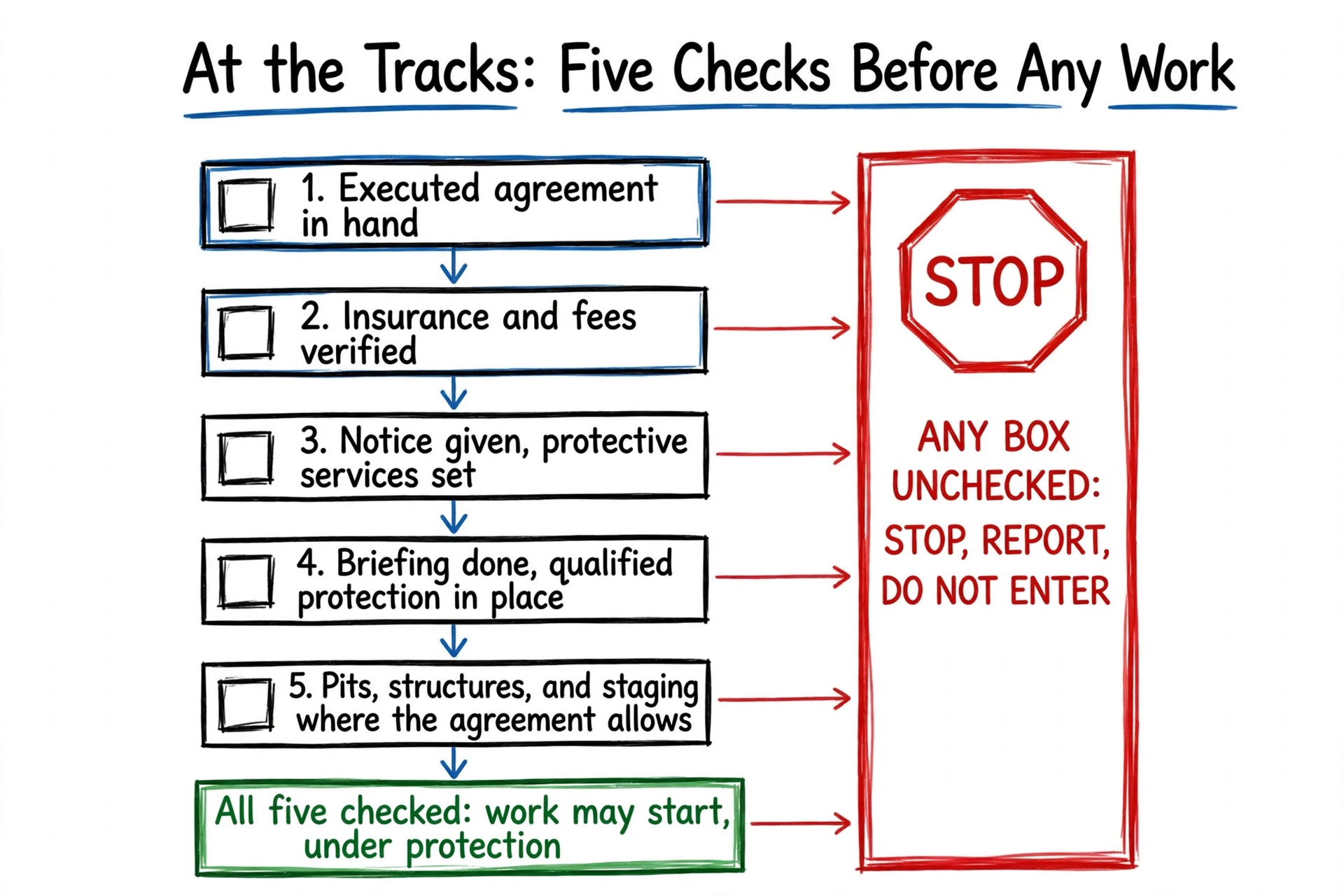
- Check a work plan for readiness at a railroad: the executed agreement, the insurance, the advance notice, and the protection, all present in the project file before any entry.
- Spot the field conditions that mean stop and report, including a second track the prints do not show and a pit that only fits on ground the agreement does not cover.
Start With the Basics
Picture a road that a fiber route follows until the road meets a pair of steel rails set in crushed stone. A car can drive over those rails at a marked crossing and keep going. A fiber crew cannot treat the same strip of ground that way. The rails are only the top of a working transportation system, and the ground under and beside them belongs to, or is controlled by, a railroad that runs trains on its own schedule, under its own rules, with legal duties that no fiber project can set aside.
Three ideas explain most of what follows. First, a railroad is private, controlled property with a live hazard running through it. Trains are heavy, they cannot swerve, and they cannot stop quickly, and a person on the ground can badly misjudge how fast a train is moving and how soon it will arrive, so hearing or seeing a train at a distance is not a safe warning to work by. A train may arrive on any track, from either direction, at times that do not match any schedule a crew member has seen. Ground that looks empty is not therefore safe or available.
Second, a railroad is an owner and an operator at the same time. The owner side controls the property. It decides whether a utility may cross or occupy the corridor, where, by what method, under what design, insurance, and agreement, and it charges for that review and for the services it provides during construction. The operator side controls train movement and worker protection near the tracks. It decides when work near the track may happen, what protection must be in place first, and who may provide that protection. A fiber project has to satisfy both sides. Permission from a city, county, or state for the road beside the tracks satisfies neither side by itself.
Third, a railroad crossing is a bottleneck with a long lead time. On open ground a route can often shift a short distance to avoid a problem. At a railroad, the crossing point, the crossing angle, the depth and casing under the tracks, the places pits and poles may sit, and the days and hours when work may happen are all fixed by agreement before the crew arrives. A route drawn straight across the tracks on a map has solved none of those questions. Crews that discover the railroad late discover it as a stop, not as a task.
The property point works the way it does at a neighbor’s land with a private drive across it. Driving the public road past the land is open to everyone. Stepping onto the land to dig a trench is a different act entirely, and it needs the owner’s written permission, on the owner’s terms, before the first shovel. Passing a place and building in a place are two separate rights, and holding the first one says nothing about the second.
Keep one sentence in mind for the whole lesson. Near a railroad, seeing the work from the road gives a crew no right to do the work.
This lesson teaches recognition only. It does not qualify you to enter railroad property, foul a track, act as a railroad flagger, provide on-track safety, design a crossing under tracks, judge a clearance, or inspect track. Those tasks belong to the railroad that owns or operates the line, to engineers the railroad accepts, and to workers who hold the railroad training, briefing, and authorization the railroad and federal rules require for that place and that day.
What Is It?
A railroad, for construction purposes, is a system for moving trains on fixed steel rails, together with the track structure that carries those rails, the corridor of land that holds the track and its drainage, signals, and access, and the operating rules and property rights that control everything inside that corridor.
Define the parts of that sentence before going further. A train is a locomotive, the powered unit that pulls or pushes, together with the cars it moves, or a single self propelled rail vehicle. The track is the assembled structure a train runs on. In the form a beginner will meet most often, the track is built from these parts:
- Rails. Two steel beams, one under each side of the train wheels, held at a fixed spacing called the gauge.
- Cross ties. The horizontal supports laid across the direction of travel under the rails, holding the rails at their gauge and spreading the load.
- Ballast. Crushed stone placed under and around the ties. The ballast spreads train load to the ground below, holds the ties in position, and lets water drain away from the track structure instead of softening the ground under it.
- Subgrade. The prepared ground or embankment below the ballast that forms the foundation for the whole track.
- Fasteners and tie plates. The hardware that holds each rail to its ties.
None of these parts is decoration, and none of it is spare ground. Shifting ballast, loosening soil beside the ties, blocking the drainage that keeps the subgrade firm, or undermining the embankment can affect the track itself, even when no rail is ever touched.
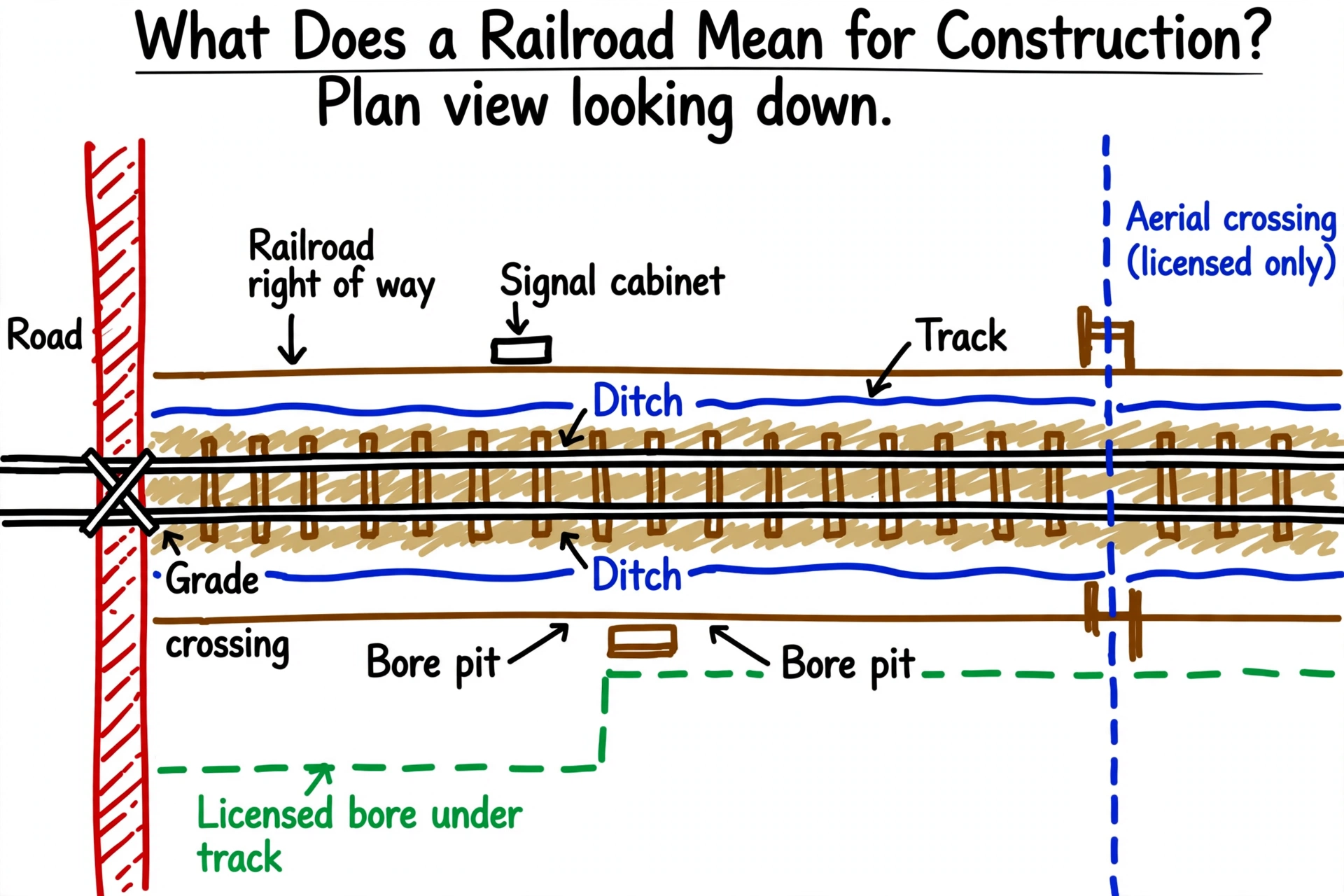
The corridor around the track is the railroad right of way. Right of way was covered in general terms in Lesson 21. Railroad right of way needs a sharper meaning here. It is land the railroad owns, or land over which the railroad holds rights, for the track, its embankments and cuts, its drainage ditches and culverts, its signal and communication lines, its access roads, and room for its own maintenance and future work. Its width varies from place to place and from railroad to railroad. It is not set by the width of the ballast, by where the grass is mowed, or by where a fence happens to stand. Fences may sit inside the right of way line, outside it, or be absent entirely. The only reliable width for a given place is the width in the railroad records, the project survey, and the agreement for that crossing.
A grade crossing, also called a highway rail grade crossing in federal writing, is a location where a public highway, road, or street, or a private roadway, including its sidewalks and pathways, crosses one or more railroad tracks at grade. At grade means at the same level, with road traffic crossing directly over the rails, rather than passing over on a bridge or under in a tunnel or underpass. The Federal Railroad Administration, shortened to FRA, is the federal agency for railroad safety inside the United States Department of Transportation. Federal regulation at 49 CFR Part 234.5 gives the grade crossing definition used in this paragraph for federal warning device purposes. Treat that as a naming definition, not as a work rule. It tells you what kind of place you are looking at. It does not tell you where you may dig, bore, set a pole, or stand.
Grade crossings come in two broad families that matter for recognition:
- Public crossing. The road is owned by a public authority and open to general public use.
- Private crossing. The road or drive is not open to the general public, for example a farm drive, an industrial plant drive, a residential access drive, or a utility access drive, and its use is usually governed by an agreement between the landowner and the railroad, as the Federal Highway Administration, shortened to FHWA, describes in its highway rail crossing handbook material.
A private crossing is not a shortcut, a staging area, or a public invitation to cross the tracks. It is someone else agreement, for someone else access, under terms a fiber crew does not hold. A fiber project that needs to cross the tracks with vehicles or equipment at a place that is not a public crossing needs its own authorization, and many railroad agreements treat a temporary construction crossing as a separate item that must be applied for, built to the railroad standard if the railroad allows it at all, and removed when the work ends.
A railroad also includes things a beginner may not count at first:
- A siding is an additional track beside the main track, used so trains can pass, wait, or serve a customer.
- A spur is a short branch track that leaves the main line to serve an industry or facility.
- A switch, also called a turnout, is the movable track device that lets a train move from one track to another.
- Signal bungalows, signal masts, crossing warning devices with flashing lights and gates, buried signal cables, marker posts, mileposts, culverts, bridges, and access roads all belong to the working railroad.
Each one narrows where fiber plant may go and each one can be damaged by work that was only thinking about the rails.
Finally, name what a railroad is not, because the mistakes in this lesson all start there. A railroad corridor is not a utility corridor that happens to have rails in it. It is not an easement a crew may use because the fiber is a utility. It is not abandoned because no train passed during a site visit, because weeds are tall, or because a local person says the line is rarely used. Lines can be out of service, embargoed, leased to another operator, or used only at certain seasons, and only the railroad can state the operating status of its line in a way a project may rely on. Until the project file holds the railroad own statement and agreement, treat every track as live and every part of the corridor as controlled.
What Does It Look Like?
You recognize a railroad first by its track structure, then by its corridor, then by the control features that tell you it is operated, owned, and protected.
Start with the track itself. Two polished steel rails run in parallel, their top surfaces bright where train wheels polish them. Dull, rusty rail tops can suggest light use, but they prove nothing about whether the line is active, and this lesson gives you no field test for that question, because there is none a fiber crew may rely on. The rails sit on ties, which may be timber, concrete, or steel, at a regular spacing, and the ties sit in gray crushed stone ballast that forms a raised, crowned bed, often called the track bed or roadbed, with sloped shoulders falling to ditches on each side. On an embankment the whole structure stands above the surrounding ground. In a cut it sits below the surrounding ground, with slopes rising on both sides. Either way, the ground changes shape well before you reach the rails, and that shaped ground is part of the track support, not a convenient ramp or pit location.
Next, read the corridor. Look for the features that repeat along the line:
- Drainage ditches run parallel to the track at the toe of the embankment or the edge of the cut.
- Culverts pass water under the track where a ditch or stream meets it.
- Mileposts or small marker signs stand at intervals.
- Fences, where present, often mark an edge the railroad cares about, but as stated above they do not by themselves prove the right of way line.
- Railroad signs warning against trespassing are common, and their presence states the owner position directly.
- Access roads of gravel or dirt run beside some lines for railroad maintenance vehicles.
A fiber crew uses none of these features as its own access, staging, or spoil ground without specific written authorization that covers that use.
At a grade crossing, read the crossing as a small system of its own. The crossing surface is the panel or material between and beside the rails that road vehicles drive on, and it may be timber, asphalt, concrete, rubber, or a composite. On the road approaches you may see the crossbuck, the white X shaped sign that marks a railroad crossing, flashing light signals, bells, automatic gates, stop lines, and pavement markings. Some crossings have only signs and markings and no lights or gates. Those are often called passive crossings in highway practice, while crossings with flashing lights or gates are often called active crossings. That naming matters for drivers. For a fiber crew the rule is the same at both kinds. The absence of gates does not mean the absence of trains, and warning devices are railroad signal property. Signal cabinets and bungalows near the crossing hold the equipment that runs those devices, and buried cables connect them to the track. Excavation near a crossing can strike signal cables far from any cabinet, and damage to a warning device or its cables is a safety failure for the whole public, not only for the project.
Away from crossings, look for switches and signals. A switch shows a short stand with a lever or motor, a target or light, and rails that divide toward a second track. Sidings and spurs mean a second set of rails may be live even when the main track is the one a beginner notices. Color light signals on masts or gantries show the operating state of the line to train crews. Overhead or pole line wires along some corridors carry railroad signal or communication circuits. On other corridors those circuits are buried, invisible, and still present. Never assume a corridor with no poles has no railroad cables in the ground.
Now read the corridor the way a fiber route meets it. Note where the tracks sit in relation to the road the route follows. A crossing route meets the tracks at some angle, and the angle you see in the field, near square or sharply skewed, affects how long the undercrossing is and where its pits can sit. A parallel route runs beside the tracks, sometimes on the road side, sometimes with only a ditch and a fence between the planned trench or bore and the ballast shoulder. Note grade crossing approaches, driveways, signal equipment, culverts, ditches, and any bridge the railroad itself uses, because each one is a place the route cannot simply pass through. Note also what is missing. There is usually no handhole, no utility pedestal line, and no spare flat ground inside the corridor waiting for fiber plant. The corridor looks empty because the railroad keeps it clear for trains, inspection, and maintenance. Empty looking ground inside railroad right of way is working ground, kept clear on purpose.
What Does It Do?
A railroad does one main job. It moves trains, carrying freight or passengers on a fixed guideway, safely and on the railroad own operating authority, and its track, drainage, signals, and corridor all exist to protect that movement.
Follow why the guideway idea matters. A train cannot steer around an obstruction, a person, a bore pit, or a piece of equipment. Its wheels follow the rails, and its path is set by the track and the switches. Its weight is carried through the rails to the ties, from the ties into the ballast, and from the ballast into the subgrade, in the same load path pattern you learned for a bridge in Lesson 30. That is why ground movement matters so much here. A bore that removes support, a trench that lets water into the subgrade, a pit dug into an embankment slope, or spoil piled against drainage can change the ground that holds the track, and the track can move by amounts that matter to a train long before the movement is obvious to a person standing beside it. The crew sees dirt. The railroad sees the foundation of a moving load it is legally responsible for.
Signals and warning devices do the communication job of the railroad. Signals tell train crews whether and how they may proceed. Crossing warning devices warn road users that a train is approaching or occupying a crossing. Where installed, both typically rely on track circuits and buried or aerial cables that run well beyond the cabinet or mast a beginner can see. Protecting those systems is part of protecting train movement itself.
The corridor does the separation job. The space beside the track gives trains a clear envelope to pass through, gives railroad workers room to inspect and maintain the track, gives drainage room to carry water away from the subgrade, and gives the railroad room for its own future work. Railroad engineering practice describes the space that must stay clear around a moving train in terms of clearances and a clearance envelope, meaning in plain terms the outline of space a train and its load occupy, with the margin the railroad requires around it, inside which fixed objects must not intrude unless the railroad has specifically designed and approved that condition. This lesson states no clearance figure, because the governing envelope for a given line is set by that railroad, by the equipment that runs on that line, and by applicable state and industry standards for that place. A pole, a handhole lid, a parked vehicle, a spoil pile, or a raised piece of equipment that would be unremarkable beside a road can be an intrusion beside a track.
For a fiber network, a railroad does a different and narrower thing. Like a bridge in Lesson 30 and a waterway in Lesson 29, it marks a forced decision point. It proves a corridor exists that other transportation already uses, but it does not prove that corridor is available to fiber. Sometimes the approved answer is a licensed undercrossing at the designed location. Sometimes the approved answer is an aerial crossing with all structures outside railroad property. Sometimes the railroad refuses a parallel occupancy or a crossing location, or sets conditions the project cannot meet, and the correct answer is a different route. The railroad does the work of moving trains. Whether it also carries the fiber past it, under it, or beside it is a separate, owned, engineered, and paid for decision.
Where Does It Fit?
Level 2 teaches you to read the physical environment. Earlier lessons placed work in the right of way, in easements, behind property lines, and past street features, drainage, waterways, and bridges. This lesson adds the feature that combines all of those controls at once and adds an operating hazard none of them has. Later lessons continue with intersections, terrain, and the visible utility features that share the corridor.
In the corridor picture, a railroad cuts across the bands a crew has learned. The road bands, lanes, shoulders, ditches, sidewalks, and utility ground, run up to the railroad corridor and stop being the controlling system. Inside the corridor the controlling system is the track, its drainage, its signals, and the railroad right of way line. A fiber route that follows a road will cross that system at grade crossings, dive under it at designed undercrossings away from the road crossing itself, or leave the road to cross it where the license allows. A print that draws a smooth line through the corridor hides a complete change of owner, rules, and risk. The field does not hide it.
In the ownership and permission picture, a railroad adds a private controlling owner whose permission takes a specific form. Railroad utility work is commonly handled under the railroad utility accommodation policy or utility installation standards, and under a site specific license, permit, or crossing agreement for the facility being built. The American Railway Engineering and Maintenance of Way Association, shortened to AREMA, publishes the Manual for Railway Engineering, including material on utility crossings of railroad property that railroads and engineers use as an industry reference when they write their own standards. AREMA material is an industry standard and recommendation source. It is not a permit, it is not a federal rule that a crew can satisfy on its own, and it does not replace the owning railroad standards. Class I railroads, the largest freight railroads, and short line and regional railroads alike publish or apply their own utility accommodation documents, application forms, drawing requirements, fee schedules, and insurance requirements. The working documents on a real crossing are, in order, the executed agreement with the railroad that owns or operates that line, the approved drawings attached to it, the railroad standards it incorporates, and then the project permit and contract documents. A rule from one railroad does not travel to the next railroad, and a rule from one state highway program does not bind a railroad at all.
Several layers can apply at the same crossing, and a beginner should be able to name which layer a given requirement comes from:
- Federal rules govern railroad operating safety, including roadway worker protection in 49 CFR Part 214, and grade crossing warning systems in 49 CFR Part 234.
- State law and state utility commissions or transportation departments may govern aspects of public grade crossings, and state highway programs add their own railroad coordination and insurance requirements when a state road project works on or near railroad property, as state department of transportation railroad coordination pages describe.
- Industry standards, above all AREMA, inform the engineering.
- Railroad owner requirements, in the accommodation policy and the site agreement, decide whether and how this utility may be on this property.
- Contract specifications then bind the contractor to carry out the agreement, schedule the railroad services the agreement requires, and pay the costs the agreement assigns.
When a number is needed, for example a depth under the rail, a casing requirement, a separation from a signal cable, or a distance that triggers flagging, that number comes from the layer that governs that item for that railroad and that site, and it must be quoted from that document in the project file. It must never be carried in from a lesson, from another railroad, or from memory.
In the crossing picture, there are four broad families of solution, and this lesson names them only so a beginner can read a plan and ask the right question.
First, cross under the tracks. A bore or other trenchless installation passes under the track structure, usually with the fiber placed inside a casing, which is a larger pipe that encloses and protects the carrier or conduit inside it, installed across the railroad property in the manner the railroad standards require. BNSF and Union Pacific utility documents, cited as owner examples in this lesson, both treat underground crossings as engineered installations, require plan approval before any work on railroad property, refer the design to AREMA recommendations and to other applicable codes, and restrict where utilities may be placed in relation to structures such as bridges and culverts. Owner requirements commonly address the crossing angle, the casing material and extent, the depth below the track and below ditches, the method of installation, and the location of pits outside the track support zone. This lesson states none of those figures as requirements, because the sources state them inside specific owner systems that differ from each other. Read any depth or casing figure you meet as a sentence that begins, in effect, this railroad, for this kind of facility, at this kind of crossing, requires the following, and verify that your crossing matches every condition in that sentence before you use the figure at all.
Second, cross over the tracks. An aerial span carries the fiber above the railroad on poles or structures. Railroad owner documents commonly require those structures to stand outside railroad property, or at a location the railroad specifically approves, so that no structure, guy, anchor, or falling pole hazard is placed inside the corridor, and they set the vertical clearance the span must maintain over the tracks and over any railroad wires as an owner and code requirement for that crossing. The governing clearance for a given span comes from the railroad agreement, the National Electrical Safety Code where it applies, and the project design. This lesson states no figure for it.
Third, occupy the corridor in parallel. A parallel installation runs along the corridor rather than across it. Railroads treat parallel occupancy more strictly than a single crossing in many of their policies, because it places a foreign facility, its construction activity, and its future maintenance visits inside the corridor for a long distance. Some corridors will not be licensed for a parallel fiber run at all. Where a railroad does license one, the agreement controls the offset from the track, the depth, the access points for future maintenance, and the notice the utility must give before it reenters the property for its own work. A parallel line drawn just inside a fence on a route map is an application, not a right.
Fourth, avoid the railroad. Move the crossing to a public road crossing corridor the project already controls, cross at a different location the railroad will license, use an existing licensed crossing or conduit where the owner of that facility and the railroad both allow it, or reroute around the railroad property entirely. Avoidance is a real engineering answer at railroads more often than beginners expect, because it removes the longest approval, the strictest construction conditions, and the recurring duties that come with occupying railroad property for the life of the fiber plant.
In the work picture, a railroad adds services and duties that no other Level 2 feature adds. Railroad protective services, often called flagging in project documents, means the railroad provides a qualified person, commonly called a flagger or flagman in those documents, or another form of on track protection, to watch for trains and protect work that is on or near the track under the railroad operating rules. State and railroad project documents describe the pattern plainly. The railroad furnishes the protective service, the project requests it in advance under the railroad notice rules, the contractor schedules work to limit the need for it, and the project pays the railroad charges for it. Whether a flagger is required for a given task depends on how close people and equipment will be to the track, whether anything can foul the track, and what the agreement and the railroad representative decide for that work. Fouling a track, in the federal roadway worker protection sense in 49 CFR Part 214, means in plain terms placing yourself or equipment where a train could strike it, on or close enough to the track that the space a train needs is no longer clear. The federal definition in 49 CFR Part 214.7 also treats placement within four feet of the field side of the near running rail as fouling in any case, even where a person judges they could not be struck. That four foot line is a federal definition, not an owner figure, and railroad rules or the project agreement may protect a wider zone. One widely used railroad and state project pattern treats work where people or equipment will be within a stated distance of a track, or where an equipment extension such as a crane boom could reach within that distance, as work that requires advance notice and a railroad determination about flagging. The distance and the notice period in that pattern belong to that railroad and that project document. This lesson teaches the trigger idea, not a universal distance. The project file must hold the figure for its railroad, quoted from its agreement or specification.
Federal roadway worker protection adds a second point a beginner must understand. Under 49 CFR Part 214, Subpart C, a roadway worker must follow the on track safety rules of the railroad the worker is on, must not foul a track except when necessary for the work, and must be sure on track safety is provided before fouling a track. A work group that fouls a track must have a designated roadway worker in charge, qualified under the rules of the railroad that runs trains on those tracks, and the group must receive an on track safety job briefing before the work. A fiber crew member does not become that qualified person by reading this lesson, by holding a road flagger card, or by experience on other railroads. Qualification is railroad specific, current, and documented, and the railroad decides who provides protection for work on its property.
In the project picture, a railroad appears early or it appears as a crisis, more sharply than a bridge does. Good projects identify every railroad crossing and parallel segment in design, confirm the owning and operating railroad, apply for the license with engineered drawings, budget the fees, insurance, and flagging charges, and schedule construction around the railroad approval and the railroad availability of protective services. Late projects discover at the tracks that the route has nowhere legal to go, that the approval will take longer than the rest of the build, and that the crew standing at the crossing cannot lawfully start.
What Is at Stake
For people first, and in plain terms. The hazard at a railroad is a moving train on a fixed path, and the consequences of a mistake are not comparable to a mistake beside a road. A train may be approaching faster than a person on the ground judges, sight lines along a corridor can be cut by curves, cuts, vegetation, structures, and stored equipment, and a second train may follow on another track after a first train passes. Equipment that fouls a track, a vehicle crossing at an unapproved place, a worker who steps onto the track to save a few steps, or a load that swings over the rails can put people in a path they cannot leave in time and a train crew cannot stop for. No production target changes that arithmetic. The protection system, meaning the agreement, the briefing, the designated protection, the flagger where the railroad requires one, and the discipline to stay clear until protection is in place, is the work. Production happens inside it or it does not happen.
For the track and the railroad operation. Work that disturbs ballast, subgrade, embankment, or drainage can degrade the track foundation. Work that damages a signal cable, a warning device, a switch, or a culvert can disable a safety system or flood the track bed. A bore that loses ground, a frac out of drilling fluid under the track, settlement over a casing, or a pit that caves toward the embankment can force the railroad to slow or stop trains and to repair its track at the project expense. Railroads require engineered crossings, casing, approved methods, inspection rights, and insurance precisely because a utility failure under a live track becomes a railroad failure in public, with the railroad carrying the operating and legal consequences for a facility it did not build.
For property and liability. Entering railroad property without authorization is trespass, whatever the worker intention. Building a facility on railroad property without a license leaves the facility itself unlawful there, subject to removal at the owner expense, and leaves the project without the maintenance access rights it will need for decades. Railroad agreements commonly require the utility or its contractor to carry specified insurance, which may include railroad protective liability coverage of the kind federal highway rules describe for work in railroad right of way, to name the railroad in the manner the agreement requires, and to indemnify the railroad for the risks the agreement assigns. Those are executed paper requirements, checked before entry, not details to assemble after the bore is done. A certificate that does not match the agreement is the same as no certificate for the purpose of starting work.
For cost and schedule. Railroad review, engineering, license fees, flagging, and inspection are project costs with their own invoices, and railroad timelines are not set by the fiber project. State coordination guidance warns in general terms that railroad permits can take months, and any specific timeline for a given railroad and crossing must be confirmed with that railroad for that project. An unapproved crossing built anyway can be ordered removed. A crossing built to the wrong railroad standards can be rejected and rebuilt. Damage to track, signals, or drainage is repaired under railroad direction, often by railroad forces, at project cost. Flagging charges accrue for the time the protective services are provided, at the rates and minimums in the agreement, and work scheduled without the required notice can stand idle while still costing the project money. Reading the railroad in design, pricing its requirements honestly, and confirming the executed agreement before mobilizing are cheaper than every one of those outcomes.
For the future of the fiber plant. A licensed crossing is a permanent legal record. It states where the fiber is under or over the railroad, how it was installed, who owns and maintains it, and what notice and protection the fiber owner must arrange before it digs, bores, or opens anything on railroad property again. A future splice repair, a relocation forced by a railroad project, or an emergency restoration all begin by finding that agreement. Plant built without one has no lawful maintenance path. Plant built under one, and recorded in as built records that match the agreement drawings, can be located, protected, and maintained for its whole life.
What Does Good Look Like?
A good railroad crossing for a fiber project looks planned from end to end:
- The owning and operating railroad is identified in design, from records and field evidence together, and the executed license, permit, or crossing agreement for the exact facility and location is in the project file before any entry onto railroad property.
- The crossing method matches the agreement and the approved drawings. The crossing angle, the casing, the depth, the pit and structure locations, and the installation method in the field are the ones the railroad approved, in the positions the drawings show, not positions adjusted in the field for convenience.
- Insurance, fees, and any other preconditions the agreement states are satisfied and verified before mobilization, and the documents in the file match the names, limits, and endorsements the agreement requires.
- Work on or near the track happens only with the protection the railroad requires for that work. Advance notice was given in the period the agreement and specification state, the railroad has determined the protective services needed, a qualified flagger or the required form of on track protection is in place where required, and every worker received the required safety orientation and the on track safety job briefing for that day and location.
- Nobody fouls a track, crosses the tracks with vehicles or equipment at an unapproved place, or places people, equipment, spoil, or material where they can fall, roll, swing, or be blown into the space a train needs. Equipment extensions are treated as part of the equipment position.
- The track structure and its systems are untouched outside the approved work. Ballast profile, ties, drainage ditches, culverts, signals, warning devices, cables, switches, fences, signs, and access roads are as they were, or restored under railroad direction where the approved work affected them.
- Pits, handholes, poles, markers, and staging sit outside railroad property, or inside it only where the agreement specifically allows, and future maintenance access follows the agreement rather than habit.
- Records are complete. Before, during, and after photographs show the corridor, the crossing, the track bed, drainage, signals, and approaches. Bore logs and depth records show the crossing as built. As built records match the agreement drawings or record the approved changes, so the railroad, the fiber owner, and a future crew are working from the same facts.
Judge a good crossing by these results: trains were never put at risk by the work, the railroad property and systems are as the owner requires, and the fiber crossing is legal, documented, insured, and maintainable for its whole life.
From the Field
Picture a fiber route following a state highway toward a town. The route crosses a single track railroad where the highway crosses it at grade, and continues on the far side. The early route sketch drew the buried fiber straight along the highway shoulder, through the railroad corridor at the same line as the road crossing, as if the corridor were ordinary shoulder.
In design review, the project engineer stops the line at the corridor and asks four questions. Which railroad owns and operates this line? Where does its right of way begin and end at this crossing? What crossing method and drawings will that railroad license? And what protection, insurance, and charges will its agreement require during construction?
The records search shows the line is operated by a regional railroad, not by the large railroad whose name appears on an old map, and the state highway railroad coordination office confirms the operator contact. The project applies to the operating railroad with engineered drawings for a bored crossing. The drawings show the bore passing under the tracks away from the highway crossing surface and its signal cables, the fiber inside a casing across the railroad property, and entry and exit pits on highway and private ground outside the railroad right of way, clear of the corridor ditch and the embankment slope.
The railroad reviews the design against its utility accommodation standards and requires a change to the pit location on one side, because the submitted pit crowded its ditch. Here is the decision point. The submitted location was the convenient one, and moving the pit costs the project a redesign. The project accepts the owner change, revises the drawings, and builds to the revision. The railroad approves the revised drawings and issues a license that names the insurance the contractor must carry, the advance notice required before work near the track, and the railroad right to inspect the bore as it passes under the track bed.
Construction is scheduled around the agreement, not around the bore rig alone. The contractor gives the notice the agreement requires, confirms the days the railroad flagger will be present for the parts of the work the railroad has determined need protection, and holds a job briefing that covers the on track safety rules for that railroad, the place each person will work, and the rule that no person or equipment enters the protected zone near the track until the flagger is in place and the briefing is complete. Before work, the crew leader walks the crossing from public ground and photographs the crossing surface, the warning devices, the signal cabinet, the ditches, the ballast shoulders, and a cracked private drive panel on the far side, recording each as existing.
During the bore, the pits stay where the approved drawings place them, spoil is kept out of the ditch, no vehicle crosses the tracks except on the public highway crossing in ordinary road use, and the railroad inspector is given the access the agreement provides while the casing passes under the track. On the far side, the buried route resumes outside the corridor. At the final walk, the track bed, ditches, crossing surface, and warning devices match the before photographs, the bore log and as built records show the crossing as actually built, and the license, the approved drawings, and the as built records are filed together.
The decision rule to carry: at a railroad, a project earns the crossing on paper before it earns it in the ground. Identify the real owner and operator, build only what the executed agreement approves, work only under the protection the railroad requires, and treat every owner change and every field mismatch as a stop and a revision, never as a field adjustment.
What Can Go Wrong?
Railroads concentrate risk in the same way bridges do, with an added moving hazard. The failures below are mostly ordinary shortcuts meeting an owner and an operation that cannot absorb them.
- Entry without an agreement. A crew walks, drives, stages, or surveys on railroad property on the strength of a road permit, a verbal okay, or the fact that the ground looked unused. That is trespass, it can stop the project, and it leaves every later act on that property unauthorized.
- Work without required protection. People or equipment work within the zone the agreement protects, or foul the track, before the railroad has provided the flagger or other protection it requires, because the line looked quiet. Quiet is not a form of protection recognized by any railroad rule.
- An unlicensed crossing. A bore is shot under the tracks over a weekend, without casing, at a depth chosen from another job. The facility is unlawful, unrecorded, possibly unsafe under train load, and subject to removal and rebuilding under railroad standards at project cost, if the railroad allows it to be replaced at all.
- A bore that damages the track foundation. Lost ground, over excavation, drilling fluid escaping under the track bed, or settlement above the bore leaves the subgrade or ballast disturbed. The railroad may restrict or stop trains and require repair under its direction.
- A pit in the wrong ground. An entry or exit pit dug into the embankment slope, the ballast shoulder, or the drainage ditch undermines track support or blocks the drainage the subgrade depends on, even though the bore itself passed at an acceptable line.
- A struck signal system. Excavation or boring cuts a buried signal or communication cable, or damages a warning device, and a crossing loses part of its warning system or a signal goes dark. The failure reaches the travelling public and the train crew, not only the project.
- An aerial span that intrudes. A pole set inside the corridor without approval, a guy wire crossing the clearance envelope, a span built lower than the agreement and code require, or a structure placed where a falling pole can reach the track. Each one puts a fixed object or a failure path into the space trains need.
- A vehicle crossing at the wrong place. Equipment crosses the tracks at a farm drive, a private crossing under someone else agreement, or a place with no crossing at all, and hangs up on the rails, damages the track or crossing surface, or meets a train. Private crossings are not project access unless the project agreement says so.
- Blocked railroad access and drainage. Spoil, matting, parked trailers, or a material yard block the railroad access road, a ditch, or a culvert, delaying railroad maintenance or flooding the track bed in the next storm.
- An assumed quiet line. The route was planned around a line a neighbour called abandoned, no railroad confirmation was obtained, and the line is in service, is leased to another operator, or returns to service. Every clearance, protection, and schedule assumption built on the rumour collapses at once.
- Paper that does not match. The crew arrives with insurance that names the wrong party, an agreement for a different milepost, drawings the railroad never approved, or no record of the required safety orientation. The work is not ready, however ready the equipment is, and starting anyway converts a paperwork gap into a violation.
These failures share one root. The railroad was treated as ground, as scenery, or as an empty strip on the map, instead of as a live, owned, engineered transportation system with its own property rights, protection rules, and approval process.
What Should Someone Notice in the Field?
Notice the railroad as its owner, its train crews, and its inspectors meet it, from a safe and authorized position, which for a beginner will usually mean from public ground or from project ground outside the railroad right of way. You are observing, locating, and reporting. You are not entering the corridor to measure, not inspecting track condition, not judging clearances, and not deciding whether any work may proceed.
- Name the crossing first. What railroad crosses or parallels the route here, and does the route meet it as a crossing, as a parallel run, or both in different places? Say it in one sentence, for example, the route crosses a single track freight line at the county road, then runs parallel to it for the next section on the road side of the ditch.
- Identify the railroad from records, not from a guess. Look for the railroad name on crossing signs, signal cabinets, mileposts, and trespass signs, and confirm the owning and operating railroad in the project documents. Two railroads can share a corridor, and the operator that runs the trains may differ from the owner of the land. Note which railroad the project agreement is with, and flag any mismatch.
- Read the track structure from a safe position. Count the tracks. Note main track, siding, or spur where the records or the layout make that plain, and note switches, signals, and signal cabinets you can see. Note whether rail tops look bright or rusty as an observation only, and record that operating status comes from the railroad, never from that observation.
- Read the corridor edges. Find ditches, culverts, fences, access roads, marker posts, and signs. Note where the project survey or the prints place the right of way line, and note honestly where the line is not marked and needs confirmation. Do not move a boundary question onto the tracks to solve it.
- Read every grade crossing in the work area. Note whether it is public or private as far as records show, its surface condition as found, its warning devices, signs, and gates or their absence, and any damage or blockage that exists before project work. Photograph it from safe positions. Do not stop vehicles or equipment on the tracks to take the photograph.
- Look for existing utilities in the corridor. Note aerial lines on poles along the corridor, conduit markers, warning signs for buried cables, cabinets, and any existing crossing markers, photographed from a safe distance. Record them as existing facilities with owners to be confirmed through the locate and the railroad records, never as available space, spare conduit, or proof that a new crossing will be allowed in the same place.
- Notice drainage and water. Where do the corridor ditches carry water, where do culverts pass under the track, is any ditch blocked or eroded, and where would project work send runoff, drilling fluid, or spoil if it were placed beside the corridor as the prints propose? Note the condition on the day, without predicting storm behaviour.
- Notice the work room honestly. Where do the prints place pits, poles, handholes, and staging in relation to the right of way line, the ditch, and the ballast shoulder? Flag any place where the plan only fits if part of it sits on railroad property that the agreement does not cover, or where equipment booms, loads, or spoil could reach toward the track.
- Notice people and public behaviour. Note farm drives, private crossings, footpaths worn across the tracks, and any place the public crosses informally. Those are hazard information for the project safety plan, not access points for the project.
- Stop on mismatch. If the prints cross the tracks and there is no executed railroad agreement in the project file, if the agreement names a different railroad, location, or method than the prints show, if the field shows a second track, a signal installation, or a private crossing the prints do not mention, or if the right of way line in the field cannot be reconciled with the prints, report the mismatch through the project process before any work starts at that railroad. A railroad is the wrong place to improvise a crossing, an entry, or a protection plan.
Safety and limits, plainly. Observing a railroad does not qualify you to enter railroad property, foul a track, provide or act as on track protection or flagging, judge a clearance or a track condition, design an undercrossing or an aerial crossing, direct trains or road traffic at a crossing, or authorize anyone else to do any of those things. Those tasks belong to the railroad, to engineers and workers holding the railroad qualification and authorization for that line, and to crews working under an executed agreement and the protection the railroad requires. Stay off the track and out of the corridor unless the project agreement, your training and briefing, and the required protection are all in place for that entry. Look and listen for trains whenever you are near a corridor, expect a train on any track from either direction at any time, and never step onto a crossing to save steps when a train may be approaching. Report through your project process.
Key Terms
- Railroad right of way. Land the railroad owns, or land over which it holds rights, for its track, embankments and cuts, drainage, signals, access, and future work. Its width for a given place comes from railroad records, survey, and the project agreement, not from fences or mowing lines.
- Track. The assembled structure a train runs on, in its common form two steel rails held at a fixed spacing by cross ties set in ballast over a prepared subgrade.
- Rail, tie, and ballast. A rail is one of the steel beams train wheels run on. A tie is a horizontal support laid across the direction of travel that holds the rails at their spacing and spreads load into the ballast. Ballast is crushed stone under and around the ties that spreads load, holds the track in position, and drains water away from the structure.
- Subgrade. The prepared ground or embankment below the ballast that forms the foundation of the track structure.
- Grade crossing. A location where a public highway, road, or street, or a private roadway, including sidewalks and pathways, crosses one or more railroad tracks at grade, meaning at the same level.
- Public crossing and private crossing. A public crossing serves a road owned by a public authority and open to general public use. A private crossing serves a road or drive not open to the general public, and its use is usually governed by an agreement between the landowner and the railroad.
- Siding, spur, and switch. A siding is an additional track beside a main track where trains can pass, wait, or serve a customer. A spur is a short branch track serving an industry or facility. A switch is the movable track device that lets a train move from one track to another.
- Clearance envelope. In plain terms, the outline of space a train and its load occupy, with the margin the railroad requires around it, inside which fixed objects must not intrude unless the railroad has specifically designed and approved that condition. Its governing dimensions come from the railroad and applicable standards for that line.
- Casing. A larger pipe that encloses and protects a carrier pipe or conduit, used in railroad undercrossings in the material and extent the railroad standards and the site agreement require.
- Utility accommodation policy. The railroad policy and standards that control whether and how utilities may cross or occupy railroad property, including application, drawing, design, fee, and insurance requirements.
- License or crossing agreement. The executed site specific agreement with the railroad that authorizes a named facility, at a named location, by an approved method, under stated conditions. It is the working permission for the crossing.
- Fouling a track. Placing yourself or equipment on a track, or close enough to it, where a train could strike it, so that the space a train needs is no longer clear. The federal definition in 49 CFR Part 214.7 also treats placement within four feet of the field side of the near running rail as fouling in any case. Federal roadway worker protection rules in 49 CFR Part 214 use this idea to decide when on track safety must be provided.
- Railroad protective services and flagging. Protection the railroad provides for work on or near its track, which may include a qualified flagger who watches for trains and protects the work under the railroad operating rules. Whether it is required, and for what work, is decided by the railroad under the agreement for that site.
- Roadway worker in charge. The designated person, qualified under the rules of the railroad that runs trains on those tracks, who provides on track safety for a work group that fouls a track, under 49 CFR Part 214.
Check Your Understanding
- In your own words, what is a railroad for construction purposes, and what are the parts of the track structure, from the rail down to the ground?
- A crew member says the corridor beside the tracks is empty grass, the line looks unused, and the project road permit covers the shoulder, so the bore pit can go inside the fence for one day. Give three separate reasons that statement fails, one about property, one about operations, and one about evidence.
- Name the four broad families of fiber solution at a railroad, and for each one name the decision or document that controls it.
- What does fouling a track mean, and why can a fiber crew member not provide the required on track protection for the crew by being careful and watching for trains?
- In the From the Field story, the railroad required one pit moved because the submitted location crowded its ditch. What did the project do with that requirement, and why would keeping the original pit location have been wrong even though the bore itself would pass under the tracks at the approved line?
Answer key
- A railroad is a system for moving trains on fixed steel rails, together with the track structure, the corridor of land that holds the track, drainage, signals, and access, and the operating rules and property rights that control the corridor. From the top down, the track is two steel rails held at a fixed spacing by cross ties, the ties set in crushed stone ballast that spreads load, holds position, and drains water, and the ballast resting on the subgrade, the prepared ground or embankment that is the foundation of the whole structure.
- Property: railroad right of way is controlled private property. A road permit does not authorize entry or occupancy, and only an executed agreement with the railroad that owns or operates the line does. Operations: trains may run on any track from either direction at any time under the railroad authority, and work near the track requires the protection the railroad determines, arranged in advance. Evidence: an empty corridor and a quiet visit prove nothing about operating status, right of way width, or buried signal facilities. Status, limits, and permission come from the railroad records and the project agreement, not from appearance.
- Cross under the tracks, controlled by the executed railroad license and its approved drawings, applying the railroad utility accommodation standards and the AREMA informed design for casing, depth, angle, method, and pit locations for that railroad. Cross over the tracks, controlled by the same license and drawings, with structures placed where the railroad approves, commonly outside its property, and the clearance the agreement, applicable code, and design require for that span. Occupy the corridor in parallel, controlled by a specific parallel occupancy agreement that sets offset, depth, access, and notice for future maintenance, where the railroad will license such an occupancy at all. Avoid the railroad, controlled by the project route decision to cross elsewhere under a license that can be obtained, use an existing authorized facility with both owners consenting in writing, or reroute clear of railroad property. Naming a family is not choosing one. The railroad decision and the project design choose.
- Fouling a track means placing yourself or equipment on a track, or close enough to it that a train could strike it, so the space a train needs is no longer clear. Federal rules in 49 CFR Part 214 require that a worker foul a track only when necessary, only after ascertaining that on track safety is provided, and under a designated roadway worker in charge who is qualified under the rules of the railroad that runs trains on those tracks, with a job briefing for the group. Personal carefulness alone is not a qualification and does not by itself establish on track safety. Train approach warning counts as protection only when it is provided by a watchman or lookout trained, qualified, and designated under the rules of that railroad and 49 CFR Part 214, arranged through the railroad. It is not transferable from another railroad or from road flagging, and a crew member cannot improvise it while doing other work.
- The project accepted the railroad change, revised the drawings, and built to the revision, so the license the railroad issued covered the crossing as actually built. Keeping the original pit would have put the excavation in the corridor ditch, outside the approved drawings. A pit in the ditch blocks the drainage the subgrade depends on, and a pit in ground the owner has not approved is an unapproved excavation beside the track for the whole crossing, whatever depth the bore passes at. An approved line under the track does not approve an unapproved excavation beside it. The pit location is part of the licensed facility, and only the railroad and the designer can move it, on revised drawings.
Lesson Takeaway
A railroad is a live, owned transportation system. Its track of rails, ties, ballast, and subgrade carries trains that cannot swerve or stop quickly, its signals and warning devices protect trains and the public, and its right of way is controlled private property whose width, status, and rules come from the railroad, not from fences, appearance, or a road permit. For a fiber route it is a forced decision point. The fiber crosses under the tracks only by a bored and cased crossing the railroad licenses on approved drawings, crosses over only on a span the railroad licenses with structures and clearances it approves, runs parallel only under a specific occupancy agreement, or avoids the railroad entirely, and the railroad decision and the project design, not field convenience or a quiet hour, decide which. Read every railroad by naming the owning and operating railroad, counting and naming the tracks and control features, finding the right of way line and the drainage from records, and checking that the executed agreement, the insurance, the notice, and the required protection are all in place before any entry. Photograph the corridor before work, protect the track bed, drainage, signals, and crossings during work, and never enter, foul, dig in, bore under, or build over a railroad without the agreement and the protection that specifically allow that act.
Sources and Technical References
- Federal regulation, 49 CFR Part 234.5, Definitions. Defines a highway rail grade crossing, for federal warning device purposes, as a location where a public highway, road, street, or private roadway, including associated sidewalks and pathways, crosses one or more railroad tracks at grade, and defines pathway grade crossings in related terms. This lesson uses that definition for naming only. http://www.law.cornell.edu/cfr/text/49/234.5
- Federal regulation, 49 CFR Part 214.313, Responsibility of individual roadway workers. States that each roadway worker follows the on track safety rules of the railroad the worker is on, shall not foul a track except when necessary for the work, and is responsible to ascertain that on track safety is being provided before fouling a track. https://www.law.cornell.edu/cfr/text/49/214.313
- Federal regulation, 49 CFR Part 214.315, Supervision and communication. Requires an on track safety job briefing for work that fouls a track and a designated roadway worker in charge, qualified under the rules of the railroad that conducts train operations on those tracks, to provide on track safety for the group. https://www.law.cornell.edu/cfr/text/49/214.315
- Federal Highway Administration, Highway Rail Crossing Handbook, Third Edition, Chapter 6, Special Topics. Describes private highway rail crossings as generally located on roadways not open to public use, usually governed by an agreement between the landowner and the railroad, and lists typical private crossing types including farm, industrial, residential access, utility access, and temporary construction crossings. https://highways.fhwa.dot.gov/safety/hsip/xings/highway-rail-crossing-handbook-third-edition/chapter-6-special-topics
- BNSF Railway, Utility Accommodation Policy, January 2026 edition as indexed. States, as one Class I railroad owner example, that its policy applies to utilities including fiber optics located, adjusted, or relocated within BNSF property, that approval of plans and application forms is required for all utility installations before work begins on railroad property, that installations should conform to the National Electrical Safety Code and to AREMA recommendations among other references, that crossings should be as near perpendicular as feasible, and that utilities are not to be placed within culverts or under railroad bridges and similar structures. Owner rules differ by railroad. http://bnsf-ttc.com/about-bnsf/pdf/utility.pdf
- BNSF Railway, Utility Accommodation Policy copy held in a public project record. States, as the same owner example in fuller form, overhead installation controls including pole location and clearance ideas stated inside that owner system, and the general provisions summarized above. Cited to show that detailed figures live inside owner documents. https://records.fcgov.com/WebLink/DocView.aspx?id=8604683&dbid=0&repo=FortCollins
- Union Pacific Railroad, Specifications for Fiber Optic Cable Systems. States, as a second Class I railroad owner example, fiber specific requirements for undertrack and parallel installations, including dry bore methods it accepts, casing expectations, and its general position on wet bore methods, all inside that owner system. This lesson cites the document to show that fiber under a railroad is an engineered, owner specified installation, and it does not adopt any figure in it as a general rule. https://www.up.com/cs/groups/public/documents/up_pdf_nativedocs/pdf_fiber_standards_manual.pdf
- Union Pacific Railroad, Public Projects Manual. Covers, as an owner example, public project coordination with the railroad, including grade crossings, grade separations, parallel corridor projects, and utility and sign attachment positions on railroad structures. https://www.up.com/cs/groups/public/@uprr/@corprel/documents/up_pdf_nativedocs/pdf_up_public_projects_manual.pdf
- Washington State Department of Transportation, Highway Railroad Coordination guidance. States, as one state program example, that permits are needed from railroads for pipeline and wire line utilities on railroad property including new installations on existing easements, for temporary occupancy for staging or access, and for new, temporary, or private crossings, that permits are in addition to construction and maintenance agreements, that obtaining a permit can take up to six months in that program experience, that the state liaison processes railroad protective services (flagging) requests, and that workers within a stated distance of track or on railroad property in that program must complete a safety orientation and carry its card. Distances, timelines, and training in that guidance belong to that state and railroad program. https://wsdot.wa.gov/engineering-standards/design-topics/utilities-railroad-agreements/highway-railroad-coordination
- Iowa Department of Transportation, Developmental Specification DS-15028 for work on Union Pacific property. States, as one railroad and state project example, advance notice duties before work, a distance based trigger stated in that specification for notifying the railroad and for requiring a railroad flagger before any person or equipment is located within that distance of a track, insurance duties that must be satisfied before work on the railroad right of way begins, and that flagging and protective services, where performed by the railroad, are at the contractor expense under that specification. The distance, notice periods, and charges belong to that specification and railroad, not to railroads generally. http://ia.iowadot.gov/specifications/dev_specs/2015/DS-15028.pdf
- San Diego Metropolitan Transit System, Jack and Bore Design Criteria and Construction Notes, referencing the AREMA Manual for Railway Engineering. States, as one transit railroad owner example, that underground utilities under its tracks are to be encased in a casing pipe, that open trench installation of casing is restricted, and that casing extent, depth, slope, and load calculation requirements are set in that owner document with an engineer seal. Cited to show casing is a widespread owner concept while its figures are owner specific. https://www.sdmts.com/sites/default/files/attachments/mts-jackandbore-constructionnotes_5-15-16.pdf
- Wisconsin Administrative Code, Trans 29, utility facilities on department railroad property. States, as one state railroad property example, permit duties for utilities on railroad property, conformance of trenched construction to railway engineering standards, untrenched construction duties including boring and casing fit, and indemnification and insurance provisions. https://docs.legis.wisconsin.gov/code/admin_code/trans/29/12/4
- American Railway Engineering and Maintenance of Way Association, report on the rewrite of Manual for Railway Engineering Chapter 1, Section 5, Utilities. Describes AREMA Subcommittee 5, Utilities, drawn from Class I railroads, trenchless contractors, pipeline companies, and rail engineering consultants, rewriting the utility crossing section to resolve conflicts and redundancy and to add general process and safety information in project sequence. Cited for the role and current state of the AREMA utility material, not for any design figure. https://tunnelingonline.com/arema/
- Federal regulation, 23 CFR Part 646.107, Railroad protective insurance. Addresses railroad protective liability insurance in connection with highway projects involving railroad right of way, as an example of the federal highway frame for the insurance layer that railroad agreements and state specifications then make specific for a project. https://www.govinfo.gov/content/pkg/CFR-2020-title23-vol1/pdf/CFR-2020-title23-vol1-sec646-107.pdf
Previous lesson: Lesson 30: What Does a Bridge Mean for Construction? |
Back to Level 2 hub |
Next lesson: Lesson 32: Why Do Intersections Matter?